Scleroderma & Renal Crisis
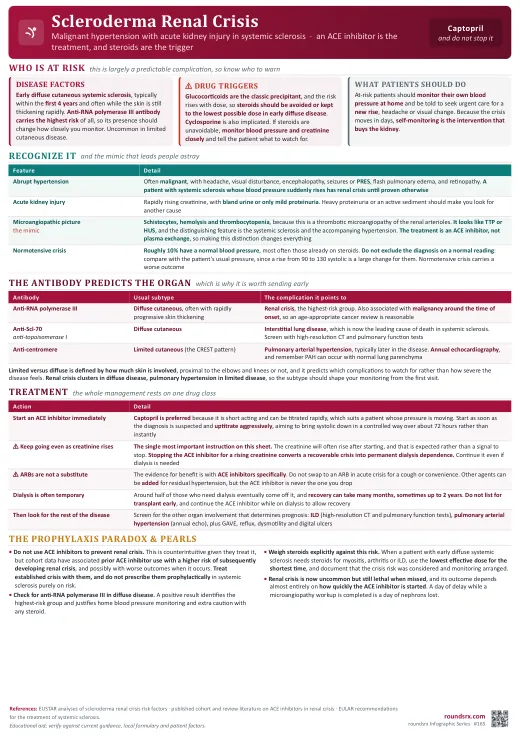
Systemic sclerosis -fibrosis of skin and internal organs. The emergency: scleroderma renal crisis (SRC) -acute HTN + AKI + MAHA. Treatment: ACE inhibitors. Do NOT give steroids -they precipitate SRC.
🔍 Overview
Limited vs Diffuse
| Feature | Limited (CREST) | Diffuse |
|---|---|---|
| Skin involvement | Distal to elbows/knees + face | Proximal (trunk, upper arms, thighs) |
| Antibody | Anti-centromere | Anti-Scl-70 (topoisomerase I) |
| Internal organs | Pulmonary HTN (isolated PAH -screen with annual echo), esophageal dysmotility (GERD) | ILD (NSIP pattern), scleroderma renal crisis, cardiac fibrosis |
| Prognosis | Better (slower progression) | Worse (organ fibrosis -lungs, kidneys) |
| CREST | C alcinosis · R aynaud's · E sophageal dysmotility · S clerodactyly · T elangiectasias | |
Scleroderma Renal Crisis (SRC)
SRC = acute hypertensive emergency + AKI + MAHA in a scleroderma patient. Occurs in ~10% of diffuse SSc, usually within the first 5 years. ACE inhibitors are life-saving. Steroids (especially > 15 mg prednisone/day) PRECIPITATE SRC.
- Presentation: acute severe HTN (often > 180/120), rapid rise in Cr, oliguria, schistocytes on smear (MAHA), elevated LDH, thrombocytopenia (can mimic TTP)
- Treatment: Captopril 6.25–12.5 mg PO q8h, titrate aggressively to normalize BP. ACEi even if Cr is rising -do NOT hold for AKI. ACEi reduces mortality from > 80% to ~25%. Continue even if patient needs dialysis (some recover renal function months later).
- ARBs are NOT a substitute -evidence is only for ACE inhibitors in SRC.
- Prevention: avoid steroids > 15 mg prednisone/day in diffuse SSc. Monitor BP closely in all diffuse SSc patients.
📋 On Rounds
Why do steroids precipitate scleroderma renal crisis?
The mechanism isn't fully understood, but the leading theory is that steroids cause direct endothelial injury in the renal vasculature of scleroderma patients (whose vessels are already primed by intimal fibrosis and vascular obliteration). This triggers a cascade of renin release → severe hypertension → further endothelial damage → MAHA → AKI -a vicious cycle.
Why are ACE inhibitors life-saving in scleroderma renal crisis but ARBs are not?
This is a critical distinction. ACE inhibitors block the conversion of angiotensin I → II, reducing both circulating and tissue-level angiotensin II. Before ACEi were used, scleroderma renal crisis had > 80% mortality at 1 year. With captopril, survival improved to ~60%. ARBs block the AT1 receptor but do NOT reduce angiotensin II levels -in fact, Ang II levels rise (compensatory).
What organ complications define limited vs diffuse scleroderma?
Limited (CREST): Calcinosis, Raynaud's, Esophageal dysmotility, Sclerodactyly, Telangiectasia. Antibody: anti-centromere. Key complication: pulmonary arterial hypertension (PAH) -screen with annual echo (RVSP). Skin involvement limited to distal extremities/face. Diffuse: widespread skin thickening (trunk + proximal extremities). Antibody: anti-Scl-70 (topoisomerase I) or anti-RNA polymerase III.
Why are steroids dangerous in scleroderma?
Prednisone > 15 mg/day is a risk factor for scleroderma renal crisis (SRC). The mechanism is not fully understood but likely involves steroid-induced endothelial injury in the renal vasculature → activation of the renin-angiotensin system → malignant hypertension + TMA + AKI. Anti-RNA polymerase III antibody patients are at highest risk. Rule: avoid steroids > 15 mg/day in diffuse scleroderma.
A scleroderma patient presents with sudden severe hypertension and AKI. What is this and how do you treat it?
Scleroderma renal crisis. Treat with ACE inhibitor (captopril) -titrate aggressively to normalize BP. This transformed survival from ~10% to ~65%. Do NOT use prophylactic ACEi -it may worsen outcomes. Start only when crisis occurs.
Which scleroderma antibody predicts ILD?
Anti-Scl-70 (anti-topoisomerase I) -associated with diffuse cutaneous SSc and interstitial lung disease. Anti-centromere = limited SSc (CREST) + pulmonary HTN. Anti-RNA polymerase III = renal crisis risk.
What is first-line treatment for SSc-ILD?
Mycophenolate mofetil Scleroderma Lung Study II, 2016. Similar efficacy to cyclophosphamide with fewer side effects. Add nintedanib SENSCIS, 2019 if progressive despite MMF.
What screening should all scleroderma patients get annually?
PFTs with DLCO (ILD screening -FVC decline or isolated DLCO decline) and echocardiogram (PAH screening -RVSP, TR velocity). Isolated DLCO decline out of proportion to FVC suggests pulmonary hypertension rather than ILD.
📣 Sample Presentation
One-Liner
"Mrs. Kim is a 48-year-old with diffuse cutaneous systemic sclerosis (on prednisone 20 mg for ILD) presenting with acute BP 210/130, Cr rising from 1.0 to 3.8 over 3 days, and schistocytes on peripheral smear. Scleroderma renal crisis."
Key Points to Cover on Rounds
Scleroderma renal crisis -hypertension + AKI + MAHA. Risk factor: prednisone >15 mg/day. Treatment: captopril 6.25 mg PO q8h, titrated aggressively to 25 mg TID over 24h (short-acting ACEi -captopril specifically, not ARB). DO NOT hold for rising Cr -it may take weeks to recover. Prednisone tapered urgently (precipitated the crisis). BP improved 210/130→158/92 within 24h. Cr still rising (expected initially). Schistocytes → monitoring for concurrent TMA. Nephrology following -dialysis if needed (may be temporary). Plan: continue aggressive ACEi titration, trend Cr/plt/LDH daily.
🧪 Workup
Workup
- ANA -positive in > 90%. Nucleolar pattern suggestive of scleroderma.
- Anti-Scl-70 (anti-topoisomerase I) -associated with diffuse cutaneous SSc + ILD. ~40% of dcSSc.
- Anti-centromere -associated with limited cutaneous SSc (CREST) + pulmonary HTN. ~60% of lcSSc.
- Anti-RNA polymerase III -associated with scleroderma renal crisis + rapidly progressive skin. Screen these patients carefully.
- PFTs with DLCO -screen at baseline and q6-12 months. FVC decline or DLCO decline > 15% = progressive ILD. Isolated DLCO decline = pulmonary HTN.
- HRCT chest -ILD pattern: NSIP most common (ground-glass opacities, subpleural sparing). UIP pattern less common.
- Echocardiography -annual screening for pulmonary HTN (RVSP > 40, RV dilation). Confirm with right heart catheterization if suspected.
- BMP + Cr -scleroderma renal crisis: sudden severe HTN + AKI + MAHA. Medical emergency. Treat with ACE inhibitor.
- UA -proteinuria, hematuria in renal crisis
- Modified Rodnan Skin Score (mRSS) -extent and severity of skin thickening. Track q6-12 months.
- Nailfold capillaroscopy -dilated capillary loops, hemorrhages, avascular areas. Supports diagnosis + correlates with organ involvement.
⚡ Management
Management
- Raynaud's: CCBs first-line (nifedipine 30-60 mg daily or amlodipine 5-10 mg). Severe/refractory: add PDE5 inhibitor (sildenafil), IV epoprostenol, or digital sympathectomy. Avoid beta-blockers.
- Skin fibrosis (dcSSc): Methotrexate for early diffuse disease [van den Hoogen]. Mycophenolate for progressive skin thickening. Tocilizumab (IL-6 inhibitor) -emerging option [focuSSced, 2020]. For severe, rapidly progressive diffuse SSc: autologous stem cell transplant SCOT, Sullivan 2018
- ILD (most common cause of death in SSc): Mycophenolate (first-line) SLS II, Tashkin 2016 or nintedanib SENSCIS, Distler 2019. Cyclophosphamide as alternative SLS I, Tashkin 2006. Screen with HRCT + PFTs (FVC trend). Refer for transplant if FVC < 50% or declining rapidly.
- PAH: Right heart cath to confirm. Upfront combination: ambrisentan + tadalafil [AMBITION]. Add riociguat or selexipag for inadequate response. IV epoprostenol for FC III-IV.
- Scleroderma renal crisis (SRC): ACE inhibitor immediately (captopril 6.25-12.5 mg q8h, titrate aggressively). Even if creatinine rising -continue ACEi. Do NOT use ARBs (no evidence). Avoid corticosteroids ≥ 15 mg prednisone (triggers SRC). Steen & Medsger, 1990
- GI: GERD → PPI (high-dose often needed). Gastroparesis → prokinetics (metoclopramide, erythromycin). GAVE (watermelon stomach) → APC ablation. Intestinal dysmotility → rotating antibiotics for SIBO.
💊 Medications
Medications
| Drug | Dose | Route | Notes |
|---|---|---|---|
| ILD (Interstitial Lung Disease) | |||
| Mycophenolate mofetil | 2-3g daily | PO | First-line for SSc-ILD. Scleroderma Lung Study II, 2016 -similar efficacy to cyclophosphamide with fewer side effects. |
| Nintedanib | 150 mg BID | PO | Antifibrotic. Add-on to MMF for progressive SSc-ILD SENSCIS, 2019. Slows FVC decline. GI side effects (diarrhea). |
| Tocilizumab | 162 mg SQ weekly | SQ | Anti-IL-6. Preserves FVC in early dcSSc with elevated inflammatory markers [focuSSced, 2020]. |
| Raynaud's | |||
| Nifedipine ER | 30-90 mg daily | PO | First-line CCB for Raynaud's. Reduces frequency/severity of attacks. |
| Sildenafil | 20 mg TID | PO | PDE5 inhibitor for severe Raynaud's + digital ulcers. Also used for PAH. |
| Iloprost | 0.5-2 ng/kg/min × 6h | IV | IV prostacyclin for refractory Raynaud's + digital ischemia. |
| Renal Crisis | |||
| ACE inhibitor (captopril) | 6.25-25 mg TID, titrate aggressively | PO | Drug of choice for scleroderma renal crisis. Revolutionized survival from ~10% to ~65%. Do NOT use prophylactically -prophylactic ACEi may worsen outcomes. Start when crisis occurs. |
| Pulmonary Arterial Hypertension | |||
| Ambrisentan + tadalafil | 10 mg + 40 mg daily | PO | Upfront combination ERA + PDE5i is standard AMBITION, 2015. Reduces hospitalization + clinical worsening. |
⚡ Summary
Summary
Recognize the Triad
Acute hypertensive emergency plus acute kidney injury plus microangiopathic hemolytic anemia, in a patient with scleroderma. It occurs in about 10% of diffuse systemic sclerosis, usually within the first 5 years, which is when surveillance matters most.
ACE Inhibitors Are Life-Saving
Captopril first, because its short half-life allows rapid titration, escalated aggressively to control the blood pressure. Start it even when the creatinine is rising: this is the one situation where a climbing creatinine is not a reason to stop the ACE inhibitor, and treatment transformed the outcome from near-universal death to largely survivable.
Steroids Precipitate It
Prednisone above about 15 mg daily is a recognized trigger for scleroderma renal crisis. Avoid steroids in diffuse systemic sclerosis wherever possible, and if they are unavoidable, use the lowest dose for the shortest time with close blood pressure and creatinine monitoring.
Teach Home Blood Pressure Monitoring
A rise from the patient's own baseline is the earliest sign, and it can precede symptoms and the creatinine rise. An absolute value that looks only mildly elevated can be a crisis in a patient who normally runs low, which is why the baseline, not the threshold, is what matters.
Distinguish Limited From Diffuse
Limited (CREST): skin distal to elbows and knees plus face, anti-centromere antibody, and the feared complication is isolated pulmonary arterial hypertension, screened with annual echocardiography. Diffuse: proximal skin involvement, anti-Scl-70, and the feared complications are interstitial lung disease and renal crisis. The antibody predicts which organ will fail.
Screen the Lungs Annually in Diffuse Disease
Interstitial lung disease, usually an NSIP pattern, is a leading cause of death. PFTs with DLCO and high-resolution CT, and treat progressive disease with mycophenolate, or nintedanib or tocilizumab. Do not wait for breathlessness: by then substantial function is already lost.
Manage Raynaud and the Gut Actively
Raynaud phenomenon: cold avoidance, calcium channel blockers, and PDE5 inhibitors or prostacyclin for digital ulcers, which are painful and disabling. Esophageal dysmotility and reflux: proton pump inhibitors, elevate the head of the bed, and be aware of small bowel bacterial overgrowth causing malabsorption.
Expect Dialysis and Do Not Rush to Transplant
Many patients need renal replacement therapy during the crisis, but a substantial proportion recover enough renal function to come off dialysis over 6 to 18 months if the ACE inhibitor is continued. Wait at least 2 years before considering transplant, and do not discontinue the ACE inhibitor simply because the patient is on dialysis.
📄 One Pager
Text version
Rheumatology · One Pager
Systemic Sclerosis
Limited = CREST + PAH risk + anti-centromere. Diffuse = ILD + renal crisis + anti-Scl-70/anti-RNA pol III. Steroids > 15mg → renal crisis. Captopril for SRC.
Classification
Limited (CREST): Calcinosis, Raynaud, Esophageal, Sclerodactyly, Telangiectasia. Ab: anti-centromere. Key risk: PAH. Diffuse: widespread skin, Ab: anti-Scl-70/anti-RNA pol III. Key risks: ILD, renal crisis.
Scleroderma Renal Crisis
HTN emergency + AKI + MAHA. Triggered by steroids > 15 mg/day. Treatment: CAPTOPRIL (short-acting ACEi) -titrate aggressively. Don't hold for rising Cr (may take weeks to recover).
Screening
ILD: HRCT + PFTs at diagnosis, then annually. PAH: echo annually. GI: PPI for GERD. Raynaud: nifedipine/amlodipine. Avoid beta-blockers (worsen Raynaud).
Key Drugs
Captopril6.25-50 mg TID (renal crisis)
Nifedipine30-90 mg daily (Raynaud)
Mycophenolate2-3g/day (ILD)
Nintedanib150 mg BID (ILD)
Pitfalls
- Steroids > 15 mg/day (precipitates renal crisis)
- Not monitoring BP/Cr on steroids
- Beta-blockers (worsen Raynaud)
- Late ILD screening (PFTs + HRCT at diagnosis)
Related Topics
Acute Gout & PseudogoutAntiphospholipid SyndromeDermatomyositis & PolymyositisPMR & Giant Cell ArteritisRheumatoid ArthritisSeronegative Spondyloarthropathies