Septic Arthritis
Septic arthritis is a joint emergency, delay in drainage and antibiotics leads to irreversible cartilage destruction within 24–48 hours. The knee is the most commonly affected joint. Synovial fluid WBC >50,000 with >90% PMNs is the diagnostic hallmark. Aspirate before antibiotics when possible, but never delay empiric treatment for a toxic-appearing patient.
🔍 Overview
Key Concepts
- Definition: Bacterial infection within a joint space, a true orthopedic/medical emergency requiring urgent drainage and IV antibiotics
- Incidence: 2–10 per 100,000/year; higher in RA, prosthetic joints, immunosuppression, IV drug use
- Most common joint: Knee (50%), followed by hip, shoulder, ankle, wrist
- Route: Hematogenous spread (most common), direct inoculation (trauma, injection, surgery), contiguous spread from adjacent osteomyelitis
- Irreversible cartilage damage begins within 24–48 hours if untreated, this is why urgent drainage is essential
Microbiology
| Population | Most Common Organisms | Key Notes |
|---|---|---|
| Adults (non-gonococcal) | Staphylococcus aureus (60–70%), Streptococcus spp. (15–20%) | MRSA prevalence increasing, consider empiric vancomycin. GNRs in elderly, immunocompromised, IVDU. |
| Young sexually active adults | Neisseria gonorrhoeae | Most common cause in sexually active young adults. Migratory polyarthralgia → mono/oligoarthritis + tenosynovitis + skin lesions (pustular). Blood/synovial cultures often negative, send NAAT. |
| Children <5 years | S. aureus, Kingella kingae, Group A Strep | Kingella often culture-negative, request PCR/16S rRNA. H. influenzae now rare (vaccination). |
| IVDU | S. aureus, Pseudomonas, Serratia | Unusual joints (sacroiliac, sternoclavicular). Consider GNR coverage. |
| Prosthetic joint | S. aureus, coagulase-negative Staph, Cutibacterium acnes | Early (<3 months): aggressive organisms. Late (>12 months): low-virulence organisms (CoNS, C. acnes). Hold cultures ≥14 days for slow-growers. |
| Animal/human bites | Pasteurella multocida (cat), Eikenella corrodens (human), polymicrobial | Amoxicillin-clavulanate for bite wounds near joints. If joint penetrated, treat as septic arthritis. |
Risk Factors
- Pre-existing joint disease: Rheumatoid arthritis (RA), osteoarthritis, gout, crystal arthropathy, RA has 10x increased risk
- Prosthetic joint, foreign material = biofilm risk
- Immunosuppression: Diabetes, HIV, corticosteroids, biologics (TNF inhibitors), malignancy
- Skin breakdown: Psoriasis, eczema, cellulitis, skin ulcers overlying joints
- Recent joint procedure: Arthrocentesis, injection, arthroscopy, surgery
- IVDU, hematogenous seeding; unusual joint locations
- Age >80
Septic arthritis and crystal arthropathy can coexist. Finding crystals on synovial fluid does NOT rule out infection. If clinical suspicion is high, treat empirically until cultures finalize, gout and septic arthritis overlap in 5% of cases.
🧪 Workup
Synovial Fluid Analysis, The Key Diagnostic Test
Arthrocentesis is mandatory for any acute monoarthritis with effusion. Aspirate BEFORE starting antibiotics when possible (but do not delay antibiotics if patient is septic).
| Parameter | Normal | Non-inflammatory | Inflammatory (Gout/RA) | Septic |
|---|---|---|---|---|
| Appearance | Clear, colorless | Clear, yellow | Translucent–opaque, yellow | Opaque, purulent |
| WBC (/μL) | <200 | 200–2,000 | 2,000–50,000 | >50,000 (often >100K) |
| PMN % | <25% | <25% | 50–70% | >90% |
| Gram stain | Negative | Negative | Negative | Positive in 50–75% |
| Culture | Negative | Negative | Negative | Positive in 70–90% |
| Crystals | None | None | MSU (gout) or CPPD | Usually none (but coexistence possible) |
WBC >50,000 with >90% PMNs = septic until proven otherwise. However, partially-treated infections and prosthetic joint infections may have lower WBC counts. A WBC of 25,000–50,000 does NOT rule out infection, clinical context matters.
Additional Workup
| Test | Rationale |
|---|---|
| Synovial fluid Gram stain & culture | Gold standard. Positive in ~70–90% for non-gonococcal. Only ~25% positive for gonococcal. Send in blood culture bottles to improve yield. |
| Synovial fluid crystal analysis | Rule out gout (negatively birefringent MSU) and pseudogout (weakly positive CPPD). Remember: crystals + infection can coexist. |
| Blood cultures (×2 sets) | Positive in 40–50% of non-gonococcal septic arthritis. Essential for tailoring therapy. |
| CBC, CRP, ESR | WBC, CRP elevated in most cases. CRP >100 mg/L has high sensitivity. ESR less specific. Useful for monitoring treatment response. |
| Gonococcal NAAT | Urethral/cervical/pharyngeal/rectal NAAT if disseminated gonococcal infection (DGI) suspected. Synovial fluid NAAT increasingly available. |
| X-ray (affected joint) | Often normal early. Soft tissue swelling, joint effusion. Late: joint space narrowing, erosions, periosteal reaction. Baseline for comparison. |
| Ultrasound | Detect effusion (especially hip, difficult to examine clinically). Guide arthrocentesis. Rapidly available at bedside. |
| MRI | Best imaging for complications: adjacent osteomyelitis, soft tissue abscess, synovial enhancement. Order if poor response to treatment. |
Kocher Criteria (Pediatric Hip, Septic vs Transient Synovitis)
| Criteria | Points |
|---|---|
| Non-weight-bearing on affected side | 1 |
| Fever >38.5°C | 1 |
| WBC >12,000/μL | 1 |
| ESR >40 mm/hr | 1 |
0 criteria: <0.2% risk • 1: 3% • 2: 40% • 3: 93% • 4: 99% probability of septic arthritis. CRP >20 mg/L added as 5th criterion in modified Kocher.
🚨 Management
Two Pillars: Drainage + Antibiotics
Both drainage AND antibiotics are required. Antibiotics alone are insufficient, purulent material destroys cartilage via proteolytic enzymes. Source control is mandatory.
Drainage Options
| Method | When to Use | Key Points |
|---|---|---|
| Serial arthrocentesis (needle aspiration) | First-line for most accessible joints (knee, ankle, wrist, elbow) | Aspirate to dryness daily until effusion resolves. Monitor WBC trend, should decrease with effective treatment. Simple, bedside, repeatable. |
| Arthroscopic washout | Failed serial aspiration, loculated collection, shoulder | Better visualization, more thorough lavage. Can break adhesions/loculations. Preferred for shoulder (difficult to aspirate completely). |
| Open arthrotomy | Hip (always), failed arthroscopy, prosthetic joint, pediatric | Hip joint is deep and difficult to drain percutaneously, open surgical drainage is standard for septic hip. Also needed if hardware present or tissue necrosis. |
Septic hip = surgical emergency. The hip joint cannot be adequately drained by needle aspiration, consult orthopedics immediately for open washout. In children, a septic hip can compromise femoral head blood supply and cause avascular necrosis.
Empiric Antibiotic Therapy
| Scenario | Empiric Regimen | Duration | Notes |
|---|---|---|---|
| Native joint (typical) | Vancomycin 15–20 mg/kg IV q8–12h | 2–4 weeks total (IV → PO step-down) | Covers MRSA + MSSA. Add ceftriaxone 2g IV daily if GNR suspected (elderly, immunocompromised, IVDU). De-escalate by culture. |
| GNR risk factors (elderly, IVDU, immunocompromised) | Vancomycin + Ceftriaxone 2g IV daily or Cefepime 2g IV q8h | 2–4 weeks | Cefepime if Pseudomonas risk (IVDU, recent hospitalization). Narrow by culture & sensitivity. |
| Disseminated gonococcal infection | Ceftriaxone 1g IV daily | 7–14 days (switch to PO after improvement) | Treat until clinically improved (usually 24–48h IV) then step down to PO cefixime or azithromycin. Treat concomitant chlamydia (azithromycin 1g or doxycycline). Test + treat sexual partners. |
| Prosthetic joint infection (acute) | Vancomycin + Cefepime or Meropenem | 6 weeks IV + chronic suppressive PO | ID + Orthopedics co-management. Options: DAIR (debridement, antibiotics, implant retention) if early (<30 days) and stable implant. Otherwise: 1-stage or 2-stage exchange arthroplasty. |
IV-to-PO Transition & Duration
- Switch to PO when: Clinical improvement (less pain, decreased effusion, defervesced), declining CRP, known organism with oral susceptibility, GI tract functioning
- OVIVA trial evidence supports early PO step-down for bone and joint infections with equivalent outcomes to prolonged IV therapy OVIVA, 2019
- Total duration (native joint): S. aureus: 4 weeks minimum. Streptococcus: 2–3 weeks. GNRs: 3–4 weeks. Gonococcal: 7–14 days.
- Monitor: CRP trending down (best marker), clinical exam (pain, ROM, effusion), repeat aspiration if not improving
- Ortho follow-up: Functional rehabilitation after infection clears, early PT to prevent joint stiffness and contracture
💊 Medications
Key Antibiotics for Septic Arthritis
| Drug (Brand) | Mechanism | Dosing | Key Considerations |
|---|---|---|---|
| Vancomycin (Vancocin) | Glycopeptide, inhibits cell wall synthesis by binding D-Ala-D-Ala | 15–20 mg/kg IV q8–12h Target AUC/MIC 400–600 | Empiric MRSA coverage. Monitor trough or AUC. Nephrotoxic, monitor SCr. Red man syndrome with rapid infusion (rate-related, not allergy). Good synovial fluid penetration. |
| Ceftriaxone (Rocephin) | 3rd-gen cephalosporin, inhibits PBPs | 2g IV q24h | GNR coverage + gonococcal coverage. Once-daily dosing (long half-life). Do not use in neonates with bilirubin issues. Good bone/joint penetration. |
| Cefazolin (Ancef) | 1st-gen cephalosporin | 2g IV q8h | Step-down from vancomycin once MSSA confirmed. Excellent bone penetration. Can transition to PO cephalexin or dicloxacillin. |
| Nafcillin/Oxacillin | Anti-staphylococcal penicillin | 2g IV q4h | Gold standard for MSSA. Excellent bone/joint penetration. Interstitial nephritis risk. Alternative: cefazolin (easier dosing). |
| Cefepime (Maxipime) | 4th-gen cephalosporin | 2g IV q8h | Pseudomonas coverage + GNR. Use when Pseudomonas risk (IVDU, nosocomial). CNS toxicity at high doses/renal impairment. |
| TMP-SMX (Bactrim) | Folate synthesis inhibitor | DS 1–2 tabs PO BID | Oral MRSA step-down option. Good bioavailability. Monitor K⁺ (hyperkalemia risk). Not for strep coverage (unreliable). |
📋 On Rounds
What synovial fluid findings diagnose septic arthritis?
WBC >50,000/μL with >90% PMNs is the classic finding. Gram stain positive in 50–75%. Synovial fluid culture positive in 70–90%. However, partially-treated infections may have lower counts. Any WBC >25,000 with clinical suspicion warrants empiric treatment pending cultures. Crystals do NOT exclude infection.
Why does a septic hip always require open surgical drainage?
The hip is a deep ball-and-socket joint that cannot be adequately drained by needle aspiration. Increased intra-articular pressure from purulent effusion can compress the retinacular blood supply to the femoral head, causing avascular necrosis. In children, the femoral head blood supply is especially vulnerable. Open arthrotomy allows thorough washout, debridement, and pressure decompression.
How do you distinguish gonococcal from non-gonococcal septic arthritis?
Gonococcal: Young, sexually active. Classic triad: migratory polyarthralgia → tenosynovitis + dermatitis (pustular/vesicular skin lesions) + mono/oligoarthritis. Synovial fluid cultures often NEGATIVE (<25%). Diagnosis: GC NAAT from urethra/cervix/pharynx/rectum + synovial NAAT. Non-gonococcal: Older, comorbidities. Acute monoarthritis. Synovial cultures positive 70–90%. S. aureus predominates.
Can gout and septic arthritis coexist? How do you manage this?
Yes, crystals + infection coexist in ~5% of cases. Finding MSU or CPPD crystals does NOT rule out septic arthritis. If clinical suspicion remains (fever, WBC >50K, risk factors), treat empirically with antibiotics AND drainage until cultures return. A common pitfall is attributing a hot joint to gout alone and missing concomitant infection.
What are the Kocher criteria and when are they used?
The Kocher criteria distinguish septic arthritis from transient synovitis in pediatric hip pain: (1) non-weight-bearing, (2) fever >38.5°C, (3) WBC >12,000, (4) ESR >40. With 0 criteria: <0.2% risk; 4 criteria: 99% risk. CRP >20 added as modified 5th criterion. ≥2 criteria warrant aspiration under sedation/US guidance.
📣 Sample Presentation
One-Liner
"Mr. Davis is a 68-year-old man with diabetes and rheumatoid arthritis on methotrexate presenting with 2 days of acute right knee swelling, pain, and inability to bear weight, with fever to 39.1°C. Arthrocentesis showed WBC 78,000 with 95% PMNs and positive Gram stain for gram-positive cocci in clusters, consistent with septic arthritis."
Key Points to Cover on Rounds
Septic arthritis of right knee, synovial fluid WBC 78,000, >95% PMNs, Gram stain with GPC in clusters (likely S. aureus). Started vancomycin empirically, awaiting final culture and sensitivities. Serial arthrocentesis performed, aspirated 45 mL of purulent fluid. Blood cultures ×2 sent. CRP 185. Orthopedics consulted, will reassess for arthroscopic washout if not improving with serial aspiration. Held methotrexate given active infection. Plan to narrow antibiotics by culture. Target 4-week course if S. aureus confirmed. Early PT once infection controlled.
⚡ Summary
Summary
The Clock Is 24 to 48 Hours
Delay in drainage and antibiotics leads to irreversible cartilage destruction within 24 to 48 h. The knee is the commonest joint. A hot, swollen, exquisitely painful joint with severe pain on any passive movement is septic arthritis until the fluid says otherwise.
Aspirate Before Antibiotics When You Can
Synovial fluid is the diagnostic test, and a single dose of antibiotic can render the culture negative. Do not delay antibiotics in a septic patient, but in a stable one the aspirate comes first, and it should be arranged in hours rather than overnight.
Read the Synovial Fluid
WBC above 50,000 with more than 90% neutrophils is the hallmark, with a low glucose and a positive Gram stain in about half. No single cutoff excludes it: counts between 20,000 and 50,000 can be septic, particularly early, in prosthetic joints and in the immunocompromised. Crystals do not rule out infection, since gout and sepsis coexist, so send culture regardless.
Two Pillars: Drainage Plus Antibiotics
Antibiotics alone do not treat a septic joint, because pus under pressure destroys cartilage and antibiotic penetration into a purulent joint is poor. Serial needle aspiration, arthroscopic washout or open arthrotomy, with arthroscopy usually preferred for large joints, and the hip and any prosthetic joint go to the operating room.
Cover Staph Empirically
S. aureus is the commonest organism overall and MRSA is common enough that vancomycin is the empiric backbone. Add gram-negative cover in the elderly, the immunocompromised, injection drug users and after trauma. Narrow when culture and susceptibilities return.
Ask About Gonococcal Disease in the Young and Sexually Active
Disseminated gonococcal infection presents either as a purulent monoarthritis or as the triad of migratory polyarthralgia, tenosynovitis and pustular skin lesions. Synovial cultures are often negative, so send urethral, cervical, rectal and pharyngeal NAAT. It responds rapidly to ceftriaxone and rarely needs surgical drainage, which is the opposite of staphylococcal disease.
Use Kocher for the Limping Child
Fever above 38.5°C, non-weight-bearing, ESR above 40, and WBC above 12,000. The probability of septic arthritis of the hip rises steeply with the number of criteria met, and it is what separates it from transient synovitis. A child who will not bear weight at all deserves an aspirate.
Treat Long Enough and Follow the Joint
2 to 4 weeks total for most organisms, longer for S. aureus and for prosthetic joints, with an IV-to-oral switch once the patient is improving and the organism is susceptible to a well-absorbed oral agent. Repeat aspiration if the joint does not settle. Start physical therapy early, since a joint immobilized through the infection stiffens permanently, and look for the source, since most septic joints are hematogenous.
📄 One Pager
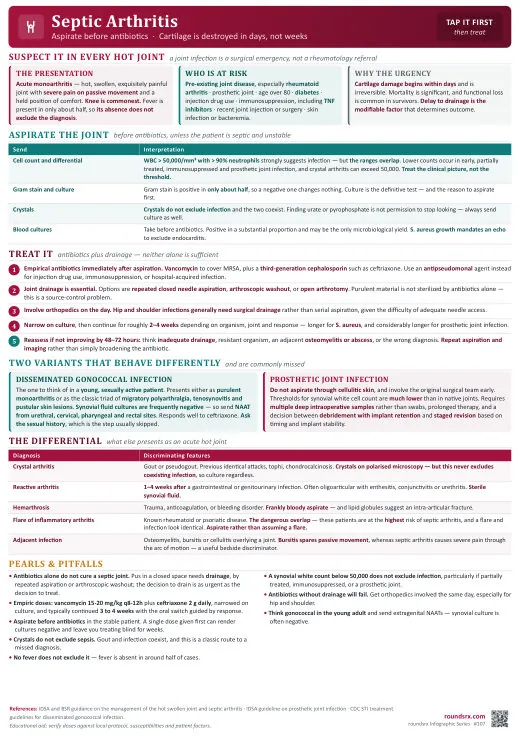
Text version
Septic Arthritis, Quick Reference Card
Print this page (Ctrl/Cmd + P) for a condensed reference card.
SEPTIC ARTHRITIS, AT A GLANCE
📋 Diagnose: Aspirate every acute monoarthritis. WBC >50K + >90% PMNs = septic. Gram stain + culture.
🧪 Labs: Blood cultures ×2, CRP, ESR. GC NAAT if young/sexually active. X-ray baseline.
💉 Drain: Serial aspiration (knee/ankle). Hip = open arthrotomy ALWAYS. Arthroscopy if failing.
💊 Treat: Vancomycin empirically (± ceftriaxone/cefepime for GNR). DGI: ceftriaxone 1g daily.
⏱️ Duration: Staph 4 wk, Strep 2–3 wk, GNR 3–4 wk, GC 7–14d. IV → PO when improving.
⚠️ Pitfalls: Crystals don't rule out infection. Prosthetic joint = ID + Ortho. RA = 10x risk.
🧪 Labs: Blood cultures ×2, CRP, ESR. GC NAAT if young/sexually active. X-ray baseline.
💉 Drain: Serial aspiration (knee/ankle). Hip = open arthrotomy ALWAYS. Arthroscopy if failing.
💊 Treat: Vancomycin empirically (± ceftriaxone/cefepime for GNR). DGI: ceftriaxone 1g daily.
⏱️ Duration: Staph 4 wk, Strep 2–3 wk, GNR 3–4 wk, GC 7–14d. IV → PO when improving.
⚠️ Pitfalls: Crystals don't rule out infection. Prosthetic joint = ID + Ortho. RA = 10x risk.
Related Topics
Cellulitis & Skin InfectionsCLABSI & Line InfectionsDiabetic Foot InfectionFungal InfectionsHantavirus (HPS & HFRS)Herpes Simplex (HSV)