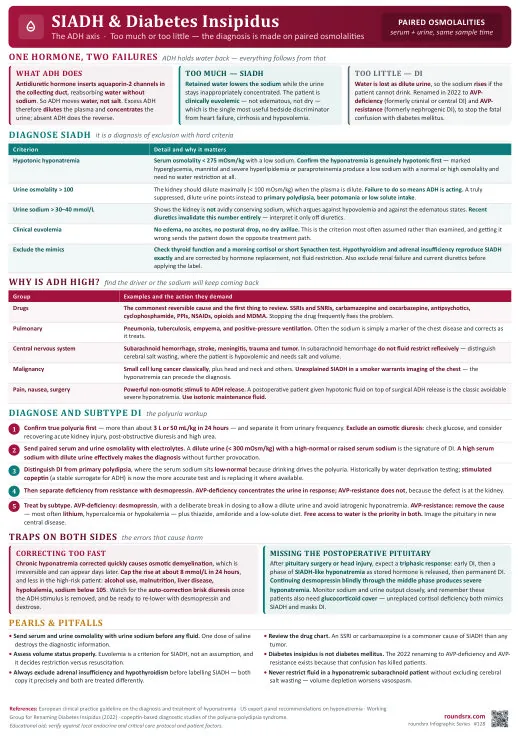
SIADH
- Serum Na⁺ < 135 mEq/L (hyponatremia)
- Serum osmolality < 275 mOsm/kg (truly hypo-osmolar, which excludes pseudohyponatremia and hyperglycemia)
- Urine osmolality > 100 mOsm/kg (inappropriately concentrated: in a hypo-osmolar state the kidney should be making maximally dilute urine)
- Urine sodium > 40 mEq/L on a normal salt intake (the kidney is not volume-depleted, so it is not avidly retaining sodium)
- Clinically euvolemic (no edema, no orthostasis, no JVD)
- Normal thyroid and adrenal function, and no recent diuretic
| Category | Specifics | Clinical clue |
|---|---|---|
| Drugs the first thing to review | SSRIs (most common drug cause), carbamazepine and oxcarbazepine, cyclophosphamide, vincristine, NSAIDs, antipsychotics, MDMA, desmopressin, thiazides (a mimic rather than true SIADH) | Onset typically 2 to 4 weeks after starting the drug, and the elderly are most at risk. Check a sodium at that interval after starting an SSRI. |
| CNS disease | Stroke, subarachnoid hemorrhage, head trauma, meningitis, encephalitis, brain tumor, and post-neurosurgical states | In a hyponatremic SAH patient you must separate SIADH from cerebral salt wasting before restricting fluids. See the comparison tab. |
| Pulmonary disease | Pneumonia, tuberculosis, lung abscess, empyema, and positive-pressure ventilation | Often resolves as the lung process resolves; no specific therapy is needed beyond treating the pneumonia. |
| Malignancy | Small cell lung cancer is the classic ectopic ADH producer, then head and neck cancers | Unexplained SIADH in a smoker warrants chest imaging. Hyponatremia may be the presenting sign of SCLC. |
| Pain, nausea, post-op | Any severe pain or nausea is a potent physiologic ADH stimulus | Frequently overlooked. Treating the pain and nausea treats the hyponatremia, so do that before reaching for tolvaptan. |
| Step | Test | How to read it |
|---|---|---|
| 1. Is it truly hypo-osmolar? | Serum osmolality | < 275 confirms true hyponatremia. If normal or high, you have pseudohyponatremia (severe hyperlipidemia or paraproteinemia) or a second osmole such as glucose, mannitol or ethanol. Correct sodium for glucose before going further. |
| 2. Is ADH acting? | Urine osmolality | > 100 means ADH is on when it should be off. A urine osmolality < 100 points instead to primary polydipsia, beer potomania or low solute intake, where the kidney is diluting appropriately and the problem is intake. |
| 3. What is the volume state? | Urine sodium plus the bedside exam | > 40 with clinical euvolemia supports SIADH. < 20 means an avidly sodium-retaining kidney, so think hypovolemia or a low effective circulating volume state (heart failure, cirrhosis). |
- TSH and AM cortisol on every patient, because hypothyroidism and adrenal insufficiency mimic SIADH exactly and are treatable
- Review the medication list with SSRIs, carbamazepine and thiazides specifically in mind
- Serum uric acid is low (< 4 mg/dL). Urate is reabsorbed in the proximal tubule coupled to sodium. SIADH retains water, which mildly expands the effective circulating volume, and that expansion switches off proximal sodium reabsorption. Urate is lost along with it. It does not distinguish SIADH from cerebral salt wasting, where it is also low
- BUN is low or low-normal from dilution; a raised BUN should make you reconsider hypovolemia
- Chest imaging if the cause is not obvious, particularly in a smoker, to look for small cell lung cancer
- Document the acuity. Hyponatremia known to be under 48 hours old can be corrected faster; anything undocumented is treated as chronic, which is the safe assumption
| Scenario | Treatment | Correction target and cautions |
|---|---|---|
| Symptomatic (seizure, coma, severe altered mental status) | 3% hypertonic saline 100 to 150 mL IV bolus over 10 to 20 min. May repeat up to twice if symptoms persist. ICU admission and frequent sodium checks. | Immediate goal is to raise the sodium by 4 to 6 mEq/L in the first 6 hours, which is enough to stop seizures and reduce cerebral edema. Then hold at ≤ 8 mEq/L total in 24 hours. You are treating the brain, not the number. |
| Asymptomatic or chronic (Na 120 to 134) | Fluid restriction 800 to 1000 mL/day, stop the offending drug, and treat the underlying cause. Add salt tablets or oral urea 15 to 30 g daily if restriction alone fails. | ≤ 8 mEq/L per 24 hours. The brain has adapted by extruding osmolytes, so a fast correction is what injures it. Fluid restriction is slow and often unpopular with patients, so set expectations. |
| Refractory | Tolvaptan 15 mg PO daily, a V2 receptor antagonist producing a free water aquaresis. SALT-1 and SALT-2, 2006 | Start inpatient only and check sodium at 4 to 6 h, 8 to 12 h and 24 h. Do not combine with hypertonic saline or fluid restriction during initiation, since the combination overcorrects. Hepatotoxicity limits use to 30 days. |
| Feature | SIADH | Diabetes Insipidus |
|---|---|---|
| ADH | Excess (or ectopic) | Deficient (central) or ineffective (nephrogenic) |
| Serum sodium | Low, often 120s | High, if the patient cannot reach water |
| Serum osmolality | < 275 | > 290 |
| Urine osmolality | > 100, inappropriately concentrated | < 300, inappropriately dilute |
| Urine output | Normal or low | Polyuria > 3 L/day |
| Volume status | Euvolemic | Euvolemic to hypovolemic |
| Treatment | Restrict water. Salt, urea or tolvaptan if refractory | Give water. DDAVP for central; remove the cause plus thiazide for nephrogenic |
| Feature | SIADH | Cerebral salt wasting |
|---|---|---|
| Primary defect | ADH excess, so water is retained | Renal sodium wasting, so water follows the salt out |
| Volume status the discriminator | Euvolemic | Hypovolemic: dry mucous membranes, orthostasis, flat neck veins |
| Urine output | Normal or low | High, often frankly polyuric |
| BUN / creatinine | Low-normal, dilutional | Raised, prerenal pattern |
| Hematocrit, albumin | Normal or low | Raised, hemoconcentrated |
| CVP, weight | Normal; weight stable or up | Low; weight down |
| Serum uric acid | Low | Low. Does not distinguish them, which is the classic trap |
| Fractional excretion of urate | Elevated in both while hyponatremic, so it is useless on first encounter. After the sodium is corrected it normalizes to < 11% in SIADH but stays > 11% in cerebral salt wasting, which is the most reliable discriminator described. | |
| Response to saline | No change, or the sodium falls further through desalination | Improves |
| Treatment | Fluid restriction | Isotonic saline and salt repletion. Fludrocortisone 0.1 to 0.2 mg daily reduces the natriuresis. Never fluid restrict. |
| Drug | Dose | Role | Watch for |
|---|---|---|---|
| Hypertonic saline 3% | 100 to 150 mL IV bolus over 10 to 20 min, repeat up to twice | Symptomatic hyponatremia only (seizure, coma, severe altered mental status) | Aim for a 4 to 6 mEq/L rise in 6 h, then stop. Recheck sodium 2 h after each bolus. Peripheral administration of small boluses is acceptable. |
| Sodium chloride tablets | 1 g PO TID, titrated | Add-on when fluid restriction alone is not enough | Often paired with a loop diuretic when urine osmolality is high, since the loop lowers urinary concentrating ability. |
| Urea (oral) | 15 to 30 g daily | Induces an osmotic diuresis of free water; useful for chronic SIADH | Poor palatability is the main limit. Cheaper than tolvaptan and no hepatotoxicity ceiling. |
| Tolvaptan (Samsca) | 15 mg PO daily, titrate to 30 to 60 mg | V2 receptor antagonist producing free water aquaresis without sodium loss | Inpatient initiation only. Sodium at 4 to 6 h, 8 to 12 h and 24 h. Do not combine with hypertonic saline or fluid restriction at initiation. Hepatotoxicity limits use to 30 days. |
| Desmopressin (DDAVP) | 2 mcg IV q8h for rescue; 1 to 2 mcg IV/SC q12h for central DI | Two opposite roles: ODS rescue in overcorrected hyponatremia, and replacement in central DI | In rescue, pair with D5W to re-lower the sodium. Know which indication you are treating before you order it. |
| Fludrocortisone | 0.1 to 0.2 mg PO daily | Cerebral salt wasting, to reduce renal sodium wasting | Watch for volume overload, hypokalemia and hypertension. Not a treatment for SIADH. |
Patient: 72-year-old woman started on escitalopram 3 weeks ago for depression. Presents with fatigue, nausea, mild confusion. Na 118, serum osm 248, urine osm 520, UNa 58. Euvolemic. TSH and AM cortisol normal.
Key findings: Classic SSRI-induced SIADH. All diagnostic criteria met: hypo-osmolar, inappropriately concentrated urine, euvolemic, UNa > 40, normal thyroid and adrenal function.
Management:
- Hold escitalopram (offending agent)
- Fluid restriction < 1 L/day
- Na q4-6h (symptomatic with confusion)
- If Na not improving: salt tabs 1g TID
- Correction rate ≤ 8 mEq/L per 24h (high risk: elderly)
Teaching point: SSRIs are the most common drug cause of SIADH. Always check a sodium 2 to 4 weeks after starting an SSRI in an elderly patient. Leth-Moller et al., 2016
Patient: 38-year-old man, POD 1 from transsphenoidal pituitary adenoma resection. UOP 650 mL/hr x 4 hours. Clear, dilute urine. Na 151 (was 140 pre-op), serum osm 308, urine osm 78.
Key findings: Post-surgical central DI. Massive polyuria with inappropriately dilute urine and a rising sodium. Watch for the triphasic response.
Management:
- DDAVP 1 mcg IV q12h
- D5W to replace the free water deficit and match ongoing losses
- Na q4h, strict I&Os, hourly UOP
- If UOP drops and Na falls on days 5-10: STOP DDAVP immediately (SIADH phase)
Teaching point: The triphasic response (DI, then SIADH, then permanent DI) occurs in roughly 25% of pituitary surgery patients. Continuing DDAVP into the SIADH phase causes fatal hyponatremia.
Patient: 65-year-old man with chronic hyponatremia (Na 108) from SCLC-associated SIADH. After 18 hours of 3% saline and fluid restriction, Na corrected to 122, a 14 mEq/L rise.
Key findings: Overcorrection. 14 mEq/L in 18h exceeds the safe limit of 8 mEq/L per 24h. High risk for ODS: chronic, severe hyponatremia and malignancy.
Management:
- STOP hypertonic saline immediately
- DDAVP 2 mcg IV q8h to re-lower Na
- D5W infusion to bring Na back down
- Target: Na no more than 8 mEq/L above the starting value for the 24h period (goal Na ≤ 116)
- Na q2h until trending downward
Teaching point: ODS rescue (DDAVP plus D5W) should start the moment overcorrection is detected. ODS presents 2 to 6 days later and is irreversible. Verbalis Expert Panel, 2013
| Parameter | Frequency | Target / Action |
|---|---|---|
| Serum sodium | q2h while on hypertonic saline, q4-6h if symptomatic, q12-24h once stable | Ceiling ≤ 8 mEq/L per 24 h, or ≤ 6 if high-risk for ODS. The single most important number on this page. |
| Urine output and fluid balance | Strict, hourly if on hypertonic saline | A sudden water diuresis means the ADH stimulus has switched off and the sodium is about to rise fast. Anticipate overcorrection and consider pre-emptive DDAVP. |
| Urine osmolality | At diagnosis, then if not responding | Above 500 predicts failure of fluid restriction. Falling values mean ADH is switching off. |
| Potassium | Daily | Hypokalemia raises ODS risk, and repleting it also raises the sodium, so count it in your 24h correction budget. |
| Neurologic exam | Each assessment | Improving mental status guides how aggressive to be. New dysarthria, dysphagia or weakness 2 to 6 days after correction suggests ODS. |