Sickle Cell
| Complication | Features | Management |
|---|---|---|
| Vaso-occlusive crisis (VOC) | Severe pain (bones, chest, abdomen) triggered by dehydration, cold, infection, stress | Aggressive pain control (IV opioids -PCA preferred), IVF (NS or D5 1/2 NS at 1.5× maintenance), incentive spirometry q2h (prevents ACS) |
| Acute chest syndrome (ACS) | New infiltrate on CXR + one of: fever, chest pain, cough, hypoxia, tachypnea. #1 cause of death in SCD. | Antibiotics (ceftriaxone + azithromycin -covers atypicals + encapsulated), exchange transfusion if severe (target HbS < 30%), supplemental O₂, bronchodilators, incentive spirometry |
| Stroke | Children: ischemic (large vessel). Adults: hemorrhagic more common. Sudden neuro deficit. | Exchange transfusion emergently (target HbS < 30%). Chronic transfusion program to prevent recurrence. |
| Splenic sequestration | Sudden splenomegaly + hemoglobin drop ≥ 2 from baseline + reticulocytosis. Mostly children (adults with HbSC). | Volume resuscitation + transfusion. Can be fatal within hours. Consider splenectomy after recovery. |
| Aplastic crisis | Parvovirus B19 → transient red cell aplasia. Hgb drops, reticulocyte count near zero. | Supportive. Transfuse if symptomatic anemia. Self-limited (1–2 weeks). |
| Priapism | Painful sustained erection > 4 hours. Urologic emergency. | IVF, analgesia, aspiration/irrigation by urology. Exchange transfusion if refractory. > 4h → ischemic → impotence risk. |
| Organism | Clinical Scenario | Key Points |
|---|---|---|
| Streptococcus pneumoniae #1 KILLER | Bacteremia, pneumonia, meningitis | Most common cause of fatal sepsis in SCD. Can progress from well → dead in < 12 hours. Penicillin prophylaxis (age < 5) + pneumococcal vaccines (PCV13 → PPSV23) are essential. |
| Haemophilus influenzae type b | Bacteremia, pneumonia, meningitis | Second most common encapsulated pathogen. Hib vaccine has dramatically reduced incidence. |
| Neisseria meningitidis | Meningococcemia, meningitis | Fulminant course with purpura fulminans. Requires meningococcal vaccines (MenACWY + MenB). |
| Salmonella species OSTEOMYELITIS | Osteomyelitis -most common cause in SCD | In the general population, S. aureus is #1 for osteomyelitis. In SCD, Salmonella is #1 (infarcted bone is a perfect growth medium). Also causes bacteremia and GI infections. |
| Capnocytophaga canimorsus DOG/CAT BITE | Dog or cat bite, scratch, or saliva exposure | Gram-negative rod found in dog/cat saliva. In asplenic/functionally asplenic patients → fulminant sepsis, DIC, purpura fulminans, gangrene. Mortality 25–30% in asplenic patients. Treat with amoxicillin-clavulanate (bite prophylaxis) or piperacillin-tazobactam (if septic). Any SCD patient with a dog or cat bite needs immediate antibiotics and close monitoring. |
| Parvovirus B19 | Aplastic crisis (NOT sepsis) | Infects erythroid precursors → transient red cell aplasia. Retic count drops to near zero. Self-limited but may need transfusion. |
- Blood cultures × 2 (before antibiotics -but do NOT delay antibiotics if cultures take time)
- CBC with differential -WBC, Hgb vs baseline, reticulocyte count
- CXR -rule out ACS and pneumonia
- Urinalysis + urine culture -UTI common
- CMP -check for end-organ damage
- Empiric ceftriaxone 2g IV -covers encapsulated organisms. Add vancomycin if toxic-appearing, meningitis suspected, or local DRSP rates are high
| Vaccine | Schedule |
|---|---|
| PCV13 → PPSV23 | PCV13 series in childhood. PPSV23 at age 2, booster at age 5, then q5 years. Both types needed. |
| MenACWY | Primary series + booster every 5 years (lifelong in asplenic patients) |
| MenB | 2-dose or 3-dose series (depending on product) |
| Hib | Standard childhood series. If unvaccinated adult, give 1 dose. |
| Influenza | Annual -respiratory infections trigger ACS |
- IV opioids: PCA (patient-controlled analgesia) is preferred. Hydromorphone or morphine. Titrate to pain relief.
- Multimodal: ketorolac 15–30 mg IV q6h (if no AKI), acetaminophen 1g IV q6h, lidocaine patch
- IVF: NS or D5 1/2 NS at 1.5× maintenance. Avoid over-hydration (risk of ACS).
- Incentive spirometry q2h while awake -prevents atelectasis → ACS. Most important preventive measure during VOC admission.
- Transfusion: simple transfusion if Hgb < 7 or > 2 below baseline. Target Hgb ≤ 10 (higher viscosity worsens sickling).
| Drug | Mechanism | Key Notes |
|---|---|---|
| Hydroxyurea 1ST LINE | ↑ HbF production → ↓ sickling. Also ↓ WBC (anti-inflammatory), ↑ NO, ↑ MCV. | Most important disease-modifying drug. Reduces crises by 50%, reduces ACS, reduces mortality. MSH, 1995. Offer to ALL patients with ≥ 3 crises/year (or any ACS/stroke). Teratogenic -contraception required. |
| Voxelotor (Oxbryta) | HbS polymerization inhibitor -stabilizes oxy-Hb state | ↑ Hgb by ~1 g/dL. FDA-approved. Long-term outcomes still being studied. |
| Crizanlizumab (Adakveo) | Anti-P-selectin monoclonal antibody -blocks sickle cell adhesion to endothelium | SUSTAIN, 2017: reduced median annual crises from 2.98 to 1.63. IV infusion monthly. |
| L-glutamine (Endari) | Reduces oxidative stress in RBCs | PO BID. Reduced crises by ~25%. Second-line add-on. |
| Drug | Dose | Indication | Key Notes |
|---|---|---|---|
| Hydromorphone (Dilaudid) | 0.5–1 mg IV q2–3h PRN or PCA | VOC pain | PCA preferred. Titrate to pain control. These patients have opioid tolerance -use adequate doses. |
| Ketorolac (Toradol) | 15–30 mg IV q6h (max 5 days) | VOC adjunct | Avoid if AKI. Reduces opioid requirements. Hold if Cr rising. |
| Ceftriaxone (Rocephin) | 2g IV q24h | Febrile SCD / ACS | Empiric coverage for encapsulated organisms. Combine with azithromycin for ACS. |
| Azithromycin (Zithromax) | 500 mg IV/PO daily | ACS (atypical coverage) | Covers Mycoplasma, Chlamydophila -common ACS triggers. |
| Hydroxyurea DISEASE-MODIFYING | 15–35 mg/kg/day PO | Chronic -all SCD patients | ↑ HbF → ↓ sickling. Reduces crises, ACS, mortality. Teratogenic. Monitor CBC q4–8wk. |
| Penicillin VK | 125 mg BID (age < 3) → 250 mg BID (age 3–5) | Prophylaxis (children) | Prevents pneumococcal sepsis. PROPS, 1986: ↓ sepsis by 84%. |
| Amoxicillin-clavulanate | 875/125 mg PO BID × 5d | Dog/cat bite prophylaxis | Covers Capnocytophaga + Pasteurella. Start immediately -do not wait for signs of infection. |
| Folic acid | 1 mg PO daily | Chronic -all SCD patients | Chronic hemolysis depletes folate stores. Prevents megaloblastic crisis. |
Patient: 22F with HbSS, presents with severe bilateral leg and back pain 10/10, not relieved by home oxycodone. Temp 37.8°C, HR 108. WBC 15K, Hgb 7.0 (baseline 7.5), retic 12%. No new infiltrate on CXR.
Key findings: Typical VOC: severe pain in bones/joints, mild fever (from inflammation, not necessarily infection), slight Hgb drop. No ACS (no infiltrate, no hypoxia). Pain management is the primary intervention.
Management:
- IV opioids within 30 min of arrival: hydromorphone 0.5-1 mg IV q15-20min until pain controlled (PCA if repeated doses needed)
- IV ketorolac 15-30 mg q6h (NSAID, reduces opioid requirement by 30-40%)
- IVF: NS or D5-½NS at 1-1.5× maintenance (avoid overhydration → ACS risk)
- Incentive spirometry q2h while awake (prevents ACS, the #1 killer during VOC hospitalization)
- Avoid: under-treating pain (causes splinting → atelectasis → ACS), over-hydration, excessive supplemental O₂ (suppress erythropoiesis if not hypoxic)
Teaching point: Incentive spirometry is the most important nursing order in SCD, it prevents ACS. Pain management is not optional, undertreated pain → splinting → ACS → death. Treat pain aggressively and reassess frequently.
Patient: 28M with HbSS, admitted 2 days ago for VOC. Now develops fever 39.2°C, cough, pleuritic chest pain, SpO₂ 88% on RA. CXR: new RLL infiltrate. Hgb dropped 7.5 → 6.2.
Key findings: ACS = new pulmonary infiltrate + one of: chest pain, fever, hypoxia, cough. Developed during VOC hospitalization (classic, splinting → atelectasis → sickling → ACS). #1 cause of death in SCD during hospitalization.
Management:
- Simple transfusion to Hgb 10 (if Hgb < 9 or dropping; avoid Hgb > 10 in SCD → hyperviscosity)
- Exchange transfusion if severe (SpO₂ < 90% despite O₂, multilobar infiltrates, rapid deterioration), target HbS < 30%
- Ceftriaxone 2g IV + azithromycin 500 mg IV (cover typical + atypical pathogens, infection triggers ~50% of ACS)
- Supplemental O₂ to SpO₂ ≥ 95%, incentive spirometry, bronchodilators if wheezing
- Continue pain management, do NOT reduce opioids just because ACS developed (pain → splinting → worsens ACS)
Teaching point: ACS and pneumonia are indistinguishable on imaging, treat for both. Exchange transfusion is the definitive treatment for severe ACS. Simple transfusion is sufficient for mild-moderate cases. Never let Hgb exceed 10 g/dL in SCD.
Patient: 8-year-old girl with HbSS presents with sudden right hemiplegia and aphasia. CT head: no hemorrhage. CT angiography: left MCA stenosis. Hgb 6.8, HbS 78%.
Key findings: Ischemic stroke from large-vessel vasculopathy, affects 11% of SCD children by age 20. Sickled RBCs damage endothelium → intimal hyperplasia → stenosis of large cerebral vessels (especially ICA and MCA).
Management:
- Emergent exchange transfusion, target HbS < 30%, Hgb ~10 (do NOT wait, this is the #1 treatment)
- IV tPA is NOT standard in SCD stroke (exchange transfusion is preferred and more effective for the underlying pathology)
- Chronic transfusion program: monthly simple transfusions to maintain HbS < 30% indefinitely (reduces stroke recurrence from 67% to 10%)
- Consider transition to hydroxyurea after 1+ year of transfusions (SWiTCH trial) if iron overload problematic
- Transcranial Doppler (TCD) screening annually for all SCD children ages 2-16, abnormal velocity (> 200 cm/s) predicts stroke risk
Teaching point: TCD screening is one of the most impactful preventive measures in SCD, identifying high-risk children and starting chronic transfusions reduces primary stroke risk by 92% (STOP trial). Every SCD child needs annual TCD.
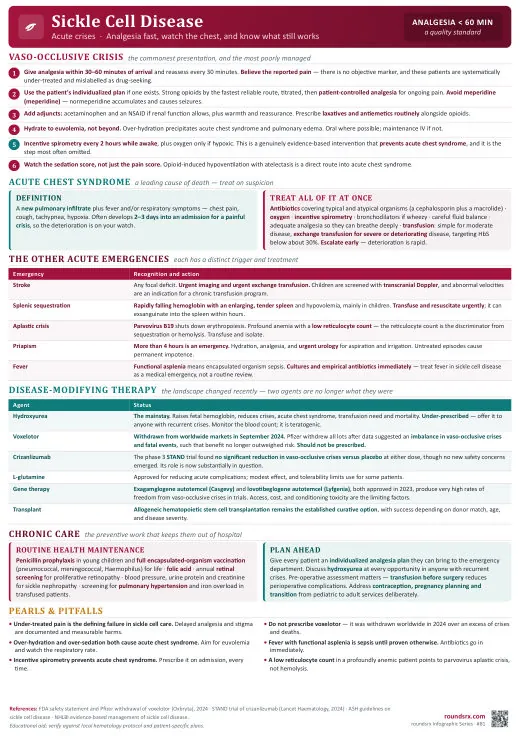
Text version
💉 Pain (VOC): IV hydromorphone PCA + ketorolac + acetaminophen. Treat within 30 min. IVF D5 1/2NS 1.5× maintenance.
🫁 ACS: New CXR infiltrate + fever/cough/hypoxia. #1 cause of death. Ceftriaxone + azithro. Exchange transfusion if severe.
🩸 Transfusion: Simple if Hgb < 7 or ≥ 2 below baseline. Exchange for ACS/stroke/MOF. Target Hgb ≤ 10 (never higher!).
🦠 Bugs to know: S. pneumoniae (#1 killer), Salmonella (osteomyelitis), Capnocytophaga (dog/cat bite → fulminant sepsis).
💊 Hydroxyurea: All adults with SCD. ↑ HbF → ↓ crises, ACS, mortality. 15–35 mg/kg/day. Monitor CBC q4–8wk.
🌬️ IS q2h: 10 breaths every 2 hours. Prevents ACS. Most important thing you can do during admission.
💉 Vaccines: PCV13 + PPSV23, MenACWY + MenB, Hib, annual flu. Penicillin VK prophylaxis age < 5.
- CBC + retic -Hgb vs baseline
- Type & screen -extended phenotype matching
- CXR -new infiltrate = ACS
- Blood cultures if febrile
- LDH, indirect bili, haptoglobin
- TCD -stroke screening children 2-16