Small Bowel Obstruction & Ileus
| Feature | SBO (Mechanical) | Ileus (Functional) |
|---|---|---|
| Cause | Adhesions (#1, 60–75%), hernias, tumor, volvulus | Post-operative, electrolyte imbalance, opioids, peritonitis |
| Imaging | Dilated proximal bowel + decompressed distal bowel + transition point | Diffuse dilation of small AND large bowel, no transition point |
| Air-fluid levels | Multiple, differential (step-ladder pattern) | Few, similar height |
| Management | NGT, NPO, IVF. Surgery if complete/strangulated. | Treat underlying cause. Bowel rest. Ambulation. |
| Feature | Partial SBO | Complete SBO |
|---|---|---|
| Gas in colon | Present | Absent |
| Passage of flatus/stool | May continue initially | Absent (obstipation) |
| CT findings | Transition point with some distal bowel gas | Discrete transition point, no distal gas, "small bowel feces sign" |
| Conservative trial | Resolves in 60-80% without surgery | Higher failure rate, closer surgical monitoring |
| Gastrografin useful? | Yes, both diagnostic and therapeutic | Less therapeutic benefit, more for surgical decision-making |
- Prior abdominal surgery - single greatest risk factor. Lower GI and pelvic surgeries have highest adhesion rates Menzies & Ellis, Ann Surg 1990
- Number of prior laparotomies - risk increases with each additional surgery
- Type of surgery - open > laparoscopic for adhesion formation Strik et al, Lancet 2016
- Peritonitis/contamination - inflammatory peritoneal environment drives adhesion formation
- Foreign bodies - mesh, drains, retained surgical materials
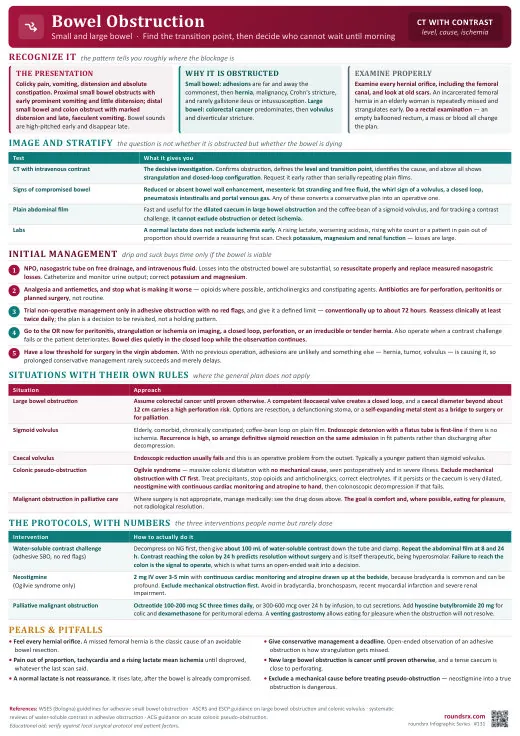
- NPO -strict bowel rest
- NGT to low intermittent suction -decompression
- IV fluids -aggressive resuscitation (3rd-spacing)
- Electrolyte repletion -K, Mg, PO₄
- Serial abdominal exams q4–8h
- Water-soluble contrast (Gastrografin) -both diagnostic and therapeutic. If contrast reaches colon by 24h → likely to resolve without surgery
- Complete SBO with no improvement in 48–72h
- Signs of strangulation/ischemia
- Closed-loop obstruction
- Free air (perforation)
- Incarcerated/strangulated hernia
| Step | Action | Details |
|---|---|---|
| 1 | Confirm partial SBO | CT showing transition point without signs of strangulation or complete obstruction |
| 2 | Administer Gastrografin | 100 mL via NGT (clamp NGT for 2h after) |
| 3 | Abdominal XR at 8h | Early check for contrast progression |
| 4 | Abdominal XR at 24h | Definitive assessment |
| 5a | Contrast in colon at 24h | High likelihood of non-operative resolution. Continue conservative management |
| 5b | No contrast in colon at 24h | Unlikely to resolve. Surgical consultation for operative planning |
- 0-24h: NPO, NGT, IVF, serial exams. Administer Gastrografin if partial SBO
- 24h: Assess Gastrografin follow-through XR. If contrast in colon, continue conservative Rx
- 48-72h: Maximum window for conservative trial in partial SBO without improvement
- 72h+: If no resolution, strongly consider surgical exploration
- CT abdomen/pelvis with IV contrast -gold standard. Shows transition point, dilated vs decompressed bowel, signs of ischemia
- Abdominal X-ray -dilated small bowel (> 3 cm), air-fluid levels, absent distal gas (complete SBO)
- BMP -dehydration, electrolyte derangements
- CBC -leukocytosis (strangulation)
- Lactate -elevated with ischemia/strangulation
- Lipase -rule out pancreatitis
| Finding | Significance | Action |
|---|---|---|
| Transition point | Location where dilated bowel transitions to decompressed | Confirms mechanical obstruction vs ileus |
| Small bowel feces sign | Particulate matter in dilated small bowel proximal to obstruction | Suggests prolonged/complete obstruction Mayo-Smith et al, AJR 1999 |
| Decreased wall enhancement | Bowel wall ischemia | Urgent surgical consultation |
| Mesenteric haziness/stranding | Venous congestion, early ischemia | Close monitoring, lower threshold for surgery |
| Pneumatosis intestinalis | Gas in bowel wall - necrosis | Surgical emergency |
| Portal venous gas | Severe ischemia/necrosis | Surgical emergency |
| Free fluid | Strangulation until proven otherwise | Surgical consultation |
| Closed-loop sign | U-shaped or C-shaped dilated loop with convergence of mesentery | High risk for strangulation - surgery |
| Drug | Dose | Purpose |
|---|---|---|
| IV Normal Saline | Bolus 1–2 L then maintenance | Volume resuscitation -significant 3rd-spacing |
| Ondansetron (Zofran) | 4 mg IV q6h PRN | Anti-emetic |
| Gastrografin | 100 mL via NGT | Water-soluble contrast -diagnostic and therapeutic (osmotic draws fluid into lumen) |
| Piperacillin-Tazobactam (Zosyn) | 3.375 g IV q6h | If strangulation/perforation suspected -broad-spectrum coverage |
| AVOID opioids | - | Worsen ileus. Use non-opioid pain management when possible. |
Patient: 58M with PMH of appendectomy 20 years ago presents with 1 day of crampy abdominal pain, nausea, vomiting, and decreased flatus.
Exam: Abdomen distended, diffusely tender without peritonitis. Well-healed RLQ scar. BS hyperactive. T 37.1, HR 95, BP 130/78.
Labs: WBC 9.2, lactate 1.1, BMP with Cr 1.4 (baseline 0.9), K 3.2, Cl 94.
CT: Dilated small bowel to 4.2 cm with transition point in mid-ileum. Decompressed distal bowel. Some gas in colon. No signs of ischemia.
Assessment: Partial adhesive SBO. No strangulation.
Management: NPO, NGT to LIWS, NS at 150 mL/hr, K repletion. Gastrografin 100 mL via NGT. AXR at 24h: contrast in colon. Diet advanced on day 2. Discharged day 3.
Patient: 72F with PMH of hysterectomy and two prior laparotomies presents with 3 days of worsening abdominal pain, no flatus or stool for 48h, and bilious vomiting.
Exam: Distended, rigid abdomen with rebound tenderness in periumbilical area. Absent bowel sounds. T 38.9, HR 120, BP 88/52.
Labs: WBC 18.5, lactate 5.2, BMP with metabolic acidosis (HCO3 16), Cr 2.1.
CT: Dilated small bowel loops with transition point. Closed-loop configuration with C-shaped dilated segment. Decreased bowel wall enhancement. Mesenteric haziness and free fluid. No distal gas.
Assessment: Complete SBO with strangulation (closed-loop, elevated lactate, peritonitis, CT ischemic changes).
Management: Emergent surgical exploration (no conservative trial). IVF resuscitation. Piperacillin-tazobactam 4.5g IV. Found 30 cm of non-viable ileum. Small bowel resection with primary anastomosis. ICU post-op.
Patient: 65M with no surgical history presents with acute-onset periumbilical pain x6h, nausea, and 2 episodes of vomiting.
Exam: Firm, tender, non-reducible mass in right inguinal region. Abdomen distended and tympanic. T 37.5, HR 105.
Labs: WBC 11.2, lactate 2.0. BMP unremarkable.
CT: Right inguinal hernia containing small bowel loop. Proximal small bowel dilated. Bowel wall enhancing normally.
Assessment: SBO from incarcerated inguinal hernia. No strangulation yet (lactate mildly elevated but wall enhancing). Virgin abdomen: always examine for hernias.
Management: Attempted bedside reduction failed. Urgent surgical hernia repair with reduction. Viable bowel confirmed intra-operatively. Mesh repair. Diet advanced day 1. Discharged day 2.