Smoking Cessation
- Ask -about tobacco use at every visit
- Advise -to quit in a clear, personalized way ("Quitting is the single best thing you can do for your health")
- Assess -willingness to make a quit attempt
- Assist -offer medication + counseling (combination is most effective)
- Arrange -follow-up within 1 week of quit date
| Agent | Dose | Quit Rate | Notes |
|---|---|---|---|
| Varenicline (Chantix) MOST EFFECTIVE | 0.5 mg daily × 3 days → 0.5 mg BID × 4 days → 1 mg BID × 12 weeks. Can extend to 24 weeks. | ~30% at 1 year | Partial nicotine receptor agonist (reduces craving + blocks reward from smoking). FDA removed black box warning for neuropsych events EAGLES, 2016 -safe even in psychiatric patients. Start 1 week before quit date. GI side effects (nausea -take with food). Can combine with NRT for even higher efficacy. |
| NRT -patch | 21 mg/day × 6 wks → 14 mg × 2 wks → 7 mg × 2 wks (if > 10 cig/day). 14 mg start if < 10/day. | ~15–20% alone, ~25–30% combined | Apply to clean, hairless skin, rotate sites. Combine patch (sustained) + lozenge or gum (acute cravings) for best results -combination NRT is as effective as varenicline. |
| NRT -gum/lozenge | 2 mg or 4 mg (if first cigarette within 30 min of waking → 4 mg). Use q1–2h PRN. | ~15–20% | Best as add-on to patch for breakthrough cravings. Gum: "park and chew" technique. Lozenge: dissolve in mouth, don't chew. |
| Bupropion SR (Zyban) | 150 mg daily × 3 days → 150 mg BID × 12 weeks. Start 1–2 weeks before quit date. | ~20% | Also treats depression. Contraindicated in seizure disorders, eating disorders, MAOI use. Weight-neutral (unlike most cessation -patients often gain 5–10 lbs). Can combine with NRT. |
Patient: 54M, 35-pack-year smoker, COPD, HTN. Failed NRT patch × 2 prior attempts. Motivated to quit (Prochaska: preparation stage). No history of seizures or psychiatric illness.
Key findings: High nicotine dependence (Fagerström score 7/10), multiple prior failures with NRT alone. Combination pharmacotherapy + counseling has highest quit rates.
Management:
- Varenicline 0.5 mg daily × 3 days → 0.5 mg BID × 4 days → 1 mg BID × 12 weeks (most effective single agent, 33% quit rate vs 14% placebo)
- Set quit date 1-2 weeks after starting (allows drug to reach steady state)
- Behavioral counseling: 1-800-QUIT-NOW (quitline doubles quit rates when combined with meds)
- Consider combo: varenicline + nicotine patch (JAMA 2014: combo superior to varenicline alone)
- Warn: nausea (most common side effect, take with food). Vivid dreams. Psychiatric monitoring
Teaching point: Varenicline is the most effective single cessation agent. The old FDA black box warning for psychiatric events was REMOVED in 2016 after EAGLES, 2016 showed no increased risk. Do not withhold from patients with psychiatric history.
Patient: 48M admitted for NSTEMI, underwent PCI. 25-pack-year smoker. Currently nicotine-deprived and motivated. Asking about quitting.
Key findings: Hospitalization for ACS is a "teachable moment", quit rates are highest when cessation is initiated during admission. Continued smoking post-ACS doubles the risk of recurrent MI and death.
Management:
- Start NRT in hospital: nicotine patch 21 mg/day + nicotine lozenge 2 mg PRN (combo NRT during admission)
- Add varenicline before discharge if no contraindication (start during admission → continue outpatient)
- Brief motivational interviewing: "How important is quitting to you on a scale of 1-10? What would make it higher?"
- Arrange follow-up: smoking cessation clinic or quitline within 1 week of discharge
- Document smoking status and cessation plan in discharge summary
Teaching point: Every admission is an opportunity. The 5 A's: Ask (smoking status), Advise (quit), Assess (readiness), Assist (meds + counseling), Arrange (follow-up). NRT is safe in ACS, nicotine from patches causes far less cardiovascular harm than nicotine from cigarettes.
Patient: 28F, 10-pack-year smoker, newly pregnant (8 weeks). Smoking 10 cigarettes/day. Concerned about harm to baby but unable to quit cold turkey.
Key findings: Smoking during pregnancy: risk of preterm birth (2×), low birth weight, placental abruption, SIDS, and childhood asthma. Behavioral counseling is first-line in pregnancy. Pharmacotherapy options are limited.
Management:
- Behavioral counseling FIRST, pregnancy-specific counseling programs achieve 5-10% quit rates (doubles with intensive support)
- If counseling alone fails: nicotine patch (lowest effective dose), benefits of quitting likely outweigh NRT risks, but discuss shared decision-making
- Varenicline and bupropion are NOT recommended in pregnancy (insufficient safety data)
- Motivational framing: "Quitting before 15 weeks eliminates most of the excess risk to your baby"
- Postpartum relapse prevention, 70% of women who quit during pregnancy relapse within 6 months postpartum
Teaching point: Behavioral counseling is first-line for pregnant smokers. NRT can be used if counseling fails, the risk of continued smoking far outweighs NRT risk. The critical window is quitting before 15 weeks, which nearly eliminates the excess risk of preterm birth and low birth weight.
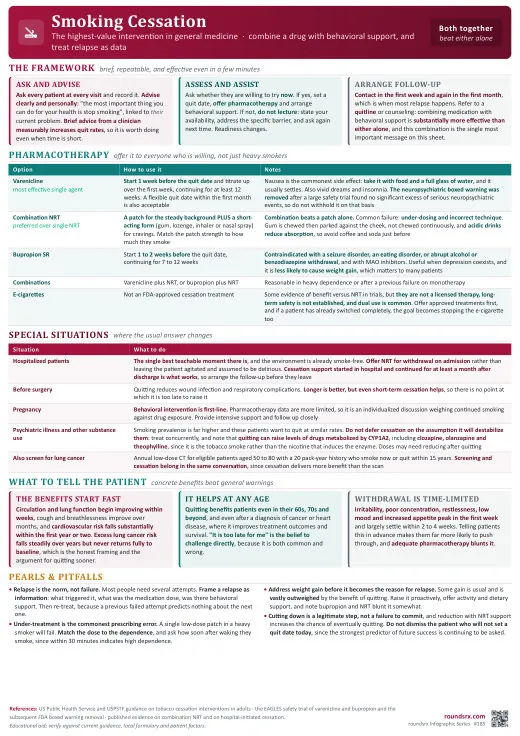
Text version
- Ask about tobacco use at every visit, because status changes and a documented ask is what triggers the rest of the pathway.
- Advise to quit in a clear, personalized way: "Quitting is the single best thing you can do for your health."
- Assess willingness to make a quit attempt, since this decides whether you set a quit date today or do motivational work instead.
- Assist with medication plus counseling, because the combination substantially outperforms either alone.
- Arrange follow-up within 1 week of the quit date, which is when relapse risk peaks.
- A prior failed attempt is a good sign, not a bad one. Most successful quitters try 6-8 times first; each attempt teaches the patient their triggers and what does not work.
- Varenicline + NRT patch: ~35%. The most effective strategy, so this is the default offer unless something contraindicates it.
- Varenicline alone: ~30% at 1 year, the most effective single agent.
- Combination NRT (patch + gum or lozenge): ~28%, which is roughly as effective as varenicline and matters when varenicline is unavailable or refused.
- Bupropion + NRT: ~25%.
- Bupropion alone: ~20%; NRT patch alone: ~15-20%.
- Counseling alone: ~5-10%. Every pharmacotherapy option beats it, which is the argument for always offering a drug.
- Annual LDCT lung cancer screening: age 50-80, ≥ 20 pack-years, and currently smoking or quit within 15 years (USPSTF 2021). It reduces lung cancer mortality 20% (NLST), so eligibility should be checked at the same visit you address cessation.
- Follow-up call at 1 week post-quit date, office visit at 4 weeks: early relapse is the dominant failure mode and is often fixable by adding a short-acting NRT or adjusting the dose.
- Document pack-years, prior quit attempts, and stage of change, because the number of prior attempts and what failed last time drives the next regimen choice.
- Counsel on weight gain (typically 5-10 lbs) up front, so it does not become an unspoken reason to relapse. Bupropion is the weight-neutral option.
- Warn about varenicline side effects: nausea (take with food) and vivid dreams, both of which patients stop the drug over if they are not forewarned.
- Withholding varenicline from patients with psychiatric illness. The FDA removed the neuropsychiatric black box warning in 2016 after EAGLES, 2016 showed no increased risk. These are exactly the patients who need the most effective drug.
- Bupropion in a patient with a seizure disorder, eating disorder, or on an MAOI. All are contraindications.
- Using the patch alone and calling it maximal therapy. The patch covers baseline; add a gum or lozenge for acute cravings, which lifts the quit rate from ~15-20% to ~25-30%.
- Starting the drug on the quit date. Varenicline needs a week and bupropion 1-2 weeks to reach steady state first.
- Treating a prior failed attempt as evidence the patient cannot quit. Reframe it: most quitters need several attempts, and the useful question is what happened last time.
- Recommending e-cigarettes as cessation therapy. USPSTF has NOT endorsed them, evidence is insufficient, dual use means many patients get no net benefit, and long-term safety is unknown.
- Pregnancy: behavioral counseling is first-line (pregnancy-specific programs achieve 5-10% quit rates, which doubles with intensive support). Varenicline and bupropion are NOT recommended given insufficient safety data. If counseling fails, nicotine patch at the lowest effective dose with shared decision-making, since continued smoking carries clearly greater risk.
- Pregnancy, the framing that motivates: quitting before 15 weeks eliminates most of the excess risk to the baby (preterm birth 2×, low birth weight, placental abruption, SIDS, childhood asthma). Plan postpartum relapse prevention, because 70% of women who quit in pregnancy relapse within 6 months.
- Inpatient after ACS: admission is a teachable moment with the highest quit rates. Start combination NRT in hospital (patch 21 mg/day plus lozenge 2 mg PRN) and add varenicline before discharge. NRT is safe in ACS: nicotine from a patch causes far less cardiovascular harm than nicotine from cigarettes, and continued smoking post-ACS doubles the risk of recurrent MI and death.
- Any hospitalization: document smoking status and the cessation plan in the discharge summary, and arrange quitline or cessation clinic follow-up within 1 week of discharge.
- EAGLES, 2016: no excess neuropsychiatric events with varenicline or bupropion, including in psychiatric patients. This is why the FDA black box came off and why you should not withhold the drug.
- NLST: annual LDCT reduced lung cancer mortality 20%, the basis for the USPSTF 2021 screening criteria (age 50-80, ≥ 20 pack-years, current or quit within 15 years).
- Combination beats monotherapy: varenicline plus NRT patch reaches ~35%, versus ~30% varenicline alone and ~5-10% for counseling alone, which is the practical case for always layering drug plus counseling.