Spinal Cord Compression
| Cause | Details |
|---|---|
| Metastatic disease | #1 cause. Lung, breast, prostate, RCC, myeloma. Usually epidural (vertebral body mets → posterior extension) |
| Primary spine tumors | Meningioma, schwannoma, ependymoma |
| Epidural abscess | Fever + back pain + risk factors (IVDU, recent spinal procedure). S. aureus #1. |
| Epidural hematoma | Post-procedure or anticoagulation |
| Disc herniation | Most common cause of non-malignant cord compression |
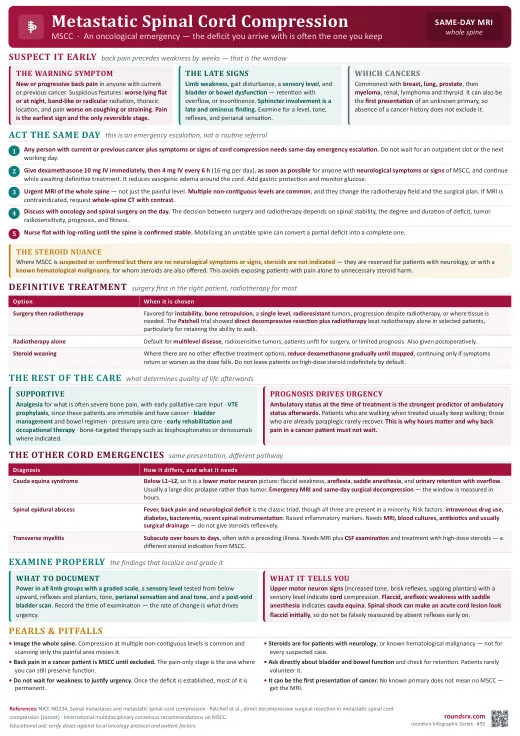
- Dexamethasone 10 mg IV STAT then 4 mg IV q6h -reduces vasogenic edema around cord
- MRI entire spine with contrast -STAT. Multiple levels in 30% of cases.
- Neurosurgery consult -surgical decompression if: single level, good functional status, life expectancy > 3 months, radioresistant tumor
- Radiation oncology consult -definitive treatment for most metastatic SCC. Start within 24h.
- Pain management -often severe. Opioids appropriate.
- MRI entire spine with gadolinium -gold standard. Must image ENTIRE spine (multiple lesions in 30%)
- CT myelogram -if MRI contraindicated (pacemaker)
- Plain films -vertebral body collapse, but misses early compression
- Neuro exam -motor level, sensory level, rectal tone (cauda equina), reflexes
- Post-void residual -bladder dysfunction is late sign
| Drug | Dose | Purpose |
|---|---|---|
| Dexamethasone (Decadron) | 10 mg IV bolus → 4 mg IV q6h | Reduce cord edema. Start immediately on clinical suspicion. |
| Oxycodone (OxyContin) | 5–15 mg PO q4–6h | Pain control. Often severe. |
| Gabapentin (Neurontin) | 300–900 mg TID | Neuropathic pain adjunct |
| Omeprazole (Prilosec) | 20–40 mg daily | GI prophylaxis with high-dose steroids |
Patient: 67M with known metastatic prostate cancer. Progressive mid-back pain × 3 weeks, now unable to walk since yesterday. Bilateral LE weakness (3/5), hyperreflexia, upgoing toes. Urinary retention (600 mL on bladder scan).
Key findings: UMN signs (hyperreflexia, Babinski) + sensory level at T8 + bladder dysfunction = thoracic spinal cord compression. Metastatic prostate cancer is the #1 cause of malignant cord compression.
Management:
- Dexamethasone 10 mg IV STAT → 4 mg IV q6h (reduces vasogenic edema around the cord)
- Emergent MRI entire spine with contrast (30% have multiple levels of compression)
- Neurosurgery consult for decompressive surgery if single level, good prognosis, and not radiosensitive Patchell, 2005
- Radiation oncology consult, XRT alone if radiosensitive tumor (lymphoma, myeloma, SCLC) or poor surgical candidate
- Foley catheter for urinary retention; bowel regimen
Teaching point: Ambulatory status at diagnosis is the #1 predictor of outcome. Patients who can still walk at presentation have ~80% chance of maintaining ambulation. Once paralyzed > 48h, recovery is rare. Speed matters, dexamethasone and MRI are both emergent.
Patient: 42F with acute low back pain after heavy lifting, now with bilateral leg weakness, saddle numbness, and inability to urinate × 12 hours. Exam: flaccid bilateral LE weakness, absent ankle reflexes, decreased perianal sensation, lax anal tone.
Key findings: LMN signs (flaccid weakness, areflexia) + saddle anesthesia + urinary retention = cauda equina syndrome. Disc herniation at L4-L5 or L5-S1 is the most common cause in young adults.
Management:
- Emergent MRI lumbar spine, do not delay for any reason
- Neurosurgery consult for emergent decompressive laminectomy (within 24-48h of symptom onset for best outcomes)
- Foley catheter for urinary retention
- Pain management: avoid opioids if possible pre-surgery; ketorolac 15 mg IV
- Post-op: bladder function recovery may take weeks-months; monitor post-void residuals
Teaching point: Cauda equina syndrome is a surgical emergency with a narrow treatment window. Decompression within 48 hours of urinary retention onset gives the best chance of bladder recovery. After 48h, permanent deficits are common.
Patient: 55M IVDU with 5 days of progressive back pain, fever (39.2°C), and now bilateral LE weakness. WBC 22K, ESR 110, blood cultures positive for MSSA. MRI: epidural abscess T10-T12 with cord compression.
Key findings: Spinal epidural abscess, classic triad: back pain + fever + neurologic deficits. IVDU is the #1 risk factor. S. aureus is the #1 organism. Hematogenous spread from bacteremia.
Management:
- Emergent neurosurgery consult for decompressive laminectomy + abscess drainage (neurologic deficit = operative emergency)
- Vancomycin 25-30 mg/kg IV load + cefepime 2g IV q8h (empiric until culture-directed, cover MRSA + GNRs)
- Narrow to nafcillin/oxacillin once MSSA confirmed (6-8 weeks IV antibiotics)
- Serial MRI to monitor abscess resolution
- Echo to rule out endocarditis (IVDU + S. aureus bacteremia = 30% concomitant endocarditis)
Teaching point: The classic triad of epidural abscess (back pain + fever + neuro deficits) is only present in 10-15% at initial presentation. Back pain + fever in IVDU → MRI the spine. Once motor deficits develop, surgery must happen within hours to prevent permanent paralysis.