Stable Angina & Chronic CAD
| Feature | Low Risk | High Risk |
|---|---|---|
| Stress test | No ischemia, good exercise capacity | Ischemia at low workload, ↓ EF with exercise, ≥ 2 mm ST depression |
| Anatomy | Single-vessel disease, normal EF | Left main, 3-vessel disease, ↓ EF |
| Symptoms | CCS Class I–II | CCS Class III–IV despite GDMT |
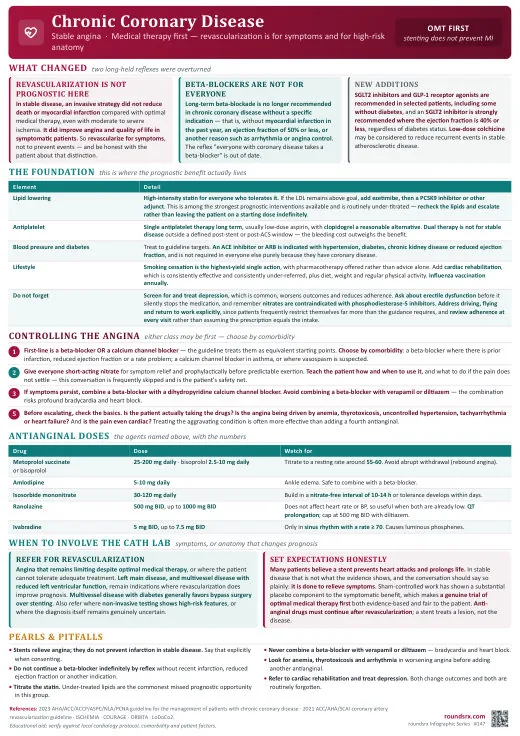
- Anti-anginal: β-blockers (1st line) → CCBs (if β-blocker contraindicated) → long-acting nitrates → ranolazine
- Anti-ischemic risk reduction: Aspirin 81 mg daily, high-intensity statin, ACEi/ARB (especially if DM, HTN, HFrEF)
- Lifestyle: Smoking cessation (#1 modifiable risk factor), exercise, weight loss, Mediterranean diet, BP < 130/80, A1c < 7%
- PCI - symptom relief only. No mortality benefit in stable CAD (COURAGE, 2007; ORBITA, 2018; REVIVED-BCIS2, 2022).
- CABG - survival benefit in left main disease, 3-vessel disease with ↓ EF, or diabetes with multi-vessel disease (FREEDOM, 2012)
- ECG - may be normal at rest. ST depression during pain.
- Stress testing - exercise preferred. Pharmacologic if cannot exercise. Nuclear/echo for added anatomic info.
- Coronary CT angiography - anatomic assessment, calcium scoring
- Cardiac catheterization - if high-risk features on non-invasive testing
- Lipid panel, HbA1c, BMP, TSH
- Echo - baseline LV function
| Test Type | When to Use | Sensitivity | Key Notes |
|---|---|---|---|
| Exercise ECG | Can exercise + interpretable ECG | ~68% | First-line, cheapest. Positive = ≥ 1mm ST depression. |
| Exercise Echo | Can exercise + uninterpretable ECG or need anatomic info | ~85% | Detects wall motion abnormalities. Better specificity than ECG alone. |
| Exercise Nuclear (SPECT) | Can exercise + need perfusion data | ~87% | Identifies ischemic territory for intervention planning. |
| Pharmacologic (Dobutamine Echo) | Cannot exercise | ~82% | Simulates exercise. Detects viable/stunned myocardium. |
| Pharmacologic (Vasodilator Nuclear) | Cannot exercise + LBBB or paced rhythm | ~90% | Adenosine/regadenoson. Preferred over dobutamine for LBBB (avoids septal artifact). |
| Coronary CTA | Low-intermediate risk, anatomy needed | ~95% | High NPV. Rules out CAD. Also gives calcium score. |
| Drug | Dose | Role | Key Notes |
|---|---|---|---|
| Metoprolol Succinate (Toprol XL) | 25–200 mg daily | 1st line anti-anginal | ↓ HR → ↓ myocardial O₂ demand. Target HR 55–60. |
| Amlodipine (Norvasc) | 5–10 mg daily | 2nd line / add-on | Long-acting DHP CCB. Use if β-blocker contraindicated or vasospastic angina. Caps simvastatin at 20 mg/day (CYP3A4 inhibition, simvastatin exposure ~1.8x, myopathy risk). Most CAD patients need high-intensity statin anyway, so use atorvastatin or rosuvastatin rather than a capped simvastatin dose. |
| Isosorbide Mononitrate (Imdur) | 30–120 mg daily | Add-on anti-anginal | 10–14h nitrate-free interval required to prevent tolerance. |
| Ranolazine (Ranexa) | 500–1000 mg BID | Add-on | Late sodium current inhibitor. No hemodynamic effects. Prolongs QTc. |
| Aspirin | 81 mg daily | Antiplatelet | Lifelong. Reduces MI and CV death. |
| Atorvastatin (Lipitor) | 40–80 mg daily | High-intensity statin | Plaque stabilization + LDL reduction. Target LDL < 70. |
Patient: 64M with HTN, HLD, T2DM. Exertional chest pressure with brisk walking × 3 months, relieved by rest within 5 min. Normal ECG at rest. EF 60%.
Key findings: Classic stable angina: predictable exertional chest pain, relieved by rest. Intermediate pretest probability for CAD given age, sex, and risk factors.
Management:
- Stress test for risk stratification, exercise stress echo (can exercise, interpretable ECG)
- Start ASA 81 mg + high-intensity statin (atorvastatin 80 mg)
- Metoprolol succinate 25 mg daily (first-line anti-anginal, reduces HR and O₂ demand)
- SL nitroglycerin PRN for breakthrough episodes
- If high-risk stress test (large ischemic burden, drop in BP) → coronary angiography
Teaching point: Beta-blockers are first-line for stable angina, they reduce mortality in post-MI patients and improve anginal symptoms. CCBs (amlodipine, diltiazem) are second-line or added if beta-blockers insufficient.
Patient: 72F with known 3-vessel CAD (declined CABG 2 years ago). Angina now occurring with minimal exertion despite metoprolol 100 mg BID, amlodipine 10 mg, isosorbide mononitrate 60 mg daily, ASA, atorvastatin. CCS class III.
Key findings: Refractory angina on maximized triple anti-anginal therapy. Previously documented 3-vessel disease. Progressive limitation despite optimal medical management.
Management:
- Add ranolazine 500 mg BID → titrate to 1000 mg BID (late sodium channel inhibitor, reduces ischemia without hemodynamic effects)
- Reassess revascularization candidacy, repeat coronary angiography
- Heart team discussion: CABG vs high-risk PCI for 3-vessel disease ISCHEMIA, 2020
- Cardiac rehab referral (improves exercise capacity and anginal threshold)
- Ensure nitrate-free interval (10-14h overnight) to prevent tolerance
Teaching point: Ranolazine is the fourth-line anti-anginal agent, it works by a unique mechanism (late Na channel) and can be added to any combination without hemodynamic interactions. No mortality benefit, but improves symptoms.
Patient: 42F non-smoker, no traditional risk factors. Recurrent rest angina at 3-4 AM with transient ST elevation on telemetry that resolves spontaneously. Normal coronary angiogram.
Key findings: Classic vasospastic angina: rest pain, early morning, transient ST elevation, clean coronaries. Often triggered by smoking, cocaine, or cold exposure.
Management:
- Long-acting CCB first-line: amlodipine 5-10 mg daily or diltiazem ER 240 mg daily
- Long-acting nitrate (isosorbide mononitrate 30-60 mg daily) if CCB alone insufficient
- AVOID beta-blockers (unopposed alpha-mediated vasoconstriction can worsen spasm)
- SL nitroglycerin PRN for acute episodes
- Avoid triggers: cocaine, triptans, ergot alkaloids, cold exposure
Teaching point: Beta-blockers are contraindicated in vasospastic angina, they remove beta-2 vasodilation, leaving alpha-mediated constriction unopposed. This is the one form of angina where beta-blockers make things worse.