Status Epilepticus
Refractory SE: Failure of 2 first-line agents (benzodiazepine + second AED) -requires ICU admission and anesthetic agents.
Super-refractory SE: SE persisting ≥ 24 hours after initiation of anesthetic agents, including recurrence on weaning.
- Known epilepsy + subtherapeutic AED levels (most common)
- Acute CNS insult: stroke, hemorrhage, encephalitis, meningitis, trauma, tumor
- Metabolic: severe hyponatremia, hypoglycemia, hypocalcemia, uremia
- Toxins/withdrawal: alcohol withdrawal, cocaine, TCAs, isoniazid
- Anoxic brain injury (post-cardiac arrest)
- Autoimmune encephalitis (anti-NMDA receptor -especially young women)
- Fingerstick glucose FIRST, hypoglycemia is a reversible cause of seizure
- BMP, Na (hyponatremia), Ca, Mg, renal function
- AED levels (if patient on chronic anticonvulsants), subtherapeutic levels are a top cause of breakthrough SE
- CBC, leukocytosis (infection, stress)
- LFTs, ammonia, hepatic encephalopathy with myoclonus
- Toxicology screen, sympathomimetic, cocaine, alcohol withdrawal, TCA overdose, INH toxicity (→ pyridoxine)
- Lactate, elevated early post-seizure (anaerobic metabolism); should clear within ~1h if seizure has stopped
- Non-contrast CT head, rule out stroke, hemorrhage, mass, edema
- LP, if meningitis/encephalitis suspected (fever, immunocompromised, signs of infection)
- MRI brain, after acute stabilization; more sensitive for cortical lesions, autoimmune encephalitis
- Continuous EEG × 24–48h, mandatory if patient doesn't rapidly return to baseline; diagnoses NCSE (present in up to 30% of persistent coma after convulsive SE)
- Pregnancy test, eclampsia is a stroke mimic and changes AED choice (levetiracetam preferred; avoid valproate)
- Autoimmune encephalitis panel (anti-NMDA-R, LGI1, GABA-B, etc.), if no clear etiology, especially young women
Classic post-ictal lab pattern:
- ↑↑ CK (often 1,000 to >10,000 U/L), confirms muscle source. Always order CK on a post-ictal LFT abnormality.
- ↑ AST and ↑ ALT, with AST > ALT. AST often 200–500 in moderate post-ictal rhabdo.
- ↑ LDH, ↑ aldolase (also leaked from muscle)
- ↑ K⁺, ↑ phosphate, ↓ Ca²⁺ (intracellular contents released; Ca²⁺ binds to damaged muscle and phosphate)
- Tea-colored urine, dipstick + for blood with no RBCs on micro = myoglobinuria
- AKI from myoglobin cast nephropathy (CK > 10,000 = high risk)
One more nuance, myoglobin does NOT cause jaundice. Although myoglobin contains heme, its clinical fate in rhabdo is renal excretion (causing the tea-colored urine and pigment AKI), not conversion to bilirubin. Bilirubin overwhelmingly comes from hemoglobin breakdown by splenic macrophages (~80% of daily production). If a post-ictal or rhabdo patient is jaundiced, look elsewhere, hemolysis, ischemic hepatitis from shock, or drug-induced hepatic injury.
| Lab | Starts to Rise | Peaks | Back to Normal | Typical Magnitude | Why It Matters |
|---|---|---|---|---|---|
| Lactate | Within minutes | Immediate post-event | 30–90 min | 5–15 mmol/L | Best fast discriminator. Rapid clearance distinguishes post-ictal from sepsis (sepsis lactate doesn't drop in an hour). Cutoff: lactate > 2.5 mmol/L within 2h of TLOC has ~80% sensitivity, ~95% specificity for GTC seizure. |
| Anion gap / pH ↓ | Minutes | Immediate | 30–90 min | AG often > 16, pH 7.20–7.30 | Tracks lactate. Resolves as lactate clears. Don't confuse with DKA or toxic ingestion if it's already correcting. |
| Prolactin | 10–20 min | 20 min | 60 min | 2–3× baseline | GTC vs PNES (psychogenic non-epileptic seizure). Useless if drawn after 60 min or in NCSE/focal/established status. Window matters. |
| WBC | Minutes (demargination) | 1–2 hours | 24–48h | 12–20K, neutrophil-predominant | Mild leukocytosis is expected post-seizure, not necessarily infection. Don't reflex broad-spectrum antibiotics on WBC alone. |
| Cortisol | Minutes | 30–60 min | 2–4h | 2–3× baseline | Not used for diagnosis. Explains the leukocytosis (demargination + neutrophilia + lymphopenia). |
| Glucose | Minutes | 30–60 min | 1–2h | 150–250 mg/dL | Stress hyperglycemia from catecholamine surge. Don't restart insulin sliding scale based on a single post-ictal glucose. |
| Ammonia | Immediate | < 60 min | 2–12h | 2–3× ULN | Can falsely flag hepatic encephalopathy in a non-cirrhotic patient. Recheck in 4–6h before treating with lactulose. |
| Serum myoglobin | 1–3h | 6–12h | 24h | Variable | Clears rapidly via kidney. Urine myoglobin lingers longer (24–48h). Rarely needed if CK is being trended. |
| Troponin | 3–6h | 6–12h | 24–72h | Usually low-level (< 0.5 ng/mL) | False bump from sympathetic surge / demand ischemia. Don't reflex an ACS workup if seizure history is solid; trend it instead. |
| AST | 6–12h | 24–48h | 3–5 days | 200–500 U/L | Released from lysed muscle, not made by injured liver. AST > ALT (opposite of viral hepatitis). |
| ALT | 6–12h | 24–72h | 3–7 days | 100–300 U/L | Smaller bump than AST because muscle has less ALT. Tracks AST. |
| CK | 2–12h | 24–72h | 5–7 days | 1,000 to > 10,000 U/L | Best late marker. Confirms a convulsive event happened even days after the lactate window has closed. CK > 10,000 = high AKI risk. |
| Aldolase | 6–12h | 24–72h | 5–7 days | Variable | Tracks CK. Rarely added if CK is already being trended; useful if CK is borderline and you want corroboration. |
| K⁺ ↑ | Hours | 12–24h | 2–3 days | Up to 6–7 mEq/L in significant rhabdo | Arrhythmia risk window. Recheck q4–6h until trending down. Don't extrapolate from a single normal K⁺ at hour 2. |
| Phosphate ↑ | Hours | 12–24h | 3–5 days | 5–8 mg/dL | From muscle cell lysis. Contributes to hypocalcemia by binding free Ca²⁺. |
| Calcium ↓ | Hours | 24–48h (lowest) | 1–2 weeks | Often 7–8 mg/dL corrected | Binds to damaged muscle and phosphate. Don't reflexively replace unless symptomatic, rebound hypercalcemia during recovery is common and replacement makes it worse. |
| Urine dipstick + blood, no RBCs (myoglobinuria) | 1–3h | First 24h | 24–48h | Tea-colored urine | Classic finding; dipstick heme cross-reacts with myoglobin. Confirms muscle injury source. |
| Creatinine ↑ (if AKI) | 24–72h | 3–5 days | Days to weeks | Variable | Pigment cast nephropathy from myoglobin. Severity proportional to peak CK and time to fluids. |
| LDH | 6–12h | 24–48h | 7–10 days | 500–2,000 U/L | Long half-life; persists longest of all post-ictal markers. Useful retrospective clue if a patient presents days later with unclear history. |
- Patient arrives within 1 hour of event: draw lactate, prolactin, ABG/VBG with anion gap. The fast-decay markers are still recoverable. After this window they're gone.
- Patient arrives 2–6 hours later: lactate window may be missed. Pivot to early CK trend, troponin (with caveats), early AST/ALT, ammonia.
- Patient arrives 24–72 hours later: CK is the workhorse. AST > ALT pattern still visible. LDH still elevated. Lactate and prolactin gone.
- Patient arrives 3–7 days later: CK still mildly up, LDH still elevated, urine has cleared. Diagnostic certainty drops; lean on history, EEG, MRI.
If a post-ictal patient IS jaundiced, look elsewhere:
- Massive rhabdo (CK > 50,000): mild indirect ↑ (1–3 mg/dL) from heme-load overwhelming conjugation. Uncommon outside truly massive injury.
- Status epilepticus + shock → ischemic hepatitis ("shock liver"): direct or mixed ↑, AST in the thousands, LDH ↑↑↑, ↑ INR. Peaks 24–72h, falls fast once perfusion is restored.
- AED-induced liver injury (DILI): direct ↑ with AST/ALT, often weeks after starting the drug. Valproate, lamotrigine, phenytoin are the usual suspects.
- DRESS (drug-induced hypersensitivity): direct ↑ + eosinophilia + rash + fever. Carbamazepine, phenytoin, lamotrigine, days-to-weeks after initiation.
- Underlying alcohol use or cirrhosis: bilirubin reflects baseline liver disease, not the seizure. Common in withdrawal-related seizures.
- Hemolysis (any cause): haptoglobin ↓, retic ↑, schistocytes or spherocytes on smear.
| Feature | GTC Seizure | Syncope | PNES (psychogenic) |
|---|---|---|---|
| Lactate (early, < 1h) | ↑↑ (often > 5 mmol/L) then rapid clearance | Normal or trivial bump | Normal |
| CK at 24h | Often > 1,000 U/L | Normal | Normal (rare exceptions in prolonged events) |
| Prolactin (drawn 10–60 min post) | 2–3× baseline | Mild ↑ at most | Normal |
| Lateral tongue bite | ~99% specific when present (sensitivity ~24%) | No | No |
| Postictal confusion | > 5 min, gradual recovery | < 30 sec, rapid full recovery | Variable, often abrupt return to baseline |
| Eyes during event | Open, often deviated | Open or closed | Often forcibly closed (resists examiner opening them) |
| Cyanosis | Common during tonic phase | Pallor more typical | Absent |
| Incontinence | Common (urinary > fecal) | Possible if prolonged | Possible (less specific than once thought) |
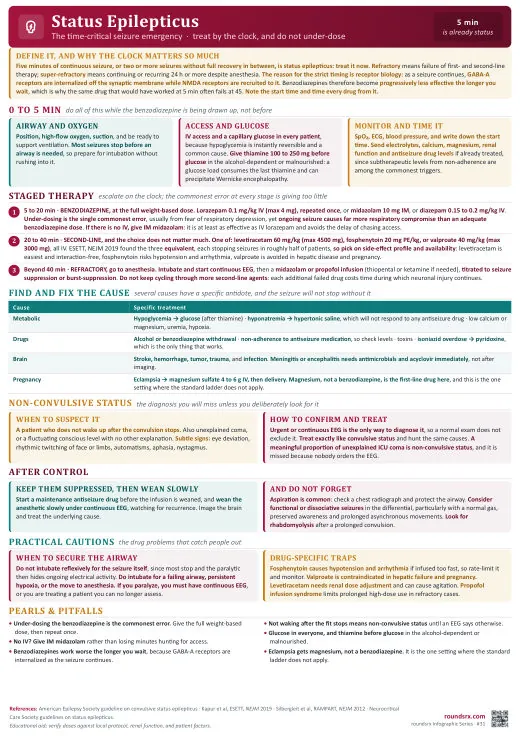
No IV access: Midazolam (Versed) 10 mg IM if ≥ 40 kg (5 mg IM if 13–40 kg). IM is as fast as IV, do not delay for IV access.
RAMPART 2012: IM midazolam = IV lorazepam in efficacy. Use IM if no IV. Why benzos first: they enhance GABAergic inhibition, the same neurotransmission that fails as SE persists (GABA-A receptors internalize, NMDA receptors externalize after ~30 min, which is why benzos lose potency in prolonged SE and you need NMDA antagonists like ketamine).
- Levetiracetam (Keppra) 60 mg/kg IV (max 4500 mg) over 10 min, preferred (fewest drug interactions, no respiratory depression, no cardiac monitoring needed)
- Valproate (Depakote) 40 mg/kg IV (max 3000 mg) over 10 min. Avoid in pregnancy (teratogenic, FDA black box), severe liver disease, mitochondrial disease (POLG mutations).
- Fosphenytoin (Cerebyx) 20 mg PE/kg IV (max 1500 mg PE), infusion rate ≤ 150 mg PE/min. Cardiac monitoring required (hypotension, arrhythmia during infusion). Use caution in severe liver disease (monitor free phenytoin levels), but not absolutely contraindicated in emergent SE. (Why fosphenytoin, not phenytoin: 3× faster infusion (150 vs 50 mg/min), no purple-glove tissue necrosis on extravasation, less propylene-glycol cardiotoxicity, IM option if IV is lost. Same active drug after 8–15 min plasma hydrolysis.)
- Lacosamide (Vimpat) 200–400 mg IV load over 5–15 min, then 100–200 mg IV/PO BID. ALTERNATIVE Not studied in ESETT, but increasingly used when LEV/VPA/PHT are contraindicated or fail. Especially useful in focal-onset SE, hepatic disease (no liver concern), or when minimal drug interactions are needed (no CYP effect, compatible with chemo, immunosuppressants, DOACs, OCPs). Watch for PR prolongation, get baseline ECG; avoid in 2°/3° AV block.
Options:
- Propofol (Diprivan) 1–2 mg/kg IV bolus then 1–15 mg/kg/hr drip. Watch for propofol infusion syndrome (PRIS) at > 5 mg/kg/hr for > 48h: lactic acidosis, rhabdo, hypertriglyceridemia, bradyarrhythmia, cardiac collapse. Cap dose if you can or rotate to midazolam.
- Midazolam (Versed) 0.2 mg/kg IV bolus then 0.05–2 mg/kg/hr drip. Tachyphylaxis develops over hours-days; expect dose escalation.
- Ketamine (Ketalar) 1–2 mg/kg IV bolus then 1.2–5 mg/kg/hr. NMDA antagonist (the receptor that's externalized in prolonged SE), neuroprotective, preserves hemodynamics, bronchodilator. Increasingly used early in refractory SE.
- Pentobarbital (super-refractory): 5 mg/kg bolus then 1–5 mg/kg/hr. Reserve for failure of midazolam/propofol/ketamine; high hemodynamic and infectious complication burden.
| Drug | Dose | Phase | Notes |
|---|---|---|---|
| Lorazepam (Ativan) 1ST LINE | 0.1 mg/kg IV, max 4 mg per dose; repeat × 1 (max 8 mg total) | Phase 1 (IV) | First-line if IV access. Respiratory depression risk -have bag-mask ready. Alternative IV benzo: diazepam (Valium) 0.15–0.2 mg/kg IV, max 10 mg/dose, repeat × 1. |
| Midazolam (Versed) IM | 10 mg IM (> 40 kg); 5 mg (13–40 kg) | Phase 1 (no IV) | RAMPART 2012: non-inferior to IV lorazepam. Faster than establishing IV access. Use the outer thigh. |
| Levetiracetam (Keppra) PREFERRED 2ND | 60 mg/kg IV, max 4500 mg over 10 min | Phase 2 | Preferred second agent. No hepatotoxicity, no CYP interactions, no cardiac monitoring needed. Can cause agitation. |
| Valproate (Depakote) 2ND LINE | 40 mg/kg IV, max 3000 mg over 10 min | Phase 2 | Avoid: liver disease, pregnancy, metabolic disorders (mitochondrial disease). Effective for absence/myoclonic SE. |
| Fosphenytoin (Cerebyx) 2ND LINE | 20 mg PE/kg IV, max 1500 mg PE | Phase 2 | Cardiac monitoring required (hypotension, arrhythmia during infusion). Give ≤ 150 mg PE/min. Use caution in severe liver disease (monitor free phenytoin levels), but not absolutely contraindicated in emergent SE. |
| Lacosamide (Vimpat) ALTERNATIVE | 200–400 mg IV load over 5–15 min, then 100–200 mg IV/PO BID | Phase 2 (off-label SE) | Not in ESETT but increasingly used. Minimal drug interactions, no CYP effect, no respiratory depression, 1:1 IV→PO. PR prolongation, baseline ECG; avoid in 2°/3° AV block. Especially useful in focal SE, hepatic disease, or when LEV/VPA/PHT contraindicated. |
| Propofol (Diprivan) | 2 mg/kg bolus, then 1–15 mg/kg/hr | Phase 3 (refractory) | Rapid, titratable. Propofol infusion syndrome risk at high doses/prolonged use. Requires intubation. |
| Ketamine (Ketalar) | 1.5 mg/kg IV bolus, then 1.2–5 mg/kg/hr | Phase 3 | NMDA antagonist. Emerging evidence for refractory SE. Bronchodilator. Preserves airway reflexes better. Less hemodynamic compromise. |
- Provoked seizure (alcohol withdrawal, hypoglycemia, hyponatremia, drug toxicity, fever in pediatrics): treat the cause, no chronic AED. Recurrence rate is low if the trigger is removed.
- First unprovoked seizure with high-risk features (abnormal EEG with epileptiform discharges, MRI lesion, status presentation, prior brain insult): ~60% recurrence over 2 years → start AED. Why: the recurrence risk approximates the definition of epilepsy itself, so treatment is justified after a single event.
- First unprovoked seizure, normal EEG/MRI, no prior brain insult: ~30% recurrence over 2 years → shared decision. Treating cuts recurrence by ~35%, but does not change long-term remission rate. Many neurologists hold back unless a second seizure occurs (the textbook definition of epilepsy).
- Two or more unprovoked seizures (= epilepsy): AED indicated regardless of EEG/MRI.
| Seizure Type | First-Line | Alternatives | Avoid (can worsen) |
|---|---|---|---|
| Focal-onset (most common in adults) | Levetiracetam (Keppra), lamotrigine (Lamictal) | Lacosamide (Vimpat), oxcarbazepine (Trileptal), carbamazepine (Tegretol), zonisamide (Zonegran), brivaracetam (Briviact) | - |
| Generalized tonic-clonic (idiopathic generalized epilepsy) | Levetiracetam, lamotrigine, valproate (Depakote) (if not pregnancy) | Topiramate (Topamax), zonisamide | CBZ, oxcarbazepine, phenytoin, gabapentin, can paradoxically worsen idiopathic generalized epilepsy |
| Absence (childhood, brief staring spells) | Ethosuximide (Zarontin), valproate | Lamotrigine | CBZ, phenytoin, oxcarbazepine, worsen absence seizures |
| Myoclonic (juvenile myoclonic epilepsy, JME) | Levetiracetam, valproate | Topiramate, zonisamide, clobazam (Onfi) | CBZ, phenytoin, lamotrigine, oxcarbazepine, gabapentin, can worsen myoclonus |
| Drug | Maintenance Dose | Titration / Levels | Key Side Effects & Why It Matters |
|---|---|---|---|
| Levetiracetam (Keppra) FIRST-LINE | 500–1500 mg BID PO/IV | Start 500 mg BID, titrate q1–2 wk. No level monitoring needed routinely. | Rare but life-threatening (STOP drug): SJS-like reactions, angioedema, severe thrombocytopenia. Suicidal ideation (AED class effect, FDA warning), screen for new mood changes. Behavioral SE (irritability, anxiety, depression, aggression, rarely psychosis) in ~10–15%, dose-limiting. Empirical pyridoxine (B6) 50–200 mg/day may help in ~30–50% (mechanism unclear, not repleting a true deficiency, supraphysiologic adjunct); switch to brivaracetam if no response in 2–4 weeks. Common but tolerable: somnolence/fatigue ~15%, headache, dizziness, asthenia. Renally cleared, dose-adjust for CrCl < 80. |
| Lamotrigine (Lamictal) FIRST-LINE | 100–200 mg BID | Start 25 mg/day × 2 wk → 50 mg/day × 2 wk → titrate to target over 4–6 wk. | Stevens-Johnson syndrome / TEN if titrated too fast (especially with VPA, which doubles lamotrigine levels, halve the starting dose). Hemophagocytic lymphohistiocytosis (HLH, FDA 2018 boxed warning), fever + cytopenias + ↑ ferritin + ↑ triglycerides → STOP. DRESS, aseptic meningitis (rare). Suicidal ideation (class). Rash distinction: benign maculopapular rash ~10% (days 5–14 of titration); STOP if fever, mucosal involvement, blisters, or desquamation. Common: insomnia, headache, dizziness, ataxia, diplopia, blurred vision. Estrogen-containing OCPs ↓ lamotrigine ~50% during active pill weeks (cycling toxicity risk). |
| Lacosamide (Vimpat) | 100–200 mg BID PO/IV | Start 50 mg BID × 1 wk → 100 mg BID. 1:1 IV-to-PO conversion. | PR prolongation (baseline ECG; avoid in 2°/3° AV block). Rare but serious: DRESS, atrial fibrillation/flutter, syncope. Suicidal ideation (class effect). Common: dizziness, diplopia, ataxia, headache, nausea (slow titration mitigates). Renal dose adjust for CrCl < 30 (cap 300 mg/day). Minimal drug interactions, attractive in polypharmacy. |
| Oxcarbazepine (Trileptal) | 300–1200 mg BID | Start 150 mg BID, titrate weekly. | SJS / DRESS / agranulocytosis (rare; HLA-B*1502 testing in Asian patients, cross-reactive with CBZ). Hyponatremia in ~25% (SIADH-like, dose-dependent, more in elderly), check Na 1–2 wk after start and after dose increases. Suicidal ideation (class). Mild CYP3A4 inducer at higher doses (still ↓ OCPs, less than CBZ). Common: dizziness, somnolence, diplopia, ataxia, nausea, rash ~5% (less than CBZ). |
| Carbamazepine (Tegretol) | 200–600 mg BID | Start 200 mg BID. Level: 4–12 mcg/mL. Auto-induces own metabolism over 4–6 wk, levels drop after starting. | SJS/TEN, DRESS (HLA-B*1502 testing in Asian patients, FDA mandate). Agranulocytosis, aplastic anemia (rare, monitor CBC q3–6 mo); leukopenia ~10% (usually benign). Hepatotoxicity. Avoid in idiopathic generalized epilepsy (worsens absence/myoclonic). Fetal anomalies (NTDs ~1%, craniofacial, IUGR, FDA category D). SIADH / hyponatremia. Strong CYP3A4/2C9 inducer, drops OCPs, warfarin, DOACs, immunosuppressants, lamotrigine. Common CNS (peak-level dependent): ataxia, nystagmus, diplopia, blurred vision. |
| Valproate (Depakote ER) | 500–1500 mg QD (ER) or 250–750 mg BID (IR) | Level: 50–100 mcg/mL. Check baseline LFTs, recheck if symptomatic. | Hepatotoxicity (especially < 2 yr, mitochondrial disease/POLG mutations, can be fatal). Pancreatitis (rare but fatal, check lipase if abdominal pain). Avoid in pregnancy (NTDs ~1–2%, lower offspring IQ ~9 points, FDA black box). Hyperammonemic encephalopathy can occur with normal LFTs and therapeutic VPA level (treat with L-carnitine). Carbapenem interaction drops VPA > 60% in 24h → breakthrough seizures (do not co-administer). PCOS / menstrual irregularity in adolescent girls. Common: thrombocytopenia, weight gain, alopecia, tremor. |
| Topiramate (Topamax) | 100–200 mg BID | Start 25 mg QHS, titrate by 25–50 mg/wk. | Acute angle-closure glaucoma (FDA warning, typically first month, painful red eye + acute visual change → STOP and ophthalmology emergent). Cleft palate in pregnancy (FDA category D). Suicidal ideation, depression, mood changes. Word-finding difficulty / cognitive slowing (dose-limiting). Kidney stones, metabolic acidosis (non-AG, carbonic anhydrase inhibition), oligohidrosis. Reduced OCP efficacy at > 200 mg/day. Common: paresthesias ~50%, weight loss (helpful or harmful). |
| Phenytoin (Dilantin) | 300 mg QD or 100 mg TID | Level: 10–20 mcg/mL total, 1–2 mcg/mL free. Saturable kinetics, small dose changes cause big level swings. | DRESS, SJS, lupus-like syndrome, lymphadenopathy (rare, life-threatening). Purple glove syndrome from IV extravasation (skin necrosis; use fosphenytoin instead). Fetal hydantoin syndrome (cleft lip/palate, IUGR, microcephaly, distal phalangeal hypoplasia). Cerebellar atrophy from chronic toxicity (sometimes irreversible). Megaloblastic anemia from folate inhibition. Strong CYP inducer (drops OCPs, warfarin, DOACs, immunosuppressants). Common: gingival hyperplasia, hirsutism, coarse facies, ataxia, nystagmus (peak-related), peripheral neuropathy, osteopenia (long-term, vit D catabolism). Free phenytoin levels in low albumin or uremia. Largely supplanted by Keppra/lamotrigine for chronic use. |
| Zonisamide (Zonegran) | 200–400 mg QD | Start 100 mg QD × 2 wk, titrate. | Sulfa allergy = absolute contraindication. Rare but serious: SJS/TEN, DRESS, blood dyscrasias. Suicidal ideation, depression. Oligohidrosis → heat stroke (especially in pediatrics, fatalities reported). Kidney stones, metabolic acidosis (carbonic anhydrase inhibition). Common: cognitive slowing, paresthesias, somnolence, dizziness, anorexia. Long half-life (~60h), once-daily dosing convenient. |
| Brivaracetam (Briviact) | 50–100 mg BID PO/IV | Start 50 mg BID, can titrate quickly. | Rare but serious: anaphylaxis, angioedema, bronchospasm. Suicidal ideation (class). Similar to Keppra (binds same SV2A target with higher affinity) but fewer behavioral side effects, useful when a patient cannot tolerate Keppra-induced irritability/depression. Common: somnolence ~15%, dizziness, fatigue, nausea. |
- Preferred: lamotrigine or levetiracetam (lowest teratogenic risk in registries; major malformation rates ~2–3%, similar to baseline population).
- Avoid: valproate (NTDs ~1–2%, lower offspring IQ ~9 points, FDA black box), topiramate (cleft lip/palate ~1–2%), phenobarbital, polytherapy (additive risk).
- Folic acid 4 mg daily at least 3 months before conception (vs 0.4–0.8 mg in general population). Why: AEDs deplete folate, and high-dose folate cuts NTD risk in this population.
- OCP interactions: enzyme inducers (CBZ, phenytoin, phenobarbital, oxcarbazepine, topiramate > 200 mg/day) ↓ ethinyl estradiol levels by 30–50% → contraception failure. Use IUD, depot medroxyprogesterone, or higher-dose OCP. Conversely, estrogen ↓ lamotrigine ~50% during active pill weeks.
- Levels during pregnancy: volume of distribution and clearance increase. Lamotrigine and levetiracetam levels often drop 30–50% by third trimester, anticipate dose increases. Recheck levels q month and post-partum (taper back).
- Driving restrictions: state-specific. Most US states require 3–6 months seizure-free before driving; some mandate physician reporting (CA, DE, NJ, NV, OR, PA), others rely on patient self-reporting. Document the conversation in the chart, this is a med-legal flashpoint.
- Adherence is the #1 cause of breakthrough seizures and SE. Pillbox, smartphone reminders, family involvement. Missed doses are NOT benign, AED levels can drop below threshold within 24–48h.
- Triggers to avoid: sleep deprivation (single biggest after non-adherence), alcohol (especially binge → withdrawal seizures), recreational drugs, photic stimulation (in photosensitive epilepsy, ~5% of patients).
- Bone health: long-term enzyme inducers (CBZ, phenytoin, phenobarbital, primidone) increase osteoporosis risk via vitamin D catabolism. DEXA every 2 years after 5+ years of therapy; vitamin D 1000–2000 IU + calcium 1000–1200 mg daily.
- SUDEP counseling: sudden unexpected death in epilepsy occurs ~1 per 1000 patient-years, higher with uncontrolled GTC seizures. Best prevention is seizure freedom. Discuss bedside monitors, partner education, prone-sleep avoidance in high-risk patients.
- Follow-up: neurology in 1–2 weeks, EEG (if not done), MRI brain (if not done). Recheck AED level at 1–2 weeks for narrow-TI drugs (phenytoin, valproate, CBZ).
- Pregnancy planning: if patient is or could become pregnant, discuss preferred AEDs and high-dose folic acid before conception, not after.
- OCPs and emergency contraception (~30–50% drop in ethinyl estradiol) → contraception failure. Use IUD or depot medroxyprogesterone.
- Warfarin and DOACs → subtherapeutic anticoagulation, thrombotic events.
- Immunosuppressants (cyclosporine, tacrolimus, sirolimus) → graft rejection risk.
- Direct-acting antivirals (HCV regimens) → treatment failure.
- Methadone, buprenorphine → withdrawal symptoms, cravings.
Patient: 28M with epilepsy on levetiracetam. Found seizing ~10 min ago. GTC activity ongoing on EMS arrival.
Key findings: No IV access initially. Glucose 110. Levetiracetam level undetectable.
Management:
- Midazolam (Versed) 10 mg IM if ≥ 40 kg (5 mg if 13–40 kg), no IV needed. RAMPART, 2012
- Establish IV; if seizure persists, levetiracetam (Keppra) 60 mg/kg IV (max 4500 mg) over 10 min
- Check BMP (Na, Ca, Mg), tox screen, AED levels, CT head
- Continuous EEG if not at baseline within 30–60 min (rule out NCSE)
Teaching point: Medication non-adherence is the most common cause of SE. IM midazolam is non-inferior to IV lorazepam and faster when IV access is unavailable.
Patient: 52F with brain metastases. Seizing 25 min despite lorazepam (Ativan) 4 mg IV × 2 and levetiracetam (Keppra) 4500 mg IV.
Key findings: Failed first-line and second-line agents = refractory SE. SpO₂ 88%.
Management:
- Intubate for airway protection
- Propofol (Diprivan) 1–2 mg/kg bolus then 1–15 mg/kg/hr, titrate to burst suppression on cEEG. Watch for propofol infusion syndrome (PRIS) at > 5 mg/kg/hr × 48h.
- Alternative: midazolam (Versed) 0.2 mg/kg bolus then 0.05–2 mg/kg/hr, or ketamine (Ketalar) 1–2 mg/kg bolus then 1.2–5 mg/kg/hr (NMDA antagonist, preserves hemodynamics, increasingly used early)
- Continuous EEG mandatory, clinical exam useless once sedated
- Target burst suppression 24–48h, then slowly wean
- MRI brain; neurosurgery and oncology consult
Teaching point: After second-line AED fails = refractory SE. Must have cEEG, cannot assess seizure activity clinically in sedated patients. ESETT, 2019 showed all three second-line AEDs equally effective (~50% cessation).
Patient: 74M post-cardiac arrest with ROSC. Comatose at 24h. Subtle eye twitching and lip movements. No overt convulsions.
Key findings: Continuous EEG: electrographic seizures without motor correlate. NCSE in up to 30% of comatose ICU patients.
Management:
- IV levetiracetam (Keppra) 60 mg/kg (less sedating, preferred post-arrest)
- If seizures persist, add lacosamide (Vimpat) 200 mg IV or valproate (Depakote) 40 mg/kg IV (max 3000 mg)
- Avoid overly aggressive sedation unless electrographic SE persists
- Continue targeted temperature management per post-arrest protocol
- Neurology consult for EEG interpretation
Teaching point: NCSE is extremely common and frequently missed. Any ICU patient with unexplained AMS or failure to wake up post-seizure needs an EEG. You cannot diagnose NCSE without EEG.
- Continuous EEG
- AED levels
- Neuro exam q2-4h
- Glucose
- CK if prolonged seizure
Text version
- AED levels (non-adherence)
- Glucose, electrolytes
- CT head → LP
- Toxicology screen
- Anti-NMDA antibodies
- NCSE -AMS after seizure + not waking → EEG now
- Glucose before anything else
- Thiamine before glucose in alcoholic