pocket brain.
- Type 1 DM (can be the presenting illness in ~25%)
- Type 2 DM under physiologic stress
- SGLT2-inhibitor users (euglycemic DKA -BG may be < 200!)
- Precipitants: infection (30–40% -most common), insulin omission/non-compliance (20–25%), new diagnosis T1DM, MI/ACS, pancreatitis, cocaine, alcohol
Infection (30–40%, #1 cause -UTI, pneumonia, skin) · Insulin (missed or inadequate doses) · Infarction (MI, stroke, mesenteric ischemia) · Intoxication (cocaine, alcohol, drugs) · Inflammation (pancreatitis, surgery, trauma)
- Polyuria, polydipsia, nausea, vomiting, abdominal pain
- Weakness, fatigue, altered mental status (in severe cases)
- Timeline: hours to days (faster than HHS)
- Kussmaul respirations (deep, rapid -compensating for acidosis)
- Fruity/acetone breath
- Signs of dehydration: dry mucosa, tachycardia, hypotension, poor skin turgor
- Altered mental status → think cerebral edema, severe osmolarity
- Potassium < 3.5 → do NOT start insulin until repleted
- Euglycemic DKA (SGLT2i) -don't miss it
- pH < 7.0 or bicarb < 10 → severe DKA, ICU threshold
- HHS -BG often > 600, severe hypertonicity, no/minimal ketones, pH usually > 7.3
- Alcoholic ketoacidosis -low or normal glucose, ketones present, history of binge drinking + poor PO
- Starvation ketosis -mild, pH > 7.3, bicarb usually > 18
- Other high AG acidosis -lactic acidosis, toxic ingestions (methanol, ethylene glycol, salicylates)
- BMP -BG, creatinine, K⁺, bicarbonate
- VBG or ABG -pH, pCO₂, calculated bicarb
- Anion gap = Na – (Cl + HCO₃) → normal 8–12; in DKA typically > 20
- Beta-hydroxybutyrate (serum) -preferred over urine ketones for monitoring
- Urine ketones (if serum BHB unavailable)
- Phosphate, magnesium -often depleted
- CBC, blood cultures -rule out infectious precipitant
- Lipase -DKA can elevate lipase without true pancreatitis
- HbA1c -assess chronic control
- Urinalysis + urine culture
- Pregnancy test (women of childbearing age)
- ECG -assess for hyperkalemia changes (peaked T waves, wide QRS) or ischemia as precipitant
- CXR -rule out pneumonia as precipitant
- CT head only if focal neuro deficits or concern for cerebral edema
| Parameter | Mild | Moderate | Severe |
|---|---|---|---|
| pH | 7.25–7.30 | 7.00–7.24 | < 7.00 |
| Bicarb (mEq/L) | 15–18 | 10–14 | < 10 |
| Anion Gap | > 10 | > 12 | > 12 |
| Mental Status | Alert | Alert/Drowsy | Stupor/Coma |
ABCs. IV access × 2. Foley if altered or unable to void. Cardiac monitor. POC glucose. Draw all STAT labs. Call senior if severe (pH < 7.1, AMS, K⁺ < 3.5).
1–1.5 L NS over 1 hour if hypotensive ADA DKA Guidelines, 2023. Then switch to 0.45% or 0.9% NS at 250–500 mL/hr depending on corrected Na⁺. Goal: replace estimated fluid deficit (typically 3–6 L) over 24 hours. LR vs NS: No proven outcome difference in DKA SKALE-DKA, 2024.
K⁺ < 3.5 → replace aggressively (20–40 mEq/hr IV), do NOT start insulin yet
K⁺ 3.5–5.0 → add 20–30 mEq K⁺ per liter of IVF, start insulin
K⁺ > 5.0 → start insulin, hold K⁺ replacement, recheck in 2 hours
Insulin Infusion
Regular insulin drip at 0.1 units/kg/hr (no bolus needed per ADA 2023). Target: BG drop of 50–75 mg/dL/hr.
Add D5 to IV fluids (D5-0.45%NS) -reduce insulin drip to 0.05 units/kg/hr. Continue until anion gap closes, NOT just until BG normalizes. This is the most common resident mistake.
- BG < 200 mg/dL
- Anion gap ≤ 12 mEq/L
- Serum bicarbonate ≥ 15 mEq/L
- pH > 7.3
- pH < 7.0 or bicarb < 10
- Altered mental status / decreased GCS
- Hemodynamic instability not responding to fluids
- K⁺ < 3.0 or > 6.0 with ECG changes
- Concurrent MI, stroke, or surgical emergency
Patient: 28F with T1DM, glucose 520, pH 7.15, bicarb 8, AG 28, K⁺ 5.8
| Time | Action |
|---|---|
| Hour 0 | Start insulin drip 0.14 units/kg/hr (no bolus). NS 1L/hr. Do NOT give K⁺ yet (K⁺ > 5.2). |
| Hour 2 | Glucose 380 (↓140). K⁺ 4.5 → start KCl 20 mEq/hr in IV fluids. Continue insulin drip. |
| Hour 4 | Glucose 280 (↓100/hr -on target). K⁺ 3.8 → increase KCl to 40 mEq/hr. AG closing (18). |
| Hour 6 | Glucose 240 → approaching 250 threshold. Switch fluids to D5 1/2NS + KCl to prevent hypoglycemia while continuing insulin to close the gap. |
| Hour 8 | Glucose 190, pH 7.32, bicarb 16, AG 12 (closing). K⁺ 4.0. |
| Hour 10 | AG closed (AG 10), pH 7.38, bicarb 20, patient eating. → Overlap SC insulin (give long-acting + meal dose), wait 2 hours, THEN stop drip. |
Key: Never stop insulin drip until: (1) AG closed, (2) pH > 7.3, (3) bicarb > 18, (4) patient eating, AND (5) SC insulin given ≥ 2h prior.
| Drug | Dose / Route | Indication | Key Points |
|---|---|---|---|
| Regular Insulin | 0.14 units/kg/hr IV drip (no bolus) OR 0.1 units/kg/hr (with 0.1 units/kg IV bolus) ADA 2023 |
Insulin infusion | Do not start if K⁺ < 3.5. Reduce to 0.05 when BG < 250 |
| Normal Saline (0.9%) | 1–1.5 L over 1 hr, then 250–500 mL/hr | Volume resuscitation. LR is an acceptable alternative (SMART, 2018 -balanced crystalloids reduce AKI/death vs NS in critically ill) | Switch to 0.45%NS after initial bolus based on corrected Na⁺ |
| KCl | 20–40 mEq/hr IV (max 40 mEq/hr via central line) 10–20 mEq/hr peripheral |
Hypokalemia in DKA | Continuous cardiac monitoring. Expect K⁺ to drop as insulin given |
| Sodium Bicarbonate | 100 mEq in 400 mL D5W over 2 hrs | pH < 6.9 only | Controversial. May worsen hypokalemia and CNS acidosis. Use sparingly |
| Phosphate | 20–30 mmol IV over 6 hrs | PO₄ < 1.0 mg/dL with symptoms | Routine replacement not recommended. Risk of hypocalcemia |
| Glargine (Lantus) | 0.25–0.3 units/kg SQ (or prior home dose) | Transition off drip | Give 2 hours before stopping drip. Do not skip |
- Glucose: every 1 hour (via POC meter)
- BMP (or at least K⁺, bicarb): every 2–4 hours
- Anion gap: calculated every 2–4 hours to confirm closure
- Beta-hydroxybutyrate: every 4 hours (preferred over urine ketones)
- Urine output: target ≥ 0.5 mL/kg/hr -place Foley if needed
- ECG: if K⁺ < 3.0 or > 6.0
- Stopping insulin too early -always wait for AG closure, not just BG normalization
- Forgetting the 2-hour overlap when transitioning to SQ insulin
- Overcorrecting fluids -iatrogenic fluid overload, especially in elderly or cardiac patients
- Missing the precipitant -always ask: why did they get DKA?
- Euglycemic DKA on SGLT2i -BG may be near-normal; check ketones regardless
- Cerebral edema -rare in adults but watch for headache, declining GCS during treatment
- Hypokalemia (from insulin shifting K⁺ intracellular)
- Hypoglycemia (from excess insulin or failure to add dextrose)
- Cerebral edema (especially children, rapid fluid shifts)
- ARDS (from aggressive fluid resuscitation)
- Thrombosis (hypercoagulable state)
- Patient tolerating PO fluids and meals
- On appropriate SQ insulin regimen
- BG < 200, AG closed, K⁺ repleted
- Precipitant identified and addressed
- Diabetes education arranged
- Endocrine follow-up within 1–2 weeks
- BG > 250 mg/dL
- pH < 7.3 / Bicarb < 18
- Anion gap > 10–12
- Ketones positive (serum BHB preferred)
- Euglycemic DKA: BG normal on SGLT2i
- Infection (30–40%)
- Missed insulin (20–25%)
- New diagnosis T1DM
- MI, pancreatitis, surgery
- SGLT2 inhibitor use
- BG every 1h (POC)
- BMP q2–4h
- Anion gap q2–4h
- BHB q4h
- UOP ≥ 0.5 mL/kg/hr
- Insulin with K⁺ < 3.5
- Stopping drip at BG normal
- Missing euglycemic DKA
- No SQ overlap
- Missing precipitant
- pH < 7.0 / bicarb < 10
- Altered mental status
- Hemodynamic instability
- K⁺ < 3.0 with ECG changes
- ADA 2023: No IV insulin bolus -drip only at 0.1 u/kg/hr
- Resolution: Gap closure, not glucose normalisation
- Bicarb: Only if pH < 6.9 (not routine)
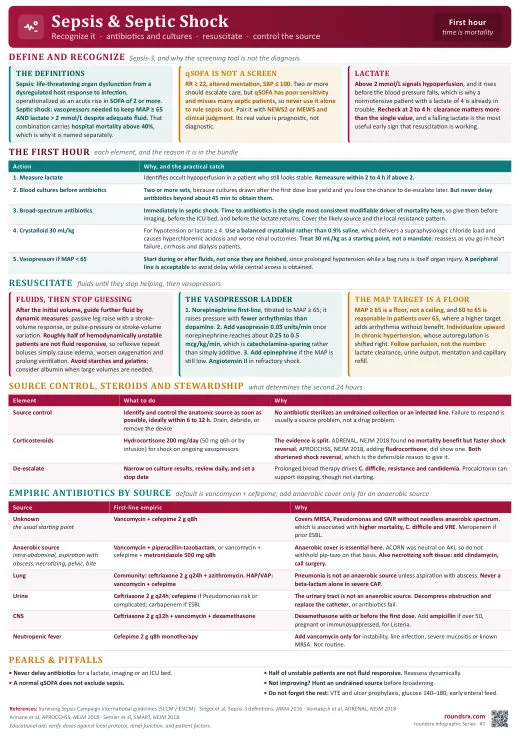
Septic Shock: Sepsis + vasopressor requirement to maintain MAP ≥ 65 mmHg + serum lactate > 2 mmol/L despite adequate fluid resuscitation. In-hospital mortality > 40%.
⚠️ SSC 2026: qSOFA has poor sensitivity -misses too many septic patients. NEWS/MEWS now recommended as primary screening tools.
Replaced by Sepsis-3 (2016) due to poor specificity -SIRS is present in most hospitalized patients Sepsis-3, 2016 regardless of infection. Still used as a triage trigger in some institutions given its high sensitivity.
| Domain | 2021 SSC | 2026 SSC Update |
|---|---|---|
| Screening | qSOFA suggested outside ICU | NEWS/NEWS2/MEWS/SIRS now recommended OVER qSOFA. qSOFA has poor sensitivity -should not be sole screening tool. |
| Fluids | 30 mL/kg crystalloid within 3h. No preference NS vs balanced. | 30 mL/kg still suggested. Balanced crystalloids now suggested over 0.9% saline (except TBI). New: fluid removal after resuscitation now addressed. |
| Vasopressors | Start via central line | Peripheral vasopressor start now OK -don't delay for central access. NE → vasopressin → epi unchanged. New: BP targets for older adults. |
| Steroids | Suggested if ongoing vasopressor need | Strengthened: hydrocortisone 200 mg/day if vasopressors ≥ 4 hours. Reverses 2016 recommendation against routine steroids. |
| Antibiotics | Within 1h of recognition | Refined: 1 hour for septic shock, 3 hours for sepsis without shock. New: antibiotic optimization & prehospital antibiotics may reduce mortality (OR 0.58). |
| New topics | - | "Code sepsis" huddle protocols. Post-sepsis discharge rehab. Institutional performance improvement programs. 46 entirely new statements (129 total). |
- Lung -pneumonia (30–40%, most common)
- Urinary tract -pyelonephritis, urosepsis (20–30%)
- Abdomen -peritonitis, cholangitis, bowel perforation, diverticulitis
- Line/device -CLABSI, endocarditis, infected hardware
- Skin/soft tissue -necrotizing fasciitis, infected wounds
- CNS -meningitis, encephalitis, brain abscess (least common)
- Unknown source -20–30% of sepsis cases (especially in immunocompromised)
- Fever > 38.3°C OR hypothermia < 36°C (hypothermia = worse prognosis)
- Tachycardia, tachypnea
- Hypotension, warm/flushed skin (early distributive), later cold/mottled
- Altered mental status (confusion, agitation, lethargy)
- Decreased urine output (< 0.5 mL/kg/hr)
- Elevated lactate (tissue hypoperfusion marker)
- Measure serum lactate (repeat if initial > 2 mmol/L to confirm clearance)
- Blood cultures × 2 sets from 2 separate sites -before antibiotics, but do not delay antibiotics > 45 min waiting for cultures
- Broad-spectrum antibiotics administered IV
- 30 mL/kg crystalloid bolus if MAP < 65 mmHg OR lactate ≥ 4 mmol/L
- Vasopressors if MAP < 65 despite fluid resuscitation → target MAP ≥ 65
- Lactate -venous or arterial; most critical early test; > 4 = cryptic shock regardless of BP
- Blood cultures × 2 peripheral sets (before antibiotics)
- BMP -creatinine (AKI), glucose, bicarb (metabolic acidosis)
- CBC with differential (leukocytosis, left shift, or leukopenia)
- Procalcitonin -helps guide antibiotic duration (de-escalation at < 0.25)
- UA + urine culture (UTI/urosepsis -2nd most common source)
- Sputum Gram stain + culture, respiratory panel (pneumonia -most common source)
- LFTs, lipase, RUQ ultrasound (abdominal source)
- Coagulation panel (PT/INR, PTT, fibrinogen) -if DIC suspected
- LP (cell count, protein, glucose, Gram stain, culture) if CNS source
- C. diff if recent antibiotics + diarrhea
- Bedside echo -cardiac function, IVC collapsibility (volume status), wall motion, pericardial effusion (fastest, most actionable)
- CXR -portable if unstable; pneumonia, pulmonary edema, effusion
- RUQ ultrasound -gallbladder, biliary dilation (cholangitis)
- CT abdomen/pelvis with contrast -abdominal source, abscess (do not delay abx for CT)
- CT head -if AMS, meningismus, focal neuro deficit (LP after if no mass lesion)
| Lactate Level | Category | Action |
|---|---|---|
| < 2 mmol/L | Normal | Standard care; monitor if clinical concern |
| 2–4 mmol/L | Elevated -sepsis | Aggressive resuscitation; repeat lactate in 2h |
| ≥ 4 mmol/L | Cryptic shock | ICU, vasopressors even if BP normal, repeat q2h |
If shock criteria met (MAP < 65, lactate ≥ 4, AMS): activate ICU consult now -not after labs, not after imaging. Bedside echo to exclude obstructive shock (PE, tamponade) and assess LV function.
| Drug | Dose | Bugs Covered | ⚠️ Side Effects | When to Use |
|---|---|---|---|---|
| Piperacillin-tazobactam (Zosyn) | 3.375g IV q6h (or 4.5g q8h extended infusion over 4h) | Gram-positives: Strep, MSSA (not MRSA) Gram-negatives: E. coli, Klebsiella, Proteus, Pseudomonas, Enterobacter Anaerobes: Bacteroides, Fusobacterium | ⚠️ Diarrhea, rash, ↑ AKI when paired with vancomycin ACORN, 2024, thrombocytopenia (prolonged use), hypokalemia, C. diff | Default empiric -broadest beta-lactam. Covers gram-negatives + anaerobes. Use when source unknown or intra-abdominal/respiratory suspected. |
| Cefepime (Maxipime) | 2g IV q8h | Gram-positives: Strep, MSSA (not MRSA) Gram-negatives: E. coli, Klebsiella, Pseudomonas, Enterobacter, Serratia, Citrobacter No anaerobes | ⚠️ Neurotoxicity (confusion, myoclonus, seizures -especially in renal failure), rash, C. diff | Alternative to pip-tazo. Better with vanc (↓ AKI vs pip-tazo+vanc). Use when anaerobic coverage not needed. Add metronidazole if anaerobes needed. |
| Meropenem (Merrem) | 1g IV q8h | Gram-positives: Strep, MSSA (not MRSA) Gram-negatives: E. coli, Klebsiella, Pseudomonas, Enterobacter, ESBL-producers, Acinetobacter Anaerobes: Bacteroides | ⚠️ Seizures (less than imipenem), diarrhea, C. diff, rash. ↓ valproic acid levels (contraindicated together) | Use if: prior ESBL/MDR organism, recent hospitalization + IV abx within 90 days, high local resistance, failed pip-tazo. Broadest gram-negative coverage. |
| Vancomycin (Vancocin) | 15–20 mg/kg IV q8–12h (AUC/MIC target 400–600) | Gram-positives only: MRSA, MSSA, Strep, Enterococcus (not VRE) No gram-negatives. No anaerobes. | ⚠️ Nephrotoxicity (worse with pip-tazo), Red Man Syndrome (infuse over ≥ 1h), ototoxicity, DRESS (rare) | Add for MRSA coverage -any sepsis with: prior MRSA, IVDU, skin/soft tissue source, healthcare exposure, HD catheter. Pair with pip-tazo, cefepime, or meropenem. |
| Linezolid (Zyvox) | 600 mg IV/PO q12h | Gram-positives only: MRSA, VRE, Strep, Enterococcus No gram-negatives. No anaerobes. | ⚠️ Thrombocytopenia (> 14d), serotonin syndrome (weak MAOi -avoid SSRIs/SNRIs/tramadol), lactic acidosis, peripheral neuropathy & optic neuritis (> 28d -may be irreversible), myelosuppression | Alternative to vanc if: CKD/AKI (no renal adjustment), VRE suspected, MRSA pneumonia (superior lung penetration), no IV access (100% PO bioavailability). |
| Metronidazole (Flagyl) | 500 mg IV q8h | Anaerobes: Bacteroides fragilis, Clostridium, Fusobacterium, Prevotella Protozoa: C. diff (PO), Giardia, Entamoeba | ⚠️ Metallic taste, nausea, peripheral neuropathy (prolonged use), disulfiram reaction with alcohol, seizures (rare) | Add to cefepime or meropenem when anaerobic coverage needed (intra-abdominal, abscess, aspiration with empyema). Not needed with pip-tazo (already covers anaerobes). |
After initial bolus: reassess after each 500 mL. Check JVP, lung auscultation, passive leg raise response. Do not reflexively give more fluids if no hemodynamic response -start vasopressors. Fluid overload in sepsis = worse outcomes. CLOVERS, 2023 showed no benefit to liberal fluid strategy, supporting a conservative approach. Use crystalloids over colloids -CRISTAL, 2013 found no 28-day mortality difference between colloids and crystalloids. Notably, FEAST, 2011 demonstrated that fluid boluses increased mortality in febrile children (resource-limited setting), underscoring the importance of judicious fluid use.
Add vasopressin 0.03 units/min (fixed dose, no titration) when NE reaches 0.25–0.5 mcg/kg/min (spares NE, possibly reduces mortality) VASST 2008.
Add epinephrine for refractory shock. Use dobutamine (2–20 mcg/kg/min) only if MAP adequate but persistent signs of low CO (cold extremities, rising lactate, low ScvO₂).
Hydrocortisone 200 mg/day IV (50 mg q6h or continuous) if vasopressors required ≥ 4 hours (SSC 2026 threshold -don't wait all day). Shortens shock duration. ADRENAL 2018; APROCCHSS 2018 CORTICUS, 2008.
Drain abscess (IR-guided or surgical). Remove infected IV lines (replace in new site). Decompress biliary obstruction (ERCP or percutaneous). Surgical consult for perforated viscus, necrotizing fasciitis, infected prosthetic. Time to source control should be < 6–12 hours for drainage procedures.
Glucose: Target 140–180 mg/dL with insulin infusion NICE-SUGAR, 2009. Avoid hypoglycemia.
DVT prophylaxis: Enoxaparin (or UFH if CrCl < 30) + SCDs.
Stress ulcer prophylaxis: IV PPI or H2-blocker if high-risk (mechanically ventilated > 48h, coagulopathy, history of GI bleed, TBI, burns > 35% BSA). Not all ICU patients need it -SUP-ICU, 2018: no mortality benefit from routine prophylaxis; weigh risk of C. difficile and nosocomial pneumonia.
Nutrition: Early enteral nutrition within 24–48h. Enteral is preferred over parenteral -NUTRIREA-2, 2018 and CALORIES, 2014 showed no mortality difference between parenteral and enteral, but enteral maintains gut integrity.
Antibiotic de-escalation: Reassess at 48–72h based on cultures + clinical trajectory. Target 5–7 days total if good source control and clinical improvement. Use procalcitonin to guide stopping PRORATA 2010.
| Parameter | Target | Notes |
|---|---|---|
| MAP | ≥ 65 mmHg | Higher (≥ 75) in chronic hypertension or AKI |
| Lactate | Clearance ≥ 10% per 2h | Target < 2 mmol/L; failure to clear = reassess |
| UOP | ≥ 0.5 mL/kg/hr | Oliguria = inadequate perfusion or AKI |
| ScvO₂ | ≥ 70% | Low = high O₂ extraction → low CO or anemia |
| Glucose | 140–180 mg/dL | Avoid hypoglycemia -check q1–2h |
| Hgb | ≥ 7–9 g/dL | Transfuse if Hgb < 7 (or < 8 if cardiac ischemia) TRICC, 1999 |
| Empiric Regimen | Culture Result | De-Escalate To | Duration |
|---|---|---|---|
| Vancomycin (Vancocin) + Piperacillin-Tazobactam (Zosyn) | Blood cx: MSSA | Stop vanc + Zosyn. Switch to Cefazolin (Ancef) 2g IV q8h | Bacteremia: 2–4 weeks (with ID consult). Source dependent. |
| Vancomycin (Vancocin) + Piperacillin-Tazobactam (Zosyn) | Blood cx: MRSA | Stop Zosyn. Continue Vancomycin (Vancocin) alone (AUC-guided dosing) | MRSA bacteremia: minimum 2 weeks, longer if endocarditis/osteo |
| Vancomycin (Vancocin) + Piperacillin-Tazobactam (Zosyn) | Urine cx: E. coli (pansensitive) | Stop both. Switch to Ceftriaxone (Rocephin) 1g IV daily → PO Ciprofloxacin (Cipro) 500mg BID or TMP-SMX (Bactrim) DS BID | Uncomplicated UTI: 5–7 days. Pyelo: 7–10 days. |
| Vancomycin (Vancocin) + Cefepime (Maxipime) | Sputum cx: Strep pneumoniae | Stop vanc + cefepime. Switch to Ceftriaxone (Rocephin) 1g IV daily → PO Amoxicillin (Amoxil) 1g TID | CAP: 5 days (if afebrile ≥ 48h and clinically improving) |
| Meropenem (Merrem) + Vancomycin (Vancocin) | Blood cx: ESBL* E. coli *ESBL = Extended-Spectrum Beta-Lactamase producing organisms | Stop vanc. Continue Meropenem (Merrem) (ESBL requires carbapenem) → PO TMP-SMX (Bactrim) if susceptible (for UTI source) | Source dependent. Carbapenem is appropriate -this is NOT over-treatment. |
| Vancomycin (Vancocin) + Piperacillin-Tazobactam (Zosyn) | All cultures negative at 48h, patient improving, low procalcitonin | Consider stopping antibiotics entirely. Non-infectious source of SIRS/sepsis (pancreatitis, PE, drug reaction, adrenal crisis)? | If truly no infection: stop. Unnecessary antibiotics = harm. |
| Clinical Scenario | Empiric Regimen | Notes |
|---|---|---|
| Unknown source, community-acquired | Pip-tazo (Zosyn) 3.375g q6h IV (E. coli, Klebsiella, Pseudomonas, Proteus, Bacteroides, MSSA) + Vancomycin (Vancocin) 25–30 mg/kg loading (MRSA, Strep, Enterococcus) | Pip-tazo = gram-negatives + anaerobes + Pseudomonas. Vanc = MRSA. Together = broadest empiric coverage. |
| Recent abx (< 90 days) or recent hospitalization (increased risk of resistant organisms but NOT automatic carbapenem) | Pip-tazo (Zosyn) 3.375g q6h IV + Vancomycin (Vancocin) (same regimen -Zosyn + vanc is still appropriate) | Still start with Zosyn + vanc. This already covers Pseudomonas + MRSA + anaerobes. Consider adding: (1) antifungal (Micafungin (Mycamine) 100mg IV) if prolonged abx + TPN/central line, (2) double Pseudomonas coverage (add Amikacin (Amikin) or Ciprofloxacin (Cipro)) only if severely ill + high local Pseudomonas resistance. Do NOT escalate to meropenem based on these risk factors alone. |
| Known or suspected MDR* organism *MDR = Multi-Drug Resistant (prior ESBL/CRE* culture, known MDR colonization, institutional antibiogram showing >10–20% ESBL prevalence) *CRE = Carbapenem-Resistant Enterobacterales | Meropenem (Merrem) 1g q8h IV (ESBL E. coli, ESBL Klebsiella, Pseudomonas, Acinetobacter, Enterobacter, Bacteroides) + Vancomycin (Vancocin) (MRSA) | ”HCAP” is no longer a category (removed 2019 ATS/IDSA). Meropenem is NOT first-line for most patients. Reserve for known ESBL/CRE colonization or high institutional ESBL rates on antibiogram. Prior abx use or recent hospitalization alone does NOT warrant a carbapenem -Zosyn + vanc covers the vast majority of scenarios. Add micafungin if Candida risk (TPN, prior abx, abdominal surgery). Always check your local antibiogram. |
| CAP (community-acquired pneumonia) | Ceftriaxone (Rocephin) 1–2g IV daily (S. pneumoniae, H. influenzae, Moraxella, E. coli, Klebsiella) + Azithromycin (Zithromax) 500 mg IV/PO (Mycoplasma, Chlamydophila, Legionella) | Ceftriaxone = typical organisms. Azithro = atypicals. Add vanc/linezolid if MRSA risk. Or levofloxacin monotherapy if Legionella risk. |
| Urosepsis (community-acquired) | Ceftriaxone (Rocephin) 1g IV daily (E. coli, Klebsiella, Proteus, Enterobacter) | E. coli is #1 cause of UTI/urosepsis. Adjust based on urine Gram stain + culture. Cipro if quinolone-susceptible. Add ampicillin if Enterococcus on Gram stain. |
| Biliary / abdominal source | Pip-tazo (Zosyn) 3.375g q6h IV (E. coli, Klebsiella, Enterococcus, Bacteroides, Clostridium) OR Ceftriaxone (Rocephin) (gram-negatives) + Metronidazole (Flagyl) 500 mg q8h IV (Bacteroides, Clostridium, Fusobacterium) | Abdominal infections = gram-negatives + anaerobes. Needs urgent source control (ERCP, IR drainage, surgery). |
| Neutropenic fever (ANC < 500) | Cefepime (Maxipime) 2g q8h IV (E. coli, Klebsiella, Pseudomonas, Enterobacter, Serratia, MSSA) ± Vancomycin (Vancocin) (MRSA) | Cefepime = anti-pseudomonal + broad gram-negative. Add vanc if line infection, skin source, or hemodynamically unstable. Add micafungin at day 4–5 if fever persists. |
| Suspected meningitis | Ceftriaxone (Rocephin) 2g q12h IV (S. pneumoniae, N. meningitidis, H. influenzae, E. coli) + Vancomycin (Vancocin) (penicillin-resistant S. pneumoniae) + Dexamethasone (Decadron) 0.15 mg/kg q6h × 4d | Dex before or with first abx dose. Add ampicillin (Listeria monocytogenes) if > 50yo, immunocompromised, or pregnant. |
| Necrotizing fasciitis | Pip-tazo (Zosyn) (gram-negatives, anaerobes) + Vancomycin (Vancocin) (MRSA) + Clindamycin (Cleocin) 900 mg q8h (Group A Strep toxins, S. aureus toxins -50S ribosome inhibitor suppresses toxin production) | Clindamycin = toxin suppression (not for coverage). Surgical emergency -OR for debridement ASAP. Delay = death. |
| Suspected fungal sepsis | Micafungin (Mycamine) 100 mg IV daily (Candida species including C. glabrata, C. krusei) OR Fluconazole (Diflucan) 800 mg load → 400 mg IV daily (Candida albicans, C. tropicalis, C. parapsilosis) | Add if: TPN, prior broad-spectrum abx, abdominal surgery, Candida colonization, persistent fever despite antibiotics. Micafungin preferred empirically (broader Candida coverage). Fluconazole for step-down if C. albicans confirmed susceptible. |
| Agent | Dose | Receptor | Role | Avoid |
|---|---|---|---|---|
| Norepinephrine (Levophed) 1ST LINE | 0.01–3 mcg/kg/min | α₁>>β₁ | First-line. ↑ SVR + mild inotropy | - |
| Vasopressin (Pitressin) ADD-ON | 0.03 units/min (fixed, no titration) | V1/V2 | Add vasopressin when NE dose reaches 0.25–0.5 mcg/kg/min (per SSC 2026). Adding vasopressin early allows NE dose reduction (NE-sparing effect). May reduce AKI (V2-mediated water reabsorption). Non-catecholamine → works even in catecholamine-resistant shock (acidosis, downregulated adrenergic receptors). VASST 2008 SSC 2026 | Cardiac ischemia (coronary vasospasm), mesenteric ischemia at high doses, hyponatremia (V2 effect -monitor Na⁺) |
| Epinephrine (Adrenalin) 2ND LINE | 0.01–0.5 mcg/kg/min | α₁, β₁, β₂ | Refractory shock. Adds inotropy. | Falsely elevates lactate (β₂ effect) |
| Phenylephrine (Neo-Synephrine) | 0.5–6 mcg/kg/min | α₁ pure | If tachyarrhythmia limits NE | Low CO states (pure vasoconstriction) |
| Dobutamine (Dobutrex) | 2–20 mcg/kg/min | β₁>β₂ | Low CO despite adequate MAP | Without vasopressor if MAP < 65 |
| Dopamine (Intropin) AVOID | - | D1, β₁, α₁ | Avoid in sepsis -more arrhythmias, higher mortality SOAP II, 2010 | Avoid |
| Drug | Indication | Dose | Evidence |
|---|---|---|---|
| Hydrocortisone (Solu-Cortef) | Refractory shock on NE > 0.25 mcg/kg/min | 200 mg/day IV (50 mg q6h or continuous) | ADRENAL 2018 -faster shock reversal; no mortality benefit |
| Drotrecogin alfa | - | Withdrawn from market | PROWESS-SHOCK 2012 -no benefit |
| Parameter | Frequency | Target / Action |
|---|---|---|
| MAP (arterial line) | Continuous | ≥ 65 mmHg; higher if chronic HTN |
| Urine output | Hourly | ≥ 0.5 mL/kg/hr; oliguria = reassess volume + pressors |
| Lactate | q2h until < 2 × 2 | Target clearance ≥ 10%/2h |
| Blood glucose | q1–2h (insulin infusion) | 140–180 mg/dL; avoid < 70 |
| BMP | q6–12h initially | Monitor AKI (creatinine), electrolytes, bicarb |
| CBC | Daily | Thrombocytopenia = DIC; trend WBC |
| Cultures | At 48–72h | De-escalate antibiotics based on growth + sensitivities |
| Procalcitonin | q48–72h | If falling and < 0.25 → consider stopping antibiotics PRORATA 2010 |
| Coags (INR, fibrinogen, D-dimer) | Daily if coagulopathy | Fibrinogen < 1.5 + falling = DIC |
| Temperature | Continuous | Hypothermia = worse prognosis than fever |
Certain infections require longer: endocarditis (4–6 weeks), osteomyelitis (6 weeks -oral step-down is acceptable OVIVA, 2019), S. aureus bacteraemia (minimum 14 days from first negative culture).
- Cultures finalized? → Narrow antibiotics today if possible. What day of antibiotics are we on?
- Lactate cleared? → < 2 on two consecutive measurements = adequate perfusion
- Vasopressor trajectory → Weaning or escalating? Note exact dose and trend
- UOP adequate? → Target ≥ 0.5 mL/kg/hr. If oliguric -reassess volume status + pressor dose
- Source controlled? → Drain placed? Infected line removed? Surgery consulted?
- Procalcitonin trend → Falling PCT supports antibiotic cessation PRORATA 2010
- Glucose 140–180 mg/dL? → Avoid hypoglycemia; tight control not beneficial NICE-SUGAR 2009
- DVT + stress ulcer prophylaxis ordered? (SUP only if high-risk: ventilated > 48h, coagulopathy, GI bleed hx SUP-ICU, 2018)
- Nutrition started? → Enteral preferred within 24–48h if hemodynamically stable
- Sedation/delirium assessment → CAM-ICU, RASS target, daily SAT/SBT
- Sepsis: SOFA ≥ 2 + suspected infection
- Septic shock: Vasopressors + lactate > 2 despite IVF
- qSOFA: AMS + RR ≥ 22 + SBP ≤ 100 (≥ 2 = high risk, screen only)
- SIRS: ≥ 2 of temp >38/<36, HR >90, RR >20, WBC >12k/<4k (historical, high sensitivity triage)
- Lactate ≥ 4 = cryptic shock even if BP normal
- 🫁 Lung -pneumonia (most common)
- 🚿 UTI / urosepsis
- 🫀 Abdomen -cholangitis, peritonitis
- 💉 Line infection / endocarditis
- 🧠 Meningitis (neck stiffness + fever)
- Delaying antibiotics for cultures
- Using dopamine SOAP II, 2010
- NS over balanced crystalloids
- No source control
- Broad abx never narrowed
- Missing hypothermia = bad sign
| Profile | Perfusion | Congestion | Management |
|---|---|---|---|
| Warm & Wet (~70%) | Adequate (warm extremities, normal mentation) | Yes (JVD, edema, crackles) | IV diuresis. This is the most common profile. Furosemide, monitor UOP, daily weights. |
| Cold & Wet (~20%) | Impaired (cold, clammy, AMS, low UOP) | Yes | ICU. Inotropes (dobutamine/milrinone) + diuresis. May need invasive monitoring. Consider mechanical circulatory support (MCS) early. |
| Cold & Dry (~5%) | Impaired | No | Cardiogenic shock. Pressors + inotropes + MCS. See Cardiogenic Shock topic. |
| Warm & Dry (~5%) | Adequate | No | Compensated. Optimize oral GDMT. Do NOT over-diurese. Symptom management. |
- Dyspnea, orthopnea, paroxysmal nocturnal dyspnea
- Rapid weight gain (> 2 kg in 48 hrs)
- Leg edema, fatigue, decreased exercise tolerance
- JVD, S3 gallop, pulmonary crackles, pitting edema
- Elevated JVP = elevated filling pressures (wet)
- Cool extremities, narrow pulse pressure = low output (cold)
| Test | Why |
|---|---|
| BNP / NT-proBNP | Most sensitive. Very high NPV for ruling out HF. BNP > 400 or NT-proBNP > 900 supports ADHF. |
| CXR | Pulmonary vascular congestion, Kerley B lines, cardiomegaly, pleural effusions. Fastest imaging. |
| Echo | Definitive. EF (HFrEF vs HFpEF), wall motion abnormalities, valvular disease, pericardial effusion. |
| BMP | Cr (tracks with diuresis), Na⁺ (hyponatremia = poor prognosis), K⁺, bicarb. |
| Troponin | Rule out ACS as trigger. Demand ischemia common in ADHF. |
| ECG | STEMI trigger? Afib with RVR? New LBBB? |
| CBC, LFTs, TSH | Anemia worsens HF. Congestive hepatopathy. Thyroid disease is reversible cause. |
- Medication non-adherence -most common, especially diuretics and sodium restriction
- Dietary indiscretion -sodium/fluid overload
- ACS / ischemia -always rule out with troponin + ECG
- Afib with RVR -loss of atrial kick + tachycardia-mediated worsening
- Uncontrolled HTN -flash pulmonary edema
- Infection / sepsis -increased metabolic demand on failing heart
- Worsening renal function -impaired diuresis
- Anemia, thyroid disease, PE, medication changes (NSAIDs, CCBs, TZDs)
Patient: 58M with newly diagnosed HFrEF (EF 25%), BP 118/72, HR 78, K⁺ 4.2, Cr 1.1. Currently on no cardiac medications.
🔄 Old approach: Start ACEi → wait weeks → add BB → wait weeks → add MRA → months later maybe ARNI. Patients spent months without full therapy.
New approach (2022 AHA/ACC, STRONG-HF, 2022): Start all 4 pillars within 1–2 weeks at low doses. Don't wait for one to reach target before starting the next.
| Timepoint | Action |
|---|---|
| Day 1 (Admission) | SGLT2i: Dapagliflozin (Farxiga) 10mg daily -start immediately, no titration needed, minimal BP effect. Beta-blocker: Carvedilol (Coreg) 3.125mg BID -start low, do NOT uptitrate during acute decompensation. |
| Day 2–3 | ARNI: Sacubitril-valsartan (Entresto) 24/26mg BID -if SBP > 100. Go straight to ARNI (skip ACEi if new diagnosis). If already on ACEi, must wash out 36h before starting ARNI. Check BMP: K⁺ and Cr before adding MRA. |
| Day 3–5 | MRA: Spironolactone (Aldactone) 25mg daily -if K⁺ < 5.0 and eGFR > 30. |
| All 4 pillars on board within 1 week. Now uptitrate in parallel: | |
| Week 2 | Entresto → 49/51mg BID, carvedilol → 6.25mg BID (if BP and HR tolerate). |
| Week 4 | Entresto → 97/103mg BID (target dose), carvedilol → 12.5mg BID. |
| Week 8 | Carvedilol → 25mg BID (target dose). |
Key principles:
- Each drug reduces mortality independently -every day without full GDMT is a missed opportunity.
- Hypotension (SBP < 90) is the main limiting factor -prioritize ARNI > BB > MRA if BP-limited.
- "Creatinine bumps" of 0.3–0.5 are acceptable when starting RAAS inhibitors -don't reflexively stop.
- SGLT2i + MRA together are safe -monitor K⁺ but the risk of hyperkalemia is lower than feared.
Patient: 64F with known HFrEF (EF 20%), presents with orthopnea, PND, bilateral crackles, JVP 14cm, 2+ pitting edema. BP 142/88, SpO₂ 90% on RA.
Profile: Wet & Warm (congested, adequate perfusion) -most common presentation.
Immediate:
- Sit upright, O₂ to maintain SpO₂ > 92%. BiPAP if respiratory distress.
- Furosemide (Lasix) 80mg IV push (give 2.5× their home oral dose as IV dose -she takes 40mg PO daily → give 80–100mg IV). Can redose in 2h if < 100mL UOP.
- If inadequate response: double the dose → 160mg IV. If still inadequate → add metolazone (Zaroxolyn) 5mg PO 30 min before next lasix dose (sequential nephron blockade).
Monitoring: Strict I&Os, daily weights (goal: net negative 1–2L/day), BMP BID (watch K⁺ and Cr -"creatinine bumps" of 0.3–0.5 are acceptable if patient is decongesting).
Home GDMT: Continue metoprolol succinate (Toprol XL) at current dose (do NOT uptitrate during decompensation, but do NOT stop unless cardiogenic shock). Hold ACEi/ARNI if hypotensive or Cr rising sharply.
Discharge when: Stable on oral diuretics × 24h, ambulatory SpO₂ > 92%, weight at or near dry weight, scheduled HF clinic follow-up within 7 days.
| Drug (Brand) | Dose | Role | Key Notes |
|---|---|---|---|
| Furosemide (Lasix) 1ST LINE | 40–200 mg IV bolus or 10–40 mg/hr infusion | First-line diuretic. Decongestion. | 1–2.5× home oral dose IV. Monitor UOP, K⁺, Mg, Cr daily. Continuous infusion may cause less ototoxicity than large boluses. |
| Bumetanide (Bumex) ALTERNATIVE | 1–4 mg IV | Alternative loop diuretic. 40:1 ratio (furosemide 40 mg ≈ bumetanide 1 mg). | More predictable oral bioavailability than furosemide. Some prefer in outpatient setting. |
| Metolazone (Zaroxolyn) ADD-ON | 2.5–5 mg PO 30 min before loop diuretic | Sequential nephron blockade. Overcomes diuretic resistance. | Thiazide-like. Works even at low GFR (unlike HCTZ). Massive electrolyte shifts -monitor K⁺, Mg, Na aggressively. |
| Nitroglycerin (Tridil) HYPERTENSIVE ADHF | 5–200 mcg/min IV drip | Preload reduction. Rapid relief of dyspnea in flash pulmonary edema with SBP > 140. | Venodilator predominantly. Titrate to symptom relief. Avoid if SBP < 90, severe AS, RV infarct, or PDE5 inhibitor use (sildenafil within 24h). |
| Nitroprusside (Nipride) SPECIALIZED | 0.3–5 mcg/kg/min IV | Afterload + preload reduction. Refractory hypertensive ADHF. | Requires arterial line. Cyanide toxicity risk > 48h or > 2 mcg/kg/min. Thiocyanate levels if prolonged. Avoid in renal failure (thiocyanate accumulation). |
| Dobutamine (Dobutrex) COLD & WET | 2–20 mcg/kg/min IV | Inotrope for low-output state. Cold & Wet profile. | ↑ CO, ↑ HR. Never use alone if MAP < 65 -pair with NE. Tachyphylaxis after 72h. See Inotropes Guide. |
| Milrinone (Primacor) COLD & WET / RV | 0.125–0.75 mcg/kg/min IV (skip loading dose) | Inodilator. RV failure, pulmonary HTN, patients on chronic BB. | ↓ PVR (key advantage in RV failure). Renally cleared -dose-adjust in AKI. Longer half-life than dobutamine (2–3h). |
| Drug Class | During ADHF | When to Hold |
|---|---|---|
| ACEi / ARB / ARNI* *ARNI = Angiotensin Receptor-Neprilysin Inhibitor (sacubitril-valsartan) | Continue unless hypotensive or AKI | SBP < 90, Cr rising > 30%, K⁺ > 5.5 |
| Beta-blocker | Reduce dose if decompensated. Do NOT stop abruptly. | Cardiogenic shock, symptomatic bradycardia, severe hypotension |
| MRA* (spironolactone) *MRA = Mineralocorticoid Receptor Antagonist (spironolactone, eplerenone) | Continue if K⁺ stable | K⁺ > 5.0, AKI |
| SGLT2i* *SGLT2i = Sodium-Glucose Co-Transporter 2 Inhibitor (dapagliflozin, empagliflozin) | Continue if tolerated. EMPULSE, 2022: empagliflozin started in-hospital ADHF → clinical benefit. | eGFR < 20, DKA risk |
- BNP / NT-proBNP (very sensitive)
- BMP -creatinine, Na (hyponatremia = poor prognosis)
- Troponin -rule out ACS trigger
- Echo -EF, valves, effusion
- CXR -pulmonary congestion
- ACEi / ARB / ARNI
- Beta-blocker (reduce if needed)
- MRA (if K⁺ stable)
- SGLT2 inhibitor
- Stable on oral diuretics
- RA on room air
- At dry weight
- No orthopnea
- Creatinine stable
- Fluids to Cold-Wet patient
- Starting BB in decompensation
- Stopping GDMT abruptly
- Over-diuresing Warm-Dry
| Test | Rationale | Key Values |
|---|---|---|
| BNP / NT-proBNP | Diagnosis and prognostication. Trend to assess treatment response. | BNP > 400 pg/mL or NT-proBNP > 900 pg/mL (age < 75) supports HF. Obesity falsely lowers BNP. |
| TTE (echocardiogram) | Classify HFrEF (EF ≤ 40%) vs HFpEF (EF ≥ 50%). Assess wall motion, valves, diastolic function, RVSP. | EF ≤ 40% = HFrEF. EF 41-49% = HFmrEF. LA dilation, elevated E/e' suggest elevated filling pressures. |
| BMP | Cr (cardiorenal syndrome), K⁺ (before RAAS inhibitors), Na⁺ (hyponatremia = poor prognosis), bicarb | Cr rise > 0.3 from baseline = cardiorenal. Na < 135 = independent mortality predictor. |
| CBC | Anemia worsens HF (high-output physiology). Infection as precipitant. | Hgb < 10 → evaluate and treat anemia. Leukocytosis → infectious trigger? |
| Iron studies | Iron deficiency (even without anemia) worsens HF outcomes. IV iron improves symptoms. | Ferritin < 100 OR ferritin 100-299 + TSAT < 20% = iron deficient. Treat with IV iron FAIR-HF, 2009. |
| TSH | Hyper- and hypothyroidism are reversible causes of HF. | Check in all new HF diagnoses. |
| Lipid panel | Assess for ischemic etiology. Guides statin therapy. | Ischemic cardiomyopathy is the #1 cause of HFrEF. |
| ECG | Ischemia, arrhythmia (new AF), LVH, LBBB (CRT candidacy if QRS ≥ 150 ms). | LBBB + EF ≤ 35% + QRS ≥ 150 ms → strong CRT indication. |
| Troponin | Rule out ACS as trigger for decompensation. Chronic mild elevation common in HF. | Acute rise-and-fall → ACS workup. Chronic low-level elevation = myocardial stress (not necessarily ACS). |
| CXR | Pulmonary edema (cephalization, Kerley B lines, effusions), cardiomegaly. | ~20% of ADHF patients have a normal CXR. Do not rely on CXR alone to rule out HF. |
| Parameter | Frequency | Target / Action |
|---|---|---|
| Daily weights | Every morning, same scale, before breakfast | Target 1-2 kg/day net loss during active diuresis. Weight gain > 2 lbs/day = fluid retention → uptitrate diuretics. |
| Strict I&Os | Every shift (q8h tallies) | Net negative 1-2 L/day during active diuresis. UOP ≥ 0.5 mL/kg/hr. If UOP drops, consider diuretic dose increase or combination diuretic therapy. |
| BMP (K⁺, Cr, Na⁺) | Daily while on IV diuretics; q1-2 days after RAAS inhibitor initiation or titration | K⁺ 4.0-5.0 (RAAS inhibitors raise K⁺, diuretics lower it). Cr rise ≤ 0.3 acceptable with diuresis. Na < 130 → consider fluid restriction. |
| Blood pressure | q4-6h inpatient; each clinic visit outpatient | SBP ≥ 90 for ARNI/ACEi/ARB titration. Tolerate asymptomatic SBP 90-100 if on GDMT. Hold vasodilators if symptomatic hypotension. |
| Heart rate | q4-6h inpatient; each visit outpatient | Resting HR 60-70 on maximally tolerated beta-blocker. Do NOT uptitrate BB during active decompensation. |
| BNP / NT-proBNP | Admission and pre-discharge (trend) | > 30% reduction from admission = adequate decongestion. Discharge BNP predicts readmission risk. |
| Echocardiogram (EF) | Reassess at 3-6 months after GDMT optimization | EF improvement on GDMT may reclassify HFrEF → HFimpEF. Continue all GDMT even if EF improves. |
| Telemetry | Continuous during IV diuresis and inotrope use | Monitor for AF, VT, bradycardia from BB/digoxin. Discontinue when stable on oral regimen. |
| Functional status | Each assessment | Dyspnea improvement, orthopnea resolution, exercise tolerance, appetite. The exam matters more than the labs. |
| Criteria | Definition |
|---|---|
| ST elevation | ≥ 1 mm in ≥ 2 contiguous leads (or ≥ 2 mm in V1–V3 in men, ≥ 1.5 mm in women) |
| New LBBB | New or presumably new LBBB in setting of ischemic symptoms → treat as STEMI equivalent (use Sgarbossa criteria if prior LBBB) |
| Posterior MI | ST depression V1–V3 with tall R waves → get posterior leads (V7–V9). ST elevation ≥ 0.5 mm confirms posterior STEMI. |
| De Winter T waves | Upsloping ST depression at J-point with tall symmetric T waves in precordial leads → STEMI equivalent (proximal LAD). |
| Wellens syndrome | Deep symmetric T-wave inversions or biphasic T waves in V2–V3 during pain-free interval → critical LAD stenosis. Will STEMI soon if not intervened on. |
| ECG Leads | Territory | Artery | Key Complications |
|---|---|---|---|
| V1–V4 | Anterior | LAD | Largest territory. Highest mortality. LV failure, cardiogenic shock, VT/VF, anterior wall aneurysm. |
| II, III, aVF | Inferior | RCA (85%) or LCx (15%) | Bradycardia (AV node from RCA), RV infarct (get right-sided leads V4R). Hypotension -treat with fluids, NOT nitrates. |
| I, aVL, V5–V6 | Lateral | LCx | Often subtle. May be missed. MR from papillary muscle ischemia. |
| V7–V9 | Posterior | PDA (from RCA or LCx) | Missed on standard 12-lead. Always check if ST depression V1–V3. |
| V4R | Right ventricle | Proximal RCA | Avoid nitroglycerin, morphine, diuretics -RV is preload-dependent. Treat hypotension with IV fluids. |
| Complication | Timing | Presentation | Diagnosis | Treatment |
|---|---|---|---|---|
| Ventricular free wall rupture | Day 3–7 | Sudden PEA arrest, tamponade | Bedside echo → pericardial effusion | Emergent surgery. Almost always fatal without it. |
| Ventricular septal rupture (VSR) | Day 3–7 | New harsh holosystolic murmur + acute HF | Echo with color Doppler → L-to-R shunt. O₂ step-up on right heart cath. | Surgical repair. IABP/Impella as bridge. Very high mortality. |
| Papillary muscle rupture | Day 2–7 | New holosystolic murmur → acute severe MR → flash pulmonary edema | Echo → flail mitral leaflet, severe MR | Emergent mitral valve surgery. Afterload reduction (nitroprusside, IABP) as bridge. |
| LV aneurysm | Weeks–months | Persistent ST elevation post-MI, HF symptoms, arrhythmias | Echo → dyskinetic/akinetic thin-walled segment | Medical management. Anticoagulation if thrombus. Surgery if refractory arrhythmias. |
| Drug | Dose | Timing | Notes |
|---|---|---|---|
| Aspirin IMMEDIATE | 325 mg chewed (not swallowed) | Immediately on recognition | Chewing provides faster absorption. Continue 81 mg daily indefinitely after. ISIS-2, 1988 |
| Ticagrelor (Brilinta) PREFERRED P2Y12 | 180 mg loading → 90 mg BID | At time of PCI (or sooner) | Preferred over clopidogrel PLATO, 2009: reduced CV death + MI + stroke. Reversible binding. Side effects: dyspnea, bradycardia pauses. Do NOT use with > 100 mg ASA. |
| Prasugrel (Effient) PREFERRED P2Y12 | 60 mg loading → 10 mg daily | At time of PCI | TRITON-TIMI 38, 2007: superior to clopidogrel. Contraindicated: prior stroke/TIA, age ≥ 75, weight < 60 kg (increased bleeding). |
| Clopidogrel (Plavix) 2ND LINE P2Y12 | 600 mg loading → 75 mg daily | At PCI | Use if ticagrelor/prasugrel contraindicated. Prodrug -depends on CYP2C19 metabolism. ~30% of patients are poor metabolizers (consider genetic testing). |
| Heparin (UFH) PCI | 70–100 units/kg IV bolus (per cath lab) | At PCI | ACT-guided in cath lab. Bivalirudin is alternative (lower bleeding but higher stent thrombosis). If no PCI planned: enoxaparin 1 mg/kg SC BID is an option ESSENCE, 1997 |
| High-intensity statin ALL ACS | Atorvastatin 80 mg or rosuvastatin 40 mg | Within 24h | Start regardless of LDL. Plaque stabilization + anti-inflammatory beyond lipid lowering. Lifelong. PROVE IT–TIMI 22, 2004 |
| Beta-blocker | Metoprolol 12.5–25 mg PO | Within 24h if stable | Avoid if: cardiogenic shock, HR < 60, SBP < 100, decompensated HF, cocaine use, severe reactive airway. |
| ACEi / ARB | Lisinopril 2.5–5 mg or equivalent | Within 24h | Especially if anterior MI or EF < 40%. Prevents remodeling. Reduce mortality SAVE, 1992. |
| Nitroglycerin (Nitrostat) | 0.4 mg SL q5 min × 3, or drip 5–200 mcg/min | For ongoing chest pain | AVOID in: RV infarct (preload-dependent), SBP < 90, PDE5 inhibitor within 24h (sildenafil) or 48h (tadalafil). Inferior MI → check V4R first. |
| Test | Rationale | Key Values |
|---|---|---|
| 12-lead ECG | Diagnose STEMI. Identify culprit territory. Repeat q15 min if evolving or diagnostic uncertainty. | ≥ 1 mm ST elevation in 2 contiguous leads (≥ 2 mm in V1-V3 for men > 40). New LBBB with ischemic symptoms. Right-sided leads (V4R) for inferior STEMI → RV involvement. |
| Serial troponins | Confirm myocardial injury and trend infarct size. Do NOT wait for troponin to activate cath lab in STEMI. | Draw at presentation, then q3-6h × 3. Peak troponin correlates with infarct size. High-sensitivity troponin (hs-cTnI or hs-cTnT). |
| CBC | Baseline Hgb (bleeding risk with anticoagulation/DAPT), platelets (for P2Y12 inhibitor). | Hgb < 10 = higher bleeding risk with aggressive antithrombotics. Plt < 100K = relative contraindication to DAPT. |
| BMP | Cr (contrast nephropathy risk, ACEI dosing), K⁺ (arrhythmia risk), glucose (stress hyperglycemia). | K⁺ > 4.0 and Mg²⁺ > 2.0 to minimize arrhythmia risk. Cr for contrast load planning. |
| Coagulation (PT/INR, aPTT) | Baseline before heparin. Identify existing anticoagulation. | Needed before heparin bolus in cath lab. |
| Lipid panel | Draw within 24h (acute-phase changes lower LDL after 24-48h). | Start high-intensity statin regardless of LDL. LDL target < 70 (some guidelines < 55). |
| BNP / NT-proBNP | Prognostication. Elevated BNP = higher risk of HF and mortality post-MI. | Guides post-MI HF risk stratification. |
| Echocardiogram | Assess EF, wall motion abnormalities (correlate with culprit vessel), mechanical complications (VSD, papillary muscle rupture, free wall rupture). | Obtain within 24-48h post-PCI. EF ≤ 40% → ACEI/ARB + aldosterone antagonist. New MR → papillary muscle dysfunction. |
| Type and screen | In case of bleeding complication or need for emergent surgery. | Standard pre-procedural lab. |
| Parameter | Frequency | Target / Action |
|---|---|---|
| Continuous telemetry | Minimum 48 hours post-PCI (longer if EF ≤ 40% or arrhythmias) | Watch for reperfusion arrhythmias (AIVR -usually benign, VT/VF, bradycardia in inferior MI). AIVR is a sign of successful reperfusion -do not treat unless hemodynamically unstable. |
| Serial troponins | q3-6h until peak identified (typically 12-24h post-PCI) | Peak troponin correlates with infarct size. Rising troponin after initial decline → stent thrombosis or reinfarction. |
| ECG | Immediately post-PCI, then daily × 2-3 days | ST resolution > 50% within 60-90 min post-PCI = successful reperfusion. New ST changes → concern for stent thrombosis, re-occlusion. |
| BP and HR | q1h × 4h post-cath, then q4h | SBP > 90 for ACEI/BB initiation. HR 60-80. Hypotension in inferior MI → suspect RV infarct (give fluids, avoid nitroglycerin). |
| Access site | q15min × 1h, then q1h × 4h post-cath | Check for hematoma, bleeding, pseudoaneurysm. Radial: check radial pulse, hand perfusion. Femoral: check distal pulses, retroperitoneal bleed (back pain, Hgb drop). |
| BMP | Daily × 2-3 days, then post-ACEI initiation | Cr (contrast nephropathy peaks 48-72h post-cath). K⁺ > 4.0 and Mg²⁺ > 2.0 for arrhythmia prevention. |
| DAPT compliance | Daily medication reconciliation | ASA 81 mg daily + P2Y12 inhibitor (ticagrelor 90 BID or prasugrel 10 daily). Minimum 12 months post-DES. Premature DAPT discontinuation = stent thrombosis risk. |
| Echocardiogram | Within 24-48h post-PCI | EF, wall motion, mechanical complications (VSD -new murmur + hemodynamic collapse; papillary muscle rupture -acute MR). Repeat at 6-12 weeks if EF ≤ 40%. |
| Phase | Time | Action | Rationale / Pearl |
|---|---|---|---|
| ED Arrival | T+0 min | 12-lead ECG within 10 minutes | ECG shows ST elevation V1-V4 with reciprocal ST depression in II, III, aVF. This is an anterior STEMI -LAD territory. Activate cath lab immediately. |
| Immediate Meds | T+5 min | ASA 325 mg (chewed) + ticagrelor 180 mg PO + heparin 60 U/kg bolus + atorvastatin 80 mg | Chew ASA for rapid absorption. Load P2Y12 inhibitor before cath. Heparin for anticoagulation during PCI. Statin started day 1 regardless of lipid panel. |
| Cath Lab | T+48 min | PCI to LAD: 99% proximal occlusion. Drug-eluting stent (DES) placed. TIMI 3 flow restored. | Door-to-balloon = 48 min (goal < 90 min). Complete occlusion confirmed -this is why ECG, not troponin, drives the decision. Troponin was still negative at arrival. |
| Troponin #1 | T+0 (arrival) | hs-cTnI: 45 ng/L (normal < 26) | Only mildly elevated at presentation -do not wait for troponin to confirm STEMI. ECG is the decision tool. Early troponin may be falsely reassuring in early presenters. |
| Troponin #2 | T+3h | hs-cTnI: 12,400 ng/L (> 250× ULN). Rising rapidly. | Large delta = large infarct. Rapid rise-and-fall pattern typical of reperfused STEMI. Expected to peak 12-24h post-onset. |
| Troponin #3 | T+6h | hs-cTnI: 38,600 ng/L. Still rising. | Continue trending q6h. The magnitude of peak predicts LV dysfunction severity and 30-day mortality. > 10,000 ng/L in anterior STEMI = high risk for EF < 40%. |
| Troponin #4 (peak) | T+12h | hs-cTnI: 85,000 ng/L (peak). Begins declining thereafter. | Peak troponin reached ~12h post-symptom onset. Large anterior MI confirmed. Correlates with TTE findings. Subsequent decline = no re-occlusion. Any secondary rise → suspect stent thrombosis. |
| CCU Day 1 | T+3h | Chest pain resolved. Troponin peaks at 85 ng/mL. TTE: EF 40%, anterior wall hypokinesis. | Peak troponin correlates with infarct size. EF 40% -will need ACEi/ARB and assess for ICD at 40 days. Start metoprolol 25 mg BID if hemodynamically stable. |
| Day 2 | T+24h | Troponin trending down: 42,000 → 18,000 ng/L. Start lisinopril 2.5 mg, uptitrate metoprolol. Cardiac rehab consult. Smoking cessation counseling. | Declining troponin = reassuring (no re-occlusion). ACEi started for EF ≤ 40% (reduces remodeling and mortality). BB reduces arrhythmia risk. Early rehab referral improves adherence and outcomes. |
| Discharge (Day 3) | ASA 81 mg + ticagrelor 90 BID (DAPT × 12 months). Metoprolol succinate 50 mg daily. Lisinopril 5 mg. Atorvastatin 80 mg. Cardiac rehab. Follow-up in 1 week. | Ensure all 4 pillars prescribed before discharge. LDL goal < 70 (or < 55 per ESC). Repeat TTE in 6-12 weeks. Discuss ICD if EF still ≤ 35% at 40 days. |
| Phase | Time | Action | Rationale / Pearl |
|---|---|---|---|
| ED Arrival | T+0 | ECG: ST elevation II, III, aVF. Reciprocal depression I, aVL. | Inferior STEMI -RCA territory (85%). Immediately get right-sided leads (V4R). V4R shows ST elevation ≥ 1mm -confirms RV infarct. |
| Critical Decision | T+3 min | NO nitroglycerin. NO morphine. Start 500 mL NS bolus. | RV infarct = preload dependent. Nitrates and morphine drop preload → cardiovascular collapse. Fluids first. If still hypotensive after 1-2L, start dobutamine (not norepinephrine -need inotropy, not vasoconstriction). |
| Meds | T+8 min | ASA 325 + clopidogrel 600 (not ticagrelor -patient is bradycardic). Heparin. Atropine 0.5 mg IV for symptomatic bradycardia. | Ticagrelor can worsen bradycardia (PLATO showed more bradycardic pauses). Clopidogrel is safer here. Atropine for vagally-mediated bradycardia (common in inferior MI due to RCA supplying AV node). |
| Cath Lab | T+62 min | PCI to RCA: 100% mid-vessel occlusion. DES placed. TIMI 3 flow. BP improves to 106/68. | RCA reperfusion often dramatically improves hemodynamics. Bradycardia may resolve as AV node perfusion returns. If persistent complete heart block → temporary pacer. |
| Troponin #1 | T+0 (arrival) | hs-cTnI: 180 ng/L (elevated > 26) | Elevated at presentation -1 hour of symptoms means troponin is already rising. In inferior STEMI, absolute values tend to be lower than anterior (smaller territory). Still -do NOT wait for troponin result. |
| Troponin #2 | T+3h | hs-cTnI: 5,800 ng/L. Rising. | Moderate elevation consistent with RCA territory (supplies ~25-30% of LV). Compare: LAD occlusion often produces troponins > 50,000. |
| Troponin #3 (peak) | T+8h | hs-cTnI: 14,200 ng/L (peak). | Earlier peak than anterior STEMI (smaller territory = faster washout post-reperfusion). Declining troponin + improving hemodynamics = successful reperfusion. Any secondary rise → re-occlusion or stent thrombosis. |
| CCU Day 1 | T+6h | Sinus rhythm restored, HR 68. BP 110/72 on 150 mL/hr NS. TTE: EF 50%, inferior hypokinesis, RV dilated but improving. Troponin trending down. | RV function often recovers within days-weeks (RV is more resilient than LV). Avoid diuretics -patient needs volume. Hold ACEi until hemodynamically stable. |
| Day 2-3 | Troponin 3,400 → 890 ng/L (steadily declining). Wean fluids. Start low-dose metoprolol if HR tolerates. Start lisinopril 2.5 mg cautiously (monitor BP). | RV infarct patients are exquisitely sensitive to volume depletion AND afterload reduction. Titrate meds slowly. If EF preserved, ACEi is less urgent but still beneficial. | |
| Discharge (Day 4) | ASA 81 + clopidogrel 75 × 12 months. Metoprolol succinate 25 mg. Lisinopril 2.5 mg. Atorvastatin 80 mg. Strict diabetes management (A1c target < 7). | Key teaching: Always check V4R in inferior STEMI. RV infarct changes your entire management -no nitrates, aggressive fluids, be cautious with preload-reducing drugs. |
| Phase | Time | Action | Rationale / Pearl |
|---|---|---|---|
| ED Arrival | T+0 | ECG: ST elevation V1-V6, I, aVL (massive anterolateral). Chest X-ray: bilateral pulmonary edema. | Extensive anterior STEMI with Killip Class IV (cardiogenic shock). This is the highest-risk presentation -mortality 40-50% even with PCI. Do NOT delay cath for stabilization. |
| Immediate | T+5 min | ASA 325 + clopidogrel 600 (avoid ticagrelor in shock -absorption unreliable). Heparin. Activate cath lab. Place arterial line. Start norepinephrine 0.1 mcg/kg/min. | Cardiogenic shock = primary PCI regardless of time from onset. Norepinephrine is first-line vasopressor in cardiogenic shock (SOAP II trial). Avoid dopamine (more arrhythmias). Load P2Y12 via NG if vomiting. |
| Pre-Cath | T+15 min | Intubated for respiratory failure and impaired consciousness. PA catheter placed: CI 1.6, PCWP 28, SVR 1800. | PA catheter confirms cardiogenic shock: low CI (< 2.2), high PCWP (> 18), high SVR. BiPAP is an alternative if patient is alert, but this patient is deteriorating. |
| Cath Lab | T+55 min | PCI to LAD: 100% proximal occlusion. DES placed. TIMI 2 flow (incomplete reperfusion). Intra-aortic balloon pump (IABP) placed. | TIMI 2 flow (partial) has worse prognosis than TIMI 3 (complete). Mechanical circulatory support (IABP or Impella) considered for refractory shock. IABP-SHOCK II showed no mortality benefit for IABP, but still used as bridge. |
| Troponin #1 | T+0 (arrival) | hs-cTnI: 28,400 ng/L (massively elevated) | Already very high at presentation -6 hours of unreperfused ischemia. In cardiogenic shock, troponin may be falsely lower due to decreased cardiac output (poor washout). Once reperfused, expect a secondary surge. |
| Troponin #2 | T+3h post-PCI | hs-cTnI: 96,000 ng/L. Massive surge post-reperfusion. | Reperfusion washout phenomenon: troponin spikes after PCI as necrotic myocardium is reperfused and cellular contents flood the circulation. Higher post-PCI spike = more necrosis, not a new event. |
| Troponin #3 | T+12h | hs-cTnI: 142,000 ng/L (peak). | Late presenters (6h+) have the highest peak troponins. TIMI 2 flow means incomplete washout -troponin may plateau longer. This level predicts severe LV dysfunction and high 30-day mortality. |
| Troponin #4 | T+24h | hs-cTnI: 98,000 ng/L. Beginning to decline. | Slow decline expected with TIMI 2 flow. If troponin re-rises → stent thrombosis, extension of infarct, or type 2 MI from shock. Recheck ECG immediately. |
| CCU Day 1-2 | Persistent shock on norepi + dobutamine. TTE: EF 15%, diffuse anterior akinesis. Lactate trending down from 6.8 to 3.1. Cr rising (1.1 → 2.3). Troponin 98,000 → 54,000 ng/L. | Multiorgan dysfunction from prolonged cardiogenic shock. Add milrinone if dobutamine insufficient. Avoid aggressive diuresis -cardiorenal syndrome. Consider Impella if failing IABP. | |
| Day 3-5 | Slowly weaning vasopressors. Extubated Day 4. Watch for mechanical complications (VSD, papillary rupture -classically Day 3-7). | Day 3-7 is the danger zone for mechanical complications. New murmur + hemodynamic collapse = STAT TTE. Free wall rupture presents as sudden PEA arrest with tamponade. | |
| Day 7-10 | Off pressors. EF 20% on repeat TTE. Start captopril 6.25 mg TID (short-acting, easy to titrate). Careful diuresis with IV furosemide. | Use short-acting ACEi (captopril) initially -if BP drops, it wears off in hours. Sacubitril/valsartan NOT in acute phase (< 36h post-MI). Start after stabilization. | |
| Discharge (Day 14) | ASA 81 + clopidogrel 75 × 12 months. Carvedilol 3.125 BID. Captopril 12.5 TID (switch to sacubitril/valsartan outpatient). Atorvastatin 80. Eplerenone 25 mg. Furosemide PRN. LifeVest (wearable defibrillator) until 40-day EF reassessment for ICD. | EF 20% → high SCD risk. LifeVest bridges to 40-day reassessment (don't implant ICD immediately -EF may recover). If EF still ≤ 35% at 40 days → ICD. Refer for advanced HF evaluation if no recovery. |
| Phase | Time | Action | Rationale / Pearl |
|---|---|---|---|
| ED Arrival | T+0 | ECG: No ST elevation. But -ST depression V1-V3, tall R waves in V1-V2 (R/S ratio > 1). Subtle but there. | This IS a STEMI. ST depression V1-V3 with tall R waves = posterior MI (mirror image). The standard 12-lead has NO posterior-facing leads. This is the most commonly missed STEMI. |
| Key Move | T+5 min | Posterior leads V7-V9. V7-V9 show ST elevation ≥ 0.5 mm. | Posterior STEMI confirmed. This is a STEMI equivalent -activate cath lab immediately. LCx or PDA (from RCA) territory. Any ST elevation ≥ 0.5 mm in posterior leads is diagnostic. |
| Meds | T+8 min | ASA 325 + ticagrelor 180 + heparin + atorvastatin 80. Cath lab activated. | Standard STEMI protocol. Do NOT wait for troponin to confirm. The posterior leads are your proof. |
| Cath Lab | T+72 min | PCI to LCx: 100% mid-vessel occlusion. DES placed. TIMI 3 flow. | LCx occlusion confirmed. Door-to-balloon 72 min. Without posterior leads, this patient would have been admitted as "NSTEMI" and waited hours-days for cath. |
| Troponin #1 | T+0 (arrival) | hs-cTnI: 620 ng/L (elevated) | 2 hours of symptoms -troponin already elevated. In posterior STEMI, the ECG may look "normal" but the troponin confirms myocardial injury. However the posterior leads, NOT the troponin, drove the cath lab activation. |
| Troponin #2 | T+3h | hs-cTnI: 4,200 ng/L. Rising. | LCx territory is smaller than LAD -expect moderate (not massive) troponin elevation. Peak troponins in LCx STEMI are typically 5,000-25,000 ng/L range. |
| Troponin #3 (peak) | T+8h | hs-cTnI: 9,800 ng/L (peak). | Moderate peak -consistent with smaller infarct territory and good TIMI 3 reperfusion. Early reperfusion limits infarct size. Declining troponin + preserved EF = excellent prognosis. |
| CCU Day 1 | Pain free. Troponin trending down: 6,100 ng/L. TTE: EF 55%, mild posterior/lateral hypokinesis. Mild MR (papillary muscle ischemia). | Good EF because LCx territory is smaller than LAD. Mild MR from posterior papillary muscle -monitor with serial TTE. Usually improves with reperfusion. | |
| Discharge (Day 2) | ASA 81 + ticagrelor 90 BID × 12 months. Metoprolol succinate 25 mg. Atorvastatin 80. Cardiac rehab. No ACEi needed (EF preserved). | Key teaching: "Normal" ECG + ACS symptoms → get posterior leads. ST depression V1-V3 is never normal in ACS. This diagnosis is made by the physician who thinks of it, not by the ECG machine's algorithm. |
| Phase | Time | Action | Rationale / Pearl |
|---|---|---|---|
| ED Arrival | T+0 | ECG: ST elevation V1-V4. STEMI criteria met. But -is this true coronary occlusion or cocaine-induced vasospasm? | Doesn't matter initially -treat as STEMI. Activate cath lab. Can distinguish at angiography. 6% of cocaine chest pain has real MI. |
| Critical Meds | T+3 min | ASA 325 mg. Benzodiazepine (diazepam 5-10 mg IV). Nitroglycerin 0.4 mg SL. NO BETA-BLOCKERS. | Beta-blockers are CONTRAINDICATED in cocaine MI -causes unopposed alpha stimulation → worsens coronary vasospasm and hypertension. Benzos reduce sympathetic drive. Nitro treats vasospasm. If nitro + benzo resolve ST elevation → likely vasospasm, not thrombotic occlusion. |
| Response | T+15 min | After diazepam + nitro: ST elevation persists. Pain ongoing. → Proceed to cath lab. | If ST changes resolve with benzos + nitro → observe, serial ECGs, troponins. If ST changes persist → angiography. This patient has persistent ST elevation → real occlusion until proven otherwise. |
| Cath Lab | T+58 min | PCI to LAD: Thrombus with 90% stenosis in a young vessel. Aspiration thrombectomy + DES. TIMI 3 flow. | Cocaine causes MI via: (1) coronary vasospasm, (2) accelerated atherosclerosis, (3) increased platelet aggregation, (4) increased myocardial oxygen demand. This patient had both thrombus AND underlying disease. |
| Troponin #1 | T+0 (arrival) | hs-cTnI: 52 ng/L (mildly elevated) | Only mildly elevated -cocaine was used 2h ago, but coronary occlusion may be more recent. Key point: if ST elevation resolves with benzos + nitro AND troponin is normal → vasospasm. If troponin rises → true infarction regardless of vasospasm resolution. |
| Troponin #2 | T+3h | hs-cTnI: 6,800 ng/L. Significant rise confirms infarction. | Rising troponin confirms true MI -not just vasospasm. Cocaine-induced MI can have both components (spasm + thrombus). The delta (52 → 6,800) confirms acute necrosis. |
| Troponin #3 (peak) | T+8h | hs-cTnI: 18,400 ng/L (peak). | Moderate peak -aspiration thrombectomy + early reperfusion limited infarct size. Young vessels with less collateral disease may paradoxically have larger infarcts (no collateral protection). Monitor for decline. |
| CCU Day 1 | Symptom free. Troponin declining: 11,200 ng/L. TTE: EF 50%. Start amlodipine 5 mg (vasodilator, safe in cocaine). Still no beta-blocker. | CCB (amlodipine or diltiazem) is safe and treats both vasospasm and hypertension. Can consider non-selective BB (carvedilol) only after cocaine fully cleared (24-48h) and only if clear cardiac indication. | |
| Discharge (Day 3) | ASA 81 + ticagrelor 90 BID × 12 months. Amlodipine 5 mg. Atorvastatin 80. Substance abuse counseling. Psychiatry referral. Social work. | Discharge prescription without addressing cocaine use = guaranteed readmission. Substance abuse consult is as important as the stent. Document the conversation. Arrange follow-up. |
🧪 Workup: Focused labs + imaging → see Workup tab
⚡ Treat: Evidence-based algorithm → see Management tab
💊 Drugs: Key medications with dosing → see Medications tab
📈 Monitor: Disease-specific targets → see Monitoring tab
📣 Present: One-liner + key points → see Rounds tab
- ST elevation ≥ 1mm in ≥ 2 contiguous leads (≥ 2mm in V1-V3)
- New LBBB with ischemic symptoms
- Posterior MI: ST depression V1-V3 → get V7-V9
- Troponin may be normal initially -ECG is the decision tool
- ASA 325 mg chewed + P2Y12 load (ticagrelor 180 mg)
- Heparin bolus + drip
- Activate cath lab → PCI
- Atorvastatin 80 mg
- Morphine only if refractory pain (may reduce P2Y12 absorption)
- II, III, aVF = Inferior (RCA)
- V1-V4 = Anterior (LAD)
- I, aVL, V5-V6 = Lateral (LCx)
- V3R, V4R = Right ventricle (check if inferior STEMI)
- Delaying PCI for "stabilization"
- Missing posterior/RV STEMI
- Nitro in RV infarct (preload dependent)
- No DAPT × 12 months post-PCI
| Feature | NSTEMI | Unstable Angina |
|---|---|---|
| Troponin | Elevated (rise and/or fall) | Normal |
| ECG | ST depression, T-wave inversions, or nonspecific (NO ST elevation) | Same -may be normal |
| Pathology | Partial/intermittent occlusion with myocardial necrosis | Partial/intermittent occlusion without necrosis |
| Management | Same initial management. NSTEMI → higher risk → earlier invasive strategy. | Risk-stratify. May be managed conservatively if low-risk. |
| Component | 0 Points | 1 Point | 2 Points |
|---|---|---|---|
| H -History | Non-suspicious | Moderately suspicious | Highly suspicious |
| E -ECG | Normal | Non-specific repolarization changes | Significant ST deviation |
| A -Age | < 45 | 45–64 | ≥ 65 |
| R -Risk factors | None | 1–2 factors | ≥ 3 factors or known CAD |
| T -Troponin | Normal | 1–3× ULN | > 3× ULN |
| Score | Risk | Action |
|---|---|---|
| 0–3 | Low (< 2% MACE at 6 weeks) | Consider early discharge with outpatient follow-up. Stress test if needed. |
| 4–6 | Intermediate | Admit, observe, serial troponins. Consider angiography. |
| 7–10 | High (> 50% MACE) | Early invasive strategy -angiography within 24h. |
| Variable | 1 Point If Present |
|---|---|
| Age ≥ 65 | Yes / No |
| ≥ 3 CAD risk factors | HTN, DM, dyslipidemia, smoking, family hx of premature CAD |
| Known CAD (stenosis ≥ 50%) | Prior coronary stenosis ≥ 50% on cath |
| ASA use in past 7 days | Suggests breakthrough event despite aspirin |
| ≥ 2 anginal episodes in 24h | Recurrent ischemia = higher risk |
| ST deviation ≥ 0.5 mm | ST depression or transient ST elevation on ECG |
| Elevated cardiac biomarkers | Troponin or CK-MB above upper limit of normal |
| TIMI Score | 14-Day Event Rate | Risk Level | Action |
|---|---|---|---|
| 0–2 | 4.7% | Low | Conservative management. Consider early discharge if HEART score also low. |
| 3–4 | 13.2% | Intermediate | Admit. Consider angiography within 24–72h. |
| 5–7 | 40.9% | High | Early invasive strategy -cath within 24h. Consider ICU-level monitoring. |
| Variable | Details |
|---|---|
| Age | Continuous -higher age = more points (e.g., 60 yo = ~58 pts, 80 yo = ~91 pts) |
| Heart rate | Higher HR = more points (e.g., HR 100 = ~15 pts, HR 150 = ~42 pts) |
| Systolic BP | Inverse -lower SBP = more points (SBP 80 = ~63 pts, SBP 160 = ~12 pts) |
| Creatinine | Higher Cr = more points (renal dysfunction worsens prognosis) |
| Killip class | I (no HF) = 0 pts → IV (cardiogenic shock) = ~64 pts |
| Cardiac arrest at presentation | Yes = +43 pts |
| ST-segment deviation | Yes = +30 pts |
| Elevated cardiac enzymes | Yes = +15 pts |
| GRACE Score | In-Hospital Mortality | Risk Level | Action |
|---|---|---|---|
| ≤ 108 | < 1% | Low | Conservative strategy. Stress test before discharge. |
| 109–140 | 1–3% | Intermediate | Consider angiography within 24–72h based on other features. |
| > 140 | > 3% | High | Early invasive strategy -cath within 24h. |
I -No heart failure signs
II -Rales, S3, elevated JVP (mild HF)
III -Acute pulmonary edema
IV -Cardiogenic shock (SBP < 90, end-organ hypoperfusion)
12-lead ECG within 10 minutes. Establish 2 large-bore IVs. Continuous cardiac monitoring. Supplemental O₂ only if SpO₂ < 90%.
Do NOT swallow whole -chewing provides faster buccal absorption. Continue 81 mg daily lifelong after.
SL NTG 0.4 mg q5min × 3, then NTG drip 5–200 mcg/min if pain persists. ⚠️ Contraindications: SBP < 90, RV infarct (check right-sided ECG), PDE5 inhibitor within 24–48h.
UFH drip: 60 U/kg bolus (max 4,000) → 12 U/kg/hr (max 1,000). Target aPTT 1.5–2.5× control.
OR Enoxaparin: 1 mg/kg SC BID (if no PCI planned within 24h, CrCl > 30) ESSENCE, 1997
⚠️ Do NOT switch between heparin types (increases bleeding risk).
Atorvastatin 80 mg PO (or rosuvastatin 40 mg). Start regardless of LDL -plaque stabilization + anti-inflammatory effects beyond lipid lowering. Lifelong.
Metoprolol tartrate 12.5–25 mg PO q6–12h → titrate to HR 55–65. ⚠️ Hold if: SBP < 100, HR < 60, active HF/pulmonary edema, cocaine use, high-degree AV block.
TIMI score Quick bedside -7 yes/no questions, 1 point each. Predicts 14-day death/MI/urgent revasc. Fast to calculate at the bedside; higher score = more benefit from early invasive strategy. TIMI 11B, 1998
HEART score ED disposition -best for deciding who goes home vs who gets admitted. 0–3 = low risk (< 2% MACE), safe for early discharge with outpatient follow-up.
GRACE score Most accurate mortality prediction -in-hospital and 6-month mortality. Drives invasive strategy timing: GRACE > 140 = cath within 24h. Use for all admitted NSTEMI patients.
Serial troponins q3–6h -watch for rise and/or fall pattern.
GRACE > 140 or high-risk features → Early invasive (cath within 24h)
Intermediate risk → Delayed invasive (cath within 24–72h)
Low risk (HEART 0–3, negative troponins) → Conservative. Stress test if needed.
Going to cath → Load in the cath lab AFTER coronary anatomy is known (preserves CABG option -ticagrelor/clopidogrel delay surgery 5–7 days).
Conservative strategy → Load upfront (ticagrelor 180 mg or clopidogrel 600 mg).
Preferred: Ticagrelor 90 mg BID (reversible, faster onset, no CYP2C19 resistance). Prasugrel if going to PCI and no contraindications (prior stroke/TIA, age ≥75, wt <60 kg).
DAPT: ASA 81 mg + ticagrelor 90 mg BID × 12 months (minimum 6 months if high bleed risk) PLATO, 2009
High-intensity statin lifelong 4S, 1994
Beta-blocker (continue indefinitely if EF reduced)
ACEi/ARB if EF < 40%, HTN, DM, or CKD
Smoking cessation + cardiac rehab referral
• Aspirin -give IMMEDIATELY on recognition
• ECG -within 10 minutes
• Heparin -start as soon as ACS confirmed
• Cath -within 2h if hemodynamically unstable (treat like STEMI)
| Strategy | Who | Timing | Notes |
|---|---|---|---|
| Immediate invasive (< 2h) | Refractory angina, hemodynamic instability, VT/VF, acute HF | Emergent cath | This is essentially a STEMI-equivalent presentation without ST elevation. |
| Early invasive (≤ 24h) | HEART ≥ 7, GRACE > 140, rising troponin, new ST changes, diabetes | Cath within 24h | TIMACS, 2009: early (< 24h) vs delayed (> 36h) → reduced refractory ischemia in high-risk patients. |
| Delayed invasive (24–72h) | Intermediate risk (HEART 4–6) | Cath within 72h | Acceptable for stable patients. Load P2Y12 when anatomy known (cath lab). |
| Conservative / ischemia-guided | Low risk (HEART 0–3), no recurrent symptoms, negative serial troponins | Stress test if needed | Medical management. Cath only if stress test positive or recurrent symptoms. |
• Stable CAD: PCI does NOT beat optimal medical therapy on hard outcomes COURAGE, 2007
• Multivessel/left-main: CABG preferred over PCI for complex anatomy SYNTAX, 2009
• Diabetics with multivessel CAD: CABG beats PCI FREEDOM, 2012
| Test | Rationale | Key Values |
|---|---|---|
| Serial troponins | Diagnose NSTEMI (rising/falling pattern). Draw at presentation, 3h, and 6h. Unstable angina = negative troponins with ischemic symptoms. | hs-cTnI or hs-cTnT: rising delta > 20% from baseline = acute injury. Peak troponin correlates with infarct size and prognosis. |
| 12-lead ECG | ST depressions, T-wave inversions, or dynamic changes. Repeat with any symptom recurrence. | ST depression ≥ 0.5 mm in 2+ contiguous leads. New TWI ≥ 1 mm. Normal ECG does NOT exclude NSTEMI. Wellens' pattern (deep symmetric TWI in V2-V3) = critical LAD stenosis. LCx occlusion is often electrically silent -standard 12-lead has no posterior-facing leads, so isolated posterior/lateral wall ischemia may show only subtle ST depression in V1–V3 or no changes at all. If clinical suspicion is high despite a normal ECG, get posterior leads (V7–V9) and maintain a low threshold for serial ECGs and troponins. |
| HEART score | Risk stratification for chest pain. Guides disposition (discharge vs admit vs cath). | 0-3 = low risk (1.7% MACE, consider discharge). 4-6 = moderate (12% MACE, admit). 7-10 = high (65% MACE, early invasive). |
| TIMI risk score | Predicts 14-day MACE in NSTEMI/UA. Guides invasive vs conservative strategy. | Score 0-2 = low risk. 3-4 = intermediate. 5-7 = high risk → early invasive strategy (cath within 24h). |
| TTE (echocardiogram) | Assess EF, regional wall motion abnormalities (correlate with ischemic territory), valvular disease. | New RWMA supports ACS. EF ≤ 40% → ACEI/ARB + aldosterone antagonist post-MI. Assess for mechanical complications. |
| CBC | Baseline Hgb for bleeding risk, platelets for DAPT safety. | Anemia may contribute to demand ischemia (Type 2 MI). Thrombocytopenia limits antiplatelet options. |
| BMP | Cr for contrast and medication dosing, K⁺/Mg²⁺ for arrhythmia risk. | Adjust heparin dosing for renal function. K⁺ > 4.0, Mg²⁺ > 2.0. |
| Coags, lipid panel | Baseline coags before anticoagulation. Lipid panel within 24h (LDL drops after 24-48h in acute MI). | Start high-intensity statin (atorvastatin 80 mg) regardless of LDL. |
| Class | Drug / Dose | Key Pearls |
|---|---|---|
| Aspirin | ASA 325 mg loading (chew), then 81 mg daily indefinitely | Give immediately on presentation. Non-enteric coated for faster absorption. Continue lifelong. |
| P2Y12 inhibitor | Ticagrelor (Brilinta) 180 mg load → 90 mg BID PREFERRED Clopidogrel (Plavix) 600 mg load → 75 mg daily Prasugrel (Effient) 60 mg load → 10 mg daily (post-PCI only) | Ticagrelor superior to clopidogrel PLATO, 2009. Prasugrel contraindicated if prior stroke/TIA, age ≥ 75, or weight < 60 kg. DAPT duration: minimum 12 months post-PCI. |
| Anticoagulation | Heparin (UFH) 60 U/kg bolus (max 4000 U) → 12 U/kg/hr (max 1000 U/hr) OR Enoxaparin 1 mg/kg SC q12h | Continue until cath or for duration of hospitalization if conservative strategy. Check aPTT q6h for UFH (goal 60-80s). Reduce enoxaparin to 1 mg/kg daily if CrCl < 30. |
| Beta-blocker | Metoprolol tartrate 12.5-25 mg PO q6-12h → titrate to HR 60-70 | Start within 24h if no HF, cardiogenic shock, bradycardia, or heart block. Avoid IV beta-blocker acutely (increased cardiogenic shock risk). Convert to succinate for discharge. |
| Statin | Atorvastatin (Lipitor) 80 mg daily PREFERRED OR Rosuvastatin 40 mg daily | High-intensity statin for ALL ACS regardless of baseline LDL. Start in-hospital. Do not check LDL to decide -just start it. |
| ACEi / ARB | Lisinopril 2.5-5 mg daily (start low) OR Losartan 25-50 mg daily if ACEi intolerant | Indicated if EF ≤ 40%, anterior MI, diabetes, or HTN. Start within 24h if hemodynamically stable (SBP ≥ 90). Continue indefinitely. |
| Nitroglycerin | NTG 0.4 mg SL q5min × 3 PRN chest pain NTG drip 5-200 mcg/min for refractory pain | Contraindicated if SBP < 90, RV infarct, PDE5 inhibitor within 24-48h. Provides symptom relief -does NOT reduce mortality. |
| Parameter | Frequency | Target / Action |
|---|---|---|
| Continuous telemetry | Duration of hospitalization (minimum 24-48h) | Monitor for VT/VF, new AF, bradycardia, ST changes. Ischemic ST changes on telemetry → repeat 12-lead ECG immediately. |
| Serial troponins | At presentation, 3h, 6h (until peak identified) | Rising pattern confirms NSTEMI. Plateau or decline = peak identified. Re-elevation after decline → reinfarction or stent thrombosis. |
| Chest pain assessment | q4h nursing assessment + PRN | Recurrent chest pain → repeat ECG, consider NTG, notify cardiology. Refractory pain = indication for urgent cath. |
| BP | q4h (q1h if on NTG drip or hemodynamically unstable) | SBP ≥ 90 for beta-blocker and ACEi initiation. Hold NTG if SBP < 90. Target HR 60-70 with beta-blocker. |
| HR | q4h; continuous on telemetry | Tachycardia > 100 → pain? anxiety? HF? bleeding? Bradycardia < 50 → hold BB, check for conduction disease. |
| aPTT (if on heparin drip) | q6h until therapeutic, then q12h | Goal aPTT 60-80 seconds (1.5-2.5× control). Adjust per institutional heparin nomogram. |
| BMP | Daily; post-cath (contrast nephropathy) | K⁺ > 4.0, Mg²⁺ > 2.0. Cr at 24 and 48h post-contrast. Cr rise > 0.5 = contrast nephropathy. |
| Hgb / Hct | Daily; more frequently if on anticoagulation or post-cath | Hgb drop > 2 without overt bleeding → access site bleed? retroperitoneal hemorrhage? GI bleed? |
🧪 Workup: Focused labs + imaging → see Workup tab
⚡ Treat: Evidence-based algorithm → see Management tab
💊 Drugs: Key medications with dosing → see Medications tab
📈 Monitor: Disease-specific targets → see Monitoring tab
📣 Present: One-liner + key points → see Rounds tab
- Troponin rise + fall with ≥ 1 value > 99th percentile
- Ischemic symptoms or ECG changes (ST depression, TWI)
- UA = same presentation but troponin negative
- GRACE score determines invasive vs conservative strategy
- ASA 325 + P2Y12 load + heparin drip
- GRACE > 140 → cath within 24h (early invasive)
- Low GRACE → conservative: medical therapy + stress test
- Atorvastatin 80 mg, BB if no contraindication
- Dynamic ST changes
- Recurrent angina despite medical therapy
- Hemodynamic instability
- Elevated troponin trending up
- EF < 40% on echo
- Diabetes, CKD, prior PCI/CABG
- Switching heparin types (increases bleeding)
- Missing Wellens or de Winter pattern
- Not risk-stratifying with GRACE
- Discharging without follow-up plan
| Width | Regularity | Likely Rhythm | First-Line Treatment |
|---|---|---|---|
| Narrow (< 120 ms) | Regular | AVNRT (~60%), AVRT (~30%), atrial tachycardia (~10%) | Vagal maneuvers → adenosine 6 mg → 12 mg → 12 mg |
| Narrow | Irregular | Afib, Aflutter with variable block, MAT | See Afib topic. MAT → treat underlying (COPD, hypoxia, Mg/K). |
| Wide (> 120 ms) | Regular | VT until proven otherwise. Also: SVT with aberrancy, pre-excited tachycardia. | Treat as VT. Stable → amiodarone. Unstable → cardioversion. Pulseless → defibrillate. |
| Wide | Irregular | Afib with WPW (DANGEROUS), polymorphic VT / Torsades, Afib with aberrancy | Afib + WPW → procainamide or cardiovert. NEVER adenosine/CCB/BB. Torsades → Mg 2g IV + defibrillate if pulseless. |
| Feature | Favors VT | Favors SVT with Aberrancy |
|---|---|---|
| AV dissociation | ✅ Most specific for VT. P waves march independently at a different rate from QRS. | ❌ Absent -P waves are associated with each QRS (1:1 relationship). |
| Fusion & capture beats | ✅ Pathognomonic for VT. Fusion = P wave partially captures ventricle mid-VT. Capture = sinus beat "captures" ventricle (narrow QRS in midst of wide complexes). | ❌ Not seen. |
| QRS width | ✅ > 160 ms strongly favors VT. Extremely wide (> 200 ms) = almost certainly VT. | Typically 120–140 ms (bundle branch block pattern). |
| QRS morphology | ✅ Bizarre, atypical -doesn't look like a classic RBBB or LBBB pattern. | Looks like a typical RBBB or LBBB (rsR' in V1, or rS in V1 with broad R in V6). |
| Concordance | ✅ All precordial leads (V1–V6) deflect in the same direction (all positive or all negative) = VT. | ❌ Mixed precordial directions (typical R-wave progression). |
| Northwest axis | ✅ Extreme axis deviation (negative in I and aVF) = almost always VT. | Axis is within normal or expected BBB range. |
| RS interval in precordial leads | ✅ RS interval > 100 ms in any precordial lead (Brugada criterion) favors VT. | RS interval < 100 ms. |
| Absence of RS complex | ✅ No RS complex in any V1–V6 lead (all QS or monophasic R) = VT. | RS complexes present in at least one precordial lead. |
| History | ✅ Prior MI, known cardiomyopathy, HF, structural heart disease -VT is overwhelmingly more likely. | Young, no structural heart disease, known SVT/BBB on prior ECG. |
| Hemodynamic stability | ⚠️ Does NOT help differentiate. VT can be hemodynamically stable. Do not assume stable = SVT. | ⚠️ Same -SVT with aberrancy can also be unstable. |
| Response to adenosine | ❌ No effect (VT does not involve AV node). ⚠️ Adenosine is generally safe but NOT diagnostic -VT that doesn't terminate ≠ SVT. | ✅ Terminates or slows (involves AV node reentry). But only give if you're reasonably confident it's SVT. |
Step 1: Absence of RS complex in ALL precordial leads? → VT
Step 2: RS interval > 100 ms in any precordial lead? → VT
Step 3: AV dissociation present? → VT
Step 4: Morphology criteria for VT in V1 and V6? → VT
If none of the above → SVT with aberrancy. Sensitivity > 98% for VT.
- Sawtooth pattern in II, III, aVF (best seen in II). Rate typically ~300 bpm with 2:1 block → ventricular rate ~150 bpm.
- If the ventricular rate is exactly ~150 bpm → think flutter until proven otherwise.
- Management: same as Afib (rate control, anticoagulation by CHA₂DS₂-VASc). Often responds better to cardioversion and ablation than to drugs.
- Ablation cure rate for typical (CTI-dependent) flutter is > 95% -refer early.
| Common Causes | Clue |
|---|---|
| Pain / Anxiety | Most common in hospital. Treat the pain. |
| Hypovolemia / Hemorrhage | Tachycardia + hypotension → fluid resuscitate, check Hgb |
| Fever / Infection / Sepsis | HR rises ~10 bpm per 1°F. Look for source. |
| Pulmonary Embolism | Acute onset + hypoxia + pleuritic pain → CT angiogram |
| Hyperthyroidism | Check TSH if persistent without clear cause |
| Anemia | Compensatory tachycardia. Check CBC. |
| Withdrawal | Alcohol, benzodiazepines, opioids |
| Medications | Albuterol, theophylline, stimulants, anticholinergics |
- ≥ 3 distinct P-wave morphologies with varying P-P, PR, and R-R intervals. Irregular rhythm.
- NOT Afib -MAT has discrete P waves before each QRS (Afib has no organized P waves).
- Almost always associated with severe underlying illness: COPD exacerbation, hypoxia, hypercapnia, hypomagnesemia, heart failure, theophylline use.
- Treatment = treat the underlying cause. Correct Mg²⁺ and K⁺. Improve oxygenation. Treat COPD.
- ⚠️ Do NOT cardiovert MAT -it will not work (multiple foci, not a single reentrant circuit).
- If rate control needed: IV magnesium 2g first. Then non-dihydropyridine CCB (verapamil/diltiazem) if no HF. Avoid beta-blockers in COPD-driven MAT.
- Junctional escape rhythm (40–60 bpm): narrow QRS, absent/retrograde P waves. Occurs when SA node fails or slows (sinus bradycardia, sick sinus, high vagal tone).
- Accelerated junctional rhythm (60–100 bpm): enhanced automaticity of AV junction. Causes: digoxin toxicity (#1), inferior MI, post-cardiac surgery, myocarditis.
- Junctional tachycardia (> 100 bpm): rare in adults. Think dig toxicity or post-surgical.
- Treatment: identify and treat the cause. If dig toxicity → hold digoxin, check level, give Digibind if hemodynamically unstable.
| Type | Cause | Key Features |
|---|---|---|
| Acquired (most common) | Drugs (see table below), electrolyte abnormalities (hypoK, hypoMg, hypoCa), bradycardia, hypothermia, structural heart disease | Reversible -stop offending agent, correct electrolytes |
| Congenital -LQT1 | KCNQ1 mutation (K⁺ channel) | Events triggered by exercise (especially swimming). Beta-blockers effective. |
| Congenital -LQT2 | KCNH2 (hERG) mutation (K⁺ channel) | Events triggered by auditory stimuli (alarm clock, phone). Beta-blockers + avoid triggers. |
| Congenital -LQT3 | SCN5A mutation (Na⁺ channel) | Events at rest/sleep. Beta-blockers less effective. May need ICD + mexiletine. |
| Category | Drugs |
|---|---|
| Antiarrhythmics | Amiodarone, sotalol, dofetilide, procainamide, quinidine, ibutilide |
| Antibiotics | Fluoroquinolones (levofloxacin, moxifloxacin), macrolides (azithromycin, erythromycin), TMP-SMX |
| Antifungals | Fluconazole, voriconazole |
| Antipsychotics | Haloperidol, quetiapine, ziprasidone, chlorpromazine |
| Antiemetics | Ondansetron (IV doses > 16 mg), droperidol |
| Antidepressants | Citalopram, escitalopram (dose-dependent), TCAs |
| Other | Methadone, hydroxychloroquine, sumatriptan |
- ECG pattern: Coved ST elevation (> 2 mm) with T-wave inversion in V1–V3 (Type 1 = diagnostic). Type 2 (saddleback) is suggestive but not diagnostic.
- Risk: Sudden cardiac death from VF -often during rest or sleep. Young males (20–40), Southeast Asian descent.
- Genetics: SCN5A mutation (Na⁺ channel loss-of-function) in ~20–30% of cases. Autosomal dominant.
- Triggers that unmask/worsen Brugada pattern: Fever (#1 -treat aggressively with antipyretics), sodium channel blockers (flecainide, procainamide, TCAs), cocaine, alcohol excess, vagal stimulation.
- Diagnosis: Type 1 pattern (spontaneous or provoked with ajmaline/flecainide challenge) + clinical criteria (syncope, documented VT/VF, family hx SCD).
| Treatment | Details |
|---|---|
| ICD (implantable cardioverter-defibrillator) | Only proven therapy to prevent SCD. Indicated for: survived cardiac arrest, documented spontaneous sustained VT, Type 1 + syncope. |
| Quinidine | May suppress VF in Brugada. Used for ICD storm, patients who refuse/can't have ICD, or as bridge. |
| Isoproterenol | Acute VF storm rescue -increases heart rate and Ito current, suppresses arrhythmia. |
| Avoid | Na⁺ channel blockers (flecainide, procainamide, lidocaine), TCAs, excessive alcohol, cocaine, large meals (vagal). |
- ECG triad: Short PR (< 120 ms) + delta wave (slurred QRS upstroke) + wide QRS (> 120 ms). Caused by an accessory pathway (Bundle of Kent) bypassing the AV node.
- Orthodromic AVRT (~95%): Impulse goes DOWN the AV node, UP the accessory pathway. Narrow QRS. Treat like SVT (adenosine safe).
- Antidromic AVRT (~5%): Impulse goes DOWN the accessory pathway, UP the AV node. Wide QRS -looks like VT. Procainamide or cardiovert.
NEVER give AV nodal blockers: adenosine, beta-blockers, calcium channel blockers, digoxin. These block the AV node and force ALL conduction down the accessory pathway.
Treatment: Procainamide IV (slows accessory pathway) or synchronized cardioversion. If unstable → immediate cardioversion.
| Feature | PAC (Premature Atrial Contraction) | PVC (Premature Ventricular Contraction) |
|---|---|---|
| Origin | Ectopic atrial focus (above AV node) | Ventricular myocardium (below AV node) |
| P Wave | Present -early, abnormal morphology (differs from sinus P) | Absent -no preceding P wave |
| QRS | Narrow (< 120 ms) -conducts normally through His-Purkinje | Wide & bizarre (> 120 ms) -cell-to-cell spread, NOT His-Purkinje |
| QRS Axis | Same as baseline -normal conduction pathway preserved | Different from baseline -axis points away from PVC origin. RVOT PVCs → LBBB + inferior axis. LV PVCs → RBBB morphology. |
| Compensatory Pause | Usually non-compensatory (incomplete) -SA node resets | Usually full compensatory pause -SA node not reset |
| Pulse on Exam | Normal pulse -patient may feel a brief "skip" | Weaker pulse (↓ filling time → ↓ stroke volume). May drop the beat entirely on radial pulse. Followed by a stronger "thud" beat after the pause. |
| Clinical Significance | Almost always benign. Common with caffeine, stress, alcohol. Frequent PACs may predict future Afib. | Benign if: < 10% burden, structurally normal heart, asymptomatic. ⚠️ Concern if: > 10–15% burden (PVC-induced cardiomyopathy), R-on-T phenomenon, post-MI. |
| Aberrancy Clue | Very early PACs may conduct aberrantly (usually RBBB pattern -right bundle has longer refractory period) → wide QRS but axis still normal | Always wide QRS with abnormal axis. If wide-complex beat has same axis as baseline → think aberrant PAC, not PVC. |
| Management | Reassurance. Reduce caffeine/alcohol if symptomatic. Rarely need treatment. | < 10% burden + normal echo: reassure, BB if symptomatic. > 10–15% burden: echo to check EF, consider ablation. CAST, 1991 -⚠️ do NOT suppress PVCs with Class Ic agents post-MI. |
- Definition: SA node dysfunction causing alternating bradycardia (sinus bradycardia, sinus pauses, sinoatrial exit block) and tachycardia (paroxysmal Afib, atrial flutter, atrial tachycardia).
- Presentation: Syncope, presyncope, fatigue, exercise intolerance. Often elderly with fibrosis of the SA node.
- Diagnostic clue: Bradycardia that doesn't respond to atropine + intermittent tachyarrhythmias.
- Treatment: Permanent pacemaker (allows safe use of rate-control drugs for the tachycardia component). Without a pacer, rate-controlling drugs worsen the bradycardia.
- Key point: You can't treat the tachy without a pacer to protect against the brady.
| Presentation | Treatment |
|---|---|
| Pulseless VT | Defibrillate (unsynchronized) 120–200J biphasic. Start CPR. Follow ACLS arrest protocol. |
| Unstable VT with pulse | Synchronized cardioversion 100–200J. Sedate first if time permits. |
| Stable monomorphic VT | Amiodarone 150 mg IV over 10 min → 1 mg/min × 6h → 0.5 mg/min × 18h. Alternative: procainamide 20–50 mg/min until rhythm converts (monitor QRS width and BP). Lidocaine 1–1.5 mg/kg as third option. |
| Polymorphic VT / Torsades | Magnesium 2g IV push. If pulseless → defibrillate (unsynchronized). Stop QT-prolonging drugs. Overdrive pacing or isoproterenol to increase HR (shortens QT). IV potassium to K⁺ > 4.5. |
- Step 1: Treat the underlying cause -optimize COPD, correct hypoxia, treat HF/sepsis.
- Step 2: IV magnesium 2g -often converts or slows MAT.
- Step 3: If rate control needed → non-dihydropyridine CCB (verapamil/diltiazem). Avoid beta-blockers if COPD is the driver.
- ⚠️ Cardioversion does NOT work for MAT -multiple automatic foci, not a reentrant circuit.
- ⚠️ Antiarrhythmics are not effective -focus on the underlying disease.
| Rhythm | Synchronized? | Energy (Biphasic) | Notes |
|---|---|---|---|
| SVT | ✅ Synchronized | 50–100J | Sedate first (propofol, midazolam, or etomidate) |
| Atrial Flutter | ✅ Synchronized | 50–100J | Often converts at low energy |
| Atrial Fibrillation | ✅ Synchronized | 120–200J | Higher energy needed. Anticoagulate ≥ 3 weeks pre or TEE to rule out LAA thrombus. |
| Monomorphic VT (stable) | ✅ Synchronized | 100J → 200J → 300J → 360J | Escalate if first shock fails |
| Polymorphic VT / Torsades | ❌ Unsynchronized (DEFIB) | 120–200J | Can't sync to irregular rhythm -treat as VF |
| VF / Pulseless VT | ❌ Unsynchronized (DEFIB) | 120–200J | ACLS protocol. CPR between shocks. |
- 12-lead ECG during tachycardia -narrow complex (< 120 ms)? Regular or irregular? P waves visible? Relationship of P to QRS? Short RP vs long RP? These features differentiate AVNRT, AVRT, and atrial tachycardia.
- Adenosine (6 mg → 12 mg rapid IV push) -diagnostic AND therapeutic. Terminates re-entrant SVTs involving the AV node (AVNRT, AVRT). If it doesn't terminate but reveals underlying atrial activity (flutter waves, atrial tachycardia) → the diagnosis is NOT AVNRT/AVRT.
- BMP -K⁺ (hypokalemia triggers arrhythmias), Mg²⁺ (low Mg → refractory hypoK and arrhythmias), Ca²⁺ (hypercalcemia can shorten QT)
- TSH -hyperthyroidism is a common reversible cause of SVT and atrial fibrillation. Check in all new-onset SVT.
- Troponin -if prolonged SVT (sustained rapid rates can cause demand ischemia, especially in CAD patients) or if chest pain is present
- Echocardiogram -if recurrent SVT, to assess for structural heart disease (WPW with accessory pathway, hypertrophic cardiomyopathy, valvular disease). Not urgent for first isolated episode with normal ECG.
| Class | MOA | Drugs | Clinical Use | ⚠️ Side Effects |
|---|---|---|---|---|
| Ia Na⁺ channel block (intermediate) | Blocks Na⁺ channels + K⁺ channels → slows conduction + prolongs repolarization. Widens QRS and prolongs QT. | Procainamide (Pronestyl) Quinidine Disopyramide (Norpace) | VT, SVT, Afib, WPW (procainamide). Brugada VF storm (quinidine). | ⚠️ Procainamide: drug-induced lupus (chronic use), QT prolongation → Torsades, agranulocytosis ⚠️ Quinidine: cinchonism (tinnitus, HA, vision changes), diarrhea, thrombocytopenia, QT prolongation |
| Ib Na⁺ channel block (fast) | Blocks Na⁺ channels with fast kinetics → shortens repolarization. Works preferentially on ischemic/depolarized tissue. | Lidocaine (Xylocaine) Mexiletine (Mexitil) | VT/VF (acute, especially ischemia-related). Mexiletine for congenital LQT3. Lidocaine for refractory VF in ACLS. | ⚠️ Lidocaine: CNS toxicity (seizures, confusion, perioral numbness, tremor), bradycardia ⚠️ Mexiletine: GI upset, tremor, dizziness |
| Ic Na⁺ channel block (slow) | Potent Na⁺ channel blockade with slow kinetics → markedly slows conduction. Minimal effect on repolarization. | Flecainide (Tambocor) Propafenone (Rythmol) | Afib/flutter (rhythm control) -"pill-in-pocket" for paroxysmal Afib. SVT. Only in structurally normal hearts. | ⚠️ CAST trial: increased mortality 3.6× post-MI CAST, 1991 ⚠️ Contraindicated in structural heart disease, CAD, HF ⚠️ Proarrhythmic (can organize Afib → flutter with 1:1 conduction → always co-prescribe AV nodal blocker) |
| II Beta-blockers | Block β₁-adrenergic receptors → decrease SA node automaticity, slow AV conduction, reduce myocardial O₂ demand. | Metoprolol (Lopressor) Esmolol (Brevibloc) (ultra-short acting) Atenolol (Tenormin) Propranolol (Inderal) | Rate control (Afib, SVT, sinus tachycardia). Suppress PVCs. Congenital long QT (LQT1, LQT2). Post-MI arrhythmia prevention. | ⚠️ Bradycardia, hypotension, bronchospasm (non-selective), fatigue, depression, mask hypoglycemia in diabetics ⚠️ Do NOT stop abruptly -rebound tachycardia/hypertension |
| III K⁺ channel blockers | Block K⁺ channels → prolong repolarization (action potential duration) → prolong QT interval. | Amiodarone (Cordarone) Sotalol (Betapace) Dofetilide (Tikosyn) Ibutilide (Corvert) | Amiodarone: VT, VF, Afib, almost any arrhythmia (Swiss army knife). Sotalol: Afib, VT. Dofetilide: Afib maintenance. Ibutilide: acute Afib/flutter conversion. | ⚠️ Amiodarone (multiple organ toxicity): pulmonary fibrosis, thyroid dysfunction (hypo & hyper -contains iodine), hepatotoxicity, corneal microdeposits, peripheral neuropathy, blue-gray skin, photosensitivity, QT prolongation ⚠️ Sotalol: QT prolongation → Torsades, bradycardia (also has Class II activity) ⚠️ Dofetilide: must be initiated inpatient (3-day telemetry) -QT prolongation risk. Renally dosed. ⚠️ Ibutilide: QT prolongation → Torsades (monitor 4–6h post-infusion) |
| IV Ca²⁺ channel blockers (non-DHP) | Block L-type Ca²⁺ channels in SA/AV node → slow AV conduction and decrease heart rate. | Diltiazem (Cardizem) Verapamil (Calan) | Rate control (Afib, SVT). Acute SVT termination. AVNRT/AVRT (second-line after adenosine). | ⚠️ Hypotension, bradycardia, constipation (verapamil), peripheral edema ⚠️ NEVER in WPW + Afib (enhances accessory pathway conduction → VF) ⚠️ NEVER in decompensated HF (negative inotropy worsens failure) ⚠️ Avoid with beta-blockers IV (additive AV block risk) |
| Drug | MOA | Clinical Use | ⚠️ Side Effects |
|---|---|---|---|
| Adenosine (Adenocard) | Activates A₁ adenosine receptors → transient AV node block (6-second half-life) | First-line for stable narrow-complex SVT (AVNRT/AVRT). Diagnostic (unmasks underlying rhythm). 6 mg → 12 mg → 12 mg rapid IV push. | ⚠️ Transient: chest tightness, flushing, dyspnea, sense of doom (warn patient!) ⚠️ Contraindicated in WPW + Afib, severe asthma, 2nd/3rd degree heart block ⚠️ Theophylline/caffeine antagonize. Dipyridamole/carbamazepine potentiate → reduce dose. |
| Digoxin (Lanoxin) | Inhibits Na⁺/K⁺-ATPase → increases vagal tone (slows AV conduction). Also increases intracellular Ca²⁺ → positive inotropy. | Rate control in Afib (especially with HF -provides inotropy + rate control). Third-line in most settings. | ⚠️ Narrow therapeutic window (0.5–2.0 ng/mL). Toxicity: N/V, visual changes (yellow halos), arrhythmias (accelerated junctional, bidirectional VT, PAT with block) ⚠️ Hypokalemia and hypomagnesemia worsen toxicity ⚠️ Toxicity antidote: Digibind (digoxin-specific Fab antibodies) |
| Magnesium | Stabilizes cardiac cell membranes. Suppresses early afterdepolarizations. Essential cofactor for Na⁺/K⁺-ATPase. | First-line for Torsades de Pointes. Adjunct in MAT. Electrolyte repletion in any arrhythmia. | ⚠️ Flushing, hypotension (if given too fast), loss of deep tendon reflexes (toxicity), respiratory depression (severe toxicity) |
| Atropine | Muscarinic (M₂) receptor antagonist → blocks vagal input to SA/AV node → increases HR and conduction. | First-line for symptomatic bradycardia. 0.5 mg IV q3–5min (max 3 mg). Bridge to transcutaneous/transvenous pacing. | ⚠️ Tachycardia, urinary retention, dry mouth, mydriasis, delirium (especially elderly) ⚠️ Ineffective in infranodal block (Mobitz II, 3rd degree with wide escape) -go straight to pacing |
| Parameter | Frequency | Target |
|---|---|---|
| Continuous telemetry | Until rhythm stable ×24h | Identify recurrence, assess rate control |
| 12-lead ECG | After conversion + daily | Confirm sinus rhythm, rule out pre-excitation (delta wave → WPW) |
| Vitals | q4h | HR, BP -especially after starting rate/rhythm control agents |
| Electrolytes | Daily | K⁺ > 4.0, Mg²⁺ > 2.0 (low levels promote arrhythmia) |
🧪 Workup: 12-lead ECG, BMP (K⁺, Mg²⁺), TSH, trop if chest pain
⚡ Treat: Vagal → adenosine → cardioversion if unstable
💊 Maintenance: Metoprolol, diltiazem, or flecainide/sotalol for recurrent
📈 Monitor: Telemetry, ECG post-conversion, electrolytes
📣 Present: See Rounds tab
- Narrow complex (QRS < 120ms) + regular + HR 150-250
- Most common: AVNRT > AVRT > atrial tachycardia
- No P waves visible or retrograde P waves
- Flutter: sawtooth pattern, HR often ~150 (2:1 block)
- Step 1: Modified Valsalva (blow 15s → lie flat + legs up) [REVERT, 2015]
- Step 2: Adenosine 6 mg rapid IV push → 12 mg if no effect
- Step 3: If refractory → diltiazem 20 mg IV or metoprolol 5 mg IV
- Unstable (hypotension, AMS) → synchronized cardioversion 50-100J
- Delta wave + short PR on baseline ECG = accessory pathway
- Do NOT give adenosine, BB, CCB, or digoxin
- Risk: Afib conducting via accessory pathway → VF
- Use procainamide or ibutilide instead
- All WPW → EP referral for ablation
- AV nodal blockers in WPW → VF
- Not trying modified Valsalva first
- Missing atrial flutter (2:1 looks like SVT at 150)
- Adenosine in wide-complex tachycardia
- Pleuritic chest pain -sharp, worse with inspiration and supine, improved leaning forward
- Pericardial friction rub -scratchy, 3-component (best heard with diaphragm, patient leaning forward)
- Diffuse ST elevation with PR depression (concave-up, diffuse -NOT territorial like STEMI)
- New or worsening pericardial effusion on echo
| Feature | Pericarditis | STEMI |
|---|---|---|
| ST elevation | Diffuse, concave-up ("smiley face") | Territorial (matches coronary distribution), convex-up |
| PR segment | PR depression (except aVR -PR elevation) | Usually normal |
| Reciprocal changes | None (except aVR) | Present (ST depression in opposite leads) |
| Q waves | Absent | May develop |
| T-wave evolution | ST normalizes BEFORE T inversions | T inversions occur WITH persistent ST elevation |
- Beck's triad: hypotension, JVD, muffled heart sounds (only ~30% have all three)
- Pulsus paradoxus > 10 mmHg (SBP drop > 10 with inspiration) -most sensitive clinical sign
- Echo: RA collapse in systole (earliest), RV diastolic collapse, IVC plethora (no collapse with inspiration)
- Electrical alternans on ECG (swinging heart) -classic but uncommon
- Treatment: emergent pericardiocentesis -subxiphoid approach, echo-guided. Drain as much as possible. Send fluid for cell count, protein, LDH, glucose, gram stain, culture, cytology, ADA.
| Drug | Dose | Duration | Notes |
|---|---|---|---|
| NSAIDs 1ST LINE | Ibuprofen 600 mg PO TID or ASA 750–1000 mg PO TID | 1–2 weeks, taper over 2–4 weeks | First-line anti-inflammatory. ASA preferred post-MI (NSAIDs impair scar formation). Add PPI for gastric protection. |
| Colchicine (Colcrys) ADD TO ALL | 0.5 mg BID (if > 70 kg) or 0.5 mg daily (if ≤ 70 kg) | 3 months | COPE, 2005 + ICAP, 2011: colchicine reduced recurrence by ~50%. Should be added to ALL pericarditis treatment. GI side effects (diarrhea). Renal dose if CrCl < 30. |
| Corticosteroids LAST RESORT | Prednisone 0.25–0.5 mg/kg/day | Taper over weeks–months | Avoid if possible -steroids increase recurrence rate. Use only if NSAIDs + colchicine contraindicated or failed, or autoimmune etiology confirmed. Taper VERY slowly. |
| Test | Findings | Clinical Significance |
|---|---|---|
| 12-lead ECG | Diffuse ST elevation (concave up), PR depression, Spodick sign (downsloping TP segment) | Stage I changes present in ~80%. Diffuse = not in a coronary territory (distinguishes from STEMI). |
| TTE (Echocardiogram) | Pericardial effusion size, tamponade physiology (RA/RV collapse, IVC plethora, respiratory variation) | Assess effusion size and hemodynamic impact. Repeat in 1-2 weeks to monitor resolution. |
| Troponin | Elevated if myopericarditis | Mild elevation suggests myocardial involvement. Does NOT change treatment but restricts activity longer. |
| CRP / ESR | Elevated (CRP often markedly) | CRP guides treatment duration -continue colchicine + NSAIDs until CRP normalizes. |
| CBC | Leukocytosis (if infectious/inflammatory) | WBC differential helps distinguish viral (lymphocytic) vs bacterial (neutrophilic). |
| BMP | Cr (baseline), electrolytes | Baseline renal function before NSAID therapy. Monitor during treatment. |
| Blood cultures | If infectious etiology suspected | Obtain if febrile, immunocompromised, or subacute presentation suggesting bacterial/TB pericarditis. |
| Drug | Dose | Duration | Notes |
|---|---|---|---|
| Ibuprofen (Advil) 1ST LINE | 600 mg PO TID | 1-2 weeks, then taper over 2-3 weeks | First-line NSAID. Take with PPI for GI protection. Taper by 200-400 mg/week. |
| Colchicine (Colcrys) 1ST LINE | 0.5 mg BID (0.5 mg daily if <70 kg) | 3 months (first episode), 6 months (recurrent) | Halves recurrence rate. COPE, 2005 + ICAP, 2013. GI side effects (diarrhea) -dose-reduce if needed. |
| Aspirin | 750-1000 mg PO TID | 1-2 weeks, then taper | Preferred over ibuprofen if recent MI (post-infarction pericarditis / Dressler syndrome). |
| Prednisone 2ND LINE ONLY | 0.25-0.5 mg/kg/day | Slow taper over weeks-months | Only if contraindication to NSAIDs (renal failure, GI bleeding). Increases recurrence risk. Always use with colchicine. |
| Parameter | Frequency | Target / Action |
|---|---|---|
| CRP | Weekly until normal | Guides duration of therapy. Do NOT taper NSAIDs until CRP normalizes. Premature taper = recurrence. |
| ECG | At diagnosis, then at follow-up | Monitor ST/PR normalization through 4 stages. Persistent changes may suggest constrictive physiology. |
| TTE (Echo) | Repeat in 1-2 weeks | Confirm effusion resolution. Repeat sooner if hemodynamic compromise or clinical worsening. |
| Symptoms | Each visit | Pleuritic chest pain, dyspnea, positional symptoms. Worsening = consider effusion enlargement or recurrence. |
| Renal function (Cr) | 1-2 weeks after starting NSAIDs | NSAID nephrotoxicity. Check BMP especially in elderly, CKD, heart failure, or concurrent ACEi/ARB. |
| Activity restriction | Until CRP normal + asymptomatic | Non-athletes: restrict until symptom resolution. Athletes: no competitive sports for minimum 3 months (6 months if myopericarditis). |
- Pleuritic chest pain (sharp, worse lying flat, better leaning forward)
- Pericardial friction rub
- Diffuse ST elevation + PR depression on ECG
- New or worsening pericardial effusion on echo
- Ibuprofen 600 mg TID × 2 weeks (taper over weeks)
- Colchicine 0.5 mg BID × 3 months (halves recurrence) [COPE, ICAP]
- Activity restriction until CRP normalizes + symptoms resolve
- Myopericarditis (troponin ↑): no exercise × 3-6 months
- Beck's triad: hypotension + JVD + muffled heart sounds
- Pulsus paradoxus > 10 mmHg
- Echo: RV diastolic collapse (most specific), IVC plethora
- Treatment: emergent pericardiocentesis (echo-guided)
- Missing tamponade
- Using steroids first-line (high recurrence)
- Anticoagulation → hemorrhagic effusion
- Not adding colchicine from day 1
- Confusing with STEMI on ECG
| Type | Involvement | % of Cases | Mortality (Untreated) | Treatment |
|---|---|---|---|---|
| Stanford A | Ascending aorta (± descending) | ~60% | ~1–2% per hour for first 48h | Emergent surgery. Call CT surgery immediately. IRAD Registry, Hagan 2000 |
| Stanford B | Descending aorta only (distal to L subclavian) | ~40% | ~10% at 30 days | Medical management (BP + HR control). Surgery/TEVAR only if complicated. |
- "Tearing" or "ripping" chest/back pain -acute onset, maximal at onset (unlike MI which crescendos), may migrate as dissection propagates
- BP differential > 20 mmHg between arms -dissection flap compromising subclavian
- Pulse deficit -absent or diminished pulses in one limb
- Aortic regurgitation murmur (Type A -flap disrupts aortic valve)
- Stroke symptoms (carotid involvement), ACS/STEMI (coronary involvement), paraplegia (spinal artery), mesenteric ischemia, AKI (renal artery)
| Test | Role |
|---|---|
| CTA chest/abdomen/pelvis TEST OF CHOICE | Sensitivity > 95%. Shows intimal flap, true vs false lumen, extent, branch vessel involvement. Get with arterial phase + delayed phase. |
| TEE (transesophageal echo) | If too unstable for CT. Can be done at bedside / in OR. Excellent for Type A. Limited for distal descending. |
| CXR | Widened mediastinum (~60% sensitivity -absence does NOT rule out dissection). May see left pleural effusion. |
| D-dimer | Elevated in > 95% of dissections. Negative D-dimer has high NPV -can help rule out in low-pretest probability. Not reliable alone. |
- Emergent CT surgery consult -do not delay for any reason
- Ascending aorta replacement ± aortic valve repair/replacement ± coronary reimplantation
- Mortality without surgery: 50% at 48h. With surgery: 15–25%.
- Tamponade → emergent pericardiocentesis as bridge to OR (limited drainage -just enough to restore perfusion)
- Uncomplicated Type B: BP/HR control + pain management + ICU monitoring. Long-term oral BB + amlodipine. Repeat imaging at 48–72h, 1 month, 6 months, then annually. INSTEAD-XL, Nienaber 2013 ADSORB, Brunkwall 2014
- Complicated Type B (malperfusion, rupture, refractory pain, rapid expansion) → TEVAR (thoracic endovascular aortic repair) or open surgery.
| Drug (Brand) | Dose | Role |
|---|---|---|
| Esmolol (Brevibloc) 1ST LINE | 500 mcg/kg bolus → 50–200 mcg/kg/min | Preferred BB -ultra-short t½ (9 min), highly titratable. Stops fast if complications. |
| Labetalol (Trandate) 1ST LINE | 20 mg IV q10 min (max 300 mg) or 1–2 mg/min drip | α + β blocker. Good alternative if esmolol drip unavailable. Longer acting. |
| Nicardipine (Cardene) ADD-ON | 5–15 mg/hr IV | Add if BP not at target despite BB. Do NOT use alone without BB. |
| Nitroprusside (Nipride) ADD-ON | 0.3–5 mcg/kg/min | Potent vasodilator. Only use AFTER HR controlled -reflex tachycardia worsens shear stress. Cyanide toxicity > 48h. |
| Test | Findings | Clinical Significance |
|---|---|---|
| CTA chest/abdomen/pelvis GOLD STANDARD | Intimal flap, true/false lumen, extent of dissection, branch vessel involvement | Sensitivity >95%. Defines Stanford type (A vs B), extent, malperfusion. Get full aorta (chest through pelvis). |
| CXR | Widened mediastinum (>8 cm), abnormal aortic contour, left pleural effusion | Insensitive (~60%) but may be first clue. Normal CXR does NOT rule out dissection. |
| Type & Screen | - | Prepare for potential emergent surgery. Crossmatch if Type A. |
| CBC | H/H for baseline | Serial Hgb to monitor for hemorrhage. Leukocytosis common (stress response). |
| BMP | Cr (baseline), electrolytes | Renal function -renal artery malperfusion? Baseline before contrast. |
| Coags (PT/INR, aPTT) | Baseline coagulation | Pre-surgical assessment. DIC can develop with extensive dissection. |
| Troponin | May be elevated | Coronary malperfusion (Type A extending into coronary ostia → STEMI mimic). Also consider concurrent ACS. |
| Lactate | Elevated if malperfusion | Mesenteric ischemia, limb ischemia, shock. Rising lactate = urgent surgical indication. |
| Drug | Dose | Route | Notes |
|---|---|---|---|
| Esmolol (Brevibloc) 1ST LINE -HR | 500 mcg/kg bolus, then 50-200 mcg/kg/min drip | IV | Target HR <60 bpm FIRST. Ultra-short half-life (9 min) -easily titratable. Preferred initial agent. |
| Nicardipine (Cardene) ADD FOR BP | 5-15 mg/hr IV drip | IV | Add AFTER beta-blocker for SBP target <120 mmHg. Smooth arterial vasodilator. No reflex tachycardia when BB already on board. |
| Labetalol (Trandate) ALTERNATIVE | 20 mg IV bolus, then 1-2 mg/min drip | IV | Combined alpha + beta blockade. Alternative to esmolol + nicardipine. Less titratable than esmolol. |
| Nitroprusside ADJUNCT ONLY | 0.25-10 mcg/kg/min | IV | NEVER without prior beta-blockade. Potent vasodilator -reflex tachycardia worsens dissection. Cyanide toxicity risk with prolonged use. |
| IV Morphine | 2-4 mg IV q5-15min PRN | IV | Pain control is critical -pain drives sympathetic surge → elevated HR/BP. Reduces shear stress. |
| Parameter | Frequency | Target / Action |
|---|---|---|
| Arterial line BP | Continuous | SBP 100-120 mmHg. Place in right radial (unless right subclavian involved). A-line is mandatory -cuff BP unreliable with branch vessel involvement. |
| Heart rate | q5-15 min during titration, then continuous | Target HR <60 bpm. Reduce HR BEFORE adding vasodilators. Titrate esmolol drip to goal. |
| Urine output | Hourly via Foley | UOP ≥ 0.5 mL/kg/hr. Declining UOP = renal artery malperfusion → urgent surgical/IR consideration. |
| Neuro checks | q1-2h | New focal deficits = carotid extension (Type A). Stroke, altered mental status, limb weakness → emergent intervention. |
| Distal pulses | q2-4h + with each BP change | Bilateral radial, femoral, dorsalis pedis. New pulse deficit = malperfusion → surgical/IR consultation. |
| Abdominal exam | q4h | Tenderness, distension = mesenteric malperfusion. Correlate with lactate and LFTs. |
| Serial CTA | If conservative management (Type B) | Repeat at 48-72h, then 1-2 weeks, then 1, 3, 6, 12 months. Monitor for aneurysmal degeneration or new malperfusion. |
| Serial Hgb, lactate | q6-8h or with clinical change | Dropping Hgb = hemorrhage. Rising lactate = malperfusion or shock. |
🧪 Workup: CTA chest/abdomen/pelvis (gold standard). Type & screen, CBC, BMP, troponin, lactate.
⚡ Treat: HR <60 FIRST (esmolol), THEN SBP <120 (nicardipine). Type A = emergent surgery.
💊 Drugs: Esmolol drip → nicardipine. Labetalol alternative. NEVER vasodilate without BB.
📈 Monitor: A-line, HR q5-15min, UOP hourly, neuro checks, serial CTA if Type B.
🚨 Malperfusion: Stroke, MI, bowel ischemia, renal failure, limb ischemia = surgical emergency.
- CTA chest/abdomen/pelvis -gold standard. Defines Stanford type, extent, branch involvement. Sensitivity >95%.
- Type & Screen -prepare for emergent surgery (Type A). Crossmatch 4-6 units pRBCs.
- CBC, BMP, coags -baseline H/H, renal function, electrolytes, PT/INR/aPTT
- Troponin -coronary malperfusion (Type A into coronary ostia). MI mimic.
- Lactate -mesenteric malperfusion, shock. Rising lactate = surgical urgency.
- CXR -widened mediastinum (>8 cm), but insensitive (~60%). Normal CXR does NOT rule out dissection.
- D-dimer -highly sensitive negative predictor. If <500 ng/mL, dissection very unlikely (NPV >95%).
- Esmolol (Brevibloc) -500 mcg/kg bolus then 50-200 mcg/kg/min drip. Ultra-short acting, highly titratable.
- Nicardipine (Cardene) -5-15 mg/hr IV. Add AFTER BB for SBP control.
- Labetalol (Trandate) -20 mg IV bolus then 1-2 mg/min drip. Combined alpha/beta blocker alternative.
- Pain control: IV morphine 2-4 mg q5-15min PRN. Pain drives sympathetic surge.
- Arterial line -continuous BP monitoring mandatory. SBP target 100-120 mmHg.
- HR q5-15 min during drip titration. Target HR <60 bpm.
- Urine output hourly -renal malperfusion if declining.
- Neuro checks q1-2h -carotid extension (stroke, altered mental status).
- Distal pulses q2-4h -bilateral radial, femoral, DP. New deficit = malperfusion.
- Serial CTA -if conservative management. 48-72h, then 1-2 weeks, 1/3/6/12 months.
- Stanford Type A: ascending aorta involved → SURGICAL EMERGENCY
- Stanford Type B: descending only (distal to L subclavian) → medical management
- DeBakey I: ascending + descending. II: ascending only. III: descending only
- Mortality: Type A = 1-2%/hour without surgery
- Esmolol IV first (BB before vasodilator)
- Target HR < 60, then SBP 100-120
- Add nicardipine AFTER HR controlled
- Type A → CT surgery emergently
- Type B → ICU, medical management, serial imaging
- Stroke (carotid dissection)
- MI (coronary ostia involvement)
- Mesenteric ischemia (celiac/SMA)
- Renal failure (renal artery)
- Limb ischemia (iliac)
- Spinal cord ischemia (artery of Adamkiewicz)
- Vasodilator before BB (reflex tachy worsens dissection)
- Delaying CTA for other workup
- Missing Type A -always scan the ascending aorta
- Thrombolytics for "STEMI" that is actually dissection
| Major Criteria | Details |
|---|---|
| 1. Positive blood cultures | Typical organisms from 2 separate cultures: Viridans strep, S. bovis, HACEK, S. aureus, or Enterococcus (without primary focus). OR persistently positive cultures (≥ 2 drawn > 12h apart, or 3/3 or majority of ≥ 4 cultures positive). |
| 2. Endocardial involvement | Echo: vegetation, abscess, new prosthetic dehiscence. OR new valvular regurgitation (murmur change). |
| Minor Criteria |
|---|
| Predisposition: IV drug use, prosthetic valve, prior IE, structural heart disease |
| Fever ≥ 38°C |
| Vascular phenomena: septic emboli, mycotic aneurysm, Janeway lesions, conjunctival hemorrhage |
| Immunologic phenomena: Osler nodes, Roth spots, glomerulonephritis, positive RF |
| Microbiologic: positive cultures not meeting major criteria, or serologic evidence |
| Organism | % of IE | Key Association |
|---|---|---|
| S. aureus | ~30–40% | Most common overall (especially IVDU and healthcare-associated). Acute, destructive. High embolic risk. |
| Viridans streptococci | ~20–25% | Subacute. Dental procedures. Native valve. More indolent course. |
| Enterococcus | ~10% | GI/GU source. Elderly patients. Requires synergistic therapy (ampicillin + gentamicin or ampicillin + ceftriaxone). |
| Coagulase-negative staph | ~10% | Prosthetic valve IE (especially early < 1 year). S. epidermidis. |
| HACEK organisms | ~3% | Gram-negative, slow-growing. May need prolonged incubation. Treat with ceftriaxone. |
| Culture-negative | ~5–10% | Prior antibiotics (most common reason), Coxiella burnetii (Q fever), Bartonella, Brucella, fungi. |
| Setting | Empiric Regimen | Notes |
|---|---|---|
| Native valve, acute | Vancomycin (Vancocin) 15–20 mg/kg IV q8–12h + cefepime (Maxipime) 2g IV q8h | Covers MRSA + gram-negatives. Narrow based on cultures. Duration: 4–6 weeks. |
| Native valve, subacute | Vancomycin (Vancocin) + ceftriaxone (Rocephin) 2g IV q24h | Covers strep + staph. Add gentamicin if Enterococcus suspected. Enterococcal Endocarditis Trial, 2013 |
| Prosthetic valve | Vancomycin (Vancocin) + gentamicin + rifampin (Rifadin) 300 mg PO q8h | Rifampin for biofilm penetration. Triple therapy × 6 weeks minimum. Gentamicin × 2 weeks only. |
| IVDU (right-sided) | Vancomycin (Vancocin) (covers MRSA -most common in IVDU IE) | Narrow to nafcillin/oxacillin if MSSA. Right-sided (tricuspid) has better prognosis than left-sided. POET, 2019 |
- Heart failure from severe valvular regurgitation -most common surgical indication
- Uncontrolled infection -persistent bacteremia > 5–7 days despite appropriate antibiotics, perivalvular abscess, fistula
- Large vegetation (> 10 mm) with embolic events despite antibiotics
- Fungal endocarditis -almost always requires surgery
- Prosthetic valve endocarditis with dehiscence, abscess, or persistent bacteremia
- S. aureus prosthetic valve IE -consider early surgery regardless
| Test | Findings | Clinical Significance |
|---|---|---|
| Blood cultures ×3 ESSENTIAL | Persistent bacteremia (same organism in multiple sets) | Draw from 3 separate sites BEFORE antibiotics. Continuous bacteremia is a major Duke criterion. Identifies organism + susceptibilities. |
| TTE → TEE | Vegetations, abscess, valve perforation, regurgitation | Start with TTE. If negative but suspicion high → TEE (sensitivity 90-100% vs TTE ~60-75%). TEE mandatory for prosthetic valves. |
| CBC | Leukocytosis, anemia (chronic disease), thrombocytopenia | Anemia of chronic disease common in subacute IE. Thrombocytopenia suggests severe sepsis or DIC. |
| BMP | Cr (baseline + immune complex GN), electrolytes | Renal function -immune complex glomerulonephritis, aminoglycoside toxicity monitoring. |
| ESR / CRP | Elevated | Markers of inflammation. Trend to monitor treatment response. |
| Rheumatoid factor | Elevated in chronic IE | Minor Duke criterion. Immune complex formation in subacute endocarditis. |
| Complement levels (C3/C4) | Low | Consumed by immune complex deposition (glomerulonephritis). |
| Urinalysis | Microscopic hematuria, RBC casts, proteinuria | Immune complex GN or renal septic emboli. Hematuria in up to 50% of IE patients. |
| Scenario | Regimen | Duration | Notes |
|---|---|---|---|
| Empiric (native valve) | Vancomycin (AUC 400-600) + Ceftriaxone (Rocephin) 2g IV q24h | Pending cultures | Covers MRSA + streptococci + HACEK. Add gentamicin if considering enterococcal coverage. |
| MSSA -native valve | Nafcillin or Oxacillin 2g IV q4h | 6 weeks | Anti-staphylococcal penicillins are preferred over vancomycin for MSSA (better outcomes). Cefazolin 2g IV q8h if penicillin allergy (non-anaphylactic). |
| MRSA -native valve | Vancomycin IV, AUC-guided dosing (target AUC 400-600) | 6 weeks | Trough-based dosing is outdated. AUC-guided dosing reduces nephrotoxicity. Alternative: daptomycin 8-10 mg/kg IV daily (NOT for left-sided endocarditis with pulmonary involvement -inactivated by surfactant). |
| Prosthetic valve (empiric) | Vancomycin + Gentamicin 1 mg/kg IV q8h + Rifampin 300 mg PO q8h | ≥6 weeks (vanco + rifampin), 2 weeks (gent) | Rifampin penetrates biofilm on prosthetic material. Do NOT start rifampin until blood cultures are negative (resistance develops rapidly). |
| Viridans streptococci (MIC ≤0.12) | Ceftriaxone 2g IV q24h | 4 weeks | Can use 2-week short course with ceftriaxone + gentamicin if uncomplicated native valve. Penicillin G 12-18 million units/day IV continuous is alternative. |
| Enterococcus | Ampicillin 2g IV q4h + Ceftriaxone 2g IV q12h | 6 weeks | Ampicillin + ceftriaxone preferred over ampicillin + gentamicin (avoids nephrotoxicity, similar efficacy). If VRE: linezolid or daptomycin. |
| Parameter | Frequency | Target / Action |
|---|---|---|
| Blood cultures | Daily until negative ×2 | Clearance of bacteremia confirms antibiotic efficacy. Persistent bacteremia (>5-7 days) → search for abscess, consider surgery. |
| CBC | Weekly | WBC trending down. Monitor for anemia (chronic disease, hemolysis). Thrombocytopenia if DIC or drug-related. |
| BMP / Cr | 2-3× weekly | Renal function -nephrotoxicity (vancomycin, gentamicin), immune complex GN, septic emboli. Adjust antibiotic dosing. |
| CRP / ESR | Weekly | Trending down confirms treatment response. Persistent elevation → treatment failure or abscess. |
| Vancomycin AUC | Per pharmacy protocol | Target AUC 400-600 mcg·h/mL. AUC-guided dosing preferred over troughs. Reduces nephrotoxicity. |
| Gentamicin levels | Peak + trough with 3rd dose | Peak 3-4 mcg/mL (synergy dosing), trough <1 mcg/mL. Nephrotoxicity and ototoxicity monitoring. |
| TTE/TEE repeat | If clinical change | New murmur, heart failure, persistent fevers, embolic event → repeat imaging. Assess vegetation size, abscess, valve function. |
| Embolic surveillance | Daily clinical assessment | Neuro exam (stroke), skin (Janeway lesions, Osler nodes, petechiae), splenic tenderness, hematuria. CT head/chest/abdomen if new symptoms. |
🧪 Workup: Focused labs + imaging → see Workup tab
⚡ Treat: Evidence-based algorithm → see Management tab
💊 Drugs: Key medications with dosing → see Medications tab
📈 Monitor: Disease-specific targets → see Monitoring tab
📣 Present: One-liner + key points → see Rounds tab
- Blood cultures × 3 sets from separate sites BEFORE antibiotics. 20 mL per set (10 mL aerobic + 10 mL anaerobic). Sensitivity > 90% with 3 sets
- CBC: Leukocytosis, anemia (normocytic, chronic disease), thrombocytopenia (if DIC)
- BMP: Cr (renal emboli, drug-induced nephritis), electrolytes
- ESR/CRP: Elevated in > 90%. Useful for monitoring treatment response
- Urinalysis: Microscopic hematuria (renal emboli, immune complex GN) in 25-50%
- RF (rheumatoid factor): Positive in ~50% of subacute IE
- Procalcitonin: Supports bacterial etiology if elevated
- TTE first -sensitivity ~75% for native valves. Adequate if high quality and clinical picture clear
- TEE if: TTE negative but high suspicion, prosthetic valve, poor TTE windows, suspected abscess/fistula. Sensitivity ~95%
- CT chest/abdomen/pelvis: If concern for septic emboli (splenic infarct, renal infarct, mycotic aneurysm)
- Brain MRI: If neurologic symptoms. Mycotic aneurysms, septic emboli, meningitis
- PET/CT: Consider for prosthetic valve IE or cardiac implantable device infection when echo is equivocal
| Organism | Native Valve | Prosthetic Valve | Duration |
|---|---|---|---|
| Empiric (acute) | Vancomycin + cefepime (or gentamicin) | Vancomycin + cefepime + rifampin | Until cultures return |
| MSSA | Nafcillin/oxacillin 2g IV q4h | Nafcillin + rifampin 300mg PO q8h + gentamicin × 2 weeks | NV: 6 weeks. PV: ≥ 6 weeks |
| MRSA | Vancomycin 15-20 mg/kg IV q8-12h (trough 15-20) OR daptomycin 8-10 mg/kg IV daily | Vancomycin + rifampin + gentamicin × 2 weeks | 6 weeks |
| Viridans Strep (MIC ≤ 0.12) | Ceftriaxone 2g IV daily OR penicillin G 12-18 MU/day | Same + gentamicin × 2 weeks | NV: 4 weeks. PV: 6 weeks |
| Enterococcus | Ampicillin 2g IV q4h + ceftriaxone 2g IV q12h (preferred for E. faecalis) | Ampicillin + ceftriaxone 6 weeks | 6 weeks |
| HACEK | Ceftriaxone 2g IV daily | Ceftriaxone 2g IV daily | NV: 4 weeks. PV: 6 weeks |
| Culture-negative | Vancomycin + cefepime. ID consult for serologies (Bartonella, Coxiella, Brucella) | Same + rifampin | 6 weeks |
| Parameter | Frequency | Target / Action |
|---|---|---|
| Blood cultures | q24-48h until negative | Must document clearance. Persistent bacteremia → evaluate for abscess, source control |
| Vancomycin trough | Before 4th dose, then 1-2x/week | AUC/MIC-guided dosing preferred. Target AUC 400-600 |
| Gentamicin levels | Peak and trough with first dose | Peak 3-5 mcg/mL (synergy). Trough < 1. Monitor Cr and hearing |
| Renal function | 2-3x/week | Aminoglycosides and vancomycin are nephrotoxic. Adjust doses accordingly |
| CBC, ESR/CRP | Weekly | Trend WBC and inflammatory markers. Should decline with treatment |
| Repeat TTE/TEE | At completion of therapy | New baseline. Sooner if clinical deterioration, new murmur, or concern for abscess |
| Neuro checks | Daily | Embolic stroke in 20-40%. New focal deficit → urgent CT/MRI head |
| ECG | Daily initially | New PR prolongation → perivalvular abscess. New AV block is an emergency |
- 2 major = definite IE
- 1 major + 3 minor = definite IE
- Major: typical organism on ≥ 2 cultures; vegetation/abscess on echo
- Minor: predisposing condition, fever, vascular/immunologic phenomena, positive cultures not meeting major
- Blood cultures × 3 from different sites BEFORE antibiotics
- Empiric: vancomycin + ceftriaxone (native valve)
- Prosthetic valve: vancomycin + gentamicin + rifampin
- TTE first → TEE if negative but high suspicion
- ID consult always. Duration: 4-6 weeks IV
- Heart failure from valvular dysfunction (most common indication)
- Uncontrolled infection (persistent bacteremia > 7 days, abscess)
- Large vegetation > 10mm with embolism [EASE, 2012]
- Prosthetic valve IE with any of the above
- Fungal endocarditis (almost always requires surgery)
- Antibiotics before blood cultures
- Missing perivalvular abscess (need TEE)
- Not consulting surgery early enough
- Not checking for embolic complications (CT head, spleen)
| Parameter | Mild | Moderate | Severe |
|---|---|---|---|
| Aortic valve area (AVA) | > 1.5 cm² | 1.0–1.5 cm² | < 1.0 cm² |
| Mean gradient | < 20 mmHg | 20–40 mmHg | > 40 mmHg |
| Peak velocity | < 3 m/s | 3–4 m/s | > 4 m/s |
- Symptomatic severe AS: any symptom from the classic triad → immediate referral for AVR
- Classic triad (SAD): Syncope (3-year survival without AVR), Angina (5-year), Dyspnea/HF (2-year). Once symptoms develop, mortality is 50% at 2 years without surgery.
- Asymptomatic severe AS with EF < 50% → AVR
- TAVR (transcatheter) now approved for all surgical risk categories PARTNER 3, 2019
| Feature | Acute MR | Chronic MR |
|---|---|---|
| Cause | Papillary muscle rupture (post-MI), chordae rupture, endocarditis | Mitral valve prolapse (#1), rheumatic disease, annular dilation from LV dilation |
| LV size | Normal (no time to dilate) | Dilated (volume overload compensated) |
| LA size | Normal → pulmonary edema (no compliance) | Dilated (accommodates regurgitant volume) |
| Murmur | May be soft or absent (equalization of pressures) | Holosystolic at apex, radiates to axilla |
| Treatment | Emergent surgery. Afterload reduction (nitroprusside, IABP) as bridge. | Surgery when: symptomatic, or asymptomatic with EF ≤ 60% or LVESD ≥ 40 mm. MitraClip for high surgical risk. |
| Feature | Acute AR | Chronic AR |
|---|---|---|
| Cause | Endocarditis (valve destruction), aortic dissection, trauma | Bicuspid aortic valve, rheumatic disease, aortic root dilation (Marfan, HTN) |
| LV response | Normal size → cannot accommodate volume → pulmonary edema | Eccentric hypertrophy (LV dilation -"cor bovinum") |
| Pulse pressure | May be narrow (LV can't compensate) | Wide (bounding "water-hammer" pulse, Corrigan pulse, de Musset sign) |
| Murmur | Short early diastolic (equalization) | Blowing early diastolic at LUSB, best heard sitting up and leaning forward |
| Treatment | Emergent surgery. Nitroprusside bridge. IABP is CONTRAINDICATED in AR. | Surgery when symptomatic, or asymptomatic with EF < 55% or LVESD > 50 mm or LVIDd > 65 mm. |
| Feature | Details |
|---|---|
| #1 Cause | Rheumatic heart disease (virtually always). Rare in developed countries now. |
| Pathophysiology | Stenotic MV → ↑ LA pressure → LA dilation → atrial fibrillation → pulmonary HTN → RV failure |
| Murmur | Low-pitched diastolic rumble at apex with opening snap. Best heard in left lateral decubitus. Shorter snap-to-rumble interval = more severe. |
| Key complication | Afib (from LA dilation) → high stroke risk → anticoagulate with warfarin (DOACs inferior in mechanical/rheumatic valvular disease) |
| Severity | Normal MVA ~4–6 cm². Severe MS: MVA < 1.5 cm², mean gradient > 10 mmHg |
| Treatment | Rate control (BB/CCB) + anticoagulation if Afib. Intervention: percutaneous mitral balloon commissurotomy (PMBC) if pliable valve, no significant MR, no LA thrombus. Otherwise → surgical MV replacement. |
| Feature | Details |
|---|---|
| #1 Cause | Functional/secondary -RV dilation from pulmonary HTN, LV failure, or COPD stretches the tricuspid annulus |
| Primary causes | Endocarditis (IVDU -right-sided), Ebstein anomaly, carcinoid, rheumatic, pacemaker leads |
| Murmur | Holosystolic at LLSB. ↑ with inspiration (Carvallo sign) -increased RV venous return augments regurgitant flow |
| Exam findings | Elevated JVP with prominent CV waves, pulsatile liver, peripheral edema, ascites |
| Treatment | Treat the underlying cause (pulmonary HTN, LV failure). Diuretics for volume overload. Surgery rarely needed unless primary TR with severe symptoms. |
| Lesion | Murmur | Timing | Best Heard | Key Maneuver |
|---|---|---|---|---|
| Aortic Stenosis | Crescendo-decrescendo (ejection) | Systolic | RUSB → carotids | ↓ with Valsalva (except HCM) |
| Mitral Regurgitation | Holosystolic (blowing) | Systolic | Apex → axilla | ↑ with handgrip (↑ afterload) |
| Aortic Regurgitation | Early diastolic (blowing, decrescendo) | Diastolic | LUSB, sitting up/leaning forward | Wide pulse pressure, water-hammer pulse |
| Mitral Stenosis | Low-pitched rumble with opening snap | Diastolic | Apex, left lateral decubitus | Louder with exercise (↑ flow) |
| Tricuspid Regurgitation | Holosystolic (blowing) | Systolic | LLSB | ↑ with inspiration (Carvallo sign) |
- New murmur with symptoms (dyspnea, syncope, chest pain)
- Any diastolic murmur (always pathologic)
- Any holosystolic murmur (MR or TR)
- Grade ≥ 3/6 systolic murmur
- Systolic murmur + abnormal symptoms/exam findings
- Known valve disease with change in symptoms
| Test | Purpose | When to Order |
|---|---|---|
| TTE (transthoracic echo) | Valve area, gradients, regurgitation severity, EF, chamber dimensions | All suspected valvular disease. First-line imaging. |
| TEE (transesophageal echo) | Superior visualization of mitral valve, prosthetic valves, endocarditis vegetations, LA thrombus | Prosthetic valve evaluation, pre-surgical planning, suspected endocarditis with negative TTE, pre-cardioversion in AF with valvular disease |
| ECG | LVH (voltage criteria in AS), atrial fibrillation (common in MS, MR), conduction abnormalities | All patients -baseline and with any symptom change |
| BNP / NT-proBNP | Assess hemodynamic burden, detect subclinical decompensation | Baseline and trending with symptom changes. Helps time intervention in asymptomatic severe disease. |
| Exercise stress test | Unmask symptoms in "asymptomatic" severe AS or MR. Assess functional capacity and hemodynamic response. | Asymptomatic severe valve disease when surgery timing is uncertain. Contraindicated in symptomatic severe AS. |
| Cardiac catheterization | Coronary anatomy pre-operatively, hemodynamic assessment when echo is discordant | Pre-surgical evaluation (assess CAD), discrepant echo findings |
| Indication | Drug | Dose / Target | Notes |
|---|---|---|---|
| Mechanical valve anticoagulation | Warfarin (Coumadin) | Target INR 2.5–3.5 (mitral) or 2.0–3.0 (aortic bileaflet) | Warfarin ONLY. DOACs contraindicated [RE-ALIGN]. Lifelong therapy. Add ASA 81mg for additional protection. |
| AF with valvular disease (MS or mechanical valve) | Warfarin (Coumadin) | Target INR 2.0–3.0 | Warfarin, NOT DOACs. "Valvular AF" = moderate-severe MS or mechanical valve. All other AF with valve disease can use DOACs. |
| Volume overload / congestion | Furosemide (Lasix) | 20–80 mg PO/IV daily, titrate to symptoms | Diuretics for symptom relief in any valve lesion with congestion. Caution in severe AS -avoid excessive preload reduction. |
| Afterload reduction (regurgitant lesions) | ACEi/ARB (e.g., lisinopril, losartan) | Standard dosing, titrate to BP | Beneficial in chronic MR and AR with LV dysfunction or HTN. Reduces regurgitant volume. Avoid vasodilators in severe AS. |
| Rate control (MS with AF) | Beta-blockers or CCBs | Metoprolol 25–100mg BID or diltiazem 30–60mg TID | Slowing HR increases diastolic filling time -critical in MS. Avoid tachycardia. |
- Prosthetic heart valve (mechanical or bioprosthetic)
- Prior infective endocarditis
- Unrepaired cyanotic CHD (including palliative shunts/conduits)
- Cardiac transplant with valvulopathy
- Drug: Amoxicillin 2g PO 30–60 min before procedure. If PCN allergy: clindamycin 600mg PO or azithromycin 500mg PO.
| Parameter | Frequency | Target / Action |
|---|---|---|
| TTE (echocardiogram) | Annual for mild disease, q6–12 months for moderate disease | Valve area, gradients, regurgitation severity, EF, chamber dimensions. Urgent echo if new/worsening symptoms. |
| Symptom assessment | Every visit | Exercise tolerance (NYHA class), dyspnea, syncope, angina, palpitations. New symptoms in severe disease = urgent surgical evaluation. |
| BNP / NT-proBNP | Baseline, then with clinical changes | Rising BNP suggests hemodynamic deterioration even before symptoms -may prompt earlier intervention in severe disease. |
| ECG | Annual or with symptom change | New AF (common in MS, MR), LVH progression, conduction abnormalities |
| INR (if on warfarin) | Weekly initially, then monthly when stable | Mechanical valve: INR 2.5–3.5 (mitral) or 2.0–3.0 (aortic). Therapeutic range prevents both thromboembolism and bleeding. |
| Exercise stress test | As needed in asymptomatic severe disease | Unmask occult symptoms, assess functional capacity. Abnormal response may prompt surgical referral. |
🧪 Workup: Focused labs + imaging → see Workup tab
⚡ Treat: Evidence-based algorithm → see Management tab
💊 Drugs: Key medications with dosing → see Medications tab
📈 Monitor: Disease-specific targets → see Monitoring tab
📣 Present: One-liner + key points → see Rounds tab
- AVA < 1.0 cm², mean gradient > 40 mmHg, Vmax > 4 m/s
- Symptoms: exertional dyspnea, syncope, angina
- Once symptomatic → 2-year survival ~50% without intervention
- Low-flow low-gradient: dobutamine stress echo to differentiate true vs pseudo-severe
- Symptomatic severe AS → TAVR or SAVR (no medical therapy works)
- Asymptomatic severe AS + EF < 50% → surgery
- Severe MR → surgery when EF ≤ 60% or LVESD ≥ 40mm
- Acute severe MR (papillary rupture) → emergent surgery
- Mechanical valve = warfarin lifelong (DOACs contraindicated [RE-ALIGN])
- INR target: 2.5-3.5 (mitral), 2.0-3.0 (aortic)
- Bioprosthetic: warfarin × 3-6 months → then ASA only
- TAVR: DAPT × 3-6 months → then ASA
- Vasodilators in severe AS (fixed obstruction → hypotension)
- DOACs with mechanical valve [RE-ALIGN increased events]
- Missing low-flow low-gradient AS (gradient looks mild)
- Delaying surgery in asymptomatic severe with declining EF
| Category | % of Syncope | Examples | Risk |
|---|---|---|---|
| Reflex / vasovagal | ~50–60% | Emotional trigger, prolonged standing, pain, micturition, carotid sinus hypersensitivity | Benign. Prodrome (lightheadedness, warmth, diaphoresis, nausea). |
| Orthostatic hypotension | ~15% | Volume depletion, medications (antihypertensives, diuretics), autonomic neuropathy (diabetes, Parkinson) | Low. SBP drop ≥ 20 or DBP ≥ 10 within 3 min of standing. |
| Cardiac -arrhythmic | ~10–15% | Bradycardia (sick sinus, heart block), VT, SVT, long QT, Brugada, channelopathies | HIGH. Sudden onset without prodrome. Exertional syncope. Family history of SCD. |
| Cardiac -structural | ~5% | Severe AS, HCM (LVOT obstruction), massive PE, cardiac tamponade, aortic dissection | HIGH. Exertional syncope, new murmur, dyspnea. |
| Neurologic | Rare (< 5%) | Vertebrobasilar TIA, subclavian steal. Seizure is NOT syncope (different mechanism). | Variable. True neurologic syncope is rare -most "neurologic" syncope is actually cardiac. |
- Exertional syncope -cardiac until proven otherwise (AS, HCM, arrhythmia)
- Syncope while supine or seated -eliminates orthostatic/vasovagal
- No prodrome -sudden LOC without warning suggests arrhythmia
- Abnormal ECG: long QT, Brugada pattern, heart block, new LBBB, delta wave (WPW)
- Family history of sudden cardiac death (especially < 50 yo)
- Known structural heart disease (HF, prior MI, EF < 35%)
- Associated chest pain, dyspnea, or palpitations
- Significant injury from the fall
| Test | Why |
|---|---|
| ECG MANDATORY | EVERY syncope patient gets an ECG. Look for: long QT, short QT, Brugada, WPW (delta wave), heart block, prior MI (Q waves), HCM (LVH + septal Q waves), arrhythmia. |
| Orthostatic vitals | Lying → sitting → standing. SBP drop ≥ 20 or DBP ≥ 10 or HR rise > 30 = positive. |
| BMP, CBC, glucose | Dehydration, anemia, hypoglycemia (not true syncope but a mimic). |
| Troponin | If ACS suspected or exertional syncope. |
| Echo | If structural heart disease suspected (new murmur, exertional syncope, abnormal ECG). Identifies AS, HCM, RV strain (PE), effusion. |
| Telemetry / Holter / Loop recorder | If arrhythmic cause suspected. Telemetry inpatient. Holter for 24–48h. Implantable loop recorder (ILR) for recurrent unexplained syncope. ISSUE-3, Brignole 2012 |
| Predictor | Points |
|---|---|
| ED diagnosis: vasovagal | −2 |
| Heart disease history (HF, CAD, VHD) | +1 |
| Any ED SBP < 90 or > 180 | +2 |
| Troponin elevated (> 99th percentile) | +2 |
| Abnormal QRS axis (< −30° or > 100°) | +1 |
| QRS > 130 ms | +1 |
| Corrected QT > 480 ms | +2 |
| ED diagnosis: cardiac syncope | +2 |
| Type | Management |
|---|---|
| Vasovagal | Reassurance and education. Counter-pressure maneuvers (leg crossing, hand grip, squatting). Increase fluid/salt intake (2-3 L/day, 6-10 g salt). Avoid triggers. Tilt training for recurrent episodes |
| Orthostatic | Review and stop offending meds (diuretics, alpha-blockers, vasodilators). Compression stockings. Increase fluids/salt. Rise slowly. Midodrine 2.5-10 mg TID if refractory. Fludrocortisone 0.1-0.2 mg daily |
| Cardiac arrhythmia | Bradycardia (SSS, CHB, Mobitz II) → pacemaker. VT → ICD. WPW → ablation. Long QT → avoid QT-prolonging drugs, beta-blocker, consider ICD |
| Structural cardiac | Aortic stenosis → valve replacement. HCM → avoid dehydration/vasodilators, beta-blocker, ICD if high risk. PE → anticoagulation |
| Carotid sinus | Avoid tight collars/neck manipulation. Pacemaker if cardioinhibitory type with recurrent syncope |
| Situational | Avoid triggers (cough, micturition, defecation). Sit to urinate. Treat underlying cough. Counter-pressure maneuvers |
- Admit if: Abnormal ECG, exertional syncope, syncope while supine, significant injury, known structural heart disease, family history of sudden cardiac death, new murmur, older age with no clear cause
- Discharge if: Young patient, classic vasovagal prodrome, situational trigger, orthostatic (correctable), normal ECG, no structural heart disease, normal exam
| Drug | Indication | Dose | Notes |
|---|---|---|---|
| Midodrine | Orthostatic hypotension | 2.5-10 mg PO TID | Alpha-1 agonist. Give morning/noon/afternoon. Avoid evening dose (supine HTN) |
| Fludrocortisone | Orthostatic hypotension | 0.1-0.2 mg PO daily | Volume expansion. Monitor K+ and edema. Avoid in HF |
| Droxidopa | Neurogenic orthostatic hypotension | 100-600 mg PO TID | For autonomic failure (Parkinson's, MSA). Norepinephrine prodrug |
| Beta-blockers | Long QT syndrome | Nadolol 40-80 mg daily preferred | Reduces risk of cardiac events in LQTS. Non-selective preferred |
| SSRI (paroxetine) | Refractory vasovagal | 20 mg PO daily | Limited evidence. Consider in severely recurrent vasovagal only |
| Setting | Monitoring | Purpose |
|---|---|---|
| Inpatient (high risk) | Continuous telemetry | Detect arrhythmias (VT, pauses, heart block). Minimum 24-48h |
| Holter monitor | 24-48h outpatient | Frequent symptoms (> 1/week). Captures rhythm during symptoms |
| Event monitor | 2-4 weeks outpatient | Less frequent symptoms. Patient-activated during episodes |
| Implantable loop recorder | Up to 3 years | Recurrent unexplained syncope. Gold standard for infrequent events. ISSUE-3 |
| Orthostatic vitals | At follow-up visits | Confirm response to treatment. SBP drop > 20 or DBP > 10 within 3 min of standing |
| Driving restrictions | Counsel at discharge | Varies by state/country. Generally no driving for weeks to months after cardiac syncope |
- Vasovagal (~50%): prodrome → LOC → rapid recovery
- Orthostatic: volume depletion, meds, autonomic failure
- Cardiac: arrhythmia, structural (HCM, AS, PE, tamponade)
- Neurologic: rare as cause of syncope (more likely seizure)
- ECG (everyone) -look for Brugada, long QT, WPW, BBB, CHB
- Orthostatic vitals (lying → standing)
- Echo if cardiac cause suspected
- Labs: glucose, Hgb, troponin (if cardiac)
- Tilt-table test for recurrent unexplained
- Exertional or supine syncope
- FH sudden cardiac death < 50
- Structural heart disease
- Abnormal ECG (Brugada, QT, WPW, new BBB, AV block)
- Older age with no clear benign cause
- Associated with chest pain, dyspnea, palpitations
- Discharging cardiac syncope as vasovagal
- Missing ECG red flags (Brugada, QT, WPW)
- Not checking orthostatics
- Young athlete collapse without full cardiac workup
| Type | ECG Pattern | Level of Block | Clinical Significance | Needs Pacing? |
|---|---|---|---|---|
| 1st Degree | PR > 200 ms, every P followed by QRS | AV node delay | Benign. No treatment needed. Common in athletes, vagal tone, beta-blockers. | No |
| 2nd Degree -Mobitz I (Wenckebach) | Progressive PR prolongation → dropped QRS. Grouped beating pattern. | AV node (above His) | Usually benign. Common in inferior MI (RCA supplies AV node), athletes, digoxin. Often transient. | Rarely. Only if symptomatic (bradycardia with hemodynamic compromise). |
| 2nd Degree -Mobitz II | Constant PR interval → sudden dropped QRS. No progressive prolongation. | Below His bundle (infranodal) | DANGEROUS. High risk of progressing to complete heart block without warning. Often associated with anterior MI, structural disease. | Yes -pacemaker indicated even if asymptomatic. |
| 3rd Degree (Complete) | Complete AV dissociation. P waves march through at their own rate. QRS at escape rate (junctional 40–60 or ventricular 20–40). | Complete block at any level | EMERGENCY if symptomatic. May be stable if junctional escape with narrow QRS. Wide QRS escape = unstable, unreliable. | Yes -permanent pacemaker. |
- Medications -beta-blockers, CCBs (verapamil/diltiazem), digoxin, amiodarone (most common reversible cause)
- Ischemia -inferior MI (AV node block, often transient), anterior MI (His-Purkinje, often permanent)
- Degenerative -fibrosis of conduction system (Lenegre disease, Lev disease) -most common in elderly
- Infiltrative -sarcoidosis (think cardiac sarcoid in young patient with unexplained heart block), amyloidosis
- Infectious -Lyme disease (early disseminated → AV block, usually reversible with antibiotics), endocarditis with abscess
- Post-surgical -TAVR, septal myectomy, congenital heart surgery
- 3rd degree AV block (symptomatic or asymptomatic) ACC/AHA/HRS Bradycardia Guidelines, Kusumoto 2019
- Mobitz II (symptomatic or asymptomatic -high progression risk)
- Symptomatic Mobitz I not due to reversible cause
- Symptomatic sinus node dysfunction (sick sinus syndrome, tachy-brady syndrome)
- Post-MI persistent 2nd or 3rd degree block
- Alternating bundle branch block (RBBB alternating with LBBB -impending complete block)
- ECG -degree and level of block
- BMP + Mg²⁺ -hyperkalemia
- Medication review -BB, CCB, digoxin, amiodarone
- TSH -hypothyroidism
- Lyme serology -AV block in Lyme carditis
- Troponin -inferior MI → AV node ischemia
- Echo -structural/infiltrative disease
| Drug | Dose | Route | Notes |
|---|---|---|---|
| Atropine 1ST LINE | 0.5-1 mg IV, repeat q3-5 min (max 3 mg) | IV push | Vagolytic -works for nodal block only (1st degree, Mobitz I). Will NOT work for Mobitz II or 3rd degree (infranodal) -no vagal innervation below AV node. Can paradoxically worsen infranodal block. |
| Isoproterenol (Isuprel) | 2-10 mcg/min IV drip | IV | Beta-1 + Beta-2 agonist. Increases HR and AV conduction. Bridge to pacing. Caution: increases myocardial O₂ demand. |
| Dopamine | 5-20 mcg/kg/min IV drip | IV | Chronotropic at 5-10 mcg/kg/min (beta effect). Alternative to isoproterenol if hypotensive. Higher doses add alpha vasoconstriction. |
| Epinephrine | 2-10 mcg/min IV drip | IV | For symptomatic bradycardia unresponsive to atropine. Potent chronotrope and vasopressor. |
| Transcutaneous pacing | Start 60-80 mA, rate 60-80 bpm | External pads | Bridge to transvenous pacing. Painful -requires sedation. Verify mechanical capture (palpable pulse with each complex). |
| Transvenous pacing | Per EP/cardiology | Central venous | Temporary pacing wire via RIJ or femoral vein. For refractory symptomatic bradycardia awaiting permanent pacemaker. |
| Parameter | Frequency | Target / Action |
|---|---|---|
| Continuous telemetry | Continuous | Mandatory. Monitor for progression (1st → 2nd → 3rd degree), escape rhythm stability, pause duration. Keep transcutaneous pads on. |
| Heart rate trend | q1-4h depending on stability | Symptomatic threshold varies but HR <40 bpm or pauses >3 sec usually require intervention. |
| Symptoms | Each assessment | Syncope, presyncope, lightheadedness, fatigue, exertional intolerance, chest pain. Asymptomatic Mobitz I may not need pacing. |
| BMP (K⁺, Mg²⁺, Ca²⁺) | Daily + PRN | Correct hyperkalemia (most dangerous reversible cause). Hypomagnesemia and hypocalcemia can contribute. |
| Medication review | Daily | Hold AV-nodal blockers. Document time of last dose and expected clearance. Reassess after drug washout (24-48h for most). |
| Pacemaker thresholds | Daily if temp wire placed | Check capture threshold, sensing, impedance. Increase output to 2× capture threshold for safety margin. |
| TSH, Lyme serology | Once (if indicated) | Hypothyroidism and Lyme carditis are reversible causes. Lyme: AV block usually resolves with antibiotics (IV ceftriaxone × 14-21 days). |
🧪 Workup: Focused labs + imaging → see Workup tab
⚡ Treat: Evidence-based algorithm → see Management tab
💊 Drugs: Key medications with dosing → see Medications tab
📈 Monitor: Disease-specific targets → see Monitoring tab
📣 Present: One-liner + key points → see Rounds tab
- 1st degree: PR > 200ms. Benign. Observe.
- 2nd degree Mobitz I: progressive PR → dropped beat. AV nodal. Usually benign.
- 2nd degree Mobitz II: constant PR → sudden drop. Infranodal. DANGEROUS → pacer.
- 3rd degree (CHB): complete dissociation. Narrow escape = junctional (40-60). Wide = ventricular (20-40, unstable).
- Check and hold offending meds: BB, CCB, digoxin, amiodarone
- Check K⁺ (hyperkalemia causes any degree of block)
- Symptomatic bradycardia → atropine 0.5 mg IV
- Transcutaneous pacing pads on standby
- Transvenous wire if unstable + awaiting permanent pacer
- Lyme screen and TSH if no obvious cause
- Mobitz II (risk of sudden progression to CHB)
- Third-degree AV block (symptomatic or with wide escape)
- Symptomatic sinus node dysfunction
- Post-TAVR CHB (common, may resolve -observe 24-48h)
- Alternating bundle branch block
- Exception: inferior MI CHB often resolves (observe, don't rush to pacer)
- Not checking med list first (most common cause)
- Missing hyperkalemia
- Rushing to permanent pacer in inferior MI CHB
- Not placing transcutaneous pads early
| Type | Presentation | Hemodynamics | Prognosis |
|---|---|---|---|
| Acute (non-fulminant) | Chest pain, dyspnea, palpitations. Preceded by viral URI 1–4 weeks prior. Mild-moderate LV dysfunction. | Stable. Mild EF reduction. | ~50% recover fully. ~25% develop chronic DCM. ~25% stable but reduced EF. |
| Fulminant | Rapid-onset cardiogenic shock within days. Severe biventricular failure. Arrhythmias. | Hemodynamic collapse. May need MCS (Impella, ECMO). | Paradoxically better long-term prognosis if they survive the acute phase -~90% recover LV function (robust immune response clears the virus). |
| Chronic active | Persistent HF symptoms > 3 months. Ongoing inflammation on biopsy. | Progressive LV dilation and dysfunction. | May progress to DCM. May need transplant evaluation. |
| Giant cell | Rapidly progressive HF + VT. Young-middle age. | Severe. Refractory arrhythmias. | Worst prognosis. Median survival ~5 months without transplant. Immunosuppression is indicated. |
- Viral (most common) -Coxsackievirus B, parvovirus B19, HHV-6, adenovirus, SARS-CoV-2, influenza
- Autoimmune -SLE, sarcoidosis, eosinophilic myocarditis (hypersensitivity)
- Drug/toxin -immune checkpoint inhibitors (PD-1/PD-L1 -pembrolizumab, nivolumab), doxorubicin, cocaine, amphetamines
- Giant cell myocarditis -idiopathic, associated with autoimmune diseases (IBD, thymoma)
| Test | Findings |
|---|---|
| Troponin | Elevated (may mimic MI). Often with recent viral prodrome. |
| ECG | Diffuse ST changes (may mimic pericarditis or STEMI), sinus tachycardia, arrhythmias (VT, heart block), low voltage. |
| Echo | New wall motion abnormalities (often non-territorial -unlike MI). Reduced EF. May see pericardial effusion. |
| Cardiac MRI KEY DIAGNOSTIC TOOL | Lake Louise criteria: (1) T2 hyperintensity (edema), (2) late gadolinium enhancement -mid-wall or epicardial pattern (unlike MI which is subendocardial/transmural). (3) T1 mapping abnormalities. Sensitivity ~80%, specificity ~90%. |
| Endomyocardial biopsy | Gold standard but rarely done (low sensitivity due to sampling error). Indicated in: fulminant myocarditis, suspected giant cell, no improvement despite treatment, need to guide immunosuppression. |
- Supportive care -standard HF therapy if reduced EF (ACEi/ARB, beta-blocker, diuretics as needed). Avoid NSAIDs in acute phase (may impair healing).
- Activity restriction -no competitive sports for 3–6 months minimum. Risk of fatal arrhythmias with exertion. Repeat echo and MRI before return to play.
- Arrhythmia management -telemetry monitoring. Life vest (wearable defibrillator) if EF < 35% acutely. Avoid permanent ICD in acute phase -EF may recover. Reassess at 3–6 months.
- Fulminant → ICU. Inotropes, vasopressors. Early MCS (Impella/ECMO) if deteriorating -these patients often recover if supported through the acute phase.
- Giant cell myocarditis → immunosuppression (cyclosporine + steroids ± azathioprine). Early transplant evaluation. Giant Cell Myocarditis Registry, 1997: immunosuppression improved survival from 3 months to 12 months.
- Checkpoint inhibitor myocarditis → stop drug + high-dose IV methylprednisolone 1g/day × 3–5 days, then oral taper.
- Troponin -elevated, trend q6-8h
- ECG -diffuse ST changes, arrhythmias
- Echo -EF, wall motion, pericardial effusion
- Cardiac MRI (gold standard) -T2 edema, mid-myocardial LGE
- ESR, CRP
- Endomyocardial biopsy -only if giant cell suspected
| Drug | Dose | Route | Notes |
|---|---|---|---|
| Lisinopril (Zestril) | 2.5-20 mg daily | PO | ACEi for LV remodeling. Start low, uptitrate. ARB if ACEi-intolerant. |
| Carvedilol (Coreg) | 3.125-25 mg BID | PO | Low-dose BB -titrate cautiously. Hold if cardiogenic shock or decompensated HF. |
| Furosemide (Lasix) | 20-80 mg PRN | IV/PO | Diuresis for fluid overload/congestion. Titrate to euvolemia. |
| Avoid NSAIDs | - | - | Worsen myocardial inflammation and necrosis. Contraindicated even though chest pain is prominent. |
| Immunosuppression | Per biopsy/pathology | IV/PO | ONLY for giant cell myocarditis (cyclosporine + steroids) or eosinophilic myocarditis (high-dose steroids). NOT for viral myocarditis. |
| IVIG | 2 g/kg over 2-5 days | IV | Consider in select cases (pediatric, fulminant). Evidence mixed. Not routine. |
| Inotropes / MCS | Per hemodynamics | IV | Milrinone or dobutamine for cardiogenic shock. Impella/ECMO for fulminant myocarditis with refractory shock. |
- Continuous telemetry -high risk for VT/VF, AV block. Keep defibrillator pads on in fulminant cases.
- Serial troponin q8-12h -trend to peak and decline. Persistent elevation suggests ongoing myocyte injury.
- Serial echocardiography -EF trending, wall motion abnormalities, pericardial effusion. Repeat at discharge, 1-3 months, 3-6 months.
- Hemodynamic monitoring -watch for cardiogenic shock (hypotension, rising lactate, cool extremities, declining UOP). Early MCS consultation if deteriorating.
- Daily volume assessment -JVP, lung exam, I&Os, daily weights. Titrate diuretics to euvolemia.
- Cardiac MRI repeat at 3-6 months -resolution of edema and inflammation before clearing for activity.
- Holter + exercise stress test before return to competitive sports. No exercise for minimum 3-6 months.
- Suspect: young patient + chest pain + troponin ↑ + new HF + recent viral illness
- ECG: diffuse ST changes, low voltage, arrhythmias
- Echo: reduced EF, regional or global wall motion abnormality
- Gold standard: Cardiac MRI -mid-myocardial LGE (not subendocardial like MI)
- Standard HF therapy: ACEi + low-dose BB + diuretics PRN
- Avoid NSAIDs (worsen myocardial necrosis in animal models)
- Activity restriction: no exercise × 3-6 months minimum
- Arrhythmia monitoring: telemetry (VT/VF risk during active inflammation)
- Follow-up echo at 3-6 months (EF should recover in most viral cases)
- ≥ 3 months from symptom onset
- EF normalized on echo
- No LGE on cardiac MRI (or stable/reduced)
- No arrhythmias on Holter + exercise stress test
- Normal inflammatory markers (CRP, troponin)
- Gradual return, individualized [ESC Sports Cardiology 2020]
- NSAIDs in acute myocarditis
- Early return to exercise (arrhythmia risk)
- Missing giant cell myocarditis (rapid HF + VT → biopsy)
- Confusing with STEMI (check MRI pattern)
- ↓ Preload -dehydration, Valsalva, standing, diuretics (smaller LV cavity → septum and MV closer together)
- ↓ Afterload -vasodilators, exercise-induced vasodilation
- ↑ Contractility -exercise, inotropes, digoxin, catecholamines
- ↑ Preload -IV fluids, leg elevation, squatting
- ↑ Afterload -phenylephrine (alpha agonist)
- ↓ Contractility / HR -beta-blockers, verapamil
- Murmur: harsh crescendo-decrescendo systolic murmur at LLSB. Louder with Valsalva and standing (decreased preload). Softer with squatting (increased preload). This is the opposite of most murmurs.
- Symptoms: exertional dyspnea, syncope (especially exertional -red flag), chest pain, palpitations
- ECG: LVH, deep septal Q waves (V1–V3, "dagger" Q waves), T-wave inversions
- Echo (diagnostic): septal wall thickness ≥ 15 mm, SAM of mitral valve, LVOT gradient, MR
| Drug | Role | Notes |
|---|---|---|
| Beta-blocker (non-vasodilating) 1ST LINE | ↓ HR, ↓ contractility, ↑ diastolic filling time | Metoprolol or propranolol preferred. Titrate to resting HR 60–65. Do NOT use carvedilol (vasodilating properties worsen obstruction). |
| Verapamil (Calan) 2ND LINE | ↓ HR, ↓ contractility, improves diastolic relaxation | If BB intolerant. Avoid in severe resting obstruction (gradient > 100 mmHg) -vasodilatory effect may worsen hemodynamics. |
| Disopyramide ADD-ON | Negative inotrope (Class Ia antiarrhythmic) | Added to BB for refractory symptoms. Must combine with BB (disopyramide alone → reflex tachycardia from anticholinergic effects). |
| Mavacamten (Camzyos) BREAKTHROUGH | Cardiac myosin inhibitor. Directly reduces contractility by decreasing myosin-actin cross-bridge formation. | EXPLORER-HCM, 2020: reduced LVOT gradient from 74 → 12 mmHg. Improved symptoms and exercise capacity. First targeted therapy for HCM. Requires REMS program (risk of excessive EF reduction). |
- Septal myectomy (Morrow procedure) -surgical resection of hypertrophied septum. Gold standard for refractory obstructive HCM. Success rate > 95%. Mortality < 1% at experienced centers.
- Alcohol septal ablation -ethanol injection into septal perforator artery → controlled MI of hypertrophied septum. Alternative for high surgical risk. Higher rates of heart block (10–20%) and need for permanent pacemaker.
- ICD indicated (secondary prevention): prior cardiac arrest, sustained VT
- ICD considered (primary prevention) if ≥ 1 major risk factor:
| Risk Factor | Details |
|---|---|
| Family history of SCD | 1st degree relative with SCD from HCM (especially < 50 yo) |
| Massive LVH | Max wall thickness ≥ 30 mm |
| Unexplained syncope | Recent (< 6 months), especially exertional |
| NSVT | Non-sustained VT on Holter (≥ 3 beats at ≥ 120 bpm) |
| Abnormal BP response to exercise | Failure of SBP to rise ≥ 20 mmHg with exercise (especially age < 40) |
| Extensive LGE on MRI | ≥ 15% LGE → significant fibrosis → arrhythmia substrate |
| LV apical aneurysm | Independent risk for VT |
- Echo -wall thickness, LVOT gradient, SAM
- 48h Holter -NSVT for SCD
- Exercise stress -hypotension
- Cardiac MRI -fibrosis, apical HCM
- Genetic testing
- Family echo -first-degree relatives
- First-line agents: See Management tab for evidence-based recommendations with trial citations
- Renal adjustment: Check CrCl -see Antibiotic Guide renal dosing tab or Calculators for CrCl
- Drug interactions: See Drug Interactions reference
- Allergies: Always verify before prescribing. Document reaction type (rash vs anaphylaxis)
| Parameter | Frequency | Target / Action |
|---|---|---|
| Vitals | q4h floor, q1–2h ICU | HR, BP, RR, SpO₂, Temp -notify for significant deviations |
| Labs (BMP, CBC) | Daily AM or as indicated | Trend Cr, K⁺, WBC, Hgb -adjust treatment based on trajectory |
| Disease-specific markers | Per clinical context | See Overview and Management tabs for condition-specific targets |
| I&Os | Strict if volume-sensitive | UOP ≥ 0.5 mL/kg/hr. Net fluid balance guides diuresis or resuscitation. |
| Telemetry | Continuous if indicated | Arrhythmia detection. Discontinue when no longer indicated (reduces alarm fatigue). |
| Clinical response | Each assessment | Symptom improvement, functional status, appetite, mental status -the exam matters more than labs |
🧪 Workup: Focused labs + imaging → see Workup tab
⚡ Treat: Evidence-based algorithm → see Management tab
💊 Drugs: Key medications with dosing → see Medications tab
📈 Monitor: Disease-specific targets → see Monitoring tab
📣 Present: One-liner + key points → see Rounds tab
- LV wall thickness ≥ 15mm (any segment) not explained by loading conditions
- Autosomal dominant (screen first-degree relatives)
- LVOT obstruction: gradient ≥ 30 mmHg at rest or provocation
- SAM of mitral valve on echo
- Beta-blocker first-line (reduce HR → improve filling time → reduce obstruction)
- Verapamil second-line (if BB-intolerant)
- Disopyramide for refractory obstruction
- Mavacamten (cardiac myosin inhibitor) [EXPLORER-HCM, 2020]
- Septal myectomy or alcohol septal ablation if refractory to meds
- FH sudden cardiac death < 50 years
- Unexplained syncope
- Non-sustained VT on Holter
- Max wall thickness ≥ 30mm
- Exercise hypotension
- ICD implantation based on risk score (≥ 1 major risk factor → discuss ICD)
- Vasodilators (ACEi, nitrates) → worsen obstruction
- Diuretics → reduce preload → worsen obstruction
- Digoxin → increases contractility → worsen obstruction
- Dehydration → worse obstruction
- No competitive sports
| Type | EF | Pathology | Key Feature |
|---|---|---|---|
| HFrEF (systolic) | ≤ 40% | Impaired contraction | GDMT* proven to reduce mortality. All four pillars apply. *GDMT = Guideline-Directed Medical Therapy |
| HFmrEF (mid-range) | 41–49% | Borderline -may behave like either | Emerging data supports GDMT (especially SGLT2i). Treat like HFrEF if symptomatic. |
| HFpEF (diastolic) | ≥ 50% | Impaired relaxation / filling | No mortality-reducing GDMT until SGLT2i. Manage volume, comorbidities, and now SGLT2i. |
| Class | Symptoms | Implication |
|---|---|---|
| I | No limitation. Ordinary activity does not cause symptoms. | Optimize GDMT. Continue current regimen. |
| II | Slight limitation. Comfortable at rest, symptoms with ordinary activity. | Ensure all four pillars are at target doses. |
| III | Marked limitation. Comfortable at rest, symptoms with less than ordinary activity. | Maximize GDMT. Consider ICD/CRT. Diuretic optimization. |
| IV | Unable to carry on any activity without symptoms. Symptoms at rest. | Advanced HF referral. Evaluate for LVAD / transplant. |
- BNP / NT-proBNP -higher levels = worse prognosis. Useful for tracking response to therapy.
- Hyponatremia (Na⁺ < 135) -independent predictor of mortality in HF
- Peak VO₂ -gold standard for transplant candidacy (≤ 14 mL/kg/min → list)
- NYHA class -class III/IV = ↑ mortality
- EF -lower EF = higher mortality, but HFpEF also carries significant morbidity
| Pillar | Drug (Brand) | Target Dose | Key Trial | Mortality Reduction | Watch Out |
|---|---|---|---|---|---|
| 1. ARNI* *= Angiotensin Receptor-Neprilysin Inhibitor (sacubitril-valsartan) 1ST LINE |
Sacubitril/valsartan (Entresto) Start 24/26 mg BID → target 97/103 mg BID |
97/103 mg BID | PARADIGM-HF, 2014 | 20% reduction in CV death vs enalapril | Hold ACEi 36h before starting (angioedema risk). Hypotension. Do not use with ACEi. Avoid if SBP < 100. |
| 1. ACEi/ARB (if ARNI not tolerated) |
Enalapril (Vasotec) 10–20 mg BID Lisinopril (Zestril) 20–40 mg daily Losartan (Cozaar) 50–150 mg daily Valsartan (Diovan) 160 mg BID |
Max tolerated | CONSENSUS, 1987 SOLVD, 1991 |
~25–30% | Hyperkalemia, AKI, cough (ACEi). Monitor Cr + K⁺ at 1–2 weeks. Cr rise ≤ 30% acceptable. |
| 2. Beta-blocker 1ST LINE |
Carvedilol (Coreg) 3.125 → 25 mg BID Metoprolol succinate (Toprol-XL) 12.5 → 200 mg daily Bisoprolol 1.25 → 10 mg daily |
Max tolerated of one of the three | MERIT-HF, 1999 COPERNICUS, 2001 CIBIS-II, 1999 |
~35% | Only these three BBs are evidence-based for HFrEF. Atenolol, propranolol, etc. have no HF data. Start low, go slow. Do NOT start during decompensation. |
| 3. MRA* *= Mineralocorticoid Receptor Antagonist (spironolactone, eplerenone) 1ST LINE |
Spironolactone (Aldactone) 12.5–50 mg daily or Eplerenone (Inspra) 25–50 mg daily |
25–50 mg daily | RALES, 1999 EMPHASIS-HF, 2011 |
~30% | Hyperkalemia -monitor K⁺ at 3 days, 1 week, monthly. Avoid if K⁺ > 5.0 or eGFR < 30. Eplerenone = less gynecomastia than spironolactone. |
| 4. SGLT2 inhibitor 1ST LINE |
Dapagliflozin (Farxiga) 10 mg daily or Empagliflozin (Jardiance) 10 mg daily |
10 mg daily (no titration needed) | DAPA-HF, 2019 EMPEROR-Reduced, 2020 |
~25% reduction in HF hospitalization + CV death | Benefit regardless of diabetes status. Genital mycotic infections (warn patients). Euglycemic DKA (rare). Do not initiate if eGFR < 20. |
| Drug | Indication | Trial | Notes |
|---|---|---|---|
| Hydralazine/Isosorbide dinitrate (BiDil) | Black patients with NYHA III–IV on maximal GDMT. Or ACEi/ARB-intolerant. | A-HeFT, 2004 | 43% reduction in mortality in self-identified Black patients. Only HF drug with race-specific evidence. |
| Ivabradine (Corlanor) | HR ≥ 70 despite max BB. Sinus rhythm only. | SHIFT, 2010 | Selective If channel blocker. Reduces HR without ↓ BP or inotropy. Does NOT work in Afib (requires sinus node). |
| Digoxin (Lanoxin) | Persistent symptoms despite GDMT. Afib rate control adjunct. | DIG, 1997 | No mortality benefit -reduces HF hospitalizations only. Target level 0.5–0.9 ng/mL. Narrow therapeutic index. |
| Diuretics (furosemide, torsemide, bumetanide) | Symptom relief of congestion. All HF patients with volume overload. | No mortality data | Symptom management only -not disease-modifying. Torsemide may have better oral bioavailability than furosemide. TRANSFORM-HF, 2022: no difference in outcomes. |
| Vericiguat (Verquvo) | Worsening HFrEF (recent hospitalization despite GDMT) | VICTORIA, 2020 | 10% reduction in CV death + HF hospitalization. sGC stimulator. Add-on for high-risk patients. |
| Domain | HFrEF (EF ≤ 40%) | HFpEF (EF ≥ 50%) |
|---|---|---|
| Core pathology | Systolic dysfunction -weakened pump. Dilated LV, ↓ contractility. | Diastolic dysfunction -stiff ventricle. Normal LV size, impaired relaxation and filling. |
| ARNI / ACEi / ARB | MORTALITY BENEFIT ARNI preferred over ACEi/ARB. PARADIGM-HF, 2014: sacubitril/valsartan reduced CV death + HF hospitalization by 20% vs enalapril. | NO PROVEN BENEFIT PARAGON-HF, 2019: ARNI did not significantly reduce primary endpoint vs valsartan. Possible benefit in lower EF range (EF ≤ 57%). |
| Beta-blocker | MORTALITY BENEFIT Carvedilol, metoprolol succinate, or bisoprolol. COPERNICUS, 2001: carvedilol reduced mortality 35% in severe HFrEF. MERIT-HF, 1999: metoprolol succinate reduced mortality 34%. | NO PROVEN BENEFIT No mortality benefit in HFpEF trials. Use for rate control (Afib) or HTN -not as HF-specific therapy. |
| MRA | MORTALITY BENEFIT RALES, 1999: spironolactone reduced mortality 30% in severe HFrEF. EPHESUS, 2003: eplerenone in post-MI HFrEF. | POSSIBLE BENEFIT TOPCAT, 2014: overall negative, but Americas subgroup showed benefit. Consider if symptomatic despite diuretics. |
| SGLT2 inhibitor | MORTALITY BENEFIT DAPA-HF, 2019: dapagliflozin reduced worsening HF/CV death 26%. EMPEROR-Reduced, 2020: empagliflozin confirmed class effect. | HF HOSPITALIZATION BENEFIT EMPEROR-Preserved, 2021: empagliflozin reduced CV death + HF hospitalization 21%. DELIVER, 2022: dapagliflozin confirmed across EF spectrum. Only drug class with clear benefit in HFpEF. |
| Diuretics | Symptom relief. Loop diuretics for congestion. No mortality benefit but essential for decongestion. | Cornerstone of symptom management. Low-dose loop diuretics. Avoid over-diuresis -these patients are preload-dependent. |
| GLP-1 RA | No specific HFrEF indication. Use for comorbid T2DM/obesity. | EMERGING STEP-HFpEF, 2023: semaglutide improved symptoms, exercise capacity, and weight in obese HFpEF. Targets the obesity-HFpEF phenotype. |
| Comorbidity focus | ICD/CRT if EF ≤ 35% on optimal GDMT × 3 months. Cardiac rehab. Iron repletion if deficient. | Central to management. Aggressive HTN control, Afib rate control (restore atrial kick), weight loss, OSA treatment, glycemic control, exercise training. Ex-DHF, 2011: exercise training improved peak VO₂ and quality of life. |
| Devices | ICD if EF ≤ 35% + NYHA II–III on optimal GDMT ≥ 3 months (SCD-HeFT, 2005). CRT if EF ≤ 35% + LBBB + QRS ≥ 150ms. | No role for ICD or CRT. EF is preserved -sudden death risk is lower. |
- EF ≤ 35% despite ≥ 3 months of optimal GDMT
- NYHA class II–III
- Expected survival > 1 year
- Wait ≥ 40 days post-MI and ≥ 90 days post-revascularization before implant MADIT-II, 2002 SCD-HeFT, 2005
- EF ≤ 35% + LBBB with QRS ≥ 150 ms + NYHA II–IV on optimal GDMT → strongest indication (class I)
- LBBB with QRS 120–149 ms → class IIa
- Non-LBBB with QRS ≥ 150 ms → class IIa (weaker benefit)
- QRS < 120 ms → NO benefit from CRT
- NYHA III–IV despite maximal GDMT
- ≥ 2 HF hospitalizations in 12 months
- Rising BNP/NT-proBNP despite optimization
- Refractory volume overload requiring frequent IV diuretics
- Declining renal function (cardiorenal syndrome)
- Consideration for LVAD (bridge to transplant or destination therapy) or heart transplant
- Echocardiogram -the single most important test. Establishes EF (HFrEF vs HFpEF vs HFmrEF), wall motion abnormalities, valvular disease, diastolic dysfunction, chamber sizes. Repeat at 3–6 months after GDMT optimization to reassess EF.
- BNP / NT-proBNP -elevated in HF (BNP > 100, NT-proBNP > 300). Useful for diagnosis, prognosis, and monitoring response to therapy. Trend over time -> 30% reduction with treatment is a good prognostic sign.
- BMP -baseline Cr, K⁺, Na⁺ before starting RAAS inhibitors and diuretics. Monitor after each dose change. Cr rise ≤ 30% acceptable on ACEi/ARB/ARNI. K⁺ must be < 5.0 for MRA initiation.
- CBC -anemia worsens HF symptoms and is common (anemia of chronic disease, hemodilution). Iron studies if anemic -IV iron if ferritin < 100 or ferritin 100–300 + TSAT < 20% AFFIRM-AHF, 2020
- TSH -hypo- and hyperthyroidism are reversible causes of HF. Check in all new diagnoses.
- Iron studies -ferritin and TSAT. Iron deficiency is common in HF and independently worsens exercise capacity and outcomes, even without anemia.
- ECG -LVH, prior MI, arrhythmia (AF common), conduction disease (LBBB -CRT candidate if QRS > 150 ms + EF ≤ 35%).
- Cardiac MRI -if echo is inadequate, or to characterize etiology (ischemic vs non-ischemic, infiltrative, myocarditis, hemochromatosis, amyloid).
| Pillar | Drug (Brand) | Starting → Target Dose | Key Monitoring |
|---|---|---|---|
| 1. ARNI | Sacubitril/valsartan (Entresto) | 24/26 mg BID → 97/103 mg BID | BP, Cr, K⁺ at 1–2 weeks. Hold ACEi 36h before starting. SBP ≥ 90. |
| 2. Beta-blocker | Carvedilol (Coreg) or metoprolol succinate (Toprol-XL) | Carvedilol 3.125 mg BID → 25 mg BID Metoprolol XL 12.5 mg → 200 mg daily | HR ≥ 60, SBP ≥ 90. Do NOT start during decompensation. Only these 3 BBs have evidence. |
| 3. MRA | Spironolactone (Aldactone) or eplerenone (Inspra) | Spironolactone 12.5 → 25–50 mg daily Eplerenone 25 → 50 mg daily | K⁺ < 5.0 and Cr < 2.5 before starting. Recheck at 1 week. Eplerenone if gynecomastia from spironolactone. |
| 4. SGLT2i | Dapagliflozin (Farxiga) or empagliflozin (Jardiance) | Dapagliflozin 10 mg daily Empagliflozin 10 mg daily | No titration needed. Works in diabetic AND non-diabetic HF. Watch for GU infections, euglycemic DKA (rare). |
- Diuretics -furosemide (Lasix) for volume management. Symptom relief only -no mortality benefit. Titrate to dry weight.
- Hydralazine/isosorbide dinitrate (BiDil) -add to GDMT in Black patients with NYHA III–IV (A-HeFT, 2004). Also for patients who cannot tolerate ACEi/ARB/ARNI.
- Ivabradine (Corlanor) -if HR ≥ 70 on maximally tolerated beta-blocker, sinus rhythm, EF ≤ 35%.
- IV iron -ferric carboxymaltose (Injectafer) if ferritin < 100 or ferritin 100–300 + TSAT < 20%. Improves symptoms and reduces HF hospitalizations.
| Parameter | Frequency | Target / Action |
|---|---|---|
| Daily weights | Every morning, same scale, before breakfast | Weight gain > 2 lbs in 2 days or > 5 lbs in 1 week → call clinic / increase diuretic per action plan. Most important home monitoring tool. |
| BMP (K⁺, Cr, Na⁺) | 1–2 weeks after each GDMT initiation or dose change; then q3–6 months when stable | K⁺ 4.0–5.0 (RAAS inhibitors + MRA raise K⁺, diuretics lower it). Cr rise ≤ 30% acceptable on ACEi/ARB/ARNI. Na < 130 → fluid restrict. |
| Blood pressure | Each clinic visit; home monitoring encouraged | SBP ≥ 90 for ARNI/ACEi/ARB titration. Tolerate asymptomatic low SBP (90–100) if on optimal GDMT. Symptomatic hypotension → reduce diuretic first, then GDMT. |
| Heart rate | Each clinic visit | Resting HR 60–70 on maximally tolerated beta-blocker. HR ≥ 70 despite max BB → consider ivabradine (if sinus rhythm, EF ≤ 35%). |
| BNP / NT-proBNP | Baseline, then to track response to therapy | > 30% reduction from baseline = good prognostic sign. Do not chase a specific number -trend matters more than absolute value. |
| Echocardiogram (EF) | Repeat at 3–6 months after GDMT optimization | EF improvement → continue all GDMT (may reclassify HFrEF → HFimpEF). LBBB + EF ≤ 35% + QRS > 150 ms → CRT candidate. |
| Functional status (NYHA class) | Each visit | Dyspnea, exercise tolerance, orthopnea, PND. NYHA III–IV despite optimal GDMT → advanced HF referral (LVAD/transplant evaluation). |
| Iron studies | At diagnosis, then annually | Ferritin < 100 or ferritin 100–300 + TSAT < 20% → IV iron replacement. Improves functional capacity and reduces HF hospitalizations. |
🧪 Workup: See Workup tab
⚡ Treat: See Management tab
💊 Drugs: See Medications tab
📈 Monitor: See Monitoring tab
📣 Present: See Rounds tab
- Holding BB in acute HF (continue unless cardiogenic shock)
- Not starting all 4 GDMT pillars
- Chasing BNP number instead of clinical volume status
- Discharging without GDMT optimization + 7-day f/u
| Stage | Creatinine Criteria | Urine Output |
|---|---|---|
| 1 | ↑ ≥ 0.3 in 48h OR 1.5–1.9× baseline | < 0.5 mL/kg/hr × 6–12h |
| 2 | 2.0–2.9× baseline | < 0.5 mL/kg/hr × ≥ 12h |
| 3 | ≥ 3× baseline OR ≥ 4.0 mg/dL OR RRT initiated | < 0.3 mL/kg/hr × ≥ 24h or anuria × 12h |
- Volume depletion: vomiting, diarrhea, poor intake, diuresis
- Low CO states: heart failure, cardiogenic shock
- Renal hypoperfusion: ACEi/ARB in bilateral RAS, NSAIDs, hepatorenal syndrome
- ATN (most common intrinsic): ischemia, nephrotoxins (aminoglycosides, contrast, myoglobin, vancomycin)
- Glomerulonephritis: RBCs + protein + RBC casts on UA
- AIN (interstitial nephritis): drug-induced (PCN, NSAIDs, PPIs), eosinophiluria
- Vascular: renal artery thrombosis, TTP, HUS
- Bilateral ureteral obstruction, BPH, bladder outlet obstruction
- Check with renal ultrasound + bladder scan
- UA with microscopy -RBC casts (GN), waxy/granular casts (ATN), eosinophils (AIN), protein
- FENa = (UNa × PCr) / (PNa × UCr) × 100
< 1% = pre-renal or early contrast nephropathy
> 2% = ATN (intrinsic)
Note: FEUrea more reliable in patients on diuretics (< 35% = pre-renal)
- BMP -creatinine trend, K⁺, bicarb, BUN:Cr ratio (> 20:1 suggests pre-renal)
- CBC, LFTs
- Complement, ANA, ANCA, anti-GBM -if GN suspected
- Renal ultrasound -hydronephrosis, echogenicity, kidney size
- Review all medications -nephrotoxins, ACEi/ARBs, NSAIDs
- Volume resuscitation with IV crystalloid (LR preferred SMART, 2018)
- Hold ACEi/ARBs, NSAIDs, diuretics until creatinine stabilizes
- Treat underlying cause (heart failure, hepatorenal syndrome, hemorrhage)
- Expect creatinine to improve within 24–48h if truly pre-renal
- Supportive care -no specific treatment accelerates recovery
- Strict I&Os, careful fluid management (avoid overload)
- Aggressive electrolyte management (K⁺, bicarb, phosphate)
- Avoid contrast, nephrotoxins
- Foley catheter if BPH/bladder outlet obstruction → expect post-obstructive diuresis
- Urology consult for ureteral obstruction (stenting vs percutaneous nephrostomy)
- Monitor for post-obstructive diuresis (replace 50–75% UOP with IV fluids)
| Letter | Indication | Details |
|---|---|---|
| A | Acidosis | Severe metabolic acidosis (pH < 7.1) refractory to bicarb infusion |
| E | Electrolytes | Refractory hyperkalemia (K⁺ > 6.5 with ECG changes despite medical Rx -insulin/glucose, calcium, patiromer/Lokelma) |
| I | Ingestions | Toxic alcohols (methanol, ethylene glycol), lithium, salicylates -dialyzable toxins |
| O | Overload | Volume overload causing pulmonary edema/respiratory failure refractory to diuretics |
| U | Uremia | Uremic encephalopathy (asterixis, AMS, seizures), uremic pericarditis (friction rub -pericardial effusion risk) |
| Trial | Year | Finding |
|---|---|---|
| AKIKI | 2016 | Early RRT (within 6h of KDIGO 3) vs delayed (watchful waiting for AEIOU indication) in critically ill AKI -no mortality difference. 49% of delayed group never needed dialysis at all. |
| IDEAL-ICU | 2018 | Early vs delayed RRT in septic shock with AKI -no benefit. Stopped early for futility. 38% of delayed group avoided RRT entirely. |
| STARRT-AKI | 2020 | Largest trial (n=2,927). Accelerated vs standard RRT initiation -no 90-day mortality benefit. Accelerated group had more catheter-related bloodstream infections and hypotension during dialysis. |
Patient: 72M admitted for pneumonia, Cr rising 1.0 → 2.4 over 48h (KDIGO Stage 2)
Step 1 -Pre-renal vs Intrinsic vs Post-renal:
- BUN/Cr ratio: 42 (> 20:1 → suggests pre-renal)
- FENa: 0.4% (< 1% → pre-renal)
- Urine Na: 8 mEq/L (< 20 → avid Na retention = pre-renal)
- UA: No casts, no protein (argues against ATN or glomerulonephritis)
- Renal US: No hydronephrosis (rules out post-renal obstruction)
Assessment: Pre-renal AKI from volume depletion (poor PO intake + fever + insensible losses from pneumonia). No nephrotoxic meds.
Management: IV LR 500 mL bolus × 2, then 125 mL/hr maintenance. Hold ACEi. Avoid contrast if possible. Recheck Cr in 24h.
24h later: Cr 1.8 (improving with fluids) → confirms pre-renal physiology.
- FENa < 1% / BUN:Cr > 20
- Volume depletion, low CO
- NSAIDs, ACEi/ARB
- Rx: IV fluids, hold nephrotoxins
- Cr improves in 24–48h
- FENa > 2% / muddy brown casts
- ATN: ischemia, contrast, aminoglycosides
- AIN: drugs (PPIs, NSAIDs, PCN)
- GN: RBC casts + proteinuria
- Rx: Supportive, avoid nephrotoxins
- Hydronephrosis on U/S
- BPH, bladder outlet obstruction
- Ureteral obstruction
- Rx: Foley or urology consult
- Watch for post-obstructive diuresis
- (UNa × PCr) ÷ (PNa × UCr) × 100
- < 1% = Pre-renal
- > 2% = ATN (intrinsic)
- Use FEUrea if on diuretics (< 35% = pre-renal)
- A -Acidosis (pH < 7.1)
- E -Electrolytes (refractory K⁺)
- I -Ingestion (toxic)
- O -Overload (refractory)
- U -Uremia (pericarditis, encephalopathy)
- First-line agents: See Management tab for evidence-based recommendations with trial citations
- Renal adjustment: Check CrCl -see Antibiotic Guide renal dosing tab or Calculators for CrCl
- Drug interactions: See Drug Interactions reference
- Allergies: Always verify before prescribing. Document reaction type (rash vs anaphylaxis)
| Parameter | Frequency | Target / Action |
|---|---|---|
| Vitals | q4h floor, q1–2h ICU | HR, BP, RR, SpO₂, Temp -notify for significant deviations |
| Labs (BMP, CBC) | Daily AM or as indicated | Trend Cr, K⁺, WBC, Hgb -adjust treatment based on trajectory |
| Disease-specific markers | Per clinical context | See Overview and Management tabs for condition-specific targets |
| I&Os | Strict if volume-sensitive | UOP ≥ 0.5 mL/kg/hr. Net fluid balance guides diuresis or resuscitation. |
| Telemetry | Continuous if indicated | Arrhythmia detection. Discontinue when no longer indicated (reduces alarm fatigue). |
| Clinical response | Each assessment | Symptom improvement, functional status, appetite, mental status -the exam matters more than labs |
| Stage | GFR (mL/min/1.73m²) | Description | Mortality Risk |
|---|---|---|---|
| G1 | ≥ 90 | Normal or high (with kidney damage markers) | Baseline |
| G2 | 60–89 | Mildly decreased | Slightly increased |
| G3a | 45–59 | Mild-moderately decreased | Moderately increased |
| G3b | 30–44 | Moderate-severely decreased | High |
| G4 | 15–29 | Severely decreased | Very high |
| G5 | < 15 | Kidney failure (ESKD) | Highest |
| Category | UACR (mg/g) | Description |
|---|---|---|
| A1 | < 30 | Normal to mildly increased |
| A2 | 30–300 | Moderately increased (microalbuminuria) |
| A3 | > 300 | Severely increased (macroalbuminuria) -high ESKD risk |
| Cause | % of ESKD | Key Features |
|---|---|---|
| Diabetes mellitus | ~45% | Most common cause worldwide. Nodular glomerulosclerosis (Kimmelstiel-Wilson). Progressive albuminuria → nephrotic range. |
| Hypertension | ~28% | Hypertensive nephrosclerosis. Arteriolar thickening → ischemic nephron loss. Often coexists with DM. |
| Glomerulonephritis | ~8% | IgA nephropathy (most common GN globally), FSGS, membranous, lupus nephritis. Active sediment (RBC casts). |
| Polycystic kidney disease (ADPKD) | ~5% | Autosomal dominant. Bilateral enlarged cystic kidneys on imaging. Family history. Tolvaptan slows progression TEMPO 3:3, 2012. |
| Other | ~14% | Reflux nephropathy, obstructive uropathy, interstitial nephritis, amyloidosis, myeloma kidney, sickle cell. |
- Early (G1–G3a): Usually asymptomatic. Detected incidentally on labs (elevated Cr, proteinuria on UA).
- Moderate (G3b–G4): Fatigue, nocturia (loss of concentrating ability), mild edema, anemia symptoms, pruritus.
- Severe (G5 / ESKD): Uremic symptoms -nausea, anorexia, metallic taste, asterixis, encephalopathy, pericarditis, bleeding diathesis (platelet dysfunction), volume overload, Kussmaul breathing (acidosis).
| Test | Purpose |
|---|---|
| BMP (Cr, BUN) | Calculate eGFR (CKD-EPI 2021). Two values ≥ 3 months apart confirm chronicity. |
| Urinalysis with micro | Proteinuria, hematuria, casts. Active sediment (RBC casts) → GN. Bland sediment → DM/HTN nephrosclerosis. |
| UACR (spot urine) | Quantify albuminuria. Most important prognostic marker. Repeat × 2 to confirm (transient proteinuria is common). |
| Renal ultrasound | Kidney size (small bilateral = chronic), echogenicity (increased = fibrosis), cysts (ADPKD), hydronephrosis (obstruction). |
| CBC | Anemia of CKD (normocytic, normochromic). EPO deficiency begins at G3. |
| Ca²⁺, PO₄, PTH, Vitamin D (25-OH) | CKD-MBD evaluation. Start monitoring at G3a. Expect: ↓ Ca, ↑ PO₄, ↑ PTH, ↓ Vit D. |
| Iron studies (ferritin, TSAT) | Iron deficiency is common and must be corrected before EPO agents. Target: ferritin > 100, TSAT > 20%. |
| Lipid panel | CVD risk assessment. CKD is a coronary risk equivalent. |
| HbA1c | Glycemic control if diabetic. Note: HbA1c is unreliable in ESKD (shortened RBC lifespan, EPO use). |
| Hepatitis B/C, HIV | Screen all CKD patients. Hep B vaccination if non-immune (double dose in CKD). |
- Active urine sediment (RBC casts, dysmorphic RBCs) → glomerulonephritis workup: complement levels (C3/C4), ANA, anti-dsDNA, ANCA, anti-GBM, SPEP/UPEP, hepatitis serologies
- Nephrotic-range proteinuria (> 3.5 g/day) without DM → consider renal biopsy
- Rapidly declining GFR (> 5 mL/min/year) → urgent nephrology referral + biopsy
- Family history of kidney disease → ADPKD (US), Alport syndrome (genetic testing)
- Young patient with CKD → always pursue cause (GN, reflux, congenital)
Expect Cr to rise 10–30% after initiation -this is acceptable and expected. Only hold if Cr rises > 30% or K⁺ > 5.5.
DAPA-CKD, 2020: dapagliflozin reduced CKD progression by 34%. Trial stopped early for efficacy. Benefit in both diabetic and non-diabetic CKD.
EMPA-KIDNEY, 2022: empagliflozin reduced progression by 28%. Benefit down to eGFR 20.
Mechanism: restores tubuloglomerular feedback → constricts afferent arteriole → reduces intraglomerular pressure. Also natriuretic, reduces weight, lowers BP.
Expect initial eGFR dip of 3–5 mL/min (like ACEi) -this is hemodynamic, not injury. Do not stop.
FIDELIO-DKD, 2020: 18% reduction in kidney composite endpoint. FIGARO-DKD, 2021: 13% reduction in CV composite.
Non-steroidal MRA -less hyperkalemia than spironolactone. Requires K⁺ < 5.0 and eGFR ≥ 25 to initiate. Monitor K⁺ within 4 weeks.
- Dietary sodium restriction -< 2g/day. Enhances efficacy of RAAS blockade and reduces edema/HTN.
- Protein intake -0.8 g/kg/day in G3–G5 (not on dialysis). Excessive protein accelerates hyperfiltration.
- Glycemic control (DM) -HbA1c < 7% (individualize in elderly/frail). SGLT2i counts toward this.
- Smoking cessation -smoking accelerates CKD progression and CV risk.
- Statin therapy -CKD is a coronary risk equivalent. Statin for all G3–G5 not on dialysis SHARP, 2011: simvastatin/ezetimibe reduced major atherosclerotic events by 17%.
- Avoid nephrotoxins -NSAIDs, aminoglycosides, IV contrast (pre-hydrate if essential), herbal supplements.
- Vaccinations -Hepatitis B (double dose: 40 mcg), influenza annually, pneumococcal (PCV20 or PCV15 + PPSV23), COVID-19.
| Parameter | CKD G3–G4 | CKD G5 / Dialysis | Treatment |
|---|---|---|---|
| Phosphate | Keep in normal range | Target 3.5–5.5 mg/dL | Dietary restriction → phosphate binders: sevelamer (Renvela), calcium acetate (PhosLo), lanthanum (Fosrenol) |
| Calcium | Maintain normal | Avoid hypercalcemia | Avoid calcium-based binders if hypercalcemic. Calcitriol (Rocaltrol) or paricalcitol (Zemplar) for active vitamin D. |
| PTH | Trend -no target | 2–9× upper normal | Calcitriol, cinacalcet (Sensipar), or parathyroidectomy if refractory. |
| Vitamin D (25-OH) | Replete if < 30 ng/mL | Replete | Ergocalciferol or cholecalciferol (inactive form) for deficiency. Active forms for secondary hyperPTH. |
| Step | Action | Target |
|---|---|---|
| 1. Iron first | IV iron (ferric carboxymaltose or iron sucrose) if ferritin < 100 or TSAT < 20% | Ferritin 200–500, TSAT 20–30% |
| 2. ESA if needed | Epoetin alfa (Epogen/Procrit) or darbepoetin (Aranesp). Start if Hgb < 10 after iron repletion. | Hgb 10–11.5 g/dL. Do NOT target > 13 TREAT, 2009: ↑ stroke risk. CHOIR, 2006: ↑ CV events. |
| 3. HIF-PHI (newer) | Roxadustat (Evrenzo) -oral HIF-prolyl hydroxylase inhibitor. Stimulates endogenous EPO. | Alternative to injectable ESAs. Approved in CKD + dialysis. |
- Target serum bicarb ≥ 22 mEq/L
- Sodium bicarbonate tablets 650–1300 mg PO TID (1–3 mEq/kg/day)
- Bicarb CKD Progression Trial, 2010: bicarb supplementation slowed CKD progression by 60%
- Hyperkalemia -from impaired K⁺ excretion + ACEi/ARB/MRA. Manage with dietary restriction, patiromer (Veltassa), sodium zirconium cyclosilicate (Lokelma). Do NOT stop ACEi/ARB unless K⁺ > 5.5 persistently.
- Volume overload / edema -loop diuretics (furosemide). Dose escalation needed as GFR declines. Thiazides lose efficacy below GFR 30 (exception: metolazone for synergy).
- Cardiovascular disease -#1 cause of death in CKD. CKD is a coronary risk equivalent. Statin for all SHARP, 2011. Manage HTN aggressively.
- Uremic pruritus -gabapentin (renal dose), emollients, UVB phototherapy, difelikefalin (Korsuva) for dialysis patients.
- Uremic platelet dysfunction -prolonged bleeding time despite normal PT/INR. Treat with desmopressin (DDAVP) 0.3 mcg/kg IV for acute procedures. Conjugated estrogens for sustained effect.
| Drug (Brand) | Class | Dose | Indication | Key Points |
|---|---|---|---|---|
| Dapagliflozin (Farxiga) 1ST LINE | SGLT2i | 10 mg PO daily | CKD with eGFR ≥ 20 + albuminuria | DAPA-CKD, 2020. DM and non-DM. Do not initiate < 20. |
| Empagliflozin (Jardiance) 1ST LINE | SGLT2i | 10 mg PO daily | CKD with eGFR ≥ 20 | EMPA-KIDNEY, 2022. Benefits down to eGFR 20. |
| Finerenone (Kerendia) ADD-ON | Non-steroidal MRA | 10–20 mg PO daily | Diabetic CKD with albuminuria despite ACEi/ARB | FIDELIO-DKD, 2020. Requires K⁺ < 5.0 to start. Monitor K⁺ at 4 wks. |
| Sevelamer (Renvela) PREFERRED | Phosphate binder | 800–1600 mg with meals | Hyperphosphatemia (G4–G5) | Non-calcium binder. Preferred over calcium-based binders to avoid vascular calcification. |
| Calcitriol (Rocaltrol) | Active vitamin D | 0.25–0.5 mcg PO daily | Secondary hyperparathyroidism | Monitor Ca²⁺ (risk of hypercalcemia). Alternative: paricalcitol (Zemplar) -less hypercalcemia. |
| Cinacalcet (Sensipar) | Calcimimetic | 30–180 mg PO daily | Secondary hyperPTH on dialysis | Activates CaSR on parathyroid → suppresses PTH. GI side effects common. |
| Epoetin alfa (Epogen) AFTER IRON | ESA | 50–300 units/kg 3×/week IV/SC | Anemia of CKD (Hgb < 10) | Iron-replete first. Target Hgb 10–11.5. Never > 13 TREAT, 2009. |
| Darbepoetin (Aranesp) | ESA (long-acting) | 0.45 mcg/kg q2 weeks or monthly | Anemia of CKD | Less frequent dosing than epoetin. Same Hgb target. |
| Sodium bicarbonate | Alkali | 650–1300 mg PO TID | Metabolic acidosis (bicarb < 22) | Slows CKD progression. Watch for volume overload (Na⁺ content). |
| Patiromer (Veltassa) ADJUNCT | K⁺ binder | 8.4–25.2 g PO daily | Chronic hyperkalemia on RAAS blockade | Allows continuation of ACEi/ARB/MRA. Takes hours to work -not for acute hyperK. |
| Indication | Details |
|---|---|
| A -Acidosis | Refractory metabolic acidosis despite oral bicarb |
| E -Electrolytes | Refractory hyperkalemia despite binders + dietary restriction |
| I -Intoxication | Uremic encephalopathy, uremic pericarditis (absolute indication) |
| O -Overload | Refractory volume overload despite max diuretics |
| U -Uremia | Symptomatic uremia (nausea, anorexia, asterixis, neuropathy) -typically GFR 5–10 |
| Modality | Access | Schedule | Best For | Disadvantages |
|---|---|---|---|---|
| Hemodialysis (HD) | AV fistula (best) > AV graft > tunneled catheter (worst) | 3×/week, 3–4 hrs/session | Most ESKD patients. Rapid solute/fluid removal. | Hemodynamic instability, vascular access complications, in-center schedule burden. |
| Peritoneal dialysis (PD) | Tenckhoff catheter (peritoneal) | Daily exchanges (CAPD) or nightly cycler (APD) | Patient autonomy, home-based, preserves residual renal function longer, better for hemodynamically fragile patients. | Peritonitis risk, protein loss, not ideal if prior abdominal surgery/hernias. |
| CRRT | Temporary dialysis catheter | Continuous (ICU only) | Hemodynamically unstable ICU patients (septic shock). Gentler fluid/solute removal. | ICU-only, resource intensive, requires anticoagulation of circuit. |
- AV fistula referral at eGFR ~20 (G4) -needs 2–3 months to mature before use. "Fistula first" approach.
- Protect the non-dominant arm -no blood draws, no IVs, no BP cuffs on the future fistula arm from G4 onwards.
- Avoid subclavian lines -causes subclavian stenosis, makes future fistula/graft on that side impossible. Use IJ if central access needed.
- Transplant evaluation -refer when GFR < 20. Pre-emptive transplant (before dialysis) has best outcomes. Living donor preferred.
- Not starting SGLT2i (renal protection independent of diabetes)
- NSAIDs in CKD (accelerates decline + hyperK)
- Late nephrology referral (need time for fistula maturation)
- Not checking UACR annually
| Component | Response | Score |
|---|---|---|
| Eye Opening (E) | Spontaneous | 4 |
| To voice / command | 3 | |
| To pressure / pain | 2 | |
| None | 1 | |
| Verbal Response (V) | Oriented (person, place, time, event) | 5 |
| Confused (converses but disoriented) | 4 | |
| Inappropriate words (random words, no conversation) | 3 | |
| Incomprehensible sounds (moaning, no words) | 2 | |
| None | 1 | |
| Motor Response (M) Most prognostically important | Obeys commands | 6 |
| Localizes pain (reaches toward stimulus) | 5 | |
| Normal flexion / withdrawal (pulls away) | 4 | |
| Abnormal flexion / decorticate (arms flex, legs extend) | 3 | |
| Extension / decerebrate (arms and legs extend) | 2 | |
| None | 1 |
| GCS Score | Severity | Action |
|---|---|---|
| 13 – 15 | Mild | Observation, serial neuro exams q1–2h. CT head if: anticoagulation, focal deficit, LOC, persistent vomiting, age > 65, coagulopathy. |
| 9 – 12 | Moderate | CT head. Frequent neuro checks (q1h). ICU admission. Neurosurgery consult if structural lesion. |
| 3 – 8 | Severe | INTUBATE for airway protection. CT head STAT. ICU. Neurosurgery consult. Consider ICP monitoring if TBI (bolt if GCS ≤ 8 + abnormal CT). |
| 3 | Minimum (coma) | Worst possible score. No eye opening, no verbal, no motor. Evaluate for brain death criteria if persistent. |
- GCS ≤ 8 = intubate. The patient cannot protect their own airway. This is the single most important GCS threshold.
- Motor score is the most prognostically important component. A patient with E1V1M5 (GCS 7) has a much better prognosis than E2V2M3 (GCS 7) -same total, very different meaning.
- Always report components, not just the total: "GCS 8 (E2V2M4)" -not just "GCS 8." The components tell you where the deficit is.
- Intubated patients: Verbal = 1T (denotes tube). Report as "GCS 7T (E2V1TM4)." Cannot assess verbal in intubated patients.
- Confounders: sedation, paralysis, alcohol, metabolic encephalopathy, aphasia, orbital swelling (can't assess eye opening). Always document confounders.
- GCS was validated for TBI -it is less reliable in metabolic coma, drug overdose, or non-traumatic causes. Use alongside pupil reactivity for better prognostication (GCS-Pupils score).
- Pupil reactivity: GCS-P = GCS − pupil reactivity score (both reactive = 0, one reactive = −1, neither reactive = −2). GCS-P adds prognostic value to GCS alone GCS-Pupils Study, 2018.
| Scenario | What to Say |
|---|---|
| Normal / alert patient | "GCS is 15 -eyes open spontaneously, oriented and conversing, following commands." |
| Confused patient | "GCS is 13, that's E4 V4 M5 -eyes open spontaneously, conversing but confused to date and place, localizes to pain." |
| Obtunded patient | "GCS is 9, E2 V3 M4 -eyes open to pain only, inappropriate words, withdraws from pain. This is down from 12 yesterday -we need a stat CT head." |
| Intubated patient | "GCS is 7T -that's E2 V1T M4. Eyes open to pain, intubated so verbal is untestable, withdraws to pain. Sedation is off for over 2 hours." |
| Comatose patient | "GCS is 3, E1 V1 M1 -no eye opening, no verbal, no motor response to central pain. Pupils are 4 mm and fixed bilaterally. We need to discuss brain death evaluation." |
| Improving patient | "GCS improved from 8 to 11 overnight -now E3 V3 M5. Eyes opening to voice, still using inappropriate words, but now localizing to pain. Motor improvement is the most important prognostic sign here." |
| Component | How to Assess |
|---|---|
| Eye | Observe → if no spontaneous opening, call patient's name loudly → if no response, apply central pain (trapezius squeeze or sternal rub). Do NOT use peripheral pain for eye opening (may cause withdrawal without eye opening). |
| Verbal | Ask: "What is your name? Where are you? What month/year is it? What happened?" Oriented = all 4 correct. Confused = conversing but wrong answers. Inappropriate = single words, no conversation. Incomprehensible = moans/groans only. |
| Motor | Ask patient to "show me two fingers" or "lift your arms." If no response → apply central pain (trapezius squeeze preferred over sternal rub -less tissue damage). Observe best response in any limb. Localizes = hand crosses midline and reaches above clavicle toward stimulus. Flexion = arm bends at elbow. Extension = arm straightens and internally rotates. |
| Parameter | Frequency | Target / Action |
|---|---|---|
| eGFR and UACR | q3–6 months | Track progression rate. eGFR decline > 5 mL/min/year = rapid progression → reassess treatment, nephrology referral. UACR reduction with ACEi/ARB/SGLT2i = treatment working. |
| BMP (K+, bicarb, Ca, PO4) | q3–6 months (more often in G4–G5) | K+ < 5.5 (on RAAS blockade). Bicarb ≥ 22 (supplement if low). Ca/PO4 for CKD-MBD monitoring. |
| PTH | Annually (G3–G4), q3–6mo (G5/dialysis) | Rising PTH = secondary hyperparathyroidism → add phosphate binders, calcitriol, cinacalcet. Target 2–9x ULN on dialysis. |
| CBC (anemia) | q3–6 months | Hgb trending -anemia of CKD begins at G3. If Hgb < 10 → check iron studies → replete iron → then ESA if needed. |
| Iron studies (ferritin, TSAT) | q3–6 months | Ferritin > 100 (or > 200 on dialysis), TSAT > 20%. Iron-replete before starting ESA. |
| HbA1c (if diabetic) | q3 months | Target < 7% (individualize). Note: HbA1c unreliable in ESKD (shortened RBC lifespan, EPO use) -use fructosamine or CGM. |
| BP | Every visit + home monitoring | Target < 130/80 (KDIGO 2024). < 120/80 if tolerated with proteinuria SPRINT, 2015. |
| Lipids | Annually | CKD is a coronary risk equivalent. Statin for all G3–G5 not on dialysis. |
| Urinalysis | Annually | Monitor for active sediment (new hematuria, worsening proteinuria). |
| Hepatitis B/C screening | At diagnosis, then periodically | All CKD patients. Hep B vaccination if non-immune (double dose: 40 mcg). |
| Bone density (DEXA) | Consider in G3–G5 with fracture risk | CKD-MBD causes renal osteodystrophy. DEXA interpretation is complex in CKD -discuss with nephrology. |
- Diagnose: Disease-specific criteria (Overview tab)
- Treat: Evidence-based algorithm (Management tab)
- Monitor: Disease-specific targets (Monitoring tab)
- Present: One-liner + key points (Rounds tab)
🧪 Workup: See Workup tab
⚡ Treat: See Management tab
💊 Drugs: See Medications tab
📈 Monitor: See Monitoring tab
📣 Present: See Rounds tab
| Criterion | Requirement |
|---|---|
| Timing | Within 1 week of clinical insult |
| Imaging | Bilateral opacities on CXR/CT (not explained by effusion/collapse) |
| Origin of edema | Not fully explained by heart failure or fluid overload |
| Oxygenation (P/F) | Used to grade severity (see below), with PEEP ≥ 5 cmH₂O |
| Severity | PaO₂/FiO₂ (P/F Ratio) | Mortality |
|---|---|---|
| Mild | 200–300 mmHg | ~27% |
| Moderate | 100–200 mmHg | ~32% |
| Severe | < 100 mmHg | ~45% |
| Cause | Approx % |
|---|---|
| Sepsis | ~40–50% |
| Pneumonia | ~30–40% |
| Aspiration | ~10–15% |
| Trauma / contusion | ~5–10% |
| Pancreatitis | ~3–5% |
| Massive transfusion (TRALI) | ~2–5% |
| Inhalational injury | < 2% |
- Pneumonia (bacterial, viral, fungal)
- Aspiration of gastric contents
- Pulmonary contusion, inhalation injury
- Near-drowning
- Sepsis (most common overall cause)
- Pancreatitis
- Massive transfusion / TRALI
- Burns, trauma, DIC
- Drug overdose (heroin, aspirin, cocaine)
| Step | Pathology |
|---|---|
| Lung insult | Infection, aspiration, trauma |
| Macrophage activation | Cytokine release (TNF-α, IL-1, IL-6) |
| Neutrophil recruitment | Endothelial damage |
| ↑ Capillary permeability | Protein-rich edema floods alveoli |
| Alveolar flooding | Impaired gas exchange, ↓ compliance, shunt physiology |
| Process | Effect |
|---|---|
| Type II pneumocyte proliferation | Surfactant restoration |
| Fibroblast activation | Collagen deposition |
| Alveolar repair | Partial recovery |
- Diffuse bilateral infiltrates
- "White lungs" in severe cases
- Dependent consolidation (gravity-dependent atelectasis)
- Ground glass opacities
- Better characterizes distribution -not required for diagnosis
| Mechanism | Meaning |
|---|---|
| Volutrauma | Excessive tidal volume → alveolar overdistension |
| Barotrauma | High airway pressure → pneumothorax, pneumomediastinum |
| Atelectrauma | Repeated alveolar collapse and reopening → shear injury |
| Biotrauma | Mechanical injury → systemic cytokine release → MODS |
- Acute onset dyspnea, tachypnea, worsening hypoxemia
- Bilateral crackles, diffuse infiltrates on CXR
- Refractory hypoxemia -O₂ sats not improving with supplemental O₂
- Decreased lung compliance (stiff lungs on vent -high plateau pressures)
- P/F < 150 despite FiO₂ 1.0 → severe ARDS, consider prone positioning immediately
- pH < 7.15 despite optimal vent → consider ECMO consultation
| Parameter | Target |
|---|---|
| SpO₂ | 88–95% |
| PaO₂ | 55–80 mmHg |
- ARDS mortality still 30–45%
- Most common cause is sepsis
- Low tidal volume ventilation saves lives ARDSNet, 2000
- Prone positioning improves survival PROSEVA, 2013
- Preventing ventilator-induced lung injury is critical
| Test | Purpose |
|---|---|
| ABG | Calculate P/F ratio (PaO₂ ÷ FiO₂). P/F < 300 = ARDS by Berlin criteria. Most important diagnostic step. |
| CXR | Bilateral opacities not explained by effusion or collapse (Berlin criterion) |
| Echo (bedside) | Rule out cardiogenic pulmonary edema (PCWP > 18 argues against ARDS). Fastest way to exclude cardiac cause. |
| BNP / NT-proBNP | Further differentiates cardiogenic vs non-cardiogenic edema |
| CBC, CMP, coags, lactate, procalcitonin | Assess severity, organ dysfunction, identify sepsis |
| Blood cultures | Identify infectious cause (sepsis = most common etiology) |
| CT chest | Dependent consolidation, ground glass opacities. Rules out PE/effusion. Not required for diagnosis. |
| BAL / sputum cultures | Identify infectious precipitant; obtain after securing airway |
| Feature | ARDS | Cardiogenic |
|---|---|---|
| PCWP | Normal (≤ 18 mmHg) | High (> 18 mmHg) |
| BNP | Normal or mildly elevated | High |
| Cause | Lung injury (sepsis, pneumonia, aspiration) | Heart failure |
| Edema fluid | Protein-rich exudate | Transudate |
| CXR pattern | Diffuse bilateral, peripheral | Perihilar "bat wing", Kerley B lines |
| Response to diuresis | Minimal improvement | Significant improvement |
| Heart size | Normal | Often enlarged |
IBW male = 50 + 2.3 × (height in inches − 60)
IBW female = 45.5 + 2.3 × (height in inches − 60)
If Pplat remains > 30 after reducing to 6 mL/kg, reduce further to as low as 4 mL/kg IBW. Increase RR to max 35 to maintain minute ventilation.
Driving pressure (Pplat − PEEP) < 12–15 cmH₂O may be advantageous in patients without spontaneous breathing LUNG SAFE, 2016. Higher plateau pressures correlated with mortality; the relationship was strongest above 29 cmH₂O.
ARDSNet Lower PEEP / FiO₂ Table:
| FiO₂ | 0.3 | 0.4 | 0.5 | 0.6 | 0.7 | 0.8 | 0.9 | 1.0 |
|---|---|---|---|---|---|---|---|---|
| PEEP | 5 | 5–8 | 8–10 | 10 | 10–14 | 14 | 14–18 | 18–24 |
| FiO₂ | 0.3 | 0.4 | 0.5 | 0.6 | 0.7 | 0.8 | 0.9 | 1.0 |
|---|---|---|---|---|---|---|---|---|
| PEEP | 12 | 14 | 16 | 18 | 18 | 20 | 22 | 22–24 |
Improves V/Q matching, recruits dependent lung, reduces compression by mediastinum. Meta-analysis confirmed benefit when applied within 36 hours of intubation for > 12 hrs/day in P/F < 200 Munshi, 2017. Associated with increased pressure sores (RR 1.22) but no increase in accidental extubation.
SSC, 2021: suggests intermittent NMBA boluses over continuous infusion (weak recommendation, moderate evidence). Overall, NMBAs reduce barotrauma (RR 0.55). If NMBAs used, ensure adequate sedation and analgesia.
Early dexamethasone in moderate-to-severe ARDS (P/F ≤ 200): DEXA-ARDS, 2020: dexamethasone 20 mg IV daily × 5 days → 10 mg daily × 5 days. Reduced 60-day mortality (21% vs 36%, p=0.0047) and increased ventilator-free days. Start within 30h of ARDS diagnosis. This applies to non-COVID ARDS. Supported by CoDEX, 2020, which also showed dexamethasone increased ventilator-free days in moderate-severe ARDS.
Unresolving/fibroproliferative ARDS (after day 7): ARDS Steroid Trial, 2007: methylprednisolone 1 mg/kg/day with slow taper improved LIS score and reduced mechanical ventilation days. Do NOT start after day 14 -ARDSNet LaSRS, 2006: late initiation associated with increased 60- and 180-day mortality.
COVID-19 ARDS: RECOVERY, 2020: dexamethasone 6 mg/day × 10 days reduced 28-day mortality in patients on mechanical ventilation (29.3% vs 41.4%). CAPE COVID, 2020 found that low-dose hydrocortisone did not significantly reduce treatment failure in COVID pneumonia. REMAP-CAP, 2021 showed IL-6 inhibitors (tocilizumab, sarilumab) improved organ support-free days and survival in severe COVID when combined with corticosteroids.
| Therapy | Outcome |
|---|---|
| Late steroids (> day 14) | ↑ mortality when started after day 14 ARDSNet LaSRS, 2006. Early dexamethasone (within 30h) IS beneficial -see above. |
| Inhaled nitric oxide (iNO) | Transient oxygenation improvement only. No mortality benefit. Increases renal dysfunction. |
| Surfactant | Effective in neonatal RDS. Ineffective in adult ARDS. |
| High-frequency oscillation (HFOV) | Increased mortality. Trial stopped early. OSCILLATE, 2013 |
| Incremental PEEP recruitment | Increased 28-day mortality (RR 1.12). ART, 2017 |
| IV beta-agonists (salbutamol) | Increased mortality. BALTI-2, 2012 |
| Drug | Dose | Indication | Notes |
|---|---|---|---|
| Fentanyl (Sublimaze) | 25–200 mcg/hr IV | Analgesia (first-line) | Analgesia-first approach. Less histamine release and hypotension than morphine. Accumulates with hepatic/renal failure. |
| Propofol (Diprivan) | 5–50 mcg/kg/min IV | Sedation (first-line) | Rapid on/off -ideal for daily awakening trials. Monitor triglycerides q48h. Propofol infusion syndrome risk if > 80 mcg/kg/min > 48h. |
| Dexmedetomidine | 0.2–1.5 mcg/kg/hr IV | Light sedation (no NMBAs) | Preserves respiratory drive. Less delirium than benzos. May cause bradycardia/hypotension. Not appropriate for deep sedation. |
| Midazolam (Versed) | 0.02–0.1 mg/kg/hr IV | Sedation (2nd-line) | Accumulates in renal/hepatic failure → prolonged wake-up. Associated with more delirium. Avoid long-term use. |
| Drug | Dose | Indication | Notes |
|---|---|---|---|
| Cisatracurium (bolus) | 0.1–0.2 mg/kg IV PRN | Intermittent use in mod-severe ARDS SSC, 2021 | Preferred strategy per SSC 2021. Monitor ventilator synchrony. Does not require train-of-four for intermittent dosing. |
| Cisatracurium (infusion) | 0.1–0.2 mg/kg/hr IV × 48h | Severe ARDS with refractory dyssynchrony | ACURASYS, 2010: mortality benefit vs deep sedation. ROSE, 2019: no benefit vs light sedation + boluses. Monitor with train-of-four (target 1–2/4). |
| Drug | Dose | Indication | Notes |
|---|---|---|---|
| Methylprednisolone (Solu-Medrol) | 1 mg/kg/day IV → taper over 2 wks | Unresolving ARDS (fibroproliferative phase, day 7–14) | ARDS Steroid Trial, 2007. Do NOT start after day 14 ARDSNet LaSRS, 2006: late steroids = ↑ mortality. |
| Dexamethasone (early) | 20 mg IV daily × 5d → 10 mg × 5d | Moderate-severe ARDS (P/F ≤ 200), start within 30h | DEXA-ARDS, 2020: reduced 60-day mortality (21% vs 36%) and ↑ ventilator-free days in non-COVID ARDS. |
| Dexamethasone (COVID) | 6 mg IV/PO daily × 10 days | COVID-19 ARDS | RECOVERY, 2020: NNT 8 in ventilated COVID patients. |
| Furosemide (Lasix) | Titrated to even/negative fluid balance | Conservative fluid strategy | FACTT, 2006. Start after resuscitation phase. Monitor Cr and K⁺ closely. CVP or PAOP guidance if available. |
| Sodium Bicarbonate | 1–2 mEq/kg IV slow push or infusion | pH < 7.15 with permissive hypercapnia | Use sparingly. Does not improve outcomes. Temporizing for severe acidemia only. |
- P/F ratio -calculate every morning from ABG. Trend drives all major decisions (prone, ECMO).
- Plateau pressure -perform inspiratory hold. Target ≤ 30 cmH₂O.
- Driving pressure (Pplat − PEEP) -target < 15 cmH₂O. Strongest independent predictor of mortality Driving Pressure Meta-Analysis, 2015.
- Tidal volume -confirm 6 mL/kg IBW. Recalculate if height was incorrectly entered.
- Static compliance = Vt / (Pplat − PEEP). Normal ~50–80 mL/cmH₂O. In ARDS typically 20–40.
- SpO₂ target -88–95%. Avoid hyperoxemia ICU-ROX, 2020: conservative O₂ therapy may benefit; liberal O₂ offers no advantage.
- Fluid balance -calculate 24h net. Target even or negative after resuscitation FACTT, 2006.
- ABG with P/F ratio
- Vent settings review: TV (mL/kg IBW), RR, FiO₂, PEEP, Pplat, driving pressure
- Sedation assessment: RASS score, daily awakening trial eligibility
- Spontaneous breathing trial (SBT) eligibility if improving
- Prone positioning: hours completed, plan for next cycle if P/F < 150
- Fluid balance: I/O, weight, diuretic needs
- DVT prophylaxis, stress ulcer prophylaxis (if high-risk SUP-ICU, 2018), HOB ≥ 30°
- Nutrition: enteral preferred, start within 48h SSC, 2021
- Source control: is the ARDS precipitant being treated?
- Worsening P/F despite optimal PEEP + prone → ECMO evaluation
- P/F < 80 on FiO₂ 1.0 → emergent ECMO referral
- pH < 7.15 despite max RR and permissive hypercapnia → ECMO or iNO as bridge
- Pplat > 30 despite TV 4 mL/kg → consider ECMO, rule out tension PTX or abdominal compartment syndrome
- New hemodynamic instability → rule out tension PTX, PE, auto-PEEP, RV failure from high PEEP
- Barotrauma (subcutaneous emphysema, pneumomediastinum, PTX) → reduce PEEP/TV, chest tube if indicated
- Precipitant resolving or resolved
- Hemodynamically stable (off or low-dose vasopressors)
- Adequate cough and gag reflex
- RASS −1 to +1 (awake, cooperative)
- No planned surgery or procedures requiring deep sedation
- Rapid shallow breathing index (RSBI) < 105 breaths/min/L
- Ventilator-associated pneumonia (VAP) -new fever, purulent sputum, new infiltrate on CXR after 48h of MV. Maintain HOB ≥ 30°, oral care, subglottic suctioning.
- Barotrauma -pneumothorax, pneumomediastinum, subcutaneous emphysema. Risk increases with Pplat > 30.
- ICU-acquired weakness -from NMBAs, steroids, immobility. Early mobilization when safe Early Mobilization Trial, 2009.
- Delirium -screen daily with CAM-ICU. Minimize benzos, sleep hygiene, early mobilization.
- RV failure -from high PEEP and pulmonary vasoconstriction. Monitor with echo. Reduce PEEP if RV dilation/failure suspected.
- Renal failure -common in ARDS. May be from underlying sepsis, contrast, or positive pressure effects on renal perfusion.
- Acute onset ≤ 1 week of clinical insult
- Bilateral opacities on CXR/CT
- Not explained by cardiac failure/fluid overload
- P/F < 300 with PEEP ≥ 5
- HFOV OSCILLATE, 2013
- Inhaled nitric oxide
- Routine steroids (non-COVID)
- Surfactant (adults)
- Incremental PEEP recruit ART, 2017
- IV salbutamol BALTI-2, 2012
- High TV "for comfort"
- Delaying prone positioning
- Fluid overload post-resus
- Not calculating IBW
- Deep sedation without indication
- Late ECMO referral
- Airway protection -GCS ≤ 8, inability to handle secretions, impending obstruction
- Hypoxemic respiratory failure -SpO₂ < 90% despite high-flow O₂, P/F < 200
- Hypercapnic respiratory failure -rising PaCO₂ with acidosis (pH < 7.25), fatigue
- Impending respiratory failure -accessory muscle use, paradoxical breathing, rising work of breathing
Pressure Control (PC): You set the pressure -the volume varies depending on lung compliance. Preferred when you want to limit pressures.
- Tidal volume (Vt) -actual delivered TV in mL/kg IBW
- Rate (RR) -set respiratory rate
- FiO₂ -fraction of inspired oxygen (0.21–1.0)
- PEEP -positive end-expiratory pressure in cmH₂O
- Peak pressure (Ppeak) -total pressure to deliver breath (airway resistance + alveolar)
- Plateau pressure (Pplat) -alveolar distension pressure (inspiratory hold). Target ≤ 30.
- Driving pressure = Pplat − PEEP. Target ≤ 15. Strong predictor of ARDS mortality.
- P/F ratio = PaO₂ ÷ FiO₂ -oxygenation index
- SpO₂ target -88–95% in ARDS; 94–98% otherwise
| Device | Flow Rate | FiO₂ Delivered | Best For | ⚠️ Limitations |
|---|---|---|---|---|
| Nasal Cannula (NC) | 1–6 L/min | 24–44% | Mild hypoxemia. Stable patients. Most common starting point. | ⚠️ Uncomfortable > 6L (dries mucosa). Unreliable FiO₂ -depends on patient's minute ventilation and mouth breathing. |
| Simple Face Mask | 5–10 L/min | 35–55% | Moderate hypoxemia. Short-term use (ED, post-op). | ⚠️ Must run ≥ 5 L/min to prevent CO₂ rebreathing. Claustrophobic. Can't eat/talk well. |
| Venturi Mask | 4–12 L/min | Precise: 24%, 28%, 31%, 35%, 40%, 50% | COPD patients -need precise low FiO₂ (24–28%) to avoid suppressing hypoxic drive. Color-coded adapters. | ⚠️ Max 50% FiO₂. Bulky. Used mainly for COPD. |
| Non-Rebreather (NRB) | 10–15 L/min | 60–90% | Severe hypoxemia. Pre-oxygenation before intubation. CO poisoning. Trauma. | ⚠️ Reservoir bag must stay inflated. Not truly 100% -room air mixes around mask. If patient needs NRB → consider escalation. |
| High-Flow Nasal Cannula (HFNC) | 20–60 L/min | 21–100% (titratable) | Hypoxemic respiratory failure, post-extubation, immunocompromised (avoid intubation), pre-oxygenation. Delivers heated humidified O₂. | ⚠️ Generates ~1 cmH₂O PEEP per 10 L/min (so 60L ≈ 6 cmH₂O). Patient must breathe spontaneously. If still desatting on HFNC 60L/100% → intubate. |
| CPAP | BiPAP | |
|---|---|---|
| What it does | Single continuous pressure (like PEEP) | Two pressures: IPAP (inhale) + EPAP (exhale) |
| Helps with | Oxygenation only -splints airways open, recruits alveoli | Both oxygenation AND ventilation -IPAP augments tidal volume (blows off CO₂), EPAP = PEEP |
| Best for | Cardiogenic pulmonary edema, OSA | COPD exacerbation (hypercapnic failure), obesity hypoventilation, neuromuscular weakness |
| Typical settings | CPAP 5–10 cmH₂O | IPAP 10–20 / EPAP 5–8 cmH₂O. Start IPAP 10, EPAP 5. Titrate IPAP up by 2 q15–30 min for CO₂. |
| Pressure support | None (single pressure) | PS = IPAP − EPAP. Higher PS = more ventilatory support. PS of 10 cmH₂O is moderate support. |
- COPD exacerbation with respiratory acidosis (pH < 7.35, PaCO₂ > 45) -strongest evidence, reduces intubation by 65% Brochard, 1995
- Cardiogenic pulmonary edema -CPAP or BiPAP both work. Reduces preload + afterload + recruits flooded alveoli. 3CPO, 2008
- Post-extubation -prophylactic NIV in high-risk patients reduces reintubation
- Immunocompromised with respiratory failure -try NIV/HFNC first to avoid vent-associated infections
- Palliative / DNI patients -ceiling of care when intubation is not desired
- Cardiac or respiratory arrest -intubate
- Unable to protect airway -GCS ≤ 8, no gag, excessive secretions
- Vomiting or high aspiration risk -mask traps vomit → aspiration
- Hemodynamic instability (uncontrolled shock) -needs intubation for airway control
- Facial trauma/burns/surgery -can't seal mask
- Upper airway obstruction -positive pressure won't pass the obstruction
- Uncooperative / agitated patient -won't tolerate mask
• No improvement in pH or PaCO₂ after 1–2h of BiPAP
• Worsening tachypnea (RR > 30 despite NIV)
• SpO₂ < 90% despite FiO₂ escalation
• Declining mental status (somnolence, confusion)
• Hemodynamic instability
• Patient intolerance / non-compliance with mask
Do NOT delay intubation if NIV is failing. Late intubation = worse outcomes.
Equipment: ETT (7.0–7.5 women, 7.5–8.0 men), laryngoscope (video preferred), bougie, BVM, suction, end-tidal CO₂, backup airway (LMA). Two IV lines. Monitors on. Confirm code status.
3–5 minutes of 100% O₂ via NRB or HFNC 60L/min (builds O₂ reserve in FRC). Goal: SpO₂ 100%. In obese or critically ill → apneic oxygenation: leave NC at 15L under the NRB or continue HFNC during intubation attempt.
Fentanyl 1–3 mcg/kg IV (blunts sympathetic surge -useful in elevated ICP, aortic dissection). Lidocaine 1.5 mg/kg IV (for elevated ICP -controversial). Most patients skip this step.
See drug table below. Induction agent → wait 20–30 seconds → paralytic.
Sniffing position: neck flexed, head extended (aligns oral-pharyngeal-laryngeal axes). Elevate head of bed 20–30° in obese. Apply cricoid pressure (Sellick maneuver -controversial but still used).
Direct or video laryngoscopy → visualize cords → pass tube through cords → inflate cuff → confirm placement: (1) End-tidal CO₂ waveform (gold standard), (2) bilateral breath sounds, (3) misting in tube, (4) CXR for depth (2–4 cm above carina).
Start sedation (propofol or midazolam + fentanyl). Set initial vent settings. Secure tube (tape or holder). NG/OG tube. Arterial line if not already placed. ABG in 30 min. CXR to confirm ETT position.
| Drug | MOA | Dose | Onset | Duration | Best For | ⚠️ Avoid If |
|---|---|---|---|---|---|---|
| INDUCTION AGENTS | ||||||
| Etomidate | GABA-A agonist | 0.3 mg/kg IV push | 15–30 sec | 5–15 min | Hemodynamically unstable -most neutral on BP. Most common RSI induction agent. | ⚠️ Adrenal suppression (single dose is clinically insignificant). Avoid in septic shock? -debated. |
| Ketamine (Ketalar) | NMDA antagonist | 1–2 mg/kg IV push | 30–60 sec | 10–20 min | Asthma/bronchospasm (bronchodilator), hypotension (preserves BP via sympathetic stimulation), elevated ICP (old teaching said avoid -now considered safe). | ⚠️ Psychosis/schizophrenia (emergence reactions). Increases secretions -give glycopyrrolate. |
| Propofol (Diprivan) | GABA-A agonist | 1.5–2.5 mg/kg IV push | 15–30 sec | 5–10 min | Status epilepticus (anticonvulsant), elevated ICP (lowers ICP). | ⚠️ Causes significant hypotension -avoid in shock, hypovolemia. Egg/soy allergy (controversial). |
| Midazolam (Versed) | GABA-A agonist (benzo) | 0.1–0.3 mg/kg IV push | 1–2 min | 15–30 min | Rarely used for RSI (slower onset). Backup option. Provides amnesia. | ⚠️ Hypotension. Slower onset than etomidate/ketamine. Can reverse with flumazenil. |
| PARALYTICS (NEUROMUSCULAR BLOCKERS) | ||||||
| Succinylcholine (Anectine) | Depolarizing NMB -mimics ACh, sustained depolarization → paralysis | 1–1.5 mg/kg IV push | 30–45 sec | 6–10 min | Fastest onset + shortest duration. Good when you need to quickly reassess neuro status (e.g., stroke). | ⚠️ Hyperkalemia (burns > 48h, crush injury, denervation, renal failure with K⁺ > 5.5). Malignant hyperthermia (personal/family history). Myasthenia gravis. |
| Rocuronium (Zemuron) | Non-depolarizing NMB -competitive ACh blocker at nicotinic receptor | 1.2 mg/kg IV push (RSI dose) | 45–60 sec | 45–70 min | When succinylcholine is contraindicated. Reversible with sugammadex (16 mg/kg for immediate reversal). Becoming first-line at many centers. | ⚠️ Long duration -if can't intubate AND can't ventilate, patient is paralyzed for 45+ min (unless sugammadex available). |
If 2 intubation attempts fail AND cannot bag-mask ventilate AND LMA fails → cricothyrotomy. Palpate cricothyroid membrane (between thyroid and cricoid cartilage) → vertical skin incision → horizontal stab through membrane → insert bougie → railroad 6.0 ETT or cric tube. This is the final rescue. Do not delay.
Look externally (short neck, obesity, facial trauma, beard)
Evaluate 3-3-2 (3 fingers mouth opening, 3 fingers hyoid-to-chin, 2 fingers thyroid notch-to-floor of mouth)
Mallampati score (III/IV = harder)
Obstruction (epiglottitis, angioedema, tumor, hematoma)
Neck mobility (c-spine collar, ankylosing spondylitis, rheumatoid arthritis)
| Mode | How It Works | You Set | What Varies | Best For | ⚠️ Watch For |
|---|---|---|---|---|---|
| AC/VC Assist Control / Volume Control | Every breath (patient-triggered or machine-triggered) delivers a set tidal volume. | TV, RR, FiO₂, PEEP, flow rate | Pressure (Ppeak varies with compliance/resistance) | Most common mode. Default for most intubations. ARDS (guarantees 6 mL/kg TV). | ⚠️ If compliance drops → pressures rise → barotrauma. Watch Pplat. |
| AC/PC Assist Control / Pressure Control | Every breath delivers a set pressure for a set inspiratory time. | Pressure, I-time, RR, FiO₂, PEEP | Tidal volume (varies with compliance) | When you want to limit pressures strictly. Neonatal/pediatric. Some ARDS protocols. | ⚠️ If compliance worsens → TV drops → hypoventilation. Must monitor TV closely. |
| SIMV Synchronized Intermittent Mandatory Ventilation | Delivers set number of mandatory breaths. Patient can take extra breaths on their own (unsupported or with PS). | TV, RR, FiO₂, PEEP, PS level | Patient's spontaneous breaths are variable | Weaning mode -gradually reduce mandatory rate as patient takes over. | ⚠️ Increases work of breathing if PS too low on spontaneous breaths. Largely fallen out of favor -SBT preferred for weaning. |
| PSV Pressure Support Ventilation | Patient triggers every breath. Vent augments each breath with set pressure support. | PS level, FiO₂, PEEP | TV and RR (entirely patient-driven) | SBT (PS 5–8 cmH₂O), weaning assessment, awake cooperative patients. | ⚠️ No backup rate -if patient becomes apneic, no breaths are delivered. Need apnea backup alarm. |
| APRV Airway Pressure Release Ventilation | Sustained high pressure (P-high) with brief releases to low pressure (P-low) for CO₂ clearance. Essentially inverse-ratio CPAP. | P-high, T-high, P-low, T-low | TV during releases | Refractory ARDS -keeps alveoli open with sustained high pressure. Allows spontaneous breathing. | ⚠️ Complex to manage. Requires experience. Not proven superior to standard lung-protective ventilation. Hemodynamic effects from sustained high intrathoracic pressure. |
| Scenario | Mode | Why |
|---|---|---|
| Fresh intubation (default) | AC/VC | Guarantees tidal volume. Simple. Predictable. |
| ARDS | AC/VC (6 mL/kg IBW) | Must control TV tightly for lung protection. |
| COPD / asthma | AC/VC (low rate, long I:E) | Need guaranteed TV with long expiratory time to avoid air trapping. |
| High peak pressures | Switch AC/VC → AC/PC | Limits pressure delivery. But monitor TV -may drop. |
| Ready to wean / SBT | PSV 5–8 / PEEP 5 | Minimal support. Tests if patient can breathe independently. |
| Refractory ARDS | APRV (by experienced team) | Last resort before ECMO. Keeps alveoli recruited. |
| 🔵 Oxygenation (O₂) | 🔴 Ventilation (CO₂) | |
|---|---|---|
| What is it? | Getting oxygen INTO the blood | Getting CO₂ OUT of the blood |
| Measured by | PaO₂ (ABG) or SpO₂ (pulse ox) | PaCO₂ (ABG) or EtCO₂ (capnography) |
| Normal values | PaO₂ 80–100 mmHg, SpO₂ 94–98% | PaCO₂ 35–45 mmHg |
| Problem | Hypoxemia -O₂ too low | Hypercapnia -CO₂ too high Hypocapnia -CO₂ too low |
| Vent settings that fix it | FiO₂ (↑ = more O₂ delivered) PEEP (↑ = recruits collapsed alveoli, improves gas exchange surface area) | Respiratory Rate (↑ RR = blow off more CO₂) Tidal Volume (↑ TV = each breath removes more CO₂) Together = Minute Ventilation (MV = RR × TV) |
| Think of it as | How much oxygen you're putting IN the lungs | How much air you're moving THROUGH the lungs |
Step 2: ↑ PEEP (recruit alveoli -increases surface area for gas exchange)
Step 3: Prone positioning -flip patient face-down ≥ 16h/day. Redistributes ventilation to dorsal lung (where perfusion is greatest) → improves V/Q matching. Mortality benefit in severe ARDS (P/F < 150) PROSEVA, 2013
Step 4: Inhaled nitric oxide (iNO) 5–40 ppm or inhaled epoprostenol -selective pulmonary vasodilators. Dilate vessels ONLY in ventilated alveoli → redirects blood flow to functioning lung units → improves V/Q matching + oxygenation. ⚠️ No proven mortality benefit -used as rescue/bridge therapy.
Step 5: ECMO (VV-ECMO) -when all above fail. Blood is oxygenated externally. Consider if P/F < 80 despite optimal vent + prone + iNO.
⚠️ Do NOT increase RR or TV -these do not fix oxygenation. Breathing faster doesn't put more O₂ in the blood if the alveoli can't exchange gas.
Step 2: ↑ Tidal Volume (each breath removes more CO₂)
Minute Ventilation = RR × TV → this is what determines CO₂ clearance
Step 3 (if bronchospasm): Heliox (70–80% helium / 20–30% O₂) -helium is less dense than nitrogen → reduces turbulent airflow resistance → gas flows past the obstruction more easily → improves ventilation in severe bronchospasm/upper airway obstruction refractory to bronchodilators. ⚠️ Limitation: Max FiO₂ is 30% (rest is helium), so don't use if patient needs high FiO₂.
⚠️ Do NOT increase FiO₂ or PEEP -these do not remove CO₂. Giving more oxygen doesn't help ventilation.
⚠️ Watch for auto-PEEP: If RR too high (especially in COPD), patient may not fully exhale → air trapping → hemodynamic collapse.
| ABG Shows | Problem | Adjust | ⚠️ Watch For |
|---|---|---|---|
| PaO₂ 55, SpO₂ 88% | Hypoxemia | ↑ FiO₂ and/or ↑ PEEP | FiO₂ > 0.6 for > 24h → O₂ toxicity. Wean FiO₂ first, then PEEP. |
| PaCO₂ 65, pH 7.22 | Respiratory acidosis (hypoventilating) | ↑ RR or ↑ TV (↑ minute ventilation) | Auto-PEEP in COPD. Pplat > 30 if TV too high. Max RR ~35 before ineffective. |
| PaCO₂ 25, pH 7.55 | Respiratory alkalosis (overventilating) | ↓ RR or ↓ TV (↓ minute ventilation) | Patient may be anxious/in pain → treat the cause. Don't just sedate to fix CO₂. |
| PaO₂ 55 AND PaCO₂ 60 | Both hypoxemic + hypercapnic | ↑ FiO₂/PEEP (for O₂) AND ↑ RR/TV (for CO₂). If refractory → prone + iNO + ECMO. | Suggests severe disease (ARDS + dead space). Consider prone, paralytics, iNO, ECMO. |
| PaO₂ 120, FiO₂ 1.0 | Over-oxygenating | ↓ FiO₂ (wean to target SpO₂ 92–96%) | Hyperoxia harms: ↑ mortality in cardiac arrest, stroke, MI. Wean FiO₂ aggressively. |
> 300: Normal
200–300: Mild ARDS
100–200: Moderate ARDS
< 100: Severe ARDS → consider prone, paralytics, ECMO
| Type | Name | Mechanism | ABG Pattern | Common Causes | Treatment Focus |
|---|---|---|---|---|---|
| Type 1 | Hypoxemic | Failure of gas exchange -O₂ can't cross alveolar membrane into blood. V/Q mismatch, shunt, diffusion impairment. | PaO₂ < 60 PaCO₂ normal or low | Pneumonia, ARDS, pulmonary edema, PE, pulmonary fibrosis, atelectasis | 🔵 FiO₂ + PEEP → prone → iNO → ECMO |
| Type 2 | Hypercapnic | Failure of ventilation -can't move enough air to clear CO₂. Pump failure (muscles, drive, mechanics). | PaCO₂ > 50 pH < 7.35 PaO₂ may be low too | COPD, asthma, obesity hypoventilation, neuromuscular disease (GBS, MG, ALS), drug overdose (opioids), chest wall deformity | 🔴 RR × TV (↑ minute ventilation). BiPAP first if possible. |
| Type 3 | Perioperative | Atelectasis from anesthesia, supine positioning, diaphragm splinting (pain, abdominal distension). | PaO₂ low PaCO₂ usually normal | Post-surgical (especially abdominal/thoracic), obesity, poor pain control limiting deep breathing | Incentive spirometry, early mobilization, pain control, CPAP if needed |
| Type 4 | Shock | Hypoperfusion → insufficient O₂ delivery to tissues despite adequate lung function. Respiratory muscles fatigue from hypoperfusion. | Lactic acidosis Mixed picture | Cardiogenic shock, septic shock, hypovolemic shock, massive PE | Treat the shock first (fluids, vasopressors, inotropes). Intubate to reduce O₂ consumption by respiratory muscles. |
| Parameter | Standard | ARDS | COPD/Obstructive |
|---|---|---|---|
| Mode | AC/VC or AC/PC | AC/VC | AC/VC or SIMV |
| Tidal Volume | 8 mL/kg IBW | 6 mL/kg IBW | 6–8 mL/kg IBW |
| Rate | 14–16 /min | 18–22 /min | 10–14 /min (avoid stacking) |
| FiO₂ | Start 1.0, wean | Wean to keep SpO₂ 88–95% | Target SpO₂ 88–92% |
| PEEP | 5 cmH₂O | 8–16 (ARDSnet table) | Auto-PEEP concern -keep low |
| I:E Ratio | 1:2 | 1:2 to 1:3 | 1:3 to 1:4 (more time to exhale) |
- ETT displaced (too deep → right mainstem, or dislodged)
- Check: confirm with laryngoscope, CXR, ETCO₂, auscultation
- Fix: reposition or replace tube
- Mucus plug, biting tube, kinked circuit
- Check: suction catheter passes easily? Pass suction first
- Fix: suction, reposition head, bite block
- Tension pneumothorax: absent breath sounds + tracheal deviation + hypotension
- Fix: needle decompression NOW (2nd ICS, MCL or 4th ICS, anterior axillary line) then chest tube. Do NOT wait for CXR if hemodynamically unstable.
- Vent malfunction, circuit disconnect, O₂ supply failure
- Fix: disconnect from vent → manually bag the patient → troubleshoot equipment
- ABG pre/post intubation
- CXR -ETT 2-4cm above carina
- Plateau pressure -goal <30
- Driving pressure -Pplat−PEEP, goal <15
- Auto-PEEP -expiratory hold
- Peak vs Plateau -high peak + normal plat = airway resistance; both high = compliance problem
- Lung-protective: TV 6–8 mL/kg IBW, Pplat < 30, driving pressure < 15
- ARDS: TV 6 mL/kg IBW ARDSNet, 2000, PEEP per ARDSNet table, prone if P/F < 150 PROSEVA, 2013
- Daily SBT: FiO₂ ≤ 40%, PEEP ≤ 8, following commands → PSV 5/5 × 30 min
- Sedation: RASS 0 to −2. Daily SAT before SBT.
| Drug | Dose | Route | Notes |
|---|---|---|---|
| Propofol (Diprivan) | 5–50 mcg/kg/min | IV | First-line sedation. ⚠️ PRIS risk if > 48h or > 80 mcg/kg/min (check CK, triglycerides, lactate). |
| Fentanyl (Sublimaze) | 25–200 mcg/hr | IV | Analgesia-first approach. Preferred analgesic in ICU. Lipophilic -accumulates > 72h. |
| Cisatracurium | 1–3 mcg/kg/min | IV | Neuromuscular blockade for severe ARDS × 48h. Must have adequate sedation first -paralyzed + aware = torture. ACURASYS, 2010 |
| Dexmedetomidine | 0.2–1.5 mcg/kg/hr | IV | Less delirium than benzos MENDS, 2007. DEXCOM, 2016: reduced delirium and shorter time to extubation vs midazolam. ⚠️ Bradycardia, hypotension. No respiratory depression -can use during SBT. |
- Stop sedation infusions daily (unless contraindicated: active seizures, alcohol withdrawal, paralytics, elevated ICP)
- Assess: Is patient following commands? Opening eyes? Breathing comfortably?
- Restart sedation at half dose if patient fails (agitation, RR > 35, SpO₂ < 88%, distress)
- RR < 30, SpO₂ > 90%, TV > 5 mL/kg IBW
- RSBI (Rapid Shallow Breathing Index) = RR ÷ Vt (in L) < 105 -most validated weaning predictor
- No distress, paradoxical breathing, or diaphoresis
- HR and BP within 20% of baseline
- Passed SBT ✓
- Airway reflexes intact -strong cough, follows commands
- Cuff leak test: deflate cuff → listen for air leak around tube. No leak suggests laryngeal edema → post-extubation stridor risk → give dexamethasone and delay extubation
- Secretion burden manageable (not suctioning > q2h)
- Consider dexamethasone 8 mg IV q8h × 4 doses starting 12h before extubation if intubated > 7 days or failed cuff leak
- Anesthesia or airway team notified if anticipated difficult reintubation
| Parameter | Frequency | Target / Action |
|---|---|---|
| ABG | 30 min after any vent change, then q4–6h | pH, PaCO2, PaO2, P/F ratio. Guides FiO2/PEEP (oxygenation) and RR/TV (ventilation) adjustments. |
| Daily SBT assessment | Every morning | Assess readiness: FiO2 ≤ 40%, PEEP ≤ 8, hemodynamically stable, no high-dose vasopressors, adequate mental status. RSBI < 105 (RR/TV in liters) predicts successful extubation. Girard, 2008: paired SAT + SBT improves outcomes. |
| Plateau pressure | q4–6h or with vent changes | Pplat < 30 cmH2O (lung protective). If exceeding → reduce TV, check for pneumothorax, bronchospasm, or mucus plugging. |
| Driving pressure | q4–6h | Driving pressure < 15 cmH2O (Pplat - PEEP). Strongest predictor of ARDS mortality Amato, 2015. Optimize by adjusting TV and PEEP. |
| SpO2 / FiO2 trending | Continuous SpO2, track P/F ratio | SpO2 target 88–95% in ARDS, 94–98% otherwise. Worsening P/F may indicate disease progression, fluid overload, or new complication. |
| Auto-PEEP check | q shift and with clinical concern | Expiratory hold maneuver. Auto-PEEP > 5 = air trapping → increase expiratory time (decrease RR, decrease I:E ratio). Common in COPD/asthma. |
| Sedation level (RASS) | q4h | Target RASS -2 to 0 (light sedation). Deeper sedation only if specific indication (prone, paralysis, severe agitation). Daily sedation awakening trial (SAT). |
| Daily SAT + SBT | Every morning | Girard, 2008: paired protocol -SAT first (hold sedation, assess arousal) → if passes → SBT (PS 5–8/PEEP 5 for 30–120 min). Reduces vent days and mortality. |
| VAE surveillance | Daily | Ventilator-associated events: new/worsening infiltrate, rising FiO2/PEEP after period of stability, fever, purulent secretions. Prevent with: HOB 30-45°, oral care, DVT/PUD prophylaxis, daily SBT. |
- D -Displacement (ETT too deep/dislodged)
- O -Obstruction (mucus plug, biting)
- P -Pneumothorax → needle decompress
- E -Equipment failure → bag the patient
- High Peak, Normal Plat: Airway resistance → suction, bronchodilator
- High Peak + High Plat: Compliance problem → PTX, ARDS, edema
- Driving pressure = Pplat − PEEP. Target ≤ 15.
- Stop sedation daily (SAT)
- SBT on CPAP 5 / PS 5–8 for 30–120 min
- RSBI < 105 = ready to extubate
- Pass both → extubate
| Cause | Key Features |
|---|---|
| Acute MI / ACS (~70–80%) | Most common cause. Large anterior STEMI, RV infarct. Emergent PCI/cath lab. SHOCK trial: early revascularization ↓ 6-month mortality SHOCK, 1999. |
| Acute decompensated HFrEF (~10–15%) | End-stage HF on maximal GDMT. Progressive pump failure. Bridge to LVAD/transplant or palliative. |
| Acute valvular emergency (~5–8%) | Acute severe MR (papillary muscle rupture post-MI), acute AR (endocarditis, aortic dissection), critical AS. Emergent surgical consult. |
| Fulminant myocarditis (~2–5%) | Viral (Coxsackie, parvovirus B19), giant cell, eosinophilic. Young patient, rapid-onset HF. MRI if stable, biopsy if refractory. May need mechanical circulatory support (MCS) bridge to recovery. |
| Massive PE (~2–3%) | RV failure from acute pressure overload. Not true "pump" failure -it's obstructive. tPA, catheter-directed therapy, or surgical embolectomy. |
| Cardiac tamponade (~1–2%) | Beck's triad: hypotension, JVD, muffled heart sounds. Pulsus paradoxus > 10 mmHg. Emergent pericardiocentesis. |
| Arrhythmia-induced (~1–2%) | Refractory VT/VF, complete heart block, tachycardia-mediated cardiomyopathy. Treat the rhythm -cardioversion, pacing, amiodarone. |
| Takotsubo (~1–2%) | Apical ballooning, post-emotional/physical stress. Often mimics STEMI. Usually recovers in days to weeks. Supportive care. |
| Post-cardiotomy (~2–6%) | Low CO syndrome post-cardiac surgery (CPB-related stunning). Milrinone or dobutamine. IABP/Impella if refractory. |
- Hypotension (SBP < 90) + cool, clammy extremities
- Mottled skin, cyanosis of peripheries
- Altered mental status (cerebral hypoperfusion)
- Oliguria / anuria (renal hypoperfusion)
- Elevated JVP, S3, pulmonary crackles (elevated filling pressures)
- Lactate > 2 (tissue hypoperfusion)
- Do NOT give aggressive fluids -will worsen pulmonary edema without improving CO
- Do NOT use beta-blockers, calcium channel blockers, or nitrates in acute CS
- ECG immediately -rule out STEMI (immediate cath lab activation), complete heart block, arrhythmia
- Bedside echo -EF, wall motion abnormalities, tamponade, valvular emergency, RV failure
- Troponin, BNP -confirm myocardial injury, severity of HF
- ABG -lactate, acid-base (metabolic acidosis = bad sign)
- BMP -creatinine, K⁺, glucose
- CXR -pulmonary edema, cardiomegaly
- Invasive monitoring (PA catheter / arterial line) -if diagnosis uncertain or refractory to treatment
| Shock Type | CO | SVR | PCWP |
|---|---|---|---|
| Cardiogenic | ↓↓ | ↑↑ | ↑↑ |
| Distributive (Septic) | ↑ or normal | ↓↓ | Low/normal |
| Hypovolemic | ↓ | ↑ | ↓↓ |
| Obstructive (PE/Tamponade) | ↓ | ↑ | Variable |
| Drug | Dose | Role | Notes |
|---|---|---|---|
| Norepinephrine (Levophed) 1ST LINE | 0.1–1 mcg/kg/min | First-line vasopressor | Preferred over dopamine in CS. Increases MAP without excessive tachycardia. |
| Dobutamine (Dobutrex) | 2–20 mcg/kg/min | Inotrope | ↑CO, ↓SVR. Use when MAP adequate but CO still low. Titrate to clinical response. Can cause arrhythmias. |
| Milrinone (Primacor) | 0.375–0.75 mcg/kg/min | Inotrope/vasodilator | PDE3 inhibitor. Good in chronic HF (not beta-blocked). Avoid if hypotensive (vasodilatory). Renally cleared. |
| Vasopressin (Pitressin) | 0.03–0.04 units/min | Vasopressor add-on | Nonadrenergic -useful adjunct to reduce catecholamine dose. Fixed dose. |
| Aspirin + Heparin | 325 mg PO + UFH per ACS protocol | ACS-associated CS | Antiplatelet + anticoagulation for PCI. Do not hold for hemodynamic instability. |
- SBP < 90 + CI < 2.2 + PCWP > 15
- Acute MI (large anterior STEMI)
- Acute valvular emergency
- Fulminant myocarditis
- Massive PE / tamponade
- ECG immediately -activate cath lab if STEMI
- Echo -EF, wall motion, tamponade, RV
- Troponin, BNP, ABG, lactate
- PA catheter if diagnosis unclear
- Dopamine (↑ arrhythmias)
- Beta-blockers
- CCBs
- Aggressive fluids
- IABP routinely
| Parameter | Frequency | Target / Action |
|---|---|---|
| MAP (arterial line) | Continuous (art line mandatory) | MAP ≥ 65 mmHg. Art line is standard of care in CS -cuff pressures are unreliable in low-output states. |
| CVP / ScvO₂ | Continuous if PA catheter in place | ScvO₂ > 70% suggests adequate O₂ delivery. Low ScvO₂ = inadequate cardiac output or ↑ O₂ extraction. Guide inotrope titration. |
| Lactate | q2–4h | Lactate clearance = improving. Falling lactate is the best marker of resuscitation adequacy. Rising or static lactate despite pressors → escalate (MCS consideration). |
| Urine output | Continuous (Foley) | UOP ≥ 0.5 mL/kg/hr. Oliguria reflects renal hypoperfusion. Falling UOP despite adequate MAP → worsening CO. |
| Mixed venous O₂ (SvO₂) | Continuous if PA catheter | SvO₂ < 60% = inadequate tissue O₂ delivery. Real-time surrogate of cardiac output adequacy. Trend over time. |
| Cardiac output / index | q4–6h or continuous (PA catheter / Vigilance) | Target CI > 2.2 L/min/m². Guide inotrope titration. If CI remains < 2.0 on maximal medical therapy → escalate to MCS. |
| Vasopressor / inotrope doses | Continuous titration, document q1h | Track trajectory -escalating pressors = worsening shock. Weaning = improving. Document total doses on rounds for trending. |
| End-organ perfusion | q2–4h assessment | Mental status (confusion = cerebral hypoperfusion), skin (mottling, cool extremities, capillary refill > 3s), extremities (cyanosis). The bedside exam matters more than any number. |
| Serial echocardiography | Daily or with clinical change | EF trending, wall motion changes, new MR, tamponade, RV function. Guides decisions on MCS and recovery potential. |
| LFTs / Creatinine | Daily (BID if deteriorating) | Rising AST/ALT = shock liver (hepatic hypoperfusion). Rising Cr = AKI from low output. End-organ injury = failing resuscitation. |
Urgency: Severely elevated BP without end-organ damage. Can be managed with oral agents and close outpatient follow-up. NOT an emergency. Outpatient target: SBP <130 for high-risk patients SPRINT, 2015. First-line: thiazide-type diuretic ALLHAT, 2002.
- Neurologic: Hypertensive encephalopathy (AMS, headache, vision changes), hemorrhagic stroke, ischemic stroke
- Cardiac: Aortic dissection, ACS, acute pulmonary edema
- Renal: AKI, hematuria, proteinuria (hypertensive nephrosclerosis)
- Ophthalmologic: Papilledema, retinal hemorrhages (fundoscopy)
- Hematologic: Microangiopathic hemolytic anemia (MAHA), TTP-like picture
- OB: Eclampsia, HELLP syndrome
| Syndrome | Target | First-Line Drug |
|---|---|---|
| Hypertensive encephalopathy | MAP reduction 20–25% in 1h | Nicardipine or labetalol IV |
| Aortic dissection (Type A/B) | SBP < 120, HR < 60 ASAP | Esmolol + nitroprusside or nicardipine |
| Acute pulmonary edema | Rapid reduction | Nicardipine + nitroglycerin IV + diuresis |
| ACS with hypertension | SBP < 140 | Nitroglycerin IV + beta-blocker |
| Ischemic stroke | Only treat if BP > 220/120 (no tPA) or > 185/110 (if tPA candidate) [AHA/ASA, 2019 | Labetalol or nicardipine IV -go slow |
| Hemorrhagic stroke | SBP < 140 ATACH-2, 2016 INTERACT2, 2013 | Nicardipine or labetalol IV |
| Eclampsia | SBP < 160, DBP < 110 | Labetalol IV or hydralazine IV + MgSO₄ MAGPIE, 2002 |
| Pheochromocytoma crisis | MAP reduction 20–25% | Phentolamine IV -α-blockade first, then add beta-blocker |
- Patient: 52M presents with BP 228/134, headache, blurred vision, chest pain. Cr 2.4 (baseline 1.0). Troponin 0.08. UA: 2+ protein, RBC casts.
- This is a hypertensive EMERGENCY (not urgency) -end-organ damage present: AKI, proteinuria with active sediment (renal), troponin elevation (cardiac), visual changes (retinal/CNS).
- Step 1 -Choose IV agent based on end-organ damage:
- Renal damage → Nicardipine (Cardene) 5mg/hr IV, titrate by 2.5mg/hr q5-15min (max 15mg/hr). Smooth, titratable, no renal dosing needed.
- Aortic dissection → Esmolol (Brevibloc) drip first (target HR <60), THEN add nicardipine. Must reduce HR before afterload reduction.
- Acute pulmonary edema → Nitroglycerin (Nitrostat) drip + furosemide (Lasix).
- Eclampsia → Magnesium sulfate + hydralazine (Apresoline) or labetalol (Trandate).
- Stroke → see specific stroke BP targets (different for ischemic vs hemorrhagic, tPA vs no tPA).
- Step 2 -BP target:
- Reduce MAP by no more than 25% in the first hour. Then toward 160/100 over next 2-6 hours.
- Do NOT normalize BP rapidly → risk of watershed infarction (brain, kidneys).
- Exception: Aortic dissection → SBP <120 within 20 minutes.
- Step 3 -Transition to oral:
- Once stable on IV × 12-24h → start oral antihypertensive (amlodipine 5-10mg, lisinopril, etc.).
- Overlap IV + PO for 2-4 hours before weaning drip.
- Hypertensive URGENCY (BP >180/120 WITHOUT end-organ damage): Do NOT use IV meds. Restart/uptitrate oral meds. Discharge with close follow-up. The BP did not get this high overnight and does not need to come down overnight.
| Drug | Dose | Onset | Best For | Avoid In | ||||||||||||||||||||||||||||||||||||
|---|---|---|---|---|---|---|---|---|---|---|---|---|---|---|---|---|---|---|---|---|---|---|---|---|---|---|---|---|---|---|---|---|---|---|---|---|---|---|---|---|
| Nicardipine (Cardene) | 5–15 mg/hr IV drip | 5–10 min | Most hypertensive emergencies. Excellent titratable agent. | Advanced aortic stenosis | ||||||||||||||||||||||||||||||||||||
| Labetalol (Trandate) | 20–80 mg IV bolus q10min, or 0.5–2 mg/min drip | 5 min | Aortic dissection, stroke, eclampsia | Asthma, severe bradycardia, acute HF | ||||||||||||||||||||||||||||||||||||
| Esmolol (Brevibloc) | 500 mcg/kg bolus, then 50–200 mcg/kg/min | 1–2 min | Aortic dissection (HR control) | Bronchospasm, bradycardia | ||||||||||||||||||||||||||||||||||||
| Sodium Nitroprusside | 0.3–10 mcg/kg/min | Seconds | Hypertensive emergency when other agents fail | Renal failure (cyanide toxicity), elevated ICP, pregnancy | ||||||||||||||||||||||||||||||||||||
| Nitroglycerin (Nitrostat) | 5–200 mcg/min IV | 1–2 min | Pulmonary edema, ACS | Aortic dissection (reflex tachycardia), PDE5 inhibitor use | ||||||||||||||||||||||||||||||||||||
| Hydralazine (Apresoline) | 10–20 mg IV q4–6h | 10–20 min | Eclampsia (if labetalol not available) | Aortic dissection, aortic aneurysm
🧪 Workup
Workup -Hypertensive Emergency
The workup answers ONE question: Is there end-organ damage? YES → hypertensive emergency (IV meds, ICU). NO → hypertensive urgency (oral meds, outpatient). The BP number alone does NOT define the emergency.
Emergency vs Urgency: Emergency = elevated BP + end-organ damage → IV meds, ICU, reduce MAP 25% in first hour. Urgency = elevated BP WITHOUT damage → oral meds, discharge with follow-up 24-72h. Do NOT use IV meds for urgency.
|
| Parameter | Frequency | Target / Action |
|---|---|---|
| Arterial line BP | Continuous (art line mandatory in ICU) | Reduce MAP no more than 25% in the first hour. Cuff pressures are insufficient for IV drip titration -art line is standard of care. |
| MAP during titration | q5–15 min while adjusting IV drip | First hour: ≤ 25% MAP reduction. Next 2–6h: target ~160/100. Next 24–48h: gradual normalization. Too fast → watershed stroke. |
| Neuro checks | q1–2h during active titration | GCS, pupil reactivity, focal deficits, level of consciousness. New deficit during BP lowering → stop titration, allow BP to rise, urgent imaging (stroke?). |
| Urine output | q1h (Foley) | UOP ≥ 0.5 mL/kg/hr. Declining UOP during BP reduction = renal hypoperfusion -may need to allow higher BP target. |
| Creatinine | q12–24h | Trend from baseline. Rising Cr suggests renal end-organ injury or overly aggressive BP lowering. Adjust target accordingly. |
| Troponin | On admission, repeat at 6h if elevated or ongoing chest pain | Hypertensive emergency can cause demand ischemia (type 2 MI). Elevated troponin changes management -cardiology consult. |
| Fundoscopic exam | On admission, repeat if worsening | Papilledema, flame hemorrhages, cotton-wool spots, AV nicking. Presence confirms end-organ damage and classifies as true emergency vs urgency. |
| Transition to oral agents | After 12–24h stable on IV drip | Start long-acting oral antihypertensives (amlodipine, lisinopril, etc.) with IV drip overlap. Wean drip gradually as oral agents take effect (24–48h). Do not abruptly stop IV. |
- Chest/back pain + very high BP → CTA chest/abdomen NOW
- Target SBP < 120, HR < 60 ASAP
- Esmolol + nicardipine or nitroprusside
- Never nitrates alone (reflex tachycardia)
- Reduce MAP ≤ 25% in first hour
- Then to 160/100 over 2–6h
- Exception: Dissection (aggressive) and ischemic stroke (conservative)
- Ischemic stroke: only treat if BP > 220/120
- α-block FIRST with phentolamine
- THEN add beta-blocker
- Beta-block first → unopposed α → crisis
- Chronic HT shifts autoregulation rightward
- Rapid drop → cerebral ischemia
- Watershed infarcts, blindness, renal infarction
Refractory SE: Failure of 2 first-line agents (benzodiazepine + second AED) -requires ICU admission and anesthetic agents.
Super-refractory SE: SE persisting ≥ 24 hours after initiation of anesthetic agents, including recurrence on weaning.
- Known epilepsy + subtherapeutic AED levels (most common)
- Acute CNS insult: stroke, hemorrhage, encephalitis, meningitis, trauma, tumor
- Metabolic: severe hyponatremia, hypoglycemia, hypocalcemia, uremia
- Toxins/withdrawal: alcohol withdrawal, cocaine, TCAs, isoniazid
- Anoxic brain injury (post-cardiac arrest)
- Autoimmune encephalitis (anti-NMDA receptor -especially young women)
No IV access: Midazolam 10 mg IM (IM is as fast as IV -do not delay for IV access)
RAMPART 2012: IM midazolam = IV lorazepam in efficacy. Use IM if no IV.
ESETT 2019: all three equally effective (~50% seizure termination at 60 min).
Options: Propofol 2 mg/kg IV bolus then 1–15 mg/kg/hr drip OR Midazolam 0.2 mg/kg IV bolus then 0.05–2 mg/kg/hr drip OR Ketamine 1.5 mg/kg IV bolus then 1.2–5 mg/kg/hr (NMDA antagonist, neuroprotective, less respiratory depression).
Neurology and/or epilepsy consult. Continuous EEG mandatory to detect NCSE and guide treatment.
- Patient: 28M found seizing in ED, generalized tonic-clonic. Ongoing seizure for 8 minutes. No IV access yet.
- 0-5 min (Stabilize): ABCs, O2, glucose check. Position safely. Time the seizure.
- No IV? → Midazolam (Versed) 10mg IM (RAMPART 2012 -IM midazolam non-inferior to IV lorazepam and faster to administer).
- IV obtained? → Lorazepam (Ativan) 4mg IV over 2 min. May repeat × 1 in 5 min.
- 5-20 min (Established status -benzo failed): Choose ONE:
- Levetiracetam (Keppra) 60mg/kg IV (max 4500mg) over 15 min -no cardiac monitoring needed, no drug interactions
- Fosphenytoin 20mg PE/kg IV over 20 min -requires cardiac monitoring (hypotension, arrhythmia risk)
- Valproate (Depakote) 40mg/kg IV over 10 min -avoid in pregnancy, liver disease
- ESETT 2019: All three equally effective (~45% seizure cessation). Choose based on patient factors.
- >20 min (Refractory status -failed 2 agents): Intubate → continuous IV anesthesia:
- Midazolam drip 0.2mg/kg/hr, propofol (Diprivan) 2-5mg/kg/hr, or pentobarbital
- Continuous EEG monitoring. Target: burst suppression for 24-48h, then slowly wean.
- Post-ictal workup: BMP (Na, glucose, Ca, Mg), tox screen, AED levels, CT head, LP if concern for infection. MRI brain when stable.
| Drug | Dose | Phase | Notes |
|---|---|---|---|
| Lorazepam 1ST LINE | 0.1 mg/kg IV, max 4 mg; repeat × 1 | Phase 1 (IV) | First-line if IV access. Respiratory depression risk -have bag-mask ready. |
| Midazolam (Versed) IM | 10 mg IM (> 40 kg); 5 mg (13–40 kg) | Phase 1 (no IV) | RAMPART 2012: non-inferior to IV lorazepam. Faster than establishing IV access. Use the outer thigh. |
| Levetiracetam (Keppra) PREFERRED 2ND | 60 mg/kg IV, max 4500 mg over 10 min | Phase 2 | Preferred second agent. No hepatotoxicity, no CYP interactions, no cardiac monitoring needed. Can cause agitation. |
| Valproate (Depakote) 2ND LINE | 40 mg/kg IV, max 3000 mg over 10 min | Phase 2 | Avoid: liver disease, pregnancy, metabolic disorders (mitochondrial disease). Effective for absence/myoclonic SE. |
| Fosphenytoin 2ND LINE | 20 mg PE/kg IV, max 1500 mg PE | Phase 2 | Cardiac monitoring (hypotension, arrhythmia during infusion). Avoid in liver disease. Give ≤ 150 mg PE/min. |
| Propofol (Diprivan) | 2 mg/kg bolus, then 1–15 mg/kg/hr | Phase 3 (refractory) | Rapid, titratable. Propofol infusion syndrome risk at high doses/prolonged use. Requires intubation. |
| Ketamine (Ketalar) | 1.5 mg/kg IV bolus, then 1.2–5 mg/kg/hr | Phase 3 | NMDA antagonist. Emerging evidence for refractory SE. Bronchodilator. Preserves airway reflexes better. Less hemodynamic compromise.< |
- Continuous EEG
- AED levels
- Neuro exam q2-4h
- Glucose
- CK if prolonged seizure
- AED levels (non-adherence)
- Glucose, electrolytes
- CT head → LP
- Toxicology screen
- Anti-NMDA antibodies
- NCSE -AMS after seizure + not waking → EEG now
- Glucose before anything else
- Thiamine before glucose in alcoholic
- Peptic ulcer disease (most common -40–50%) -H. pylori, NSAIDs, stress
- Mallory-Weiss tear (retching → gastroesophageal junction tear)
- Gastritis / duodenitis
- Dieulafoy lesion (large submucosal artery)
- Upper GI malignancy
- Esophageal varices (portal hypertension from cirrhosis)
- Gastric varices
- Higher mortality, requires different initial management (octreotide + antibiotics)
- CBC -Hgb/Hct (may be normal initially -equilibration takes hours), platelets
- BMP -BUN (elevated in UGIB from digestion of blood -BUN:Cr > 20:1 = UGIB), creatinine
- Coags -PT/INR, PTT, fibrinogen (especially if cirrhosis or on anticoagulants)
- Type & Screen -always. Type & Cross if actively bleeding
- LFTs -cirrhosis workup if variceal source suspected
- Nasogastric lavage -controversial; positive (bloody or coffee-ground aspirate) confirms UGIB; negative does not rule out (30% false negative if duodenal source)
- EGD (upper endoscopy) -diagnostic and therapeutic; perform within 24 hours (within 12h if hemodynamically unstable or actively bleeding)
Patient: 58M on aspirin + clopidogrel (Plavix), presents with melena × 2 days, hematemesis in ED. HR 112, BP 88/54, Hgb 6.8.
Immediate resuscitation:
- 2 large-bore IVs (18G or larger). Type & crossmatch.
- IV LR bolus 1L. Transfuse 2 units pRBC (Hgb < 7, hemodynamically unstable).
- NPO. Proton pump inhibitor: pantoprazole (Protonix) 80mg IV bolus → 8mg/hr drip.
- Hold aspirin and clopidogrel -discuss with cardiology (balancing GI bleed vs stent thrombosis risk).
- Octreotide (Sandostatin) 50mcg IV bolus → 50mcg/hr IF variceal bleed suspected (cirrhosis, known varices). Add ceftriaxone (Rocephin) 1g IV daily for SBP prophylaxis.
- GI consult for EGD within 24h (within 12h if hemodynamically unstable after resuscitation).
Post-EGD: Ulcer with visible vessel found and clipped. Continue PPI IV drip × 72h → then PO PPI BID. Resume aspirin in 3-5 days (cardiovascular benefit > rebleed risk if indicated). Clopidogrel -discuss with cards about timing.
Glasgow-Blatchford Score: Determines need for intervention. Score 0 = safe for outpatient management. This patient scores high → inpatient + urgent EGD.
| Drug | Dose | Indication | Notes |
|---|---|---|---|
| Pantoprazole (Protonix) | 80 mg IV bolus → 8 mg/hr × 72h | Non-variceal UGIB (high-risk) | Raises gastric pH → stabilizes clot. Start before EGD empirically. Switch to oral after 72h. |
| Octreotide (Sandostatin) | 50 mcg IV bolus → 50 mcg/hr × 3–5 days | Variceal UGIB | ↓ Splanchnic blood flow → ↓ portal pressure. Start as soon as variceal source suspected. Continue 3–5 days post-banding. |
| Ceftriaxone (Rocephin) | 1 g IV daily × 7 days | Variceal UGIB (cirrhosis) | Prophylaxis against SBP and bacterial infections. Significantly reduces mortality. Start with octreotide immediately. |
| FFP / Vitamin K | FFP 2–4 units; Vit K 10 mg IV | Coagulopathy (INR > 1.5–2) | Reverse anticoagulation before endoscopy if significant coagulopathy. Vit K for warfarin reversal. 4-factor PCC if urgent. |
| PRBCs | Transfuse to Hgb 7–9 g/dL | Hemodynamically significant bleed | Restrictive transfusion (target Hgb 7) TRIGGER 2015. Exception: ACS/active cardiac disease -target 8–9. |
- PUD (most common)
- Mallory-Weiss tear
- Rx: IV pantoprazole 80 mg → 8 mg/hr
- EGD within 24h (12h if unstable)
- Treat H. pylori
- Portal hypertension (cirrhosis)
- Start immediately: Octreotide 50 mcg → 50 mcg/hr
- Antibiotics: Ceftriaxone 1g IV daily × 7 days
- EGD with band ligation
- TIPS if refractory
- BUN:Cr > 20:1
- Blood digested as protein
- Confirms UGIB source
- Target Hgb 7–9 TRIGGER 2015
- Restrictive = better survival
- ACS: target Hgb 8–9
- Over-transfusing variceal bleed
- No antibiotics in cirrhotic
- Scoping unstable patient
| Parameter | Frequency | Target / Action |
|---|---|---|
| Vitals | q4h floor, q1–2h ICU | HR, BP, RR, SpO₂, Temp -notify for significant deviations |
| Labs (BMP, CBC) | Daily AM or as indicated | Trend Cr, K⁺, WBC, Hgb -adjust treatment based on trajectory |
| Disease-specific markers | Per clinical context | See Overview and Management tabs for condition-specific targets |
| I&Os | Strict if volume-sensitive | UOP ≥ 0.5 mL/kg/hr. Net fluid balance guides diuresis or resuscitation. |
| Telemetry | Continuous if indicated | Arrhythmia detection. Discontinue when no longer indicated (reduces alarm fatigue). |
| Clinical response | Each assessment | Symptom improvement, functional status, appetite, mental status -the exam matters more than labs |
- Post-arrest brain injury -cerebral edema, impaired autoregulation, seizures (30–40% of arrests)
- Post-arrest myocardial dysfunction -global systolic/diastolic dysfunction (peaks at 24–48 hrs, often reversible)
- Systemic ischemia/reperfusion injury -cytokine storm, coagulopathy, multi-organ dysfunction
- Precipitating cause -must identify and treat (ACS, PE, electrolytes, toxins)
| H's | Clue / How to Find | Fix |
|---|---|---|
| Hypovolemia | Flat IVC on echo, trauma, GI bleed | Volume resuscitation, blood products, source control |
| Hypoxia | SpO₂, cyanosis, airway obstruction | Secure airway, ventilate, confirm ETT placement |
| Hydrogen ion (acidosis) | ABG -pH < 7.1, severe DKA, renal failure, sepsis | Bicarb, treat underlying cause |
| Hypo/Hyperkalemia | ECG (peaked T's, wide QRS, sine wave), BMP | Calcium, insulin/glucose, dialysis (hyperK). IV KCl, Mg (hypoK). |
| Hypothermia | Core temp < 30°C, exposure history, near-drowning | Active rewarming. "Not dead until warm and dead." |
| T's | Clue / How to Find | Fix |
|---|---|---|
| Tension pneumothorax | Absent breath sounds, tracheal deviation, hypotension, distended neck veins | Needle decompression (2nd ICS MCL) → chest tube |
| Tamponade (cardiac) | Distended neck veins, muffled heart sounds, hypotension (Beck's triad). Echo: effusion + RV collapse. | Pericardiocentesis (subxiphoid, echo-guided) |
| Toxins | Med hx, pill bottles, toxidrome. Common: TCA, digoxin, beta-blockers, CCBs, opioids. | Specific antidotes. Bicarb (TCA), digibind, glucagon (BB), high-dose insulin (CCB), naloxone. |
| Thrombosis -PE | RV dilation on echo, history of immobility/DVT, PEA arrest | tPA 50mg IV push (if massive PE during arrest), surgical/IR embolectomy |
| Thrombosis -MI | 12-lead ECG: STEMI or new LBBB, regional wall motion abnormality on echo | Emergent cath lab -even during CPR (in select patients) |
| Drug | Dose | Role | Notes |
|---|---|---|---|
| Norepinephrine (Levophed) | 0.1–1 mcg/kg/min | Vasopressor (first-line) | Maintain MAP ≥ 65–70 post-ROSC. Post-arrest myocardial dysfunction is common -monitor CO. |
| Dobutamine (Dobutrex) | 2–15 mcg/kg/min | Post-arrest cardiogenic shock | Add if MAP adequate but echo shows severely reduced EF. Titrate to echo/clinical response. |
| Propofol (Diprivan) | 5–50 mcg/kg/min | Sedation during TTM | Reduces shivering, facilitates temperature control. Monitor for propofol infusion syndrome. |
| Meperidine / Buspirone | Meperidine 25–50 mg IV PRN | Anti-shivering during TTM | Shivering increases metabolic demand and raises temperature. Treat aggressively. Magnesium also helps. |
| Aspirin + Heparin | Per ACS protocol | If ACS precipitant | Do not withhold antiplatelet/anticoagulation for neurologic concerns alone. Treat the cause. |
| Insulin infusion | Target BG 140–180 mg/dL | Glycemic control | Avoid both hypoglycemia and severe hyperglycemia. Tight control (< 110) increases hypoglycemia and worsens outcomes. |
- Hypovolemia, Hypoxia
- Hypo/hyperkalemia
- Tension PTX, Tamponade
- Thrombosis (PE/ACS)
- Toxins
- Wait ≥ 72h post-rewarming
- Neuro exam + SSEP + EEG
- MRI brain + NSE levels
- No single test is definitive
- Hyperoxia (FiO₂ 1.0 left on)
- Early prognostication
- Missing post-arrest NCSE
- Delaying PCI for STEMI
| Parameter | Frequency | Target / Action |
|---|---|---|
| Vitals | q4h floor, q1–2h ICU | HR, BP, RR, SpO₂, Temp -notify for significant deviations |
| Labs (BMP, CBC) | Daily AM or as indicated | Trend Cr, K⁺, WBC, Hgb -adjust treatment based on trajectory |
| Disease-specific markers | Per clinical context | See Overview and Management tabs for condition-specific targets |
| I&Os | Strict if volume-sensitive | UOP ≥ 0.5 mL/kg/hr. Net fluid balance guides diuresis or resuscitation. |
| Telemetry | Continuous if indicated | Arrhythmia detection. Discontinue when no longer indicated (reduces alarm fatigue). |
| Clinical response | Each assessment | Symptom improvement, functional status, appetite, mental status -the exam matters more than labs |
- History: Onset, duration, severity, associated symptoms, prior episodes, medications
- Physical exam: Focused exam relevant to presentation
- Labs: CBC, BMP + disease-specific labs (see Overview tab)
- Imaging: As clinically indicated
Acute Liver Failure (ALF): Rapid hepatic necrosis in a previously healthy liver: coagulopathy (INR > 1.5) + encephalopathy without prior liver disease. Medical emergency requiring ICU + transplant evaluation.
- T -Toxins/drugs (opioids, benzos, sedatives), Transjugular shunts
- I -Infection (SBP is most common! -always tap ascites), Increased protein load (GI bleed)
- P -Portal shunting, Portosystemic shunts
- S -Sodium low (hyponatremia), Surgical stress, Starvation
- Also: Constipation, Dehydration, Electrolyte disturbance (hypokalemia → alkalosis → ↑NH3)
- Acetaminophen toxicity (most common in US -50%)
- Viral hepatitis (HAV, HBV, HEV)
- Drug-induced (isoniazid, amoxicillin-clavulanate, NSAIDs)
- Autoimmune hepatitis
- Ischemic hepatitis ("shock liver")
- Wilson's disease, Budd-Chiari, pregnancy-related (AFLP, HELLP)
- LFTs, INR/PT -severity of liver dysfunction (most critical for staging)
- Ammonia -confirms HE but does NOT correlate well with grade. Trend more useful than single value.
- BMP -Na (hyponatremia worsens HE), K, BUN/Cr (renal function -HRS?)
- CBC -infection? thrombocytopenia (cirrhosis)?
- Diagnostic paracentesis -PMN count > 250 = SBP (most commonly missed precipitant); do this early
- Blood cultures + UA + urine culture -rule out infection triggering HE
- CXR -pulmonary infection
- Head CT -if focal neuro deficits or unclear diagnosis (rule out structural cause); not routine
- Acetaminophen level -most common cause of ALF in US (50%); check even without clear history
- Toxicology screen -rule out other drug/toxin causes
- Viral hepatitis panel (HAV IgM, HBsAg, HBV DNA, HCV RNA) -2nd most common etiology group
- Autoimmune hepatitis (ANA, ASMA, IgG) -treatable, do not miss
- Pregnancy test -AFLP and HELLP are obstetric emergencies
- Wilson's disease (ceruloplasmin, Kayser-Fleischer rings, urine copper) -rare but treatable in young patients
- Contact transplant hepatology early in ALF -before deterioration
- Patient: 62M with alcoholic cirrhosis (Child-Pugh C), brought in confused and somnolent. Asterixis present. NH3 68.
- Grade: West Haven Grade 3 (somnolent but arousable, confused, asterixis).
- Identify precipitant: Infection (SBP? UTI? Pneumonia?), GI bleed, constipation, medications (benzos, opioids), electrolyte derangement (hypokalemia, hyponatremia), non-compliance with lactulose. Check: CBC, BMP, UA, CXR, blood cultures, diagnostic paracentesis (ALWAYS if ascites -rule out SBP).
- Treatment:
- Lactulose (Kristalose) 30mL PO/NG q1-2h until first bowel movement → then titrate to 3-4 soft stools/day. Can give as enema (300mL in 700mL water) if unable to take PO.
- Rifaximin (Xifaxan) 550mg PO BID -add for prevention of recurrence (not just acute treatment). Reduces recurrence by 58%.
- Protein restriction is OUTDATED -maintain 1.2-1.5 g/kg/day protein. Malnutrition worsens encephalopathy.
- Zinc 220mg PO daily -zinc deficiency impairs urea cycle, worsening ammonia metabolism.
- 🔄 Updated Practice: Old teaching: restrict protein intake in hepatic encephalopathy to reduce ammonia production. Current practice: protein restriction is HARMFUL — it worsens malnutrition (which is already severe in cirrhosis) and does NOT improve encephalopathy. Maintain protein intake at 1.2-1.5 g/kg/day. Branched-chain amino acid supplements may help in protein-intolerant patients.
- Key: NH3 level does NOT correlate with severity and should NOT be trended. Treat the patient, not the number. Lactulose titrated to stool output is the cornerstone.
- ICU admission -all ALF patients
- N-acetylcysteine (NAC) -for acetaminophen ALF (and emerging evidence for non-acetaminophen ALF). 150 mg/kg IV over 1h, then 12.5 mg/kg/hr × 4h, then 6.25 mg/kg/hr × 16h. Start immediately if APAP toxicity possible.
- Liver transplant evaluation immediately -contact transplant center
- Manage ICP (cerebral edema risk in ALF) -head of bed 30°, avoid hypotonic fluids, consider ICP monitoring
- Correct coagulopathy only if actively bleeding (do NOT give FFP prophylactically -INR is prognostic)
- Avoid
nephrotoxins, sedatives, hepatotoxic drugs💊 MedicationsMedications -Hepatic Encephalopathy
Drug Dose Route Notes Lactulose (Kristalose)
1ST LINE30 mL PO q1–2h until first BM → titrate to 3–4 soft stools/day PO/NG/PR Cornerstone of HE treatment. Acidifies colon → traps NH4+ → reduces ammonia absorption. Enema (300 mL in 700 mL water) if unable to take PO. Titrate to stool output, NOT ammonia level. Rifaximin (Xifaxan) 550 mg PO BID PO Non-absorbable antibiotic. Added to lactulose for recurrence prevention -reduces HE recurrence by 58%. Not just for acute treatment. Well tolerated, minimal systemic absorption. Zinc sulfate 220 mg PO daily PO Zinc deficiency impairs the urea cycle, worsening ammonia metabolism. Adjunctive therapy. Common deficiency in cirrhosis. LOLA (L-ornithine L-aspartate) Per protocol PO/IV Adjunct therapy. Provides substrates for ammonia metabolism (urea cycle and glutamine synthesis). Evidence modest -use as add-on when lactulose + rifaximin insufficient. Metronidazole (Flagyl) 250 mg PO TID PO Only if rifaximin unavailable. Reduces ammonia-producing gut bacteria. Limit duration -neurotoxicity with prolonged use (peripheral neuropathy, cerebellar dysfunction). Not first-line. Protein restriction is OUTDATED. Maintain 1.2–1.5 g/kg/day protein. Malnutrition worsens encephalopathy and increases mortality. Branched-chain amino acids (BCAA) may be beneficial if intolerant of standard protein.
| Parameter | Frequency | Target / Action |
|---|---|---|
| West Haven grade | q4–8h (more frequent if worsening) | Track mental status: orientation, asterixis, somnolence. Grade 3–4 → consider ICU for airway protection. |
| Asterixis | Each assessment | Negative myoclonus ("liver flap"). Presence confirms HE. Disappearance suggests improvement. |
| Orientation | Each assessment | Person, place, time, situation. Serial number connection test if able to participate. |
| Lactulose stool output | Strict I&O tracking | Target 3–4 stools/day. Too few → increase lactulose. Excessive diarrhea → dehydration → worsens HE. |
| Ammonia level | On admission only | Do NOT trend ammonia -it does NOT correlate with severity. An initial elevated ammonia supports the diagnosis but serial levels do not guide treatment. Treat clinically. |
| BMP (K+, Na+, Cr, BUN) | Daily | Hypokalemia → metabolic alkalosis → increased renal ammonia production → worsens HE. Hyponatremia worsens cerebral edema. Cr for HRS surveillance. |
| Infection workup | On admission + any worsening | CBC, blood cultures, UA/UCx, CXR, diagnostic paracentesis (rule out SBP -most commonly missed precipitant). Repeat paracentesis with any AMS change. |
- T -Toxins/drugs, TIPS shunts
- I -Infection (SBP!), increased protein
- P -Portal shunting
- S -Sodium (hyponatremia), starvation
- Also: constipation, dehydration, hypokalemia
- PMN > 250/mm³ = SBP
- Treat: cefotaxime 2g IV q8h + albumin 1.5 g/kg day 1, 1 g/kg day 3
- Most commonly missed precipitant
- ICU admission
- NAC (especially APAP)
- Transplant evaluation NOW
- Do NOT correct INR prophylactically
- Not tapping ascites
- FFP prophylactically (obscures prognosis)
- Grade 3–4 → intubate early
- Lactulose without finding cause
| Type | Definition |
|---|---|
| Paroxysmal | Self-terminates within 7 days (usually < 48h) |
| Persistent | Lasts > 7 days, requires intervention to terminate |
| Long-standing persistent | Continuous > 12 months |
| Permanent | Rate control accepted; no further attempts at rhythm control |
| Valvular AF | AF with moderate-severe mitral stenosis or mechanical heart valve → requires warfarin (not DOACs) |
- Hypertension -most common modifiable risk factor
- Heart failure -AF and HF exacerbate each other
- Valvular disease -especially mitral stenosis/regurgitation
- Thyrotoxicosis -always check TSH in new AF
- Alcohol -"holiday heart" (binge drinking → AF)
- Post-operative -especially cardiac and thoracic surgery (30–50%)
- PE -AF can be the first sign of PE
- Sepsis / critical illness -new AF in ICU = search for underlying cause
- OSA, obesity, advancing age, pericarditis
- Absent P waves -replaced by irregular fibrillatory baseline
- Irregularly irregular R-R intervals (the hallmark)
- Narrow QRS (unless aberrant conduction or pre-existing BBB)
- Ventricular rate typically 100–180 bpm if untreated (RVR)
| Setting | First-Line | Dose | Notes |
|---|---|---|---|
| Preserved EF (HFpEF or normal) | Diltiazem | 0.25 mg/kg IV over 2 min → repeat 0.35 mg/kg in 15 min if needed → drip 5–15 mg/hr | Fastest onset. Can also use metoprolol. Avoid in pre-excitation (WPW). |
| Preserved EF (alternative) | Metoprolol tartrate | 5 mg IV push q5 min × 3 doses → 25–100 mg PO BID | Good if also hypertensive or ACS. Safer than diltiazem in borderline EF. |
| Reduced EF (HFrEF, EF < 40%) | Amiodarone | 150 mg IV over 10 min → 1 mg/min × 6h → 0.5 mg/min × 18h | Avoid CCBs and high-dose BB in HFrEF. Amio provides rate + rhythm control. Monitor QTc. |
| Reduced EF (alternative) | Digoxin | 0.25–0.5 mg IV load → 0.125–0.25 mg PO daily | Slow onset (hours). No acute rate control. Add-on for refractory rate. Check levels (0.5–0.9 ng/mL). RATE-AF, 2020: digoxin non-inferior to bisoprolol for rate control in permanent AF. |
| Critical illness / ICU | Amiodarone or esmolol | Esmolol: 500 mcg/kg IV bolus → 50–200 mcg/kg/min drip | Esmolol = ultra-short acting β₁ blocker. Ideal for hemodynamic uncertainty -stops fast if BP drops. |
| Strategy | Target HR | Evidence |
|---|---|---|
| Lenient (most patients) | < 110 bpm at rest | RACE II, 2010: lenient was non-inferior to strict. Less drug side effects. Preferred initial approach. |
| Strict (if symptomatic) | < 80 bpm at rest | Use if persistent symptoms despite lenient control. |
- 12-lead ECG -confirm AF, rule out flutter, WPW, STEMI
- TSH -always check. Thyrotoxicosis is a reversible cause.
- BMP -electrolytes (K⁺, Mg²⁺ -both must be repleted), renal function
- BNP/Echo -assess EF. Determines drug choice (CCB vs amio).
- Troponin -RVR can cause demand ischemia
- CBC -anemia worsens tachycardia and symptoms
- Mg²⁺ -replete aggressively (target ≥ 2.0). Low Mg = refractory RVR.
- Consider PE workup if new AF + dyspnea + tachycardia + hypoxia
| Drug | Dose | Best For | Avoid In |
|---|---|---|---|
| Metoprolol succinate 1ST LINE | 25–200 mg PO daily | First-line. HTN, HFrEF (evidence-based BB), ACS | Decompensated HF, severe bradycardia, asthma |
| Diltiazem (Cardizem) ER 1ST LINE | 120–360 mg PO daily | Preserved EF. Fast symptom relief. COPD-safe. | HFrEF (EF < 40%), WPW, concurrent BB |
| Verapamil (Calan) | 120–480 mg PO daily | Alternative CCB if diltiazem intolerant | Same as diltiazem. More constipation. |
| Digoxin (Lanoxin) | 0.125–0.25 mg PO daily | Add-on if BB/CCB insufficient. HFrEF. Sedentary patients. | Renal failure (adjust dose), hypokalemia (toxicity risk). Target level 0.5–0.9 ng/mL. |
| Amiodarone (Cordarone) HFrEF ONLY | 200 mg PO daily | HFrEF with refractory rate. Also provides rhythm control. | Long-term toxicities: thyroid, liver, lung, cornea, skin. Monitor TFTs/LFTs/PFTs q6 months. |
- Symptomatic despite adequate rate control
- Young patients with first episode
- AF duration < 1 year (higher success of maintaining sinus)
- Tachycardia-mediated cardiomyopathy
- EAST-AFNET 4, 2020: early rhythm control (within 1 year of diagnosis) reduced cardiovascular outcomes vs rate control alone
| Drug | Use | Key Caution |
|---|---|---|
| Flecainide (Tambocor) 1ST LINE | No structural heart disease ("pill-in-the-pocket" for paroxysmal AF) | Contraindicated in CAD, HFrEF, structural disease (proarrhythmic). Must give with AV nodal blocker. |
| Propafenone (Rythmol) | Same as flecainide -no structural disease | Same contraindications. Also has mild BB activity. |
| Amiodarone (Cordarone) | Structural heart disease, HFrEF -most versatile | Long-term toxicities (thyroid, pulmonary fibrosis, hepatotoxicity, corneal deposits). Not first-line in young patients. |
| Dofetilide INPATIENT ONLY | HFrEF, structural disease. Inpatient initiation required. | QTc prolongation → Torsades. Must monitor QTc × 3 days inpatient. Renally dosed. |
| Sotalol | No severe structural disease. Combined BB + class III. | QTc prolongation. Avoid in HFrEF, renal failure. Monitor QTc closely. |
| Ibutilide | Acute pharmacologic cardioversion (IV only) | QTc prolongation → Torsades (risk ~4%). Monitor on telemetry × 4h. Have Mg²⁺ and defibrillator ready. |
| Letter | Risk Factor | Points |
|---|---|---|
| C | Congestive heart failure (or LV dysfunction, EF ≤ 40%) | 1 |
| H | Hypertension (or on antihypertensive therapy) | 1 |
| A₂ | Age ≥ 75 years | 2 |
| D | Diabetes mellitus | 1 |
| S₂ | Stroke / TIA / thromboembolism (prior) | 2 |
| V | Vascular disease (prior MI, PAD, aortic plaque) | 1 |
| A | Age 65–74 years | 1 |
| Sc | Sex category -female | 1 |
| Score (Male / Female) | Annual Stroke Risk | Recommendation |
|---|---|---|
| 0 (M) / 1 (F) | ~0.2–0.6% | No anticoagulation recommended |
| 1 (M) / 2 (F) | ~1.3–2.2% | Consider anticoagulation (discuss with patient -benefit may outweigh bleed risk) |
| ≥ 2 (M) / ≥ 3 (F) | ~2.2–15% | Anticoagulate. DOACs preferred over warfarin for non-valvular AF. |
| Drug | Dose | Key Points |
|---|---|---|
| Apixaban (Eliquis) PREFERRED | 5 mg PO BID (2.5 mg if ≥ 2 of: age ≥ 80, weight ≤ 60 kg, Cr ≥ 1.5) | Preferred DOAC. Lowest bleeding risk. ARISTOTLE, 2011: superior to warfarin for stroke prevention with less bleeding. |
| Rivaroxaban (Xarelto) ALTERNATIVE | 20 mg PO daily with dinner (15 mg if CrCl 15–50) | Once daily. ROCKET-AF, 2011: non-inferior to warfarin. Must take with food for absorption. |
| Dabigatran (Pradaxa) ALTERNATIVE | 150 mg PO BID (75 mg if CrCl 15–30) | RE-LY, 2009: 150 mg dose superior to warfarin for stroke; higher GI bleed. Reversible with idarucizumab. |
| Edoxaban (Savaysa) | 60 mg PO daily (30 mg if CrCl 15–50, weight ≤ 60 kg, or P-gp inhibitor) | ENGAGE AF-TIMI 48, 2013: non-inferior to warfarin. Do NOT use if CrCl > 95 (reduced efficacy). |
| Warfarin (Coumadin) VALVULAR ONLY | Titrate to INR 2.0–3.0 | Required for valvular AF (mechanical valve, moderate-severe mitral stenosis). TTR > 70% needed for benefit. Bridging with heparin may be needed. |
| Letter | Risk Factor | Points |
|---|---|---|
| H | Hypertension (uncontrolled, SBP > 160) | 1 |
| A | Abnormal renal/liver function (1 pt each) | 1–2 |
| S | Stroke (prior) | 1 |
| B | Bleeding (history or predisposition) | 1 |
| L | Labile INR (if on warfarin, TTR < 60%) | 1 |
| E | Elderly (age > 65) | 1 |
| D | Drugs (antiplatelets, NSAIDs) or alcohol (≥ 8 drinks/week) (1 pt each) | 1–2 |
Patient: 72F presents with palpitations, HR 142, irregularly irregular, BP 108/72. No prior Afib history.
Step 1 -Rate Control:
Metoprolol (Lopressor) 5mg IV push over 2 min. Repeat q5min × 3 doses (max 15mg). HR → 118.
Additional: metoprolol (Lopressor) 5mg IV → HR 98. Start metoprolol tartrate (Lopressor) 25mg PO q6h.
If HFrEF (EF < 40%): Avoid diltiazem -contraindicated (negative inotrope worsens HF). Use amiodarone (Cordarone) 150mg IV over 10 min → 1mg/min × 6h → 0.5mg/min × 18h. If preserved EF but hypotensive: diltiazem (Cardizem) 0.25 mg/kg IV bolus → drip 5-15 mg/hr is acceptable.
Step 2 -Anticoagulation:
CHA₂DS₂-VASc: Age 72 (+1), Female (+1) = 2 → Anticoagulate.
Start apixaban (Eliquis) 5mg PO BID (preferred DOAC -no renal dose adjustment unless Cr > 1.5 AND age > 80 AND wt < 60kg).
Step 3 -Assess for Cause:
TSH (hyperthyroidism?), TTE (structural heart disease, valvular?), BMP (electrolytes), troponin (ACS trigger?).
Step 4 -Rate vs Rhythm Control:
New-onset, symptomatic → consider cardioversion if < 48h onset OR TEE-guided if > 48h. Otherwise rate control + anticoagulation × 3 weeks → then cardioversion.
- 12-lead ECG -confirm AF (irregularly irregular, no P waves). Rule out flutter, WPW (delta wave).
- TSH -hyperthyroidism is a reversible cause. Check in ALL new AF.
- BMP -electrolytes (K⁺, Mg²⁺), Cr (for DOAC dosing)
- CBC -anemia can worsen rate, infection can trigger AF
- TTE (echocardiogram) -assess LV function (EF), valvular disease, LA size, wall motion abnormalities
- Troponin -if chest pain or concern for ACS as trigger
- BNP/NT-proBNP -if concern for heart failure
- Consider: D-dimer/CTPA if PE suspected, sleep study if OSA suspected, alcohol history ("holiday heart")
| Category | First-Line | Key Pearl |
|---|---|---|
| Rate control | Metoprolol (Lopressor) (HFrEF) or Diltiazem (Cardizem) (preserved EF) | Diltiazem contraindicated if EF < 40%. Target HR < 110 at rest RACE II, 2010. |
| Rhythm control | Flecainide (Tambocor) (no structural disease) or Amiodarone (Cordarone) (HFrEF) | Flecainide is proarrhythmic in CAD/HFrEF. Amiodarone has cumulative organ toxicity. |
| Anticoagulation | Apixaban (Eliquis) 5 mg BID PREFERRED | Lowest bleeding risk among DOACs ARISTOTLE, 2011. Warfarin only for valvular AF (mechanical valve, MS). |
| Acute RVR | Diltiazem (Cardizem) 20 mg IV bolus → drip 5–15 mg/hr | Fastest onset. Can repeat bolus q15 min. Transition to PO within 24h. |
| Parameter | Frequency | Target / Action |
|---|---|---|
| Heart rate | Continuous telemetry inpatient; daily resting HR outpatient | Resting HR < 110 bpm (lenient) RACE II, 2010. Stricter < 80 if symptomatic. |
| Rhythm | Telemetry inpatient; ambulatory monitor (Holter/Zio) outpatient | Assess AF burden, recurrence after cardioversion, breakthrough episodes on AAD |
| Electrolytes (K⁺, Mg²⁺) | Daily inpatient; q3–6 months outpatient | K⁺ > 4.0, Mg²⁺ > 2.0 -low levels promote AF and reduce AAD efficacy |
| Renal function | At DOAC initiation, then q6–12 months | Adjust DOAC dose per CrCl. Apixaban: 2.5 mg dose if ≥ 2 of (age ≥ 80, wt ≤ 60, Cr ≥ 1.5). |
| TSH | At diagnosis; annually if on amiodarone | Amiodarone causes both hyper- and hypothyroidism (iodine load) |
| LFTs, PFTs, TFTs | q6 months if on amiodarone | Monitor for hepatotoxicity, pulmonary fibrosis, thyroid dysfunction |
| QTc | Baseline + 3 days inpatient if starting dofetilide/sotalol | Hold if QTc > 500 ms. Dofetilide requires inpatient initiation. |
🧪 Workup: ECG, TSH, BMP (K⁺/Mg²⁺), TTE, troponin if ACS concern
⚡ Acute RVR: Unstable → cardiovert. Stable → diltiazem 20 mg IV → drip
💊 Rate control: Metoprolol (HFrEF) or Diltiazem (preserved EF). Target HR < 110.
⚡ Rhythm control: Flecainide (no structural disease) or Amiodarone (HFrEF)
💉 Anticoag: CHA₂DS₂-VASc ≥ 2M/3F → Apixaban 5 mg BID (preferred DOAC)
📈 Monitor: HR, rhythm, K⁺/Mg²⁺, renal function, QTc if on AAD
📣 Present: See Rounds tab
- CCB in HFrEF (negative inotrope → worsens HF)
- Not anticoagulating based on CHA₂DS₂-VASc
- Not checking TSH (hyperthyroidism is reversible cause)
- Not screening for OSA (#1 modifiable risk factor for AF recurrence)
| Parameter | 1 Point | 2 Points | 3 Points |
|---|---|---|---|
| Bilirubin | < 2 | 2–3 | > 3 |
| Albumin | > 3.5 | 2.8–3.5 | < 2.8 |
| INR | < 1.7 | 1.7–2.3 | > 2.3 |
| Ascites | None | Mild (controlled) | Moderate-severe (refractory) |
| Encephalopathy | None | Grade I–II | Grade III–IV |
- MELD-Na = 3.78 × ln(bilirubin) + 11.2 × ln(INR) + 9.57 × ln(creatinine) + 1.32 × (137 − Na) − 0.025 × MELD + 6.43
- Used for transplant listing priority. Higher MELD = sicker = higher priority on the waitlist.
- MELD ≥ 15: transplant generally beneficial over medical management
- MELD ≥ 30: 3-month mortality > 50% without transplant
- Ascites -most common (see Ascites Management tab)
- Variceal hemorrhage -see Upper GI Bleed
- Hepatic encephalopathy -see Hepatic Encephalopathy
- SBP -see Spontaneous Bacterial Peritonitis
- Hepatorenal syndrome (HRS) -functional renal failure from splanchnic vasodilation
- Jaundice (bilirubin > 3 with liver failure)
| Send | Why |
|---|---|
| Cell count + differential | PMN ≥ 250/mm³ = SBP (treat immediately -don't wait for culture). This is the most important test. |
| Albumin | Calculate SAAG (serum albumin − ascites albumin). SAAG ≥ 1.1 = portal hypertension (cirrhosis, HF, Budd-Chiari). SAAG < 1.1 = non-portal (malignancy, TB, nephrotic, pancreatitis). |
| Total protein | Ascites protein < 1.5 g/dL = high risk for SBP → consider prophylaxis. |
| Culture (blood culture bottles at bedside) | Inoculate aerobic + anaerobic blood culture bottles with 10 mL each. Bedside inoculation ↑ yield from ~50% to ~80%. |
| Glucose, LDH, gram stain | If concerned for secondary peritonitis (perforation): glucose < 50, LDH > serum, polymicrobial → CT + surgery. |
- Functional renal failure -kidneys are structurally normal but underperfused due to splanchnic vasodilation + renal vasoconstriction
- HRS-AKI (Type 1): rapid Cr rise > 2× baseline in < 2 weeks. Median survival 2 weeks without treatment.
- HRS-CKD (Type 2): gradual, stable Cr elevation. Associated with refractory ascites.
- Diagnosis: no response to volume challenge (albumin 1 g/kg × 2 days), no shock, no nephrotoxins, no parenchymal disease on UA/imaging
- Treatment: Albumin 20–40 g/day + octreotide 200 mcg SC TID + midodrine 7.5–15 mg TID (splanchnic vasoconstrictors). Or norepinephrine drip in ICU (more effective). Definitive treatment: liver transplant. CONFIRM, 2024: terlipressin FDA-approved for HRS-AKI (improved renal function in ~30%).
| Setting | Management |
|---|---|
| No varices | EGD screening. Repeat in 2–3 years (compensated) or 1 year (decompensated). |
| Small varices, no red signs | NSBB (propranolol 20–40 mg BID or nadolol 20–40 mg daily or carvedilol 6.25–12.5 mg daily Bañares, 2002). Target HR reduction 25% or HR 55–60. |
| Medium/large varices | NSBB (carvedilol preferred) OR endoscopic variceal ligation (EVL). Both are first-line for primary prophylaxis. PREDESCI, 2019: NSBB in compensated cirrhosis with CSPH delayed decompensation. |
| Post-bleed (secondary prophylaxis) | NSBB + EVL (combination is superior to either alone) Lo, 2012. TIPS if rebleeding despite combo Early-TIPS, 2010. |
- CBC, BMP, LFTs, INR, albumin
- MELD-Na
- RUQ US + AFP q6mo -HCC screening
- EGD -variceal screening
- Paracentesis -new ascites or clinical change
- Hepatitis serologies
- Autoimmune/metabolic panel
- Ascites: Na restrict 2g/day + spiro/furosemide 100:40. LVP+albumin. TIPS if refractory.
- Varices: nadolol prophylaxis. Bleed: octreotide+ceftriaxone+banding.
- HE: lactulose+rifaximin. Find precipitant.
- SBP: ceftriaxone+albumin. Lifelong prophylaxis.
- HCC: US+AFP q6mo.
- Transplant: refer MELD≥15.
- First-line agents: See Management tab for evidence-based recommendations with trial citations
- Renal adjustment: Check CrCl -see Antibiotic Guide renal dosing tab or Calculators for CrCl
- Drug interactions: See Drug Interactions reference
- Allergies: Always verify before prescribing. Document reaction type (rash vs anaphylaxis)
| Parameter | Frequency | Target / Action |
|---|---|---|
| Vitals | q4h floor, q1–2h ICU | HR, BP, RR, SpO₂, Temp -notify for significant deviations |
| Labs (BMP, CBC) | Daily AM or as indicated | Trend Cr, K⁺, WBC, Hgb -adjust treatment based on trajectory |
| Disease-specific markers | Per clinical context | See Overview and Management tabs for condition-specific targets |
| I&Os | Strict if volume-sensitive | UOP ≥ 0.5 mL/kg/hr. Net fluid balance guides diuresis or resuscitation. |
| Telemetry | Continuous if indicated | Arrhythmia detection. Discontinue when no longer indicated (reduces alarm fatigue). |
| Clinical response | Each assessment | Symptom improvement, functional status, appetite, mental status -the exam matters more than labs |
- NSAIDs (renal failure in cirrhotics)
- ACEi/ARBs (hypotension)
- Missing HCC screening
- Not doing diagnostic paracentesis for new ascites or clinical change
- PMN ≥ 250/mm³ with positive culture = SBP
- PMN ≥ 250/mm³ with negative culture = culture-negative neutrocytic ascites (CNNA) -treat the same as SBP
- PMN < 250/mm³ with positive culture = bacterascites -repeat paracentesis in 48h. Treat if symptomatic or PMN rises.
| Feature | SBP | Secondary Peritonitis (perforation) |
|---|---|---|
| Organisms | Monomicrobial (single enteric organism -E. coli, Klebsiella, strep) | Polymicrobial (multiple organisms including anaerobes) |
| Glucose | > 50 mg/dL | < 50 mg/dL |
| LDH | < serum LDH | > serum LDH |
| Protein | Low (< 1 g/dL) | Higher |
| Treatment | Antibiotics alone | Antibiotics + surgical source control (CT abdomen → OR) |
- E. coli (~40%) -most common
- Klebsiella pneumoniae (~10–15%)
- Streptococcus pneumoniae (~10%)
- Enterococcus (~5–10%)
- Mechanism: bacterial translocation from gut lumen → mesenteric lymph nodes → bloodstream → ascitic fluid (which has impaired opsonization due to low complement/protein)
| Component | Regimen | Notes |
|---|---|---|
| Antibiotics IMMEDIATE | Ceftriaxone 2g IV daily × 5 days | Covers E. coli, Klebsiella, strep. If nosocomial SBP or recent FQ prophylaxis failure → broaden to piperacillin-tazobactam or meropenem (resistance is higher). Narrow based on culture + sensitivity. |
| Albumin CRITICAL | 1.5 g/kg on day 1, then 1 g/kg on day 3 | SBP Albumin Trial, 1999: albumin with antibiotics in SBP reduced HRS from 33% to 10% and mortality from 29% to 10%. One of the most impactful interventions in hepatology. Do not skip this. |
- Repeat paracentesis at 48h if no clinical improvement. PMN should decrease by ≥ 25%. If not → suspect resistant organism, secondary peritonitis, or wrong diagnosis.
- Total duration: 5 days if culture-guided. 5–7 days empiric if culture-negative.
- After first SBP episode → lifelong prophylaxis (see below)
- Transplant evaluation -1-year survival after SBP is ~30–70%. SBP marks a critical inflection point.
| Indication | Regimen |
|---|---|
| Prior SBP episode (secondary prophylaxis) | Norfloxacin 400 mg daily (or ciprofloxacin 500 mg daily or TMP-SMX DS daily) -lifelong |
| Ascitic protein < 1.5 g/dL + advanced liver disease (Child-Pugh ≥ 9 with bilirubin ≥ 3 OR Cr ≥ 1.2 or Na ≤ 130 or BUN ≥ 25) | Norfloxacin 400 mg daily (or alternatives as above). Fernández, 2007: primary prophylaxis in high-risk patients reduced SBP incidence and improved survival. |
| Acute GI hemorrhage (all cirrhotics) | Ceftriaxone 1g IV daily × 7 days -reduces SBP, bacteremia, and mortality in acute variceal bleed Fernández, 2006. |
- Diagnostic paracentesis: Cell count with differential (PMN ≥ 250/mm³ = SBP), gram stain, culture (inoculate blood culture bottles at bedside), albumin, total protein
- Ascitic fluid glucose, LDH, protein: If secondary peritonitis suspected (polymicrobial, glucose < 50, LDH > ULN, protein > 1 g/dL → CT abdomen)
- Blood cultures: Before antibiotics -bacteremia common in SBP
- BMP/Cr: Baseline renal function -HRS surveillance
- CBC, LFTs, INR, lactate: Assess severity, liver function, sepsis
| Drug | Dose | Duration | Notes |
|---|---|---|---|
| Ceftriaxone (Rocephin) 1ST LINE | 2g IV daily | 5 days | Covers E. coli, Klebsiella, Strep. Start immediately once PMN ≥ 250. If nosocomial SBP or FQ prophylaxis failure → broaden to piperacillin-tazobactam or meropenem. |
| Albumin CRITICAL | 1.5 g/kg on day 1 + 1 g/kg on day 3 | 2 doses | Reduces HRS from 33% to 10% and mortality from 29% to 10% SBP Albumin Trial, 1999. Do NOT skip this -one of the highest-impact interventions in hepatology. |
| PROPHYLAXIS (after acute treatment) | |||
| Norfloxacin | 400 mg PO daily | Lifelong (secondary prophylaxis) | First-line for secondary prophylaxis after first SBP episode. Also for primary prophylaxis if ascitic protein < 1.5 g/dL with renal/liver dysfunction. |
| TMP-SMX DS | 1 DS tablet PO daily | Lifelong | Alternative to norfloxacin for secondary prophylaxis. Equally effective. |
| Ceftriaxone (Rocephin) | 1g IV daily | 7 days | Acute GI hemorrhage prophylaxis in all cirrhotics -reduces SBP, bacteremia, and mortality during variceal bleed. |
| Parameter | Frequency | Target / Action |
|---|---|---|
| Repeat paracentesis | At 48 hours | PMN should drop > 25% from baseline. If not improving → suspect resistant organism, secondary peritonitis, or wrong diagnosis. Broaden antibiotics and get CT abdomen. |
| BMP / Creatinine | Daily | HRS surveillance. Rising Cr despite albumin = hepatorenal syndrome → urgent nephrology + hepatology consult. Cr is the most important lab to trend. |
| Urine output | Strict I&Os | UOP < 0.5 mL/kg/hr or declining → early sign of HRS. Correlate with Cr trend. |
| Mental status | q4–8h | HE surveillance -SBP is the most common precipitant of hepatic encephalopathy. Worsening confusion → start/escalate lactulose. |
| Blood cultures | At diagnosis, repeat if persistent fever | Guide antibiotic narrowing once sensitivity data available. |
| Vitals | q4h | Fever curve, hemodynamics. Persistent fever > 72h on appropriate antibiotics → reconsider diagnosis. |
🧪 Workup: Focused labs + imaging → see Workup tab
⚡ Treat: Evidence-based algorithm → see Management tab
💊 Drugs: Key medications with dosing → see Medications tab
📈 Monitor: Disease-specific targets → see Monitoring tab
📣 Present: One-liner + key points → see Rounds tab
- Not doing paracentesis (the test IS the diagnosis)
- Forgetting albumin (prevents HRS -mortality benefit)
- Not starting lifelong secondary prophylaxis
- Missing secondary peritonitis (surgical abdomen, multiple organisms)
- Antibiotics -#1 risk factor. Worst offenders: fluoroquinolones (#1), clindamycin, cephalosporins, carbapenems. But ANY antibiotic can cause it.
- Age > 65
- Hospitalization / healthcare facility
- PPI use -controversial but associated in multiple studies
- Immunosuppression, chemotherapy, IBD, recent GI surgery
- Only test patients with ≥ 3 unformed stools in 24h. Do NOT test formed stool. Do NOT test asymptomatic patients. Do NOT test as "test of cure" after treatment.
- Best test: NAAT (PCR) for toxin gene -highly sensitive. But detects carriers too (can be positive for weeks after treatment). Combine with toxin EIA for clinical disease.
- Recommended algorithm: GDH screen (sensitive) → if positive → toxin EIA (specific). Or: NAAT + toxin EIA together. NAAT-positive + toxin-negative = possible carrier -clinical judgment needed.
| Severity | Criteria |
|---|---|
| Non-severe | WBC ≤ 15,000 AND Cr < 1.5 mg/dL |
| Severe | WBC > 15,000 OR Cr ≥ 1.5 |
| Fulminant | Hypotension, shock, ileus, or megacolon |
| Severity | First Episode | First Recurrence | Second+ Recurrence |
|---|---|---|---|
| Non-severe | Fidaxomicin 200 mg PO BID × 10 days PREFERRED OR vancomycin 125 mg PO QID × 10 days | Fidaxomicin 200 mg PO BID × 10 days (preferred) or vancomycin pulse-taper | Vancomycin pulse-taper, fidaxomicin, or fecal microbiota transplant (FMT) |
| Severe | Vancomycin (Vancocin) 125 mg PO QID × 10 days OR fidaxomicin 200 mg PO BID × 10 days | Same as first episode + consider FMT | FMT strongly recommended |
| Fulminant | Vancomycin 500 mg PO/NG QID + metronidazole 500 mg IV q8h. If ileus: add vancomycin retention enemas 500 mg in 100 mL NS q6h. Surgical consult → subtotal colectomy if toxic megacolon, perforation, or no improvement. | Same approach. Early surgical involvement critical. | |
- Stop the offending antibiotic if at all possible -this is the single most important step
- Fidaxomicin is now preferred over vancomycin for initial non-severe CDI IDSA/SHEA, 2021 -lower recurrence rate (~13% vs ~27%) because it's narrow-spectrum and preserves normal flora
- IV metronidazole is ONLY used in fulminant CDI (as adjunct to PO/PR vancomycin). It is NOT first-line for any other severity -oral metronidazole is inferior to vancomycin
- Do NOT use loperamide (Imodium) -can precipitate toxic megacolon
- Contact precautions: gown + gloves, hand washing with soap and water (alcohol-based sanitizer does NOT kill C. diff spores)
- Bezlotoxumab (anti-toxin B monoclonal antibody): single IV dose during treatment → reduces recurrence by ~40% MODIFY I/II, 2017. Consider for high recurrence risk patients.
| Test | Rationale | Key Values / Notes |
|---|---|---|
| Stool C. diff testing | Confirm diagnosis. Use institutional algorithm -do NOT order both PCR and toxin independently. | NAAT/PCR = highly sensitive (detects carriers). Toxin EIA = specific for active disease. Best approach: GDH screen → toxin EIA, or NAAT + toxin EIA. PCR⁺/toxin⁻ = possible carrier -use clinical judgment. |
| CBC with differential | WBC stratifies severity and identifies fulminant disease. | WBC > 15K = severe. WBC > 30K = fulminant (high mortality). Bandemia and left shift common. |
| BMP (Cr) | Creatinine defines severity. Monitor renal function during illness. | Cr ≥ 1.5 mg/dL = severe (IDSA/SHEA criteria). Also check K⁺ (diarrheal losses) and bicarb. |
| Lactate | Elevated lactate = fulminant disease or sepsis. | Lactate > 5 mmol/L = fulminant CDI. Indicates tissue hypoperfusion -consider surgical consult. |
| CT abdomen/pelvis | If concern for fulminant disease, toxic megacolon, or perforation. | Colonic wall thickening, pericolonic stranding, "accordion sign." Colon > 6 cm = megacolon → urgent surgical consult. |
| Abdominal X-ray | Rapid screen for megacolon if CT not immediately available. | Dilated colon, thumbprinting, pneumatosis. Less sensitive than CT. |
| Drug | Dose | Route | Indication | Key Notes |
|---|---|---|---|---|
| Fidaxomicin (Dificid) FIRST-LINE | 200 mg BID × 10 days | PO | First-line for initial and recurrent episodes (non-severe and severe) | Narrow-spectrum -preserves gut flora → lower recurrence (~13% vs ~27% for vancomycin) IDSA/SHEA, 2021. Main limitation: cost (~$3,000). |
| Vancomycin PO | 125 mg QID × 10 days | PO | Alternative first-line. Standard-dose for non-severe and severe. | 500 mg QID for fulminant disease. Not absorbed systemically -acts locally in gut. IV vancomycin does NOT treat C. diff (does not reach colon). |
| Vancomycin pulse-taper | 125 mg QID × 14d → BID × 7d → daily × 7d → q2d × 7d → q3d × 14d | PO | First and subsequent recurrences | Gradual taper allows spore germination between doses, then kills vegetative forms. Effective for breaking recurrence cycle. |
| Metronidazole (Flagyl) | 500 mg IV q8h | IV | Fulminant CDI adjunct ONLY (with PO/PR vancomycin) | NO longer recommended as monotherapy for any severity. IV metronidazole reaches colon via biliary excretion -useful when ileus prevents oral drug delivery. |
| Vancomycin enemas | 500 mg in 100 mL NS q6h | PR | Fulminant CDI with ileus (oral medications cannot reach colon) | Given in addition to PO/NG vancomycin and IV metronidazole. Retain for 60 minutes if possible. |
| Bezlotoxumab (Zinplava) | 10 mg/kg IV × 1 dose | IV | Recurrence prevention in high-risk patients (during active treatment course) | Anti-toxin B monoclonal antibody. Reduces recurrence by ~40% MODIFY I/II, 2017. Consider if: age ≥ 65, immunocompromised, severe CDI, or prior recurrence. |
| Fecal microbiota transplant (FMT) | Per protocol (colonoscopic, capsule, or enema) | Various | After ≥ 2 recurrences despite appropriate antibiotic therapy | ~85-90% cure rate for recurrent CDI. FDA-approved products now available (RBX2660/Rebyota, SER-109/Vowst). Restores normal gut microbiome. |
| Parameter | Frequency | Target / Action |
|---|---|---|
| Stool frequency | Daily (nursing stool count) | Expect improvement in 3-5 days. Stool frequency should decrease. Diarrhea may persist for days even with effective treatment -judge by trend, not single day. |
| WBC | Daily if severe or fulminant; q2-3 days if non-severe | Trending down = improving. Rising WBC (especially > 30K) = worsening → reassess severity, consider surgical consult. Leukemoid reaction (> 40K) is a poor prognostic sign. |
| Creatinine | Daily if severe/fulminant; at baseline and mid-course if non-severe | Rising Cr = worsening (may need to escalate therapy). AKI from volume depletion -ensure adequate hydration. |
| Lactate | q6-12h if severe or fulminant | Lactate > 5 = fulminant disease. Rising lactate = tissue hypoperfusion → ICU, surgical consult. |
| Abdominal exam | At least daily; more frequently if severe/fulminant | Increasing distension, tenderness, guarding, rigidity → CT imaging, surgical consult. Absent bowel sounds + distension = ileus (add rectal vancomycin). |
| Volume status | Each assessment | Aggressive IV fluid resuscitation for dehydration from diarrhea. Monitor UOP, orthostatics, mucous membranes. |
- Using metronidazole alone (inferior to vancomycin/fidaxomicin)
- Testing for "cure" (don't retest after treatment)
- Not using soap and water (alcohol fails against spores)
- Unnecessary PPI use (risk factor for C. diff)
| Cause | % of LGIB | Key Features | ||||
|---|---|---|---|---|---|---|
| Diverticular bleed | ~30–40% | Most common cause in adults > 60. Painless, large-volume, bright red blood. Usually self-limited (80% stop spontaneously). Right-sided diverticula bleed more often than left. | ||||
| Hemorrhoids | ~20% | Bright red blood on toilet paper or coating stool. Most common cause of LGIB overall when including outpatient. Usually minor. | ||||
| Angiodysplasia / AVM | ~10% | Vascular ectasias, usually right colon. Chronic, intermittent bleeding. Associated with aortic stenosis (Heyde syndrome) and CKD. | ||||
| Colitis (ischemic, IBD, infectious) | ~10–15% | Bloody diarrhea + abdominal pain. Ischemic colitis: elderly + hypotension → "watershed" (splenic flexure). IBD: younger, chronic. | ||||
| Colorectal cancer/polyps | ~5–10% | Occult or slow chronic bleeding → iron deficiency anemia. Mass on colonoscopy. | ||||
| Post-polypectomy bleed | Variable | 1–7 days after colonoscopy with polypectomy. Usually self-limited. | ||||
| Test | When | Notes |
|---|---|---|
| CT angiography | Active bleeding (requires > 0.3–0.5 mL/min) | Fast, widely available. Localizes active extravasation. Can guide IR embolization. Get BEFORE colonoscopy if hemodynamically unstable. |
| Tagged RBC scan (nuclear medicine) | Intermittent or slow bleeding (> 0.1 mL/min) | More sensitive than CTA for slow bleeds. Localizes to a region (not exact vessel). Takes hours. Less useful in acute management. |
| Angiography + embolization (IR) | Active hemorrhage not controlled by endoscopy | Requires active bleeding (> 0.5 mL/min). Can embolize the bleeding vessel. Risk: bowel ischemia (~5%). |
| Surgery | Massive, life-threatening, refractory bleed | Last resort. Segmental colectomy if source localized. Subtotal colectomy if source unknown (high morbidity). Always try to localize before surgery. |
- Hold anticoagulation during active bleed + resuscitation
- Restart early -within 7 days for most patients (if indication is strong: Afib, mechanical valve, recent VTE). Longer delay → increased thromboembolic events without mortality benefit from reduced rebleeding.
- Aspirin for secondary cardiovascular pre
vention: do NOT stop (increased cardiac events outweigh GI bleed risk). Hold if li🧪 WorkupWorkup
- CBC, BMP, coags, type&screen
- BUN/Cr ratio >20 → upper source
- Colonoscopy within 24h
- CTA abdomen if unstable
- EGD first if upper suspected
- Tagged RBC scan for intermittent bleeds
fe-threatening hemorrhage only.💊 MedicationsMedicationsDrug Dose Route Notes pRBCs If Hgb<7 IV Restrictive Hold anticoag Resume after hemostasis - - PPI If upper source suspected IV -
- Hgb q6-8h during active bleed
- Hemodynamics
- Stool output
- Repeat Hgb after transfusion
- Assuming hematochezia = lower source (15% are upper)
- Not holding anticoagulation
- Over-transfusion (Hgb > 7 threshold for most)
- Not doing colonoscopy within 24h
| Serum Osm | Category | Causes |
|---|---|---|
| < 275 (low) | Hypotonic (true hyponatremia) | Most cases. Proceed to Step 2. |
| 275–295 (normal) | Isotonic (pseudohyponatremia) | Hyperlipidemia, hyperproteinemia (multiple myeloma). Lab artifact -true Na is normal. Check lipid panel + protein. |
| > 295 (high) | Hypertonic (translocational) | Hyperglycemia (#1 -correct Na for glucose: add 1.6 mEq/L Na for every 100 mg/dL glucose above 100), mannitol, IV contrast. |
| Volume Status | Urine Na | Causes | Treatment |
|---|---|---|---|
| Hypovolemic (dry mucous membranes, orthostasis, tachycardia, skin tenting) | < 20: extrarenal losses (GI: vomiting, diarrhea; 3rd spacing: burns, pancreatitis) > 20: renal losses (diuretics, adrenal insufficiency, cerebral salt wasting) | GI losses, diuretics, adrenal crisis, burns | Volume resuscitation with NS. Na will correct as volume is restored. Watch for overcorrection -once ADH stimulus (hypovolemia) is removed, kidneys dump free water rapidly. |
| Euvolemic (no edema, no orthostasis -hardest to assess) | > 40 (inappropriately concentrated urine) | SIADH (#1), hypothyroidism, adrenal insufficiency, psychogenic polydipsia (Uosm < 100), beer potomania, tea-and-toast | Fluid restriction (SIADH). Treat underlying cause. See SIADH topic for details. |
| Hypervolemic (edema, JVD, ascites, anasarca) | < 20: CHF, cirrhosis, nephrotic syndrome (effective hypovolemia → ADH release → water retention) > 20: CKD/ESKD (kidneys can't excrete water) | HF, cirrhosis, nephrotic, CKD | Fluid restriction + treat underlying disease. Diuretics for HF/cirrhosis. Dialysis if ESKD. |
- Serum osmolality (first -classifies the hyponatremia)
- Urine osmolality (Uosm < 100 = appropriate dilution → water overload/polydipsia. Uosm > 100 = kidneys inappropriately concentrating → ADH-mediated)
- Urine sodium (renal vs extrarenal losses in hypovolemic; confirms SIADH if > 40 in euvolemic)
- Serum glucose (correct for hyperglycemia: add 1.6 per 100 above 100)
- TSH, AM cortisol (rule out hypothyroidism and adrenal insufficiency before diagnosing SIADH)
| Scenario | Max Correction Rate | Treatment |
|---|---|---|
| Chronic (> 48h or unknown duration) | ≤ 8 mEq/L in 24h (some guidelines use ≤ 10). High-risk for ODS: ≤ 6 mEq/L in 24h. | Fluid restriction (SIADH), NS (hypovolemic), treat underlying cause. Check Na q4–6h. |
| Acute (< 48h, known onset) | Can correct faster -brain hasn't adapted. Still aim for ≤ 10–12 mEq/L in 24h. | More aggressive treatment acceptable. Still monitor closely. |
| Symptomatic (seizures, coma, severe AMS) | Immediate goal: raise Na by 4–6 mEq/L in first 6h to stop symptoms. Then ≤ 8 total in 24h. | 3% hypertonic saline 100–150 mL IV bolus over 10–20 min. SALSA, 2021 May repeat × 2. ICU. Check Na q2h. |
- Occurs 2–6 days after overcorrection -not immediately
- Central pontine myelinolysis → "locked-in syndrome" (quadriplegia, inability to speak/swallow, preserved consciousness)
- Risk factors for ODS: chronic hyponatremia (> 48h), alcoholism, malnutrition, hypokalemia (correct K⁺ simultaneously -K⁺ correction counts toward Na correction!), liver disease, Na < 105
- If overcorrecting (Na rising too fast): (1) D5W infusion (free water to re-lower Na), (2) DDAVP 2 mcg IV q8h (clamp urine output → stop Na from rising further), (3) target: bring Na back within safe correction range
Patient: 68F with SCLC, found lethargic, Na⁺ 118 mEq/L.
Step 1 -Is this real? Serum osm: 248 (< 280 = true hypoosmolar hyponatremia). Not pseudohyponatremia.
Step 2 -Assess volume status:
- Exam: Mucous membranes moist, no edema, no JVD, skin turgor normal → euvolemic
- Urine Na: 45 mEq/L (> 40 = kidneys wasting Na → SIADH)
- Urine osm: 520 (> 100 = kidneys concentrating inappropriately → SIADH)
- TSH: normal. AM cortisol: normal (rules out hypothyroid and adrenal insufficiency)
Diagnosis: SIADH from SCLC (paraneoplastic ADH secretion)
Step 3 -Treatment:
- Symptomatic (lethargic) → 3% hypertonic saline 100 mL IV bolus over 10 min. Recheck Na in 2h.
- Na went 118 → 121 (+3 in 2h) -good. Symptoms improving.
- Target: correct ≤ 8 mEq/L in first 24h (risk of osmotic demyelination if faster)
- Fluid restriction 1L/day for maintenance
- If refractory SIADH: tolvaptan (Samsca) 15mg PO daily (check Na q6h -potent)
| Test | Rationale | Key Values / Interpretation |
|---|---|---|
| Serum osmolality | First step -classifies the hyponatremia. | < 275 = hypotonic (true hyponatremia -proceed to step 2). 275-295 = isotonic (pseudohyponatremia -check lipids, protein). > 295 = hypertonic (hyperglycemia -correct Na: add 1.6 mEq/L per 100 mg/dL glucose above 100). |
| Urine osmolality | Distinguishes ADH-mediated from water overload. | < 100 mOsm/kg = kidneys appropriately diluting (polydipsia, beer potomania, tea-and-toast). > 100 = ADH-mediated (inappropriate concentration → SIADH, hypovolemia, hypervolemia). |
| Urine sodium | Differentiates renal from extrarenal sodium losses in hypovolemic states; confirms SIADH in euvolemic. | UNa < 20 = extrarenal losses (GI, third-spacing) or effective hypovolemia (CHF, cirrhosis). UNa > 40 in euvolemic state = SIADH. UNa > 20 in hypovolemic = renal losses (diuretics, adrenal insufficiency). |
| Volume status (clinical) | Essential physical exam -guides entire differential and treatment. | Hypovolemic (orthostasis, dry mucous membranes, tachycardia) → NS. Euvolemic → SIADH workup. Hypervolemic (edema, JVD, ascites) → CHF/cirrhosis/nephrotic. |
| TSH | Hypothyroidism is a reversible cause -must exclude before diagnosing SIADH. | Severe hypothyroidism → decreased free water clearance → hyponatremia. Treat thyroid disease first. |
| AM cortisol | Adrenal insufficiency mimics SIADH (euvolemic, high UNa). Must exclude before SIADH diagnosis. | AM cortisol < 3 = adrenal insufficiency likely. 3-15 = indeterminate → ACTH stimulation test. > 15 = AI unlikely. |
| Serum glucose | Correct Na for hyperglycemia (translocational hyponatremia). | Corrected Na = measured Na + 1.6 × [(glucose - 100) / 100]. If corrected Na is normal → not true hyponatremia. |
| Drug | Dose | Route | Indication | Key Notes |
|---|---|---|---|---|
| 3% Hypertonic saline | 100-150 mL IV bolus over 10-20 min. May repeat × 2 (max 3 boluses). | IV | Severe symptomatic hyponatremia (seizures, coma, severe AMS) | ICU setting. Goal: raise Na by 4-6 mEq/L in first 6h to stop symptoms. Check Na q2h. Rapid intermittent bolus is as effective and safer than continuous infusion SALSA, 2021. |
| Fluid restriction | 1-1.5 L/day (all PO and IV fluids combined) | - | SIADH (first-line), hypervolemic hyponatremia (HF, cirrhosis) | Effective if urine osmolality is not extremely high. Poor compliance limits effectiveness. Calculate free water clearance to predict response. |
| NaCl tablets (salt tabs) | 1-3 g PO TID | PO | Chronic SIADH (with or without loop diuretic) | Often combined with furosemide 20 mg daily -the diuretic promotes free water excretion while salt tabs replenish sodium. Effective outpatient strategy. |
| Furosemide | 20-40 mg PO daily | PO | Combined with salt tabs for chronic SIADH | Impairs urinary concentration → promotes electrolyte-free water excretion. Only effective when combined with adequate sodium intake (salt tabs). |
| Tolvaptan (Samsca) | 15 mg PO daily (may increase to 30-60 mg) | PO | Refractory SIADH or hypervolemic hyponatremia not responding to fluid restriction | V2 receptor antagonist ("vaptan") -blocks ADH at collecting duct → aquaresis (free water loss). Must initiate inpatient. Check Na q6h for first 24h. Hepatotoxicity risk -do not use > 30 days. Do NOT use in hypovolemic hyponatremia. |
| Demeclocycline | 300-600 mg PO BID | PO | Alternative for chronic SIADH (if tolvaptan not available/tolerated) | Tetracycline that induces nephrogenic DI. Slow onset (3-5 days). Nephrotoxic -avoid in liver disease. Largely replaced by tolvaptan. |
| DDAVP (desmopressin) | 2 mcg IV q8h | IV | ODS rescue -given when Na is overcorrecting too rapidly | Clamps urine output → stops further Na correction. Combine with D5W (3-6 mL/kg/hr) to actively re-lower Na. Target: bring correction rate back to ≤ 8 mEq/L in 24h. |
| D5W (5% dextrose) | 3-6 mL/kg/hr | IV | ODS rescue -free water to re-lower sodium if overcorrecting | Used with DDAVP. The dextrose is metabolized, leaving free water. Start immediately if Na rising > 8-10 mEq/L in 24h. |
| Parameter | Frequency | Target / Action |
|---|---|---|
| Serum sodium | q2h if on hypertonic saline; q4-6h during active correction; q6-8h once stable | Max correction ≤ 8 mEq/L in any 24h period (≤ 6 in high-risk: alcoholism, malnutrition, hypokalemia, liver disease, Na < 105). If overcorrecting → DDAVP + D5W rescue immediately. |
| Serum osmolality | At baseline, then q12-24h during correction | Should rise proportionally with Na. Guides assessment of correction adequacy. |
| Urine output | q1-2h during active treatment | Sudden brisk water diuresis (> 200 mL/hr of dilute urine) = danger sign for overcorrection. This happens when ADH stimulus is removed (e.g., volume resuscitation in hypovolemic hyponatremia). Start DDAVP preemptively if UOP surges. |
| Neurological status | q2-4h during active correction | Improving: resolution of confusion, seizures, lethargy = adequate correction. New dysarthria, dysphagia, quadriparesis 2-6 days after correction = ODS -MRI brain, neurology consult. |
| Potassium | With each Na check | K⁺ correction counts toward Na correction (K⁺ enters cells, Na⁺ comes out). If repleting K⁺ aggressively, account for this in your correction rate calculation. |
| I&Os | Strict q1h during active treatment | Track all free water intake (IV and PO). Ensure fluid restriction is enforced if indicated. Document urine osmolality if available (Uosm < 200 on tolvaptan = expected). |
- Overcorrection → ODS (irreversible pontine demyelination)
- Not checking TSH and cortisol (must exclude before diagnosing SIADH)
- Free water restriction while on tolvaptan (dangerous combo)
- IV NS for hypovolemic hyponatremia in SIADH (worsens it)
| pH | Primary Process |
|---|---|
| < 7.35 | Acidemia (acidosis is the dominant process) |
| 7.35–7.45 | Normal (or mixed disorder with complete compensation) |
| > 7.45 | Alkalemia (alkalosis is the dominant process) |
| If pH < 7.35 (acidemia) | If pH > 7.45 (alkalemia) |
|---|---|
| PCO₂ > 40 → respiratory acidosis (hypoventilation) | PCO₂ < 40 → respiratory alkalosis (hyperventilation) |
| HCO₃ < 22 → metabolic acidosis | HCO₃ > 26 → metabolic alkalosis |
| Primary Disorder | Expected Compensation |
|---|---|
| Metabolic acidosis | Winter's formula: expected PCO₂ = 1.5 × [HCO₃] + 8 (± 2). If actual PCO₂ ≠ expected → additional respiratory disorder. |
| Metabolic alkalosis | Expected PCO₂ = 0.7 × [HCO₃] + 21 (± 2). Or: PCO₂ rises ~0.7 for each 1 mEq/L rise in HCO₃. |
| Acute respiratory acidosis | HCO₃ rises 1 per 10 mmHg ↑ PCO₂ |
| Chronic respiratory acidosis | HCO₃ rises 3.5 per 10 mmHg ↑ PCO₂ |
| Acute respiratory alkalosis | HCO₃ falls 2 per 10 mmHg ↓ PCO₂ |
| Chronic respiratory alkalosis | HCO₃ falls 5 per 10 mmHg ↓ PCO₂ |
| AG Elevated (> 12) | AG Normal (non-AG / hyperchloremic) |
|---|---|
| MUDPILES: Methanol, Uremia, DKA, Propylene glycol, Isoniazid/Iron, Lactic acidosis, Ethylene glycol, Salicylates | HARDUPS: Hyperalimentation (TPN), Addison's, RTA, Diarrhea, Ureteral diversion, Post-hypocapnia, Saline (NS resuscitation) |
| Ratio | Interpretation |
|---|---|
| < 1 | AG metabolic acidosis + concurrent non-AG metabolic acidosis (the bicarb dropped more than expected from the AG alone → additional acid or bicarb loss) |
| 1–2 | Pure AG metabolic acidosis (the drop in bicarb matches the rise in AG) |
| > 2 | AG metabolic acidosis + concurrent metabolic alkalosis (bicarb is higher than expected → something is raising it -vomiting, diuretics, bicarb administration) |
| Urine Cl⁻ | Category | Causes | Treatment |
|---|---|---|---|
| < 20 mEq/L | Chloride-responsive (saline-responsive) | Vomiting/NG suction (#1), diuretics (after stopping), post-hypercapnia | NS (volume + chloride repletion). Correct the deficit. |
| > 20 mEq/L | Chloride-resistant | Hyperaldosteronism (Conn syndrome), Cushing's, Bartter/Gitelman, active diuretic use, severe hypokalemia | Treat underlying cause. K⁺ repletion. Spironolactone if hyperaldosteronism. |
| Type | Defect | pH | K⁺ | Classic Association |
|---|---|---|---|---|
| Type 1 (Distal) | Can't secrete H⁺ in distal tubule | Urine pH > 5.5 (can't acidify) | ↓ (hypoK) | Sjögren, SLE, nephrocalcinosis, amphotericin B |
| Type 2 (Proximal) | Can't reabsorb HCO₃ in proximal tubule | Urine pH < 5.5 (once threshold exceeded) | ↓ (hypoK) | Fanconi syndrome, multiple myeloma, carbonic anhydrase inhibitors (acetazolamide) |
| Type 4 (Hypoaldo) | ↓ Aldosterone or tubular resistance | Urine pH < 5.5 | ↑ (hyperK) | Most common RTA. Diabetic nephropathy, ACEi/ARBs, spironolactone, TMP-SMX, heparin |
Acid-base disorders are among the most common lab abnormalities in hospitalized patients. A systematic 5-step ABG approach prevents missed mixed disorders.
- ABG/VBG -VBG acceptable for pH/HCO₃
- BMP -AG calculation
- Albumin -corrected AG = AG + 2.5×(4−albumin)
- Lactate -#1 AG acidosis in hospital
- Ketones/BHB
- Osmolality (serum + calculated) -osmol gap >10 = toxic alcohol
- Urine AG -positive=RTA, negative=GI loss
- APAP + salicylate -always in unexplained AG acidosis
- AG acidosis: DKA→insulin. Lactic→treat shock. Toxic alcohols→fomepizole+dialysis. Uremia→dialysis. Stewart Approach, Kellum 2009
- Non-AG acidosis: Diarrhea→IVF. RTA→bicarb. NS-induced→switch to LR.
- Resp acidosis: COPD→BiPAP. Opioid→naloxone. NMD→intubation.
- Met alkalosis: Cl-responsive→NS+KCl. Cl-resistant→treat cause.
| Drug | Dose | Route | Notes |
|---|---|---|---|
| NaHCO₃ | 50-150 mEq | IV | Only pH < 6.9. Monitor K⁺. BICAR-ICU, Jaber 2018 |
| Fomepizole | 15 mg/kg load | IV | Toxic alcohols |
| Acetazolamide | 250 mg q6-12h | IV/PO | Refractory met alkalosis |
| KCl | 20-40 mEq q2-4h | IV | Must correct K⁺ to fix met alkalosis |
- ABG q2-4h during correction
- BMP q4-6h -K⁺ shifts with pH
- AG trend
- Lactate q2-4h if lactic acidosis
- UOP
- Not correcting AG for albumin (misses hidden AG acidosis in ICU patients)
- Treating number without finding cause
- Bicarb for DKA (except pH < 6.9)
- Missing mixed acid-base disorder
| Letter | Indication | Details |
|---|---|---|
| A | Acidosis | Severe metabolic acidosis (pH < 7.1) refractory to bicarb. Especially toxic ingestions (methanol, ethylene glycol -dialysis removes the toxin AND corrects acidosis). |
| E | Electrolytes | Refractory hyperkalemia not responding to medical management (calcium, insulin/glucose, albuterol, bicarb). K⁺ > 6.5 with ECG changes + anuric patient → emergent HD. |
| I | Ingestion | Toxic alcohols (methanol, ethylene glycol), lithium, salicylate, theophylline, metformin (with severe lactic acidosis). Dialysis removes the toxin directly. |
| O | Overload (volume) | Pulmonary edema refractory to diuretics. Anuric patient with flash pulmonary edema → emergent ultrafiltration/HD. |
| U | Uremia | Uremic symptoms: encephalopathy (AMS, asterixis), pericarditis (friction rub → can progress to tamponade), uremic bleeding (platelet dysfunction), intractable nausea/vomiting. Uremic pericarditis = absolute indication -can cause fatal tamponade. |
| Feature | Intermittent HD | CRRT | PD |
|---|---|---|---|
| Setting | Outpatient dialysis center, inpatient | ICU only | Home (chronic) or inpatient |
| Access | AV fistula, AV graft, or dialysis catheter (IJ preferred) | Dialysis catheter (large bore, dual lumen) | PD catheter (Tenckhoff, peritoneal) |
| Duration | 3–4 hours, 3×/week | Continuous (24/7) | Overnight (APD) or 4× daily exchanges (CAPD) |
| Hemodynamic stability | Rapid fluid/solute shifts → hypotension risk | Gentler -preferred for hemodynamically unstable patients (septic shock, cardiogenic shock) | Gentle, minimal hemodynamic effects |
| Solute clearance | Fast, efficient for small molecules | Slower per hour but continuous → equivalent over 24h | Less efficient for small molecules |
| Best for | Outpatient ESKD, emergent dialysis (fast K⁺ removal), toxin removal | ICU patients who are hemodynamically unstable. AKI in shock. Cerebral edema (slower osmolar shifts). | Chronic CKD/ESKD who want home-based therapy. Preserve residual renal function longer. |
| Mode | Mechanism | Use |
|---|---|---|
| CVVH (Continuous VenoVenous Hemofiltration) | Convection (hydrostatic pressure pushes fluid + solutes across membrane, replaced with clean fluid) | Volume overload, middle-molecule clearance |
| CVVHD (Continuous VenoVenous Hemodialysis) | Diffusion (solute moves down concentration gradient across membrane via dialysate) | Small molecule clearance (urea, K⁺, toxins) |
| CVVHDF (Continuous VenoVenous Hemodiafiltration) | Both convection + diffusion | Most commonly used in ICU. Combines benefits of both. Best overall solute + fluid clearance. |
- AV fistula -gold standard for chronic HD. Lowest infection rate, longest patency. Place when eGFR ~20 (needs 2–3 months to mature). Radiocephalic (wrist) → brachiocephalic (upper arm).
- AV graft -synthetic conduit. Can use in 2–3 weeks. Higher infection and thrombosis rate than fistula.
- Tunneled dialysis catheter (Permacath) -for patients awaiting fistula maturation or not candidates for fistula. Highest infection rate. Right IJ preferred (straightest path to RA).
- Non-tunneled temporary catheter -emergent dialysis only. IJ or femoral. Should be replaced within 1–2 weeks.
- BMP -K⁺, BUN, Cr, bicarb
- ABG -acidosis severity
- CXR -pulmonary edema
- ECG -hyperK changes
- Tox levels if ingestion
- Access assessment
- AEIOU: Acidosis pH<7.1, Electrolytes (K⁺ refractory), Ingestion, Overload, Uremia
- HD: stable patients, 3-4h sessions
- CRRT: hemodynamically unstable ICU
- IDH prevention: slow UF, cool dialysate 35.5°C, midodrine, hold antihypertensives HD days
| Drug (Brand) | Dose | Route | Indication | Notes |
|---|---|---|---|---|
| CIRCUIT ANTICOAGULATION | ||||
| Heparin | Per protocol (bolus + infusion) | IV | HD circuit anticoagulation | Standard for intermittent HD. Monitor aPTT. Hold if active bleeding -run without anticoag. |
| Citrate (regional) | Per CRRT protocol | IV | CRRT anticoagulation | Preferred for CRRT -chelates calcium in circuit. Monitor ionized calcium closely (systemic and circuit). Risk: metabolic alkalosis, hypocalcemia. |
| CKD-MBD MANAGEMENT | ||||
| Sevelamer (Renvela) | 800–1600 mg with meals | PO | Phosphate binder | Non-calcium binder -preferred to avoid vascular calcification. Take with every meal. |
| Calcium acetate (PhosLo) | 667 mg (1–2 tabs) with meals | PO | Phosphate binder | Calcium-based binder. Avoid if hypercalcemic or high Ca x PO4 product. |
| Cinacalcet (Sensipar) | 30–180 mg PO daily | PO | Secondary hyperparathyroidism | Calcimimetic -activates CaSR on parathyroid → suppresses PTH. GI side effects common. For dialysis patients with refractory hyperPTH. |
| Calcitriol (Rocaltrol) | 0.25–0.5 mcg PO daily | PO | Active vitamin D | For secondary hyperPTH. Monitor calcium (risk of hypercalcemia). Alternative: paricalcitol (Zemplar). |
| ANEMIA MANAGEMENT | ||||
| Epoetin alfa (Procrit) | 50–300 units/kg 3x/week | IV/SQ | Anemia of CKD/ESKD | Iron-replete first (ferritin > 200, TSAT > 20%). Target Hgb 10–11.5. Never > 13. |
| Darbepoetin (Aranesp) | 0.45 mcg/kg q2 weeks or monthly | IV/SQ | Anemia of CKD/ESKD | Long-acting ESA -less frequent dosing. Same Hgb target. |
| Iron sucrose (Venofer) | 100–200 mg IV per HD session | IV | Iron deficiency on dialysis | Given during HD sessions. Target ferritin 200–500, TSAT 20–30%. Must replete iron before starting ESA. |
| Parameter | Frequency | Target / Action |
|---|---|---|
| Pre/post BUN, K+, bicarb, Ca, PO4 | Each HD session (or daily for CRRT) | Assess clearance adequacy. Post-HD K+ should be 3.5–5.0. Bicarb > 22. PO4 3.5–5.5. |
| Weight (dry weight target) | Pre/post each HD session | Fluid removal goal = pre-HD weight minus dry weight. Reassess dry weight monthly -clinical exam (edema, JVP, BP) guides adjustment. |
| Access assessment (AV fistula) | Every HD session | Check thrill and bruit -absence suggests thrombosis or stenosis. Inspect for signs of infection, aneurysm, steal syndrome (cold/pale hand). |
| Kt/V | Monthly | Dialysis adequacy: target Kt/V ≥ 1.4 (single-pool) for thrice-weekly HD. URR (urea reduction ratio) > 65% is alternative measure. |
| Hgb / iron studies | Monthly | Hgb target 10–11.5 g/dL. Ferritin 200–500, TSAT 20–30%. Replete iron before adjusting ESA dose. |
| PTH | Every 3 months | Target 2–9x upper limit of normal for dialysis patients. Rising PTH → increase phosphate binders, add cinacalcet or calcitriol. |
- Late fistula referral (needs months to mature)
- IDH from aggressive UF rate (slow down, cool dialysate)
- Dialysis disequilibrium in first session (cerebral edema)
- Not adjusting medications for HD clearance
| Parameter | Bacterial | Viral | TB / Fungal |
|---|---|---|---|
| Opening pressure | ↑↑ (> 25 cmH₂O) | Normal or mildly ↑ | ↑ |
| WBC | > 1000 (PMN predominant) | 10–500 (lymphocyte predominant) | 10–500 (lymphocyte predominant) |
| Glucose | < 40 (or CSF/serum ratio < 0.4) | Normal | ↓↓ (often < 20 in TB) |
| Protein | > 250 mg/dL | 50–100 | ↑↑ (100–500) |
| Gram stain | Positive in ~60–90% | Negative | AFB smear low sensitivity (~20% in TB) |
| Age Group | Common Organisms | Empiric Coverage |
|---|---|---|
| Neonates (< 1 mo) | Group B strep, E. coli, Listeria | Ampicillin + cefotaxime (or gentamicin) |
| Children (1 mo–18 yr) | N. meningitidis, S. pneumoniae, H. influenzae | Vancomycin + ceftriaxone |
| Adults (18–50) | S. pneumoniae (#1), N. meningitidis | Vancomycin + ceftriaxone |
| Adults > 50, immunocompromised, alcoholics | S. pneumoniae, Listeria, N. meningitidis, gram-negatives | Vancomycin + ceftriaxone + ampicillin (Listeria coverage) |
- CT before LP ONLY if: immunocompromised, history of CNS disease, new-onset seizure, papilledema, altered consciousness, focal neurologic deficit
- If CT needed → give antibiotics BEFORE CT AND LP. Do NOT delay antibiotics for imaging.
- If none of these features → LP first, no CT needed
| Drug | Dose | Role |
|---|---|---|
| Vancomycin (Vancocin) | 15–20 mg/kg IV q8–12h | Covers penicillin-resistant S. pneumoniae (up to 30% resistance in some regions) |
| Ceftriaxone (Rocephin) | 2g IV q12h | Covers S. pneumoniae, N. meningitidis, H. influenzae, gram-negatives. Meningitis dose = 2g q12h (not standard 1–2g daily). |
| Ampicillin (Principen) | 2g IV q4h | Listeria coverage. Add if age > 50, immunocompromised, alcoholism, pregnancy. |
| Dexamethasone (Decadron) GIVE WITH FIRST ANTIBIOTIC | 0.15 mg/kg IV q6h × 4 days | European Dexamethasone Meningitis Trial, 2002: reduced mortality and hearing loss in S. pneumoniae meningitis. Give before or with first antibiotic dose. Discontinue if NOT S. pneumoniae (no benefit for other organisms). Do NOT give if already received antibiotics -benefit lost. |
| Acyclovir (Zovirax) | 10 mg/kg IV q8h | Add if encephalitis suspected (AMS, seizures, temporal lobe findings, behavioral changes). Covers HSV encephalitis -mortality ~70% without treatment, ~20% with acyclovir. |
- N. meningitidis confirmed: close contacts (household, kissing, shared utensils, healthcare workers with unprotected airway exposure) need prophylaxis
- Rifampin 600 mg PO BID × 2 days, OR ciprofloxacin 500 mg PO × 1 dose (preferred -single dose), OR ceftriaxone 250 mg IM × 1
- Not needed for S. pneumoniae
Patient: 22M, worst headache of life, fever 39.4°C, nuchal rigidity, photophobia, petechial rash on trunk/extremities.
Do NOT delay antibiotics for LP or CT:
- Blood cultures × 2 → antibiotics IMMEDIATELY → then CT (if indicated) → then LP.
- Antibiotics within 1 hour. Every hour of delay worsens mortality.
Empiric therapy (age 18–50):
- Ceftriaxone (Rocephin) 2g IV q12h (covers N. meningitidis, S. pneumoniae, H. influenzae)
- + Vancomycin (Vancocin) 15–20mg/kg IV q8–12h (covers resistant S. pneumoniae -MIC > 0.1)
- + Dexamethasone (Decadron) 0.15 mg/kg IV q6h × 4 days -give BEFORE or WITH first antibiotic dose (reduces mortality in pneumococcal meningitis -Cochrane 2015). No benefit if given after antibiotics.
If age > 50 or immunocompromised: Add ampicillin (Amoxil) 2g IV q4h for Listeria coverage.
Petechial rash → highly suspicious for N. meningitidis → droplet isolation (not airborne). Chemoprophylaxis for close contacts: ciprofloxacin (Cipro) 500mg PO × 1 dose or rifampin (Rifadin) 600mg PO BID × 2 days.
CSF expected: WBC > 1000 (PMN predominant), protein > 250, glucose < 40, Gram stain + in ~60%.
| Drug | Dose | Indication | Key Notes |
|---|---|---|---|
| Ceftriaxone | 2g IV q12h | Empiric coverage -S. pneumoniae, N. meningitidis, H. influenzae, GNRs | Higher dose than standard (meningeal dosing) -needed for adequate CSF penetration across BBB. |
| Vancomycin | 15-20 mg/kg IV q8-12h | Empiric -covers penicillin-resistant S. pneumoniae (up to 30% resistance in some areas) | Target AUC/MIC 400-600 (AUC-guided dosing per 2020 ASHP/IDSA guidelines). Load with 25-30 mg/kg if severe. |
| Dexamethasone | 0.15 mg/kg IV q6h × 4 days | Give BEFORE or WITH first antibiotic dose -reduces inflammation from bacterial lysis | Proven mortality benefit in pneumococcal meningitis de Gans, 2002. Discontinue if non-pneumococcal etiology confirmed. Must give before/with antibiotics -no benefit if given after. |
| Ampicillin | 2g IV q4h | Add if age > 50, immunocompromised, pregnant, or alcoholic -covers Listeria monocytogenes | Listeria is intrinsically resistant to cephalosporins. Must add ampicillin for Listeria coverage in at-risk patients. |
| Acyclovir | 10 mg/kg IV q8h | Add if HSV encephalitis suspected (temporal lobe findings, behavioral changes, seizures) | Adjust for renal function. Duration 14-21 days for HSV encephalitis. Maintain adequate hydration to prevent crystalluria. |
| Parameter | Frequency | Target / Action |
|---|---|---|
| Neuro checks | q1-2h (ICU); q4h (floor, once stable) | GCS, pupil reactivity, focal deficits, neck stiffness. Any decline → urgent re-imaging (CT head), consider repeat LP, escalate to ICU. |
| Temperature | q4h | Expect fever resolution within 48-72h on appropriate antibiotics. Persistent fever > 72h → re-evaluate (drug fever, abscess, subdural empyema, wrong organism). |
| Repeat LP | At 48h if not clinically improving | Expected improvement: CSF WBC decreasing, glucose rising, protein falling. No improvement → consider resistant organism, abscess, or wrong diagnosis. Do NOT repeat LP routinely if improving. |
| BMP (Cr, electrolytes) | Daily | Monitor for SIADH (Na⁺ -common in meningitis). Cr for vancomycin and acyclovir dosing. Hyponatremia in meningitis = fluid restrict, NOT NS boluses. |
| Vancomycin levels | AUC-guided dosing (draw trough before 4th dose or per pharmacy) | Target AUC/MIC 400-600. Nephrotoxicity risk increases with supratherapeutic levels. Coordinate with pharmacy for Bayesian dosing. |
| Seizure monitoring | Clinical observation; EEG if concern for subclinical seizures | Seizures occur in ~20-30% of bacterial meningitis. Prophylactic AEDs not recommended -treat if seizures occur. Levetiracetam first-line. |
| ICP monitoring | Clinical signs (headache, vomiting, papilledema, altered consciousness) | Elevate HOB 30 degrees. Avoid hypotonic fluids. Consider mannitol or hypertonic saline if clinical signs of elevated ICP. Neurosurgery consult if refractory. |
| Hearing assessment | Before discharge | Sensorineural hearing loss is the most common long-term complication (~30% in pneumococcal). Formal audiology referral before discharge. |
🧪 Workup: Focused labs + imaging → see Workup tab
⚡ Treat: Evidence-based algorithm → see Management tab
💊 Drugs: Key medications with dosing → see Medications tab
📈 Monitor: Disease-specific targets → see Monitoring tab
📣 Present: One-liner + key points → see Rounds tab
| Type | Definition | Treatment Duration |
|---|---|---|
| Uncomplicated cystitis | Lower UTI (dysuria, frequency, urgency) in non-pregnant, premenopausal women with normal urinary tract | 3–5 days |
| Complicated UTI | UTI with: male sex, pregnancy, structural abnormality, catheter, immunosuppression, renal transplant, recent instrumentation | 7–14 days |
| Pyelonephritis | Upper UTI: fever, flank pain, CVA tenderness ± lower urinary symptoms | 5–7 days (outpatient FQ) or 10–14 days (if complicated/inpatient) |
| Catheter-associated UTI (CAUTI) | Catheter in place (or removed within 48h) + symptoms + culture ≥ 10³ CFU/mL. NOT the same as asymptomatic bacteriuria from catheter. | 7 days (remove/replace catheter first) |
- Exceptions (treat ASB): pregnancy (risk of pyelonephritis → preterm labor), pre-urologic procedure with mucosal bleeding expected
- Do NOT treat ASB in: elderly, catheterized patients, diabetics, spinal cord injury, nursing home residents -even if pyuria is present
- Pyuria alone is NOT an indication for treatment -it reflects inflammation, not necessarily infection
| Diagnosis | First-Line | Alternative | Notes |
|---|---|---|---|
| Uncomplicated cystitis | Nitrofurantoin 100 mg BID × 5 days 1ST LINE | TMP-SMX DS BID × 3 days (if local resistance < 20%). Fosfomycin 3g PO × 1 dose. | Avoid fluoroquinolones for uncomplicated cystitis -FDA warning, collateral damage, save for complicated infections. Nitrofurantoin: avoid if CrCl < 30 (ineffective + toxic). |
| Pyelonephritis -outpatient | Ciprofloxacin (Cipro) 500 mg BID × 7 days or levofloxacin (Levaquin) 750 mg daily × 5 days | TMP-SMX DS BID × 14 days (if susceptible). Ceftriaxone 1g IM × 1 + oral step-down. | FQs are appropriate here (upper tract). Get urine culture to guide de-escalation. Consider admission if: unable to tolerate PO, sepsis, pregnancy, concern for obstruction. |
| Pyelonephritis -inpatient | Ceftriaxone (Rocephin) 1g IV daily 1ST LINE | Ciprofloxacin 400 mg IV q12h. Piperacillin-tazobactam if MDR risk. Meropenem if ESBL. | Step down to oral once afebrile × 48h and tolerating PO. Total duration depends on oral step-down agent: FQ 5–7 days, TMP-SMX 7–10 days, beta-lactam 10–14 days. CT abdomen if no improvement in 48–72h (abscess? obstruction?). |
| CAUTI | Based on local antibiogram + culture | Broader coverage initially (ceftriaxone or FQ). Narrow based on susceptibilities. | Remove or replace the catheter first -this alone can resolve the infection. Culture from NEW catheter. Duration 7 days. Assess if catheter is still needed -remove ASAP. |
- History: Onset, duration, severity, associated symptoms, prior episodes, medications, relevant PMH
- Physical exam: Focused exam relevant to clostridioides difficile (c. diff) presentation
- Labs: CBC, BMP, relevant disease-specific labs (see Overview tab for specifics)
- Imaging: As clinically indicated based on presentation
- Special studies: Consider disease-specific diagnostics (see Overview tab)
| Indication | Drug | Dose | Duration | Key Notes |
|---|---|---|---|---|
| Uncomplicated Cystitis | Nitrofurantoin (Macrobid) FIRST-LINE | 100 mg PO BID | 5 days | Avoid if CrCl < 30 (poor urinary concentration). Take with food. Not effective for pyelonephritis (no tissue penetration). |
| TMP-SMX DS (Bactrim) | 1 DS tab PO BID | 3 days | Use only if local E. coli resistance < 20%. Check sulfa allergy. Avoid in 3rd trimester pregnancy. | |
| Fosfomycin (Monurol) | 3g PO × 1 dose | Single dose | Convenient but less effective than multi-day regimens. Good option for MDR organisms (ESBL). Not for complicated UTI. | |
| Pyelonephritis (inpatient) | Ceftriaxone FIRST-LINE | 1g IV daily | Step down to PO when afebrile 24-48h; total duration by PO agent: FQ 5-7d, TMP-SMX 7-10d, beta-lactam 10-14d | Broad GNR coverage. Obtain blood and urine cultures before starting. Transition to PO based on susceptibilities. |
| Ciprofloxacin | 400 mg IV q12h | Step down to PO 500 mg BID; total 5-7 days | Fluoroquinolone -FDA black box warning (tendon, nerve, CNS effects). Use only if no safer alternative. Shorter course (5-7d) if FQ used Sandberg, 2012. | |
| Piperacillin-tazobactam | 3.375g IV q8h (extended infusion) | Narrow when cultures available | Reserve for severely ill or concern for resistant organisms. De-escalate promptly. | |
| Pyelonephritis (outpatient) | Ciprofloxacin | 500 mg PO BID | 5-7 days | Most effective oral option for pyelo. Check local resistance. Give initial dose of ceftriaxone 1g IV/IM if any concern. |
| TMP-SMX DS | 1 DS tab PO BID | 7-14 days | Only if susceptibility confirmed. Give initial parenteral dose (ceftriaxone 1g) for reliable early bactericidal activity. |
| Parameter | Frequency | Target / Action |
|---|---|---|
| Symptom resolution | 48-72h after starting antibiotics | Dysuria, frequency, urgency should improve within 48-72h. If not improving → recheck culture, consider resistant organism, imaging for complication (abscess, obstruction). |
| Temperature (pyelonephritis) | q4-8h inpatient | Fever should defervesce within 48-72h on appropriate antibiotics. Persistent fever → CT abdomen/pelvis to rule out perinephric abscess or obstruction. |
| Urine culture results | Check at 48h when available | Narrow antibiotic based on susceptibilities. De-escalate from IV to PO when afebrile 24-48h and tolerating PO. |
| Creatinine | At baseline; repeat if on nephrotoxic agents or pyelonephritis | Monitor for AKI in pyelonephritis. Adjust antibiotic dosing for renal function (nitrofurantoin ineffective if CrCl < 30). |
| Blood cultures (pyelonephritis) | At presentation; no routine repeat | Positive in ~20-30% of pyelonephritis. Guides duration (bacteremia may warrant 10-14 day course). Repeat only if persistent bacteremia suspected. |
🧪 Workup: Focused labs + imaging → see Workup tab
⚡ Treat: Evidence-based algorithm → see Management tab
💊 Drugs: Key medications with dosing → see Medications tab
📈 Monitor: Disease-specific targets → see Monitoring tab
📣 Present: One-liner + key points → see Rounds tab
- FQ for uncomplicated cystitis (disproportionate risk)
- Treating ASB in elderly/catheterized patients
- Nitrofurantoin if CrCl < 30 (ineffective)
- Not culturing urine in pyelonephritis
| Type | Mechanism | Typical Patient | Common Organisms |
|---|---|---|---|
| Hematogenous | Bacteremia seeds bone (metaphysis in children, vertebral body in adults) | Children, IVDU (vertebral), sickle cell disease | S. aureus (#1 overall). Salmonella in SCD. Pseudomonas in IVDU. |
| Contiguous spread | Direct extension from adjacent soft tissue infection, open fracture, or surgery | Post-surgical, trauma, diabetic foot ulcers, decubitus ulcers | S. aureus, coagulase-negative staph (hardware). Polymicrobial (diabetic foot -add gram-negatives + anaerobes). |
| Vascular insufficiency | Chronic ischemia + minor trauma/ulceration → infection spreads to bone | Diabetic foot, peripheral arterial disease | Polymicrobial: S. aureus, Streptococcus, Enterococcus, gram-negatives (E. coli, Proteus), anaerobes (Bacteroides). |
| Feature | Acute | Chronic |
|---|---|---|
| Duration | < 2 weeks of symptoms | > 6 weeks, or recurrent |
| Pathology | Suppurative infection, edema | Sequestrum (dead bone), involucrum (new bone around dead bone), sinus tracts |
| Treatment | Antibiotics often curative alone | Usually requires surgical debridement + prolonged antibiotics |
| Scenario | Empiric Regimen | Rationale |
|---|---|---|
| Native bone, acute | Vancomycin (Vancocin) (MRSA coverage) + Ceftriaxone (Rocephin) 2g IV daily (gram-negatives) | Covers MRSA + gram-negatives while awaiting cultures. Narrow once sensitivities return. |
| Diabetic foot | Vancomycin (Vancocin) + Piperacillin-tazobactam (Zosyn) 3.375g IV q6h | Polymicrobial -need MRSA + gram-negatives + anaerobic coverage. |
| Post-surgical / hardware | Vancomycin (Vancocin) + Cefepime (Maxipime) 2g IV q8h | Covers MRSA + Pseudomonas + skin flora. Hardware infections often need surgical removal. |
| Vertebral | Vancomycin (Vancocin) + Ceftriaxone (Rocephin) | S. aureus is #1. If IVDU, cover Pseudomonas (use cefepime instead of ceftriaxone). |
| Sickle cell disease | Ceftriaxone (Rocephin) 2g IV daily | Salmonella is #1 in SCD (not S. aureus). Ceftriaxone covers Salmonella + S. aureus. |
- Chronic osteomyelitis with sequestrum or sinus tracts
- Failed medical therapy (persistent infection after adequate antibiotics)
- Hardware-associated infection -often requires implant removal
- Abscess requiring drainage
- Spinal epidural abscess with neurological compromise -neurosurgical emergency
- Diabetic foot with non-healing ulcer and extensive bony involvement -may need amputation
- ESR and CRP -elevated in >90% of cases. ESR >70 is highly suggestive. Use to monitor treatment response.
- Blood cultures (×2 sets) -positive in ~50% of hematogenous osteomyelitis. Always obtain before antibiotics.
- CBC -WBC may be normal in chronic osteomyelitis. Left shift suggests acute infection.
- Plain radiographs -first-line imaging. Changes take 10–14 days to appear (periosteal reaction, lytic lesions). Normal X-ray does NOT rule out early osteomyelitis.
- MRI with gadolinium -imaging gold standard. Sensitivity 90–100%, specificity 80–90%. Shows bone marrow edema, soft tissue extent, abscess.
- Bone biopsy with culture -diagnostic gold standard. Identifies organism and sensitivities. Essential for targeted therapy. IR-guided or open surgical.
- Probe-to-bone test -bedside test for diabetic foot ulcers. PPV ~89% if positive.
| Organism | First-Line | Alternative | Duration / Notes |
|---|---|---|---|
| MSSA* *= Methicillin-Sensitive Staph aureus | Nafcillin (Nallpen) 2g IV q4h or Cefazolin (Ancef) 2g IV q8h | Oral step-down: Cephalexin (Keflex) 1g PO QID or Dicloxacillin (Dynapen) 500mg PO QID | 6 weeks. IV × 1–2 weeks then oral step-down per OVIVA. Cefazolin preferred for ease of outpatient dosing (q8h vs q4h). |
| MRSA* *= Methicillin-Resistant Staph aureus | Vancomycin (Vancocin) 15–20 mg/kg IV q8–12h (target AUC/MIC 400–600) | Oral step-down: TMP-SMX (Bactrim) DS 1–2 tabs PO BID + Rifampin (Rifadin) 300mg PO BID | 6 weeks. Rifampin for biofilm penetration (hardware infections). Never use rifampin monotherapy -resistance develops rapidly. |
| Streptococcus | Ceftriaxone (Rocephin) 2g IV daily | Penicillin G or Amoxicillin (Amoxil) 1g PO TID | 6 weeks. Strep are reliably penicillin-sensitive. |
| Pseudomonas | Cefepime (Maxipime) 2g IV q8h or Piperacillin-tazobactam (Zosyn) | Ciprofloxacin (Cipro) 750mg PO BID (oral option with good bone penetration) | 6 weeks. Cipro has excellent oral bioavailability and bone penetration -preferred oral agent for Pseudomonas osteo. |
| Salmonella (SCD) | Ceftriaxone (Rocephin) 2g IV daily | Ciprofloxacin (Cipro) 500mg PO BID | 6 weeks. Most common cause of osteomyelitis in sickle cell disease. |
| Polymicrobial (diabetic foot) | Vancomycin (Vancocin) + Piperacillin-tazobactam (Zosyn) | Oral step-down: Amoxicillin-clavulanate (Augmentin) 875mg PO BID + TMP-SMX (Bactrim) (if MRSA) | 6 weeks. Surgical debridement is almost always needed. Vascular assessment essential. |
- ESR and CRP -check weekly. CRP normalizes faster (1–2 weeks). ESR may take weeks to decline. Failure to trend down suggests treatment failure or undrained collection.
- CBC with differential -weekly. Monitor WBC normalization.
- Vancomycin levels -if on vancomycin, target AUC/MIC 400–600. Check trough before 4th dose, then 1–2× weekly.
- Renal function (BMP) -weekly if on vancomycin or aminoglycosides. Watch for nephrotoxicity.
- LFTs -if on rifampin (hepatotoxic). Baseline then q2 weeks.
- PICC line site -daily inspection for infection, thrombosis if on prolonged IV therapy.
- Repeat imaging -not routine. Repeat MRI only if clinical concern for treatment failure or new collection. Imaging lags behind clinical improvement.
| Feature | Delirium | Dementia |
|---|---|---|
| Onset | Acute (hours–days) | Chronic (months–years) |
| Course | Fluctuating (waxes and wanes) | Progressive, stable day-to-day |
| Attention | Impaired (cardinal feature) | Preserved until late stages |
| Consciousness | Altered (hyperalert or obtunded) | Clear until late stages |
| Reversibility | Reversible (treat the cause) | Irreversible (but delirium can be superimposed on dementia) |
- 1. Acute onset with fluctuating course (was fine yesterday, confused today, better this afternoon, worse tonight)
- 2. Inattention (can't recite months backward, can't spell WORLD backward, easily distracted) -most important feature
- 3. Disorganized thinking (incoherent speech, illogical flow of ideas)
- 4. Altered level of consciousness (anything other than alert -lethargic, stuporous, hyperalert, agitated)
| Letter | Cause | Workup |
|---|---|---|
| A | Alcohol (withdrawal or intoxication), acidosis | BAL, urine tox, ABG, CIWA |
| E | Electrolytes (Na⁺, Ca²⁺, glucose, Mg), endocrine (thyroid, adrenal) | BMP, Ca, Mg, PO₄, TSH, cortisol, glucose |
| I | Infection (UTI, pneumonia, meningitis, sepsis) | CBC, UA, CXR, blood cultures, LP if indicated |
| O | Oxygen (hypoxia, hypercarbia, CO poisoning) | ABG, SpO₂, CO level if suspected |
| U | Uremia, hepatic encephalopathy | BUN/Cr, ammonia, LFTs |
| T | Trauma, temperature (hypo/hyperthermia) | Head CT, core temp |
| I | Iatrogenic (medications -#1 modifiable cause) | Med review: benzos, opioids, anticholinergics, steroids, polypharmacy |
| P | Psychiatric (diagnosis of exclusion), post-ictal | Rule out organic causes first. EEG if concern for non-convulsive status |
| S | Stroke, seizure, space-occupying lesion | CT head, MRI, EEG |
- Reorient frequently -clock, calendar, whiteboard with date/nurse/doctor name, familiar objects from home
- Sleep hygiene -lights off at night, minimize nighttime vitals/meds/interruptions, cluster care, earplugs, eye mask
- Early mobilization -out of bed, PT/OT, minimize restraints (restraints worsen delirium)
- Sensory aids -glasses, hearing aids (at bedside, not in a drawer)
- Remove lines/catheters ASAP -Foley, central lines, telemetry if not needed
- Medication review -stop/minimize anticholinergics (diphenhydramine, hydroxyzine, oxybutynin), benzos, opioids. Use the Beers List.
- Treat pain -undertreated pain causes delirium too. Use scheduled acetaminophen, avoid PRN opioids only.
- Avoid physical restraints -they worsen agitation and prolong delirium
| Drug | Dose | When | Notes |
|---|---|---|---|
| Haloperidol (Haldol) | 0.5–2 mg IV/IM/PO q4–6h PRN | Agitated delirium threatening safety (pulling lines, aggression) | No evidence it shortens delirium duration. Use lowest effective dose, shortest duration. Monitor QTc (hold if QTc > 500). Avoid in Parkinson's (worsens motor symptoms). |
| Quetiapine (Seroquel) | 25–50 mg PO at bedtime | Sundowning, nocturnal agitation, ICU delirium | Lower EPS risk than haloperidol. Sedating. Preferred in Parkinson's and Lewy body dementia (less D2 blockade). Start 12.5–25 mg in elderly. |
| Dexmedetomidine | 0.2–1.5 mcg/kg/hr IV | ICU delirium (intubated patients) | MENDS, 2007: dex reduced delirium duration vs midazolam in ICU. DahLIA, 2016: dex resolved agitated delirium faster and reduced ventilator time. No respiratory depression. Preferred ICU sedative for delirium. |
- History: Onset, duration, severity, associated symptoms, prior episodes, medications, relevant PMH
- Physical exam: Focused exam relevant to delirium presentation
- Labs: CBC, BMP, relevant disease-specific labs (see Overview tab for specifics)
- Imaging: As clinically indicated based on presentation
- Special studies: Consider disease-specific diagnostics (see Overview tab)
- Reorientation: clock, calendar, familiar objects, consistent caregivers, windows for day/night cycle
- Sleep hygiene: minimize nighttime vitals/interruptions, reduce noise, lights off at night, cluster care
- Mobility: early ambulation, PT/OT, avoid bed rest. Remove tethers (telemetry, Foley, restraints) when possible
- Sensory aids: hearing aids, glasses at bedside -sensory deprivation worsens delirium
- Avoid restraints: increase agitation, worsen delirium, increase fall risk. Use 1:1 sitter instead.
- Review medications: STOP deliriogenic drugs (anticholinergics, benzodiazepines, opioids, diphenhydramine, muscle relaxants)
| Drug | Dose | Route | Notes |
|---|---|---|---|
| Haloperidol (Haldol) | 0.5-1 mg, repeat q30-60 min PRN | IV/IM | Low-dose antipsychotic for acute agitation. Avoid if QTc >500 ms. Check ECG before and after. Not FDA-approved for delirium but widely used. |
| Quetiapine (Seroquel) | 12.5-50 mg PO BID-TID | PO | More sedating, useful for nighttime agitation. Lower EPS risk than haloperidol. Monitor QTc. |
| Dexmedetomidine (Precedex) | 0.2-1.5 mcg/kg/hr IV | IV | Alpha-2 agonist. ICU setting for intubated patients. Maintains arousability. Reduces delirium duration vs benzodiazepines. Risk: bradycardia, hypotension. |
| Benzodiazepines AVOID | - | - | WORSEN delirium in most cases. Exception: alcohol withdrawal delirium and benzodiazepine withdrawal -benzodiazepines are treatment of choice for these specific etiologies. |
| Parameter | Frequency | Target / Action |
|---|---|---|
| CAM or CAM-ICU | BID (every shift) | Standardized delirium screening. CAM: acute onset + fluctuating + inattention + (disorganized thinking OR altered LOC). Document and trend. |
| RASS | q4h or with each sedation assessment | Richmond Agitation-Sedation Scale. Target RASS 0 to -1 (calm, arousable). Avoid over-sedation (worsens delirium). |
| QTc monitoring | Before antipsychotics, then daily if continued | Hold antipsychotics if QTc >500 ms. Torsades risk. Check electrolytes (K⁺, Mg²⁺) and correct. |
| Underlying cause workup | Daily reassessment | Infection (UA, CXR, blood cultures), metabolic (BMP, glucose, TSH), medications, urinary retention (bladder scan), constipation, pain, hypoxia. |
| Medication reconciliation | Daily | Identify and stop deliriogenic drugs. Review for new additions that may worsen (anticholinergics, benzos, opioids). |
| Sleep-wake cycle | Nursing documentation | Track sleep quality. Implement sleep protocol (minimize nighttime interruptions, reduce ambient light/noise). |
🧪 Workup: Focused labs + imaging → see Workup tab
⚡ Treat: Evidence-based algorithm → see Management tab
💊 Drugs: Key medications with dosing → see Medications tab
📈 Monitor: Disease-specific targets → see Monitoring tab
📣 Present: One-liner + key points → see Rounds tab
- Ascending symmetric weakness -starts in legs, progresses to arms, trunk, respiratory muscles, cranial nerves
- Areflexia or hyporeflexia -characteristic finding
- Preceded by infection 1–4 weeks prior in ~70%: Campylobacter jejuni (#1), CMV, EBV, HIV, Mycoplasma, Zika
- Autonomic dysfunction (~70%): labile BP, tachycardia, bradycardia, arrhythmias, urinary retention, ileus
- Neuropathic pain (~60%) -may be the presenting symptom before weakness
- Facial weakness bilateral (facial diplegia) in ~50%. Bulbar weakness → dysphagia, aspiration risk.
| Test | Findings |
|---|---|
| CSF (LP) | Albuminocytologic dissociation: elevated protein (> 45 mg/dL) with normal WBC (< 10). May be normal in first week. If WBC > 50 → think HIV, Lyme, sarcoidosis, or lymphomatous meningitis. |
| Nerve conduction studies / EMG | Demyelination pattern: prolonged distal latencies, conduction block, slowed conduction velocity, absent F waves. May be normal first few days. Repeat at 2 weeks if initially normal. |
| Anti-ganglioside antibodies | Anti-GM1 (AMAN variant), anti-GQ1b (Miller Fisher -ophthalmoplegia + ataxia + areflexia). Not required for diagnosis. |
| Treatment | Dose | Notes |
|---|---|---|
| IVIG 1ST LINE | 0.4 g/kg/day IV × 5 days | Equivalent efficacy to plasmapheresis. Easier to administer. Side effects: headache, renal failure (check IgA first -IgA-deficient patients get anaphylaxis), aseptic meningitis, thromboembolic events. GBS IVIG Trial, 1992 |
| Plasmapheresis (PLEX) EQUIVALENT | 5 exchanges over 2 weeks | Equivalent to IVIG. Preferred if IVIG contraindicated. Requires large-bore central access. More hemodynamic effects. Guillain-Barré Syndrome Study Group, 1985 |
- ICU admission for all moderate-severe GBS (rapid progression, bulbar involvement, autonomic dysfunction)
- FVC + NIF q4–6h -trend is more important than single values
- DVT prophylaxis -immobile patient, high VTE risk. Enoxaparin + SCDs.
- Pain management -gabapentin or pregabalin for neuropathic pain. Opioids if severe. Pain is often undertreated.
- Autonomic monitoring -telemetry (bradycardia, heart block possible). Gentle fluid management (labile BP). Avoid β-blockers (can worsen bradycardia episodes).
- LP -high protein, normal WBC
- NCS/EMG -demyelinating vs axonal
- FVC q4-6h -intubate <20mL/kg
- NIF -intubate <−30
- Anti-ganglioside Ab
- MRI spine -rule out cord compression
- Aspiration precautions -NPO if bulbar weakness. Speech/swallow eval
💊 MedicationsMedications -Guillain-Barre Syndrome
Drug Dose Route Notes IMMUNOTHERAPY (choose ONE) IVIG
PREFERRED0.4 g/kg/day x 5 days IV Preferred due to easier administration. Check IgA level first (IgA-deficient → anaphylaxis risk). Side effects: headache, renal failure, aseptic meningitis, thrombotic events. Plasma exchange (PLEX) 5 sessions over 2 weeks IV (large-bore access) Equivalent efficacy to IVIG. Use if IVIG contraindicated. Requires central access. More hemodynamic effects. Do NOT combine IVIG + PLEX (PLEX removes IVIG). Steroids are NOT effective in GBS. SUPPORTIVE CARE Gabapentin (Neurontin) 100–900 mg TID, titrate up PO Neuropathic pain -first-line. Pain is present in ~60% and often undertreated. Pregabalin (Lyrica) 75–150 mg BID PO Alternative to gabapentin for neuropathic pain. Enoxaparin (Lovenox)
MANDATORY40 mg SQ daily SQ DVT prophylaxis is mandatory. Immobile patients at very high VTE risk. Add SCDs. Continue until ambulatory.
| Parameter | Frequency | Target / Action |
|---|---|---|
| FVC (forced vital capacity) | q4–6h (the #1 priority) | Intubate if FVC < 20 mL/kg or declining > 30% from baseline. FVC is the vital sign in GBS -do NOT rely on SpO2 or ABG (lagging indicators). |
| NIF (negative inspiratory force) | q4–6h (with FVC) | Intubate if weaker than -20 to -30 cmH2O. Declining NIF indicates diaphragmatic weakness. |
| HR / BP (autonomic dysreflexia) | Continuous telemetry | Labile BP, tachycardia/bradycardia, arrhythmias in ~70% of GBS. Avoid beta-blockers (can worsen bradycardia episodes). Gentle fluid management for BP lability. |
| I&Os (neurogenic bladder) | Strict | Urinary retention is common from autonomic dysfunction. Monitor for distension. May need intermittent catheterization or Foley. |
| Daily neuro exam | Daily (at minimum) | Track progression: proximal vs distal strength (MRC scale), cranial nerve function, bulbar weakness (swallowing, cough). Nadir typically at 2–4 weeks. |
| Pain assessment | Each shift | Neuropathic pain in ~60% -often undertreated. Use gabapentin or pregabalin. Opioids if severe. |
- Autoantibodies against AChR (acetylcholine receptor) at the neuromuscular junction → fatigable weakness
- Fatigable: weakness worsens with repeated use and improves with rest. Worse at end of day.
- Ocular symptoms (#1 presenting symptom): ptosis, diplopia -often asymmetric
- Generalized MG: proximal limb weakness, bulbar symptoms (dysphagia, dysarthria, nasal voice), respiratory failure
- Anti-AChR antibodies positive in ~85% of generalized MG. Anti-MuSK antibodies in ~5–8% (more bulbar involvement, worse prognosis).
- CT chest for thymoma -present in ~15% of MG patients. Thymectomy recommended for thymoma and for non-thymomatous generalized AChR+ MG age 18–65.
| Drug Class | Specific Agents |
|---|---|
| Antibiotics | Aminoglycosides (gentamicin, tobramycin), fluoroquinolones, macrolides (azithromycin -controversial), tetracyclines |
| Cardiac | Beta-blockers, calcium channel blockers, procainamide, quinidine |
| Neuromuscular blockers | Avoid succinylcholine (unpredictable response). Use non-depolarizing agents with caution (increased sensitivity → prolonged paralysis). |
| Other | Magnesium (blocks NMJ -avoid IV Mg unless life-threatening indication), D-penicillamine, checkpoint inhibitors, botulinum toxin, lithium |
| Feature | Myasthenic Crisis | Cholinergic Crisis |
|---|---|---|
| Cause | Disease exacerbation (undertreated) | Pyridostigmine overdose |
| Pupils | Normal or dilated | Miosis (constricted) |
| Secretions | Normal | Excessive (SLUDGE: salivation, lacrimation, urination, diarrhea, GI cramping, emesis) |
| Fasciculations | Absent | Present |
| Response to edrophonium | Improves | Worsens |
| Treatment | IVIG or PLEX + immunosuppression | Hold pyridostigmine, atropine for secretions |
| Drug | Role | Notes |
|---|---|---|
| Pyridostigmine (Mestinon) SYMPTOMATIC | AChE inhibitor -increases ACh at NMJ | First-line symptomatic treatment. 60 mg PO TID, titrate. Does NOT alter disease course -only improves symptoms. |
| Prednisone (Deltasone) | Immunosuppression | Most patients need immunosuppression beyond pyridostigmine. Start low, escalate slowly (risk of initial worsening). |
| Azathioprine (Imuran) | Steroid-sparing agent | Takes 6–12 months to work. Check TPMT before starting (deficiency → myelosuppression). |
| Mycophenolate (CellCept) | Steroid-sparing agent | Alternative to azathioprine. Common choice. Teratogenic. |
| Rituximab (Rituxan) | Anti-CD20 -refractory MG | Especially effective in anti-MuSK MG. Growing evidence for AChR+ refractory disease. |
| Efgartigimod (Vyvgart) | FcRn inhibitor -reduces pathogenic IgG | ADAPT, 2021: improved
🧪 Workup
Workup
|
| Drug | Dose | Route | Notes |
|---|---|---|---|
| Pyridostigmine | 60mg q4-6h | PO | AChE inhibitor |
| Prednisone | Start low, titrate | PO | Can worsen MG initially |
| Azathioprine | 2-3mg/kg/day | PO | Steroid-sparing |
| IVIG | 0.4g/kg×5d | IV | Crisis |
| Rituximab | 375mg/m² | IV | Refractory |
- FVC every visit
- Med review -avoid aminoglycosides, FQs, BB, Mg
- Thymoma surveillance
- Infection screening on immunosuppression
- Aminoglycosides or FQs in MG patient → crisis
- Not checking FVC (crisis can develop rapidly)
- Missing thymoma (CT chest in all new MG)
- Cholinergic crisis from pyridostigmine excess (SLUDGE symptoms)
| Type | Setting | Mechanism | Key Features |
|---|---|---|---|
| Classic (non-exertional) | Elderly, chronic illness, medications, heat waves | Failure of thermoregulation -body cannot dissipate environmental heat | Develops over days. Skin often hot and dry (sweat glands exhausted). Elderly on anticholinergics, diuretics, beta-blockers at highest risk. |
| Exertional | Young, healthy individuals -athletes, military, laborers | Metabolic heat production overwhelms dissipation during intense physical activity | Develops over hours. Skin may still be diaphoretic. Often in hot, humid environments. Can occur even in cool conditions with extreme exertion. |
| Feature | Heat Exhaustion | Heat Stroke |
|---|---|---|
| Core Temp | < 40°C (104°F) | > 40°C (104°F) |
| Mental Status | Normal or mild confusion | Altered -confusion, delirium, seizures, coma |
| Sweating | Present (profuse) | May be absent (classic) or present (exertional) |
| Organ Damage | Absent | Present -rhabdomyolysis, DIC, liver failure, AKI, ARDS |
| Treatment | Rest, oral rehydration, passive cooling | Aggressive cooling + ICU |
- Anticholinergics -impair sweating (diphenhydramine, TCAs, antipsychotics)
- Diuretics -volume depletion impairs sweating
- Beta-blockers -blunt cardiac output response to heat stress
- Stimulants -amphetamines, cocaine, MDMA increase metabolic heat production
- Antipsychotics -impair thermoregulation centrally (especially in NMS overlap)
- Extremes of age -elderly (impaired thermoregulation) and infants (high surface area:volume)
- Obesity, deconditioning, dehydration
| Method | Technique | Effectiveness | Notes |
|---|---|---|---|
| Cold water immersion GOLD STANDARD | Immerse body (neck down) in ice water bath (1–3°C) | Cooling rate ~0.2°C/min -fastest available method | Gold standard for exertional heat stroke. Near-zero mortality if applied within 30 min. Logistically challenging in ED -need large tub. Monitor for shivering (counterproductive). |
| Evaporative cooling | Undress patient, mist with lukewarm water, fan continuously | Cooling rate ~0.05°C/min | Most practical in ED/ICU. Less effective than immersion but widely available. Combine with ice packs to axillae, groin, neck. |
| Ice packs | Apply to axillae, groin, neck, and scalp (high blood flow areas) | Adjunct -slow as standalone | Use in combination with other methods. Cover large surface area. Rotate frequently. |
| Cold IV fluids | 4°C normal saline bolus (not iced -just refrigerated) | Adjunct -modest cooling effect | Addresses volume depletion AND provides some cooling. Give 1–2L bolus. Do not use as sole cooling method. |
| Invasive cooling | Peritoneal lavage, bladder irrigation with cold saline, endovascular cooling catheter | Variable -reserved for refractory cases | Consider if temp >41°C and not responding to external cooling. Endovascular catheter allows precise temperature control. |
- ABCs first -secure airway if GCS ≤ 8, intubate if needed
- Remove from heat -move to cool environment, remove clothing
- Begin cooling immediately -cold water immersion if available, otherwise evaporative + ice packs
- IV access + fluids -cold NS or LR 1–2L bolus. LR is safe even in liver disease (lactate is metabolized by kidneys and skeletal muscle, not just liver).
- Continuous core temperature monitoring -rectal or esophageal probe (NOT oral or axillary -inaccurate)
- Stop cooling at 39°C -overshoot hypothermia is a real risk
- Treat seizures -benzodiazepines (lorazepam 2–4 mg IV). Avoid phenytoin (ineffective for hyperthermia-related seizures).
- Avoid antipyretics -acetaminophen and NSAIDs do NOT work. Heat stroke is not a fever (no prostaglandin-mediated set point elevation). Antipyretics may worsen hepatic/renal injury.
- Core temperature -rectal or esophageal probe. Oral/axillary/temporal are unreliable. Must be >40°C for diagnosis.
- CBC -leukocytosis common. Thrombocytopenia suggests DIC.
- BMP -hyperkalemia (rhabdo, cell lysis), AKI (elevated Cr), hypoglycemia (liver failure).
- LFTs -AST/ALT elevation is universal. Hepatic injury peaks at 48–72h. Fulminant liver failure is a major cause of death.
- CK (creatine kinase) -rhabdomyolysis (CK >5× ULN). Peak at 24–72h. Check q6–12h.
- Coagulation panel -PT/INR, PTT, fibrinogen, D-dimer. DIC is common and a major cause of death.
- Lactate -marker of tissue hypoperfusion and anaerobic metabolism.
- UA with myoglobin -dark urine, positive blood on dipstick but no RBCs on microscopy = myoglobinuria.
- ABG/VBG -mixed acid-base disturbances common (respiratory alkalosis from tachypnea + metabolic acidosis from lactic acid).
- CT head -if focal neurological deficits or seizures to rule out structural cause.
| Drug | Dose | Role | Notes |
|---|---|---|---|
| Normal Saline (cold, 4°C) 1ST LINE | 1–2 L IV bolus | Volume resuscitation + adjunct cooling | Most patients are severely volume depleted. LR or NS are both acceptable -LR is safe even in liver disease (lactate is metabolized by kidneys and muscle, not just liver). Titrate to UOP 1–2 mL/kg/h (especially if rhabdo). |
| Lorazepam (Ativan) | 2–4 mg IV PRN | Seizures, shivering | Shivering during cooling is counterproductive (generates heat). Benzos suppress shivering. Also first-line for heat stroke seizures. |
| Dantrolene CONSIDER | 1–2.5 mg/kg IV | Refractory hyperthermia | Skeletal muscle relaxant. Consider if NMS or malignant hyperthermia cannot be excluded. Evidence for pure heat stroke is limited, but may help if significant muscle rigidity/rhabdo. |
| Sodium Bicarbonate | 150 mEq in 1L D5W | Urine alkalinization for rhabdomyolysis | Target urine pH >6.5 to prevent myoglobin-induced AKI. Use if CK >5,000 and rising. |
- Continuous core temperature -rectal or esophageal probe. Stop active cooling at 39°C to prevent overshoot hypothermia.
- Continuous telemetry -arrhythmias from hyperkalemia, hyperthermia-induced myocardial injury.
- Urine output -target 1–2 mL/kg/h (especially with rhabdomyolysis). Foley catheter essential.
- CK q6–12h -trend for rhabdomyolysis. Peak 24–72h. Aggressive IVF if CK rising.
- LFTs daily × 3–5 days -hepatic injury peaks at 48–72h. Watch for coagulopathy, hypoglycemia as signs of liver failure.
- Coags q12–24h -DIC panel (PT, PTT, fibrinogen, D-dimer). Fibrinogen < 150 = ominous.
- BMP q6–12h -hyperkalemia (rhabdo), AKI, hypoglycemia (liver failure).
- Neuro checks q1–2h -GCS trending. Persistent AMS after cooling suggests brain injury.
| Diagnosis | Key Features | Critical Action |
|---|---|---|
| ACS (STEMI/NSTEMI) | Substernal pressure, exertional, radiates to jaw/arm, diaphoresis, nausea. Risk factors: age, DM, HTN, smoking, family hx. | ECG within 10 min. Troponin. See STEMI / NSTEMI. |
| Aortic dissection | Tearing/ripping pain, maximal at onset, radiating to back. BP differential, pulse deficit, new AR murmur. | CTA chest/abdomen. BP/HR control. See Aortic Dissection. |
| Pulmonary embolism | Pleuritic pain, dyspnea, tachycardia out of proportion. Risk: immobility, surgery, cancer, OCP. | CTPA (or D-dimer if low pretest). See PE. |
| Tension pneumothorax | Acute pleuritic pain + dyspnea. Absent breath sounds, JVD, tracheal deviation, hypotension. | Clinical diagnosis → needle decompression. See Pneumothorax. |
| Esophageal rupture (Boerhaave) | Severe retrosternal pain after forceful vomiting. Subcutaneous emphysema, Hamman's crunch (mediastinal crackle). Left pleural effusion. | CT chest with oral contrast or water-soluble esophagram. Emergent surgical consult. Mortality > 50% if delayed > 24h. |
| Category | Diagnosis | Clues |
|---|---|---|
| Musculoskeletal (~35%) | Costochondritis, muscle strain | Reproducible with palpation, worse with movement/position, no cardiac risk factors. Most common cause of chest pain in ED. |
| GI (~15%) | GERD, esophageal spasm, PUD | Burning, postprandial, relieved by antacids. Esophageal spasm can mimic ACS (substernal, relieved by NTG). |
| Pulmonary | Pneumonia, pleuritis, asthma | Pleuritic (sharp, worse with inspiration), fever, cough, focal exam findings. |
| Cardiac (non-ACS) | Pericarditis, myocarditis, aortic stenosis | Pericarditis: positional (worse supine, better leaning forward), friction rub, diffuse ST elevation. |
| Psychiatric (~10%) | Panic attack, anxiety | Diagnosis of exclusion. Young, hyperventilation, perioral/extremity tingling, sense of doom. Still need ECG + troponin. |
| Test | When | What It Rules Out |
|---|---|---|
| ECG WITHIN 10 MIN | EVERY chest pain. No exceptions. | STEMI, arrhythmia, pericarditis, PE (S1Q3T3, RV strain), Brugada, WPW |
| Troponin | All chest pain concerning for ACS | Myocardial injury. Serial troponins at 0 and 3h (high-sensitivity). 0 and 6h (conventional). |
| CXR | All admitted chest pain | Pneumothorax, pneumonia, widened mediastinum (dissection), pleural effusion, rib fractures |
| D-dimer | Low-intermediate pretest probability for PE | PE (if negative + low Wells → ruled out). Do NOT order if high pretest → go straight to CTPA. |
| CTPA | PE suspected (high Wells, positive D-dimer) | PE. Also shows dissection incidentally. |
| CTA chest | Dissection suspected | Aortic dissection. Triple rule-out CTA can assess coronaries + PE + dissection in one scan (but requires specific protocol). |
- ACS: ASA+heparin+serial troponin+cardiology
- PE: Wells→D-dimer or CTPA
- Dissection: CTA. A→surgery. B→HR/BP control.
- Tamponade: echo→pericardiocentesis
- Tension PTX: needle decompress→tube
- HEART 0-3 + 2 neg troponins → safe discharge
| Drug | Dose | Route | Indication | Notes |
|---|---|---|---|---|
| Aspirin STAT | 325 mg chew STAT | PO (chew) | All suspected ACS | Chewing provides faster absorption than swallowing. Non-enteric coated. Give immediately -do not wait for troponin results. |
| Nitroglycerin | 0.4 mg SL q5min x 3 doses | SL | Chest pain relief | Reduces preload → decreases myocardial O2 demand. Contraindicated if SBP < 90, RV infarct, PDE5 inhibitor within 24–48h (sildenafil/tadalafil). |
| Morphine | 2–4 mg IV q5–15min PRN | IV | If NTG fails for pain | Use cautiously. May cause hypotension and respiratory depression. Some data suggests worse outcomes in NSTEMI -consider alternatives (fentanyl). |
| Heparin (UFH) | 60 u/kg bolus (max 4000u) → 12 u/kg/hr | IV drip | High-suspicion ACS | Anticoagulation for suspected ACS. Target aPTT 60–80 sec. Alternative: enoxaparin 1 mg/kg SQ q12h. |
| Metoprolol | 25 mg PO | PO | ACS if HR/BP allow | Beta-blocker -reduces myocardial O2 demand. Hold if: HR < 60, SBP < 100, signs of HF, PR > 0.24, 2nd/3rd degree AV block, active wheezing. |
| High-intensity statin | Atorvastatin 80 mg PO | PO | All ACS patients | Start immediately regardless of baseline LDL. Plaque stabilization. Continue lifelong. |
| Parameter | Frequency | Target / Action |
|---|---|---|
| Serial ECGs | q15–30 min if symptoms recur or change | Compare to baseline. New ST changes, T-wave inversions, or Q waves may evolve. Dynamic ECG changes = high-risk ACS. |
| Serial troponins | 0h, 3h, 6h (conventional) or 0h/1h protocol (high-sensitivity) | Rising pattern = acute myocardial injury. Delta troponin (change between values) is more important than absolute number. Two negative high-sensitivity troponins at 0 and 3h with low HEART score = safe discharge. |
| Continuous telemetry | Continuous | Arrhythmia detection -new AF, VT, heart block. All chest pain admissions need telemetry until ACS excluded. |
| Symptom assessment | q1–2h during active symptoms | Chest pain character, severity (0–10), response to NTG/morphine. Recurrent pain with ECG changes = escalate to cardiology/cath. |
| HEART score reassessment | After troponin results | HEART 0–3 + 2 negative troponins = safe discharge. HEART 4–6 = observe/stress test. HEART 7–10 = admit, heparin, cath. |
| Hemodynamics | q1–4h based on acuity | HR, BP, SpO2. Hypotension + new murmur = mechanical complication (VSD, papillary rupture, free wall rupture) -emergent echo. |
🧪 ECG within 10 min. Serial troponins 0h/3h (hs-troponin 0h/1h)
⚡ ASA 325 chew STAT. NTG 0.4mg SL q5min x3. Heparin if high suspicion.
💊 Beta-blocker if HR/BP allow. High-intensity statin for all ACS.
📈 HEART score: 0–3 = safe discharge. 7–10 = admit + cath.
📣 Continuous telemetry. Serial ECGs with recurrent symptoms.
- Anchoring on "musculoskeletal" without ruling out ACS
- Missing posterior STEMI or Wellens pattern on ECG
- Not considering dissection (tearing pain, BP differential)
- Troponin at 0h only (need serial)
- Criterion 1: Acute onset (minutes–hours) of skin/mucosal involvement (hives, flushing, angioedema) PLUS respiratory compromise (dyspnea, stridor, wheeze, hypoxia) OR hypotension/end-organ dysfunction
- Criterion 2: ≥ 2 of the following after exposure to LIKELY allergen: skin/mucosal symptoms, respiratory compromise, hypotension, persistent GI symptoms (cramping, vomiting)
- Criterion 3: Hypotension alone after exposure to KNOWN allergen for that patient
- Foods: peanuts, tree nuts, shellfish, milk, eggs (#1 cause in children)
- Medications: antibiotics (penicillin, cephalosporins), NSAIDs, contrast dye, anesthetic agents (#1 cause in perioperative setting)
- Insect stings: Hymenoptera (bee, wasp, hornet) -#1 cause of fatal anaphylaxis in adults
- Latex
- Idiopathic (~20% -no identifiable trigger)
| Step | Drug | Dose | Notes |
|---|---|---|---|
| 1. EPINEPHRINE | Epinephrine 1:1000 (1 mg/mL) GIVE FIRST | 0.3–0.5 mg IM (0.3–0.5 mL) in anterolateral thigh. Repeat q5–15 min if no improvement. | IM (not SubQ) -faster absorption IM Epinephrine Pharmacokinetics Trial, 2004. Anterolateral thigh (not deltoid) -better blood flow. Autoinjector: EpiPen 0.3 mg adult, 0.15 mg pediatric (< 30 kg). Most common error: not giving epi, giving it too late, or giving it SubQ. WAO Anaphylaxis Guidelines, 2020 |
| 2. Position | Supine with legs elevated (improves venous return). If vomiting → recovery position. If respiratory distress → sitting up. Do NOT have the patient stand or sit upright if hypotensive -can cause fatal "empty ventricle syndrome." | ||
| 3. IV access + fluids | NS bolus | 1–2 L rapid bolus (20 mL/kg peds) | Anaphylaxis causes massive vasodilation + capillary leak → distributive shock. Aggressive fluids needed. |
| 4. Adjuncts | Diphenhydramine 50 mg IV + famotidine (Pepcid) 20 mg IV | H1 + H2 blockers | Adjunctive ONLY -do NOT give instead of epinephrine. Antihistamines treat hives but do NOT reverse bronchospasm or hypotension. |
| 5. Steroids | Methylprednisolone 125 mg IV | Or dexamethasone 10 mg IV | Does NOT help acute anaphylaxis (takes 4–6h to work). May prevent biphasic reaction (occurs in ~5–20%, usually 1–72h later) Biphasic Anaphylaxis Review, 2015. Observe ≥ 4–6h after resolution. |
| Refractory | Epinephrine drip | 1–10 mcg/min IV | If ≥ 2 doses of IM epi fail → start epi drip. Glucagon 1–5 mg IV if on beta-blockers (epi may be ineffective due to β-blockade). Vasopressin for refractory hypotension. |
- Tryptase level -draw within 1–2h of onset (peaks at 1h). Confirms mast cell degranulation. A normal tryptase does NOT rule out anaphylaxis.
- CBC -baseline hematocrit, WBC
- BMP -renal function, electrolytes (epinephrine can cause hypokalemia)
- ECG -arrhythmias from epinephrine administration or myocardial involvement (Kounis syndrome -allergic MI)
- Trigger identification -detailed timeline of exposures (food, drugs, insect stings, latex, exercise)
- Allergist referral -4–6 weeks post-event for skin-prick testing and component testing
| Drug | Dose | Route | Role |
|---|---|---|---|
| Epinephrine (1:1000) | 0.3–0.5 mg | IM anterolateral thigh | FIRST-LINE -repeat q5–15 min. No contraindications in anaphylaxis. |
| Diphenhydramine | 50 mg | IV | H1 blocker -adjunct for urticaria/pruritus. Does NOT treat hypotension or bronchospasm. |
| Famotidine (Pepcid) | 20 mg | IV | H2 blocker -adjunct. Combined H1+H2 blockade more effective than H1 alone. |
| Methylprednisolone | 125 mg | IV | Prevents biphasic reaction (theoretical -weak evidence). Takes 4–6h to work. NOT for acute treatment. |
| Albuterol | 2.5 mg neb | Nebulized | For bronchospasm refractory to epinephrine. Continuous neb if severe. |
| Glucagon | 1–5 mg bolus, then 5–15 mcg/min | IV | For patients on beta-blockers. Bypasses β-receptor blockade → direct cAMP activation. Side effect: vomiting. |
| Epinephrine drip | 1–10 mcg/min | IV infusion | Refractory anaphylaxis (failed ≥2 IM doses). ICU-level monitoring required. |
| Parameter | Frequency | Target / Action |
|---|---|---|
| Vitals (HR, BP, SpO₂, RR) | q15 min during acute phase | Hemodynamic stability. Watch for recurrent hypotension (biphasic reaction). |
| Continuous telemetry | Continuous × 4–6h minimum | Arrhythmia monitoring (epinephrine-induced or myocardial involvement). |
| Airway assessment | q15–30 min | Recurrence of stridor, lip/tongue swelling, voice changes. Have intubation tray at bedside. |
| Skin exam | q30 min–1h | New or worsening urticaria, flushing, angioedema → may indicate biphasic reaction. |
| Observation period | 4–6h minimum (12–24h if severe) | Biphasic reactions occur in up to 20% of cases, most within 8–10h. |
| Toxidrome | Vital Signs | Pupils | Other Findings | Common Agents |
|---|---|---|---|---|
| Sympathomimetic | ↑ HR, ↑ BP, ↑ Temp | Mydriasis | Diaphoresis, agitation, seizures, tremor | Cocaine, amphetamines, PCP, MDMA |
| Anticholinergic | ↑ HR, ↑ Temp | Mydriasis | "Hot as a hare, dry as a bone, red as a beet, mad as a hatter, blind as a bat." Urinary retention, ileus, DRY skin | Diphenhydramine, atropine, TCAs, jimsonweed |
| Cholinergic | ↓ HR (or ↑), ↓ BP | Miosis | SLUDGE: Salivation, Lacrimation, Urination, Diarrhea, GI cramping, Emesis. Bronchospasm, fasciculations. | Organophosphates, nerve agents, physostigmine OD |
| Opioid | ↓ HR, ↓ BP, ↓ RR | Miosis ("pinpoint") | Respiratory depression (#1 cause of death), CNS depression, hypothermia | Heroin, fentanyl, morphine, methadone, oxycodone |
| Sedative-hypnotic | ↓ HR, ↓ BP, ↓ RR | Normal or miosis | CNS depression, slurred speech, ataxia, respiratory depression | Benzodiazepines, barbiturates, GHB, ethanol |
| Serotonin syndrome | ↑ HR, ↑ BP, ↑↑ Temp | Mydriasis | Clonus (especially lower extremity), hyperreflexia, tremor, agitation, diarrhea. Key: clonus distinguishes from NMS | SSRIs + MAOIs, SSRIs + tramadol, SSRIs + linezolid |
| Poison | Antidote | Dose | Key Pearls |
|---|---|---|---|
| Acetaminophen | N-acetylcysteine (NAC) | IV: 150 mg/kg → 50 mg/kg over 4h → 100 mg/kg over 16h. PO: 140 mg/kg → 70 mg/kg q4h × 17 doses. | Check 4-hour level and plot on Rumack-Matthew nomogram. Above the treatment line → give NAC. If > 8h since ingestion or any doubt → start NAC empirically. NAC is most effective within 8h but beneficial up to 24h+. |
| Opioids | Naloxone (Narcan) | 0.04–0.4 mg IV (start low, titrate to respiratory effort). Repeat q2–3 min. IM/IN: 0.4–2 mg if no IV. | Goal: restore respiratory drive, NOT full consciousness. High-dose naloxone in opioid-dependent patients → acute withdrawal (vomiting → aspiration, agitation, arrhythmia). Fentanyl may need higher doses (2–10 mg). Half-life of naloxone (30–90 min) < most opioids → patient can re-sedate. Observe 4–6h or start drip. |
| Benzodiazepines | Flumazenil (Romazicon) | 0.2 mg IV q1 min (max 3 mg) | RARELY used. Can precipitate seizures in chronic benzo users or TCA co-ingestion. Generally contraindicated in unknown overdose. Supportive care is usually sufficient. |
| TCA (tricyclic antidepressant) | Sodium bicarbonate | 1–2 mEq/kg IV bolus → drip to maintain pH 7.45–7.55 | Hallmarks of TCA toxicity: QRS > 100 ms, R wave in aVR > 3 mm, seizures, hypotension. Bicarb widens the therapeutic window by increasing protein binding of the drug. Also: intralipid 20% for refractory cardiotoxicity. |
| Beta-blocker | Glucagon | 3–10 mg IV bolus → 3–5 mg/hr infusion | Bypasses blocked β-receptors. Also: high-dose insulin (1 unit/kg bolus → 0.5–1 unit/kg/hr) for refractory cases -"hyperinsulinemia-euglycemia therapy" (HIET) -improves cardiac output. Give with D50 + K⁺ monitoring. |
| Calcium channel blocker | Calcium + High-dose insulin | Calcium chloride 1–2g IV. Insulin: same HIET protocol as BB OD. | HIET is the primary treatment for severe CCB OD. Calcium provides temporary ionotropic support. IV lipid emulsion for refractory. Vasopressors (NE) as bridge. |
| Methanol / ethylene glycol | Fomepizole (Antizol) | 15 mg/kg IV loading → 10 mg/kg q12h | Inhibits alcohol dehydrogenase → blocks conversion to toxic metabolites (formate in methanol → blindness; oxalate in EG → AKI). Brent, 2001 Also: hemodialysis if severe (pH < 7.1, renal failure, visual symptoms, serum level > 50). Ethanol IV drip is alternative if fomepizole unavailable (target BAL 100). EXTRIP Guidelines, Lavergne 2012-2020 |
| Organophosphate | Atropine + Pralidoxime (2-PAM) | Atropine 2 mg IV q5 min (titrate to secretion control). 2-PAM 1–2g IV over 15 min. | Atropine controls muscarinic symptoms (secretions). 2-PAM reactivates AChE if given early (< 24–48h before "aging"). No upper limit on atropine dose in organophosphate poisoning -may need 10–100+ mg. |
| Warfarin / rodenticide | Vitamin K + 4F-PCC | Vitamin K 10 mg IV (slow). 4F-PCC for life-threatening bleed. | 4F-PCC reverses INR within minutes. Vitamin K takes 6–24h to work (hepatic synthesis of clotting factors). Give both if actively bleeding. |
| Digoxin | Digoxin-specific antibody fragments (DigiFab) | Empiric: 10–20 vials if acute OD. Calculated: # vials = (level × weight) / 100. | Indications: hemodynamic instability, K⁺ > 5, symptomatic bradycardia/heart block, dig level > 10 (acute) or > 6 (chronic). Avoid calcium in dig toxicity |
- Fingerstick glucose -ALWAYS
- ECG -QRS, QTc
- APAP + salicylate -ALWAYS
- Ethanol
- BMP + AG
- Osmolality -osmol gap
- VBG/ABG
- Specific levels if suspected
- Stabilize: ABCs, glucose, monitor
- Decontamination: charcoal <1-2h
- Antidotes: NAC (APAP), naloxone (opioid), fomepizole (toxic alcohol) Rumack-Matthew Nomogram, 1975, atropine+2-PAM (organophosphate), bicarb (TCA)
- Enhanced elimination: dialysis, alkalinization
- Poison control: 1-800-222-1222 EVERY case
- Continuous telemetry
- Serial ECGs
- Repeat APAP at 4h
- LFTs q12h if APAP
- ABG trend
- UOP
- Not checking APAP/ASA levels (coingestants common)
- Under-dosing naloxone for fentanyl (may need 10-20 mg)
- Flumazenil in chronic benzo users (seizures)
- Missing serotonin syndrome (clonus, hyperthermia, agitation)
- Any rapid response or code blue -call BEFORE you go, even if you think you can handle it
- New vasopressor requirement or escalation of existing pressors
- Transfer to ICU or higher level of care
- Acute stroke code -tPA window decisions
- Acute MI / STEMI activation
- Intubation needed (unless you're the person intubating)
- New GI bleed with hemodynamic instability
- Patient or family requesting to change code status urgently
- Death -expected or unexpected (pronouncement, family notification, paperwork)
- Any situation where you're unsure -calling too early is always better than calling too late
- Step 1 -Get the right information from the nurse: Vitals (current + trend), mental status change, what intervention was already tried, code status, is the primary team aware?
- Step 2 -Go see the patient: Never manage cross-cover issues by phone alone. A 30-second bedside assessment (airway, breathing, circulation, mental status) tells you more than 10 minutes of chart review.
- Step 3 -Check the chart: Admitting diagnosis, active problems, recent labs/imaging, medications (what changed today?), code status, allergies.
- Step 4 -Address the acute issue: Order what's needed (stat labs, imaging, meds). Don't shotgun -think about what will change your management.
- Step 5 -Document: Brief cross-cover note -what you were called for, what you found, what you did, and follow-up plan. The primary team needs to know what happened overnight.
| Problem | First-Line Order | Notes |
|---|---|---|
| Insomnia | Melatonin 3-5 mg PO | NOT diphenhydramine in elderly (delirium, falls). Trazodone 25-50 mg alternative. |
| Pain (mild) | Acetaminophen 650 mg PO q6h | Max 3g/day if liver disease. Scheduled > PRN for consistent control. |
| Pain (moderate) | Oxycodone 5 mg PO q4h PRN | Start low in opioid-naive. Add senna + docusate. Check last dose timing. |
| Nausea | Ondansetron 4 mg IV/PO q6h | Check QTc first. Promethazine is more sedating. Avoid metoclopramide if Parkinson's. |
| Constipation | Senna 2 tabs PO QHS + docusate 100 mg BID | If on opioids: must have a bowel regimen. Bisacodyl 10 mg PR if > 3 days. |
| Agitation | Non-pharm first. If severe: haloperidol 0.5-2 mg IV/IM | Check QTc. Avoid in Parkinson's/Lewy body. Try reorientation, family, lights first. |
| Fever | Acetaminophen 650 mg + blood cultures × 2 | UA + CXR. Don't reflexively add antibiotics without evaluating -call senior if sepsis concern. |
| Hypertension (asymptomatic) | Restart home meds if held. PRN: hydralazine 10 mg IV or labetalol 10 mg IV | Don't treat numbers -treat end-organ damage. Asymptomatic BP 180/100 can often wait until morning. |
| Hypoglycemia (glucose < 70) | D50 25 mL IV push (if NPO/altered) or juice + crackers (if eating) | Recheck in 15 min. Identify cause: excess insulin? missed meal? Hold offending agent. |
| Foley issues | Flush with 30 mL NS. If blocked → replace. | If can't place → call urology for difficult catheterization. Don't force it. |
- Read sign-out BEFORE your shift starts. Know your "watchers" -the patients most likely to decompensate. See them first.
- Pre-round on the sickest patients at the start of your shift, not when they're crashing at 3 AM.
- Keep a running list of what happened overnight. Sign out in the morning should be efficient -"here's what happened, here's what I did, here's what needs follow-up."
- Eat before your shift, bring snacks, and have caffeine strategically (not at 4 AM if you want to sleep post-call).
- Batch your work: if you're going to one floor to see a patient, check if there are other pages on the same floor.
- The patient is not your enemy at 3 AM. They're scared, in pain, and in an unfamiliar place. A 30-second reassuring visit can prevent 5 more pages.
- If you're drowning, tell someone. Call your senior. Page the attending if needed. Patient safety > pride.
| MCV | Category | Differential | Key Labs |
|---|---|---|---|
| < 80 | Microcytic | Iron deficiency (#1 -GI blood loss in men/postmenopausal women until proven otherwise), thalassemia (Mentzer index: MCV/RBC < 13 → thalassemia, > 13 → iron def), anemia of chronic disease (some), sideroblastic, lead poisoning | Iron studies, ferritin, TIBC, reticulocyte count, Hgb electrophoresis if thalassemia suspected |
| 80–100 | Normocytic | Anemia of chronic disease (#1), acute blood loss, CKD (↓ EPO), mixed deficiency (iron + B12), hemolysis (check hemolysis labs), bone marrow failure (aplastic, MDS, infiltration) | Reticulocyte count (↑ = destruction/loss, ↓ = underproduction), BMP (CKD), hemolysis labs (LDH, haptoglobin, indirect bili, smear) |
| > 100 | Macrocytic | B12 deficiency (neurologic symptoms -subacute combined degeneration), folate deficiency, alcohol/liver disease, hypothyroidism, MDS, medications (methotrexate, hydroxyurea, azathioprine, AZT), reticulocytosis (reticulocytes are large → MCV ↑) | B12, folate, reticulocyte count, TSH, peripheral smear (hypersegmented neutrophils → megaloblastic), methylmalonic acid (↑ in B12 def, normal in folate def) |
- Reticulocyte count > 2% (or reticulocyte index > 2): bone marrow is responding → the problem is blood loss or destruction (hemolysis)
- Reticulocyte count < 2%: bone marrow is NOT responding → underproduction (iron/B12/folate deficiency, CKD, bone marrow failure, anemia of chronic disease)
- Reticulocyte Production Index (RPI): (retic % × Hgb/15) / maturation factor. RPI > 2 = appropriate response.
| Lab | Iron Deficiency | Anemia of Chronic Disease | Both (Mixed) |
|---|---|---|---|
| Serum iron | ↓ | ↓ | ↓ |
| Ferritin | ↓↓ (< 30) | ↑ or normal (acute phase reactant) | Low-normal (30–100) |
| TIBC | ↑ (body wants more iron) | ↓ (body not trying to absorb more) | Variable |
| Transferrin saturation | ↓ (< 20%) | ↓ (15–20%) | ↓ |
| Route | Agent | Notes |
|---|---|---|
| Oral | Ferrous sulfate 325 mg PO daily–TID | Take on empty stomach with vitamin C (enhances absorption). GI side effects are dose-limiting. Every-other-day dosing may improve absorption and tolerability. Takes 3–6 months to replete stores. |
| IV (preferred if) | Iron sucrose (Venofer) 200 mg IV × 5 doses or ferric carboxymaltose (Injectafer) 750 mg IV × 2 | Preferred if: oral intolerant, CKD/dialysis, IBD, ongoing blood loss exceeding oral repletion, Hgb < 7 with symptoms, pre-surgery. Injectafer: can give 750 mg in one sitting (fewer visits). |
- CBC + retic count (#1 test)
- Peripheral smear
- Iron studies
- B12 + folate
- LDH, haptoglobin, indirect bili -hemolysis
- Direct Coombs
- EPO level
- Bone marrow biopsy if unclear
- Iron deficiency: FIND SOURCE + IV iron (ferric carboxymaltose 750mg×2) or PO. Transfuse: Hgb<7 in most patients TRICC, Hébert 1999
- B12: IM cyanocobalamin 1000mcg daily×7→weekly×4→monthly
- Hemolytic: autoimmune→steroids±rituximab. TTP→PLEX. Mechanical→treat cause.
- CKD: iron first, then ESA (Hgb 10-11)
- Transfuse: Hgb<7 most, <8 ACS TRISS, Holst 2014 TITRe2, Murphy 2015
| Drug | Dose | Route | Indication |
|---|---|---|---|
| Ferrous sulfate | 325 mg PO daily–TID | PO | Iron deficiency anemia (mild-moderate). Take on empty stomach with vitamin C. Every-other-day dosing may improve absorption. |
| Iron sucrose (Venofer) | 200 mg IV x 5 doses | IV | IV iron preferred if: oral intolerant, CKD/dialysis, IBD, Hgb < 7, ongoing blood loss, pre-surgery. |
| Ferric carboxymaltose (Injectafer) | 750 mg IV x 2 (1 week apart) | IV | Convenient IV iron -can give 750 mg in one sitting (fewer visits). |
| Cyanocobalamin (B12) | 1000 mcg IM daily x 7d → weekly x 4 → monthly | IM | B12 deficiency. High-dose oral (1000–2000 mcg/day) may be adequate if no absorption issues. |
| Folic acid | 1 mg PO daily | PO | Folate deficiency. Always check B12 first -folate alone can mask B12 deficiency (corrects anemia but NOT neuro damage). |
| Epoetin alfa (Procrit) | 50–300 units/kg 3x/week | IV/SQ | Anemia of CKD (after iron repletion). Target Hgb 10–11.5. Never > 13. |
| Parameter | Frequency | Target / Action |
|---|---|---|
| Reticulocyte count | Day 5–7 after starting treatment | Response to iron/B12/folate therapy. Reticulocyte count should rise by day 5–7 ("reticulocyte burst"). If no response → wrong diagnosis, non-compliance, or ongoing blood loss. |
| Hemoglobin | Weekly initially, then monthly | Expect Hgb rise ~1 g/dL per week with iron replacement. Recheck at 4 weeks -if no improvement, reassess diagnosis and compliance. |
| Iron studies (ferritin, TIBC, iron sat) | At 4–8 weeks after starting iron | Ferritin > 100, TSAT > 20% = iron repleted. Continue oral iron 3–6 months after Hgb normalizes to replete stores. |
| B12 / folate levels | At 2–3 months if supplementing | Confirm repletion. Methylmalonic acid (MMA) is more sensitive for B12 -should normalize with treatment. |
| Stool guaiac / FIT | If GI blood loss suspected | Positive → GI referral for colonoscopy + EGD. New IDA in men or postmenopausal women = GI malignancy until proven otherwise. |
| GI referral | For unexplained IDA | Colonoscopy + EGD for all men and postmenopausal women with IDA. Do NOT just treat with iron and move on without finding the source. |
🧪 Workup: Focused labs + imaging → see Workup tab
⚡ Treat: Evidence-based algorithm → see Management tab
💊 Drugs: Key medications with dosing → see Medications tab
📈 Monitor: Disease-specific targets → see Monitoring tab
📣 Present: One-liner + key points → see Rounds tab
- Transfusing above Hgb 7 threshold without indication
- Not checking reticulocyte count (production vs destruction)
- Missing B12 deficiency (can cause pancytopenia mimicking leukemia)
- Iron infusion without finding the source of loss
| Type | Features | Organism | Treatment |
|---|---|---|---|
| Non-purulent cellulitis | Diffuse erythema, warmth, tenderness. No abscess, no pus, no drainage. Clear borders. | Beta-hemolytic strep (Group A strep) is the most common cause. NOT usually MRSA. | Cefazolin (Ancef) 2g IV q8h (inpatient) or cephalexin 500 mg QID (outpatient). 5–6 days is sufficient IDSA, 2014. No MRSA coverage needed. |
| Purulent cellulitis / abscess | Fluctuant, drainable collection. Pus expressed. Central pustule or wound. | S. aureus (MSSA or MRSA) -especially CA-MRSA (USA300). | I&D is the primary treatment (antibiotics alone are less effective). Antibiotics: TMP-SMX (Bactrim) DS BID or doxycycline (Vibramycin) 100 mg BID × 5–7 days. IV: vancomycin if severe. |
| Necrotizing fasciitis SURGICAL EMERGENCY | Pain out of proportion, crepitus, rapid spread, bullae, skin necrosis, hemodynamic instability. LRINEC score ≥ 6 → high suspicion. | Type I: polymicrobial. Type II: Group A strep (monomicrobial). | Emergent surgical debridement (do NOT wait for imaging). Vanc + pip-tazo + clindamycin (clindamycin inhibits toxin production). ICU. |
- Mark the borders with a pen and date/time it -this is how you track whether it's improving or spreading on antibiotics
- Blood cultures are NOT recommended for uncomplicated cellulitis (positive in < 2%). Only get if: sepsis, immunocompromised, animal/water bite, or unusual exposures.
- Elevate the affected limb -reduces edema and speeds resolution
- Bilateral "cellulitis" is almost never cellulitis -think stasis dermatitis, HF, venous insufficiency
- Not improving at 48–72h? Consider: wrong diagnosis (mimic), abscess needing drainage, resistant organism, deeper infection (osteomyelitis, sept
ic joint), necrotizing fasciitis🧪 WorkupWorkup -Cellulitis & Skin Infections
- CBC with differential -leukocytosis supports infection, but WBC is often normal in uncomplicated cellulitis. Bandemia or left shift suggests more severe/systemic infection.
- BMP -baseline Cr (for antibiotic dosing), glucose (uncontrolled DM worsens outcomes and increases recurrence risk)
- Blood cultures -only if systemic signs/sepsis (fever > 38.5°C, tachycardia, hypotension, immunocompromised). NOT routine for simple cellulitis -yield is < 2% IDSA, 2014
- Wound culture -only if abscess drained (send purulent material) or open wound present. Swab of intact skin over cellulitis is useless -do not send.
- Ultrasound -if abscess suspected but not clinically obvious. Bedside US has excellent sensitivity for detecting drainable fluid collections. A missed abscess is the #1 reason cellulitis "fails" antibiotics.
- Mark borders with skin marker -draw along the leading edge of erythema and write the date/time. This is the most important bedside tool to objectively track response at 48h.
Cellulitis is a clinical diagnosis. Imaging is for ruling out abscess (US) or necrotizing fasciitis (CT with gas), NOT for confirming cellulitis. If bilateral → think stasis dermatitis. If unilateral with edema → consider DVT (get duplex US). Up to 30% of "cellulitis" admissions are misdiagnosed.🔄 Updated Practice: Old teaching: draw blood cultures for all cellulitis. Current practice: blood cultures are positive in <2-5% of uncomplicated cellulitis and do not change management. Only draw blood cultures if: systemic signs of sepsis (fever, tachycardia, hypotension), immunocompromised, facial cellulitis, animal/water exposure, or failed outpatient therapy (IDSA 2014). Similarly, wound cultures are only useful from abscess drainage or open wounds — surface swabs grow contaminants.
- Non-purulent (strep): cephalexin 500 QID×5-7d or cefazolin IV
- Purulent (MRSA): I&D primary + TMP-SMX or doxycycline
- IV→PO: afebrile×24h + WBC↓ + receding past marks
- Nec fasc: pain>exam, crepitus, bullae → emergent surgery
- Prevent: treat tinea pedis, compression stockings, weight loss
| Scenario | Drug (Brand) | Dose | Notes |
|---|---|---|---|
| Non-purulent cellulitis (outpatient) 1ST LINE | Cephalexin (Keflex) | 500 mg PO QID × 5–7 days | Covers beta-hemolytic strep (Group A). No MRSA coverage needed. Shorter courses (5 days) are effective IDSA, 2014. |
| Non-purulent cellulitis (inpatient) 1ST LINE | Cefazolin (Ancef) | 2g IV q8h | Transition to cephalexin PO when afebrile × 24h, WBC trending down, erythema receding past marked borders. |
| Purulent / abscess (MRSA coverage) | TMP-SMX (Bactrim) DS or Doxycycline (Vibramycin) | TMP-SMX DS 1 tab PO BID × 5–7 days Doxycycline 100 mg PO BID × 5–7 days | I&D is the primary treatment for abscess -antibiotics are adjunctive. Both cover CA-MRSA. TMP-SMX: avoid in pregnancy, check K⁺ (can cause hyperkalemia). Doxycycline: photosensitivity, avoid in pregnancy. |
| Severe / necrotizing fasciitis EMERGENT | Vancomycin + piperacillin-tazobactam (Zosyn) + clindamycin (Cleocin) | Vanc: 15–20 mg/kg IV q8–12h (target AUC/MIC 400–600) Pip-tazo: 4.5g IV q6h Clindamycin: 900 mg IV q8h | Clindamycin inhibits toxin production (ribosomal suppression) -critical for toxin-mediated disease (GAS, S. aureus). Broad coverage for polymicrobial (Type I) and monomicrobial (Type II) nec fasc. Emergent surgical debridement is definitive treatment. |
| Parameter | Frequency | Target / Action |
|---|---|---|
| Demarcation line progression | Mark and remeasure daily (at least q12h if concern for rapid spread) | Erythema receding past marked borders = responding. Spreading beyond marks at 48h → broaden antibiotics, image for abscess, or consider necrotizing fasciitis. |
| WBC | Daily while on IV antibiotics | Trending down = responding. Rising or persistently elevated → consider treatment failure, abscess, deeper infection, or wrong diagnosis. |
| Fever curve | q4h (Tmax documented daily) | Afebrile × 24h is one criterion for IV → PO transition. Persistent fever > 48h on appropriate antibiotics → re-evaluate diagnosis and coverage. |
| IV → PO transition criteria | Assess daily starting at 48h | Transition to oral when: afebrile × 24h, WBC trending down, erythema receding past marked borders, tolerating PO, systemically well. Usually at 48–72h. |
| Wound check (if I&D performed) | Daily until packing removed | Wound packing removed or changed at 48h. Assess for re-accumulation, ongoing drainage, surrounding cellulitis. Consider wound culture if not improving. |
🧪 Workup: Focused labs + imaging → see Workup tab
⚡ Treat: Evidence-based algorithm → see Management tab
💊 Drugs: Key medications with dosing → see Medications tab
📈 Monitor: Disease-specific targets → see Monitoring tab
📣 Present: One-liner + key points → see Rounds tab
| Drug Class | Examples to Stop/Minimize | Safer Alternative |
|---|---|---|
| Benzodiazepines | Lorazepam, midazolam, diazepam | Melatonin 3–5 mg for sleep. Trazodone 25–50 mg. Non-pharmacologic sleep hygiene. |
| Anticholinergics | Diphenhydramine (Benadryl) -#1 offender on inpatient med lists. Also: hydroxyzine, oxybutynin, promethazine, cyclobenzaprine. | Cetirizine (non-sedating antihistamine). Acetaminophen for pain. Remove diphenhydramine from every PRN order set. |
| Opioids (excess) | High-dose PRN without scheduled non-opioid adjuncts | Scheduled acetaminophen 1g q6h. Add gabapentin for neuropathic. Use opioids for breakthrough only. |
| Antihypertensives (excess) | Home doses continued despite lower inpatient BP → orthostatic hypotension | Hold/reduce home antihypertensives if SBP < 120 or symptomatic orthostasis. Reassess at discharge. |
| Sedating antipsychotics | Quetiapine, chlorpromazine at high doses | Use lowest effective dose. Time-limit orders. |
- Reorientation -whiteboard with date, day, nurse name. Clock in room. Familiar objects. Family at bedside.
- Sleep hygiene -lights off by 10 PM, minimize nighttime vitals, cluster care, earplugs + eye mask, avoid nighttime medication administration if possible
- Early mobility -PT/OT consult on admission for at-risk patients. Ambulate TID minimum. Chair for meals (not bed).
- Sensory aids -glasses and hearing aids AT BEDSIDE (not in a drawer). Dentures in for meals.
- Remove tethers -Foley (remove by day 2 unless specific indication), unnecessary IV lines, telemetry if not needed, restraints (worsen agitation)
- Nutrition + hydration -avoid NPO status if possible. Offer fluids. Malnutrition worsens delirium.
- Avoid physical restraints -restraints increase agitation, prolong delirium, increase falls (patients climb over them), and increase mortality
| Assessment | What to Check | Action |
|---|---|---|
| Injury survey | Head (laceration, hematoma), hip/pelvis (pain on log-roll), spine (tenderness), extremities | CT head if head strike (mandatory if on anticoagulation). Hip X-ray if hip/groin pain. C-spine if neck pain. |
| Neuro exam | GCS, pupil symmetry, focal deficits, gait (if ambulatory) | Document GCS and neuro status. If on anticoag + head strike → CT head STAT + repeat at 24h if on warfarin. |
| Vitals | Orthostatic BP/HR (lying → sitting → standing) | Drop ≥ 20/10 or HR rise ≥ 30 = orthostatic hypotension → volume depletion, meds, autonomic dysfunction |
| ECG | Arrhythmia, heart block, QTc prolongation | New arrhythmia → telemetry. Syncope-related fall → full syncope workup. |
| Labs | BMP (Na, glucose, Ca), CBC (anemia), INR if on warfarin | Correct metabolic causes. Check drug levels if applicable (digoxin, AEDs). |
| Medication review | Benzos, opioids, antihypertensives, anticholinergics, antipsychotics, diuretics | Deprescribe fall-risk meds. Use Beers Criteria AGS, 2023. Taper, don't abruptly stop. |
| Intervention | Details |
|---|---|
| Bed alarm | For high-risk patients (delirium, impaired mobility, prior fall). NOT physical restraints -restraints increase falls and agitation. |
| Non-slip socks + clear pathway | Remove clutter, ensure call bell within reach, bed in lowest position, nightlight on. |
| Medication reconciliation | Reduce/eliminate: benzodiazepines (#1 contributor), opioids, sedating antihistamines (diphenhydramine), antihypertensives causing orthostasis, anticholinergics. |
| Delirium prevention (HELP protocol) | Orientation aids (clock, calendar), minimize nighttime disruptions, early mobilization, hearing aids/glasses at bedside, avoid unnecessary catheters. |
| PT/OT consult | Gait assessment, strength training, assistive device evaluation. Early mobilization reduces deconditioning. |
| Treat underlying cause | Orthostatic hypotension → IVF, adjust meds. Syncope → cardiac workup. Delirium → find precipitant. Neuropathy → B12, glucose control. |
| Drug Class | Examples | Mechanism of Fall Risk | Action |
|---|---|---|---|
| Benzodiazepines | Lorazepam, diazepam, alprazolam | Sedation, impaired balance, cognitive slowing | Taper and discontinue. Use melatonin or trazodone for insomnia. |
| Anticholinergics | Diphenhydramine, oxybutynin, cyclobenzaprine | Delirium, sedation, blurred vision, urinary retention | Substitute: cetirizine for allergy, mirabegron for OAB. |
| Opioids | Oxycodone, morphine, tramadol | Sedation, dizziness, impaired coordination | Multimodal pain: acetaminophen, topical NSAIDs, nerve blocks. |
| Antihypertensives | Alpha-blockers (doxazosin), loop diuretics | Orthostatic hypotension, volume depletion | Liberalize BP target in frail elderly (SBP 150 may be acceptable). |
| Antipsychotics | Haloperidol, quetiapine | Sedation, orthostasis, EPS | Avoid for delirium if possible. If needed, use lowest dose × shortest duration. |
| Hypoglycemics | Sulfonylureas (glipizide), insulin | Hypoglycemia → syncope → fall | Liberalize glucose targets in elderly (A1c 7.5–8.5% acceptable). |
| Parameter | Frequency | Action |
|---|---|---|
| Neuro checks | q4h × 24h if head strike + anticoag | GCS, pupil reactivity, focal deficits. Decline → repeat CT head STAT. |
| Repeat CT head | 24h post-fall if on warfarin + head strike | Delayed SDH can develop. Even if initial CT negative. |
| Vitals + orthostatics | Daily until resolved | Orthostatic hypotension → adjust meds, IVF. |
| Morse Fall Scale | Each shift | Reassess fall risk. Update care plan. |
| Incident report | Immediately | Document fall circumstances, injuries, interventions. Notify family. |
🧪 Labs: BMP (Na, glucose, Ca), CBC, INR if on warfarin
🧠 CT head: If head strike + anticoag → STAT + repeat 24h
💊 Meds: Deprescribe benzos, anticholinergics, opioids
🛏️ Prevent: Bed alarm, clear path, HELP protocol, PT/OT
📋 Document: Incident report, family notification
- Assess for injury: head strike → CT head (especially if on anticoagulation -delayed SDH). Hip pain → hip X-ray. Neuro exam.
- On anticoagulant + head strike: CT head STAT even if asymptomatic. Repeat in 24h if on warfarin (delayed bleed).
- Root cause: what was the patient doing? Medication-related? Orthostatic? Environmental (wet floor, cords)? Delirium? Seizure? Syncope?
- Incident report + family notification + attending notification + documentation
| Risk Factor | Points |
|---|---|
| Active cancer | 3 |
| Prior VTE | 3 |
| Reduced mobility (≥ 3 days) | 3 |
| Known thrombophilia | 3 |
| Recent trauma/surgery (≤ 1 month) | 2 |
| Age ≥ 70 | 1 |
| Heart or respiratory failure | 1 |
| Acute MI or stroke | 1 |
| Acute infection or rheumatic disorder | 1 |
| Obesity (BMI ≥ 30) | 1 |
| Hormonal treatment | 1 |
| Setting | Regimen |
|---|---|
| Medical patients (Padua ≥ 4) | Enoxaparin (Lovenox) 40 mg SC daily or heparin 5000 units SC q8h. Fondaparinux 2.5 mg SC daily if HIT history. |
| Surgical -moderate/high risk | LMWH or UFH. Major orthopedic: extend prophylaxis to 35 days post-op ACCP, 2012. |
| CrCl < 30 | Heparin 5000 units SC q8h (LMWH accumulates in renal failure). Or adjust enoxaparin to 30 mg SC daily. |
| Active bleeding / high bleed risk | Mechanical only: SCDs (sequential compression devices). Remove when ambulatory. Start pharmacologic as soon as bleeding risk decreases. |
| Morbid obesity (BMI > 40) | Consider enoxaparin 40 mg SC BID (higher dose). Standard dosing may be subtherapeutic. |
| Agent | Dose | Notes |
|---|---|---|
| Rivaroxaban (Xarelto) PREFERRED | 15 mg BID × 21 days → 20 mg daily | EINSTEIN, 2010. No bridging needed. Take with food. Avoid CrCl < 30. |
| Apixaban (Eliquis) PREFERRED | 10 mg BID × 7 days → 5 mg BID | AMPLIFY, 2013. Lowest bleeding risk among DOACs. No bridging. OK in mild-moderate CKD. |
| Enoxaparin → warfarin | Enox 1 mg/kg SC BID + warfarin. Overlap ≥ 5 days AND INR ≥ 2 × 24h. | Traditional. Required for mechanical valves, APS, severe CKD. Target INR 2–3. |
| Cancer-associated VTE | LMWH (enoxaparin 1 mg/kg BID) or edoxaban / apixaban | CLOT, 2003 HOKUSAI-VTE Cancer, 2018: edoxaban non-inferior to LMWH. Avoid DOACs in GI/GU cancers (higher mucosal bleeding). Treat for ≥ 6 months or until cancer resolved. |
- Patient: 42F on OCPs, presents with unilateral left leg swelling × 3 days, calf tenderness.
- Pre-test probability (Wells DVT): Active cancer (0), paralysis/recent cast (0), bedridden >3 days/surgery <12wk (0), tenderness along deep veins (+1), entire leg swollen (+1), calf >3cm vs other side (+1), pitting edema (+1), collateral superficial veins (+1), OCPs as alternative dx less likely (+0). Score: 5 → HIGH probability.
- Workup:
- Wells ≥2 (likely DVT) → Skip D-dimer → go straight to compression ultrasound.
- Wells <2 (unlikely) → D-dimer first. If negative → DVT excluded. If positive → ultrasound.
- US: non-compressible left common femoral and popliteal veins → proximal DVT confirmed.
- Treatment:
- Anticoagulation STAT (don't wait for results if high clinical suspicion): Apixaban (Eliquis) 10mg BID × 7 days → 5mg BID (AMPLIFY trial). OR rivaroxaban (Xarelto) 15mg BID × 21 days → 20mg daily.
- DOACs preferred over warfarin for most patients (no INR monitoring, fewer interactions, lower bleeding).
- Warfarin: Only if mechanical valve, antiphospholipid syndrome (RE-ALIGN -DOACs contraindicated), severe CKD (CrCl <15-25).
- Duration: Provoked (OCPs, surgery, travel) → 3 months, then reassess. Stop OCP. Unprovoked → ≥6 months, consider indefinite. Cancer-associated → LMWH or DOAC indefinitely while cancer active.
| Drug (Brand) | Dose | Route | Key Points |
|---|---|---|---|
| DOACs (PREFERRED for most patients -no bridging needed) | |||
| Apixaban (Eliquis) LOWEST BLEED RISK | 10 mg BID x 7 days → 5 mg BID | PO | Lowest bleeding risk among DOACs AMPLIFY, 2013. No bridging. OK in mild-moderate CKD. Avoid CrCl < 25. |
| Rivaroxaban (Xarelto) | 15 mg BID x 21 days → 20 mg daily with food | PO | EINSTEIN, 2010. Must take with food (absorption). No bridging. Avoid CrCl < 30. |
| PARENTERAL ANTICOAGULATION | |||
| Heparin drip (UFH) | 80 u/kg bolus → 18 u/kg/hr | IV | Target aPTT 60–80 sec. Use in: severe CKD, high bleed risk (short half-life, reversible with protamine), before procedures, massive PE. |
| Enoxaparin (Lovenox) | 1 mg/kg SQ q12h | SQ | LMWH -bridge to warfarin or definitive treatment. Avoid in CrCl < 30 (accumulates). Anti-Xa monitoring in obesity and renal insufficiency. |
| WARFARIN (specific indications only) | |||
| Warfarin (Coumadin) | Adjust to target INR 2–3 | PO | Bridge with heparin x 5 days AND until INR ≥ 2 for 24h. Required for: APS (DOACs contraindicated), mechanical valves, severe CKD (CrCl < 15–25). |
| Parameter | Frequency | Target / Action |
|---|---|---|
| aPTT (heparin drip) | q6h until stable, then q12h | Target aPTT 60–80 sec (or per institutional protocol). Adjust infusion rate per nomogram. |
| INR (warfarin) | Daily while inpatient, then weekly → monthly when stable | Target INR 2.0–3.0. Bridge with heparin x 5 days AND until INR ≥ 2 for 24h before stopping heparin. |
| Platelets (HIT surveillance) | q2–3 days on heparin (days 4–14) | HIT: > 50% drop from baseline or platelets < 150K on heparin → check HIT antibody (PF4/heparin). 4T score to assess probability. If HIT → stop all heparin, start argatroban or bivalirudin. |
| Creatinine (DOAC dosing) | Baseline and periodically | CrCl determines DOAC eligibility: apixaban (avoid < 25), rivaroxaban (avoid < 30). Declining renal function → may need to switch to warfarin. |
| Bleeding symptoms | Each assessment | GI bleeding (melena, hematochezia), hematuria, gum bleeding, easy bruising, menorrhagia. Any major bleed → hold anticoagulation, assess need for reversal. |
| Recurrent VTE symptoms | Each assessment + patient education | New leg swelling/pain → repeat ultrasound. New dyspnea/chest pain → CTPA. Recurrence on anticoagulation → consider non-compliance, cancer workup, APS testing. |
🧪 Workup: Focused labs + imaging → see Workup tab
⚡ Treat: Evidence-based algorithm → see Management tab
💊 Drugs: Key medications with dosing → see Medications tab
📈 Monitor: Disease-specific targets → see Monitoring tab
📣 Present: One-liner + key points → see Rounds tab
- History: Onset, duration, severity, associated symptoms, prior episodes, medications
- Physical exam: Focused exam relevant to presentation
- Labs: CBC, BMP + disease-specific labs (see Overview tab)
- Imaging: As clinically indicated
- D-dimer without clinical decision rule
- Thrombophilia testing during acute VTE or on anticoag
- DOACs in APS (contraindicated [TRAPS])
- Not considering outpatient PE treatment for low-risk (sPESI 0)
- Medication reconciliation -compare admission meds vs discharge meds. What was added? Changed? Stopped? Does the patient understand each change and why?
- Labs pending? -do NOT discharge with critical pending results (blood cultures, pathology). If minor labs pending → ensure follow-up plan for results.
- Follow-up appointments -PCP within 7–14 days for all discharges. Specialist follow-up as needed (cardiology post-ACS, surgery post-op, oncology). High-risk patients: follow-up within 48–72h.
- Discharge medications prescribed + sent to pharmacy. Verify the patient can afford them. Prior authorizations done? Assistance programs if needed.
- Patient education -diagnosis explained in plain language. Red flags to return to ED. Medication side effects. Activity restrictions. Diet changes (low-sodium for HF, renal diet for CKD).
- Durable medical equipment -O₂ arranged? CPAP? Walker/wheelchair? Home health nursing?
- Social work / care coordination -safe living situation? Capable of ADLs? Need rehab (SNF, acute rehab, LTAC)? Substance use resources? Mental health follow-up?
- VTE prophylaxis post-discharge -does the patient need extended prophylaxis (post-major orthopedic surgery × 35 days, post-cancer surgery)?
- Discharge summary completed -timely, sent to PCP. Include: admission diagnosis, hospital course, key results, discharge meds (with changes highlighted), pending results, follow-up plan, and code status discussion if applicable.
| Condition | Key Discharge Interventions |
|---|---|
| Heart Failure | Daily weights at home. Fluid restrict 1.5–2 L/day. Low-sodium diet. Follow-up within 7 days. Action plan: "If weight ↑ 3 lbs in 2 days → call clinic / double Lasix." |
| COPD | Inhaler technique reviewed (observed return demonstration). Action plan. Smoking cessation. Pulmonary rehab referral. Prednisone taper if applicable. |
| Pneumonia | Complete antibiotic course. CXR follow-up in 6–8 weeks (to ensure resolution, rule out underlying mass). Smoking cessation. |
| ACS | DAPT education (do NOT stop without cardiology approval). Cardiac rehab referral. Statin, BB, ACEi. Nitroglycerin SL PRN prescription + instruction. Follow-up within 2 weeks. |
| Domain | Before Discharge |
|---|---|
| Clinical stability | Afebrile ≥ 24h, improving trajectory, tolerating PO, ambulatory (or at baseline), stable vitals off telemetry |
| Pending results | Blood cultures, biopsy, imaging reads, consult recs -assign follow-up responsibility for each. Document who will call patient. |
| Medication reconciliation | Compare admission meds → current → discharge. Mark: NEW / CHANGED / STOPPED. Verify patient can access + afford meds. |
| Follow-up arranged | PCP within 7 days (48–72h if high-risk). Specialist follow-up with date. Labs with specific date and location. |
| Transitions of care | Discharge summary sent to PCP SAME DAY. Include: diagnosis, hospital course, pending results, medication changes, follow-up plan. |
| Situation | Risk | Mitigation |
|---|---|---|
| New anticoagulation | Bleeding, missed doses, drug interactions | Teach signs of bleeding, drug-food interactions (warfarin), ensure INR follow-up if warfarin |
| New insulin | Hypoglycemia, dosing errors | Teach-back injection technique, glucose monitoring, hypo treatment. Diabetes educator consult. |
| Heart failure | 30-day readmission (25%) | Daily weights, sodium restriction, diuretic adjustment plan, 48–72h follow-up, call if gain > 3 lbs/2 days |
| COPD exacerbation | Readmission, ongoing steroid needs | Ensure inhaler technique (observed), prednisone taper written, pulmonary rehab referral, quit smoking |
| AMA discharge | Poor outcomes, medicolegal risk | Document capacity assessment, risks explained, medications offered, follow-up arranged despite AMA. Patients retain right to receive discharge meds and instructions. |
| Letter | Meaning | Example |
|---|---|---|
| I | Illness severity | "Stable" / "Watcher" / "Unstable" |
| P | Patient summary | "72M with COPD exacerbation, day 3 of prednisone, on 2L NC" |
| A | Action list | "Repeat BMP at 6 AM for K⁺ recheck. Call if below 3.5." |
| S | Situation awareness | "May need BiPAP if RR > 30 or SpO₂ < 88%. Has been borderline." |
| S | Synthesis by receiver | Receiving team reads back key action items and contingency plans. |
| Step | Action |
|---|---|
| 1. Compare lists | Home meds → inpatient meds → discharge meds. Use pharmacy reconciliation if available. |
| 2. Mark changes | Flag: * = NEW, Δ = CHANGED dose/frequency, ✕ = STOPPED. Explain WHY for each change. |
| 3. Teach-back | Review each changed med with patient. "Tell me how you'll take this at home." Low health literacy = use plain language. |
| 4. Access check | Can patient afford meds? Has pharmacy? Need prior auth? Provide 30-day bridge if insurance gap. |
| Domain | Checklist Item | Action / Details |
|---|---|---|
| Medication reconciliation | Complete and reviewed at bedside | Compare admission → discharge meds. Mark NEW / CHANGED / STOPPED. Ensure patient understands each change and why. Verify meds are affordable and filled. |
| Follow-up appointments | Scheduled before discharge | PCP within 7–14 days (48–72h if high-risk: HF, ACS, COPD). Specialist follow-up as needed with date and location confirmed. Patient has written appointment details. |
| Patient education | Red flags and return precautions | Disease-specific return precautions explained in plain language. Teach-back method: patient explains warning signs in their own words. Written instructions provided. |
| Discharge summary | Completed and sent to PCP | Sent same day. Include: admission diagnosis, hospital course, key results, medication changes with rationale, pending results, follow-up plan, code status. |
| Pending labs/results | Responsible provider assigned | Every pending result (blood cultures, pathology, imaging reads) must have a named provider responsible for follow-up. Document who will contact the patient. |
| VTE prophylaxis | Post-discharge plan if applicable | Extended prophylaxis for: post-major orthopedic surgery (35 days), post-cancer surgery (28 days). Ensure prescription and patient education on injection technique if applicable. |
| Code status | Confirmed and documented | Especially for patients with serious illness, recurrent admissions, or goals-of-care discussions during hospitalization. Ensure advance directive is in the chart. |
| Timeframe | Action |
|---|---|
| 24–48 hours | Post-discharge phone call (nursing or pharmacy). Confirm: meds filled, understanding discharge instructions, no new symptoms. |
| 48–72 hours | High-risk follow-up: HF (weight, diuretic response), AKI (Cr recheck), new anticoag (INR if warfarin), new insulin (glucose log). |
| 7 days | PCP follow-up for most patients. Review hospital course, pending results, medication changes. |
| 30 days | Specialist follow-up. Labs (Cr, CBC, LFTs as indicated). Functional status assessment. |
📋 Pending: Assign owner for every pending result
📅 Follow-up: PCP 7d (48–72h if high-risk). Specialist with date. Labs with date + location.
📄 Summary: To PCP same day -diagnosis, course, meds, pending, plan
🚨 Red flags: Specific symptoms to return for (not generic)
📞 Phone call: 24–48h post-discharge to verify meds filled + understanding
~20% of patients have adverse events within 3 weeks of discharge. ~40% involve medication errors. I-PASS handoff, bedside med reconciliation, teach-back, and 48h phone calls reduce readmissions.
- Med reconciliation by chart review only (must be at bedside with patient)
- Discharge summary not sent to PCP same day
- No specific return precautions given
- Pending results not handed off to outpatient provider
| Lab | Finding | Why |
|---|---|---|
| Platelets | ↓↓ | Consumed in microthrombi ISTH DIC Score, Taylor 2001 |
| Fibrinogen | ↓ (< 100 = severe) | Consumed. Most specific for DIC severity. |
| PT/INR, aPTT | ↑ | Clotting factors consumed |
| D-dimer | ↑↑↑ | Massive fibrinolysis |
| Smear | Schistocytes | RBCs sheared through fibrin strands |
- Sepsis (~35% -most common)
- Trauma / major surgery
- Malignancy -APL, mucin-secreting adenocarcinomas (pancreas, prostate)
- Obstetric -placental abruption, amniotic fluid embolism, HELLP
- Massive transfusion, large aortic aneurysm, envenomation
| Component | Replacement | Target |
|---|---|---|
| Fibrinogen | Cryoprecipitate 10 units | > 100–150 mg/dL. Most critical to replace. ISTH DIC Guidelines, Levi 2009 |
| Platelets | Platelet transfusion | > 50K if bleeding; > 10K if not |
| Factors | FFP 15 mL/kg | INR < 1.5 if bleeding |
| RBCs | pRBCs | Hgb > 7 (or > 8 if active bleed) |
| Product | Indication | Dose | Target |
|---|---|---|---|
| Platelets | Plt <10K (any) or <50K with active bleeding | 1 apheresis unit or 6-pack | Plt >50K if bleeding, >10K if stable |
| Cryoprecipitate | Fibrinogen <100-150 mg/dL | 10 units (pools) | Fibrinogen >150 mg/dL. Each pool raises fibrinogen ~50 mg/dL. |
| FFP | PT/aPTT >1.5× normal WITH active bleeding | 15 mL/kg (typically 4 units) | INR <1.5. Replaces all clotting factors. |
| pRBCs | Hgb <7 (or <8 if active hemorrhage) | Per transfusion protocol | Hemodynamic stability, adequate oxygen delivery. |
| Heparin SELECT CASES | Chronic/compensated DIC with thrombosis predominance | Low-dose UFH or prophylactic LMWH | Only when thrombosis outweighs bleeding risk (e.g., Trousseau syndrome, purpura fulminans). Contraindicated in acute DIC with active hemorrhage. |
| Tranexamic acid | Hyperfibrinolysis-predominant DIC | 1g IV load then 1g over 8h | Consider in APL-associated DIC or trauma. Use with caution -can worsen microvascular thrombosis. |
| Parameter | Frequency | Target / Action |
|---|---|---|
| CBC (platelets, Hgb) | q6-8h in acute DIC | Platelet trend (rising = improving). Hgb drop = ongoing hemorrhage or hemolysis. Check smear for schistocytes. |
| Fibrinogen | q6-8h in acute DIC | Target >150 mg/dL. Most specific lab for DIC severity. Replete with cryoprecipitate if <100-150. |
| PT/INR, aPTT | q6-8h in acute DIC | Trend toward normalization. Prolonged + bleeding → FFP. Improving PT/fibrinogen = resolving DIC. |
| D-dimer | q6-12h | Massively elevated in DIC. Trending down = resolving. Not specific -use in context of ISTH score. |
| ISTH DIC score | Daily recalculation | ≥5 = overt DIC. Track serial scores -declining score confirms resolution. Components: platelets, D-dimer, PT, fibrinogen. |
| Clinical bleeding assessment | q2-4h | IV sites, surgical sites, mucosal bleeding, petechiae, hematuria, GI bleeding. Simultaneous bleeding AND thrombosis is pathognomonic. |
| Thrombotic complications | Each assessment | Skin necrosis (purpura fulminans), acral ischemia, organ dysfunction (renal, hepatic). DVT/PE screening if clinical concern. |
🧪 Workup: Focused labs + imaging → see Workup tab
⚡ Treat: Evidence-based algorithm → see Management tab
💊 Drugs: Key medications with dosing → see Medications tab
📈 Monitor: Disease-specific targets → see Monitoring tab
📣 Present: One-liner + key points → see Rounds tab
- CBC + smear -thrombocytopenia + schistocytes
- PT/INR, aPTT -prolonged
- Fibrinogen -most specific. Cryo if <100.
- D-dimer -markedly elevated
- Factor VIII -LOW in DIC, HIGH in liver disease
- ISTH DIC score ≥5
| Feature | TTP | Typical HUS | Atypical HUS | |||
|---|---|---|---|---|---|---|
| Mechanism | ADAMTS13 < 10% → ultra-large vWF → platelet aggregation | Shiga toxin (E. coli O157:H7) | Complement dysregulation | |||
| Key features | Neuro predominant (confusion, seizures) | Renal failure + bloody diarrhea (children) | Renal failure | |||
| Coags | NORMAL (PT, aPTT, fibrinogen all normal) | Normal | Normal | |||
| Treatment | Plasma exchange + steroids + caplacizumab | Supportive (abx CONTRAINDICATED) | Eculizumab (anti-C5) | |||
| Criterion | 1 Point Each |
|---|---|
| P | Platelet < 30,000 |
| L | Hemolysis (retic > 2.5%, hapto undetectable, or indirect bili > 2) |
| A | No active cancer |
| S | No stem cell/organ transplant |
| M | MCV < 90 |
| I | INR < 1.5 |
| C | Creatinine < 2.0 |
- CBC + peripheral smear -severe thrombocytopenia (often < 30K) + schistocytes. Schistocytes are REQUIRED for diagnosis.
- ADAMTS13 activity level -send immediately but do NOT wait for results to start PLEX. ADAMTS13 < 10% = TTP. Takes 2-5 days to result. [ADAMTS13 Discovery Study, 2004]
- PLASMIC score -7-variable clinical prediction score. Score 6-7 = high probability of ADAMTS13 < 10% → start PLEX empirically. Components: platelet count < 30K, hemolysis (retic > 2.5%, haptoglobin undetectable, indirect bili > 2), no active cancer, no transplant, MCV < 90, INR < 1.5, Cr < 2. [PLASMIC Score Derivation, 2017]
- LDH -markedly elevated (often > 1000). Trends with disease activity -single best marker to follow during treatment.
- Haptoglobin -undetectable (consumed by free hemoglobin binding)
- Reticulocyte count -elevated (bone marrow compensating for hemolysis)
- Indirect bilirubin -elevated (hemolysis)
- Fibrinogen -NORMAL in TTP. This is the key differentiator from DIC (where fibrinogen is low). If fibrinogen is low, reconsider DIC.
- Direct Coombs (DAT) -negative. Rules out autoimmune hemolytic anemia.
- Cr -mild elevation typical. If Cr markedly elevated (> 3), consider HUS over TTP (renal-dominant TMA).
- Coags (PT/INR) -should be normal. If elevated → think DIC, not TTP.
| Drug | Dose | Route | Notes |
|---|---|---|---|
| Therapeutic plasma exchange (PLEX) | 1-1.5 plasma volumes daily | Apheresis | Cornerstone of treatment. Removes anti-ADAMTS13 antibodies and ultra-large vWF multimers, replaces ADAMTS13. Continue daily until platelet count > 150K × 2 consecutive days, then taper. [Canadian TTP PLEX Trial, 1991] |
| Methylprednisolone | 1g IV daily × 3 days | IV | Then transition to prednisone 1 mg/kg daily with taper. Immunosuppression to reduce anti-ADAMTS13 antibody production. |
| Caplacizumab | 11 mg IV first dose → 11 mg SQ daily | IV/SQ | Anti-vWF nanobody -prevents platelet-vWF binding. 74% reduction in composite of death + recurrence + major thromboembolic event. [HERCULES, 2019]. Continue for 30 days after last PLEX. Monitor for bleeding (mucocutaneous). |
| Rituximab | 375 mg/m² IV weekly × 4 doses | IV | For refractory TTP (no response after 5-7 days PLEX) or relapsing TTP. Depletes anti-ADAMTS13-producing B cells. Response in 1-3 weeks. Increasingly used upfront in severe cases. |
| DO NOT give platelets | - | - | CONTRAINDICATED (unless life-threatening hemorrhage). Transfused platelets are consumed by ultra-large vWF multimers → fuels microthrombosis → clinical deterioration. "Adding fuel to the fire." |
| Folate | 1 mg daily | PO | Support RBC production during ongoing hemolysis. |
- Platelet count daily -primary response marker. Goal: > 150K × 2 consecutive days before stopping/tapering PLEX. If platelets plateau or drop during taper → resume daily PLEX.
- LDH daily -should trend down with effective treatment. Persistent elevation despite rising platelets → consider ongoing hemolysis or alternate diagnosis.
- Schistocytes -should decrease on serial peripheral smears. Request daily smear during active treatment.
- ADAMTS13 activity -send at diagnosis. Recheck after PLEX completion. Monitor for relapse (ADAMTS13 < 10% even in remission = high relapse risk → consider preemptive rituximab).
- ADAMTS13 inhibitor level (Bethesda assay) -quantifies antibody titer. Helps differentiate immune TTP from congenital TTP.
- Cr + UA -renal function. Improving Cr supports treatment response.
- Neuro exam -focal deficits, confusion, seizures. Fluctuating neuro symptoms are classic for TTP. Should improve with PLEX.
- Haptoglobin + indirect bilirubin -hemolysis resolution markers. Haptoglobin should recover as hemolysis resolves.
- Bleeding assessment -especially while on caplacizumab (mucocutaneous bleeding risk). Check for gum bleeding, epistaxis, GI bleed.
- Long-term follow-up -ADAMTS13 levels q3-6 months for 2+ years. Relapse rate ~30-50% in immune TTP. Preemptive rituximab if ADAMTS13 drops < 10%.
- Platelet transfusion (fuels microthrombosis)
- Waiting for ADAMTS13 before starting PLEX
- Not starting caplacizumab (reduces mortality)
- Confusing with DIC (DIC has low fibrinogen, TTP has normal fibrinogen)
| Lab | Direction | Mechanism | Danger |
|---|---|---|---|
| Potassium | ↑↑ | Released from lysed cells | Cardiac arrhythmia → VF → death. Most immediately lethal. |
| Phosphate | ↑↑ | Released from lysed cells | Binds calcium → calcium phosphate deposition in kidneys → AKI |
| Calcium | ↓↓ | Bound by elevated phosphate | Seizures, QT prolongation, tetany |
| Uric acid | ↑↑ | Purine breakdown from nucleic acids | Crystal deposition in renal tubules → AKI |
- Highest risk: ALL (especially B-cell), Burkitt lymphoma, DLBCL (high LDH, bulky disease)
- Moderate risk: AML (high WBC > 100K), CLL treated with venetoclax
- Lower risk: most solid tumors (rare but can occur with highly chemo-sensitive tumors)
| Intervention | Dose | Notes |
|---|---|---|
| Aggressive IVF ALL PATIENTS | 2–3 L/m²/day NS (goal UOP 2 mL/kg/hr) | Start 24–48h before chemo. Dilutes uric acid + phosphate. Most important prevention. |
| Allopurinol (Zyloprim) MODERATE RISK | 300–600 mg PO daily | Prevents new uric acid formation (xanthine oxidase inhibitor). Does NOT break down existing uric acid. Start 1–2 days before chemo. |
| Rasburicase (Elitek) HIGH RISK | 0.2 mg/kg IV × 1 dose (or fixed 3–6 mg) | Recombinant uricase -rapidly breaks down existing uric acid. Works within hours. Rasburicase TLS Trial, 2001 CONTRAINDICATED in G6PD deficiency (hemolytic crisis -produces H₂O₂). Check G6PD before giving if possible. Falsely lowers uric acid if sample is not kept on ice. |
- Hyperkalemia: treat per hyperkalemia protocol (calcium, insulin/glucose, patiromer (Veltassa)/Lokelma, dialysis if refractory)
- Hyperphosphatemia: phosphate binders (sevelamer, aluminum hydroxide short-term), aggressive IVF, dialysis if severe
- Hypocalcemia: only treat if symptomatic (seizures, tetany, QT prolongation). Do NOT aggressively replete calcium -it worsens calcium-phosphate precipitation in kidneys
- Hyperuricemia: rasburicase (if not already given), aggressive IVF
- AKI: IVF,
correct metabolic derangements. Hemodialysis if refractory hyperkalemia,🧪 WorkupWorkup
- K⁺, PO₄, Ca²⁺, uric acid, Cr -the "TLS panel." Check q6-8h starting 12-24h before chemotherapy in high-risk tumors. Cairo-Bishop criteria: lab TLS = ≥ 2 of: K⁺ ≥ 6, PO₄ ≥ 4.5, Ca²⁺ ≤ 7, uric acid ≥ 8 (or 25% change from baseline).
- LDH -reflects tumor cell lysis and disease burden. Markedly elevated LDH pre-chemo = high TLS risk.
- Cr + BUN -AKI from uric acid crystallization in renal tubules (urate nephropathy) and calcium-phosphate precipitation.
- ECG -critical. Hyperkalemia (peaked T waves, widened QRS → fatal arrhythmia) and hypocalcemia (QTc prolongation → torsades). Get ECG before and after each lab check.
- Urine output -track hourly. Target ≥ 2 mL/kg/hr with aggressive hydration. Oliguria = urate nephropathy → may need dialysis.
- G6PD level -check BEFORE giving rasburicase. Rasburicase causes severe hemolytic anemia in G6PD-deficient patients (hydrogen peroxide accumulation). Prevalence: ~10% in African American males.
- Risk stratification: High risk = ALL, Burkitt lymphoma, DLBCL with bulky disease + high LDH, WBC > 100K in AML. Intermediate = most AML, CLL with high WBC. Low = most solid tumors, indolent lymphoma.
💊 MedicationsMedicationsDrug Dose Route Notes Rasburicase 0.2 mg/kg IV × 1 dose IV Treatment of established TLS -converts uric acid → allantoin (highly soluble) Rasburicase TLS Trial, 2001. Onset within hours. Contraindicated in G6PD deficiency (severe hemolysis). Must put blood sample on ice immediately (rasburicase degrades uric acid in tube → falsely low reading). [Rasburicase TLS Trial, 2001] Allopurinol 300-600 mg PO daily (start 2-3 days before chemo) PO PROPHYLAXIS ONLY -does NOT treat established TLS. Xanthine oxidase inhibitor -prevents NEW uric acid formation but does not break down existing uric acid. Dose-reduce in CKD. IV fluids (NS or D5W) 200-250 mL/hr (3 L/m²/day) IV Aggressive hydration is the foundation. Start 24-48h before chemo. Target UOP ≥ 2 mL/kg/hr. Promotes renal uric acid excretion + prevents crystal precipitation. Sevelamer 800 mg PO TID with meals PO Phosphate binder for hyperphosphatemia. Avoid calcium-based binders (calcium carbonate, calcium acetate) -risk of CaPO₄ precipitation in tissues with already elevated PO₄ + Ca product. Calcium gluconate 1-2g IV over 10-20 min IV ONLY for symptomatic hypocalcemia (seizures, tetany, QTc prolongation). Avoid routine correction -exogenous calcium + high PO₄ → tissue calcification. Insulin + D50 10 units regular insulin + 25g dextrose IV For hyperkalemia. Intracellular potassium shift. Check glucose at 1h. Use alongside calcium gluconate for membrane stabilization if ECG changes. Kayexalate or patiromer 15-30g PO or 8.4g PO PO GI potassium elimination for persistent hyperkalemia. Slow onset (hours). Not a substitute for insulin + calcium in acute setting. 📊 MonitoringMonitoring- K⁺, PO₄, Ca²⁺, uric acid, Cr q6-8h -for first 48-72h after chemo initiation. High-risk patients may need q4h monitoring initially.
- ECG -before each lab check. Hyperkalemia (peaked T → wide QRS → sine wave) and hypocalcemia (prolonged QTc) are immediately life-threatening.
- Urine output hourly -target ≥ 2 mL/kg/hr. Falling UOP = urate nephropathy or CaPO₄ precipitation → nephrology consult for possible dialysis.
- LDH trending -should decline after initial surge. Persistent elevation → ongoing tumor lysis.
- Fluid balance -aggressive IVF can cause volume overload, especially in patients with impaired renal or cardiac function. Daily weights + I/Os.
- Dialysis indications: refractory hyperkalemia, severe oliguria/anuria, volume overload unresponsive to diuretics, symptomatic hypocalcemia with concurrent hyperphosphatemia (can't give Ca safely)
- Ca × PO₄ product -if > 60 → high risk of metastatic calcification. Prioritize phosphate lowering.
📋 On RoundsWhy is rasburicase contraindicated in G6PD deficiency?Rasburicase is a recombinant uricase that converts uric acid to allantoin. This reaction produces hydrogen peroxide (H₂O₂) as a byproduct. Normally, glutathione neutralizes H₂O₂. In G6PD deficiency, the pentose phosphate pathway cannot regenerate NADPH → cannot regenerate glutathione → H₂O₂ accumulates → oxidative hemolytic crisis (methemoglobinemia + hemolytic anemia). This is life-threatening. Screen for G6PD before giving rasburicase when possible. Also: keep uric acid samples on ice -rasburicase continues to work ex vivo and falsely lowers the result.Why is rasburicase contraindicated in G6PD deficiency?Rasburicase is a recombinant urate oxidase that converts uric acid to allantoin (which is easily excreted). The reaction produces hydrogen peroxide (H₂O₂) as a byproduct. Normally, red blood cells neutralize H₂O₂ using glutathione, which requires G6PD to regenerate. In G6PD deficiency, RBCs cannot handle the oxidative stress → massive hemolysis + methemoglobinemia, which can be fatal. Always screen for G6PD before giving rasburicase -especially in African American, Mediterranean, and Southeast Asian populations where prevalence is highest. If G6PD deficient, use allopurinol + aggressive hydration instead.Why is allopurinol NOT a treatment for established TLS?Allopurinol is a xanthine oxidase inhibitor -it blocks the conversion of hypoxanthine → xanthine → uric acid. It prevents NEW uric acid formation but does NOT break down existing uric acid. In established TLS with already-elevated uric acid (e.g., UA = 14), you need rasburicase, which is a recombinant urate oxidase that directly converts existing uric acid → allantoin (soluble, easily excreted). Rasburicase works within hours; allopurinol takes days. Another problem: allopurinol causes xanthine accumulation, which can also precipitate in renal tubules (xanthine nephropathy). Bottom line: allopurinol = prophylaxis (before chemo). Rasburicase = treatment (after TLS develops). Both + aggressive IV fluids.What electrolyte abnormality in TLS can you NOT aggressively correct and why?Hypocalcemia -do NOT aggressively correct unless symptomatic (seizures, tetany, QTc prolongation with hemodynamic instability). In TLS, both calcium AND phosphate are abnormal: phosphate is very high from cell lysis, calcium drops because Ca²⁺ binds to the excess phosphate (calcium-phosphate precipitation). If you give IV calcium to "correct" the hypocalcemia, you increase the calcium-phosphate product → precipitation of CaPO₄ crystals in kidneys (nephrocalcinosis → worsens AKI), heart, and other tissues. Instead: treat the hyperphosphatemia first (sevelamer, aggressive hydration, rasburicase for uric acid nephropathy, dialysis if refractory). As phosphate comes down, calcium will self-correct. Only give calcium for life-threatening symptoms.❓ What are the Cairo-Bishop criteria for tumor lysis syndrome?Laboratory TLS = 2 or more of: (1) uric acid ≥ 8 or 25% increase, (2) K⁺ ≥ 6 or 25% increase, (3) PO₄ ≥ 4.5 or 25% increase, (4) Ca²⁺ ≤ 7 or 25% decrease. Clinical TLS = lab TLS + ≥ 1 of: Cr ≥ 1.5× ULN, cardiac arrhythmia, seizure, or death. Clinical TLS is what kills patients.❓ Why can you NOT give rasburicase to G6PD-deficient patients?Rasburicase converts uric acid to allantoin via an oxidation reaction that produces hydrogen peroxide (H₂O₂) as a byproduct. G6PD-deficient patients cannot generate adequate NADPH to neutralize H₂O₂ → severe oxidative hemolytic anemia + methemoglobinemia. Prevalence of G6PD deficiency: ~10% of African American males, common in Mediterranean and Asian populations. Must check G6PD BEFORE rasburicase.❓ Why do you avoid calcium-based phosphate binders in TLS?In TLS, both phosphate and calcium levels are deranged. Giving calcium-based binders (calcium carbonate, calcium acetate) adds exogenous calcium. When the calcium × phosphate product exceeds 60, calcium-phosphate crystals precipitate in tissues -kidneys (worsening AKI), heart, lungs, and soft tissues (metastatic calcification). Use sevelamer (non-calcium binder) instead.❓ What is the difference between allopurinol and rasburicase in TLS?Allopurinol = prophylaxis only. Xanthine oxidase inhibitor -prevents NEW uric acid formation but does NOT reduce existing uric acid. Start 2-3 days before chemo. Rasburicase = treatment. Recombinant urate oxidase -directly converts existing uric acid → allantoin (1000× more soluble). Works within hours. For established TLS, rasburicase is vastly superior.❓ Which malignancies are highest risk for TLS?Highest risk: Burkitt lymphoma (highest proliferation rate of any cancer), ALL (especially with WBC > 100K), DLBCL (with bulky disease + high LDH), AML (especially with WBC > 100K). Intermediate: most AML, CLL with high tumor burden, aggressive lymphomas. Low risk: most solid tumors (rare but described with small cell lung cancer, hepatocellular carcinoma).📣 Sample PresentationOne-Liner"Mr. Park is a 52-year-old with newly diagnosed Burkitt lymphoma (WBC 180K) who developed K⁺ 6.8, PO₄ 8.2, uric acid 14.2, Ca²⁺ 6.8, and Cr 3.4 twelve hours after starting chemotherapy. Consistent with tumor lysis syndrome."Key Points to Cover on RoundsTLS -Cairo-Bishop criteria met (2+ lab abnormalities + Cr rise). Labs: K⁺ 6.8 (treated emergently -Ca gluconate, insulin/D50, albuterol), PO₄ 8.2 (sevelamer started, avoid Ca-containing binders → CaPO₄ precipitation), uric acid 14.2, Ca²⁺ 6.8 (symptomatic → Ca gluconate only if ECG changes, otherwise avoid). Treatment: rasburicase 0.2 mg/kg IV × 1 (G6PD checked and normal). Aggressive IVF at 200 mL/hr. Allopurinol stopped (rasburicase is treatment, allopurinol is prophylaxis only). Nephrology consulted -HD if refractory K⁺ or fluid overload. Labs q6h. Plan: continue aggressive hydration, rasburicase, electrolyte management.⚡ SummarySummaryLab CriteriaCairo-Bishop: ≥ 2 of: K⁺ > 6, PO₄ > 4.5, uric acid > 8, Ca²⁺ < 7 (or 25% change from baseline). Clinical TLS = lab TLS + organ dysfunction.PreventionAggressive IVF 200-250 mL/hr + allopurinol (prophylaxis only). Rasburicase prophylaxis if high-risk (Burkitt, ALL with high WBC).TreatmentRasburicase (converts existing uric acid → allantoin, not allopurinol). Aggressive IVF. Patiromer/Lokelma for K⁺. Dialysis if refractory.Do NOTDon't give calcium for hypocalcemia unless symptomatic (increases CaPO₄ precipitation → renal damage). Don't give allopurinol for established TLS.High-Risk TumorsBurkitt lymphoma, ALL (high WBC), DLBCL, bulky tumors. Monitor: K⁺, PO₄, Ca²⁺, uric acid, Cr, LDH q6-8h after chemo initiation.When to DialyzeRefractory hyperkalemia, refractory hyperphosphatemia, volume overload, severe symptomatic hypocalcemia, worsening AKI despite treatment.📄 One PagerOncology / Nephrology · One PagerTumor Lysis SyndromeHigh K⁺ + high PO₄ + high uric acid + low Ca²⁺ + AKI after chemo. Prevention: hydration + allopurinol. Treatment: rasburicase + aggressive IVF + dialysis if refractory.DiagnosisCairo-Bishop: ≥ 2 lab abnormalities (K⁺ > 6, PO₄ > 4.5, uric acid > 8, Ca²⁺ < 7) OR 25% change from baseline. Clinical TLS = lab TLS + organ dysfunction.TreatmentRasburicase 0.2 mg/kg IV (converts existing uric acid → allantoin). Aggressive IVF 200-250 mL/hr. Treat hyperkalemia emergently. Sevelamer for hyperphosphatemia. Dialysis if refractory.Do NOTDon't give calcium for hypocalcemia unless symptomatic (increases CaPO₃ precipitation). Don't give allopurinol for established TLS (only prophylaxis). Check G6PD before rasburicase (hemolysis risk).Key DrugsRasburicase0.2 mg/kg IV × 1 (treatment)Allopurinol300 mg daily (prophylaxis only)IVF200-250 mL/hr NS or D5WSevelamer800 mg TID (for hyperPO₄)Pitfalls- Allopurinol for established TLS (doesn't break down existing uric acid)
- IV calcium for hypocalcemia (CaPO₃ precipitation → renal damage)
- Not monitoring labs q6-8h after chemo in high-risk tumors
- Rasburicase in G6PD deficiency (hemolysis)
| Complication | Features | Management |
|---|---|---|
| Vaso-occlusive crisis (VOC) | Severe pain (bones, chest, abdomen) triggered by dehydration, cold, infection, stress | Aggressive pain control (IV opioids -PCA preferred), IVF (NS or D5 1/2 NS at 1.5× maintenance), incentive spirometry q2h (prevents ACS) |
| Acute chest syndrome (ACS) | New infiltrate on CXR + one of: fever, chest pain, cough, hypoxia, tachypnea. #1 cause of death in SCD. | Antibiotics (ceftriaxone + azithromycin -covers atypicals + encapsulated), exchange transfusion if severe (target HbS < 30%), supplemental O₂, bronchodilators, incentive spirometry |
| Stroke | Children: ischemic (large vessel). Adults: hemorrhagic more common. Sudden neuro deficit. | Exchange transfusion emergently (target HbS < 30%). Chronic transfusion program to prevent recurrence. |
| Splenic sequestration | Sudden splenomegaly + hemoglobin drop ≥ 2 from baseline + reticulocytosis. Mostly children (adults with HbSC). | Volume resuscitation + transfusion. Can be fatal within hours. Consider splenectomy after recovery. |
| Aplastic crisis | Parvovirus B19 → transient red cell aplasia. Hgb drops, reticulocyte count near zero. | Supportive. Transfuse if symptomatic anemia. Self-limited (1–2 weeks). |
| Priapism | Painful sustained erection > 4 hours. Urologic emergency. | IVF, analgesia, aspiration/irrigation by urology. Exchange transfusion if refractory. > 4h → ischemic → impotence risk. |
| Organism | Clinical Scenario | Key Points |
|---|---|---|
| Streptococcus pneumoniae #1 KILLER | Bacteremia, pneumonia, meningitis | Most common cause of fatal sepsis in SCD. Can progress from well → dead in < 12 hours. Penicillin prophylaxis (age < 5) + pneumococcal vaccines (PCV13 → PPSV23) are essential. |
| Haemophilus influenzae type b | Bacteremia, pneumonia, meningitis | Second most common encapsulated pathogen. Hib vaccine has dramatically reduced incidence. |
| Neisseria meningitidis | Meningococcemia, meningitis | Fulminant course with purpura fulminans. Requires meningococcal vaccines (MenACWY + MenB). |
| Salmonella species OSTEOMYELITIS | Osteomyelitis -most common cause in SCD | In the general population, S. aureus is #1 for osteomyelitis. In SCD, Salmonella is #1 (infarcted bone is a perfect growth medium). Also causes bacteremia and GI infections. |
| Capnocytophaga canimorsus DOG/CAT BITE | Dog or cat bite, scratch, or saliva exposure | Gram-negative rod found in dog/cat saliva. In asplenic/functionally asplenic patients → fulminant sepsis, DIC, purpura fulminans, gangrene. Mortality 25–30% in asplenic patients. Treat with amoxicillin-clavulanate (bite prophylaxis) or piperacillin-tazobactam (if septic). Any SCD patient with a dog or cat bite needs immediate antibiotics and close monitoring. |
| Parvovirus B19 | Aplastic crisis (NOT sepsis) | Infects erythroid precursors → transient red cell aplasia. Retic count drops to near zero. Self-limited but may need transfusion. |
- Blood cultures × 2 (before antibiotics -but do NOT delay antibiotics if cultures take time)
- CBC with differential -WBC, Hgb vs baseline, reticulocyte count
- CXR -rule out ACS and pneumonia
- Urinalysis + urine culture -UTI common
- CMP -check for end-organ damage
- Empiric ceftriaxone 2g IV -covers encapsulated organisms. Add vancomycin if toxic-appearing, meningitis suspected, or local DRSP rates are high
| Vaccine | Schedule |
|---|---|
| PCV13 → PPSV23 | PCV13 series in childhood. PPSV23 at age 2, booster at age 5, then q5 years. Both types needed. |
| MenACWY | Primary series + booster every 5 years (lifelong in asplenic patients) |
| MenB | 2-dose or 3-dose series (depending on product) |
| Hib | Standard childhood series. If unvaccinated adult, give 1 dose. |
| Influenza | Annual -respiratory infections trigger ACS |
- IV opioids: PCA (patient-controlled analgesia) is preferred. Hydromorphone or morphine. Titrate to pain relief.
- Multimodal: ketorolac 15–30 mg IV q6h (if no AKI), acetaminophen 1g IV q6h, lidocaine patch
- IVF: NS or D5 1/2 NS at 1.5× maintenance. Avoid over-hydration (risk of ACS).
- Incentive spirometry q2h while awake -prevents atelectasis → ACS. Most important preventive measure during VOC admission.
- Transfusion: simple transfusion if Hgb < 7 or > 2 below baseline. Target Hgb ≤ 10 (higher viscosity worsens sickling).
| Drug | Mechanism | Key Notes |
|---|---|---|
| Hydroxyurea 1ST LINE | ↑ HbF production → ↓ sickling. Also ↓ WBC (anti-inflammatory), ↑ NO, ↑ MCV. | Most important disease-modifying drug. Reduces crises by 50%, reduces ACS, reduces mortality. MSH, 1995. Offer to ALL patients with ≥ 3 crises/year (or any ACS/stroke). Teratogenic -contraception required. |
| Voxelotor (Oxbryta) | HbS polymerization inhibitor -stabilizes oxy-Hb state | ↑ Hgb by ~1 g/dL. FDA-approved. Long-term outcomes still being studied. |
| Crizanlizumab (Adakveo) | Anti-P-selectin monoclonal antibody -blocks sickle cell adhesion to endothelium | SUSTAIN, 2017: reduced median annual crises from 2.98 to 1.63. IV infusion monthly. |
| L-glutamine (Endari) | Reduces oxidative stress in RBCs | PO BID. Reduced crises by ~25%. Second-line add-on. |
| Drug | Dose | Indication | Key Notes |
|---|---|---|---|
| Hydromorphone (Dilaudid) | 0.5–1 mg IV q2–3h PRN or PCA | VOC pain | PCA preferred. Titrate to pain control. These patients have opioid tolerance -use adequate doses. |
| Ketorolac (Toradol) | 15–30 mg IV q6h (max 5 days) | VOC adjunct | Avoid if AKI. Reduces opioid requirements. Hold if Cr rising. |
| Ceftriaxone (Rocephin) | 2g IV q24h | Febrile SCD / ACS | Empiric coverage for encapsulated organisms. Combine with azithromycin for ACS. |
| Azithromycin (Zithromax) | 500 mg IV/PO daily | ACS (atypical coverage) | Covers Mycoplasma, Chlamydophila -common ACS triggers. |
| Hydroxyurea DISEASE-MODIFYING | 15–35 mg/kg/day PO | Chronic -all SCD patients | ↑ HbF → ↓ sickling. Reduces crises, ACS, mortality. Teratogenic. Monitor CBC q4–8wk. |
| Penicillin VK | 125 mg BID (age < 3) → 250 mg BID (age 3–5) | Prophylaxis (children) | Prevents pneumococcal sepsis. PROPS, 1986: ↓ sepsis by 84%. |
| Amoxicillin-clavulanate | 875/125 mg PO BID × 5d | Dog/cat bite prophylaxis | Covers Capnocytophaga + Pasteurella. Start immediately -do not wait for signs of infection. |
| Folic acid | 1 mg PO daily | Chronic -all SCD patients | Chronic hemolysis depletes folate stores. Prevents megaloblastic crisis. |
| Parameter | Frequency | Target / Action |
|---|---|---|
| Vitals + SpO₂ | q4h floor, q1–2h if febrile/ACS | Temp ≥ 38.3°C → blood cultures + empiric ceftriaxone STAT. SpO₂ < 94% → supplemental O₂ + CXR |
| Pain scores | q2–4h with vitals | Titrate PCA/opioids to ≤ 4/10 pain. Document response to each intervention. |
| CBC + reticulocyte | Daily AM | Hgb vs baseline -drop ≥ 2 may need transfusion. Retic near zero → aplastic crisis (parvovirus B19). |
| Hgb (if transfusing) | Post-transfusion (1–2h after) | Target Hgb ≤ 10 g/dL -never higher (hyperviscosity worsens sickling) |
| LDH, indirect bili, hapto | Baseline + PRN | Hemolysis markers. Trending worse may indicate accelerated sickling or delayed transfusion reaction. |
| CXR | Baseline + if respiratory Sx | New infiltrate + fever/cough/hypoxia = ACS → escalate to exchange transfusion discussion |
| Incentive spirometry | q2h while awake | 10 breaths per session. Document compliance -this is the #1 ACS prevention measure. |
| I&Os | Strict | Maintain euvolemia (1.5× maintenance IVF). Avoid over-hydration → pulmonary edema/ACS risk. |
💉 Pain (VOC): IV hydromorphone PCA + ketorolac + acetaminophen. Treat within 30 min. IVF D5 1/2NS 1.5× maintenance.
🫁 ACS: New CXR infiltrate + fever/cough/hypoxia. #1 cause of death. Ceftriaxone + azithro. Exchange transfusion if severe.
🩸 Transfusion: Simple if Hgb < 7 or ≥ 2 below baseline. Exchange for ACS/stroke/MOF. Target Hgb ≤ 10 (never higher!).
🦠 Bugs to know: S. pneumoniae (#1 killer), Salmonella (osteomyelitis), Capnocytophaga (dog/cat bite → fulminant sepsis).
💊 Hydroxyurea: All adults with SCD. ↑ HbF → ↓ crises, ACS, mortality. 15–35 mg/kg/day. Monitor CBC q4–8wk.
🌬️ IS q2h: 10 breaths every 2 hours. Prevents ACS. Most important thing you can do during admission.
💉 Vaccines: PCV13 + PPSV23, MenACWY + MenB, Hib, annual flu. Penicillin VK prophylaxis age < 5.
- CBC + retic -Hgb vs baseline
- Type & screen -extended phenotype matching
- CXR -new infiltrate = ACS
- Blood cultures if febrile
- LDH, indirect bili, haptoglobin
- TCD -stroke screening children 2-16
| Product | Threshold | Evidence |
|---|---|---|
| pRBCs -general RESTRICTIVE | Hgb < 7 g/dL | TRICC, 1999: restrictive (7) non-inferior to liberal (10) in ICU. TRICS-III, 2017: confirmed in cardiac surgery. |
| pRBCs -ACS | Hgb < 8 g/dL (or symptomatic anemia) | REALITY, 2021: restrictive (8) vs liberal (10) -non-inferior for 30-day MACE in MI. |
| pRBCs -active bleeding | Hgb < 7–8, but transfuse to symptoms/hemodynamics | MTP: 1:1:1 ratio PROPPR, 2015 (pRBC:FFP:platelets). Don't wait for lab values in massive hemorrhage. |
| Platelets -general | < 10,000 (prophylactic) | Higher thresholds for active bleeding (< 50K), neurosurgery (< 100K), or procedures. |
| FFP | Active bleeding + INR > 1.5 | 15 mL/kg. Or 4F-PCC for warfarin reversal (faster, less volume). |
| Cryoprecipitate | Fibrinogen < 100–150 (DIC, massive transfusion) | 10 units raises fibrinogen ~50–70 mg/dL. Key product in DIC. |
| Product | Contains | Expected Effect | Special Considerations |
|---|---|---|---|
| pRBCs | Red blood cells in additive solution | ↑ Hgb ~1 g/dL per unit | Type & screen required. Irradiate if immunocompromised (prevent TA-GVHD). CMV-negative or leukoreduced for transplant candidates. |
| Platelets | Platelets (apheresis or pooled) | ↑ 30,000–50,000 per unit | ABO-compatible preferred. Room temperature storage (not refrigerated). 5-day shelf life. Highest bacterial contamination risk of all blood products. |
| FFP | All clotting factors | ↑ factor levels ~20–30% | ABO-compatible required. Thaw time ~30 min. Volume ~250 mL/unit (risk of TACO). |
| Cryoprecipitate | Fibrinogen, Factor VIII, vWF, Factor XIII | ↑ fibrinogen ~50–70 mg/dL per 10 units | Key for DIC, massive transfusion, factor XIII deficiency. Pooled (10 units = 1 dose). |
| Reaction | Timing | Features | Management |
|---|---|---|---|
| Acute hemolytic (ABO mismatch) | Minutes | Fever, flank pain, dark urine, hypotension, DIC. Most dangerous. Usually clerical error. | STOP immediately. IVF (prevent renal failure), send direct Coombs + repeat type & screen. Supportive ICU care. |
| Febrile non-hemolytic (FNHTR) | 1–6 hours | Fever, rigors. Most common reaction. Cytokines from donor WBCs. | Stop, rule out hemolytic. Acetaminophen. Leukoreduced products prevent recurrence. |
| Allergic (mild) | During | Urticaria, pruritus. No fever or hemodynamic changes. | Stop temporarily. Diphenhydramine 25–50 mg IV. Can resume slowly if mild. |
| Anaphylactic | Minutes | Hypotension, bronchospasm, angioedema. Often in IgA-deficient patients (anti-IgA antibodies). | Epinephrine 0.3–0.5 mg IM. IVF, steroids, bronchodilators. Future: washed or IgA-deficient products. |
| TRALI | ≤ 6 hours | Acute respiratory distress + bilateral infiltrates + hypoxia within 6h. No volume overload. Caused by donor antibodies activating recipient neutrophils in lungs. | Supportive (O₂, ventilation). Diuretics do NOT help (not a volume issue). Usually resolves 48–96h. Report to blood bank. |
| TACO | ≤ 6 hours | Volume overload → pulmonary edema, HTN, JVD. Distinguished from TRALI by: elevated BNP, response to diuretics, hypertension. | Diuretics. Slow transfusion rate for future products
🔍 Overview
Overview
Blood product transfusion is one of the most common inpatient procedures. Restrictive thresholds (Hgb < 7) are standard for most patients [TRICC, 1999; TRISS, 2014] -liberal transfusion does not improve outcomes and may worsen them. In acute coronary syndrome, threshold is Hgb < 8. Always transfuse 1 unit at a time and recheck before ordering more. Massive transfusion protocol (MTP): 1:1:1 ratio of pRBC:FFP:platelets + TXA 1g IV [CRASH-2, 2010; PROPPR, 2015]. Key reactions to recognize: TRALI (non-cardiogenic pulmonary edema, normal BNP, within 6h) vs TACO (volume overload, elevated BNP, responds to diuretics). Stop transfusion immediately for any suspected reaction. |
- Type & screen -ABO + Rh typing + antibody screen. Required before all transfusions. Valid for 72h in recently transfused/pregnant patients.
- Crossmatch -for elective/non-emergent transfusion. Takes 30-60 min. In emergency: use O-negative (universal donor) while crossmatch pending.
- CBC -Hgb (transfusion threshold), platelet count (threshold 10K for prophylactic, 50K for invasive procedure, 100K for neurosurgery)
- Coagulation studies -PT/INR (FFP threshold: INR > 1.5 with active bleeding), fibrinogen (cryoprecipitate threshold: < 100-150 mg/dL)
- Direct Coombs (DAT) -if suspected transfusion reaction or hemolytic anemia. Positive = antibodies coating RBCs.
- Indirect Coombs (IAT) -detects circulating antibodies. Part of antibody screen. Positive → need antigen-negative units.
- Post-transfusion Hgb -check 1-2h after transfusion. Expected rise: ~1 g/dL per unit pRBC. If less → consider ongoing bleeding, hemolysis, or hypersplenism.
- For suspected reaction: stop transfusion → send bag + tubing to blood bank → direct Coombs → free hemoglobin (plasma/urine) → haptoglobin → repeat type & screen → UA for hemoglobinuria → chest imaging if respiratory symptoms
- Transfusion thresholds (restrictive):
- Hgb < 7 -most hospitalized patients [TRICC, 1999; TRISS, 2014; FOCUS, 2011]
- Hgb < 8 -acute coronary syndrome, symptomatic anemia, acute GI bleed with hemodynamic instability
- Hgb < 10 -rarely indicated (active MI with ongoing ischemia, severe symptomatic anemia)
- Platelets < 10K -prophylactic (no bleeding)
- Platelets < 50K -active bleeding or invasive procedure
- Platelets < 100K -neurosurgery, ocular surgery
- FFP -INR > 1.5 with active bleeding. NOT for "correcting" INR without bleeding.
- Cryoprecipitate -fibrinogen < 100-150 mg/dL
- Massive transfusion protocol (MTP): pRBC:FFP:platelets = 1:1:1 [PROPPR, 2015]. Activate early in hemorrhagic shock. TXA 1g IV within 3h of injury [CRASH-2, 2010]. Calcium gluconate 1g after every 4 units (citrate chelates calcium).
- Transfusion reactions:
- Febrile non-hemolytic (most common): fever + rigors within 1-6h. Stop, rule out hemolytic. Acetaminophen. Resume with leukoreduced products.
- Acute hemolytic: ABO incompatibility. Fever, flank pain, hemoglobinuria, DIC. STOP immediately. Aggressive IVF. Send workup.
- TRALI: bilateral infiltrates + hypoxia within 6h. Normal BNP. Supportive care (no diuretics -not volume overload). Resolves 48-72h.
- TACO: volume overload. Elevated BNP. Responds to furosemide. Prevention: slow rate, furosemide between units in high-risk.
- Allergic: urticaria (minor → diphenhydramine, resume). Anaphylaxis (IgA deficiency) → epinephrine, stop, use washed products.
- Special products: irradiated (prevent TA-GVHD in immunocompromised), CMV-negative (transplant recipients), leukoreduced (prevent febrile reactions + CMV), washed (IgA deficiency, severe allergic reactions)
| Product / Drug | Indication & Threshold | Dose / Details |
|---|---|---|
| pRBCs (packed red blood cells) | Hgb < 7 (general, TRICC); Hgb < 8 (ACS / active cardiac ischemia) | 1 unit at a time. Expected rise: ~1 g/dL per unit. Recheck Hgb after each unit before ordering more. |
| Platelets | < 10K (prophylactic, no bleeding); < 50K (active bleeding or procedure); < 100K (neurosurgery) | 1 apheresis unit or 6-pack pooled. Expected rise: 30,000–50,000 per unit. Room temperature storage. |
| FFP (fresh frozen plasma) | INR > 1.5 with active bleeding. NOT for "correcting" INR without bleeding. | 15 mL/kg (~4 units for 70 kg). ABO-compatible required. ~30 min thaw time. Consider 4F-PCC for faster warfarin reversal. |
| Cryoprecipitate | Fibrinogen < 150 mg/dL (DIC, massive transfusion, post-thrombolytics) | 10 units (1 pool). Raises fibrinogen ~50–70 mg/dL. Contains fibrinogen, Factor VIII, vWF, Factor XIII. |
| Tranexamic acid (TXA) | Massive hemorrhage -within 3 hours of onset | 1g IV over 10 min, then 1g over 8h. CRASH-2, 2010. Inhibits fibrinolysis. Include in all MTP activations. |
| Parameter | Frequency | Target / Action |
|---|---|---|
| Vitals during transfusion | q15 min × 1h, then q1h until complete | Baseline vitals before starting. Fever (> 1°C rise), hypotension, tachycardia, dyspnea, rigors → STOP transfusion immediately and initiate reaction workup. |
| Transfusion reaction signs | Continuous nursing observation during transfusion | Fever, rash/urticaria, dyspnea, hypotension, back/flank pain, dark urine → stop transfusion, maintain IV access, send reaction workup to blood bank. See Reactions tab. |
| Post-transfusion Hgb | 1h after completion of each unit | Expected rise ~1 g/dL per unit pRBC. If less → ongoing bleeding, hemolysis, or hypersplenism. Do not order next unit until post-transfusion Hgb is checked. |
| I&Os | Strict during and after transfusion | Fluid overload risk especially in HF and CKD patients. Each unit pRBC = ~350 mL volume. Consider furosemide 20–40 mg IV between units for high-risk patients (EF < 40%, ESRD, anasarca). |
🧪 Workup: Type & screen, crossmatch, CBC, coags, post-transfusion Hgb 1h after → see Workup tab
⚠️ Reactions: STOP transfusion first. TRALI (normal BNP) vs TACO (elevated BNP) → see Reactions tab
💊 Products: pRBC, platelets, FFP, cryo, TXA → see Medications tab
📈 Monitor: Vitals q15min × 1h, watch for reactions, post-transfusion Hgb → see Monitoring tab
📣 Present: Indication, product, reaction workup → see Rounds tab
- Transfusing above threshold without indication
- Not checking type & screen
- Not recognizing TRALI vs TACO (BNP differentiates)
- Rapid transfusion in CHF/elderly (slow rate, furosemide between units)
| Criterion | 2 Points | 1 Point | 0 Points |
|---|---|---|---|
| Thrombocytopenia | Drop > 50% AND nadir ≥ 20K | Drop 30–50% OR nadir 10–19K | Drop < 30% OR nadir < 10K |
| Timing | Days 5–10 OR ≤ 1 day if prior heparin within 30 days | Days 5–10 (unclear) OR > day 10 | < day 4 (no prior exposure) |
| Thrombosis | New thrombosis, skin necrosis, or anaphylaxis post-heparin bolus | Progressive or recurrent thrombosis | None |
| Other causes | No other cause for thrombocytopenia | Possible other cause | Definite other cause |
- Timing: platelet drop typically 5–10 days after heparin initiation (or within 24h if prior heparin exposure within 30 days -rapid onset HIT)
- Platelet drop: usually > 50% from baseline (not absolute count -a drop from 300K to 130K is HIT)
- Thrombosis in 50%: DVT/PE (most common), arterial (stroke, MI, limb ischemia), skin necrosis at heparin injection sites
- UFH >> LMWH for HIT risk (but LMWH can also cause it -cross-reactivity ~90%)
| Drug | Dose | Notes |
|---|---|---|
| Argatroban 1ST LINE | 0.5–2 mcg/kg/min IV (no bolus). Monitor aPTT. | Hepatically cleared -preferred in renal failure. Falsely elevates INR (complicates warfarin bridging). Reduce dose in hepatic impairment, ICU, post-cardiac surgery. |
| Bivalirudin 1ST LINE | 0.15–0.2 mg/kg/hr IV. Monitor aPTT. | Short half-life (~25 min). Preferred for PCI and cardiac surgery settings. Partially renally cleared. |
| Fondaparinux ALTERNATIVE | Weight-based SC (same as VTE dosing) | Pentasaccharide -does NOT cross-react with HIT antibodies. Off-label for HIT but widely used. No monitoring needed. Renally cleared -avoid if CrCl < 30. |
- 4T score -pre-test probability. ≥ 6 = high probability → start non-heparin anticoagulation immediately while awaiting confirmatory testing. 4-5 = intermediate → test. ≤ 3 = low → HIT unlikely. Components: Thrombocytopenia (% fall + nadir), Timing (day 5-10), Thrombosis (new), oTher cause (none identified). [4T Score Validation, 2006]
- PF4/heparin ELISA (PF4 antibody) -screening test. High sensitivity (~97%), moderate specificity (~75%). Negative ELISA essentially rules out HIT. Positive → need confirmatory test. OD > 2.0 strongly predictive.
- Serotonin release assay (SRA) -confirmatory gold standard. High specificity (~95%). Takes 3-7 days to result. Functional assay -measures actual platelet activation.
- CBC trend -platelet nadir typically 5-10 days after heparin exposure. Classic: > 50% drop from baseline (e.g., 250K → 80K). Nadir usually 20-80K. If < 20K → consider other diagnoses (DIC, TTP).
- Bilateral lower extremity duplex US -30-50% of HIT patients have occult DVT at diagnosis even without symptoms. Screen all confirmed/suspected HIT patients.
- Review ALL heparin exposure -IV drips, SQ prophylaxis, line flushes, heparin-coated catheters (dialysis, PICC lines), heparin in OR tubing. Even brief exposure counts.
- Timing clues: Typical onset day 5-10. Rapid-onset HIT (< 24h) = prior heparin exposure within 100 days (pre-formed antibodies). Delayed-onset HIT = develops after heparin stopped (rare, up to 3 weeks).
| Drug | Dose | Route | Notes |
|---|---|---|---|
| Argatroban | 2 mcg/kg/min (0.5-1.2 in liver disease) | IV drip | Direct thrombin inhibitor. Argatroban HIT Trial, 2001 Hepatically metabolized -reduce dose in liver failure. Titrate to aPTT 1.5-3× baseline. Falsely elevates INR → complicates warfarin transition. [Argatroban HIT Trial, 2001] |
| Bivalirudin | 0.15-0.25 mg/kg/hr | IV drip | Alternative DTI. Shorter half-life (25 min vs 45 min) -preferred for PCI, cardiac surgery, or renal failure. Does not elevate INR. |
| Fondaparinux | 5-10 mg SQ daily | SQ | Factor Xa inhibitor. Off-label for HIT but widely used. No IV monitoring needed. Minimal cross-reactivity with HIT antibodies (< 1%). Renally cleared -avoid if CrCl < 30. |
| DO NOT use LMWH | - | - | 90% in-vitro cross-reactivity with HIT antibodies. Enoxaparin, dalteparin, tinzaparin are ALL contraindicated. |
| Warfarin transition | Start ONLY when platelets ≥ 150K | PO | Overlap argatroban for ≥ 5 days + INR ≥ 2 for 2 consecutive days. Starting warfarin too early depletes protein C Warfarin Limb Gangrene Study, 1997 → paradoxical thrombosis (venous limb gangrene, skin necrosis). [Warfarin Limb Gangrene Study, 1997] |
| DOAC transition | Per agent dosing | PO | Rivaroxaban or apixaban increasingly used as alternatives to warfarin for long-term anticoagulation post-HIT. Start when platelets recovered. Duration: 3-6 months minimum (or longer if provoked thrombosis). |
- Platelet count daily -should begin recovering within 4-10 days of stopping heparin + starting alternative anticoagulation. If NOT recovering → reconsider diagnosis or check for new thrombosis.
- aPTT q6h while on argatroban -target 1.5-3× baseline. Avoid supratherapeutic levels (bleeding risk).
- INR for warfarin transition -argatroban falsely elevates INR. Check INR after holding argatroban × 4h to get true INR. Some centers use chromogenic factor X assay instead.
- Bilateral LE duplex US at diagnosis -even if no symptoms (30-50% occult DVT)
- Clinical assessment for new thrombosis daily -arterial (stroke, limb ischemia, MI) and venous (DVT, PE). HIT is a prothrombotic state -thrombosis risk highest in first 30 days.
- Skin exam -skin necrosis at injection sites (heparin-induced skin necrosis occurs before overt HIT)
- Duration of anticoagulation: minimum 4 weeks if HIT without thrombosis. 3-6 months if HIT with thrombosis (HIT-T). Some experts recommend extended anticoagulation for arterial HIT events.
- Not stopping ALL heparin (including flushes and line locks)
- Warfarin before plt ≥ 150K (limb gangrene risk)
- LMWH for HIT (cross-reacts in 90%)
- Not checking bilateral LE duplex (30-50% occult DVT)
- Neutropenia: ANC < 500 cells/μL, or ANC < 1000 and expected to decline to < 500 within 48h
- Fever: single temperature ≥ 38.3°C (101°F) OR sustained ≥ 38.0°C (100.4°F) for ≥ 1 hour
- Profound neutropenia: ANC < 100 → highest risk of bacteremia and death
| Criterion | Points |
|---|---|
| Burden of illness: mild or no symptoms | +5 |
| Burden of illness: moderate symptoms | +3 |
| No hypotension (SBP ≥ 90) | +5 |
| No COPD | +4 |
| Solid tumor or no prior fungal infection | +4 |
| No dehydration requiring IV fluids | +3 |
| Outpatient at onset of fever | +3 |
| Age < 60 | +2 |
- Blood cultures × 2 sets (one from each lumen if central line + one peripheral). Draw BEFORE antibiotics but do NOT delay antibiotics for culture results.
- CBC with differential, BMP, LFTs, lactate
- UA + urine culture
- CXR (may be falsely negative -no neutrophils to create infiltrate)
- Sputum culture if productive cough
- Stool for C. diff if diarrhea
- Consider CT chest if pulmonary symptoms (CXR insensitive in neutropenia)
- Consider fungal markers (galactomannan, β-D-glucan) if prolonged neutropenia (> 7 days)
| Setting | Regimen | Notes |
|---|---|---|
| Standard empiric | Cefepime (Maxipime) 2g IV q8h 1ST LINE | Or piperacillin-tazobactam 4.5g IV q6h or meropenem 1g IV q8h. Anti-pseudomonal coverage is essential. Monotherapy is sufficient for uncomplicated cases IDSA, 2010. |
| Add vancomycin if: | Vancomycin (Vancocin) 15–20 mg/kg IV q8–12h | Hemodynamic instability, skin/soft tissue infection, catheter-site infection, known MRSA colonization, severe mucositis, PNA on imaging. Do NOT add vanc routinely -only for specific indications. |
| Add antifungal if: | Micafungin (Mycamine) 100 mg IV daily or voriconazole or liposomal amphotericin B | Persistent fever after 4–7 days of antibiotics with no identified source. Prolonged neutropenia (> 7 days). Consider CT chest for invasive aspergillosis (halo sign). Galactomannan, β-D-glucan. |
| Low-risk outpatient | Ciprofloxacin (Cipro) 750 mg PO BID + amoxicillin-clavulanate (Augmentin) 875 mg PO BID | Only if MASCC ≥ 21, reliable patient, close follow-up within 24h, no IV line infection. Must observe 4–6h first. |
- NOT routine in all neutropenic fever -per ASCO/IDSA, G-CSF is considered for: pneumonia, sepsis/septic shock, fungal infection, expected prolonged neutropenia (> 10 days), ANC < 100
- Dose: filgrastim 5 mcg/kg SC daily until ANC recovery
- Blood cultures × 2 sets -1 peripheral + 1 from each lumen of central line. Draw BEFORE antibiotics. If no central line, 2 peripheral sets from different sites.
- CBC with differential -confirm ANC < 500/μL (or < 1000 and expected to decline). Trend for nadir timing.
- BMP + LFTs -baseline renal/hepatic function for antibiotic dosing
- Lactate -if any concern for sepsis (tachycardia, hypotension)
- CXR -may be NORMAL even with pneumonia (neutropenic patients cannot mount an inflammatory infiltrate). A normal CXR does NOT exclude pulmonary infection.
- UA + urine culture -but note: pyuria may be absent (no WBCs to form pus)
- Skin exam -inspect ALL skin including perianal area, line sites, oral mucosa. Cellulitis without pus/erythema is common in neutropenia.
- Stool studies -C. diff PCR if diarrhea (mucositis + antibiotics = high risk)
- CT chest -if persistent fever day 4-5 despite antibiotics. Look for halo sign (invasive aspergillosis).
- Galactomannan + β-D-glucan -at day 4-5 if fevers persist (fungal biomarkers). Galactomannan specific for Aspergillus. β-D-glucan broad (not Mucor/Crypto).
- MASCC score -risk stratification for outpatient vs inpatient management (≥ 21 = low risk → may consider oral FQ + amoxicillin-clav)
- Prophylactic G-CSF is indicated for chemo regimens with ≥ 20% risk of
💊 MedicationsMedications
Drug Dose Route Notes Cefepime 2g IV q8h IV First-line anti-pseudomonal β-lactam. Start within 1 hour of presentation. IDSA, 2010 [IDSA Neutropenic Fever Guidelines, 2010] Meropenem 1g IV q8h IV Alternative if prior ESBL, cefepime allergy, or hemodynamic instability. Also covers anaerobes. Pip-tazo 4.5g IV q6h IV Alternative first-line. Covers Pseudomonas + anaerobes. Avoid if concern for seizures (piperacillin lowers threshold). Vancomycin 15-20 mg/kg IV IV NOT routine. Add ONLY if: hemodynamic instability, skin/soft tissue infection, suspected line infection, known MRSA colonization, severe mucositis, or blood culture growing GP cocci. Micafungin 100 mg IV daily IV Empiric antifungal at day 4-5 if fever persists despite antibiotics. Echinocandin covers Candida + Aspergillus. Voriconazole 6 mg/kg q12h × 2 → 4 mg/kg q12h IV/PO If invasive aspergillosis suspected (halo sign on CT, positive galactomannan). [Voriconazole Aspergillosis Trial, 2002] G-CSF (filgrastim) 5 mcg/kg SQ daily SQ Consider if ANC expected to be < 100 for > 10 days, pneumonia, sepsis, or invasive fungal infection. Not routine for uncomplicated neutropenic fever. Levofloxacin + Amox-clav 750 mg daily + 875 mg BID PO Outpatient option for LOW-RISK patients only (MASCC ≥ 21, expected short neutropenia, no comorbidities). 📊 MonitoringMonitoring- Temperature curve -defervescence expected within 3-5 days on appropriate antibiotics. Persistent fever at day 4-5 = expand workup (CT chest, fungal markers, line cultures)
- ANC daily -recovery above 500/μL is the key milestone. Antibiotics generally continued until ANC > 500 AND afebrile × 48h.
- Blood cultures at 48h -if initial cultures positive, repeat to document clearance. If persistent bacteremia → evaluate for endovascular source, line removal.
- Daily clinical assessment -new symptoms (cough, diarrhea, skin changes, abdominal pain), line sites (erythema, drainage), perianal exam, oral mucositis grade
- Galactomannan + β-D-glucan at day 4-5 if fever persists -repeat twice weekly if high suspicion for invasive fungal infection
- CRP trending -useful adjunct for tracking infection response (if rising on day 3-4, consider broadening coverage)
- Cr + LFTs -drug toxicity monitoring (vancomycin nephrotoxicity, voriconazole hepatotoxicity)
- Trough levels -vancomycin AUC/MIC targeting, voriconazole trough 1-5.5 mcg/mL
📋 On RoundsWhy can the CXR be falsely normal in neutropenic pneumonia?Infiltrates on CXR are caused by neutrophilic inflammation -exudate, pus, and cellular debris filling the alveoli. Without neutrophils (ANC < 500), the patient cannot mount this inflammatory response, so the infection exists but there's nothing to create a visible infiltrate. As the ANC recovers, the infiltrate may suddenly "appear" -this doesn't mean the infection is getting worse, it means the immune system is now responding. If you suspect pneumonia in a neutropenic patient → get a CT chest (more sensitive than CXR).When do you add vancomycin to neutropenic fever empiric coverage?NOT routinely. IDSA guidelines recommend adding vancomycin only for specific indications: (1) hemodynamic instability/septic shock, (2) suspected catheter-related infection (tunnel infection, port-site cellulitis), (3) known MRSA colonization, (4) skin/soft tissue infection, (5) severe mucositis with fluoroquinolone prophylaxis (risk of viridans strep bacteremia). Adding vanc empirically to everyone increases VRE selection, nephrotoxicity, and red man syndrome without improving outcomes in uncomplicated neutropenic fever.When do you add vancomycin to cefepime in neutropenic fever?Vancomycin is NOT routine first-line -add only for specific indications: (1) Hemodynamic instability / septic shock, (2) Suspected catheter-related infection (line erythema, tunnel infection, positive line cultures), (3) Skin/soft tissue infection (cellulitis, wound), (4) Blood culture growing gram-positive cocci (pending identification), (5) Mucositis (severe -increases risk of viridans strep bacteremia, which can cause septic shock). If none of these: cefepime monotherapy is sufficient. De-escalate vancomycin at 48-72h if cultures are negative for gram-positives. Unnecessary vancomycin → AKI (especially with pip-tazo), VRE selection pressure, red man syndrome.What is the MASCC score and how does it guide management?MASCC (Multinational Association for Supportive Care in Cancer) score stratifies neutropenic fever risk. Points for: burden of illness (5 or 3), no hypotension (5), no COPD (4), solid tumor or no prior fungal infection (4), no dehydration (3), outpatient onset (3), age < 60 (2). Score ≥ 21: low risk (~5% serious complications) → candidate for outpatient oral antibiotics (ciprofloxacin + amox-clav) if: reliable patient, lives near hospital, has caregiver, no organ dysfunction. Score < 21: high risk → inpatient IV antibiotics (cefepime). Key: even low-risk patients must have daily follow-up and clear return instructions. ANC < 100 with expected prolonged neutropenia (> 7 days) = high risk regardless of MASCC score.❓ What is the MASCC score and when do you use it?The MASCC score risk-stratifies neutropenic fever patients. Score ≥ 21 = low risk (may consider outpatient oral antibiotics: levofloxacin + amoxicillin-clavulanate). Criteria include: burden of illness, no hypotension, no COPD, solid tumor (vs hematologic), no dehydration, outpatient at onset, and age < 60.❓ When do you add vancomycin to empiric therapy in neutropenic fever?Vancomycin is NOT routine. Add only for: (1) hemodynamic instability/sepsis, (2) skin/soft tissue infection or suspected line infection, (3) blood cultures growing gram-positive cocci pending speciation, (4) known MRSA colonization, (5) severe mucositis (fluoroquinolone prophylaxis setting). [IDSA, 2010]❓ At what point do you add empiric antifungal therapy?At day 4-5 if fever persists despite broad-spectrum antibiotics. Start echinocandin (micafungin 100 mg daily). Send galactomannan + β-D-glucan. CT chest looking for halo sign (invasive aspergillosis). If CT or galactomannan positive → switch to voriconazole (better CNS penetration for Aspergillus). [Voriconazole Aspergillosis Trial, 2002]❓ Name three organisms neutropenic patients are particularly susceptible to.Pseudomonas aeruginosa (gram-negative, most feared -drives anti-pseudomonal empiric therapy), Aspergillus (invasive pulmonary aspergillosis in prolonged neutropenia > 10 days), and Candida (especially with mucositis, central lines, broad-spectrum antibiotics). Also viridans group streptococci in severe mucositis.❓ Why can a CXR be normal in a neutropenic patient with pneumonia?Neutropenic patients cannot mount an adequate inflammatory response. Pulmonary infiltrates require neutrophil recruitment to the infection site. With ANC < 500, there are insufficient neutrophils to form the inflammatory exudate that creates the radiographic infiltrate. The infiltrate may "appear" on CXR as neutrophils recover -this is why some patients develop new infiltrates during count recovery.❓ What is the role of G-CSF (filgrastim) in neutropenic fever?G-CSF is NOT routine for uncomplicated neutropenic fever. Consider in: (1) ANC expected < 100 for > 10 days, (2) pneumonia, (3) sepsis/septic shock, (4) invasive fungal infection, (5) age > 65. Prophylactic G-CSF is indicated for chemo regimens with ≥ 20% risk of febrile neutropenia. [ASCO/NCCN Guidelines]📣 Sample PresentationOne-Liner"Mr. Wilson is a 58-year-old with AML on induction chemotherapy, day 10 post-chemo, ANC 80, presenting with fever 38.8°C. Hemodynamically stable. MASCC score 21 (high risk)."Key Points to Cover on RoundsNeutropenic fever -ANC 80 (profound neutropenia). Blood cultures × 2 drawn (1 peripheral + 1 from PICC). Cefepime 2g IV q8h started within 45 min of fever. No vancomycin yet (no hemodynamic instability, no line erythema, no skin infection). Chest CT: no infiltrate. UA: no pyuria. No oral mucositis. Source: occult bacteremia until proven otherwise. Plan: daily assessment -add vancomycin if clinical deterioration or positive cultures with GP. Add antifungal (micafungin) if fever persists at day 4-5. Continue cefepime until ANC >500 + afebrile ≥48h.⚡ SummarySummaryDefinitionANC < 500 (or expected to fall to < 500) + single temp ≥ 38.3°C or sustained ≥ 38.0°C over 1 hour.First-LineCefepime 2g IV q8h. Monotherapy. Start within 1 hour of fever. Don't add vancomycin unless specific indication.Add VancomycinHemodynamic instability, catheter infection, skin/soft tissue infection, gram-positive bacteremia, mucositis.Add AntifungalPersistent fever at day 4-5 on antibiotics → micafungin or caspofungin. Galactomannan and β-D-glucan to guide.MASCC Score≥ 21 = low risk → outpatient oral abx (ciprofloxacin + amox-clav) if reliable patient, no organ dysfunction, close follow-up.Stop Abx WhenANC > 500 rising + afebrile ≥ 48h + cultures negative + clinically stable. Don't continue indefinitely.📄 One PagerOncology / ID · One PagerNeutropenic FeverANC < 500 + fever → cefepime within 1 hour. No vancomycin unless specific indication. Add antifungal at day 4-5 if persistent fever. MASCC ≥ 21 may go home.DefinitionANC < 500 (or expected to fall to < 500) + single temp ≥ 38.3°C or sustained ≥ 38.0°C over 1 hour. Medical emergency -clock starts at fever.TreatmentCefepime 2g IV q8h started within 1 hour. Blood cultures × 2 (peripheral + from line). CXR. UA. No vancomycin unless: shock, skin/line infection, GP bacteremia, mucositis.EscalationAdd vancomycin if specific indication at any time. Add antifungal (micafungin/caspofungin) at day 4-5 if persistent fever. MASCC ≥ 21: low-risk → outpatient oral abx (cipro + amox-clav) if reliable.Key DrugsCefepime2g IV q8hMeropenem1g q8h (if prior resistant GNR)Vancomycin15-20 mg/kg (only if indicated)Micafungin100 mg daily (persistent fever)Pitfalls- Delaying cefepime (start within 1 hour)
- Routine vancomycin (not needed unless specific indication)
- Missing perianal abscess (physical exam including perirectal)
- Not considering antifungal at day 4-5
| Setting | Target | Evidence |
|---|---|---|
| ICU | 140–180 mg/dL | NICE-SUGAR, 2009: tight control (81–108) increased mortality vs moderate (140–180). Do NOT target normal glucose in critically ill patients. |
| General wards | 100–180 mg/dL (premeal < 140) | ADA/Endocrine Society consensus. Avoid > 180 and < 70. |
| Perioperative | 140–180 mg/dL | Hyperglycemia > 200 increases surgical site infections. |
- Hold metformin if: Cr > 1.5 (M) or 1.4 (F), IV contrast within 48h, acute illness (risk of lactic acidosis)
- Hold SGLT2 inhibitors -risk of euglycemic DKA in acutely ill patients
- Hold sulfonylureas -unpredictable oral intake → hypoglycemia risk
- Insulin is the preferred agent for inpatient glucose management
- Type 1 diabetics always need basal insulin -never hold it completely or they develop DKA
| Patient Type | TDD Calculation |
|---|---|
| Already on insulin at home | Use 80% of home TDD (reduce for illness-related decreased intake) |
| Insulin-naive, Type 2 | 0.4–0.5 units/kg/day (start conservatively). Elderly/CKD/thin → 0.3 units/kg/day. |
| Type 1 | 0.4–0.6 units/kg/day. NEVER hold basal completely. |
| On steroids | ↑ TDD by 20–40% (prednisone causes afternoon/evening hyperglycemia). Increase nutritional insulin at lunch/dinner more than basal. |
| Component | % of TDD | Agent | Details |
|---|---|---|---|
| Basal | 50% of TDD | Glargine (Lantus) or Detemir (Levemir) | Given once daily (glargine) or BID (detemir). Covers fasting glucose. Give at same time each day. Do NOT hold if NPO -reduce by 20–50% but never to zero (Type 1 ALWAYS needs basal). |
| Nutritional (bolus) | 50% of TDD, divided across meals | Lispro (Humalog) or Aspart (NovoLog) | Given before each meal. Skip if NPO or not eating. Split equally across 3 meals (each dose = TDD/6). |
| Correction | Added to nutritional dose | Same rapid-acting insulin | Correction factor ≈ 1800 / TDD (the "1800 rule"). Example: TDD = 60 → correction factor = 30 mg/dL per unit. Added on top of nutritional dose before meals. |
- Fasting glucose high? → increase basal by 10–20%
- Pre-lunch/dinner/bedtime high? → increase prior meal's nutritional dose by 10–20%
- Hypoglycemia (< 70)? → reduce the responsible component by 20%. If nocturnal → reduce basal.
- NPO? → continue basal (reduce by 20–50% if concerned), hold nutritional, use correction-only sliding scale
- Tube feeds? → can use basal + correction q6h, or 70/30 insulin for continuous feeds
- Continuous insulin infusion for critically ill patients (DKA, postoperative, unstable PO intake)
- Regular insulin drip: start 0.5–1 unit/hr, titrate to target 140–180
- Check BG q1h until stable, then q2h
- When transitioning to SubQ: give basal insulin 2–4 hours before stopping drip (basal takes time to reach steady state). If glargine → overlap 4h. If detemir → overlap 2h. Calculate basal from drip rate: 24-hr drip total × 80% = TDD → 50% as basal.
- A1c -on admission for ALL diabetic patients and any glucose > 140. Reflects 3-month average. A1c > 9% = severe uncontrolled DM requiring basal-bolus.
- Fingerstick glucose -AC (before meals) + HS (bedtime) = 4×/day. Add q2h if on insulin drip or hypoglycemic.
- BMP -K⁺ (insulin shifts K intracellularly), Cr (dose-adjust), glucose trend
- Home medication reconciliation -exact doses of home insulin (basal type, units, timing), oral agents. Hold metformin if Cr > 1.5 or contrast planned. Hold SGLT2i inpatient (euglycemic DKA risk).
- Assess for DKA/HHS -if glucose > 300: check AG, ketones/BHB, osmolality, VBG
- Nutrition status -is patient eating? NPO? Tube feeds? TPN? This determines the insulin regimen.
| Drug | Dose | Route | Notes |
|---|---|---|---|
| Glargine (Lantus) | 0.15-0.25 U/kg once daily | SQ | Basal insulin -backbone of inpatient regimen. Give at same time daily. Do NOT hold for NPO status -reduce to 60-80%. |
| Lispro (Humalog) | 0.05-0.1 U/kg per meal | SQ | Mealtime bolus -give with first bite. Hold if not eating. |
| Aspart (NovoLog) | 0.05-0.1 U/kg per meal | SQ | Alternative rapid-acting. Same dosing as lispro. |
| NPH insulin | 0.1-0.2 U/kg with AM steroid | SQ | Steroid-induced hyperglycemia. NPH peak at 6-8h matches steroid effect. [Steroid Hyperglycemia NPH Study, 2017] |
| Regular insulin drip | 0.1 U/kg/hr (DKA protocol) | IV | ICU only. Transition to SQ 2h before stopping drip with basal overlap. |
| D50 (dextrose 50%) | 25g (50 mL) IV push | IV | Severe hypoglycemia (< 50 mg/dL or symptomatic). Follow with D10 drip if recurrent. |
| Glucagon | 1 mg IM/SQ | IM | No IV access. Onset 10-15 min. Causes nausea. Less effective in liver failure/alcohol. |
- Fingerstick glucose AC + HS (4×/day) -before breakfast, lunch, dinner, bedtime
- q2h glucose if on insulin drip, hypoglycemic episode, or NPO + correction insulin
- Hypoglycemia events -document every episode. > 2 episodes → reduce TDD by 20%.
- K⁺ -check daily, especially with IV insulin (shifts K intracellularly)
- Insulin dose adjustment: review fingerstick log daily. If fasting glucose high → increase basal. If post-meal high → increase bolus. If pattern of lows → decrease by 20%.
- Discharge planning -if A1c > 9%, patient needs education + endocrine follow-up within 1 week. Ensure patient can demonstrate injection technique before discharge.
🧪 Workup: Focused labs + imaging → see Workup tab
⚡ Treat: Evidence-based algorithm → see Management tab
💊 Drugs: Key medications with dosing → see Medications tab
📈 Monitor: Disease-specific targets → see Monitoring tab
📣 Present: One-liner + key points → see Rounds tab
| Feature | Score Range |
|---|---|
| Temperature | 99–99.9°F = 5 → 104+ = 30 |
| CNS effects | Agitation = 10, delirium = 20, seizure/coma = 30 |
| GI-hepatic dysfunction | Diarrhea/nausea = 10, jaundice = 20 |
| Heart rate | 100–109 = 5 → 140+ = 25 |
| CHF | Mild = 5, moderate = 10, severe = 15 |
| Afib | Present = 10 |
| Precipitant | Positive = 10 |
| Step | Drug | Dose | Mechanism |
|---|---|---|---|
| 1. Block synthesis | PTU PREFERRED | 500–1000 mg PO loading → 250 mg PO q4h | Blocks new thyroid hormone synthesis (inhibits TPO). PTU preferred over methimazole in storm because it also inhibits peripheral T4→T3 conversion. |
| 2. Block release (≥ 1h after PTU) | Iodine (SSKI or Lugol's) | SSKI 5 drops PO q6h, or Lugol's 10 drops PO q8h | Wolff-Chaikoff effect -high iodine temporarily shuts down thyroid hormone release. MUST give after thionamide or iodine becomes fuel. |
| 3. Block peripheral effects | Propranolol | 60–80 mg PO q4h (or 1 mg IV slowly) | β-blockade controls tachycardia, tremor, agitation. Propranolol also blocks T4→T3 conversion. Esmolol drip if too unstable for PO. |
| 4. Block conversion | Hydrocortisone (Solu-Cortef) | 100 mg IV q8h | Blocks peripheral T4→T3 conversion. Also treats possible concomitant adrenal insufficiency (thyroid storm increases cortisol metabolism). Also: dexamethasone 2 mg IV q6h is alternative. |
| 5. Supportive | Cooling, IVF, acetaminophen | As needed | Avoid aspirin -displaces T4 from TBG → increases free T4. Use acetaminophen for fever. ICU admission. Treat precipitant. |
- Altered mental status (lethargy → coma) in the setting of severe hypothyroidism
- Hypothermia (may be < 35°C -core temp may not register on standard thermometer)
- Bradycardia, hypotension
- Hypoventilation (CO₂ retention -blunted respiratory drive)
- Hyponatremia (↓ free water excretion -can be severe)
- Non-pitting edema (myxedema), delayed reflexes, ileus
- Triggers: infection (#1), cold exposure, surgery, opioids/sedatives, medication non-adherence
| Drug | Dose | Notes |
|---|---|---|
| IV Levothyroxine (T4) 1ST LINE | 200–400 mcg IV loading dose → 1.6 mcg/kg/day IV (50–100 mcg/day) | IV required -GI absorption unreliable in myxedema (ileus, edema). Large loading dose to replenish depleted T4 stores. |
| IV T3 (liothyronine) CONTROVERSIAL | 5–20 mcg IV loading → 2.5–10 mcg IV q8h | Faster onset than T4 (T4 takes days to convert). Some add T3 for severe cases. Risk: arrhythmia, cardiac ischemia (especially elderly/CAD). No RCT showing mortality benefit. |
| Hydrocortisone (Solu-Cortef) GIVE BEFORE T4 | 100 mg IV q8h | Must give stress-dose steroids BEFORE thyroid hormone. Hypothyroidism masks adrenal insufficiency -giving T4 increases metabolic rate → unmasks cortisol deficiency → adrenal crisis. Always give hydrocortisone first, taper once adrenal axis confirmed normal. |
Thyroid storm is a life-threatening exaggeration of thyrotoxicosis with multi-organ dysfunction. Mortality 10-30% even with treatment. Diagnosis is clinical -do not wait for labs. Use the Burch-Wartofsky Point Scale (BWPS): score ≥ 45 = thyroid storm, 25-44 = impending storm. Classic triggers: surgery, infection, trauma, iodinated contrast, medication non-compliance, DKA in a patient with underlying Graves' disease. Key features: fever > 104°F (40°C), tachycardia out of proportion, altered mental status, GI dysfunction (diarrhea, jaundice -liver failure is a poor prognostic sign). Treatment follows a specific order: (1) beta-blocker → (2) thionamide → (3) iodine (≥ 1h after thionamide) → (4) steroids → (5) supportive care. The delay of iodine after thionamide is critical -giving iodine first fuels more hormone synthesis (Jod-Basedow effect).
- TSH + free T4 + free T3 -TSH suppressed (< 0.01), T4/T3 elevated. T3 often disproportionately high.
- Burch-Wartofsky Score -≥ 45 = thyroid storm. 25-44 = impending storm. Scores: temp, CNS effects, GI/hepatic, HR, CHF, AF, precipitant.
- CBC, BMP, LFTs, lipase -hepatic dysfunction common (elevated AST/ALT/bilirubin). Leukocytosis.
- Blood cultures -infection is the #1 precipitant. Must rule out.
- Cortisol / ACTH stim -relative adrenal insufficiency common in storm. Stress-dose steroids given empirically.
- CXR, UA, lipase -search for precipitant (infection, surgery, trauma, iodine load, DKA, PE)
- ECG -AF in 10-35% of thyroid storm. Look for rate, ischemia.
- Pregnancy test -in women of childbearing age (PTU preferred in 1st trimester)
- Order of treatment matters: (1) Thionamide first → (2) Iodine 1 hour later → (3) Beta-blocker → (4) Steroids → (5) Supportive. Never give iodine before thionamide (Jod-Basedow effect -iodine feeds the storm).
- 1. Block new hormone synthesis: PTU 200 mg PO/PR q4h (preferred -also blocks T4→T3 conversion) or methimazole 20 mg PO q4-6h
- 2. Block hormone release (1h after thionamide): SSKI 5 drops q6h or Lugol's iodine 10 drops q8h. Lithium 300 mg q8h if iodine allergic.
- 3. Block peripheral effects: Propranolol 60-80 mg PO q4h (also blocks T4→T3) or esmolol drip if can't take PO
- 4. Block T4→T3 conversion: Hydrocortisone 100 mg IV q8h (also treats relative adrenal insufficiency) [Burch & Wartofsky]
- 5. Supportive: Cooling (acetaminophen, cooling blankets -NOT aspirin which displaces T4 from TBG), IVF, electrolyte repletion, ICU admission
- Treat the precipitant: antibiotics if infection, etc.
- Cholestyramine 4g QID -binds thyroid hormone in gut (adjunctive in refractory storm)
- Patient: 35F with known Graves' disease (non-compliant with methimazole), presents with fever 39.8°C, HR 162, agitation, vomiting, diarrhea. Burch-Wartofsky Score: 65 (>45 = thyroid storm).
- Treatment ORDER matters (block synthesis → block release → block conversion → block effects):
- Step 1 -Block new hormone synthesis: PTU 500-1000mg loading → 250mg q4h (preferred over methimazole in storm because PTU also blocks T4→T3 conversion). Give rectally if vomiting.
- Step 2 -Block hormone RELEASE (give ≥1 hour AFTER PTU): SSKI 5 drops q6h or Lugol's iodine 10 drops q8h. If given BEFORE antithyroid drugs, iodine will fuel more hormone production (Jod-Basedow effect).
- Step 3 -Block peripheral T4→T3 conversion: Hydrocortisone (Solu-Cortef) 100mg IV q8h (also treats possible relative adrenal insufficiency).
- Step 4 -Block peripheral effects: Propranolol (Inderal) 60-80mg PO q4-6h (preferred β-blocker -also inhibits T4→T3 conversion). Use esmolol drip if unable to take PO or hemodynamically tenuous.
- Supportive: Cooling blankets for fever (avoid aspirin -displaces T4 from binding proteins), IV fluids, acetaminophen. ICU admission.
- Key: Mortality of untreated thyroid storm is 20-30%. The sequential approach (PTU first, THEN iodine) is critical.
| Drug | Dose | Route | Notes |
|---|---|---|---|
| PTU | 200 mg q4h | PO/PR | First-line thionamide. Blocks synthesis AND peripheral T4→T3 conversion. Risk: hepatotoxicity, agranulocytosis. |
| Methimazole (Tapazole) | 20 mg q4-6h | PO/PR | Alternative. More potent per mg. Does NOT block T4→T3. Preferred long-term but PTU preferred in storm and 1st trimester. |
| SSKI | 5 drops q6h | PO | Give ≥ 1h AFTER thionamide. Blocks hormone release (Wolff-Chaikoff effect). |
| Propranolol | Burch-Wartofsky, 1993 60-80 mg PO q4h | PO | Non-selective BB. Also inhibits T4→T3 conversion at high doses. Controls tachycardia, tremor, diaphoresis. |
| Esmolol | 500 mcg/kg bolus → 50-200 mcg/kg/min | IV | If can't take PO or hemodynamically unstable. Ultra-short acting. |
| Hydrocortisone | ATA, 2016 100 mg IV q8h | IV | Blocks T4→T3. Treats relative adrenal insufficiency. Empiric in all storm patients. |
| Cholestyramine | 4g PO QID | PO | Adjunctive -binds thyroid hormone in gut, interrupts enterohepatic circulation. |
| Acetaminophen | 1g IV/PO q6h | IV/PO | Antipyretic. NOT aspirin (displaces T4 from TBG). |
- ICU admission -mandatory for thyroid storm
- Continuous telemetry -AF, tachyarrhythmias. HR is the best clinical marker of response.
- Vitals q1-2h -HR should improve within 1-2h of beta-blockade
- Temperature q2h -fever refractory to acetaminophen = poor prognostic sign
- Free T4, T3 q12-24h initially -should decline within 24-48h on treatment
- LFTs daily -PTU hepatotoxicity; also thyroid storm itself causes hepatic dysfunction
- CBC -agranulocytosis from thionamides (rare but fatal). Check if fever + sore throat.
- Burch-Wartofsky score daily -track clinical improvement
- Glucose -hyperglycemia common (catecholamine-driven glycogenolysis)
🧪 Workup: See Workup tab
⚡ Treat: See Management tab
💊 Drugs: See Medications tab
📈 Monitor: See Monitoring tab
📣 Present: See Rounds tab
- Iodine before PTU (substrate for more hormone)
- Aspirin for fever (displaces T4 from TBG)
- Not giving steroids (relative adrenal insufficiency)
- Missing the precipitant (infection, surgery, non-adherence)
| Category | Examples |
|---|---|
| #1 -Steroid withdrawal | Abrupt discontinuation of chronic steroids (≥ 3 weeks of prednisone ≥ 20 mg/day suppresses HPA axis). Patient gets sick, can't take oral meds, and crashes. Always taper steroids. |
| Primary adrenal insufficiency (Addison) | Autoimmune adrenalitis (#1 in developed world), TB (#1 worldwide), adrenal hemorrhage (Waterhouse-Friderichsen -meningococcemia), metastatic disease, drugs (ketoconazole, etomidate) |
| Secondary (pituitary) | Pituitary tumor/surgery/apoplexy, chronic steroid use suppressing ACTH, checkpoint inhibitor hypophysitis |
| Critical illness-related | Relative adrenal insufficiency in septic shock (adrenals cannot mount adequate cortisol response to stress) |
- Hypotension refractory to fluids and vasopressors -the hallmark. Cortisol is required for vascular tone and catecholamine sensitivity.
- Hyponatremia + hyperkalemia (primary AI -aldosterone deficiency). Secondary AI → hyponatremia only (aldosterone preserved).
- Hypoglycemia -cortisol is needed for gluconeogenesis
- Hyperpigmentation -primary AI only (↑ ACTH → ↑ MSH from POMC cleavage). Absent in secondary AI.
- Fatigue, nausea, vomiting, abdominal pain, fever
- Eosinophilia -cortisol normally suppresses eosinophils. Low cortisol → eosinophil count rises.
- Random cortisol: AM cortisol < 3 mcg/dL is diagnostic of AI. > 15–18 rules it out. Between 3–15 = indeterminate → cosyntropin stim test.
- Cosyntropin (ACTH) stimulation test: Give 250 mcg cosyntropin IV/IM → check cortisol at 30 and 60 min. Cortisol < 18 mcg/dL = adrenal insufficiency.
- ACTH level: ↑ ACTH = primary (adrenal failure). ↓ ACTH = secondary (pituitary failure).
- In crisis: draw cortisol and ACTH, then treat immediately. Do NOT wait for results.
| Stress Level | Dose | Examples |
|---|---|---|
| Minor illness | Double daily dose × 2–3 days | Mild URI, dental procedure, minor stress |
| Moderate illness/surgery | Hydrocortisone 50 mg IV q8h × 1–2 days | Moderate surgery, pneumonia, GI illness with vomiting |
| Severe stress / major surgery / critical illness | Hydrocortisone 100 mg IV q8h | Major surgery, sepsis, trauma, ICU admission Endocrine Society, 2016 |
- Patient: 55M on chronic prednisone 20mg daily for PMR, admitted for pneumonia. Now day 2, found hypotensive (BP 72/48), lethargic, Na 128, K 5.8, glucose 52.
- Recognition: This is adrenal crisis -he is on chronic steroids (HPA axis suppressed) and the pneumonia is a physiologic stress. His daily prednisone dose is insufficient for acute illness.
- Immediate treatment (do NOT wait for cortisol levels):
- Hydrocortisone (Solu-Cortef) 100mg IV STAT → then 50mg IV q8h. This is life-saving.
- NS bolus 1-2L (correct hypotension and hyponatremia). Dextrose for hypoglycemia.
- Do NOT give dexamethasone if you want to check a cortisol level (dexamethasone doesn't cross-react with cortisol assay, but hydrocortisone does).
- Stress dose steroid equivalents:
- Mild stress (minor procedure): hydrocortisone 50mg IV × 1
- Moderate stress (pneumonia, surgery): hydrocortisone 50mg IV q8h × 24-48h
- Severe stress (septic shock, major surgery): hydrocortisone 100mg IV q8h
- Who needs stress dose steroids? Any patient on ≥ prednisone 5mg/day for ≥3 weeks (or equivalent) in the past year. When in doubt, give stress dose -the risk of NOT giving it (death) far outweighs the risk of giving it (mild hyperglycemia).
- Taper: Once stress resolves, taper back to home dose over 1-3 days. Do NOT abruptly stop.
- AM cortisol -draw before giving steroids if possible. < 3 mcg/dL = adrenal insufficiency confirmed. > 18 = AI excluded. 3-18 = need ACTH stim test.
- ACTH stimulation test (cosyntropin) -250 mcg IV → cortisol at 0 and 60 min. Normal = cortisol ≥ 18 at 60 min. Do NOT delay steroids for this test -give dexamethasone (does not interfere with cortisol assay) while awaiting results.
- ACTH level -high ACTH + low cortisol = primary (Addison's). Low ACTH + low cortisol = secondary (pituitary/hypothalamic) or chronic steroid use.
- BMP -classic: hyponatremia + hyperkalemia (primary AI only -mineralocorticoid deficiency). Also hypoglycemia, mild hypercalcemia.
- CBC -eosinophilia (cortisol normally suppresses eosinophils)
- TSH -hypothyroidism common in autoimmune polyglandular syndrome. Treat cortisol BEFORE thyroid hormone (levothyroxine can precipitate crisis).
- CT adrenals -hemorrhage (anticoagulation, Waterhouse-Friderichsen), metastases, infiltration (TB, histoplasmosis, sarcoid)
- 21-hydroxylase antibodies -autoimmune adrenalitis (most common cause in developed countries)
| Drug | Dose | Route | Notes |
|---|---|---|---|
| Hydrocortisone | Endocrine Society, 2016 100 mg IV bolus → 50 mg IV q8h | IV | First-line for adrenal crisis. Has both glucocorticoid AND mineralocorticoid activity. Taper as patient improves. |
| Dexamethasone | Endocrine Society, 2016 4 mg IV q12h | IV | Alternative if ACTH stim test pending -does not interfere with cortisol assay. No mineralocorticoid activity -add fludrocortisone. |
| NS (normal saline) | 1-2L bolus, then maintenance | IV | Aggressive volume resuscitation. These patients are volume-depleted from mineralocorticoid deficiency. Add D5 if hypoglycemic. |
| Fludrocortisone (Florinef) | Endocrine Society, 2016 0.05-0.2 mg daily | PO | Mineralocorticoid replacement for primary AI (Addison's). Not needed in secondary AI (ACTH deficiency preserves aldosterone). Start once PO tolerating. |
| Hydrocortisone (maintenance) | 15-25 mg daily (10 AM + 5 PM) | PO | Chronic replacement. Mimic diurnal pattern. Sick-day rules: double or triple dose during illness/surgery. |
- Hemodynamics -BP and HR should improve within 1-2h of IV hydrocortisone + fluids
- BMP q6-12h -Na should correct with fluids + steroids. K⁺ should normalize. Glucose monitoring (hypoglycemia).
- Clinical response -improved mentation, resolved hypotension are the best markers
- Do NOT check cortisol levels to guide acute treatment -treat the clinical picture, not the number
- Taper to oral -once hemodynamically stable and eating → hydrocortisone 20/10 mg PO + fludrocortisone 0.1 mg daily (primary AI)
- Outpatient: morning cortisol levels are not useful for monitoring replacement. Adjust dose based on clinical symptoms (fatigue, weight, BP, electrolytes, skin pigmentation).
🧪 Workup: Focused labs + imaging → see Workup tab
⚡ Treat: Evidence-based algorithm → see Management tab
💊 Drugs: Key medications with dosing → see Medications tab
📈 Monitor: Disease-specific targets → see Monitoring tab
📣 Present: One-liner + key points → see Rounds tab
- Waiting for cosyntropin results to treat crisis (treat immediately)
- Forgetting fludrocortisone in primary AI (needed for mineralocorticoid)
- Abrupt steroid withdrawal → crisis
- Not teaching stress dosing rules and emergency injection
- Serum Na⁺ < 135 mEq/L (hyponatremia)
- Serum osmolality < 275 mOsm/kg (hypo-osmolar)
- Urine osmolality > 100 mOsm/kg (inappropriately concentrated urine)
- Urine sodium > 40 mEq/L (kidneys wasting sodium)
- Euvolemic on clinical exam (no edema, no orthostasis)
- Normal thyroid and adrenal function (must rule out hypothyroidism and cortisol deficiency -both cause hyponatremia)
| Category | Examples |
|---|---|
| CNS | Stroke, SAH, meningitis, head trauma, neurosurgery |
| Pulmonary | Pneumonia (especially Legionella), TB, positive pressure ventilation, lung cancer |
| Malignancy | Small cell lung cancer (ectopic ADH production -classic association) |
| Drugs | SSRIs (#1 drug cause), carbamazepine, cyclophosphamide, desmopressin, oxytocin, thiazides |
| Post-surgical | Pain, nausea, anesthesia → all stimulate ADH release |
| Severity | Treatment | Correction Rate |
|---|---|---|
| Asymptomatic / chronic (Na 120–134) | Fluid restriction (800–1000 mL/day). Stop offending drugs. Treat underlying cause. Salt tabs ± urea if refractory. | ≤ 8 mEq/L per 24h (some use ≤ 10). Chronic hyponatremia → brain has adapted → rapid correction → ODS. |
| Symptomatic (seizures, coma, severe AMS) | 3% hypertonic saline 100–150 mL IV bolus over 10–20 min. May repeat × 2 if no improvement. ICU admission. | Immediate goal: raise Na by 4–6 mEq/L in first 6h to stop symptoms. Then ≤ 8 mEq/L total in 24h. |
| Refractory | Tolvaptan (Samsca) 15 mg PO daily -vasopressin V2 receptor antagonist ("vaptan"). Or oral urea 15–30g daily. SALT-1/SALT-2, Schrier 2006 | Tolvaptan: do NOT use with hypertonic saline (risk of overcorrection). Monitor Na q6h. Only use in hospital. |
| Type | Mechanism | Causes | Urine Osm after DDAVP |
|---|---|---|---|
| Central DI | ↓ ADH production (posterior pituitary) | Neurosurgery (#1), pituitary tumors, head trauma, brain death, Sheehan syndrome, infiltrative (sarcoid, histiocytosis) | ↑↑ (concentrates > 50%) -kidneys respond to exogenous ADH |
| Nephrogenic DI | Kidney resistance to ADH | Lithium (#1 drug cause), hypercalcemia, hypokalemia, chronic kidney disease, demeclocycline | No change -kidneys don't respond |
- Polyuria (> 3 L/day of dilute urine -Uosm < 300)
- Polydipsia (intense thirst if alert)
- Hypernatremia (if unable to access water -ICU patients, post-neurosurgery, AMS)
- Urine osmolality < 300 with serum osmolality > 290 → inappropriate dilute urine
- Water deprivation test → distinguishes central vs nephrogenic (give DDAVP and measure urine osm response)
| Type | Treatment | Notes |
|---|---|---|
| Central DI | Desmopressin (DDAVP) 1–2 mcg IV/SC q12h or 10–20 mcg intranasal BID | Replaces missing ADH. Monitor Na closely -risk of hyponatremia with overdose. Titrate to UOP. |
| Nephrogenic DI | Remove offending agent (lithium). Low-sodium diet + thiazide diuretic (paradoxically ↓ urine output). Amiloride for lithium-induced NDI. | DDAVP does NOT work (kidneys are resistant). Thiazide paradox: thiazides cause mild volume depletion → ↑ proximal reabsorption → less water delivered to collecting duct → less dilute urine. |
| Acute hypernatremia (from DI) | D5W or 0.45% NS IV. Free water deficit = TBW × (Na/140 − 1). | Correct ≤ 10 mEq/L per 24h if chronic. If acute (< 48h) → can correct faster. Replace ongoing free water losses (UOP) in addition to deficit. |
- History: Onset, duration, severity, associated symptoms, prior episodes, medications, relevant PMH
- Physical exam: Focused exam relevant to cellulitis & skin infections presentation
- Labs: CBC, BMP, relevant disease-specific labs (see Overview tab for specifics)
- Imaging: As clinically indicated based on presentation
- Special studies: Consider disease-specific diagnostics (see Overview tab)
- First-line agents: See Management tab for evidence-based recommendations with trial citations
- Renal adjustment: Check CrCl -see Antibiotic Guide renal dosing tab or Calculators for CrCl
- Drug interactions: See Drug Interactions reference
- Allergies: Always verify before prescribing. Document reaction type (rash vs anaphylaxis)
| Parameter | Frequency | Target / Action |
|---|---|---|
| Vitals | q4h floor, q1–2h ICU | HR, BP, RR, SpO₂, Temp -notify for significant deviations |
| Labs (BMP, CBC) | Daily AM or as indicated | Trend Cr, K⁺, WBC, Hgb -adjust treatment based on trajectory |
| Disease-specific markers | Per clinical context | See Overview and Management tabs for condition-specific targets |
| I&Os | Strict if volume-sensitive | UOP ≥ 0.5 mL/kg/hr. Net fluid balance guides diuresis or resuscitation. |
| Telemetry | Continuous if indicated | Arrhythmia detection. Discontinue when no longer indicated (reduces alarm fatigue). |
| Clinical response | Each assessment | Symptom improvement, functional status, appetite, mental status -the exam matters more than labs |
🧪 Workup: Focused labs + imaging → see Workup tab
⚡ Treat: Evidence-based algorithm → see Management tab
💊 Drugs: Key medications with dosing → see Medications tab
📈 Monitor: Disease-specific targets → see Monitoring tab
📣 Present: One-liner + key points → see Rounds tab
| Level | Corrected Ca | Symptoms |
|---|---|---|
| Mild | 10.5–12 mg/dL | Often asymptomatic. Fatigue, constipation. |
| Moderate | 12–14 mg/dL | Polyuria, polydipsia, nausea, constipation, confusion, short QT on ECG. |
| Severe (hypercalcemic crisis) | > 14 mg/dL | AMS, stupor, coma, cardiac arrhythmias (short QT → Osborn waves → cardiac arrest), AKI, pancreatitis. |
| Cause | % of Cases | PTH | Key Features |
|---|---|---|---|
| Primary hyperparathyroidism | ~55% (most common overall, #1 outpatient cause) | ↑ or inappropriately normal | Usually mild, chronic. Single adenoma (~85%). ↑ Ca, ↓ PO₄, ↑ urine Ca. Stones, osteoporosis. |
| Malignancy | ~35% (#1 inpatient cause) | ↓ (suppressed) | Usually severe, acute onset. Mechanisms: PTHrP secretion (squamous cell, RCC, breast → humoral hypercalcemia of malignancy), osteolytic metastases (breast, myeloma), calcitriol production (lymphoma). |
| Other (~10%) | Variable | Granulomatous disease (sarcoid → ↑ calcitriol), thiazides, lithium, vitamin D intoxication, milk-alkali syndrome, immobilization, thyrotoxicosis, Addison disease. |
| Step | Drug | Dose | Onset | Notes |
|---|---|---|---|---|
| 1. Volume | IV NS FIRST | 200–500 mL/hr (aggressive -these patients are volume-depleted from hypercalcemia-induced nephrogenic DI) | Hours | Always start here. Volume expansion enhances renal Ca excretion. Target UOP 200–300 mL/hr. Most patients need 3–6 L in first 24h. |
| 2. Calcitonin | Calcitonin (Miacalcin) | 4 IU/kg SC/IM q12h | 4–6 hours | Fastest onset. Inhibits osteoclasts + enhances renal Ca excretion. Effect is modest (↓ Ca by 1–2 mg/dL) and tachyphylaxis within 48h (receptors downregulate). Bridge to bisphosphonate. |
| 3. Bisphosphonate | Zoledronic acid (Zometa) MOST EFFECTIVE | 4 mg IV over 15 min | 2–4 days | Potent osteoclast inhibitor. Best for malignancy-associated hypercalcemia. Effect lasts 2–4 weeks. Nephrotoxic -hold if Cr > 4.5. Alternative: pamidronate 60–90 mg IV over 2–4h. |
| 4. Denosumab | Denosumab (Xgeva) | 120 mg SC | 4–10 days | RANKL inhibitor. Use if bisphosphonate-refractory or CKD (not renally cleared). Risk: severe rebound hypercalcemia when stopped. |
| Steroids | Hydrocortisone (Solu-Cortef) 200 mg IV/day | As needed | Days | Specific indications: granulomatous disease (sarcoid → steroids ↓ calcitriol production), lymphoma, vitamin D intoxication, myeloma. Ineffective for PTH-mediated or most solid tumor hypercalcemia. |
| Dialysis | Hemodialysis with low-Ca bath | Emergent | Immediate | Last resort for severe (> 18 mg/dL), symptomatic, refractory, or with AKI preventing bisphosphonate use. |
- PTH -the single most important test. Elevated/inappropriately normal = PTH-mediated (primary hyperparathyroidism 90%). Suppressed = PTH-independent (malignancy, granulomatous, vitamin D).
- PTHrP -if PTH suppressed. Humoral hypercalcemia of malignancy (squamous cell lung, renal, breast). Elevated in ~80% of malignancy-associated hypercalcemia.
- 25-OH vitamin D -exogenous vitamin D toxicity
- 1,25-dihydroxy vitamin D -elevated in granulomatous disease (sarcoidosis, TB, histoplasmosis, lymphoma) -macrophage 1α-hydroxylase activity. Normal PTH, suppressed PTHrP.
- SPEP/UPEP + free light chains -multiple myeloma (osteolytic lesions → calcium release). Must check in unexplained hypercalcemia, especially with bone pain + anemia + renal failure.
- Corrected calcium = measured Ca + 0.8 × (4 − albumin). Or use ionized calcium (more accurate, not affected by albumin).
- ECG -shortened QT interval. Severe: Osborn waves, bradycardia, heart block.
- Cr + BUN -hypercalcemia causes nephrogenic DI → dehydration → prerenal AKI (most patients are significantly volume-depleted)
- Phosphorus -low in hyperPTH (PTH causes phosphaturia). High in vitamin D toxicity, granulomatous disease, tumor lysis.
| Drug | Dose | Route | Notes |
|---|---|---|---|
| Normal saline | 200-300 mL/hr | IV | FIRST and most important step. Most patients 3-6L depleted from hypercalcemia-induced nephrogenic DI. Restores GFR → renal calcium excretion. |
| Calcitonin | Endocrine Society, 2014 4 IU/kg IM/SQ q12h | IM/SQ | Fast onset (4-6h). Bridges to bisphosphonate effect. Modest drop (~1-2 mg/dL). Tachyphylaxis at 48h -stop after 2 days. |
| Zoledronic acid | Zoledronic Acid Hypercalcemia Trial, 2001 4 mg IV over 15 min | IV | Most potent long-term treatment. Onset 2-4 days, peak 4-7 days, lasts weeks. Avoid if CrCl < 35 (use denosumab instead). Monitor for osteonecrosis of jaw (rare). |
| Denosumab | Denosumab Hypercalcemia Trial, 2014 120 mg SQ | SQ | RANKL inhibitor. Use if renal impairment (not renally cleared) or bisphosphonate failure. Risk of severe rebound hypercalcemia if stopped. |
| Prednisone | 20-40 mg daily | PO | Granulomatous disease and lymphoma ONLY. Blocks 1α-hydroxylase in macrophages. NOT effective for PTH-mediated or PTHrP-mediated. |
| Cinacalcet | 30 mg BID | PO | Calcimimetic for primary hyperPTH (if not surgical candidate). Also parathyroid carcinoma. Lowers PTH → lowers Ca. |
| Furosemide (Lasix) | 20-40 mg IV PRN | IV | ONLY after adequate hydration. Calciuresis. Do NOT give to dehydrated patient -worsens hypercalcemia. |
- Ionized calcium q6-12h during active treatment (more accurate than corrected Ca in critical illness, hypoalbuminemia, acid-base disorders)
- BMP q12-24h -Cr (renal function during aggressive hydration), K⁺, Mg²⁺ (calcitonin can cause hypokalemia/hypomagnesemia)
- Urine output q1-4h during initial hydration -target ≥ 100-150 mL/hr. Hypercalcemia causes nephrogenic DI → patients are severely volume-depleted
- ECG -short QT interval, Osborn waves, bradycardia at very high levels. Monitor for QTc normalization
- Repeat Ca²⁺ at 48h after zoledronic acid -onset 2-4 days, peak effect 4-7 days. Don't re-dose before day 7.
- Phosphate -bisphosphonates can cause hypophosphatemia
- Mental status -confusion, lethargy correlate with severity ("bones, stones, groans, psychiatric overtones")
- Daily volume status -aggressive IVF can cause overload in CHF/CKD patients
- Furosemide for hypercalcemia (only if volume overloaded -most patients are dehydrated)
- Not checking PTH first (the diagnostic branch point)
- Delayed hydration
- Missing malignancy as cause in hospitalized patients
- Symmetric polyarthritis of small joints: MCPs, PIPs, wrists, MTPs. Spares DIPs (DIP involvement → think OA or psoriatic).
- Morning stiffness > 30 minutes (improves with use -opposite of OA which worsens with use)
- Labs: RF (sensitive ~70%, not specific), anti-CCP (most specific ~95%), ESR, CRP elevated. Anti-CCP negative RA exists (seronegative -harder to diagnose).
- Imaging: X-ray hands/feet -periarticular osteopenia, joint space narrowing, marginal erosions (late). US or MRI for early synovitis detection.
| System | Manifestation |
|---|---|
| Pulmonary | ILD (UIP pattern -leading cause of RA mortality after CVD), pleural effusions (low glucose, high protein), rheumatoid nodules in lung (Caplan syndrome with pneumoconiosis) |
| Cardiovascular | Accelerated atherosclerosis (#1 cause of death in RA -CV risk equivalent to DM). Pericarditis. |
| Hematologic | Anemia of chronic disease. Felty syndrome: RA + splenomegaly + neutropenia. |
| Cervical spine | C1-C2 (atlantoaxial) subluxation -check flexion/extension X-ray before intubation. Can cause cord compression. |
| Eye | Scleritis, episcleritis, keratoconjunctivitis sicca (Sjögren overlap) |
| Skin | Rheumatoid nodules (extensor surfaces, elbows). Vasculitis (rare, severe). |
| Line | Drug | Monitoring | Key Notes |
|---|---|---|---|
| 1ST LINE | Methotrexate (Trexall) 15–25 mg PO/SC weekly | CBC, LFTs, Cr q3 months. CXR at baseline (ILD screening). | Cornerstone of RA treatment. Always give with folic acid 1 mg daily (reduces GI/oral side effects). Teratogenic -contraception required. Avoid in liver disease, heavy EtOH. Hold for surgery (infection risk). |
| ADD-ON | Hydroxychloroquine (Plaquenil) 200–400 mg daily | Annual eye exam (retinal toxicity after 5 years) | Mild disease or combination therapy. Very safe. Also used in SLE. |
| ADD-ON | Sulfasalazine 2–3g daily | CBC, LFTs | Triple therapy (MTX + HCQ + SSZ) is as effective as many biologics for moderate RA. |
| BIOLOGIC | TNF inhibitors (adalimumab, etanercept, infliximab) | Screen for TB (QuantiFERON), Hep B/C, HIV before starting. Annual TB screening. | Add to MTX if inadequate response. Hold for active infection and peri-operatively. Risk: TB reactivation, serious infections, lymphoma (small increase). |
| BIOLOGIC | IL-6 inhibitor (tocilizumab), JAK inhibitor (tofacitinib, upadacitinib) | CBC, LFTs, lipids. JAKi: screen for VTE risk. | Alternatives if TNFi fails. JAK inhibitors: FDA black box for VTE, MACE, and malignancy in age > 65 ORAL Surveillance, 2022 -use after biologic failure. |
- Goal: Remission or low disease activity within 6 months -treat-to-target [TICORA, 2004]. Check DAS28 or CDAI q3 months. Adjust until target reached.
- First-line: Methotrexate 15-25 mg/week PO or SQ + folic acid 1 mg daily (reduces side effects without reducing efficacy). Start 15 mg, escalate to 25 mg by week 8 if tolerated. SQ has better bioavailability at higher doses.
- Bridge therapy: Low-dose prednisone ≤ 10 mg daily while waiting for DMARD effect (4-12 weeks). Taper ASAP -goal is OFF steroids. Depo-medrol intra-articular for 1-2 dominant joints.
- If inadequate at 3 months on max MTX: Add biologic DMARD:
- TNF inhibitors (adalimumab, etanercept, infliximab) -most commonly used first-line biologics
- Non-TNF biologics: tocilizumab (IL-6), abatacept (T-cell co-stim), rituximab (anti-CD20, especially if RF/CCP positive)
- JAK inhibitors: tofacitinib, upadacitinib, baricitinib -oral, fast onset. FDA box warning: ↑ VTE, MACE, malignancy in pts > 50 with CV risk factors [ORAL Surveillance, 2022]
- Pre-biologic checklist: QuantiFERON (TB), HBV/HCV serologies, update vaccines (no live vaccines on biologics), CXR
- Monitoring on MTX: CBC + CMP q4-8 weeks first 3 months, then q8-12 weeks. Hold MTX if transaminases > 2× ULN. Avoid alcohol. Contraception required (teratogenic -hold 3 months before conception).
- RF (rheumatoid factor) -sensitive (~80%) but not specific. Also positive in Sjögren's, HCV, endocarditis, elderly.
- Anti-CCP (anti-citrullinated peptide) -most specific for RA (~95%). Can be positive years before symptoms. High titer = more aggressive/erosive disease.
- ESR + CRP -baseline disease activity markers. CRP more responsive to treatment changes.
- CBC, BMP, LFTs -baseline before starting DMARDs. Anemia of chronic disease common.
- Hepatitis B/C serologies -before methotrexate or biologics (reactivation risk)
- QuantiFERON/PPD -latent TB screening before biologics (especially TNF inhibitors)
- X-rays of hands/feet -baseline. Periarticular osteopenia, joint space narrowing, marginal erosions. Erosions within first 2 years in 70% untreated.
- Musculoskeletal ultrasound -synovitis, erosions earlier than X-ray. Increasingly used for subclinical inflammation.
- Joint distribution -symmetric small joint polyarthritis (MCPs, PIPs, wrists, MTPs). Spares DIPs (DIP involvement = think OA or psoriatic arthritis).
| Drug | Dose | Route | Notes |
|---|---|---|---|
| Conventional DMARDs | |||
| Methotrexate | 15-25 mg/week | PO/SQ | First-line DMARD -anchor drug. Start with folic acid 1 mg daily (reduces GI + oral ulcer side effects). SQ better absorbed at doses > 15 mg. Monitor: CBC, LFTs, Cr q8-12 weeks. Teratogenic (category X) -stop 3 months before conception. |
| Leflunomide | 20 mg daily | PO | Alternative to MTX if intolerant. Pyrimidine synthesis inhibitor. Very long half-life (14 days). Cholestyramine washout if toxicity or pregnancy planned. |
| Sulfasalazine | 1-1.5g BID | PO | Mild RA or combination therapy. Safe in pregnancy (one of few DMARDs). Check G6PD. |
| Hydroxychloroquine | 200-400 mg daily | PO | Mild RA, often combined with MTX. Annual retinal screening after 5 years. |
| Biologic DMARDs -add if inadequate response to MTX at 3 months | |||
| Adalimumab | 40 mg SQ q2 weeks | SQ | TNF inhibitor. Most prescribed biologic. Screen TB/HBV before starting. Risk: serious infections, reactivation TB, lymphoma (rare). |
| Etanercept | 50 mg SQ weekly | SQ | TNF inhibitor (receptor fusion protein). Less TB reactivation risk than monoclonal anti-TNFs. Does NOT work for IBD (unlike other TNFis). |
| Tocilizumab | 162 mg SQ weekly or 8 mg/kg IV monthly | SQ/IV | Anti-IL-6 receptor. Suppresses CRP (can mask infection). Monitor lipids (LDL ↑), neutrophils, LFTs. Risk of GI perforation. |
| Abatacept | 125 mg SQ weekly | SQ | T-cell costimulation blocker (CTLA-4 Ig). Generally well tolerated. Good safety profile in elderly. |
| Rituximab | 1000 mg IV × 2 doses (day 1 + day 15) | IV | Anti-CD20 (B-cell depletion). Usually reserved for refractory RA after TNFi failure. Screen HBV. Monitor immunoglobulins. |
| JAK Inhibitors -oral targeted synthetic DMARDs | |||
| Tofacitinib | 5 mg BID | PO | JAK1/3 inhibitor. FDA boxed warning: increased CV events + malignancy vs TNFi in patients ≥ 50 with CV risk [ORAL Surveillance, 2022]. Use after TNFi failure. |
| Upadacitinib | 15 mg daily | PO | Selective JAK1 inhibitor. Superior to adalimumab in SELECT-COMPARE. Same FDA boxed warning class. VTE risk. |
- DAS28 or CDAI score q3 months -standardized disease activity tracking. Adjust treatment to target.
- CBC, CMP (LFTs, Cr) q8-12 weeks on MTX -hepatotoxicity, cytopenias, renal function
- ESR + CRP q3-6 months -inflammatory marker trending
- X-rays hands/feet annually first 3 years -structural damage progression
- Lipids -check at baseline and periodically on tocilizumab and JAK inhibitors
- Infection vigilance -on biologics/JAKi: annual flu + pneumococcal vaccines (inactivated only). Low threshold for workup of fever.
- Cervical spine X-ray -if surgery planned (atlantoaxial subluxation risk in severe RA)
- CV risk assessment -RA is an independent CV risk factor. Multiply Framingham score by 1.5.
🧪 Workup: Focused labs + imaging → see Workup tab
⚡ Treat: Evidence-based algorithm → see Management tab
💊 Drugs: Key medications with dosing → see Medications tab
📈 Monitor: Disease-specific targets → see Monitoring tab
📣 Present: One-liner + key points → see Rounds tab
| Clinical Criteria (≥ 1) | Lab Criteria (≥ 1, confirmed × 2) |
|---|---|
| Vascular thrombosis: arterial, venous, or small vessel thrombosis in any organ (DVT, PE, stroke, MI, renal/hepatic thrombosis) | Lupus anticoagulant (LA) -most strongly associated with thrombosis |
| Pregnancy morbidity: ≥ 1 unexplained fetal death ≥ 10 weeks, ≥ 3 unexplained consecutive losses < 10 weeks, premature birth < 34 weeks due to eclampsia/placental insufficiency | Anticardiolipin (aCL) IgG or IgM -medium-high titer |
| Anti-β2 glycoprotein I IgG or IgM |
| Scenario | Treatment |
|---|---|
| Venous thrombosis (DVT/PE) | Warfarin INR 2–3, indefinite. No DOACs. |
| Arterial thrombosis (stroke, MI) | Warfarin INR 2–3 (some advocate INR 3–4 for arterial events, controversial). ± aspirin. |
| Obstetric APS (no thrombosis) | LMWH (enoxaparin prophylactic dose) + low-dose aspirin throughout pregnancy. |
| Catastrophic APS (CAPS) | Triple therapy: anticoagulation + high-dose steroids + plasma exchange or IVIG. Mortality ~50%. Multiorgan thrombotic microangiopathy. |
- Lupus anticoagulant (LA) -functional assay (dRVVT or PTT-LA). Paradoxically prolongs aPTT but is PROthrombotic. Most specific of the 3 tests.
- Anticardiolipin antibodies (IgG and IgM) -ELISA. Titers > 40 GPL/MPL are clinically significant.
- Anti-β2-glycoprotein I (IgG and IgM) -ELISA. Associated with thrombosis + obstetric complications.
- Repeat positive at 12 weeks -diagnosis requires positive on 2 occasions ≥ 12 weeks apart (transient positivity in infections is common).
- Triple positivity (all 3 positive) = highest thrombotic risk -lifelong anticoagulation, never stop.
- CBC -thrombocytopenia (20-40% of APS), hemolytic anemia (Coombs+)
- Peripheral smear -schistocytes if TMA component (catastrophic APS)
- Cr, LFTs -APS nephropathy, hepatic involvement
- Echocardiogram -Libman-Sacks endocarditis (non-bacterial vegetations, usually mitral valve)
- MRI brain -if neurological symptoms (stroke, TIA, cognitive dysfunction, seizures)
| Drug | Dose | Route | Notes |
|---|---|---|---|
| Warfarin | Target INR 2-3 (arterial: 2.5-3.5) | PO | First-line for thrombotic APS. Lifelong after first event. DOACs are INFERIOR to warfarin in APS -TRAPS trial stopped early for excess arterial events with rivaroxaban [TRAPS, 2018]. ASTRO-APS confirmed: use warfarin, not DOACs. |
| Heparin (LMWH) | Enoxaparin 1 mg/kg BID | SQ | Acute thrombosis treatment, bridge to warfarin. Also used in obstetric APS. |
| ASA | 81 mg daily | PO | Primary prevention in asymptomatic aPL-positive patients (especially with SLE). Added to warfarin for arterial events. |
| Hydroxychloroquine | 200-400 mg daily | PO | Reduces thrombotic risk in SLE-associated APS. Antithrombotic + immunomodulatory properties. Consider in all APS patients. |
| Obstetric APS | |||
| ASA + LMWH | ASA 81 mg + enoxaparin 40 mg daily | PO/SQ | Standard regimen for obstetric APS (recurrent pregnancy loss, preeclampsia). Start ASA preconception, add LMWH at positive pregnancy test. |
| Catastrophic APS (CAPS) | |||
| Triple therapy | Anticoag + steroids + PLEX or IVIG | IV | CAPS = multi-organ failure in < 1 week. ~50% mortality. Anticoagulation + methylprednisolone 1g × 3d + plasma exchange. Add rituximab or eculizumab if refractory. |
| Parameter | Frequency | Target / Action |
|---|---|---|
| Vitals | q4h floor, q1–2h ICU | HR, BP, RR, SpO₂, Temp -notify for significant deviations |
| Labs (BMP, CBC) | Daily AM or as indicated | Trend Cr, K⁺, WBC, Hgb -adjust treatment based on trajectory |
| Disease-specific markers | Per clinical context | See Overview and Management tabs for condition-specific targets |
| I&Os | Strict if volume-sensitive | UOP ≥ 0.5 mL/kg/hr. Net fluid balance guides diuresis or resuscitation. |
| Telemetry | Continuous if indicated | Arrhythmia detection. Discontinue when no longer indicated (reduces alarm fatigue). |
| Clinical response | Each assessment | Symptom improvement, functional status, appetite, mental status -the exam matters more than labs |
🧪 Workup: Focused labs + imaging → see Workup tab
⚡ Treat: Evidence-based algorithm → see Management tab
💊 Drugs: Key medications with dosing → see Medications tab
📈 Monitor: Disease-specific targets → see Monitoring tab
📣 Present: One-liner + key points → see Rounds tab
- Thrombotic APS -first event: Lifelong anticoagulation with warfarin (target INR 2-3). DOACs are inferior in triple-positive APS [TRAPS, 2018] -higher thrombotic events vs warfarin. DOACs may be acceptable for single/double-positive with venous events only.
- Thrombotic APS -recurrent event on warfarin INR 2-3: Increase target to INR 3-4, or add low-dose ASA, or switch to LMWH.
- Obstetric APS (recurrent pregnancy loss): Low-dose ASA 81 mg + prophylactic LMWH (enoxaparin 40 mg SQ daily) starting at positive pregnancy test through 6 weeks postpartum. [PROMISSE]
- Catastrophic APS (CAPS): Triple therapy -anticoagulation + high-dose steroids + PLEX or IVIG. Mortality 30-50% even with treatment. Rituximab or eculizumab for refractory cases.
- Asymptomatic aPL carriers: Low-dose ASA 81 mg for primary prevention (especially if lupus anticoagulant positive + additional CV risk factors). No anticoagulation.
- DOACs in APS (contraindicated -increased thrombosis [TRAPS])
- Single antibody test (need positive × 2, ≥ 12 weeks apart)
- Not screening SLE patients for aPL antibodies
- Missing CAPS (think of it in multi-organ thrombosis)
| Feature | Limited (CREST) | Diffuse |
|---|---|---|
| Skin involvement | Distal to elbows/knees + face | Proximal (trunk, upper arms, thighs) |
| Antibody | Anti-centromere | Anti-Scl-70 (topoisomerase I) |
| Internal organs | Pulmonary HTN (isolated PAH -screen with annual echo), esophageal dysmotility (GERD) | ILD (NSIP pattern), scleroderma renal crisis, cardiac fibrosis |
| Prognosis | Better (slower progression) | Worse (organ fibrosis -lungs, kidneys) |
| CREST | Calcinosis, Raynaud's, Esophageal dysmotility, Sclerodactyly, Telangiectasias | |
- Presentation: acute severe HTN (often > 180/120), rapid rise in Cr, oliguria, schistocytes on smear (MAHA), elevated LDH, thrombocytopenia (can mimic TTP)
- Treatment: Captopril 6.25–12.5 mg PO q8h, titrate aggressively to normalize BP. ACEi even if Cr is rising -do NOT hold for AKI. ACEi reduces mortality from > 80% to ~25%. Continue even if patient needs dialysis (some recover renal function months later).
- ARBs are NOT a substitute -evidence is only for ACE inhibitors in SRC.
- Prevention: avoid steroids > 15 mg prednisone/day in diffuse SSc. Monitor BP closely in all diffuse SSc patients.
- ANA -positive in > 90%. Nucleolar pattern suggestive of scleroderma.
- Anti-Scl-70 (anti-topoisomerase I) -associated with diffuse cutaneous SSc + ILD. ~40% of dcSSc.
- Anti-centromere -associated with limited cutaneous SSc (CREST) + pulmonary HTN. ~60% of lcSSc.
- Anti-RNA polymerase III -associated with scleroderma renal crisis + rapidly progressive skin. Screen these patients carefully.
- PFTs with DLCO -screen at baseline and q6-12 months. FVC decline or DLCO decline > 15% = progressive ILD. Isolated DLCO decline = pulmonary HTN.
- HRCT chest -ILD pattern: NSIP most common (ground-glass opacities, subpleural sparing). UIP pattern less common.
- Echocardiography -annual screening for pulmonary HTN (RVSP > 40, RV dilation). Confirm with right heart catheterization if suspected.
- BMP + Cr -scleroderma renal crisis: sudden severe HTN + AKI + MAHA. Medical emergency. Treat with ACE inhibitor.
- UA -proteinuria, hematuria in renal crisis
- Modified Rodnan Skin Score (mRSS) -extent and severity of skin thickening. Track q6-12 months.
- Nailfold capillaroscopy -dilated capillary loops, hemorrhages, avascular areas. Supports diagnosis + correlates with organ involvement.
- Raynaud's: CCBs first-line (nifedipine 30-60 mg daily or amlodipine 5-10 mg). Severe/refractory: add PDE5 inhibitor (sildenafil), IV epoprostenol, or digital sympathectomy. Avoid beta-blockers.
- Skin fibrosis (dcSSc): Methotrexate for early diffuse disease [van den Hoogen]. Mycophenolate for progressive skin thickening. Tocilizumab (IL-6 inhibitor) -emerging option [focuSSced, 2020]. For severe, rapidly progressive diffuse SSc: autologous stem cell transplant SCOT, Sullivan 2018
- ILD (most common cause of death in SSc): Mycophenolate (first-line) SLS II, Tashkin 2016 or nintedanib SENSCIS, Distler 2019. Cyclophosphamide as alternative SLS I, Tashkin 2006. Screen with HRCT + PFTs (FVC trend). Refer for transplant if FVC < 50% or declining rapidly.
- PAH: Right heart cath to confirm. Upfront combination: ambrisentan + tadalafil [AMBITION]. Add riociguat or selexipag for inadequate response. IV epoprostenol for FC III-IV.
- Scleroderma renal crisis (SRC): ACE inhibitor immediately (captopril 6.25-12.5 mg q8h, titrate aggressively). Even if creatinine rising -continue ACEi. Do NOT use ARBs (no evidence). Avoid corticosteroids ≥ 15 mg prednisone (triggers SRC). Steen & Medsger, 1990
- GI: GERD → PPI (high-dose often needed). Gastroparesis → prokinetics (metoclopramide, erythromycin). GAVE (watermelon stomach) → APC ablation. Intestinal dysmotility → rotating antibiotics for SIBO.
| Drug | Dose | Route | Notes |
|---|---|---|---|
| ILD (Interstitial Lung Disease) | |||
| Mycophenolate mofetil | 2-3g daily | PO | First-line for SSc-ILD. [Scleroderma Lung Study II, 2016] -similar efficacy to cyclophosphamide with fewer side effects. |
| Nintedanib | 150 mg BID | PO | Antifibrotic. Add-on to MMF for progressive SSc-ILD [SENSCIS, 2019]. Slows FVC decline. GI side effects (diarrhea). |
| Tocilizumab | 162 mg SQ weekly | SQ | Anti-IL-6. Preserves FVC in early dcSSc with elevated inflammatory markers [focuSSced, 2020]. |
| Raynaud's | |||
| Nifedipine ER | 30-90 mg daily | PO | First-line CCB for Raynaud's. Reduces frequency/severity of attacks. |
| Sildenafil | 20 mg TID | PO | PDE5 inhibitor for severe Raynaud's + digital ulcers. Also used for PAH. |
| Iloprost | 0.5-2 ng/kg/min × 6h | IV | IV prostacyclin for refractory Raynaud's + digital ischemia. |
| Renal Crisis | |||
| ACE inhibitor (captopril) | 6.25-25 mg TID, titrate aggressively | PO | Drug of choice for scleroderma renal crisis. Revolutionized survival from ~10% to ~65%. Do NOT use prophylactically -prophylactic ACEi may worsen outcomes. Start when crisis occurs. |
| Pulmonary Arterial Hypertension | |||
| Ambrisentan + tadalafil | 10 mg + 40 mg daily | PO | Upfront combination ERA + PDE5i is standard [AMBITION, 2015]. Reduces hospitalization + clinical worsening. |
- PFTs (FVC + DLCO) q6-12 months -FVC decline ≥ 10% or DLCO decline ≥ 15% = progressive ILD → escalate therapy
- Echocardiogram annually -PAH screening (RVSP, TR velocity, RV function)
- BP monitoring -home BP. Sudden severe HTN = renal crisis. Patients on anti-RNA polymerase III antibodies need weekly BP checks.
- Cr + UA q3-6 months -renal crisis surveillance
- mRSS (skin score) q6-12 months -skin progression
- 6-minute walk test -functional capacity, PAH monitoring
- NT-proBNP -PAH marker, screening adjunct
- GI symptoms -dysphagia (esophageal dysmotility), reflux (PPI), GAVE ("watermelon stomach"), pseudo-obstruction
🧪 Workup: See Workup tab
⚡ Treat: See Management tab
💊 Drugs: See Medications tab
📈 Monitor: See Monitoring tab
📣 Present: See Rounds tab
- Steroids > 15 mg/day (precipitates renal crisis)
- Not monitoring BP/Cr on steroids
- Beta-blockers (worsen Raynaud)
- Late ILD screening (PFTs + HRCT at diagnosis)
| Feature | Gout | Pseudogout (CPPD) |
|---|---|---|
| Crystal | Monosodium urate (MSU) -needle-shaped, negatively birefringent (yellow when parallel to polarizer) | Calcium pyrophosphate (CPP) -rhomboid-shaped, positively birefringent (blue when parallel) |
| Classic joint | 1st MTP (podagra) -also ankles, knees, wrists | Knee (#1), wrists, shoulders |
| Demographics | Men > women (until menopause). Obesity, alcohol, purine-rich diet, CKD. | Elderly (> 65). Associated with hemochromatosis, hyperparathyroidism, hypomagnesemia, hypothyroidism. |
| X-ray | Erosions with overhanging edges ("rat-bite"), tophi (late) | Chondrocalcinosis (calcification of cartilage -menisci, triangular fibrocartilage of wrist) |
| Serum uric acid | Often ↑ but can be normal during acute flare (~40%). Do NOT rule out gout based on normal UA. | Normal |
| Drug | Dose | Notes |
|---|---|---|
| NSAIDs 1ST LINE | Indomethacin 50 mg TID × 5–7 days, or naproxen 500 mg BID | Most effective if started within 24h. Avoid in CKD, GI bleed, CHF, anticoagulation. |
| Colchicine (Colcrys) 1ST LINE | 1.2 mg PO, then 0.6 mg 1h later (total 1.8 mg day 1). Then 0.6 mg BID until flare resolves. | Low-dose colchicine (AGREE, 2010) is as effective as high-dose with far fewer GI side effects. Best within 36h of onset. Reduce dose in CKD. Avoid with strong CYP3A4 inhibitors (clarithromycin). |
| Corticosteroids IF NSAIDs/COLCHICINE CI | Prednisone 30–40 mg/day × 5 days (or taper over 10–14 days). Or intra-articular triamcinolone if 1–2 joints. | Preferred in CKD, GI disease, or elderly. Intra-articular injection is ideal for monoarticular flare (after ruling out septic joint). |
| IL-1 inhibitor (anakinra) REFRACTORY | 100 mg SC daily × 3–5 days | For patients who fail or cannot take NSAIDs, colchicine, AND steroids. Off-label but effective. Anakinra Pericarditis Trial, 2019 |
| Drug | Dose | Notes |
|---|---|---|
| Allopurinol (Zyloprim) 1ST LINE | Start 100 mg daily (50 mg if CKD), titrate by 100 mg q2–4 weeks. Target: serum urate < 6 mg/dL. | Check HLA-B*5801 before starting in Southeast Asian, Black, and Korean patients -risk of severe hypersensitivity (SJS/TEN/DRESS). Start low, go slow. |
| Febuxostat (Uloric) 2ND LINE | 40–80 mg daily | Alternative if allopurinol intolerant or HLA-B*5801 positive. CARES, 2018: cardiovascular mortality signal → use only if allopurinol fails. |
- Joint aspiration -gold standard. Negatively birefringent, needle-shaped monosodium urate crystals under polarized light. Yellow when parallel to compensator.
- Synovial fluid WBC -2,000-50,000 (inflammatory range). ALWAYS send culture + gram stain -gout and septic arthritis can coexist (up to 5% of gout flares).
- Serum uric acid -can be NORMAL during acute flare (don't use to diagnose). Check between flares for ULT target. Flare threshold usually > 6.8 mg/dL (supersaturation point).
- BMP + Cr -renal function determines medication choice (colchicine dose, allopurinol starting dose). CKD is both a cause and consequence of hyperuricemia.
- CBC -leukocytosis during flare (mimics infection)
- HLA-B*5801 -BEFORE allopurinol in Southeast Asian, African American, Hawaiian/Pacific Islander patients. Strong predictor of DRESS/SJS. If positive → use febuxostat instead.
- 24h urine uric acid -uric acid overproducer (> 800 mg/day) vs underexcretor. Guides ULT choice (xanthine oxidase inhibitor vs uricosuric).
- X-ray -acute: soft tissue swelling only. Chronic: "rat-bite" erosions with overhanging edges, tophi. DECT: urate crystal deposition (research, not routine).
| Drug | Dose | Route | Notes |
|---|---|---|---|
| Acute Flare Treatment | |||
| Colchicine | 1.2 mg → 0.6 mg at 1h (day 1), then 0.6 mg BID | PO | Low-dose regimen [AGREE, 2010] -equally effective, far fewer GI side effects. Reduce dose if CrCl < 30 (0.3 mg BID). Onset within 24h. |
| Indomethacin | 50 mg TID × 3 days, then taper | PO | NSAID -fast acting. Avoid in CKD, GI bleed, HF, anticoagulation. Naproxen 500 BID is alternative. |
| Prednisone | 30-40 mg daily × 5 days | PO | If NSAIDs + colchicine contraindicated. Equally effective. No taper for 5-day course. Best for polyarticular flare. |
| Intra-articular triamcinolone | 10-40 mg per joint | IA | Monoarticular flare -fast relief. Must rule out septic joint first (culture synovial fluid). |
| Anakinra | 100 mg SQ × 3-5 days | SQ | IL-1 receptor antagonist. For refractory flares when ALL of the above are contraindicated (CKD + CHF + anticoag + infection). |
| Urate-Lowering Therapy (ULT) -Start ≥ 2 weeks after flare resolves | |||
| Allopurinol | Start 100 mg daily (50 mg if CKD), titrate by 100 mg q2-4 weeks | PO | Xanthine oxidase inhibitor. Target UA < 6 mg/dL. Max 800 mg. Check HLA-B*5801 first in at-risk populations. Titrate slowly -faster titration does NOT cause more flares. [Allopurinol Dose-Escalation Study, 2017] |
| Febuxostat | 40-80 mg daily | PO | XOI alternative if allopurinol intolerant or HLA-B*5801+. More potent per mg. FDA CV warning but [FAST, 2020] showed non-inferiority to allopurinol. |
| Probenecid | 250 mg BID → 500 mg BID | PO | Uricosuric. Only if underexcretor. Contraindicated if CrCl < 50 or nephrolithiasis. |
| Pegloticase | 8 mg IV q2 weeks | IV | Recombinant uricase. Refractory tophaceous gout only. Must premedicate. Check UA before each infusion -if > 6, discontinue (loss of response → anaphylaxis risk). |
- Serum uric acid q2-4 weeks while titrating ULT -target < 6 mg/dL (or < 5 if tophi present). Most common error: starting at full dose. Always start low, go slow.
- Cr + LFTs q3-6 months on allopurinol/febuxostat -rare hepatotoxicity, dose-adjust for CKD
- CBC if on colchicine long-term (rare bone marrow suppression, especially with CKD or statin interaction)
- Flare frequency -should decrease after 6-12 months of ULT at target. Early ↑ in flares is expected when starting ULT (crystal mobilization) -this is why prophylaxis is essential
- Colchicine prophylaxis × 3-6 months when starting or titrating ULT (0.6 mg daily or BID). Prevents mobilization flares. Continue until urate at target for ≥ 3-6 months with no flares.
- Tophi assessment -should shrink over 12-24 months on ULT. If persistent → urate not at target
- Joint imaging -X-ray at baseline for erosions. Dual-energy CT if diagnostic uncertainty (research tool, not routine follow-up)
- Stopping ULT during acute flare (don't stop -continue and add anti-inflammatory)
- Starting ULT without flare prophylaxis (colchicine × 3-6 months)
- Not checking HLA-B*5801 in at-risk populations
- High-dose colchicine (use low-dose -same efficacy, less GI toxicity)
| Organ | Manifestation | Severity |
|---|---|---|
| Skin / joints | Malar rash, discoid rash, photosensitivity, oral ulcers, arthralgia/arthritis (non-erosive) | Mild -treat with hydroxychloroquine ± NSAIDs |
| Serositis | Pleuritis, pericarditis | Moderate -steroids, NSAIDs, colchicine |
| Hematologic | Autoimmune hemolytic anemia (Coombs+), leukopenia, lymphopenia, thrombocytopenia | Moderate to severe -steroids, IVIG if severe thrombocytopenia |
| Renal (lupus nephritis) | Proteinuria, hematuria, rising Cr, nephrotic/nephritic syndrome. Class IV (diffuse proliferative) is most common and most severe. | Severe -renal biopsy, pulse steroids + mycophenolate or cyclophosphamide |
| CNS (cerebral lupus) | Seizures, psychosis, stroke, transverse myelitis, cognitive dysfunction | Severe -pulse steroids + cyclophosphamide. Rule out other causes (infection, TTP, APS). |
| Pulmonary | Diffuse alveolar hemorrhage (DAH), shrinking lung syndrome, ILD, pulmonary HTN | DAH = life-threatening -pulse steroids + cyclophosphamide + possible plasmapheresis |
- ↓ C3 / C4 (complement consumed by immune complexes) -most sensitive marker of active disease
- ↑ Anti-dsDNA -correlates with lupus nephritis activity. Rising titers = impending flare.
- ↑ ESR with normal CRP -classic lupus pattern (CRP usually only rises in serositis or infection, not lupus flares). If CRP is high → think infection.
- Worsening cytopenias -active disease. But also consider medication side effects.
| Severity | Treatment |
|---|---|
| All patients (baseline) | Hydroxychloroquine (Plaquenil) 200–400 mg daily CORNERSTONE -reduces flares, organ damage, thrombosis, and mortality. Never stop. Annual eye exam for retinal toxicity. |
| Mild flare (skin, joints) | NSAIDs (short course) + topical steroids. Low-dose prednisone (≤ 7.5 mg/day). |
| Moderate flare (serositis, cytopenias) | Prednisone 0.5–1 mg/kg/day → taper. Add steroid-sparing: mycophenolate, azathioprine, or methotrexate. |
| Severe flare (nephritis Class III/IV, CNS, DAH) | Pulse methylprednisolone 1g IV daily × 3 days → prednisone 1 mg/kg. Then: mycophenolate (preferred for nephritis induction -ALMS, 2009) or cyclophosphamide (Euro-Lupus low-dose protocol for severe nephritis). Belimumab (anti-BAFF) for add-on in active lupus nephritis BLISS-LN, 2020. Voclosporin (calcineurin inhibitor) added to MMF for nephritis AURORA, 2021. |
- Patient: 28F with known SLE, presents with fatigue, joint pain, malar rash, oral ulcers, Cr rising from 0.8 → 1.6 over 2 weeks.
- Flare workup:
- Labs: CBC (cytopenias?), BMP (renal), UA with microscopy (RBC casts = lupus nephritis), protein/creatinine ratio, complement C3/C4 (low = active disease), anti-dsDNA (rising titer = flare), ESR/CRP.
- UA: 2+ protein, 25 RBCs, RBC casts → active lupus nephritis. Protein/Cr ratio 2.8 (>0.5 = significant proteinuria).
- C3: 45 (low), C4: 8 (low), anti-dsDNA: 1:640 (elevated) → serologically active.
- Diagnosis: Class III/IV lupus nephritis until biopsy proves otherwise. Renal biopsy is MANDATORY -treatment depends on ISN/RPS class.
- Treatment:
- Mild flare (skin/joints only): Hydroxychloroquine (Plaquenil) 200mg BID (NEVER stop -reduces flares, thrombosis, and mortality). Low-dose prednisone (Deltasone) ≤10mg/day.
- Moderate flare (serositis, cytopenias): Prednisone 0.5-1mg/kg/day, taper over weeks.
- Severe flare (nephritis Class III/IV): Pulse methylprednisolone (Solu-Medrol) 500-1000mg IV × 3 days → prednisone 1mg/kg → taper. Induction: mycophenolate (CellCept) 2-3g/day OR cyclophosphamide (ALMS, 2009 -myco = cyclo for induction). Add belimumab (Benlysta) per BLISS-LN.
- Maintenance: Mycophenolate (CellCept) 1-2g/day + hydroxychloroquine indefinitely.
- Key: Hydroxychloroquine is the ONE drug every SLE patient should be on. Reduces flares, organ damage, and mortality.
- History: Onset, duration, severity, associated symptoms, prior episodes, medications, relevant PMH
- Physical exam: Focused exam relevant to dic presentation
- Labs: CBC, BMP, relevant disease-specific labs (see Overview tab for specifics)
- Imaging: As clinically indicated based on presentation
- Special studies: Consider disease-specific diagnostics (see Overview tab)
- First-line agents: See Management tab for evidence-based recommendations with trial citations
- Renal adjustment: Check CrCl -see Antibiotic Guide renal dosing tab or Calculators for CrCl
- Drug interactions: See Drug Interactions reference
- Allergies: Always verify before prescribing. Document reaction type (rash vs anaphylaxis)
| Parameter | Frequency | Target / Action |
|---|---|---|
| Vitals | q4h floor, q1–2h ICU | HR, BP, RR, SpO₂, Temp -notify for significant deviations |
| Labs (BMP, CBC) | Daily AM or as indicated | Trend Cr, K⁺, WBC, Hgb -adjust treatment based on trajectory |
| Disease-specific markers | Per clinical context | See Overview and Management tabs for condition-specific targets |
| I&Os | Strict if volume-sensitive | UOP ≥ 0.5 mL/kg/hr. Net fluid balance guides diuresis or resuscitation. |
| Telemetry | Continuous if indicated | Arrhythmia detection. Discontinue when no longer indicated (reduces alarm fatigue). |
| Clinical response | Each assessment | Symptom improvement, functional status, appetite, mental status -the exam matters more than labs |
🧪 Workup: Focused labs + imaging → see Workup tab
⚡ Treat: Evidence-based algorithm → see Management tab
💊 Drugs: Key medications with dosing → see Medications tab
📈 Monitor: Disease-specific targets → see Monitoring tab
📣 Present: One-liner + key points → see Rounds tab
| Size | Disease | Key Features | Antibody | Treatment |
|---|---|---|---|---|
| Small vessel (ANCA-associated) | GPA (Granulomatosis with Polyangiitis) | Upper airway (sinusitis, saddle-nose, subglottic stenosis) + lungs (cavitary nodules, DAH) + kidneys (RPGN). Classic triad. | c-ANCA / PR3 | Pulse steroids + rituximab or cyclophosphamide RAVE, 2010. Plasmapheresis if severe renal or DAH. |
| MPA (Microscopic Polyangiitis) | Kidneys (RPGN -most common presentation) + lungs (DAH). No upper airway involvement (distinguishes from GPA). No granulomas on biopsy. | p-ANCA / MPO | Same as GPA. | |
| EGPA (Eosinophilic GPA / Churg-Strauss) | Asthma (adult-onset, severe) + eosinophilia (> 1500) + sinusitis + neuropathy (mononeuritis multiplex) + cardiac involvement. | p-ANCA / MPO (40–60%) | Steroids (often sufficient for mild). Mepolizumab (anti-IL5) MIRRA, 2017. Cyclophosphamide if organ-threatening. | |
| Medium vessel | PAN (Polyarteritis Nodosa) | ANCA-negative. Microaneurysms on angiography. Skin (livedo, nodules, ulcers), renal (HTN, infarction -but NOT glomerulonephritis), GI (mesenteric ischemia), neuropathy. Associated with HBV. | Negative | Steroids + cyclophosphamide. Treat HBV if associated. |
| Large vessel | Giant Cell Arteritis (GCA) | Age > 50. Temporal headache, jaw claudication, scalp tenderness, vision loss (anterior ischemic optic neuropathy). ESR often > 100. | Negative | Start steroids BEFORE biopsy (don't wait -vision loss is irreversible). Prednisone 40–60 mg/day. Tocilizumab for steroid-sparing GiACTA, 2017. |
| Takayasu arteritis | Young women (< 40). Aorta + branches → limb claudication, BP discrepancy, absent pulses, bruits. "Pulseless disease." | Negative | Steroids + methotrexate/tocilizumab. |
- ANCA -c-ANCA/PR3 (GPA/Wegener's), p-ANCA/MPO (MPA, EGPA). Send BOTH ELISA (PR3, MPO) AND IFA (c-ANCA, p-ANCA).
- CBC, BMP, LFTs, ESR, CRP -baseline organ function + inflammatory markers
- UA with microscopy -dysmorphic RBCs, RBC casts = glomerulonephritis (RPGN). This is an emergency -needs urgent renal biopsy.
- Cr + GFR -rapidly rising Cr = RPGN
- CXR / CT chest -pulmonary hemorrhage (DAH), nodules/cavities (GPA), infiltrates
- Renal biopsy -pauci-immune crescentic GN (hallmark of ANCA-associated vasculitis). Also classifies severity.
- Tissue biopsy -skin, sural nerve, temporal artery (GCA), lung -shows granulomatous inflammation (GPA) or necrotizing vasculitis
- Complement levels (C3, C4) -low in complement-mediated vasculitis (cryoglobulinemic, anti-GBM, SLE). Normal in ANCA vasculitis.
- Cryoglobulins + HCV -HCV-associated cryoglobulinemic vasculitis (type II mixed)
- Anti-GBM antibodies -Goodpasture syndrome (pulmonary-renal syndrome with linear IgG on biopsy)
- Eosinophil count -markedly elevated in EGPA (eosinophilic granulomatosis with polyangiitis / Churg-Strauss)
| Phase | Regimen | Details |
|---|---|---|
| Induction | Pulse methylpred 1g IV × 3d → pred 1 mg/kg taper + Rituximab (Rituxan) 375 mg/m² × 4 wks | Rituximab preferred over cyclophosphamide RAVE, 2010. Especially for PR3+/relapsing. |
| Alternative | Cyclophosphamide IV 15 mg/kg q2–4 wks | If rituximab unavailable. Limit cumulative dose (bladder CA risk). Mesna for cystitis prevention. |
| Severe renal/DAH | Add plasmapheresis | PLEX for Cr > 5.7 or DAH requiring ventilation. |
| Maintenance | Rituximab (Rituxan) 500 mg q6 months or azathioprine (Imuran) | Maintain ≥ 2 years. PR3+ = longer maintenance (higher relapse). |
| Drug | Dose | Route | Notes |
|---|---|---|---|
| ANCA-Associated Vasculitis -Induction | |||
| Rituximab | 375 mg/m² weekly × 4 or 1000 mg × 2 | IV | First-line induction (equal to cyclophosphamide). [RAVE, 2010]. Preferred in relapsing disease. Fewer side effects than CYC. Screen HBV. |
| Cyclophosphamide | 15 mg/kg IV q2 weeks × 3 then q3 weeks | IV | Alternative induction. Effective but more toxicity (bladder cancer, infertility, myelosuppression). Mesna for bladder protection. Limit cumulative dose. |
| Methylprednisolone | 500-1000 mg IV × 3 days | IV | Pulse steroids with induction. Then prednisone 1 mg/kg taper over 3-6 months. [PEXIVAS: reduced-dose glucocorticoid non-inferior, 2020] |
| Avacopan | 30 mg BID | PO | C5a receptor inhibitor -steroid-sparing. [ADVOCATE, 2021]. Can replace prednisone during induction (add to RTX or CYC). Superior sustained remission at 52 weeks. |
| Maintenance | |||
| Rituximab | 500 mg q6 months × 2-4 years | IV | Preferred maintenance. [MAINRITSAN, 2014] -superior to azathioprine. Duration: minimum 2 years, possibly longer for PR3+. |
| Azathioprine | 2 mg/kg/day | PO | Alternative maintenance. Check TPMT. Less effective than rituximab for relapse prevention. |
| Giant Cell Arteritis (GCA) | |||
| Prednisone | 40-60 mg daily | PO | Start IMMEDIATELY if clinical suspicion -do NOT wait for biopsy. Taper over 12-24 months. Visual loss = methylprednisolone 1g IV × 3d. |
| Tocilizumab | 162 mg SQ weekly | SQ | Steroid-sparing for GCA. [GiACTA, 2017]. Sustained remission with 26-week taper vs 52-week steroid-only taper. Now first-line adjunct. |
- ANCA titers (PR3/MPO) q3-6 months -rising titers MAY predict relapse (controversial, don't treat based on titer alone)
- Cr + UA at every visit -renal relapse detection
- ESR + CRP q3-6 months
- CBC -monitor for treatment-related cytopenias (cyclophosphamide, azathioprine, rituximab)
- Immunoglobulin levels -hypogammaglobulinemia with rituximab (infection risk)
- PFTs -if pulmonary involvement, monitor q6-12 months
- BVAS (Birmingham Vasculitis Activity Score) -standardized disease activity tracking
- Infection screening -TMP-SMX prophylaxis for PCP while on cyclophosphamide or high-dose steroids
- GCA: visual symptoms -any new headache, jaw claudication, visual changes → urgent ophthalmology
🧪 Workup: ANCA, UA, Cr, CRP, CT chest, biopsy
⚡ Induction: Pulse steroids + rituximab (or cyclophosphamide)
🚨 Emergency: DAH/RPGN → treat before biopsy. PLEX if Cr > 5.7.
💊 Maintenance: Rituximab q6 months or azathioprine ≥ 2 years
📈 Monitor: Cr, UA, ANCA, CRP, CBC
- Waiting for biopsy to start treatment (life-threatening disease -treat empirically)
- Missing pulmonary-renal syndrome (DAH + RPGN = emergent)
- Not starting PCP prophylaxis on immunosuppression
- Missing relapse (monitor ANCA titers, Cr, UA q3-6 months)
- Prognosis ≤ 6 months if disease runs its expected course (physician certification)
- Patient (or surrogate) elects comfort-focused care -no curative intent treatments
- General decline indicators: Karnofsky < 50% or PPS ≤ 50%, recurrent hospitalizations, progressive weight loss (> 10% in 6 months), declining functional status (increasing dependence in ADLs), albumin < 2.5
- "Surprise question": "Would you be surprised if this patient died in the next 6 months?" If no → hospice referral appropriate. SUPPORT Study, 1995
| Disease | Hospice-Eligible When |
|---|---|
| Heart Failure | NYHA Class IV at rest despite optimal therapy. EF ≤ 20%. Recurrent hospitalizations (≥ 3 in 6 months). Refractory to diuretics. Not a candidate for transplant/LVAD. Symptomatic hypotension limiting meds. |
| COPD / Pulmonary | FEV₁ < 30% predicted. Resting dyspnea on max therapy. O₂-dependent. Cor pulmonale / RHF. Recurrent exacerbations requiring hospitalization. pCO₂ > 50 or O₂ sat ≤ 88% on room air. |
| Dementia | FAST scale ≥ 7 (unable to ambulate, dress, bathe without assistance; < 6 intelligible words). Plus ≥ 1 complication in past 12 months: aspiration pneumonia, pyelonephritis, sepsis, decubitus ulcer stage III+, recurrent fever despite abx. |
| Cancer | Metastatic disease declining despite treatment or patient declines further disease-directed therapy. Poor performance status (ECOG 3–4). Progressive despite ≥ 2 lines of therapy. Hypercalcemia, malignant effusions, cachexia. |
| Liver disease | MELD ≥ 30 (not transplant candidate). Refractory ascites. SBP recurrence. HRS. Hepatic encephalopathy despite lactulose/rifaximin. Progressive jaundice. |
| Renal disease | CKD stage 5 (GFR < 15) and patient declines or discontinues dialysis. Creatinine clearance < 10 mL/min (CrCl < 15 for diabetics). Uremic symptoms not being treated with RRT. |
| Stroke / Neurologic | Coma or persistent vegetative state. Dysphagia with aspiration + declining to PEG. Progressive decline despite rehab. Recurrent aspiration pneumonia. |
- Covered by Medicare Part A -no out-of-pocket cost to patient for hospice services
- Includes: RN visits (typically 1–3×/week), aide visits, social worker, chaplain, medications related to terminal diagnosis, DME (hospital bed, O₂, wheelchair), continuous care during crises, respite care (5 days), bereavement support for 13 months after death
- Does NOT mean stopping all meds. Comfort medications continue (pain, nausea, dyspnea, anxiety). Disease-modifying meds may continue if they provide symptom benefit. Temel et al., 2010
- Can be revoked at any time -patient can re-elect curative care if they change their mind
- Functional assessment: PPS (Palliative Performance Scale) or Karnofsky score. PPS ≤ 50% supports hospice eligibility
- Prognostic tools: "Surprise question" -would you be surprised if this patient died in 6 months? Disease-specific criteria (see Criteria tab)
- Goals of care discussion: Use REMAP framework -Reframe, Expect emotion, Map values, Align, Plan. Document in chart
- Review active medications: Identify meds to continue (comfort) vs discontinue (no longer beneficial). Stop statins, metformin, vitamins, screening meds
- Assess symptom burden: Pain (numeric scale), dyspnea (at rest vs exertion), nausea, anxiety, delirium, constipation
- Code status: Confirm and document DNR/DNI. Ensure POLST/MOLST form completed
- Caregiver assessment: Evaluate family support, caregiver burnout risk, need for respite care
| Symptom | First-Line | Dose | Notes |
|---|---|---|---|
| Pain | Morphine | 5-10 mg PO q4h PRN; 2-4 mg IV/SC q2h PRN | Gold standard. Also treats dyspnea. Reduce dose in renal failure |
| Pain (renal failure) | Hydromorphone | 0.5-1 mg PO q4h PRN | Safer than morphine in CKD/ESRD -no active metabolites |
| Pain (neuropathic) | Gabapentin | 100-300 mg TID, titrate | Adjuvant for neuropathic pain. Also helps anxiety/insomnia |
| Dyspnea | Morphine | 2.5-5 mg PO q4h PRN | Low-dose morphine is first-line. Fan to face also effective |
| Nausea | Ondansetron | 4 mg PO/IV q6h PRN | First-line. Haloperidol 0.5-1 mg PO/IV q6h is excellent alternative |
| Secretions (death rattle) | Glycopyrrolate | 0.2 mg SL/SC q4h PRN | Does not cross BBB (less delirium). Atropine 1% drops SL also works |
| Agitation/delirium | Haloperidol | 0.5-2 mg PO/IV/SC q4-6h | First-line for terminal delirium. Add lorazepam if refractory |
| Anxiety | Lorazepam | 0.5-1 mg PO/SL q4-6h PRN | Short-acting. Can be given sublingual if unable to swallow |
| Constipation | Senna + docusate | 2 tabs PO BID | Start with opioids. Methylnaltrexone SC if opioid-induced refractory |
| Parameter | Approach | Notes |
|---|---|---|
| Symptom assessment | Each visit (RN 1-3x/week) | Pain, dyspnea, nausea, anxiety, delirium -use validated scales |
| Functional status | Weekly | PPS trending. Declining PPS confirms trajectory. Document for recertification |
| Medication review | Each visit | Are comfort meds working? Side effects? Need dose adjustment? Route change needed? |
| Caregiver assessment | Each visit | Burnout, coping, need for respite care, bereavement risk assessment |
| Labs | Generally NOT indicated | Labs rarely change management in hospice. Only draw if result will change comfort plan |
| Recertification | 90 days, 90 days, then 60-day periods | Two physicians must certify continued eligibility. Document ongoing decline |
- Symptom management is the primary goal. Pain, dyspnea, nausea, agitation -treat aggressively. There is no ceiling dose for opioids in hospice if symptoms persist
- Medication reconciliation: Stop all non-comfort medications. Statins, antihypertensives (unless symptomatic), diabetes meds (unless symptomatic hyperglycemia), vitamins, screening labs
- Anticipatory prescribing: Write PRN orders for common end-of-life symptoms BEFORE they occur -pain, dyspnea, secretions, agitation, nausea, fever
- Crisis plan: Document what to do for symptom emergencies. Continuous care (24h nursing) available for crises. Avoid unnecessary 911 calls/ER visits
- Family education: Prepare family for signs of active dying -Cheyne-Stokes breathing, mottling, decreased urine output, terminal restlessness, changes in consciousness
- Spiritual/psychosocial care: Chaplain, social worker, life review, legacy work. Address existential distress
- Hospice = giving up (it's active symptom management + support)
- Continuing aggressive meds that add no comfort benefit
- Not offering hospice early enough (many patients referred too late)
- Not supporting caregivers (burnout is real -hospice provides respite care)
- Intolerable side effects (nausea, sedation, pruritus, myoclonus) despite dose adjustments
- Inadequate analgesia despite dose escalation (true tolerance vs ceiling effect)
- Renal failure (rotate away from morphine -M6G accumulates) McPherson et al., 2018
- Route change required (PO → IV, or vice versa)
| Pain Type | Agent | Notes |
|---|---|---|
| Neuropathic | Gabapentin (Neurontin) 100–300 mg TID → titrate to 1200 mg TID or pregabalin (Lyrica) 75 mg BID → 300 mg BID | First-line for neuropathic pain. Start low, titrate slow (sedation, dizziness). Reduce dose in CKD. Also: duloxetine 30–60 mg daily (good for diabetic neuropathy). |
| Bone metastases | Dexamethasone (Decadron) 4–8 mg daily + radiation therapy (single fraction effective) + NSAIDs if tolerated | Steroids reduce peri-tumor edema → rapid pain relief. Bisphosphonates/denosumab for skeletal events prevention. |
| Bowel obstruction | Dexamethasone (Decadron) 8–16 mg IV daily + octreotide (Sandostatin) 100–300 mcg SC TID + glycopyrrolate for secretions | Medical management for malignant bowel obstruction when surgery is not appropriate. |
| Visceral / somatic | Acetaminophen (Tylenol) 1g q6h (scheduled, not PRN) + NSAIDs (ibuprofen 400–600 mg TID or ketorolac 15 mg IV q6h × 5 days max) | Scheduled acetaminophen reduces opioid requirements by 20–30%. NSAIDs: avoid in CKD, GI bleed risk, CHF. Ketorolac: max 5 days (renal toxicity). |
| Muscle spasm | Baclofen 5–10 mg TID or tizanidine 2–4 mg TID | Avoid cyclobenzaprine in elderly (anticholinergic → delirium). Baclofen: reduce dose in CKD (renally cleared). |
- Pain assessment -numeric rating scale (0–10), functional goals ("What would you like to be able to do?"), pain quality (nociceptive vs neuropathic), exacerbating/relieving factors. The number alone is insufficient.
- Current opioid regimen -exact drug, dose, route, frequency (scheduled + PRN). Calculate total 24h opioid consumption including all breakthrough doses actually taken.
- Equianalgesic calculation -convert current total 24h dose to oral morphine equivalents (OME), then convert to the new opioid using equianalgesic table. Apply 25–50% reduction for incomplete cross-tolerance.
- Reason for rotation -intolerable side effects (nausea, myoclonus, pruritus, sedation), analgesic tolerance despite dose escalation, cost/formulary, route change needed (PO → IV or vice versa)
- Renal function (BMP, CrCl) -affects opioid metabolism. Morphine: avoid in CKD (active metabolite M6G accumulates → prolonged sedation/respiratory depression). Hydromorphone: safer in CKD but metabolite H3G can accumulate. Fentanyl: safest in renal failure (no active metabolites).
- Hepatic function (LFTs) -most opioids are hepatically metabolized (CYP3A4, CYP2D6). Severe liver disease → reduced clearance → dose reduce and extend intervals. Methadone especially affected.
| Opioid | PO Dose (equianalgesic) | IV Dose | PO:IV Ratio | Notes |
|---|---|---|---|---|
| Morphine (MS Contin) | 30 mg | 10 mg | 3:1 | Reference standard. Avoid in CKD (M6G accumulates). IR: q4h. ER: q8–12h. |
| Hydromorphone (Dilaudid) | 6 mg | 1.5 mg | 4–5:1 | Preferred in renal impairment. 5× more potent than morphine PO. IR: q3–4h. ER: q12–24h. |
| Oxycodone (OxyContin) | 20 mg | N/A (no IV form) | - | 1.5× more potent than morphine PO. IR: q4–6h. ER: q12h. |
| Fentanyl patch (Duragesic) | 12 mcg/hr patch ≈ 30 mg PO morphine/24h | Variable | - | For stable opioid requirements ONLY (not acute pain). Takes 12–24h to reach peak effect. No active metabolites -safest in CKD/ESRD. |
| Methadone (Dolophine) | Non-linear conversion | Variable | ~2:1 | DANGER t½ = 15–60h. QTc prolongation. NMDA antagonist. Use dedicated methadone conversion tables -NOT the standard equianalgesic table. Consult pharmacy or palliative care. |
| Parameter | Frequency | Target / Action |
|---|---|---|
| Pain scores | q4h + 1h after each PRN dose | Target ≤ 4/10 or functional goals (e.g., able to ambulate, sleep). Track breakthrough use -if > 3 PRN doses/day, increase scheduled dose. |
| Sedation (Pasero Opioid-Induced Sedation Scale) | q4h with vitals (q1–2h first 24h post-rotation) | S = sleep, easy to arouse; 1 = awake, alert (acceptable); 2 = slightly drowsy (acceptable); 3 = frequently drowsy (hold dose, reduce); 4 = somnolent (hold, consider naloxone). Naloxone (Narcan) must be at bedside. |
| Respiratory rate | q4h (q1h first 24h of new opioid) | RR < 10 → hold opioid. RR < 8 or unresponsive → naloxone 0.04–0.4 mg IV (titrate to respirations, not consciousness). Monitor closely × 48–72h after rotation. |
| Bowel regimen | Daily assessment (BM frequency) | Start bowel regimen with ALL opioids -senna 8.6 mg + docusate 100 mg BID. No BM × 3 days → add bisacodyl or methylnaltrexone (Relistor) 12 mg SC if refractory. Tolerance does NOT develop to constipation. |
| Pruritus | Each assessment | Common opioid side effect (histamine release). Rotation may resolve it. Treat with low-dose nalbuphine 2.5 mg IV or hydroxyzine 25 mg PO. Avoid diphenhydramine (additive sedation). |
| Nausea | Each assessment | Often resolves with rotation. Ondansetron 4 mg IV/PO q8h PRN. Haloperidol 0.5–1 mg PO/IV for refractory opioid-induced nausea. |
| Functional status | Daily | Can the patient ambulate, participate in PT, perform ADLs? Pain management goal is function, not a number. Reassess total opioid requirements and consider multimodal adjuncts. |
📊 Equianalgesic: PO morphine 30 = oxycodone 20 = hydromorphone 6. IV morphine 10 = hydromorphone 1.5.
⚠️ Cross-tolerance: Always reduce calculated dose by 25–50% -cross-tolerance is INCOMPLETE.
🚨 Methadone: Non-linear conversion, long t½ (15–60h), QTc risk. Use dedicated tables. Experienced prescribers only.
📈 Monitor: Closely × 48–72h after rotation. Pain scores, sedation, RR. Narcan at bedside.
- Any new serious diagnosis (advanced cancer, end-stage organ failure, severe dementia)
- Significant clinical deterioration or ICU admission
- Repeated hospitalizations for chronic progressive disease
- "Would you be surprised if this patient died in the next year?" -if no, initiate GOC discussion.
| Step | What to Say |
|---|---|
| R -Reframe | "I want to step back and talk about the big picture of what's going on." |
| E -Expect emotion | Pause. Acknowledge. "I can see this is hard to hear." NURSE: Name, Understand, Respect, Support, Explore. |
| M -Map values | "What matters most to you?" "What does a good day look like?" "Are there things worse than death to you?" |
| A -Align | "Based on what you've told me -that being independent and not suffering are most important -I'd recommend..." |
| P -Plan | Concrete next steps. Document. Communicate with team. Revisit as things change. |
- Avoid: "Do you want us to do everything?" (misleading -implies no CPR = giving up)
- Better: "If your heart were to stop, CPR involves chest compressions that often break ribs, a breathing tube, and electric shocks. In someone with your condition, the chance of surviving to leave the hospital is about ___%. Given what you've told me about what matters most to you, I would recommend..."
- Make a recommendation. Patients want guidance, not just options.
| Symptom | First-Line | Notes |
|---|---|---|
| Pain | Morphine (MS Contin) 2–5 mg IV/SC q2–4h PRN or oxycodone 5–10 mg PO q4h. Scheduled + PRN for constant pain. | Titrate to comfort. No ceiling for opioids in end-of-life care. Add adjuncts: acetaminophen (scheduled), gabapentin (neuropathic), dexamethasone (bone mets, inflammation). |
| Dyspnea | Morphine (MS Contin) 2–4 mg IV/SC q2–4h PRN. Fan to face. Oxygen if hypoxic. | Opioids are the most effective treatment for dyspnea in palliative care. They reduce the sensation of breathlessness centrally. Low doses are safe and don't hasten death Opioids for Dyspnea Trial, 2003. Anxiolytics (lorazepam 0.5–1 mg) if anxiety-driven. |
| Nausea / vomiting | Ondansetron (Zofran) 4–8 mg IV q6h or haloperidol 0.5–1 mg IV q6h (good for opioid-induced or chemical causes) | Match anti-emetic to mechanism: chemoreceptor trigger zone → haloperidol/ondansetron. GI dysmotility → metoclopramide. Raised ICP → dexamethasone. Vestibular → meclizine. |
| Terminal secretions ("death rattle") | Glycopyrrolate 0.2–0.4 mg IV/SC q4h or atropine drops 1% SL q4h | Anticholinergics reduce new secretion production. Suctioning is uncomfortable and often futile. Reposition to lateral. Reassure family -the sound is often more distressing to family than to the patient. |
| Terminal agitation / delirium | Haloperidol (Haldol) 1–2 mg IV/SC q4h. Add lorazepam 1–2 mg if refractory. | Rule out reversible causes first (urinary retention, constipation, pain, medication). If actively dying and refractory → palliative sedation with midazolam or phenobarbital infusion (requires palliative care consult + family discussion). |
Palliative care improves quality of life through symptom management, GOC discussions, and psychosocial support. Appropriate at any illness stage -concurrent with curative treatment. Palliative care ≠ hospice.
- ESAS symptom scores (0-10)
- Functional status -PPS, ECOG
- Prognostication -surprise question, PPI
- Advance directives review
- Psychosocial/spiritual screening
- Pain: WHO ladder + adjuvants (gabapentin, duloxetine, dexamethasone)
- Dyspnea: Morphine 2-5mg SL + fan at face + O₂ if hypoxic
- Nausea: Ondansetron, haloperidol, metoclopramide
- Delirium: Haloperidol 0.5-2mg. Treat reversible causes.
- GOC: REMAP framework
| Drug | Dose | Route | Notes |
|---|---|---|---|
| Morphine | 2-5mg PO/SL q2-4h | PO/SL | Pain + dyspnea |
| Gabapentin | 100-900mg TID | PO | Neuropathic pain |
| Dexamethasone | 4-8mg daily | PO/IV | Bone mets, edema, obstruction |
| Haloperidol | 0.5-2mg q4-6h | PO/IV | Nausea + delirium |
| Glycopyrrolate | 0.2mg SL q4h | SL | Secretions |
| Lorazepam | 0.5-1mg SL q4h | SL | Anxiety, agitation |
- ESAS scores daily
- Pain scale -goal functional
- Bowel regimen -all opioid patients
- Sedation level
- GOC reassessment with progression
- Jumping to code status without mapping values first
- Withholding morphine for dyspnea (effective and safe at appropriate doses)
- Not considering palliative care consult until patient is dying
- O₂ for non-hypoxic dyspnea (fan at face is equally effective [Fan for Dyspnea Trial, 2010])
- Metformin (Glucophage) remains first-line for most patients (A1c reduction ~1.5%, weight neutral, cheap, CV benefit UKPDS, 1998)
- Lifestyle: 150 min/week moderate exercise, 5–7% weight loss target, medical nutrition therapy DPP, 2002
- A1c target: < 7% for most. < 6.5% if early disease, no hypoglycemia risk. < 8% if elderly, multiple comorbidities, limited life expectancy.
| Comorbidity | Preferred Agent | Key Trial | Notes |
|---|---|---|---|
| ASCVD or high CV risk | GLP-1 RA (semaglutide, liraglutide, dulaglutide) PREFERRED | SUSTAIN-6, 2016 LEADER, 2016 | Reduce MACE (MI, stroke, CV death). Weight loss 5–15%. Weekly injection (semaglutide SC) or daily (liraglutide). GI side effects (nausea) limit titration. Also available PO (oral semaglutide). |
| Heart failure (HFrEF or HFpEF) | SGLT2i (empagliflozin, dapagliflozin) PREFERRED | EMPA-REG, 2015 DAPA-HF, 2019 | Reduce HF hospitalization and CV death -even in patients WITHOUT diabetes EMPEROR-Preserved, 2021. Now part of HF guideline-directed therapy. Also renal-protective. |
| CKD (eGFR 20–60 or albuminuria) | SGLT2i (dapagliflozin, empagliflozin) PREFERRED | DAPA-CKD, 2020 EMPA-KIDNEY, 2022 | Slow CKD progression by 30–40%. Can use down to eGFR 20 (initiate) or continue to dialysis. Glucose-lowering effect diminishes at low GFR but renal benefit persists. |
| Obesity (weight loss priority) | GLP-1 RA (semaglutide > others) or tirzepatide (dual GIP/GLP-1) | SURPASS, 2021 SURMOUNT, 2022 | Tirzepatide: most potent A1c reduction (~2.5%) and weight loss (~15–20%). Semaglutide 2.4 mg (Wegovy) FDA-approved for obesity regardless of DM. |
| Cost / simplicity priority | Sulfonylurea (glipizide, glimepiride) or pioglitazone | - | Very cheap. SU: hypoglycemia + weight gain risk. Pioglitazone: fluid retention (avoid in HF), fracture risk, bladder cancer concern. |
- History: Onset, duration, severity, associated symptoms, prior episodes, medications
- Physical exam: Focused exam relevant to presentation
- Labs: CBC, BMP + disease-specific labs (see Overview tab)
- Imaging: As clinically indicated
| Parameter | Frequency | Target / Action |
|---|---|---|
| Vitals | q4h floor, q1–2h ICU | Notify for significant deviations from baseline |
| Labs | Daily AM or PRN | Trend disease-specific markers (see Overview) |
| I&Os | Strict if volume-sensitive | UOP ≥ 0.5 mL/kg/hr |
| Clinical response | Each assessment | Symptoms improving? Functional status? Appetite? |
🧪 Workup: See Workup tab
⚡ Treat: See Management tab
💊 Drugs: See Medications tab
📈 Monitor: See Monitoring tab
📣 Present: See Rounds tab
| Drug | Mechanism | Weight Loss | Key Notes |
|---|---|---|---|
| Semaglutide 2.4 mg (Wegovy) PREFERRED | GLP-1 receptor agonist → ↑ satiety, ↓ appetite, delayed gastric emptying | ~15% body weight STEP 1, 2021 | Weekly SC injection. Titrate slowly over 16 weeks (nausea management). Also reduces MACE by 20% SELECT, 2023 -CV benefit independent of diabetes. Contraindicated: personal/family history of medullary thyroid carcinoma, MEN2. |
| Tirzepatide (Zepbound) MOST EFFECTIVE | Dual GIP + GLP-1 receptor agonist | ~20–25% body weight SURMOUNT-1, 2022 | Weekly SC injection. Most potent weight loss agent available. Also FDA-approved for T2DM (as Mounjaro). Same GI side effects and contraindications as semaglutide. |
| Liraglutide 3.0 mg (Saxenda) | GLP-1 RA | ~5–8% | Daily SC injection. Less effective than semaglutide but first GLP-1 approved for obesity. Being replaced by weekly options. |
| Phentermine-topiramate ER (Qsymia) | Sympathomimetic + anticonvulsant (appetite suppression) | ~8–10% | Oral daily. Avoid in uncontrolled HTN, glaucoma, hyperthyroidism. Topiramate: teratogenic (REMS program), cognitive effects, metabolic acidosis, kidney stones. |
| Naltrexone-bupropion (Contrave) | Opioid antagonist + dopamine/NE reuptake inhibitor | ~5–6% | Oral. Good for patients with food cravings/binge eating. Avoid in seizure disorders, opioid use, uncontrolled HTN. Bupropion helps with smoking cessation too. |
| Orlistat (Xenical/Alli) | Lipase inhibitor (blocks fat absorption) | ~3–5% | GI side effects (oily stools, flatulence, fecal urgency) limit tolerability. OTC version (Alli 60 mg). Least effective. |
- Indications: BMI ≥ 40, or BMI ≥ 35 with obesity-related comorbidity (DM, HTN, OSA, NAFLD). ADA 2024: consider for BMI ≥ 30 with uncontrolled T2DM.
- Roux-en-Y gastric bypass: ~30% excess weight loss. DM remission in 60–80%. Malabsorptive → lifelong vitamin supplementation (B12, iron, calcium, folate, vitamin D).
- Sleeve gastrectomy: most commonly performed. ~25% excess weight loss. Fewer nutritional deficiencies than RYGB. GERD may worsen.
- Most effective long-term treatment for obesity and T2DM -superior to all medications for sustained weight loss and diabetes remission.
- History: Onset, duration, severity, associated symptoms, prior episodes, medications, relevant PMH
- Physical exam: Focused exam relevant to hit (heparin-induced thrombocytopenia) presentation
- Labs: CBC, BMP, relevant disease-specific labs (see Overview tab for specifics)
- Imaging: As clinically indicated based on presentation
- Special studies: Consider disease-specific diagnostics (see Overview tab)
- First-line agents: See Management tab for evidence-based recommendations with trial citations
- Renal adjustment: Check CrCl -see Antibiotic Guide renal dosing tab or Calculators for CrCl
- Drug interactions: See Drug Interactions reference
- Allergies: Always verify before prescribing. Document reaction type (rash vs anaphylaxis)
| Parameter | Frequency | Target / Action |
|---|---|---|
| Vitals | q4h floor, q1–2h ICU | HR, BP, RR, SpO₂, Temp -notify for significant deviations |
| Labs (BMP, CBC) | Daily AM or as indicated | Trend Cr, K⁺, WBC, Hgb -adjust treatment based on trajectory |
| Disease-specific markers | Per clinical context | See Overview and Management tabs for condition-specific targets |
| I&Os | Strict if volume-sensitive | UOP ≥ 0.5 mL/kg/hr. Net fluid balance guides diuresis or resuscitation. |
| Telemetry | Continuous if indicated | Arrhythmia detection. Discontinue when no longer indicated (reduces alarm fatigue). |
| Clinical response | Each assessment | Symptom improvement, functional status, appetite, mental status -the exam matters more than labs |
🧪 Workup: Focused labs + imaging → see Workup tab
⚡ Treat: Evidence-based algorithm → see Management tab
💊 Drugs: Key medications with dosing → see Medications tab
📈 Monitor: Disease-specific targets → see Monitoring tab
📣 Present: One-liner + key points → see Rounds tab
- "Just diet and exercise" for severe obesity (insufficient alone -like telling diabetic to "just eat better")
- Not screening for OSA, NAFLD, DM
- GI side effects at full dose (titrate slowly over weeks-months)
- GLP-1 RA before elective surgery (aspiration risk -hold per anesthesia guidelines)
- Ask -about tobacco use at every visit
- Advise -to quit in a clear, personalized way ("Quitting is the single best thing you can do for your health")
- Assess -willingness to make a quit attempt
- Assist -offer medication + counseling (combination is most effective)
- Arrange -follow-up within 1 week of quit date
| Agent | Dose | Quit Rate | Notes |
|---|---|---|---|
| Varenicline (Chantix) MOST EFFECTIVE | 0.5 mg daily × 3 days → 0.5 mg BID × 4 days → 1 mg BID × 12 weeks. Can extend to 24 weeks. | ~30% at 1 year | Partial nicotine receptor agonist (reduces craving + blocks reward from smoking). FDA removed black box warning for neuropsych events EAGLES, 2016 -safe even in psychiatric patients. Start 1 week before quit date. GI side effects (nausea -take with food). Can combine with NRT for even higher efficacy. |
| NRT -patch | 21 mg/day × 6 wks → 14 mg × 2 wks → 7 mg × 2 wks (if > 10 cig/day). 14 mg start if < 10/day. | ~15–20% alone, ~25–30% combined | Apply to clean, hairless skin, rotate sites. Combine patch (sustained) + lozenge or gum (acute cravings) for best results -combination NRT is as effective as varenicline. |
| NRT -gum/lozenge | 2 mg or 4 mg (if first cigarette within 30 min of waking → 4 mg). Use q1–2h PRN. | ~15–20% | Best as add-on to patch for breakthrough cravings. Gum: "park and chew" technique. Lozenge: dissolve in mouth, don't chew. |
| Bupropion SR (Zyban) | 150 mg daily × 3 days → 150 mg BID × 12 weeks. Start 1–2 weeks before quit date. | ~20% | Also treats depression. Contraindicated in seizure disorders, eating disorders, MAOI use. Weight-neutral (unlike most cessation -patients often gain 5–10 lbs). Can combine with NRT. |
- History: Onset, duration, severity, associated symptoms, prior episodes, medications
- Physical exam: Focused exam relevant to presentation
- Labs: CBC, BMP + disease-specific labs (see Overview tab)
- Imaging: As clinically indicated
| Parameter | Frequency | Target / Action |
|---|---|---|
| Vitals | q4h floor, q1–2h ICU | Notify for significant deviations from baseline |
| Labs | Daily AM or PRN | Trend disease-specific markers (see Overview) |
| I&Os | Strict if volume-sensitive | UOP ≥ 0.5 mL/kg/hr |
| Clinical response | Each assessment | Symptoms improving? Functional status? Appetite? |
🧪 Workup: See Workup tab
⚡ Treat: See Management tab
💊 Drugs: See Medications tab
📈 Monitor: See Monitoring tab
📣 Present: See Rounds tab
| Cancer | Test | Age / Frequency | Key Notes |
|---|---|---|---|
| Breast | Mammography | 40–74, every 2 years (USPSTF 2024 update -lowered from 50 to 40) | Shared decision 40–49 in prior guidelines. Now routine. High-risk (BRCA, family hx) → may add MRI. |
| Cervical | Pap ± HPV | 21–65. Pap q3 years (21–29). Pap + HPV co-test q5 years or HPV alone q5 years (30–65). | Stop at 65 if adequate prior screening. No screening if hysterectomy (no cervix) for non-cancer indication. |
| Colorectal | Colonoscopy, FIT, Cologuard | 45–75. Colonoscopy q10 years, FIT annually, Cologuard q3 years. | USPSTF 2021 lowered from 50 to 45. 76–85 = selective. Family hx → start 10 years before youngest affected relative or age 40. |
| Lung | Low-dose CT (LDCT) | 50–80, ≥ 20 pack-years, current or quit within 15 years. Annual. | NLST, 2011: 20% mortality reduction. NELSON, 2020: confirmed. Shared decision-making required. |
| Prostate | PSA | 55–69: shared decision-making. USPSTF does NOT recommend routine screening. | PSA has high false-positive rate → unnecessary biopsies. Discuss benefits/harms. Not recommended > 70. |
| Condition | Screening | Population |
|---|---|---|
| AAA | One-time abdominal US | Men 65–75 who ever smoked |
| Hepatitis C | Anti-HCV antibody | All adults 18–79 (one-time). USPSTF 2020. |
| HIV | HIV Ag/Ab combo | All adults 15–65 (one-time or more if high-risk). USPSTF 2019. |
| Diabetes | Fasting glucose, A1c, or OGTT | 35–70 with overweight/obesity. Screen q3 years. |
| Osteoporosis | DEXA scan | Women ≥ 65. Younger postmenopausal if FRAX 10-year hip fracture risk ≥ 3%. |
| Depression | PHQ-2 → PHQ-9 | All adults. USPSTF 2016. |
| Group | Recommendation |
|---|---|
| 1. Clinical ASCVD (prior MI, stroke, PAD) | High-intensity statin (atorvastatin 40–80 mg or rosuvastatin 20–40 mg) 4S, 1994. Target LDL < 70. Add ezetimibe if not at goal → add PCSK9 inhibitor if still not at goal. |
| 2. LDL ≥ 190 | High-intensity statin. Likely familial hypercholesterolemia. Lipid specialist referral. |
| 3. DM age 40–75, LDL 70–189 | Moderate-intensity statin (atorvastatin 10–20 mg, rosuvastatin 5–10 mg). High-intensity if 10-year ASCVD risk ≥ 7.5%. |
| 4. Non-DM, LDL 70–189, 10-yr ASCVD ≥ 7.5% | Moderate to high-intensity statin. If borderline (5–7.5%) → consider risk enhancers (family hx, CAC score, CRP, ABI). |
- Stage 1 HTN: 130–139/80–89. Lifestyle × 3–6 months first if ASCVD risk < 10%. Start medication if ≥ 10% risk or if not at goal after lifestyle.
- Stage 2 HTN: ≥ 140/90. Start 2-drug combination therapy. Reassess in 1 month.
- Target: < 130/80 for most adults SPRINT, 2015.
- First-line agents: ACEi/ARB (preferred if DM, CKD, proteinuria, HF), thiazide (chlorthalidone preferred), CCB (amlodipine). Start 2 of 3 for stage 2.
- Resistant HTN (≥ 3 drugs at max doses): screen for OSA, hyperaldosteronism, renal artery stenosis. Add spironolactone PATHWAY-2, 2015.
Preventive medicine is the highest-yield intervention. USPSTF Grade A/B recommendations guide screening. Key domains: cancer screening, CV risk, immunizations, behavioral counseling.
- Cancer screening: mammogram, Pap/HPV, colonoscopy, LDCT
- CV risk: ASCVD calculator, lipids, BP
- Metabolic: A1c q3y if ≥35 + overweight
- Depression: PHQ-2 annually
- Hep C: one-time 18-79
- HIV: at least once 15-65
- Osteoporosis: DEXA 65F/70M
- Statin: moderate 7.5-20% risk, high-intensity ≥20%
- ASA: limited -40-59yo if ≥10% risk, shared decision
- BP <130/80 [SPRINT]
- Smoking: 5 A's + varenicline+NRT
- Vaccines: flu, COVID, Tdap, shingrix≥50, PCV20≥65, HPV≤26
| Drug | Dose | Route | Notes |
|---|---|---|---|
| Atorvastatin (Lipitor) | 40-80mg | PO | High-intensity statin |
| Varenicline | 1mg BID × 12wk | PO | Smoking cessation |
| ASA 81mg | Daily | PO | Limited primary prevention |
- Lipids 4-12wk post-statin then annually
- BP every visit
- A1c q3y if normal
- Cancer screening per USPSTF
- Immunization records
- Not doing colonoscopy at 45 (USPSTF lowered from 50)
- Missing LDCT eligibility in former smokers
- PSA screening without shared decision-making
- Forgetting Hepatitis C screening (one-time, all adults)
| Setting | First-Line | Alternatives / Severe | Duration |
|---|---|---|---|
| CAP -outpatient, healthy | Amoxicillin (Amoxil) 1g TID | Doxycycline 100 mg BID if penicillin allergy | 5 days |
| CAP -outpatient, comorbidities | Augmentin 875 BID + azithromycin | Respiratory FQ monotherapy (levofloxacin 750 mg daily) | 5 days |
| CAP -inpatient (non-ICU) | Ceftriaxone (Rocephin) 1–2g IV + azithro 500 IV | Add vancomycin if MRSA risk | 5 days (if stable ×48h) Short-Course CAP Trial, 2016 |
| CAP -ICU (severe) | Ceftriaxone (Rocephin) 2g IV + azithro 500 IV | + vanc or linezolid if MRSA (linezolid preferred -better lung penetration). + pip-tazo/cefepime if Pseudomonas risk. | 7 days |
| HAP / VAP | Pip-tazo 4.5g q6h or cefepime 2g q8h | + vancomycin or linezolid for MRSA (linezolid if severe -better lung penetration). Pip-tazo if anaerobic concern (abscess/empyema). Cefepime preferred with vanc (↓ AKI ACORN, 2024). Need cefepime + anaerobes → add metronidazole. | 7 days ATS/IDSA, 2016 |
| Setting | First-Line | Alternatives | Duration |
|---|---|---|---|
| Uncomplicated cystitis | Nitrofurantoin (Macrobid) 100 mg BID | TMP-SMX DS BID × 3d. Fosfomycin 3g × 1. Avoid FQ for cystitis. | 3–5 days |
| Pyelonephritis -outpatient | Ciprofloxacin (Cipro) 500 BID | Ceftriaxone 1g IM × 1 + oral step-down | 5–7 days |
| Pyelonephritis -inpatient | Ceftriaxone (Rocephin) 1g IV daily | Pip-tazo or meropenem if ESBL/MDR risk | FQ 5–7d, TMP-SMX 7–10d, beta-lactam 10–14d (total duration depends on PO step-down agent) |
| Type | First-Line | Alternatives | Duration |
|---|---|---|---|
| Cellulitis (non-purulent) | Cefazolin (Ancef) 2g IV q8h (inpatient) or cephalexin (Keflex) 500 QID (outpatient) | Purulent/abscess → I&D + TMP-SMX or doxycycline for MRSA | 5–7 days |
| Necrotizing fasciitis SURGICAL EMERGENCY | Vanc + pip-tazo + clindamycin | Clindamycin inhibits toxin production (Group A strep). EMERGENT surgical debridement. | Until source controlled |
| Setting | First-Line | Alternatives | Duration |
|---|---|---|---|
| Community intra-abdominal | Ceftriaxone (Rocephin) 2g + metronidazole (Flagyl) 500 q8h | Pip-tazo 4.5g q6h (single agent). Meropenem if ESBL. | 4 days (post source control) STOP-IT, 2015 |
| SBP* *= Spontaneous Bacterial Peritonitis | Ceftriaxone (Rocephin) 2g IV daily | Pip-tazo or meropenem if nosocomial/FQ* failure *FQ = Fluoroquinolone (ciprofloxacin, levofloxacin, moxifloxacin) | 5 days |
| Setting | First-Line | Alternatives | Duration |
|---|---|---|---|
| Bacterial meningitis (adult) | Vanc + ceftriaxone 2g q12h | + ampicillin 2g q4h if age >50 or immunocompromised (Listeria). Dex before/with 1st abx dose European Dexamethasone Meningitis Trial, 2002. | 10–14 days (S. pneumo); 7 days (N. meningitidis) |
| Setting | Empiric | Culture-Directed | Duration |
|---|---|---|---|
| Native valve (empiric) | Vanc + ceftriaxone | MSSA → nafcillin/cefazolin. MRSA → vanc or daptomycin. Enterococcus → ampicillin + gentamicin or ampicillin + ceftriaxone. | 4–6 weeks |
| Setting | First-Line | Alternatives / Add-On | Duration |
|---|---|---|---|
| Sepsis (unknown source) | Vanc + cefepime or vanc + pip-tazo | Meropenem if ESBL risk or critically ill. Add antifungal if immunocompromised + no improvement day 4–7. | Source-dependent |
| Neutropenic fever (ANC < 500 + T ≥ 38.3) | Cefepime (Maxipime) 2g IV q8h | + vanc if hemodynamic instability, line infection, MRSA. + antifungal day 4–7 if persistent fever. | Until ANC recovery + afebrile ≥48h |
| Severity | First-Line | Alternatives | Duration |
|---|---|---|---|
| Non-severe | Fidaxomicin 200 mg BID PREFERRED | Vancomycin PO 125 mg QID | 10 days |
| Fulminant (ileus, megacolon, shock) | Vanc PO 500 QID + metronidazole IV 500 q8h | ± vanc enemas if ileus. Surgical consult for colectomy. | Until resolved |
| Drug | MSSA | MRSA | Strep | Enterococcus | Notes |
|---|---|---|---|---|---|
| Cefazolin (Ancef) / Cephalexin (Keflex) | ✓ | ✗ | ✓ | ✗ | Best anti-staphylococcal cephalosporin. First-line MSSA. |
| Nafcillin / Oxacillin | ✓✓ | ✗ | ✓ | ✗ | Gold standard MSSA bacteremia / endocarditis. |
| Vancomycin (Vancocin) | ✓ | ✓ | ✓ | ✓ (not VRE) | Workhorse MRSA drug. Nephrotoxic. Target AUC/MIC 400–600 (trough-based monitoring is outdated per 2020 ASHP/IDSA). |
| Linezolid (Zyvox) | ✓ | ✓ | ✓ | ✓ (incl VRE) | Covers VRE. PO = IV bioavailability. Serotonin syndrome risk. Thrombocytopenia >2 weeks. |
| Daptomycin (Cubicin) | ✓ | ✓ | ✓ | ✓ (incl VRE) | Inactivated by surfactant -do NOT use for pneumonia. Check CK weekly (rhabdo). |
| TMP-SMX (Bactrim) | ✓ | ✓ (CA-MRSA) | Variable | ✗ | Good oral MRSA option for skin/soft tissue. Not reliable for strep. |
| Drug | Enterobacteriaceae | Pseudomonas | ESBL | Anaerobes | Notes |
|---|---|---|---|---|---|
| Ceftriaxone (Rocephin) | ✓✓ | ✗ | ✗ | ✗ | Workhorse for community GNR. No Pseudomonas. No anaerobes. |
| Cefepime (Maxipime) | ✓✓ | ✓ | ✗ | ✗ | Anti-pseudomonal cephalosporin. Neurotoxic in renal failure (seizures). |
| Pip-tazo (Zosyn) | ✓✓ | ✓ | Variable | ✓ | Broadest non-carbapenem. Covers Pseudomonas + anaerobes. Workhorse for abdominal/polymicrobial. |
| Meropenem (Merrem) | ✓✓ | ✓ | ✓ | ✓ | Broadest spectrum. Reserve for ESBL, MDR, failing empiric therapy. Does NOT cover MRSA. |
| Aztreonam | ✓ | ✓ | ✗ | ✗ | Safe in penicillin allergy (monobactam, no cross-reactivity). GNR only -no gram-positive, no anaerobes. |
| Fluoroquinolones | ✓ | ✓ (cipro) | ✗ | ✗ (moxi has some) | Rising resistance. FDA black box warnings. Save for specific indications (pyelo, prostatitis, Legionella). |
| Metronidazole (Flagyl) | ✗ | ✗ | ✗ | ✓✓ | Anaerobe specialist. Also covers C. diff (fulminant, IV), Giardia, amebiasis. Disulfiram reaction with alcohol. |
| Drug | Normal Dose | CrCl 10–30 | HD | Key Notes |
|---|---|---|---|---|
| Vancomycin (Vancocin) | 15–20 mg/kg q8–12h | 15–20 mg/kg q24–48h (by levels) | Re-dose by levels post-HD | Target AUC/MIC 400–600. Check troughs. Nephrotoxic -avoid with pip-tazo if possible ACORN, 2024. |
| Pip-tazo (Zosyn) | 4.5g IV q6h | 2.25g IV q6h | 2.25g q6h + dose after HD | Extended infusion (4h) improves outcomes in critically ill. |
| Cefepime (Maxipime) | 2g IV q8h | 1g IV q12–24h | 1g IV q24h + dose after HD | Neurotoxic in renal failure (encephalopathy, myoclonus, seizures). Monitor closely. |
| Meropenem (Merrem) | 1g IV q8h | 500 mg IV q12h | 500 mg IV q12h + dose after HD | Lower seizure threshold than imipenem. |
| Levofloxacin (Levaquin) | 750 mg IV/PO daily | 750 mg q48h | 500 mg q48h | Not removed by HD. Avoid in myasthenia. |
| TMP-SMX (Bactrim) | DS BID (UTI) or 15 mg/kg/day (PCP) | Half dose if CrCl 15–30. Avoid <15. | Dose after HD | Causes hyperkalemia (blocks ENaC). Falsely ↑ Cr (blocks tubular secretion). |
| Nitrofurantoin (Macrobid) | 100 mg BID | AVOID if CrCl < 30 | Ineffective (can't concentrate in urine) + pulmonary toxicity risk. | |
| Metronidazole (Flagyl) | 500 mg q8h | No adjustment needed | Dose after HD | Hepatically metabolized. No renal adjustment. |
| Linezolid (Zyvox) | 600 mg q12h | No adjustment needed | No adjustment | Not renally cleared. 100% PO bioavailability = IV. |
| Daptomycin (Cubicin) | 6–10 mg/kg IV daily | 6–10 mg/kg IV q48h | Dose after HD | Check CK weekly. Not for pneumonia. |
- Always get cultures before antibiotics -but never delay antibiotics for cultures in sepsis or meningitis
- De-escalate within 48–72h based on culture/sensitivity. Broad empiric → narrow targeted is the rule.
- Shorter is better: CAP 5 days, UTI 3–5 days, intra-abdominal 4 days post-source-control, HAP/VAP 7 days. Longer courses don't improve outcomes and increase resistance + C. diff.
- IV to PO switch: switch to oral when afebrile ×48h, tolerating PO, improving clinically. Most antibiotics have excellent oral bioavailability (FQ, linezolid, metronidazole, TMP-SMX, fluconazole).
- Vanc + pip-tazo may increase AKI compared to vanc + cefepime ACORN, 2024. Prefer vanc + cefepime when both cover the suspected pathogens.
- "Bug-drug mismatch" -common errors: ceftriaxone doesn't cover Pseudomonas; cefazolin doesn't cover MRSA; daptomycin doesn't work in the lung; nitrofurantoin doesn't work above the bladder.
- Allergies: ~90% of "penicillin allergies" are not true IgE-mediated. Cephalosporin cross-reactivity is < 2%. Get allergy history details (rash vs anaphylaxis). Consider allergy testing.
| Feature | Vancomycin | Linezolid (Zyvox) |
|---|---|---|
| MOA | Cell wall synthesis inhibitor -binds D-Ala-D-Ala terminus of peptidoglycan precursors, preventing cross-linking. Bactericidal (slowly). | Protein synthesis inhibitor -binds 23S rRNA of the 50S ribosome, blocking formation of the 70S initiation complex → prevents translation. Bacteriostatic. Also a weak reversible MAOi (inhibits monoamine oxidase → serotonin syndrome risk). |
| Route | IV only for systemic infections (PO only for C. diff -not absorbed) | IV and PO -100% oral bioavailability (PO = IV) |
| MRSA | ✓ Gold standard | ✓ Equivalent |
| VRE* *= Vancomycin-Resistant Enterococcus | ✗ No | ✓ Yes -one of very few VRE options |
| Lung penetration | Poor (~25%) | Excellent (~100%) |
| CSF penetration | Moderate (needs inflamed meninges) | Good |
| Renal dosing | YES -must adjust. AUC/MIC-guided dosing (target 400-600). | No renal adjustment. No drug levels needed. |
| Key toxicity | Nephrotoxicity, Red Man Syndrome (infuse over ≥1h), ototoxicity, DRESS (rare) | Thrombocytopenia (#1 -dose-dependent, usually > 14 days), serotonin syndrome (MAOi activity), lactic acidosis (mitochondrial toxicity), peripheral neuropathy (may be irreversible), optic neuritis (vision loss -check visual acuity if > 28 days), myelosuppression (anemia, leukopenia) |
| Duration limit | No hard limit | ≤ 14 days preferred. > 14d: ↑ thrombocytopenia. > 28d: ↑↑ neuropathy, optic neuritis, lactic acidosis. If > 2 weeks needed → monitor closely or switch to vanc. |
| Monitoring | Trough AUC/MIC 400–600, BMP, CBC | CBC twice weekly (platelets). If > 14d: weekly lactate, visual acuity, neuro exam for neuropathy symptoms (numbness, tingling). No drug levels needed. |
| Drug interactions | Nephrotoxics (aminoglycosides, pip-tazo) | SSRIs, SNRIs, MAOIs, tramadol, meperidine → serotonin syndrome |
| Cost | Cheap | Expensive |
- MRSA bacteremia -bactericidal, proven outcomes
- Endocarditis -need bactericidal activity
- Osteomyelitis -long-duration therapy OK
- Empiric broad MRSA coverage -default first-line
- Cost-sensitive settings
- MRSA pneumonia -far superior lung penetration ZEPHyR, 2012
- VRE infections -vanc is useless against VRE
- CKD / AKI -no renal adjustment, won't worsen kidneys
- No IV access -100% PO bioavailability
- Outpatient MRSA Tx -go home on PO instead of IV vanc
- Vancomycin failure or allergy
• > 14 days: thrombocytopenia (check CBC twice weekly), myelosuppression, lactic acidosis (check weekly lactate)
• > 28 days: peripheral neuropathy (numbness/tingling -may be irreversible), optic neuritis (blurred vision, color vision loss -check visual acuity weekly)
• Any duration: serotonin syndrome if on SSRIs/SNRIs/MAOIs/tramadol (linezolid is a weak MAOi)
If you need > 2 weeks of MRSA therapy (endocarditis, osteo), vancomycin is safer for long courses.
| Infection | Duration | Key Notes / Evidence |
|---|---|---|
| CAP (uncomplicated)* *= No ICU admission, no empyema/abscess, no bacteremia, immunocompetent, clinically improving | 5 days | If afebrile ≥48h + ≤1 sign instability (HR, RR, BP, SpO₂, mental status) |
| CAP (complicated)* *= Empyema, lung abscess, necrotizing pneumonia, cavitation, or inadequate clinical response by day 3–5 | 2–6 weeks | Depends on drainage adequacy and imaging resolution. Empyema needs chest tube + abx |
| HAP* / VAP* *HAP = Hospital-Acquired Pneumonia (≥48h after admission) *VAP = Ventilator-Associated Pneumonia (≥48h after intubation) | 7 days | ATS/IDSA 2016. Shorter courses reduce resistance |
| COPD exacerbation (with abx) | 5 days | Only if ≥2 Anthonisen criteria |
| Lung abscess | 4–6 weeks | Until imaging improvement |
| Infection | Duration | Key Notes / Evidence |
|---|---|---|
| Simple cystitis (women) | 3–5 days | Nitrofurantoin (Macrobid) 5d, TMP-SMX (Bactrim) 3d, fosfomycin 1 dose |
| Complicated UTI* *= UTI extending beyond the bladder (pyelonephritis, urosepsis) OR occurring in a host with impaired urinary tract clearance (male, pregnant, anatomic abnormality, obstruction, catheter, immunocompromised, renal transplant) | 7–14 days | Depends on source control. Broader coverage needed (FQ or beta-lactam) |
| Pyelonephritis (uncomplicated) | 5–7 days | FQ 5d, TMP-SMX 7d, beta-lactam 10–14d |
| Catheter-associated UTI | 7 days | Remove or replace catheter. 10–14d if slow response |
| Prostatitis (acute) | 2–4 weeks | FQ or TMP-SMX preferred (prostate penetration) |
| Infection | Duration | Key Notes / Evidence |
|---|---|---|
| Uncomplicated gram-negative bacteremia = Source identified & controlled, no endovascular infection, no prosthetic material, immunocompetent, defervesced within 72h, cultures cleared | 7 days | From first negative blood culture. ALL criteria must be met |
| Complicated gram-negative bacteremia = Undrainable source, endovascular, prosthetic material, immunocompromised, persistent bacteremia >72h, or metastatic infection | 14 days | Any ONE feature makes it complicated → 14 days |
| Staph aureus bacteremia (MSSA*/MRSA*) *MSSA = Methicillin-Sensitive Staph aureus *MRSA = Methicillin-Resistant Staph aureus | ≥4 weeks (minimum) | ALWAYS. TTE/TEE required. ID consult mandatory |
| Coag-negative staph (true infection) | 5–7 days + line removal | Often contaminant -need 2+ positive cultures |
| Enterococcal bacteremia | 7–14 days | Longer if endocarditis not excluded |
| Candidemia | 14 days from first negative culture | Ophthalmology consult. Remove all central lines. Echo |
| Infection | Duration | Key Notes / Evidence |
|---|---|---|
| Simple cellulitis | 5 days | Extend to 7–10d if slow response |
| Purulent SSTI* / abscess *SSTI = Skin and Soft Tissue Infection | I&D* ± 5–7 days *I&D = Incision and Drainage | I&D is primary treatment |
| Necrotizing fasciitis | Until debridement complete | Surgical emergency |
| Diabetic foot (soft tissue) | 1–2 weeks | If no osteomyelitis |
| Diabetic foot (osteo) | 6 weeks | Based on bone culture |
| Infection | Duration | Key Notes / Evidence |
|---|---|---|
| Intra-abdominal (adequate source control) | 4 days | STOP-IT, 2015. NOT 7–14 days |
| Cholangitis / cholecystitis | Source control + 4–5 days | Cholecystectomy within 72h |
| SBP* *= Spontaneous Bacterial Peritonitis | 5 days | Ceftriaxone. Albumin day 1 and 3 |
| C. difficile (initial) | 10 days | Fidaxomicin preferred |
| C. difficile (fulminant) | Until improving | PO vanc 500mg q6h + IV metronidazole |
| Infection | Duration | Key Notes / Evidence |
|---|---|---|
| Osteomyelitis (native bone) | 6 weeks | IV → PO step-down OK (OVIVA trial) |
| Prosthetic joint (DAIR*) *DAIR = Debridement, Antibiotics, Implant Retention | 6 wk IV + chronic suppression | Rifampin backbone if staph |
| Septic arthritis (native) | 3–4 weeks | GPC* 3wk, GNR* 4wk. I&D essential *GPC = Gram-Positive Cocci (staph, strep, enterococcus) *GNR = Gram-Negative Rods (E. coli, Klebsiella, Pseudomonas) |
| Infection | Duration | Key Notes / Evidence |
|---|---|---|
| Bacterial meningitis | 7–21 days | Meningo 7d, pneumo 10–14d, Listeria 21d, GNR 21d |
| Brain abscess | 6–8 weeks | Often need surgical drainage |
| Epidural abscess | 6–8 weeks | Surgical drainage + IV abx |
| Infection | Duration | Key Notes / Evidence |
|---|---|---|
| Native valve (strep) | 4 weeks | 2wk if uncomplicated + gent synergy |
| Native valve (staph) | 6 weeks | Nafcillin for MSSA, vanc for MRSA |
| Prosthetic valve | ≥6 weeks | Rifampin + gentamicin backbone |
| Infection | Duration | Key Notes / Evidence |
|---|---|---|
| TB (standard) | 6 months | 2 months RIPE* → 4 months RI *RIPE = Rifampin, Isoniazid, Pyrazinamide, Ethambutol |
| TB (meningitis / bone) | 9–12 months | Extended duration |
| Febrile neutropenia | Until afebrile + ANC* ≥500 × 2d *ANC = Absolute Neutrophil Count | Min 7 days if documented infection |
| Agent | Dose | Receptor | Role | Avoid / Caution |
|---|---|---|---|---|
| Norepinephrine (Levophed) 1ST LINE | 0.01–3 mcg/kg/min | α₁>>β₁ | First-line in septic shock. ↑ SVR + mild inotropy. SSC, 2021 | - |
| Vasopressin (Vasostrict) ADD-ON | 0.03 units/min (fixed, no titration) | V1/V2 | Add-on to NE (NE-sparing). May reduce AKI. Add when NE ≥ 0.25–0.5 mcg/kg/min. VASST, 2008 | Coronary vasospasm, mesenteric ischemia at higher doses |
| Epinephrine (Adrenalin) 2ND LINE | 0.01–0.5 mcg/kg/min | α₁, β₁, β₂ | Refractory shock. Strong inotropy + vasoconstriction. Also cardiac arrest. | Falsely elevates lactate (β₂-mediated aerobic glycolysis) -can't use lactate to guide resuscitation |
| Phenylephrine (Neo-Synephrine) 3RD LINE | 0.5–6 mcg/kg/min | α₁ pure | Use if tachyarrhythmia limits NE use. Pure vasoconstriction. | Low CO states (no inotropy -worsens cardiac output) |
| Dobutamine (Dobutrex) INOTROPE | 2–20 mcg/kg/min | β₁>β₂ | Low CO despite adequate MAP (cardiogenic component). Not a vasopressor -an inotrope. | Never use alone if MAP < 65 (drops SVR via β₂). Always pair with NE. |
| Milrinone (Primacor) INOTROPE | 0.125–0.75 mcg/kg/min | PDE3 inhibitor | Inodilator. RV failure, pulmonary HTN, post-cardiac surgery. Inotropy + ↓ PVR. | Hypotension (vasodilation). Renally cleared -dose-adjust in AKI. |
| Angiotensin II (Giapreza) LAST RESORT | 20–200 ng/kg/min | AT1 receptor | Catecholamine-refractory vasodilatory shock. ATHOS-3, 2017 | Thrombosis risk. Very expensive. Last-line agent. |
| Dopamine (Intropin) AVOID | 2–20 mcg/kg/min | D1, β₁, α₁ (dose-dependent) | AVOID in sepsis. More arrhythmias, higher mortality vs NE. SOAP II, 2010 | Avoid. Only remaining role: symptomatic bradycardia if no pacing available. |
| Drug | Indication | Dose | Evidence |
|---|---|---|---|
| Hydrocortisone (Solu-Cortef) | Refractory septic shock on NE ≥ 0.25 mcg/kg/min for ≥ 4h | 200 mg/day IV (50 mg q6h or continuous infusion) | ADRENAL, 2018: faster shock reversal, no mortality benefit. APROCCHSS, 2018: mortality benefit in most severe subgroup. |
| Methylene blue (ProvayBlue) | Vasoplegia (post-cardiac surgery, refractory distributive shock) | 1–2 mg/kg IV bolus, may repeat or infuse 0.5 mg/kg/hr | Case series. Inhibits NO synthase → restores SVR. Rescue agent. |
| Thiamine (Vitamin B1) | Suspected deficiency (alcoholism, malnutrition, refeeding) | 200–500 mg IV q8h × 3 days | Prevents Wernicke's. May help refractory lactic acidosis. |
| Trial | Year | Finding |
|---|---|---|
| SOAP II | 2010 | NE vs dopamine in shock: NE had lower mortality + fewer arrhythmias |
| VASST | 2008 | Vasopressin + NE vs NE alone: no overall mortality difference, but possible benefit in less severe shock |
| VANISH | 2016 | Vasopressin vs NE as first-line: no difference. Vasopressin may reduce need for RRT. |
| ADRENAL | 2018 | Hydrocortisone in septic shock: faster shock reversal, no 90-day mortality benefit |
| APROCCHSS | 2018 | Hydrocortisone + fludrocortisone: 90-day mortality benefit in severe septic shock |
| ATHOS-3 | 2017 | Angiotensin II in vasodilatory shock: improved MAP response vs placebo |
| Type | Name | Onset | Peak | Duration | Key Notes |
|---|---|---|---|---|---|
| Rapid-Acting | Lispro (Humalog), Aspart (NovoLog), Glulisine (Apidra) | 15 min | 1–2 h | 3–5 h | Give with meals. Used for bolus dosing and correction scales. |
| Short-Acting | Regular (Humulin R, Novolin R) | 30–60 min | 2–4 h | 6–8 h | Used in IV drips (DKA). Only insulin safe for IV use. |
| Intermediate | NPH (Humulin N, Novolin N) | 1–2 h | 4–12 h | 12–18 h | Cloudy vial. Useful for steroid-induced hyperglycemia. Must be resuspended. |
| Long-Acting | Glargine (Lantus, Basaglar), Detemir (Levemir) | 1–2 h | Peakless | 20–24 h | Basal insulin of choice. Give once daily (glargine) or BID (detemir). Do NOT mix. |
| Ultra-Long | Degludec (Tresiba) | 1 h | Peakless | 42 h | Flexible dosing window. Lowest hypoglycemia risk among basals. |
| Concentrated | U-500 Regular | 30 min | 4–8 h | 12–24 h | 5x concentration of U-100. For severe insulin resistance (>200 units/day). High error risk -requires dedicated syringe. |
| Blood Glucose (mg/dL) | Low Dose | Medium Dose | High Dose |
|---|---|---|---|
| 150–199 | 1 unit | 2 units | 3 units |
| 200–249 | 2 units | 3 units | 5 units |
| 250–299 | 3 units | 5 units | 7 units |
| 300–349 | 4 units | 7 units | 9 units |
| > 350 | 5 units + notify MD | 8 units + notify MD | 11 units + notify MD |
- Elderly (≥ 70 yr) -reduced counter-regulatory response, higher hypo risk
- CKD (GFR < 30) -reduced insulin clearance, insulin lasts longer
- Hepatic impairment -decreased gluconeogenesis + insulin metabolism
- Malnourished / low BMI (< 18.5) -low glycogen stores
- Type 1 DM (lean) -insulin-sensitive, high DKA risk
- Adrenal insufficiency -impaired counter-regulation
- NPO > 24h -depleted glycogen, no oral intake to buffer
- TDD < 30 units/day
- Type 2 DM on oral agents -moderate insulin resistance
- New diabetes diagnosis -unknown sensitivity, start moderate
- Normal BMI (18.5–30) with diabetes
- A1c 7–9% -moderately uncontrolled
- Post-surgical patients -stress hyperglycemia but no steroids
- TDD 30–80 units/day
- ON STEROIDS -#1 indication for high-dose scale. Steroids cause severe insulin resistance
- Obese (BMI > 35) -increased insulin resistance
- TDD > 80 units/day -already requiring large insulin doses
- A1c > 10% -severely uncontrolled, likely very resistant
- TPN / tube feeds -continuous glucose load
- Sepsis / critical illness -stress hormones ↑ insulin resistance
- Cushing's syndrome -endogenous cortisol excess
- Transplant patients on tacrolimus -tacrolimus causes insulin resistance + beta cell toxicity
| Steroid | Equivalent Dose | Duration of BG Effect | Insulin Strategy |
|---|---|---|---|
| Prednisone (Deltasone) / Prednisolone (Orapred) | 40 mg PO daily | 12–16h (peaks afternoon) | NPH with AM dose. Start 0.1 units/mg, titrate to 0.2–0.4 units/mg. High-dose correction. |
| Methylprednisolone (Solu-Medrol) | 32 mg IV daily | 12–18h | NPH or increase basal 20%. High-dose correction. If pulse dose (1g) → insulin drip. |
| Dexamethasone (Decadron) | 6 mg PO/IV daily | 24–36h (long-acting) | Increase glargine 20–40%. High-dose correction around the clock. NPH won't cover -too short. |
| Hydrocortisone (Solu-Cortef) | 80 mg IV daily | 8–12h per dose | If q8h dosing → moderate hyperglycemia. Medium or high scale. Add NPH 2–4 units per dose if BG > 250. |
- Never use sliding scale alone -always pair correction insulin with a scheduled basal insulin. Sliding scale monotherapy leads to roller-coaster glucose and worse outcomes.
- NPO patients still need basal insulin -reduce basal dose by 20–50% but do NOT hold entirely. Basal insulin suppresses hepatic glucose output and prevents DKA in type 1 diabetics.
- Steroid-induced hyperglycemia peaks in the afternoon -use NPH insulin with morning steroids (onset matches steroid-induced glucose rise). Dose: 0.1 units per mg of prednisone equivalent.
- TPN patients: Add regular insulin directly to TPN bag at 0.1 units per gram of dextrose as starting dose. Titrate based on BG monitoring q6h.
- Renal adjustment: Reduce TDD by 25% if GFR 10–30 mL/min. Reduce TDD by 50% if GFR < 10 or on dialysis. Insulin clearance is markedly reduced in advanced CKD.
- Always check K⁺ before starting insulin in any clinical setting -insulin shifts potassium intracellularly. This applies to DKA, hyperkalemia treatment, and routine dosing in CKD patients.
- Insulin stacking: Rapid-acting insulin lasts 3–5 hours. Avoid re-dosing correction insulin within 3 hours to prevent hypoglycemia from dose overlap.
- Transition from drip to SQ: The 2-hour overlap is critical. Stopping the drip without SQ coverage causes rebound hyperglycemia/ketosis within 1–2 hours.
| Scenario | Recommendation |
|---|---|
| Patient eating normally | Full basal-bolus-correction: 50% basal (glargine QHS) + 50% nutritional (lispro AC meals) + correction scale |
| NPO | Continue basal (reduce 20–50% if concerned). Hold nutritional. Correction-only q6h. Never hold basal completely in Type 1. |
| Tube feeds (continuous) | Basal (glargine) + correction q6h. Or NPH q12h + correction. Or 70/30 insulin q12h. |
| On steroids | ↑ TDD by 20–40%. Steroids cause afternoon/evening hyperglycemia → increase lunch and dinner doses more than basal. |
| Transitioning from drip | 24h drip total × 80% = TDD. Split 50/50. Give SubQ basal 2–4h BEFORE stopping drip. |
| Correction factor | 1800 ÷ TDD = how many mg/dL 1 unit drops glucose. |
| Drug | Dose | Indication | Notes |
|---|---|---|---|
| Epinephrine (Adrenalin) | 1 mg IV/IO q3–5 min | All cardiac arrest rhythms | Give immediately in PEA/asystole. After 2nd shock in VF/pVT. No max dose. |
| Amiodarone (Cordarone) | 300 mg IV/IO first dose, 150 mg second | Refractory VF/pVT | Give after 3rd shock. Alternative: lidocaine 1–1.5 mg/kg. |
| Lidocaine | 1–1.5 mg/kg IV first, 0.5–0.75 mg/kg repeat | Alternative to amiodarone for VF/pVT | Max 3 mg/kg total. |
| Atropine | 1 mg IV q3–5 min (max 3 mg) | Symptomatic bradycardia | NOT for cardiac arrest (removed from ACLS arrest algorithm). Still used for bradycardia with pulse. |
| Adenosine (Adenocard) | 6 mg rapid IV push → 12 mg → 12 mg | Stable regular narrow-complex SVT | Rapid push + immediate flush. Half-life 6 seconds. Warn patient: transient chest pressure/flushing. |
| Calcium chloride | 1–2 g (10–20 mL of 10%) IV slow push | Hyperkalemia, Ca-channel blocker OD, hypermagnesemia | Via central line preferred (tissue necrosis if infiltrates). Calcium gluconate 3g is alternative via peripheral. |
| Sodium bicarbonate | 1 mEq/kg IV | Hyperkalemia, TCA overdose, severe acidosis (pH < 7.1) | Not routine in cardiac arrest. Only for specific causes. |
| Magnesium sulfate | 1–2 g IV over 5–20 min | Torsades de Pointes, hypomagnesemia | First-line for Torsades. Also useful in refractory VF. |
| H's | Intervention |
|---|---|
| Hypovolemia | Volume resuscitation, blood products |
| Hypoxia | Secure airway, ventilate |
| Hydrogen ion (acidosis) | Bicarb, treat cause |
| Hypo/Hyperkalemia | Calcium, insulin/glucose, dialysis |
| Hypothermia | Active rewarming |
| T's | Intervention |
|---|---|
| Tension PTX | Needle decompression → chest tube |
| Tamponade | Pericardiocentesis |
| Toxins | Specific antidotes |
| Thrombosis (PE) | tPA 50 mg IV push |
| Thrombosis (MI) | PCI / cath lab |
| Rhythm | Width | Treatment |
|---|---|---|
| SVT (regular narrow) | Narrow (< 120 ms) | Vagal maneuvers → adenosine 6 mg → 12 mg → 12 mg. If refractory: diltiazem or cardioversion. |
| Afib/Aflutter (irregular narrow) | Narrow | Rate control: diltiazem or metoprolol. If unstable: cardioversion. See Afib with RVR topic. |
| Monomorphic VT (regular wide) | Wide (> 120 ms) | Stable: amiodarone 150 mg IV over 10 min. Unstable: synchronized cardioversion. If pulseless: defibrillate. |
| Polymorphic VT / Torsades | Wide, irregular | Magnesium 2g IV. If pulseless: defibrillate (unsynchronized). Stop offending drugs (QTc prolongers). Overdrive pacing. |
| Wide-complex uncertain | Wide | Treat as VT until proven otherwise. Amiodarone if stable. Cardioversion if unstable. Never give adenosine or CCB to wide-complex tachycardia of unknown origin. |
- 12-lead ECG → STEMI → cath lab immediately
- SpO₂ target 94–98% -avoid hyperoxia
- PaCO₂ target 35–45 -avoid hypocapnia
- MAP ≥ 65–70 (norepinephrine first-line)
- Targeted temperature management -prevent fever > 37.7°C
- Continuous EEG monitoring (seizures in 30–40%)
- Full workup: echo, labs, CT head if no clear cardiac cause
- → See full Post-Cardiac Arrest (ROSC) topic for details
| Feature | Fentanyl (Sublimaze) | Remifentanil (Ultiva) | Hydromorphone (Dilaudid) | Morphine (MS Contin) |
|---|---|---|---|---|
| ICU Role | 1st LINE | Specialized | 2nd Line | AVOID |
| Dose | Analgesia: 25–100 mcg/hr Analgo-sedation: 100–200+ mcg/hr PRN: 25–100 mcg q1h | 0.05–0.2 mcg/kg/min | 0.2–0.5 mg/hr or 0.2–1 mg IV q3–4h PRN | 2–4 mg IV q2–4h PRN |
| Potency (vs morphine) | 80–100× | 100–200× | 5–7× | 1× (reference) |
| Onset | 1–2 min | < 1 min | 5 min | 5–10 min |
| Duration (single dose) | 30–60 min | 3–5 min | 3–4 hrs | 3–5 hrs |
| Hemodynamic effect | Minimal -safest | Minimal | Mild hypotension | Hypotension (histamine release) |
| Renal failure | Safe (hepatic metabolism) | Safe (plasma esterases) | Caution (H3G at high doses) | AVOID -M6G accumulates → prolonged sedation, resp depression |
| Hepatic failure | Accumulates | Safe | Accumulates | Accumulates |
| Best for | Everything. Low dose = analgesia. High dose = analgo-sedation. Often sufficient alone. | Frequent neuro checks. Ultra-rapid offset. Procedural. | Alt to fentanyl. Better renal profile than morphine. | Palliative care only. Floor patients, opioid-naive. |
| Watch out | Chest wall rigidity (rapid bolus). Accumulates > 72h (lipophilic). | Expensive. Rapid tolerance. No analgesic effect after stopping. | Neuroexcitation (myoclonus) at very high doses in renal failure. | Histamine → bronchospasm. M6G. Hypotension. Avoid in asthma, CKD, ICU. |
| Drug (Brand) | Dose | Role | Key Notes |
|---|---|---|---|
| Acetaminophen (Ofirmev IV / Tylenol PO) | 650–1000 mg q6h (max 4g/day; 2g if liver disease) | Non-opioid baseline -schedule for ALL ICU patients | Reduces opioid need 20–30%. Very safe. Should be scheduled, not PRN. |
| Ketamine (Ketalar) -sub-dissociative | 0.1–0.3 mg/kg/hr IV | Opioid-sparing. Neuropathic pain. Bronchospasm. Hemodynamically unstable. | NMDA antagonist -synergistic with opioids. Reduces opioid use 30–50%. Bronchodilator. |
| Ketorolac (Toradol) | 15–30 mg IV q6h (max 5 days) | Short-term non-opioid. Post-op. Renal colic. | Avoid: renal failure, GI bleed, platelet dysfunction, elderly. Max 5 days. |
| Gabapentin (Neurontin) | 100–300 mg PO TID (renal dose!) | Neuropathic pain adjunct | Renally cleared -#1 cause of iatrogenic AMS in CKD patients. Always renal dose. |
| Lidocaine patch (Lidoderm 5%) | 1–3 patches, 12h on / 12h off | Localized pain (rib fractures, post-herpetic, incision site) | No systemic side effects. Underutilized opioid-sparing option. |
| Pregabalin (Lyrica) | 25–150 mg PO BID (renal dose!) | Neuropathic pain. Alternative to gabapentin. | Also renally cleared. Dose-adjust in CKD. Fewer drug interactions than gabapentin. |
| Agent | Dose | Onset | Best For | Avoid When | Key Side Effects |
|---|---|---|---|---|---|
| Propofol (Diprivan) (Diprivan) 1ST LINE |
5–50 mcg/kg/min IV | 30–60 sec | Most ventilated ICU patients. Rapid on/off -ideal for daily SAT, neuro checks. | Egg/soy allergy, hypertriglyceridemia, propofol infusion syndrome risk | Hypotension (vasodilatory). Check TGs q48h. Propofol infusion syndrome if > 4 mg/kg/hr × > 48h. |
| Dexmedetomidine (Precedex) |
0.2–1.5 mcg/kg/hr IV (no load in ICU) | 15–30 min | Light sedation. Delirium prevention. Vent weaning. Only sedative without respiratory depression -can use in non-intubated patients. | Bradycardia, heart block, hemodynamic instability | Bradycardia (most common), hypotension, rebound HTN on discontinuation. Less delirium than benzos MENDS, 2007. |
| Ketamine (Ketalar) (Ketalar) |
0.5–2 mg/kg/hr IV (dissociative) 1–2 mg/kg bolus (procedural) |
1 min | Hemodynamically unstable (supports BP). Status asthmaticus. Refractory status epilepticus. Procedural. | Elevated ICP (relative), uncontrolled HTN, psychosis | Emergence phenomena, hypersalivation, tachycardia. Bronchodilator. |
| Midazolam (Versed) (Versed) 2ND/3RD LINE |
0.02–0.1 mg/kg/hr IV | 2–5 min | Benzo/alcohol withdrawal, status epilepticus, when propofol/dex contraindicated. | Prolonged ICU use, renal/hepatic failure, elderly | Accumulates → prolonged wake-up. ↑ delirium + mortality SEDCOM, 2009. Tolerance, withdrawal. |
| Lorazepam (Ativan) LAST RESORT |
0.01–0.1 mg/kg/hr IV or 0.5–4 mg PRN | 5 min | Alcohol/benzo withdrawal only (CIWA). Status epilepticus. Last resort. | Routine ICU sedation, renal failure (propylene glycol) | Propylene glycol toxicity (high-dose infusion). Worst delirium profile of all ICU sedatives. Do NOT use as first-line. |
| RASS | Description | When to Target |
|---|---|---|
| +4 | Combative | - (never a target) |
| +3 | Very agitated | - (evaluate for pain, delirium, hypoxia) |
| +2 | Agitated | - (treat cause before escalating sedation) |
| +1 | Restless | May be acceptable if comfortable |
| 0 | Alert and calm | Ideal target for most patients |
| −1 | Drowsy -opens eyes to voice | Most common ICU target (RASS −1 to 0) |
| −2 | Light sedation -brief awakening to voice | Post-op, mild agitation |
| −3 | Moderate sedation -movement to voice only | NMB use, severe ARDS |
| −4 | Deep sedation -no response to voice | NMB, status epilepticus, elevated ICP |
| −5 | Unarousable | NMB only -reassess if unintentional |
- CIWA-Ar score q4–8h -score > 8 → treat
- Lorazepam 1–4 mg IV q1h PRN (symptom-triggered) OR diazepam 5–20 mg PO/IV PRN
- Severe/refractory (CIWA > 20): phenobarbital 130–260 mg IV q15–30 min until controlled
- Add dexmedetomidine as adjunct for autonomic symptoms (tachycardia, HTN)
- Thiamine 100 mg IV before any glucose (prevents Wernicke's)
- Non-pharmacologic first: reorientation, day/night cycle, early mobility, hearing aids/glasses
- Dexmedetomidine -reduces delirium duration vs benzos MENDS, 2007
- Haloperidol 1–5 mg IV/IM q6–12h PRN -QTc monitoring required. MIND-USA, 2018
- Quetiapine 25–50 mg PO BID-TID -alternative in non-intubated patients
- Avoid: benzos (worsen delirium unless withdrawal), anticholinergics, polypharmacy
- Indications: severe ARDS (P/F < 150), refractory dyssynchrony, elevated ICP, status epilepticus
- Cisatracurium preferred (Hofmann elimination -no renal/hepatic clearance)
- Always ensure adequate sedation AND analgesia before NMB -aware paralysis is catastrophic
- Train-of-four (TOF) monitoring -target 1–2 twitches out of 4
| Procedure | Regimen |
|---|---|
| Bronchoscopy | Propofol 0.5–1 mg/kg bolus + fentanyl 25–50 mcg + topical lidocaine |
| Central / arterial line | Midazolam 1–2 mg IV + fentanyl 25–50 mcg (or local only) |
| Cardioversion | Propofol 0.5–1 mg/kg IV or etomidate 0.2 mg/kg IV |
| Paracentesis / thoracentesis | Topical lidocaine only; add midazolam if anxious |
This is the most common cause of COPD-related morbidity and mortality. Frequent exacerbators (≥ 2 per year) have accelerated lung function decline and reduced survival. ICU mortality ranges from 10–30%.
Trigger (infection, irritant) → airway inflammation → mucus plugging + bronchospasm → prolonged expiratory time → incomplete exhalation → air trapping → progressive hyperinflation → flattened diaphragm → reduced inspiratory capacity → respiratory muscle fatigue → hypercapnic respiratory failure.
Air stacking creates intrinsic PEEP (auto-PEEP), forcing patients to breathe against their own trapped air. This is why you see tripod positioning, pursed-lip breathing, and accessory muscle recruitment -they're desperately trying to empty their lungs before the next breath.
| # | P | Details |
|---|---|---|
| 1 | Pneumonia / Pulmonary infection | Most common trigger. Viral ~50% (rhinovirus, influenza, RSV, parainfluenza). Bacterial ~30% (H. influenzae, S. pneumoniae, M. catarrhalis). |
| 2 | Pulmonary embolism | Present in up to 25% of hospitalized AECOPD -often missed. Always consider if no clear infectious trigger, pleuritic pain, unexplained tachycardia, or hypoxia out of proportion. |
| 3 | Pneumothorax | Especially in emphysematous patients with bullae. CXR mandatory on all AECOPD admissions. |
| 4 | Pleural effusion | Can worsen dyspnea and restrict lung expansion. Rule out on CXR. |
| 5 | Poor compliance | Missed inhalers (LAMA/LABA/ICS non-adherence) -very common and modifiable. Always ask about medication use. |
| 6 | Pollution / environmental | PM2.5, ozone spikes, cold air, biomass fuel smoke, occupational dust. Leading cause of COPD in low-income countries (biomass > smoking). Both a cause of COPD development and a trigger for exacerbations. |
- Increased dyspnea -most sensitive symptom
- Increased sputum volume
- Increased sputum purulence -green/yellow suggests bacterial infection
- Accessory muscle use (sternocleidomastoid, scalenes), tripod positioning
- Pursed-lip breathing (creates back-pressure to prevent airway collapse)
- Prolonged expiratory phase, diffuse expiratory wheezing
- Tachypnea (RR > 24), tachycardia, diaphoresis
- Cyanosis, asterixis (CO₂ retention), altered mental status
- Severe dyspnea unresponsive to initial therapy (continued accessory muscle use, unable to speak in sentences)
- Altered mental status -confusion, somnolence, or coma
- Persistent hypoxemia: SpO₂ < 88% despite FiO₂ ≥ 0.4
- Severe or worsening respiratory acidosis: pH < 7.25 or PaCO₂ > 70 mmHg
- Acidosis not improving with NIV (recheck ABG at 1–2 hours)
- Hemodynamic instability requiring vasopressors
- NIV intolerance or failure
- ABG -mandatory in moderate-severe AECOPD. Assess pH, PaCO₂, PaO₂. Do NOT rely on SpO₂ alone.
- CXR -exclude pneumonia, pneumothorax, pulmonary edema, pleural effusion
- ECG -P pulmonale, right heart strain, arrhythmias (AF common in COPD)
- CBC -leukocytosis (infection), polycythaemia (chronic hypoxia)
- BMP -metabolic alkalosis (chronic CO₂ retainer), hypokalaemia (β₂ agonists)
- BNP / NT-proBNP -exclude heart failure as trigger or co-contributor
- Troponin if cardiac involvement suspected
| Pattern | pH | PaCO₂ | HCO₃ | Interpretation |
|---|---|---|---|---|
| Acute hypercapnia | < 7.35 | > 45 | Normal / mildly ↑ | Acute exacerbation -treat aggressively |
| Chronic compensated | 7.35–7.45 | > 45 | ↑↑ (≥ 30) | Stable CO₂ retainer -know their baseline |
| Acute-on-chronic | < 7.35 | > 45 (above baseline) | ↑↑ | Most common pattern -compensated chronically + acute decompensation |
| pH < 7.25 | < 7.25 | > 60 | ↑ | Severe -NIV now, low threshold for intubation |
- Sputum Gram stain + culture if purulent sputum and no recent culture data
- Respiratory viral panel (if influenza season -guides oseltamivir)
- Legionella urine antigen + Pneumococcal urine antigen if severe / ICU
- Procalcitonin -helps distinguish bacterial vs viral trigger PRORATA 2010
- Consider CTPA if PE not excluded (atypical presentation, no clear infectious trigger)
| GOLD Stage | Post-BD FEV₁ (% predicted) | Severity |
|---|---|---|
| GOLD 1 | ≥ 80% | Mild |
| GOLD 2 | 50–79% | Moderate |
| GOLD 3 | 30–49% | Severe |
| GOLD 4 | < 30% | Very severe |
| GOLD Group | Symptoms (mMRC or CAT) | Exacerbations | Outpatient Treatment |
|---|---|---|---|
| Group A | Low symptoms (mMRC 0-1 or CAT < 10) |
0-1 (not requiring hospitalization) | Bronchodilator monotherapy: LABA or LAMA |
| Group B | High symptoms (mMRC ≥ 2 or CAT ≥ 10) |
0-1 (not requiring hospitalization) | Dual bronchodilator: LABA + LAMA |
| Group E | Any symptoms | ≥ 2 moderate exacerbations OR ≥ 1 hospitalization |
LABA + LAMA ± ICS (ICS if eosinophils ≥ 300 or frequent exacerbations) |
CAT Score: COPD Assessment Test (0-40 scale). <10 = low impact, 10-20 = medium, 21-30 = high, >30 = very high impact.
Why the upper limit matters:
- Haldane effect -Dominant mechanism (~70%). Oxygenated Hb offloads CO₂ into plasma → PaCO₂ rises independent of respiratory rate.
- V/Q mismatch -High FiO₂ abolishes hypoxic pulmonary vasoconstriction → blood flows to poorly-ventilated units → worsened dead space.
- Hypoxic drive suppression -Correcting hypoxia reduces peripheral chemoreceptor drive → hypoventilation (real but overemphasized).
Albuterol (Ventolin, ProAir) 2.5–5 mg + ipratropium (Atrovent) 0.5 mg via nebuliser q20 min × 3, then q4–6h -or use DuoNeb (combination).
MDI + spacer equally effective as nebuliser in mild-moderate exacerbations (and doesn't aerosolise virus). Turner 1997
Continuous salbutamol nebuliser if severe bronchospasm.
Use IV methylprednisolone 125 mg if unable to take PO (nil by mouth, vomiting) or very severe.
No taper needed for 5-day course. Taper only if > 3 weeks of steroids.
Anthonisen Criteria (all 3 = definitely treat; 2/3 = probably treat; 1/3 = no benefit):
① Increased dyspnea ② Increased sputum volume ③ Increased sputum purulence
Empiric choice: Amoxicillin-clavulanate 875/125 mg PO BID OR doxycycline 100 mg BID × 5–7 days. Levofloxacin if Pseudomonas risk (structural lung disease, frequent hospitalisation, recent abx).
Initial settings: IPAP 12–16 cmH₂O, EPAP 4–5 cmH₂O. Titrate IPAP for patient comfort + TV 6–8 mL/kg. Add supplemental O₂ to maintain SpO₂ 88–92%.
NIV Contraindications: Reduced consciousness, inability to protect airway, vomiting, facial trauma/burns, hemodynamic instability, copious secretions, pH < 7.15 with poor trajectory.
Initial vent: TV 6–8 mL/kg IBW, RR 10–12/min (lower than ARDS!), I:E 1:3 or 1:4, PEEP 5 cmH₂O.
Low RR = more time for exhalation = less air trapping.
If hemodynamic collapse after intubation → disconnect ETT → manual exhalation (auto-PEEP release).
Check plateau pressure + perform expiratory hold for intrinsic PEEP measurement.
| Parameter | Good Response (1–2h) | NIV Failure → Intubate |
|---|---|---|
| pH | Improving toward 7.35 | pH < 7.25 or worsening |
| PaCO₂ | Decreasing | Rising despite NIV |
| RR | Decreasing | Still > 30 after 1–2h |
| HR | Decreasing | Worsening tachycardia |
| Mentation | More alert, cooperative | Worsening confusion, agitation |
| Accessory muscles | Decreasing | Unchanged or increasing |
- Able to use inhalers correctly
- Needs bronchodilators no more frequent than q4h
- On room air or at baseline O₂ requirement
- Able to eat and sleep without significant dyspnea
- Clinically and hemodynamically stable for 12–24h
- Maintenance therapy optimized (LAMA + LABA ± ICS reviewed and prescribed)
- Smoking cessation counselling
- Pulmonary rehab referral
- Follow-up within 1–4 weeks
Patient: 68M with severe COPD (FEV1 35%), presents with worsening dyspnea × 3 days, productive cough with purulent sputum, RR 28, SpO₂ 86% on RA.
Immediate: O₂ via nasal cannula → target SpO₂ 88–92% (NOT 100% -risk of CO₂ retention in COPD). Start BiPAP if not improving (IPAP 12, EPAP 5).
Bronchodilators: Albuterol (ProAir) 2.5mg + ipratropium (Atrovent) 0.5mg nebs q20min × 3, then q4h.
Steroids: Prednisone (Deltasone) 40mg PO daily × 5 days (REDUCE trial -5 days = 14 days in outcomes).
Antibiotics: Azithromycin (Zithromax) 500mg PO daily × 3 days (indicated because purulent sputum -meets ≥ 2 of 3 Anthonisen criteria: ↑ dyspnea, ↑ sputum volume, ↑ sputum purulence).
ABG: pH 7.31, PaCO₂ 58, PaO₂ 62 → acute-on-chronic respiratory acidosis. BiPAP initiated. Repeat ABG in 1–2h.
Key: If BiPAP fails (worsening acidosis, inability to protect airway, AMS) → intubate. But BiPAP prevents intubation in ~75% of COPD exacerbations.
| Drug | Class | Dose (Acute) | Notes |
|---|---|---|---|
| Albuterol (Ventolin, ProAir) | SABA | 2.5–5 mg neb q20 min × 3, then q4–6h | First-line. Watch hypokalaemia with frequent dosing. Check ECG. |
| Ipratropium (Atrovent) | SAMA | 0.5 mg neb q20 min × 3, then q6h | Combine with albuterol -additive bronchodilation. Less tachycardia. |
| Albuterol + Ipratropium (DuoNeb) | SABA+SAMA | 2.5/0.5 mg neb q20 min × 3 | Single-vial combination -preferred in acute setting for convenience |
| Magnesium sulphate | Smooth muscle relaxant | 1.2–2g IV over 20 min | Consider in severe/refractory bronchospasm -evidence mainly from asthma but used in COPD |
| Drug | Dose | Duration | Evidence |
|---|---|---|---|
| Prednisolone (Orapred) | 40 mg PO daily | 5 days REDUCE 2013 | Non-inferior to 14 days; reduces treatment failure and LOS |
| Methylprednisolone (Solu-Medrol) | 125 mg IV q6h | Until able to take PO → switch | Use if nil by mouth / unable to absorb PO |
| Dexamethasone (Decadron) | 8 mg IV/PO daily | 5 days | Alternative; longer half-life, once-daily dosing |
| Drug | Dose | Indication | Notes |
|---|---|---|---|
| Amoxicillin-clavulanate | 875/125 mg PO BID × 5–7d | First-line moderate AECOPD with purulent sputum | Covers H. influenzae, S. pneumo, M. catarrhalis |
| Doxycycline (Vibramycin) | 100 mg PO BID × 5–7d | Alternative to amox-clav | Good atypical coverage; useful if penicillin allergy |
| Azithromycin (Zithromax) | 500 mg PO × 1, then 250 mg daily × 4d | Atypical coverage, macrolide option | Resistance rates rising; QTc monitoring |
| Levofloxacin (Levaquin) | 500–750 mg PO/IV daily × 5–7d | Pseudomonas risk, structural lung disease, frequent hospitalisations | QTc prolongation; Achilles tendon rupture risk; reserve for high-resistance risk |
| Piperacillin-tazobactam (Zosyn) | 3.375g q6h IV | ICU-level AECOPD with Pseudomonas risk | Bronchiectasis, structural lung disease, prior Pseudomonas isolation |
| Drug Class | Example | Notes |
|---|---|---|
| LAMA (Long-acting muscarinic antagonist) | Tiotropium (Spiriva) 18 mcg daily | Reduces exacerbation frequency. Most important maintenance drug. UPLIFT 2008 |
| LABA (Long-acting β₂ agonist) | Salmeterol or Formoterol | Add to LAMA in moderate-severe disease |
| ICS + LABA | Budesonide/Formoterol | Add ICS if ≥ 2 exacerbations/year or eosinophils ≥ 300. IMPACT 2018 -triple therapy reduces exacerbations |
| Roflumilast | 500 mcg PO daily | PDE4 inhibitor. Add in severe COPD (FEV₁ < 50%, chronic bronchitis, frequent exacerbations). GI side effects common. |
| Azithromycin prophylaxis | 250 mg 3×/week or 500 mg daily | Reduces exacerbation frequency in former/non-smokers. Albert 2011. Monitor QTc + hearing. |
| Parameter | Frequency | Target / Action |
|---|---|---|
| SpO₂ | Continuous | 88–92% in CO₂ retainers. NOT 94–98%. |
| ABG | At 30–60 min after O₂/NIV start, then q4–6h if on NIV | pH improving, PaCO₂ stable or falling |
| RR, accessory muscle use | q1–2h | RR decreasing; less accessory muscle use = good response |
| Mental status | q1–2h on NIV | Worsening confusion → intubate |
| Potassium | q4–6h if frequent nebs | Hypokalaemia with frequent salbutamol + steroids; replace aggressively |
| Glucose | q6h if on steroids | Steroid hyperglycaemia -use insulin sliding scale |
| ECG | On admission + PRN | New AF common in AECOPD; rate control with diltiazem or digoxin (avoid BB) |
| CXR | On admission, repeat if worsening | Exclude new pneumonia, pneumothorax, effusion |
- Check ABG 1–2h after starting NIV -if no improvement → escalate
- Mask fit -leaks significantly reduce effectiveness
- Patient tolerance -sedation is NOT used with NIV (risks aspiration)
- Titrate IPAP for TV 6–8 mL/kg and patient comfort
- SpO₂ 88–92% while on NIV
- Reassess every 2–4h -early identification of NIV failure critical
| Parameter | Setting | Rationale |
|---|---|---|
| Mode | AC/VC | Volume control preferred for predictable TV delivery |
| Tidal volume | 6–8 mL/kg IBW | Lower than ARDS -compliance better but still protect lungs |
| Rate | 10–12 /min (low!) | Low RR = more time to exhale = less auto-PEEP |
| I:E ratio | 1:3 to 1:4 | Prolonged expiratory time to reduce air trapping |
| PEEP | 3–5 cmH₂O (low) | Counter auto-PEEP partially; high PEEP worsens hyperinflation |
| FiO₂ | Titrate to SpO₂ 88–92% | Same target as non-intubated |
- SpO₂ 88–92% confirmed? Not on high-flow O₂?
- Latest ABG -pH and PaCO₂ trend?
- NIV hours per day? Mask tolerance?
- Bronchodilator frequency -still q4h? Ready to wean to q6h?
- Steroid day #? (5-day course)
- Antibiotic day #? (5–7 days). Sputum cultures back?
- Potassium -check daily with frequent nebs
- Glucose -steroid hyperglycaemia?
- Ambulation -physio ordered?
- Discharge planning -inhalers correct technique, follow-up, smoking cessation
② Increased sputum volume
③ Increased sputum purulence
2–3 present → give antibiotics Anthonisen 1987
1 present → no antibiotic benefit
- SpO₂ 88–92% target
- ABG at 1–2h after NIV start
- K⁺ daily (salbutamol + steroids)
- Glucose q6h (steroids)
- ECG -new AF common
- High-flow O₂ → CO₂ retention
- Steroids > 5 days (not needed)
- Antibiotics for viral AECOPD
- Missing PE as trigger
- High PEEP in auto-PEEP patient
- High RR on vent → air trapping
- pH improving toward 7.35
- PaCO₂ stable or falling
- RR decreasing
- More alert and cooperative
- Accessory muscle use decreasing
- Brochard 1995: NIV reduces intubation + mortality
- REDUCE 2013: 5d steroids = 14d
- Anthonisen 1987: Antibiotic criteria
- Austin 2010: Titrated O₂ reduces mortality 58%
- UPLIFT 2008: Tiotropium reduces exacerbations
| Drug (Brand) | Class | Dose | Onset | Key Notes |
|---|---|---|---|---|
| Docusate (Colace) 1ST LINE | Stool softener | 100 mg PO BID | 24–72h | Baseline for all opioid patients. Softens stool only -does not stimulate motility. Always pair with a stimulant. |
| Senna (Senokot) 1ST LINE | Stimulant laxative | 8.6–17.2 mg PO BID (1–2 tabs) | 6–12h | The stimulant half of the standard combo. Stimulates colonic motility. Can cause cramping. |
| Bisacodyl (Dulcolax) 2ND LINE | Stimulant laxative | 10 mg PO daily or 10 mg PR | PO: 6–12h PR: 15–60 min | Add when senna insufficient. PR suppository much faster. Avoid in acute abdomen or bowel obstruction. |
| PEG 3350 (MiraLAX) 2ND LINE | Osmotic laxative | 17g in 8 oz water PO daily–BID | 24–48h | Preferred osmotic. Non-absorbed. Less bloating than lactulose. Can use up to TID in refractory. |
| Lactulose (Kristalose) ALTERNATIVE | Osmotic laxative | 15–30 mL PO q6–8h | 24–48h | Also used for hepatic encephalopathy (different dose: 30–45 mL q1–2h until BM). More bloating/gas than MiraLAX. |
| Methylnaltrexone (Relistor) OIC-SPECIFIC | Peripheral μ-opioid antagonist | 8 mg SC (< 62 kg) or 12 mg SC (≥ 62 kg) q48h | 30 min–4h | Targets opioid-induced constipation (OIC) specifically. Does NOT cross BBB -no reversal of analgesia or withdrawal. Expensive. Use after standard regimen fails. |
| Naloxegol (Movantik) OIC-SPECIFIC | Peripheral μ-opioid antagonist (PO) | 25 mg PO daily (12.5 mg if CrCl < 60 or moderate CYP3A4 inhibitor) | 6–12h | Oral alternative to methylnaltrexone. Avoid with strong CYP3A4 inhibitors. Renal dose needed. |
| Magnesium citrate ADJUNCT | Osmotic / saline laxative | 150–300 mL PO × 1 | 30 min–3h | Fast-acting. Avoid in renal failure (hypermagnesemia). Single-use, not for maintenance. |
| Fleet enema (sodium phosphate) ACUTE ONLY | Rectal enema | 1 bottle (133 mL) PR × 1 | 2–15 min | Avoid in CKD -can cause fatal hyperphosphatemia. Avoid in elderly, dehydrated, or bowel obstruction. Use tap water enema instead in CKD. |
| Scenario | Approach |
|---|---|
| Opioid-induced (most ICU patients) | Docusate + senna from day 1 → escalate per protocol. Methylnaltrexone if refractory. Consider opioid rotation or reduction. |
| Post-operative ileus | Ambulation is the best treatment. Gum chewing stimulates gut motility. Alvimopan (Entereg) 12 mg PO BID × 7 days for post-surgical ileus (hospital use only). Avoid NG tube for uncomplicated ileus. |
| Hepatic encephalopathy | Lactulose 30–45 mL q1–2h titrated to 3–4 BMs/day. Goal is ammonia clearance, not just bowel movement. Rifaximin 550 mg PO BID for maintenance. See HE topic. |
| Hyperkalemia (kayexalate alternative) | Patiromer (Veltassa) or sodium zirconium (Lokelma) preferred over sodium polystyrene sulfonate (Kayexalate) -Kayexalate has risk of bowel necrosis and questionable efficacy. |
| CKD / dialysis patients | Avoid Fleet enemas (hyperphosphatemia), magnesium-containing laxatives (hypermagnesemia), and mineral oil (aspiration risk). Use senna + docusate, MiraLAX, or bisacodyl. |
| C. difficile concern | If new diarrhea after bowel regimen → check C. diff toxin. Hold laxatives. If C. diff positive: fidaxomicin 200 mg PO BID × 10d (preferred) or vancomycin 125 mg PO QID × 10d. Avoid loperamide. |
| Clinical Scenario | Hemodynamic Profile | Agent of Choice |
|---|---|---|
| Cardiogenic shock (acute MI, decompensated HFrEF) | ↓ CO, ↑ SVR, ↓ MAP, cold extremities, poor cap refill | Dobutamine (if BP adequate) or milrinone (if RV failure / pulm HTN). Add norepinephrine if MAP < 65. |
| Septic shock with cardiac dysfunction | ↓ CO despite adequate MAP on NE, poor ScvO₂ (< 70%), elevated lactate despite fluids + pressors | Dobutamine added to norepinephrine. Or epinephrine (provides both inotropy + vasopressor). SSC, 2021 |
| Acute RV failure (massive PE, pulm HTN crisis, RV infarct) | ↓ CO, ↑ CVP/JVP, ↑ PVR, RV dilation on echo, septal bowing | Milrinone (↓ PVR + inotropy) or dobutamine. Add inhaled epoprostenol/iNO for selective pulmonary vasodilation. Avoid volume loading -worsens RV dilation. |
| Post-cardiac surgery (low CO syndrome) | ↓ CO post-CPB, stunned myocardium | Milrinone (preferred -↓ afterload helps stunned heart, ↓ PVR). Or dobutamine. Epinephrine if hemodynamically significant. |
| Bridge to LVAD / transplant | End-stage HFrEF failing oral meds, awaiting mechanical support | Milrinone (continuous infusion, can use outpatient via PICC). Or dobutamine. |
| ADHF -"warm and wet" needing diuresis | Low CO limiting diuretic response, adequate BP | Low-dose dobutamine (2–5 mcg/kg/min) to augment renal perfusion for diuresis. Short-term only. |
| Agent (Brand) | Mechanism | Dose | Hemodynamic Effect | Best For | Watch Out |
|---|---|---|---|---|---|
| Dobutamine (Dobutrex) 1ST LINE |
β₁ > β₂ agonist | 2–20 mcg/kg/min IV | ↑ CO, ↑ HR, mild ↓ SVR (β₂ vasodilation). Net MAP may be unchanged or slightly ↓. | First-line inotrope in most cardiogenic shock (if MAP adequate). Septic shock with cardiac dysfunction. Augments diuresis in acute HF. | Never use alone if MAP < 65 -can drop BP via β₂ vasodilation. Always pair with NE if hypotensive. Tachycardia dose-limiting. Arrhythmogenic (↑ O₂ demand). Tachyphylaxis after 72h (downregulation of β-receptors). |
| Milrinone (Primacor) 1ST LINE |
PDE3 inhibitor (↑ cAMP) | 0.125–0.75 mcg/kg/min IV (skip loading dose in ICU -causes hypotension) |
↑ CO, ↓ SVR, ↓ PVR. "Inodilator" -inotropy + vasodilation. Better lusitropy (diastolic relaxation) than dobutamine. | RV failure / pulmonary HTN (↓ PVR is key advantage). Post-cardiac surgery. Bridge to LVAD/transplant. Works when β-receptors are downregulated (chronic HF on BB) -bypasses β-receptor. | Hypotension (vasodilation) -more than dobutamine. Renally cleared -dose-adjust in AKI/CKD. Thrombocytopenia (rare). Longer half-life (2–3h) -effects persist after stopping. Do NOT give loading dose in ICU (severe hypotension). |
| Epinephrine (Adrenalin) 2ND LINE |
α₁ + β₁ + β₂ agonist | Low dose: 0.01–0.1 mcg/kg/min (β₁/β₂ dominant → inotropy + vasodilation) High dose: 0.1–0.5 mcg/kg/min (α₁ dominant → vasoconstriction + inotropy) |
↑ CO, ↑ HR, dose-dependent SVR. Low dose = inotrope. High dose = inopressor. | Refractory cardiogenic shock (need both inotropy + pressor). Cardiac arrest. Post-arrest low CO. Anaphylaxis. | Falsely elevates lactate (β₂-mediated aerobic glycolysis) -cannot use lactate to guide resuscitation. Arrhythmogenic. ↑ myocardial O₂ demand. Hyperglycemia. Mesenteric ischemia at high doses. |
| Dopamine (Intropin) AVOID |
Dose-dependent: D₁ (low) → β₁ (mid) → α₁ (high) | "Renal dose" 1–3 → "cardiac" 3–10 → "pressor" 10–20 mcg/kg/min | Variable. Unpredictable hemodynamics. | Avoid. Inferior to NE in shock SOAP II, 2010. Only remaining role: symptomatic bradycardia if no pacing. | More arrhythmias and higher mortality vs NE. "Renal-dose dopamine" is a myth -no renal protection Bellomo, 2000. Unpredictable dose-response. Avoid in ICU. |
| Levosimendan (Simdax) SPECIALIZED |
Calcium sensitizer + K-ATP channel opener | 0.05–0.2 mcg/kg/min IV × 24h | ↑ CO, ↓ SVR, ↓ PVR. Inotropy without ↑ O₂ demand (unique). Active metabolite lasts 7–9 days. | Decompensated HF (Europe -not FDA-approved in US). Post-cardiac surgery. Bridge. Does not increase myocardial O₂ demand (unlike all other inotropes). | Not available in the US. Hypotension. Effect lasts days after stopping (long-acting metabolite). Limited data vs milrinone. |
| Isoproterenol (Isuprel) SPECIALIZED |
Pure β₁ + β₂ agonist (no α) | 2–20 mcg/min IV | ↑ HR, ↑ CO, ↓ SVR. Potent chronotrope. | Symptomatic bradycardia (bridge to pacing). Torsades de Pointes (↑ HR shortens QT). Beta-blocker overdose. Post-heart transplant (denervated heart -atropine doesn't work). | Severe hypotension (↓ SVR via β₂). Massively increases myocardial O₂ demand. Arrhythmogenic. Never use in ischemia. |
| Digoxin (Lanoxin) ADJUNCT |
Na⁺/K⁺-ATPase inhibitor → ↑ intracellular Ca²⁺ | 0.125–0.25 mg PO/IV daily Load: 0.25–0.5 mg IV |
Mild ↑ CO, ↓ HR (vagotonic). Weak inotrope compared to IV agents. | Chronic HFrEF with persistent symptoms on GDMT. Afib rate control adjunct (especially HFrEF). DIG, 1997: reduced HF hospitalizations, no mortality benefit. | Narrow therapeutic window (target 0.5–0.9 ng/mL). Toxicity: any arrhythmia -classically "regularized Afib" (junctional rhythm), bigeminy, bidirectional VT. Hypokalemia potentiates toxicity. Renally cleared -dose-adjust. Reversal: digoxin-specific Fab (DigiFab). |
| Feature | Inotrope | Vasopressor | Inopressor (Both) |
|---|---|---|---|
| Primary effect | ↑ Contractility (↑ CO) | ↑ SVR (↑ MAP) | ↑ CO + ↑ SVR |
| Main receptor | β₁, PDE3 | α₁, V1 | α₁ + β₁ |
| Examples | Dobutamine, milrinone | Phenylephrine, vasopressin | Norepinephrine, epinephrine |
| Effect on SVR | ↓ or neutral | ↑↑ | ↑ |
| Use when | CO is low, MAP is OK | MAP is low, CO is OK | Both MAP and CO are low |
| Cardiogenic shock | Yes (primary) | Only as adjunct for MAP | NE is first-line pressor in CS |
| Septic shock | Add if ↓ CO despite MAP-targeted NE | NE is first-line | Epi if refractory |
| Category | Hemodynamics | RV Dysfunction | Troponin | Mortality | Treatment |
|---|---|---|---|---|---|
| Massive (~5%) | SBP < 90 for > 15 min or requiring pressors or cardiac arrest | Yes | Usually elevated | 25–65% | Systemic thrombolysis (tPA) or catheter-directed therapy or surgical embolectomy |
| Submassive (~25%) | Stable (SBP ≥ 90) | Yes (RV/LV > 0.9 on CT or echo) | Elevated | 3–15% | Anticoagulation ± escalation (catheter-directed lysis, half-dose tPA) if deteriorating |
| Low-risk (~70%) | Stable | No | Normal | < 1% | Anticoagulation alone. Consider outpatient treatment (Hestia criteria, sPESI = 0) Jiménez, 2010. Home treatment non-inferior to inpatient HESTIA, 2011. |
- Dyspnea -most common symptom (~80%)
- Pleuritic chest pain -sharp, worse with inspiration
- Tachycardia -often out of proportion to clinical picture
- Hypoxia -but ~20% have normal SpO₂
- Syncope -suggests massive PE (transient loss of CO)
- Hemoptysis, leg swelling (concurrent DVT in ~50%)
| Test | When | Key Points |
|---|---|---|
| Wells Score | First step -risk stratify | ≤ 4 = unlikely → D-dimer. > 4 = likely → CTPA directly. Modified Wells also used. Clinical gestalt matters. |
| D-dimer | Low/intermediate pretest probability | High sensitivity, low specificity. Negative D-dimer rules out PE (NPV > 99%). Age-adjusted cutoff: age × 10 for patients > 50. Do NOT order if high pretest probability -go straight to imaging. |
| CTPA | Test of choice for diagnosis | Gold standard. Sensitivity > 95%. Also shows RV dilation (RV/LV > 0.9 = submassive). Avoid if contrast allergy or severe CKD → V/Q scan. |
| Bedside echo | Unstable patient -cannot go to CT | RV dilation, septal bowing (D-sign), McConnell's sign (RV free wall akinesis with apical sparing). Does NOT confirm PE but supports it in unstable patient → treat empirically. |
| Troponin + BNP | All confirmed PE | Elevated troponin = RV strain = submassive. BNP/NT-proBNP elevated = RV pressure overload. Both are prognostic markers. |
| Lower extremity US | If DVT suspected | Concurrent DVT found in ~50% of PE. Positive DVT + symptoms = treat for PE even without CTPA. |
- Anticoagulation: DOAC preferred. Rivaroxaban 15 mg BID × 21 days → 20 mg daily or apixaban 10 mg BID × 7 days → 5 mg BID. No bridging needed with DOACs.
- If using warfarin: bridge with heparin/LMWH until INR 2–3 × 2 consecutive days.
- Duration: provoked (surgery, immobilization) = 3 months. Unprovoked = ≥ 6 months, consider indefinite. Cancer = DOAC or LMWH indefinitely.
- Consider outpatient treatment if sPESI = 0 and Hestia criteria negative.
| Drug (Brand) | Dose | Notes |
|---|---|---|
| Rivaroxaban (Xarelto) 1ST LINE | 15 mg BID × 21 days → 20 mg daily | No bridging. Take with food. Adjust if CrCl < 50. |
| Apixaban (Eliquis) 1ST LINE | 10 mg BID × 7 days → 5 mg BID | No bridging. Lowest bleeding risk of all DOACs. Preferred in CKD. |
| Heparin (UFH) MASSIVE/SUBMASSIVE | 80 units/kg bolus → 18 units/kg/hr drip | Target aPTT 60–80. Short half-life -use when intervention likely or high bleed risk. Reversible with protamine. |
| Enoxaparin (Lovenox) BRIDGE | 1 mg/kg SC q12h | Bridge to warfarin if DOAC not used. Avoid if CrCl < 30 -use UFH instead. |
| Alteplase / tPA (Activase) MASSIVE ONLY | 100 mg IV over 2h (or 50 mg bolus in arrest) | Massive PE only. Major bleeding risk ~10%. Absolute contraindications: active bleeding, recent CNS surgery, hemorrhagic stroke. |
Patient: 45M, post-op day 3 from knee surgery, sudden-onset dyspnea, HR 110, SpO₂ 92%, BP 128/82.
Pre-test probability: Wells score = 4.5 (HR > 100 = 1.5, immobilization/surgery = 1.5, PE most likely dx = 1.5) → Moderate probability → CT-PA indicated (skip D-dimer).
CT-PA: Saddle PE with RV dilation.
Risk stratification:
- Hemodynamically stable (BP > 90) → NOT massive
- RV dilation on CT + troponin 0.08 (elevated) + BNP 450 → Submassive PE
- sPESI score: age > 45 (+1), HR > 110 (+1) = 2 → high risk for decompensation
Treatment:
- Anticoagulation: Heparin drip (80 units/kg bolus → 18 units/kg/hr). Target aPTT 60-80 sec.
- Submassive: ICU admission. Monitor for decompensation. Consider catheter-directed therapy or systemic tPA if deteriorates.
- Transition: Once stable × 24-48h → apixaban (Eliquis) 10mg BID × 7 days → 5mg BID ongoing.
- Duration: Provoked (surgery) → 3 months. Unprovoked → ≥ 6 months, consider indefinite.
If massive (hypotension/arrest): Systemic tPA (alteplase 100mg IV over 2h). Half-dose (50mg) if concern for bleeding.
| Parameter | Frequency | Target / Action |
|---|---|---|
| Vitals | q4h floor, q1–2h ICU | Notify for significant deviations from baseline |
| Labs | Daily AM or PRN | Trend disease-specific markers (see Overview) |
| I&Os | Strict if volume-sensitive | UOP ≥ 0.5 mL/kg/hr |
| Clinical response | Each assessment | Symptoms improving? Functional status? Appetite? |
🧪 Workup: See Workup tab
⚡ Treat: See Management tab
💊 Drugs: See Medications tab
📈 Monitor: See Monitoring tab
📣 Present: See Rounds tab
- D-dimer without clinical decision rule (Wells/PERC)
- Delaying anticoag while waiting for imaging
- Missing RV strain in submassive PE
- Not considering outpatient treatment for low-risk PE
| K⁺ Level | ECG Finding | Urgency |
|---|---|---|
| 5.5–6.0 | Peaked T waves (tall, narrow, symmetric -earliest sign) | Urgent -start treatment |
| 6.0–6.5 | Prolonged PR interval, flattened P waves | Emergent |
| 6.5–7.0 | Widened QRS (> 120 ms) | Critical -calcium NOW |
| 7.0–8.0 | Sine wave pattern (QRS merges with T wave) | Pre-arrest. Calcium + emergent dialysis. |
| > 8.0 | VF, asystole, PEA | Cardiac arrest. Treat during resuscitation. |
- Renal failure (AKI, CKD G4–G5) -most common, impaired K⁺ excretion
- Medications -ACEi/ARBs, spironolactone, trimethoprim, NSAIDs, heparin, succinylcholine
- Cellular shift -acidosis, rhabdomyolysis, tumor lysis, DKA, massive transfusion
- Adrenal insufficiency -cortisol + aldosterone deficiency → impaired renal K⁺ excretion
- Pseudohyperkalemia -hemolyzed sample (most common lab artifact), high WBC/plt count, tourniquet too tight
- Hemolysis during phlebotomy -the most common cause. Traumatic draw, small-gauge needle, vigorous shaking of the tube, or pneumatic tube transport causes RBC lysis and K⁺ release. The lab usually flags the specimen as hemolyzed (hemolysis index elevated).
- Prolonged tourniquet time -fist clenching with a tight tourniquet causes local ischemia and K⁺ leakage from forearm muscles. Can raise K⁺ by 0.5–1.5 mEq/L.
- Thrombocytosis (plt > 500K) -during clot formation in a serum (red-top) tube, platelets degranulate and release intracellular K⁺. The higher the platelet count, the greater the artifact. A plasma (green-top/heparin) sample bypasses clotting and gives the true K⁺.
- Leukocytosis (WBC > 70–100K) -seen in leukemia/lymphoma. Fragile WBCs lyse in vitro, releasing K⁺. Again, a plasma sample is more accurate.
- In vitro hemolysis from specimen handling -delayed processing, refrigeration of whole blood, or prolonged storage allows ongoing K⁺ leak from cells.
- Familial pseudohyperkalemia -rare inherited RBC membrane defect causing K⁺ leak at room temperature but not at 37°C.
| Feature | Pseudohyperkalemia | True Hyperkalemia |
|---|---|---|
| ECG changes | Normal -no peaked T's, no QRS widening | Peaked T waves, PR prolongation, wide QRS, sine wave |
| Hemolysis index | Elevated (lab flags specimen as hemolyzed) | Normal (non-hemolyzed sample) |
| Serum vs. plasma K⁺ | Serum K⁺ significantly higher than plasma K⁺ (difference > 0.3–0.4 mEq/L) | Serum and plasma K⁺ are concordant |
| Clinical context | No risk factors (normal renal function, no culprit drugs, no acidosis) | AKI/CKD, K⁺-sparing drugs, acidosis, rhabdomyolysis, etc. |
| Symptoms | Patient is asymptomatic, feels well | May have weakness, palpitations, paresthesias |
| Repeat sample | Normal K⁺ on a free-flowing, non-hemolyzed redraw | Persistently elevated on repeat |
| Plt/WBC count | Often markedly elevated (thrombocytosis or leukocytosis) | Usually normal or irrelevant |
| Step | Drug (Brand) | Dose | Onset | Duration | Mechanism |
|---|---|---|---|---|---|
| 1. STABILIZE | Calcium gluconate FIRST IF ECG CHANGES | 1–2 g (10–20 mL of 10%) IV over 2–3 min | 1–3 min | 30–60 min | Stabilizes cardiac membrane. Does NOT lower K⁺. Repeat in 5 min if ECG unchanged. Use calcium chloride (1g) via central line for more rapid effect. |
| 2a. SHIFT | Insulin + Glucose 1ST LINE SHIFT | Regular insulin 10 units IV + D50 25g (1 amp) IV | 15–30 min | 4–6 hrs | Insulin drives K⁺ into cells via Na⁺/K⁺-ATPase. Must give dextrose or the patient becomes hypoglycemic (10–75% incidence) AHA Hyperkalemia Guidelines, 2023. Check glucose at 1h and 2h. Give D10 drip if glucose < 250 before insulin. |
| 2b. SHIFT | Sodium bicarbonate | 50–100 mEq (1–2 amps) IV over 5 min | 15–30 min | 2 hrs | Drives K⁺ into cells via H⁺/K⁺ exchange. Most effective if acidotic (pH < 7.2). Minimal effect if pH normal. Avoid in volume overload (sodium load). |
| 2c. SHIFT | Albuterol (nebulized) | 10–20 mg nebulized (4–8× standard asthma dose) | 15–30 min | 2–4 hrs | β₂-mediated K⁺ shift into cells. Drops K⁺ by 0.5–1.0 mEq/L. Watch for tachycardia. Often forgotten -add it to insulin/glucose. |
| 3a. REMOVE | Furosemide (Lasix) IF RENAL FUNCTION OK | 40–80 mg IV | 30–60 min | 6 hrs | Enhances renal K⁺ excretion. Only works if kidneys functional. Give with NS if volume depleted. |
| 3b. REMOVE | Patiromer (Veltassa) CHRONIC | 8.4 g PO daily | 4–7 hrs | Ongoing | K⁺ binder. NOT for acute emergencies (too slow). Best for chronic hyperK management to allow continuation of ACEi/ARB/MRA. OPAL-HK, 2015 |
| 3c. REMOVE | Sodium zirconium cyclosilicate (Lokelma) CHRONIC/SUBACUTE | 10 g PO TID × 48h (acute) → 5–10 g daily | 1–2 hrs | Ongoing | Faster than patiromer. Can be used in acute setting (onset 1–2h). Well-tolerated. HARMONIZE, 2014 |
| 3d. REMOVE | Hemodialysis REFRACTORY / SEVERE | Emergent HD | Immediate | Definitive | Most effective K⁺ removal. Drops K⁺ by 1–2 mEq/L per session. Indicated: refractory to medical therapy, anuric patient, K⁺ > 6.5 with ECG changes + CKD/ESKD. |
Patient: 68F with CKD Stage IV on lisinopril (Zestril) + spironolactone (Aldactone), K⁺ 7.1, ECG shows peaked T waves and widened QRS.
Immediate (seconds to minutes -stabilize the heart):
- Calcium gluconate 1g IV over 2–3 min → repeat ECG. Does NOT lower K⁺ -stabilizes cardiac membrane. Effect lasts 30–60 min. Repeat if ECG still abnormal.
Shift K⁺ intracellularly (minutes to hours):
- Regular insulin 10 units IV + D50 1 amp (25g glucose) -onset 15–30 min, lowers K⁺ by 0.5–1.0. Check glucose q1h × 4h (hypoglycemia risk peaks at 2–4h, give D10 infusion if needed).
- Albuterol (ProAir) 10–20mg nebulized -onset 15–30 min, lowers K⁺ by 0.5–1.0. Additive with insulin.
- Sodium bicarbonate 50 mEq IV -only if concurrent metabolic acidosis. Limited K⁺-lowering effect alone.
Remove K⁺ from body (hours):
- Furosemide (Lasix) 40–80mg IV -if any residual kidney function.
- Patiromer (Veltassa) 8.4g PO or sodium zirconium (Lokelma) 10g PO -newer K⁺ binders. Onset hours. Better tolerated than kayexalate.
- Hemodialysis -definitive treatment for severe/refractory hyperkalemia or anuric patients.
Fix the cause: Hold lisinopril + spironolactone. Recheck K⁺ in 2h.
- Hold offending medications: ACEi/ARB, spironolactone, trimethoprim, NSAIDs, K⁺-sparing diuretics
- Stop all IV potassium (check infusions, TPN, LR has 4 mEq/L K⁺)
- Low-K⁺ diet if chronic
- Treat underlying
cause: DKA → insulin, rhabdomyolysis → IVF, tumor lysis → rasburicase, adrenal🧪 WorkupWorkup
- ECG -first test
- Repeat K⁺ -rule out hemolysis
- BMP
- Med review -ACEi, ARB, spironolactone, TMP-SMX
- CK -rhabdomyolysis
- LDH, UA, PO₄ -TLS
crisis → stress dose steroids💊 MedicationsMedicationsDrug Dose Route Notes Ca gluconate 1g IV/5min IV Stabilize. Does NOT lower K⁺. Insulin 10U+D50 IV Best shifter. Check glucose 1h. Albuterol 10-20mg neb Neb Additive with insulin Patiromer (Veltassa) 8.4g daily PO GI elimination (preferred). Onset 4–7h. SZC (Lokelma) 10g PO × 3 doses PO GI elimination. Faster onset (~1h). Preferred in acute setting. Kayexalate (SPS) 15-30g PO GI elimination (outdated -prefer patiromer or Lokelma. Risk of intestinal necrosis.)
- ECG after each intervention
- K⁺ at 1h and 2h
- Glucose at 1h post-insulin
- Continuous telemetry if >6.5
- UOP
- Insulin without D50 (hypoglycemia)
- Not checking ECG
- Not holding offending meds (ACEi, spironolactone, TMP-SMX)
- Treating hemolyzed sample
| Time After Last Drink | Syndrome | Features |
|---|---|---|
| 6–12 hours | Minor withdrawal | Tremor, anxiety, insomnia, nausea, tachycardia, hypertension, diaphoresis |
| 12–24 hours | Alcoholic hallucinosis | Visual/auditory/tactile hallucinations with intact sensorium (patient knows they're hallucinating). Not DTs. |
| 12–48 hours | Withdrawal seizures | Generalized tonic-clonic. Brief, self-limited. Risk of status epilepticus. Peak at 24h. Treat with benzodiazepines, NOT phenytoin (phenytoin doesn't work for withdrawal seizures). |
| 48–96 hours | Delirium tremens (DTs) | Altered sensorium (confusion, agitation, global disorientation) + autonomic instability (fever, tachycardia, HTN, diaphoresis) + hallucinations. Mortality 15–20% if untreated. |
| CIWA Score | Severity | Action |
|---|---|---|
| < 8 | Minimal | Monitor q4–8h. Supportive care. Thiamine, folate, banana bag. |
| 8–15 | Mild-moderate | Lorazepam 1–2 mg PO/IV q1h PRN. Reassess in 1h. |
| 16–20 | Moderate-severe | Lorazepam 2–4 mg IV q1h. Consider ICU admission. |
| > 20 | Severe / impending DTs | ICU. Lorazepam 4 mg IV q15–30 min until controlled. Consider phenobarbital. Load aggressively. |
| Drug (Brand) | Dose | Role | Key Notes |
|---|---|---|---|
| Lorazepam (Ativan) 1ST LINE | 1–4 mg IV q1h PRN (CIWA-guided) | First-line benzodiazepine. | No active metabolites (preferred in liver disease over diazepam). Propylene glycol toxicity with prolonged high-dose infusion. |
| Diazepam (Valium) 1ST LINE | 5–20 mg IV/PO q1h PRN | Alternative to lorazepam. Long-acting. | Active metabolites (accumulate in liver failure). Longer duration = smoother withdrawal. Often preferred for outpatient tapers. |
| Chlordiazepoxide (Librium) MILD-MODERATE | 25–100 mg PO q6h, taper over 3–5 days | Mild-moderate withdrawal (CIWA < 15). Oral only. | Long half-life (24–48h) with active metabolites → built-in self-taper, smoother withdrawal. No IV formulation -cannot use in severe withdrawal, NPO, or vomiting. Avoid in liver disease (active metabolites accumulate -use lorazepam instead). Ideal for low-risk floor patients on a fixed taper protocol. |
| Phenobarbital SEVERE / REFRACTORY | Load: 130–260 mg IV q15–30 min until controlled (total 10–20 mg/kg). Maintenance: 32–65 mg IV q6–8h. | Growing first-line role in severe AWS. Reduces total benzo need and ICU stay. | GABA-A agonist at different site than benzos -synergistic. Long half-life (80–120h) → self-tapering. Monitor for respiratory depression. Evidence growing that front-loaded phenobarbital outperforms escalating benzos Gold, 2007. |
| Dexmedetomidine (Precedex) ADJUNCT | 0.2–1.5 mcg/kg/hr IV | Adjunct only -NOT a standalone. | Reduces autonomic symptoms (tachycardia, HTN, agitation). Does NOT prevent seizures or DTs -always co-administer with a GABA agonist (benzo or phenobarbital). |
| Thiamine (Vitamin B1) GIVE FIRST | 500 mg IV TID × 3 days (high-dose Caine protocol if Wernicke suspected) or 100 mg IV daily minimum | Give BEFORE any glucose. | Glucose metabolism depletes thiamine → precipitates Wernicke encephalopathy (confusion, ataxia, ophthalmoplegia). Give thiamine to ALL alcohol withdrawal patients. |
Patient: 48M, daily vodka drinker (1 pint/day × 15 years), last drink 14 hours ago. Tremor, anxiety, tachycardia (HR 108), diaphoresis. CIWA score: 18.
| Time | CIWA | Action |
|---|---|---|
| Hour 0 | 18 (moderate-severe) | Lorazepam (Ativan) 2mg IV. Thiamine (Vitamin B1) 500mg IV (give BEFORE any glucose). Banana bag is NOT adequate thiamine -need 500mg IV. |
| Hour 1 | 16 | Lorazepam (Ativan) 2mg IV. Replete Mg (MgSO₄ 2g IV), K⁺, PO₄. |
| Hour 2 | 14 | Lorazepam (Ativan) 1mg IV. Reassess -trending down, good sign. |
| Hour 4 | 10 | Lorazepam (Ativan) 1mg IV. |
| Hour 6 | 7 | Hold. Below threshold. Monitor q2h. |
| Hour 12 | 5 | Continue monitoring. Total lorazepam = 6mg in first 6h. |
Red flags to escalate: CIWA > 20 despite treatment → increase frequency/dose → consider phenobarbital load (130–260mg IV q15–30min). Seizure → lorazepam 4mg IV STAT (NOT phenytoin -doesn't work for withdrawal seizures). Hallucinations with clear sensorium = alcoholic hallucinosis (not DTs). DTs = altered sensorium + autonomic storm → ICU + aggressive benzos/phenobarbital.
When to use Chlordiazepoxide (Librium) instead: CIWA < 15, able to take PO, no liver disease, low risk for DTs → fixed taper 25–100mg PO q6h over 3–5 days. Smoother withdrawal due to long half-life. Floor patients only.
- CIWA-Ar score
- CBC, BMP, Mg, PO₄
- LFTs, INR, albumin
- Lipase
- Blood alcohol level
- CT head if AMS/focal deficit/head injury
| Drug | Dose | Route | Notes |
|---|---|---|---|
| Lorazepam | 1-4mg IV q1h PRN | IV | CIWA≥8. Preferred liver disease. |
| Diazepam | 10-20mg IV | IV | Long-acting. Caution liver. |
| Chlordiazepoxide (Librium) | 25-100mg PO q6h taper | PO only | Mild-mod (CIWA<15). No IV form. Avoid liver disease. |
| Phenobarbital | 130-260mg IV | IV | Benzo-resistant |
| Thiamine | 500mg IV×3d | IV | BEFORE glucose |
| MgSO₄ | 2-4g IV | IV | Replace aggressively |
- CIWA q1-2h
- Vitals q1-4h
- Mg, K, PO₄ q12h
- Seizure precautions
- DT watch 48-72h
- Blood glucose
- Glucose before thiamine (precipitates Wernicke)
- Phenytoin for alcohol withdrawal seizures (doesn't work)
- Banana bag = inadequate thiamine (only 100 mg)
- Under-dosing benzos in DTs
- Abdominal pain consistent with pancreatitis (epigastric, radiating to back, worse supine)
- Lipase ≥ 3× upper limit of normal (more sensitive and specific than amylase)
- Imaging findings on CT/MRI/US (only needed if diagnosis unclear from above two)
| Letter | Cause | % of Cases |
|---|---|---|
| I | Idiopathic | ~10–15% |
| G | Gallstones | ~40% (most common) |
| E | Ethanol | ~30% (2nd most common) |
| T | Trauma / tumor | ~2–5% |
| S | Steroids / scorpion stings | Rare |
| M | Mumps / autoimmune | Rare |
| A | Autoimmune (IgG4) | ~2% |
| S | Sphincter of Oddi dysfunction | Rare |
| H | Hyperlipidemia / Hypercalcemia / Hypothermia | TG > 1000 → ~5% |
| E | ERCP | ~5% post-ERCP |
| D | Drugs (azathioprine, valproic acid, didanosine, mesalamine) | ~2% |
| Severity | Definition | Mortality |
|---|---|---|
| Mild (~80%) | No organ failure, no local complications | < 1% |
| Moderately severe (~15%) | Transient organ failure (< 48h) OR local complications (necrosis, pseudocyst, fluid collections) | ~5% |
| Severe (~5%) | Persistent organ failure > 48h (respiratory, renal, cardiovascular) | 15–30% |
| Complication | Timing | Management |
|---|---|---|
| Acute peripancreatic fluid collection | < 4 weeks | Usually resolves spontaneously. No intervention unless infected. |
| Pancreatic pseudocyst | > 4 weeks, encapsulated | Drain if symptomatic (> 6 cm, infected, obstructing). EUS-guided drainage preferred. |
| Acute necrotic collection | < 4 weeks | Sterile → supportive. Infected → antibiotics + delayed drainage (wait ≥ 4 weeks if stable for walled-off necrosis to mature). |
| Walled-off necrosis (WON) | > 4 weeks, encapsulated | If infected: step-up approach -antibiotics → percutaneous/endoscopic drainage → surgical necrosectomy only if drainage fails PANTER, 2010. |
| Splenic vein thrombosis | Variable | Left-sided portal HTN → isolated gastric varices. Anticoagulation if symptomatic. Splenectomy if refractory GI bleeding. |
Patient: 52M heavy drinker, epigastric pain radiating to back × 12h, lipase 2,400 (>3× ULN), HR 105, Cr 1.8.
Initial management:
- Goal-directed IV LR at 1.5 mL/kg/hr (WATERFALL, 2022 -'aggressive' fluid strategy did not improve outcomes and increased fluid overload. Use goal-directed approach: target UOP ≥ 0.5 mL/kg/hr, trending BUN and hematocrit). NOT NS -LR reduces SIRS in pancreatitis.
- NPO initially → start low-fat diet as soon as tolerated (early feeding improves outcomes -do NOT wait for pain to fully resolve or lipase to normalize).
- Pain: IV hydromorphone (Dilaudid) 0.5–1mg q3h PRN. Morphine is safe despite old myths about sphincter of Oddi spasm.
- NO prophylactic antibiotics (even in severe pancreatitis -doesn't prevent infected necrosis).
Severity assessment at 48h:
- BISAP score: BUN > 25 (+1), impaired mental status (+0), SIRS (+1), age > 60 (+0), pleural effusion (+0) = 2 → moderate risk.
- CT only if: not improving by day 3–5, or concern for complications (necrosis, pseudocyst, abscess). Do NOT CT on admission -necrosis takes 48–72h to develop.
Complications to watch: Necrotizing pancreatitis (infected necrosis → antibiotics + drainage), pseudocyst (>4 weeks), pancreatic abscess. Infected necrosis = carbapenems + IR/surgical drainage.
- Lipase >3× ULN
- BMP, CBC, LFTs, Ca²⁺
- RUQ US -ALL patients
- Triglycerides
- CRP at 48h
- MRCP if CBD dilated
- CT at 72h+ only if worsening
| Drug | Dose | Route | Notes |
|---|---|---|---|
| LR | 1.5mL/kg/hr | IV | Goal-directed hydration |
| Hydromorphone | 0.5-1mg q3-4h | IV | Multimodal pain |
| Ketorolac | 15-30mg q6h×5d | IV | NSAID adjunct |
| No prophylactic abx | - | - | Unless infected necrosis |
- Lipase trend
- BMP q12-24h
- Ca²⁺ -hypoCa=severe
- UOP
- Oral intake tolerance
- CRP 48h
- Keeping patient NPO (early feeding is safe + beneficial)
- Prophylactic antibiotics (no benefit, promotes resistance)
- Missing gallstone as cause (US + LFTs in all patients)
- Not doing cholecystectomy this admission for gallstone pancreatitis
| Intervention | Window | Key Criteria | Trial |
|---|---|---|---|
| IV tPA (alteplase) 1ST LINE | ≤ 4.5 hours from last known well (LKW) | 0.9 mg/kg IV (max 90 mg). 10% bolus over 1 min, 90% infusion over 60 min. No anticoagulants or antiplatelets × 24h post. | NINDS, 1995 ECASS III, 2008 |
| IV tenecteplase EMERGING | ≤ 4.5 hours | 0.25 mg/kg IV bolus (single push -no infusion). Easier to administer than alteplase. | AcT, 2022: tenecteplase non-inferior to alteplase. Increasingly used as first-line. |
| Mechanical thrombectomy LVO | ≤ 24 hours (with perfusion imaging) | Large vessel occlusion (LVO): ICA, M1, M1-equivalent. NIHSS ≥ 6. ≤ 6h: CTA showing LVO is sufficient MR CLEAN, 2015 ESCAPE, 2015. 6–24h: requires perfusion mismatch on CT perfusion or MR-DWI DAWN, 2018 DEFUSE 3, 2018. | Multiple trials -NNT ~3–5 for LVO |
- Active internal bleeding or bleeding diathesis
- Platelets < 100,000, INR > 1.7, aPTT > 40, PT > 15
- Recent surgery/trauma (within 14 days major, 3 months head)
- History of ICH
- BP > 185/110 despite treatment (must lower before tPA)
- Glucose < 50 (correct first -hypoglycemia mimics stroke)
- On DOACs within 48h (or anti-Xa > measurable level)
| Scenario | Target | Agents |
|---|---|---|
| Pre-tPA | < 185/110 | Labetalol 10–20 mg IV, nicardipine 5–15 mg/hr |
| Post-tPA (24h) | < 180/105 | Same agents. Avoid antiplatelets/anticoagulants × 24h. |
| No tPA given, not for thrombectomy | Permissive HTN < 220/120 | Only treat if > 220/120, end-organ damage, or aortic dissection. |
| Post-thrombectomy | < 140/90 (some use < 160/90) | Tighter control to prevent reperfusion hemorrhage. |
Patient: 72M, last known well 2 hours ago, found with right-sided weakness and aphasia. NIHSS 14.
Time is brain -target door-to-needle ≤ 60 min:
- CT head STAT → no hemorrhage (hypodense changes may not appear for 6–12h -normal CT does NOT rule out stroke).
- Glucose: 142 (must be > 50 before tPA). BP: 186/98 (must be < 185/110 before tPA -give labetalol (Trandate) 10–20mg IV or nicardipine (Cardene) drip to lower).
- INR 1.1, platelets 188K → no contraindication.
tPA eligible? ✅ Onset < 4.5h, no hemorrhage on CT, no contraindications.
- Alteplase (Activase) 0.9 mg/kg (max 90 mg): 10% as IV bolus over 1 min → remaining 90% infused over 60 min.
- NO antiplatelet or anticoagulant for 24h after tPA. Repeat CT head at 24h before starting aspirin.
If onset 4.5–24h OR large vessel occlusion: Consider mechanical thrombectomy (endovascular clot retrieval). CTA/CTP to identify salvageable tissue. DAWN and DEFUSE-3 trials extended window to 24h for select patients.
Post-tPA monitoring: Neuro checks q15min × 2h, then q30min × 6h, then q1h × 16h. BP < 180/105 for 24h. Any neuro decline → STAT CT to rule out hemorrhagic transformation.
- History: Onset, duration, severity, associated symptoms, prior episodes, medications
- Physical exam: Focused exam relevant to presentation
- Labs: CBC, BMP + disease-specific labs (see Overview tab)
- Imaging: As clinically indicated
| Parameter | Frequency | Target / Action |
|---|---|---|
| Vitals | q4h floor, q1–2h ICU | Notify for significant deviations from baseline |
| Labs | Daily AM or PRN | Trend disease-specific markers (see Overview) |
| I&Os | Strict if volume-sensitive | UOP ≥ 0.5 mL/kg/hr |
| Clinical response | Each assessment | Symptoms improving? Functional status? Appetite? |
🧪 Workup: See Workup tab
⚡ Treat: See Management tab
💊 Drugs: See Medications tab
📈 Monitor: See Monitoring tab
📣 Present: See Rounds tab
- Delaying tPA for detailed neuro exam (time is brain)
- Not checking glucose first (hypoglycemia mimics stroke)
- Not doing dysphagia screen before any PO intake
- Missing posterior circulation stroke (vertigo, ataxia, diplopia)
| Type | % of AMI | Mechanism | Key Clue |
|---|---|---|---|
| Arterial embolism (SMA) (~50%) | Most common | Embolus from heart (Afib, LV thrombus, valvular) lodges in SMA | Sudden onset severe pain. Afib is the #1 risk factor. Pain out of proportion to exam. |
| Arterial thrombosis (~25%) | Thrombosis at atherosclerotic plaque (usually SMA origin) | History of chronic mesenteric ischemia (postprandial pain, food fear, weight loss) → acute event. | |
| Mesenteric venous thrombosis (~10%) | SMV thrombosis → venous congestion → mucosal ischemia | More insidious onset (days). Risk: hypercoagulable states, portal HTN, recent surgery, OCP use. | |
| Non-occlusive (NOMI) (~15%) | Splanchnic vasoconstriction in low-flow states | ICU patients on vasopressors, post-cardiac surgery, hemodialysis, shock. No clot -vasospasm. |
- "Pain out of proportion to exam" -severe abdominal pain with a soft, non-tender abdomen (early). The exam catches up later (peritonitis = bowel already dead).
- Nausea, vomiting, bloody diarrhea (late -mucosal sloughing)
- Elevated lactate (often markedly, > 4–5) -but normal lactate does NOT rule it out early
- Leukocytosis, metabolic acidosis, elevated LDH
- Risk factors: Afib, recent MI, CHF, PVD, vasopressor use, hypercoagulable state
| Test | Findings |
|---|---|
| CT angiography (CTA) TEST OF CHOICE | Sensitivity > 95%. [ACG Guidelines, Defined 2005 Shows arterial/venous filling defects, bowel wall thickening, pneumatosis (gas in bowel wall = necrosis), portal venous gas, free fluid. |
| Lactate | Elevated (often > 4). But normal lactate does not exclude early AMI. Trend is more useful than single value. |
| Plain X-ray | Late findings: pneumatosis intestinalis, portal venous gas, free air (perforation). Normal X-ray does not rule out AMI. |
- CTA abdomen/pelvis -sensitivity >95%
- Lactate -LATE marker
- CBC -leukocytosis
- BMP -acidosis, AKI
| Drug | Dose | Route | Notes |
|---|---|---|---|
| Heparin | 80U/kg→18U/kg/hr | IV | All types |
| Pip-tazo | 4.5g q6h | IV | If peritonitis |
| IVF aggressive | NS/LR | IV | Third-spacing |
| Papaverine | 30-60mg/hr IA | IA | NOMI only |
- Serial abdominal exams q2-4h
- Lactate q4-6h
- UOP
- Repeat CTA if change
- Reassured by benign abdominal exam (early ischemia = soft abdomen + severe pain)
- Waiting for lactate to elevate (late marker)
- Not thinking about it (must suspect to diagnose)
- Delaying surgical consult
| Criterion | Exudate Cutoff |
|---|---|
| Pleural protein / Serum protein | > 0.5 |
| Pleural LDH / Serum LDH | > 0.6 |
| Pleural LDH | > 2/3 upper limit of normal for serum LDH |
| Transudative | Exudative |
|---|---|
| CHF (most common overall) | Pneumonia / parapneumonic (most common exudate) |
| Hepatic hydrothorax (cirrhosis) | Malignancy (lung, breast, lymphoma) |
| Nephrotic syndrome | PE |
| Peritoneal dialysis | TB (lymphocyte-predominant, ADA > 40) |
| Hypothyroidism | Autoimmune (SLE, RA) |
| Pancreatitis (elevated amylase) | |
| Esophageal rupture (low pH, high amylase) |
| Always Send | If Indicated |
|---|---|
| Cell count with differential | Cytology (if malignancy suspected -send ≥ 60 mL) |
| Protein, LDH, glucose | ADA (adenosine deaminase) -TB (> 40 suggestive) |
| Gram stain, culture | Amylase -pancreatitis, esophageal rupture |
| pH | Triglycerides -chylothorax (> 110 mg/dL) |
| + serum protein, LDH, albumin (same day) | Hematocrit -hemothorax (pleural Hct > 50% of blood) |
- New effusion of unknown etiology -diagnostic thoracentesis
- Clinically significant (dyspnea) -therapeutic thoracentesis (remove up to 1.5 L per session)
- Suspected empyema or complicated parapneumonic -emergent drainage
| Category | Fluid Features | Management |
|---|---|---|
| Simple parapneumonic | Clear, pH > 7.2, glucose > 60, LDH < 1000, culture negative | Antibiotics alone. May not need drainage. |
| Complicated parapneumonic | pH < 7.2, glucose < 60, LDH > 1000, or positive gram stain/culture | Chest tube drainage + antibiotics. Consider tPA/DNase instillation MIST2, 2011. |
| Empyema | Frankly purulent fluid or positive culture | Chest tube drainage mandatory. If loculated or not draining → tPA/DNase or VATS. Prolonged antibiotics (3–6 weeks). |
- Positive cytology or biopsy confirms malignancy
- Recurrent → indwelling pleural catheter (IPC) or talc pleurodesis
- Median survival with malignant effusion: 3–12 months (depends on primary cancer)
- IPC allows outpatient drainage, avoids repeated thoracenteses. Can achieve spontaneous pleurodesis in ~50%.
- History: Onset, duration, severity, associated symptoms, prior episodes, medications
- Physical exam: Focused exam relevant to presentation
- Labs: CBC, BMP + disease-specific labs (see Overview tab)
- Imaging: As clinically indicated
| Parameter | Frequency | Target / Action |
|---|---|---|
| Vitals | q4h floor, q1–2h ICU | Notify for significant deviations from baseline |
| Labs | Daily AM or PRN | Trend disease-specific markers (see Overview) |
| I&Os | Strict if volume-sensitive | UOP ≥ 0.5 mL/kg/hr |
| Clinical response | Each assessment | Symptoms improving? Functional status? Appetite? |
🧪 Workup: See Workup tab
⚡ Treat: See Management tab
💊 Drugs: See Medications tab
📈 Monitor: See Monitoring tab
📣 Present: See Rounds tab
- Not doing thoracentesis on new effusion (it's the test)
- Missing false exudate in diuresed CHF (check albumin gradient)
- Not sending pH/glucose on parapneumonic effusion (determines tube need)
- Chest tube delay in empyema
| Type | Definition | Common Organisms | Empiric Antibiotics |
|---|---|---|---|
| CAP (Community-acquired) | Acquired outside hospital, or < 48h after admission | S. pneumoniae (#1), H. influenzae, Mycoplasma, Chlamydophila, Legionella, respiratory viruses | Outpatient (healthy): Amoxicillin 1g TID Outpatient (comorbid): Amox-clav + azithromycin Inpatient: Ceftriaxone IV + azithromycin IV ICU: Same ± vanc/linezolid if MRSA risk (linezolid if severe) |
| HAP* (Hospital-acquired) *HAP = Hospital-Acquired Pneumonia (≥48h after admission) | ≥ 48h after admission, not intubated at time of infection | MRSA, Pseudomonas, Klebsiella, Acinetobacter, Enterobacter | Pip-tazo 4.5g q6h or cefepime 2g q8h + vancomycin or linezolid (MRSA; linezolid if severe) Meropenem if ESBL/MDR risk Pip-tazo if anaerobic concern (aspiration + abscess/empyema). Cefepime if no anaerobes -especially with vanc (↓ AKI) ACORN, 2024 |
| VAP* (Ventilator-associated) *VAP = Ventilator-Associated Pneumonia (≥48h after intubation) | ≥ 48h after intubation | Same as HAP + higher Pseudomonas and MDR organisms | Pip-tazo or cefepime or meropenem + vanc or linezolid (MRSA; linezolid if severe) ± double Pseudomonas coverage if MDR risk Pip-tazo if anaerobic risk (aspiration, abscess). Cefepime + vanc preferred (lower nephrotoxicity). Need cefepime + anaerobes → add metronidazole |
| Aspiration pneumonia | Witnessed or high-risk aspiration event (AMS, dysphagia, GERD). Classically RLL or posterior segments of upper lobes (gravity-dependent). | Same as CAP -S. pneumoniae, H. influenzae, S. aureus, Enterobacteriaceae. Anaerobes are NOT the primary cause (old teaching). Anaerobes only significant if: lung abscess, empyema, necrotizing PNA, or poor dentition + indolent course. | Acute: Treat like CAP (ceftriaxone + azithro) If abscess/empyema/necrotizing: ADD anaerobic coverage -amp-sulbactam 3g q6h or pip-tazo or metronidazole Chemical pneumonitis = NO abx |
Old teaching: Hospitalization within 90 days, nursing home residence, hemodialysis, or home wound care = "Healthcare-Associated Pneumonia" → treat like HAP with broad-spectrum antibiotics.
Current teaching: HCAP led to massive over-treatment -most of these patients had CAP organisms, not MDR bugs. Increased C. diff and worse outcomes. Now: classify as CAP and assess individual MDR risk factors (prior MRSA culture, prior Pseudomonas culture, IV antibiotics within 90 days, structural lung disease) to decide if broader coverage is needed.
1 Major criterion = ICU: (1) Septic shock requiring vasopressors, (2) Mechanical ventilation.
≥ 3 Minor criteria = ICU: RR ≥ 30, PaO₂/FiO₂ ≤ 250, multilobar infiltrates, confusion, BUN ≥ 20, WBC < 4K, platelets < 100K, temp < 36°C, hypotension requiring aggressive fluids.
Severe pneumonia gets broader coverage -add vanc or linezolid (MRSA) ± anti-pseudomonal agent. Linezolid preferred over vanc in severe MRSA pneumonia due to superior lung penetration.
| Criterion | 1 Point Each |
|---|---|
| C | Confusion (new AMS) |
| U | Urea (BUN) > 20 mg/dL |
| R | Respiratory rate ≥ 30 |
| B | Blood pressure: SBP < 90 or DBP ≤ 60 |
| 65 | Age ≥ 65 |
| Setting | Regimen | Notes |
|---|---|---|
| CAP -Outpatient, no comorbidities | Amoxicillin (Amoxil) 1g TID 1ST LINE | Or doxycycline 100 mg BID. Or azithromycin 500 mg → 250 mg daily (only if local resistance < 25%). |
| CAP -Outpatient, with comorbidities | Amoxicillin-clavulanate 875 mg BID + azithromycin | Or respiratory fluoroquinolone (levofloxacin 750 mg daily or moxifloxacin 400 mg daily) -monotherapy. |
| CAP -Inpatient (non-ICU) | Ceftriaxone 1–2g IV daily + azithromycin 500 mg IV daily STANDARD | Or respiratory FQ monotherapy. Duration: 5 days minimum Short-Course CAP Trial, 2016 -no benefit of longer courses if clinically stable at day 5. |
| CAP -ICU (severe) | Ceftriaxone (Rocephin) 2g IV + azithromycin (Zithromax) 500 mg IV | Add vancomycin or linezolid if MRSA risk factors (linezolid preferred if severe -superior lung penetration). Add piperacillin-tazobactam or cefepime if Pseudomonas risk. Always get blood cultures + sputum + Legionella/pneumococcal urine antigens. |
| HAP / VAP | Piperacillin-tazobactam (Zosyn) 4.5g IV q6h or cefepime 2g IV q8h or meropenem | Add vancomycin or linezolid for MRSA (linezolid if severe -superior lung penetration). Duration: 7 days ATS/IDSA HAP/VAP Guidelines, 2016. Shorter is better -reduces resistance. |
| Aspiration | Treat like CAP (ceftriaxone + azithro) | Anaerobes are NOT the primary cause -same organisms as CAP. Add anaerobic coverage (amp-sulbactam or pip-tazo) ONLY if: lung abscess, empyema, necrotizing PNA, or poor dentition + indolent course. Aspiration pneumonitis (chemical) = NO antibiotics. |
- Aspiration with abscess/empyema/necrotizing PNA -anaerobic coverage built in
- Intra-abdominal co-infection suspected
- Poor dentition + indolent course (anaerobes likely)
- Post-obstructive pneumonia (distal to tumor)
- Mixed aerobic-anaerobic infection
- HAP/VAP without anaerobic concern -standard nosocomial pneumonia
- Preferred when combining with vancomycin -lower AKI risk ACORN, 2024
- Neutropenic fever (first-line IDSA, 2010)
- CKD/AKI patients on vancomycin -safer renal profile
- No suspected anaerobic infection
| Feature | Vancomycin | Linezolid (Zyvox) |
|---|---|---|
| Route | IV only (PO only for C. diff) | IV and PO (100% PO bioavailability) |
| MOA | Cell wall inhibitor -binds D-Ala-D-Ala, blocks peptidoglycan cross-linking. Bactericidal (slowly). | 50S ribosome inhibitor -blocks 70S initiation complex → stops protein synthesis. Bacteriostatic. Also a weak MAOi (→ serotonin syndrome risk). |
| VRE | ✗ No | ✓ Yes |
| Lung penetration | Poor (~25%) | Excellent (~100%) -key advantage in pneumonia |
| Renal dosing | Yes -trough/AUC monitoring required | No adjustment needed |
| Max duration | No hard limit | ≤ 14 days (thrombocytopenia risk) |
| Key toxicity | Nephrotoxicity, Red Man Syndrome, ototoxicity | Thrombocytopenia (> 14d), serotonin syndrome (MAOi), lactic acidosis, peripheral neuropathy (may be irreversible), optic neuritis (> 28d), myelosuppression |
- MRSA bacteremia / endocarditis
- Osteomyelitis (long-duration OK)
- Default empiric MRSA coverage
- Patient on SSRIs (serotonin risk with linezolid)
- MRSA pneumonia (superior lung penetration) ZEPHyR, 2012
- VRE infections
- CKD / AKI (no renal adjustment)
- No IV access / outpatient Tx (PO = IV)
Patient: 55M, cough with yellow sputum × 5 days, fever 38.9°C, RR 22, SpO₂ 94% on RA, CXR: RLL consolidation.
Severity -CURB-65: Confusion (0), Urea > 7 mmol/L (0), RR ≥ 30 (0), BP < 90 systolic (0), Age ≥ 65 (0) = Score 0 → outpatient treatment appropriate.
But: SpO₂ 94% borderline + looks unwell → admit for observation.
Inpatient non-ICU CAP:
- Ceftriaxone (Rocephin) 1g IV daily + azithromycin (Zithromax) 500mg IV/PO daily
- OR levofloxacin (Levaquin) 750mg PO/IV daily (respiratory fluoroquinolone monotherapy -reserve for PCN allergy or failure of beta-lactam)
When to add MRSA coverage (vanc or linezolid): Prior MRSA infection/colonization, cavitary infiltrate, empyema, recent influenza, or severe necrotizing pneumonia. Get nasal MRSA swab -negative PCR has ~95% NPV for MRSA pneumonia → can safely withhold MRSA coverage.
Duration: 5 days total if afebrile ≥ 48h and ≤ 1 sign of clinical instability (CAP-START trial). No need for 7–14 days.
IV → PO switch: Once afebrile, tolerating PO, and clinically improving → switch to oral and discharge. Do not keep patients NPO or on IV abx waiting for "completion of course."
- History: Cough (productive vs dry), fever/chills, dyspnea, pleuritic chest pain, sick contacts, travel, immunosuppression, recent hospitalization/abx (within 90 days)
- Physical exam: Tachypnea, crackles/bronchial breath sounds, dullness to percussion, egophony, tactile fremitus
- Labs: CBC, BMP, procalcitonin (guides abx duration), lactate if sepsis concern, blood cultures ×2 (before abx in severe/ICU), sputum culture + Gram stain
- Imaging: CXR PA + lateral (infiltrate, consolidation, effusion). CT chest if CXR equivocal or complications suspected
- Urine antigens: Legionella (serogroup 1) + S. pneumoniae -order in ICU-level or severe CAP
- MRSA nasal swab: NPV > 95% -if negative, can safely de-escalate vanc/linezolid
- Procalcitonin: < 0.25 → bacterial unlikely. Serial levels guide antibiotic de-escalation (drop > 80% from peak → safe to stop)
| Parameter | Frequency | Target / Action |
|---|---|---|
| Vitals | q4h floor, q1–2h ICU | Afebrile ×48h = clinical improvement. Persistent fever > 72h → re-evaluate (empyema? wrong bug? wrong abx?) |
| O₂ sat / SpO₂ | Continuous if on O₂ | Target ≥ 92% (88–92% if COPD with CO₂ retention) |
| Procalcitonin | q48–72h | Drop > 80% from peak or < 0.25 → safe to stop abx |
| Repeat CXR | Only if worsening | Do NOT repeat daily. Follow-up CXR at 6–8 weeks (rule out underlying malignancy in smokers, age > 50) |
| Clinical response | Each assessment | Improving cough, appetite, ambulation? If no improvement at 48–72h → broaden coverage, consider CT, bronch |
- Treating > 5 days without indication (short course is standard)
- FQ for uncomplicated outpatient CAP (reserve for comorbidities)
- Not getting follow-up CXR at 6-8 weeks in smokers
- Forgetting atypical coverage (azithromycin) for inpatient CAP
| Size | Low Risk (< 5% malignancy) | High Risk (≥ 5% malignancy) |
|---|---|---|
| < 6 mm | No follow-up needed | Optional CT at 12 months |
| 6–8 mm | CT at 6–12 months, then consider CT at 18–24 months | CT at 6–12 months, then CT at 18–24 months |
| > 8 mm | CT at 3 months, PET-CT, or tissue sampling depending on clinical probability | |
- Patient: smoking history, older age, family history of lung cancer, prior cancer, occupational exposures
- Nodule: upper lobe location, spiculated margins, growth on serial imaging, part-solid morphology, > 8 mm
- Pure ground-glass < 6 mm: no follow-up
- Pure ground-glass ≥ 6 mm: CT at 6–12 months, then q2 years × 5 years
- Part-solid (mixed) ≥ 6 mm: CT at 3–6 months. If solid component ≥ 6 mm and persists → PET or biopsy. Part-solid nodules have the highest malignancy rate of any morphology.
- Age 50–80 years
- ≥ 20 pack-year smoking history
- Currently smoke or quit within the past 15 years
- Annual low-dose CT (LDCT) -no IV contrast
- History: Onset, duration, severity, associated symptoms, prior episodes, medications
- Physical exam: Focused exam relevant to presentation
- Labs: CBC, BMP + disease-specific labs (see Overview tab)
- Imaging: As clinically indicated
| Parameter | Frequency | Target / Action |
|---|---|---|
| Vitals | q4h floor, q1–2h ICU | Notify for significant deviations from baseline |
| Labs | Daily AM or PRN | Trend disease-specific markers (see Overview) |
| I&Os | Strict if volume-sensitive | UOP ≥ 0.5 mL/kg/hr |
| Clinical response | Each assessment | Symptoms improving? Functional status? Appetite? |
🧪 Workup: See Workup tab
⚡ Treat: See Management tab
💊 Drugs: See Medications tab
📈 Monitor: See Monitoring tab
📣 Present: See Rounds tab
- Lost to follow-up (major malpractice risk -document and schedule)
- Part-solid nodules dismissed as benign (highest malignancy rate)
- Not considering malignancy in smoker > 50 with new nodule
- Fleischner applied to screening LDCT (use Lung-Rads instead)
| FEV₁/FVC | Pattern | Examples |
|---|---|---|
| < 0.70 (or < LLN) | Obstructive GOLD Criteria, 2024 | COPD, asthma, bronchiectasis, bronchiolitis obliterans |
| Normal or ↑ | Restrictive (if TLC reduced) | ILD (IPF, sarcoidosis), chest wall disease, neuromuscular (ALS, myasthenia), obesity |
| ↓ with ↓ TLC | Mixed | Combined COPD + ILD, sarcoidosis |
- Positive response: FEV₁ or FVC improves ≥ 12% AND ≥ 200 mL after albuterol ATS/ERS Spirometry Standardization, 2005
- Positive → suggests asthma (reversible obstruction)
- Negative → suggests COPD (fixed obstruction), but some COPD patients have partial reversibility
| DLCO | Pattern | Think |
|---|---|---|
| Low DLCO + Obstruction | Emphysema (parenchymal destruction) | COPD (emphysema phenotype). Asthma has NORMAL DLCO -key differentiator. |
| Low DLCO + Restriction | Interstitial lung disease | IPF, sarcoidosis, hypersensitivity pneumonitis, drug-induced ILD |
| Low DLCO + Normal spirometry | Pulmonary vascular disease | Pulmonary hypertension, PE, early ILD |
| Normal/↑ DLCO + Restriction | Extrapulmonary restriction | Obesity, neuromuscular disease, chest wall deformity (lungs are normal) |
| ↑ DLCO | Increased pulmonary blood flow | Diffuse alveolar hemorrhage, polycythemia, L-to-R shunt, asthma, obesity |
| Volume | Obstructive | Restrictive |
|---|---|---|
| TLC | ↑ or normal (hyperinflation, air trapping) | ↓ (< 80% predicted) |
| RV | ↑↑ (air trapping) | ↓ or normal |
| RV/TLC ratio | ↑ | Normal or ↓ |
| FRC | ↑ | ↓ |
- Spirometry -FEV₁, FVC, ratio
- Lung volumes -TLC (confirm restriction)
- DLCO -low=emphysema/ILD; normal=asthma
- Bronchodilator response
- Methacholine challenge
- Flow-volume loop
| Drug | Dose | Route | Notes |
|---|---|---|---|
| Albuterol neb | 2.5mg | Neb | Reversibility testing |
| PFTs are diagnostic | not therapeutic | - | - |
- PFTs q6-12mo
- FVC decline >5-10%/yr in ILD → escalate
- DLCO <40% → O₂+transplant eval
- 6MWT
- Diagnosing restriction without lung volumes (need TLC)
- Missing asthma vs COPD distinction (reversibility + DLCO)
- Not correcting DLCO for anemia
- Ignoring the flow-volume loop (upper airway obstruction)
| Type | Cause | Key Features |
|---|---|---|
| Primary spontaneous (PSP) | Rupture of apical bleb/bulla in otherwise healthy lung | Tall, thin, young male, smoker. Usually small. Low recurrence after first episode (~30%), high after second (~50%). |
| Secondary spontaneous (SSP) | Underlying lung disease (COPD, CF, Pneumocystis, ILD, LAM) | More dangerous -limited pulmonary reserve. Even small PTX can cause significant compromise. Lower threshold for intervention. |
| Traumatic | Blunt/penetrating chest trauma, rib fractures | Chest tube. Evaluate for hemothorax (check pleural Hct). |
| Iatrogenic | Central line (subclavian > IJ), thoracentesis, lung biopsy, positive pressure ventilation | Post-procedure CXR. Small iatrogenic PTX in stable patient → may observe. |
| Tension | One-way valve effect → progressive air trapping → mediastinal shift → ↓ venous return → hemodynamic collapse | CLINICAL DIAGNOSIS: hypotension + JVD + absent breath sounds + tracheal deviation away. Needle decompression BEFORE imaging. 14–16G needle, 2nd ICS, midclavicular line (or 5th ICS, anterior axillary line). |
| Scenario | Management |
|---|---|
| Small PSP (< 2 cm at apex), stable | Observation + high-flow O₂ (accelerates reabsorption 4×). Repeat CXR in 4–6h. Discharge if stable and improving. |
| Large PSP (≥ 2 cm) or symptomatic | Needle aspiration (14–16G, 2nd ICS) → recheck CXR. If re-expands → observe. If fails → chest tube. BTS Guidelines, 2023: aspiration first-line for PSP. |
| SSP -any size | Chest tube (14–28 Fr) connected to water seal or low suction (−20 cmH₂O). These patients have no reserve. Do NOT just observe SSP. |
| Tension PTX | Immediate needle decompression → chest tube. Do not wait for CXR. |
| Recurrent PSP (≥ 2 episodes ipsilateral) | VATS with pleurodesis (mechanical or chemical). Recurrence after first: ~30%. After VATS: < 5%. |
- History: Onset, duration, severity, associated symptoms, prior episodes, medications
- Physical exam: Focused exam relevant to presentation
- Labs: CBC, BMP + disease-specific labs (see Overview tab)
- Imaging: As clinically indicated
| Parameter | Frequency | Target / Action |
|---|---|---|
| Vitals | q4h floor, q1–2h ICU | Notify for significant deviations from baseline |
| Labs | Daily AM or PRN | Trend disease-specific markers (see Overview) |
| I&Os | Strict if volume-sensitive | UOP ≥ 0.5 mL/kg/hr |
| Clinical response | Each assessment | Symptoms improving? Functional status? Appetite? |
🧪 Workup: See Workup tab
⚡ Treat: See Management tab
💊 Drugs: See Medications tab
📈 Monitor: See Monitoring tab
📣 Present: See Rounds tab
- Waiting for CXR in tension PTX (clinical diagnosis → decompress)
- Discharging without recurrence counseling (30% after 1st episode)
- Not admitting secondary PTX (these patients decompensate quickly)
- Flying within 2 weeks (risk of re-expansion)
- Polysomnography (PSG) = gold standard. Measures AHI (apnea-hypopnea index).
- Home sleep apnea testing (HSAT) -acceptable for uncomplicated suspected OSA (no significant comorbidities). Underestimates AHI.
| AHI | Severity | Treatment |
|---|---|---|
| 5–14 | Mild | CPAP if symptomatic. Weight loss, positional therapy, oral appliance. |
| 15–29 | Moderate | CPAP recommended. Weight loss. |
| ≥ 30 | Severe | CPAP strongly recommended. Significant CV risk if untreated. |
| Letter | Question |
|---|---|
| S | Snoring loudly? |
| T | Tired / daytime sleepiness? |
| O | Observed apneas during sleep? |
| P | Pressure -treated for HTN? |
| B | BMI > 35? |
| A | Age > 50? |
| N | Neck circumference > 40 cm (16 in)? |
| G | Gender -male? |
- Resistant hypertension -OSA is the #1 cause of resistant HTN. Screen all patients with HTN on ≥ 3 drugs.
- Atrial fibrillation -OSA increases Afib risk 2–4×. Untreated OSA increases Afib recurrence after cardioversion and ablation.
- Heart failure -intermittent hypoxia → increased afterload → RV/LV dysfunction
- Stroke -independent risk factor
- Pulmonary hypertension -chronic intermittent hypoxia → pulmonary vasoconstriction
| Feature | OSA | OHS |
|---|---|---|
| Definition | Repetitive upper airway collapse during sleep | BMI ≥30 + awake hypercapnia (PaCO₂ >45) not explained by another cause |
| Daytime PaCO₂ | Normal | Elevated (>45 mmHg) -THE distinguishing feature |
| Mechanism | Mechanical pharyngeal obstruction | ↓ Chest wall compliance + impaired central respiratory drive + coexisting OSA (90%) |
| ABG (awake) | Normal | Chronic respiratory acidosis (↑CO₂, ↑HCO₃⁻ from renal compensation) |
| Serum HCO₃⁻ | Normal | Elevated (>27 mEq/L) -a screening clue on BMP |
| Sleep study | AHI ≥5 with symptoms | 90% also have OSA. Key is the awake hypercapnia, not the AHI |
| Treatment | CPAP (splints airway open) | BiPAP with backup rate (needs inspiratory pressure support to ventilate, not just splint). Average volume-assured pressure support (AVAPS) is emerging. |
| Why CPAP fails in OHS | N/A -CPAP is sufficient | CPAP only holds the airway open. OHS patients also have impaired respiratory drive + restrictive physiology → need the extra pressure support of BiPAP to move air in and out |
| Mortality | Increased CV risk if untreated | Higher than OSA alone. 18-month mortality ~23% if untreated (vs ~9% for OSA alone) |
| Screening tip | STOP-BANG ≥3 | Obese patient with unexplained elevated HCO₃⁻ on BMP → check ABG → if PaCO₂ >45 → OHS |
| Treatment | Indication | Notes |
|---|---|---|
| CPAP 1ST LINE | All moderate-severe OSA. Mild if symptomatic. | Gold standard. Eliminates apneas, reduces daytime sleepiness, improves BP. Adherence is the biggest challenge (only ~50% use regularly). Minimum 4 hours/night for benefit. |
| Weight loss ALL PATIENTS | BMI > 25 | 10% weight loss → ~50% reduction in AHI. GLP-1 agonists (semaglutide) showing significant AHI improvement SURMOUNT-OSA, 2024. Bariatric surgery for BMI > 40. |
| Oral appliance (MAD) | Mild-moderate OSA, CPAP intolerant | Mandibular advancement device -holds jaw forward to open airway. Fitted by sleep dentist. Less effective than CPAP but better adherence. |
| Hypoglossal nerve stimulator (Inspire) | Moderate-severe, CPAP intolerant, BMI < 35 | Implanted device stimulates CN XII → tongue protrusion during sleep → opens airway. STAR, 2014: 68% reduction in AHI. |
| Positional therapy | Positional OSA (AHI worse supine) | Sleep on side. Tennis ball technique. Positional devices. |
- Bring home CPAP to hospital -use immediately postop
- Minimize opioids -multimodal analgesia (acetaminophen, NSAIDs, regional anesthesia)
- Continuous pulse oximetry (not just spot checks)
- Semi-upright positioning (not flat supine)
- Avoid benzodiazepines
- History: Onset, duration, severity, associated symptoms, prior episodes, medications
- Physical exam: Focused exam relevant to presentation
- Labs: CBC, BMP + disease-specific labs (see Overview tab)
- Imaging: As clinically indicated
| Medication | Dose | Mechanism | Notes |
|---|---|---|---|
| Semaglutide (Wegovy) EMERGING | 0.25mg SQ weekly → titrate to 2.4mg weekly | GLP-1 RA → weight loss → reduced pharyngeal fat → improved AHI | SELECT, 2023: ~20% weight loss. Dual benefit: weight + AHI reduction. Not yet FDA-approved specifically for OSA. |
| Tirzepatide (Mounjaro/Zepbound) EMERGING | 2.5mg SQ weekly → titrate to 15mg weekly | GIP/GLP-1 dual agonist → greater weight loss → AHI improvement | SURMOUNT-OSA, 2024: Up to 62.8% reduction in AHI. May become first-line pharmacologic adjunct for obese OSA. |
| Modafinil (Provigil) | 200mg PO daily (AM) | Wakefulness-promoting agent | For residual daytime sleepiness DESPITE adequate CPAP use. Does NOT treat the apnea itself -treats the symptom only. Not a substitute for CPAP. |
| Armodafinil (Nuvigil) | 150mg PO daily (AM) | R-enantiomer of modafinil, longer half-life | Same indication as modafinil -residual sleepiness on CPAP. Slightly longer duration of action. |
| Solriamfetol (Sunosi) | 75mg PO daily → max 150mg | Dopamine/norepinephrine reuptake inhibitor | FDA-approved for excessive daytime sleepiness in OSA (on CPAP). More potent wakefulness effect than modafinil. Avoid in uncontrolled HTN. |
| Acetazolamide (Diamox) | 250mg PO BID | Carbonic anhydrase inhibitor → metabolic acidosis → stimulates ventilation | Used for central sleep apnea (CSA) and high-altitude OSA. NOT standard for typical OSA. May reduce AHI in select cases. |
| Parameter | Frequency | Target / Action |
|---|---|---|
| Vitals | q4h floor, q1–2h ICU | Notify for significant deviations from baseline |
| Labs | Daily AM or PRN | Trend disease-specific markers (see Overview) |
| I&Os | Strict if volume-sensitive | UOP ≥ 0.5 mL/kg/hr |
| Clinical response | Each assessment | Symptoms improving? Functional status? Appetite? |
🧪 Workup: See Workup tab
⚡ Treat: See Management tab
💊 Drugs: See Medications tab
📈 Monitor: See Monitoring tab
📣 Present: See Rounds tab
- Not screening resistant HTN patients for OSA
- Poor CPAP adherence (mask fitting + education + follow-up critical)
- Not bringing home CPAP to hospital (perioperative risk)
- Prescribing sedatives/opioids without screening for OSA
| HRCT Pattern | Key Features | Most Likely Diagnosis | Prognosis |
|---|---|---|---|
| UIP (Usual Interstitial Pneumonia) | Basal, peripheral, subpleural honeycombing + traction bronchiectasis + reticulation. Heterogeneous (areas of normal lung adjacent to fibrosis). | IPF (if no identifiable cause) | Worst. Median survival 3–5 years. |
| NSIP (Non-Specific Interstitial Pneumonia) | Ground-glass opacities, basal-predominant, relatively uniform. Subpleural sparing. Less honeycombing. | CTD-ILD (RA, scleroderma), drug-induced, idiopathic NSIP | Better than UIP. Often responds to immunosuppression. |
| Organizing Pneumonia (OP) | Peripheral, patchy consolidations that may be migratory. "Reverse halo" (atoll sign). | COP (cryptogenic), drug-induced, post-infection, CTD | Good. Usually responds dramatically to steroids. |
| Upper-lobe predominant | Fibrosis/nodules in upper lobes | Sarcoidosis, hypersensitivity pneumonitis (chronic), silicosis, coal workers | Variable |
- Most common IIP. Male > female. Typically age > 60. Smoking is a risk factor.
- Clinical: progressive exertional dyspnea, dry cough, bibasilar Velcro-like crackles on auscultation, clubbing (~50%)
- PFTs: restrictive pattern (↓ FVC, ↓ TLC) + ↓↓ DLCO
- Diagnosis: UIP pattern on HRCT in appropriate clinical context → may not need biopsy. If HRCT indeterminate → surgical lung biopsy via VATS for confirmation.
- Non-caseating granulomas. Affects lungs (~90%) but is systemic (skin, eyes, liver, heart, CNS).
- Demographics: peak age 25–40. More common and more severe in Black patients.
- CXR staging: Stage I (bilateral hilar lymphadenopathy -BHL), Stage II (BHL + infiltrates), Stage III (infiltrates only), Stage IV (fibrosis)
- Lab: ↑ ACE level (not specific), ↑ calcium (granulomas produce 1,25-OH vitamin D), ↑ 24-hr urine calcium
- Treatment: Many resolve spontaneously (especially Stage I). Treat if symptomatic, progressive, or extrapulmonary involvement. Prednisone 20–40 mg daily × 4–6 weeks, then taper. Steroid-sparing: methotrexate, azathioprine.
| Drug | Dose | Evidence | Notes |
|---|---|---|---|
| Pirfenidone (Esbriet) ANTIFIBROTIC | 267 mg TID → titrate to 801 mg TID | ASCEND, 2014: reduced FVC decline by ~50% at 1 year. | Slows progression, does not cure. GI side effects (nausea), photosensitivity. Take with food. |
| Nintedanib (Ofev) ANTIFIBROTIC | 150 mg BID | INPULSIS, 2014: reduced FVC decline by ~50%. Also approved for SSc-ILD and progressive fibrosing ILD. | Tyrosine kinase inhibitor. Diarrhea is the main side effect (~60%). Hepatotoxicity -monitor LFTs. |
- FVC decline ≥ 10% in 6 months
- DLCO < 40% predicted
- Desaturation < 88% on 6-minute walk test
- Hospitalization for respiratory decline or pneumothorax
- Refer early -transplant evaluation takes months
- History: Onset, duration, severity, associated symptoms, prior episodes, medications
- Physical exam: Focused exam relevant to presentation
- Labs: CBC, BMP + disease-specific labs (see Overview tab)
- Imaging: As clinically indicated
| Parameter | Frequency | Target / Action |
|---|---|---|
| Vitals | q4h floor, q1–2h ICU | Notify for significant deviations from baseline |
| Labs | Daily AM or PRN | Trend disease-specific markers (see Overview) |
| I&Os | Strict if volume-sensitive | UOP ≥ 0.5 mL/kg/hr |
| Clinical response | Each assessment | Symptoms improving? Functional status? Appetite? |
🧪 Workup: See Workup tab
⚡ Treat: See Management tab
💊 Drugs: See Medications tab
📈 Monitor: See Monitoring tab
📣 Present: See Rounds tab
- Steroids for IPF (harmful -worsens outcomes [PANTHER-IPF])
- Not screening for CTD (ANA, RF, CCP, myositis panel) in new ILD
- Late transplant referral (IPF median survival 3-5 years)
- Forgetting pulmonary rehab (dramatically improves QOL)
| Category | Volume | Urgency |
|---|---|---|
| Non-massive (most common) | < 500 mL/24h, hemodynamically stable | Workup: CT chest, bronchoscopy if no source on CT. Outpatient if stable. |
| Massive | > 500 mL/24h (or > 100 mL/hr), or any amount causing hemodynamic instability or respiratory compromise [Crocco Classification, 1968 | EMERGENCY. Airway protection → bronchoscopy → IR embolization or surgery. |
| Category | Examples |
|---|---|
| Airway (most common) | Bronchitis (#1 cause overall), bronchiectasis, lung cancer |
| Parenchymal | Pneumonia, TB (cavitary), lung abscess, fungal (aspergilloma) |
| Vascular | PE, AV malformations, Dieulafoy lesion (bronchial artery), mitral stenosis |
| Diffuse alveolar hemorrhage (DAH) | Vasculitis (GPA, anti-GBM), SLE, coagulopathy. Bilateral GGOs on CT + dropping Hgb + hemoptysis. |
| Iatrogenic | Anticoagulation (unmasks underlying lesion), post-biopsy, PA catheter |
- History: Onset, duration, severity, associated symptoms, prior episodes, medications
- Physical exam: Focused exam relevant to presentation
- Labs: CBC, BMP + disease-specific labs (see Overview tab)
- Imaging: As clinically indicated
| Parameter | Frequency | Target / Action |
|---|---|---|
| Vitals | q4h floor, q1–2h ICU | Notify for significant deviations from baseline |
| Labs | Daily AM or PRN | Trend disease-specific markers (see Overview) |
| I&Os | Strict if volume-sensitive | UOP ≥ 0.5 mL/kg/hr |
| Clinical response | Each assessment | Symptoms improving? Functional status? Appetite? |
🧪 Workup: See Workup tab
⚡ Treat: See Management tab
💊 Drugs: See Medications tab
📈 Monitor: See Monitoring tab
📣 Present: See Rounds tab
- Not positioning bleeding side down (protects good lung)
- Small ETT (need ≥ 8.0 to allow bronchoscopy through tube)
- Missing malignancy in smoker > 40 (always consider)
- Attributing to bronchitis without follow-up imaging in high-risk patients
- Spirometry: post-bronchodilator FEV₁/FVC < 0.70 confirms airflow obstruction
- Symptoms: chronic dyspnea, cough, sputum production (≥ 3 months/year × 2 years = chronic bronchitis definition)
- Risk factors: smoking (> 10 pack-years), alpha-1 antitrypsin deficiency (test in early-onset or non-smoker COPD), biomass fuel exposure
| GOLD Stage | FEV₁ (% predicted) | Severity |
|---|---|---|
| GOLD 1 | ≥ 80% | Mild |
| GOLD 2 | 50–79% | Moderate |
| GOLD 3 | 30–49% | Severe |
| GOLD 4 | < 30% | Very severe |
| Group | Symptoms (mMRC/CAT) | Exacerbations | Initial Therapy |
|---|---|---|---|
| A | Low (mMRC 0–1, CAT < 10) | 0–1 (not leading to hospitalization) | Bronchodilator (SABA PRN or LAMA or LABA) |
| B | High (mMRC ≥ 2, CAT ≥ 10) | 0–1 (not leading to hospitalization) | LABA + LAMA combination |
| E (Exacerbator) | Any | ≥ 2 moderate or ≥ 1 hospitalization | LABA + LAMA. Consider LABA + LAMA + ICS if eos ≥ 300. |
| Drug Class | Examples | When | Key Notes |
|---|---|---|---|
| SABA PRN RESCUE | Albuterol (ProAir/Ventolin) 2 puffs q4–6h PRN | All patients -rescue inhaler | Quick onset (5–15 min). If using > 2×/week → step up maintenance therapy. |
| LAMA 1ST LINE MAINTENANCE | Tiotropium (Spiriva) 18 mcg daily Umeclidinium (Incruse) 62.5 mcg daily | Group A (monotherapy) or as part of combination | Preferred first-line maintenance in COPD (unlike asthma where ICS is first). Reduces exacerbations. Once-daily dosing. |
| LABA 1ST LINE MAINTENANCE | Salmeterol (Serevent) 50 mcg BID Formoterol 12 mcg BID Indacaterol (Arcapta) 75 mcg daily | Monotherapy or combination | Long-acting bronchodilator. Never use LABA alone in asthma (but OK in COPD). |
| LABA + LAMA GROUP B/E | Umeclidinium/vilanterol (Anoro Ellipta) Tiotropium/olodaterol (Stiolto) | Group B (symptomatic), Group E (exacerbator) | Dual bronchodilation = backbone of COPD therapy. Better than either alone for FEV₁, symptoms, and exacerbation reduction. |
| ICS (add-on) SELECTIVE USE | Fluticasone, budesonide (always in combination with LABA ± LAMA) | Only if eosinophils ≥ 300 or frequent exacerbations despite LABA+LAMA | ICS is NOT first-line in COPD (unlike asthma). Increases pneumonia risk TORCH, 2007. Use blood eosinophils to guide: ≥ 300 → add ICS. < 100 → avoid ICS. |
| Triple: ICS + LABA + LAMA ESCALATION | Fluticasone/umeclidinium/vilanterol (Trelegy Ellipta) | Group E with eos ≥ 300 or persistent exacerbations on dual | IMPACT, 2018: triple reduced exacerbations by 15% vs LAMA+LABA and 25% vs ICS+LABA. ETHOS, 2020: also showed mortality reduction. Best evidence for triple in high-eos exacerbators. |
| Therapy | Who Benefits | Key Evidence |
|---|---|---|
| Smoking cessation MOST IMPORTANT | ALL patients. Only intervention proven to slow FEV₁ decline. | Lung Health Study, 1994: sustained quitters had significantly slower FEV₁ decline. Offer pharmacotherapy (varenicline, NRT, bupropion) + behavioral counseling. |
| Pulmonary rehabilitation | mMRC ≥ 2, post-exacerbation | Improves exercise capacity, dyspnea, QOL. Most effective non-pharmacologic intervention. Refer early. |
| Long-term O₂ therapy | PaO₂ ≤ 55 or SpO₂ ≤ 88% at rest (or PaO₂ 56–59 with cor pulmonale/polycythemia) | NOTT, 1980: continuous O₂ (> 15 h/day) reduced mortality. LOTT, 2016: NO benefit for moderate desaturation (SpO₂ 89–93%). Don't prescribe O₂ for mild hypoxemia. |
| Azithromycin prophylaxis | Frequent exacerbators despite optimal inhaler therapy | Albert, 2011: azithromycin 250 mg daily × 1 year reduced exacerbations by 27%. Risk: hearing loss, QT prolongation, resistance. Screen for MAC (NTM) before starting. |
| Roflumilast (Daliresp) | FEV₁ < 50% + chronic bronchitis phenotype + frequent exacerbations | PDE4 inhibitor. Modest exacerbation reduction. Side effects: diarrhea, nausea, weight loss, psychiatric symptoms. |
- Influenza -annually
- Pneumococcal -PCV20 (Prevnar 20) or PCV15 + PPSV23
- COVID-19 -per current guidelines
- Tdap -if not previously received, then Td booster q10y
- RSV -for adults ≥ 60 (shared clinical decision)
- Zoster (Shingrix) -if ≥ 50
- History: Onset, duration, severity, associated symptoms, prior episodes, medications
- Physical exam: Focused exam relevant to presentation
- Labs: CBC, BMP + disease-specific labs (see Overview tab)
- Imaging: As clinically indicated
| Parameter | Frequency | Target / Action |
|---|---|---|
| Vitals | q4h floor, q1–2h ICU | Notify for significant deviations from baseline |
| Labs | Daily AM or PRN | Trend disease-specific markers (see Overview) |
| I&Os | Strict if volume-sensitive | UOP ≥ 0.5 mL/kg/hr |
| Clinical response | Each assessment | Symptoms improving? Functional status? Appetite? |
🧪 Workup: See Workup tab
⚡ Treat: See Management tab
💊 Drugs: See Medications tab
📈 Monitor: See Monitoring tab
📣 Present: See Rounds tab
- O₂ target > 92% in COPD (risk of hypercapnia -target 88-92%)
- ICS without LABA (ICS monotherapy not recommended in COPD)
- Missing OSA overlap (common, worsens outcomes)
- Not referring for pulmonary rehab (most effective non-pharmacologic intervention)
| Severity | Features | PEF | Management |
|---|---|---|---|
| Mild-Moderate | Can speak in sentences, RR < 30, HR < 120, SpO₂ > 92% | > 50% predicted | Albuterol nebs + oral steroids. May discharge if responsive. |
| Severe | Speaking in words only, RR ≥ 30, HR ≥ 120, SpO₂ 90–92%, accessory muscle use | 25–50% | Continuous albuterol + ipratropium + IV steroids + Mg sulfate. Admit. |
| Life-threatening | "Silent chest" (no air movement), drowsy/confused, bradycardia, cyanosis | < 25% | ICU. Continuous nebs, IV Mg, consider IV terbutaline, ketamine, heliox. Prepare for intubation. |
- Discharge if: PEF > 70% predicted, symptom improvement, can speak in full sentences, SpO₂ > 94% on RA. Send with: prednisone 40 mg × 5 days (no taper needed for ≤ 5 days), albuterol PRN, step up controller if needed.
- Admit if: PEF < 50% after treatment, persistent hypoxia, unable to speak in sentences, prior near-fatal asthma, high-risk features.
| Step | Track 1 (Preferred) | Track 2 (Alternative) | Notes |
|---|---|---|---|
| Step 1 (Mild intermittent) | As-needed low-dose ICS-formoterol (e.g., budesonide-formoterol PRN) | Low-dose ICS whenever SABA used | No more SABA-only. SYGMA, 2018: PRN budesonide-formoterol was superior to SABA alone for severe exacerbation prevention. |
| Step 2 (Mild persistent) | As-needed low-dose ICS-formoterol | Daily low-dose ICS + SABA PRN | ICS reduces exacerbations, hospitalizations, and death from asthma. This is the foundation. |
| Step 3 (Moderate) | Low-dose ICS-formoterol maintenance + reliever (MART) | Low-dose ICS-LABA + SABA PRN | MART = Maintenance And Reliever Therapy (same inhaler for both). Reduces exacerbation risk. |
| Step 4 (Moderate-severe) | Medium-dose ICS-formoterol maintenance + reliever | Medium/high-dose ICS-LABA + SABA PRN | Consider adding LAMA (tiotropium) if uncontrolled. |
| Step 5 (Severe) | Refer to specialist. High-dose ICS-LABA + LAMA. Phenotype: eosinophilic → add biologic (anti-IgE, anti-IL5, anti-IL4R). Low-dose OCS as last resort. | Biologics: omalizumab (anti-IgE), mepolizumab/benralizumab (anti-IL5), dupilumab (anti-IL4R), tezepelumab (anti-TSLP). | |
| Feature | Asthma | COPD |
|---|---|---|
| Age of onset | Usually childhood/young adult | Usually > 40, smoker |
| Reversibility | Reversible (FEV₁ improves ≥ 12% + 200 mL post-bronchodilator) | Irreversible (FEV₁/FVC stays < 0.70) |
| Inflammation | Eosinophilic (Th2, IgE-mediated) | Neutrophilic (CD8+, macrophages) |
| ICS role | Cornerstone of therapy | Add-on only if eos ≥ 300 |
Chronic inflammatory airway disease with reversible obstruction. ~8% adults. Variable wheeze/cough/dyspnea worse at night. Diagnosis: spirometry with reversibility (≥12% AND ≥200mL).
- Spirometry -FEV₁/FVC <0.70 + reversibility
- Peak flow variability >20%
- Methacholine challenge -if normal PFTs + suspected asthma
- FeNO >25ppb → eosinophilic inflammation
- CBC eosinophils -biologic selection
- IgE -omalizumab candidacy
- Allergy testing
- CXR to exclude other diagnoses
- Step 1: PRN low-dose ICS-formoterol
- Step 2: Daily low-dose ICS
- Step 3: Low-dose ICS/LABA
- Step 4: Medium/high ICS/LABA ± LAMA
- Step 5: Biologic by phenotype
| Drug | Dose | Route | Notes |
|---|---|---|---|
| Fluticasone/salmeterol | 100-500/50 BID | DPI | ICS/LABA Steps 3-4 |
| Budesonide/formoterol | 80-160/4.5 | DPI | SMART strategy |
| Tiotropium Respimat | 2.5mcg 2 puffs daily | Inhaler | LAMA add-on Step 4-5 |
| Prednisone | 40-60mg × 5d | PO | Exacerbation -no taper |
| Mepolizumab | 100mg q4wk | SQ | Anti-IL-5 (eos asthma) |
| Dupilumab | 200-300mg q2wk | SQ | Anti-IL-4/13 |
- Spirometry at dx, 3-6mo, then q1-2y
- ACT ≤19 = not controlled
- Exacerbation frequency
- FeNO trending
- Inhaler technique -observe every visit
- Adherence -refill records
- Incorrect inhaler technique (70-80% use incorrectly -observe return demo)
- SABA-only treatment (all persistent asthma needs a controller)
- Not checking eos/FeNO before biologics
- Missing VCD (vocal cord dysfunction mimics asthma)
| Site | Pros | Cons | Preferred For |
|---|---|---|---|
| Right IJ | Most commonly used. Straight path to SVC. Low PTX risk with US. Easy for right-handed operators. | Neck motion limitation. Infection risk if tracheostomy nearby. | Dialysis catheters, Swan-Ganz, general access. |
| Subclavian | Lowest infection rate. Most comfortable for patient. Best for long-term use. | Highest PTX risk. Non-compressible if arterial puncture. Harder with US. | Long-term access, TPN, when lower infection risk critical. |
| Femoral | Easiest landmark access. No PTX risk. No airway compromise. | Highest infection rate. DVT risk. Can't use for CVP monitoring (inaccurate). Limits mobility. | Emergent access, codes, coagulopathy (compressible site). |
| Site | Notes |
|---|---|
| Radial (1st choice) | Most common. Superficial, easy to access. Modified Allen test before (check ulnar collateral -though evidence for utility is weak). Wrist extension 30° on roll. US-guided preferred. 20G catheter-over-needle. Angle 15–30°. |
| Femoral (2nd) | Larger artery, easier to access in shock (radial may be pulseless). Below inguinal ligament, lateral to femoral vein (NAVEL: Nerve-Artery-Vein-Empty-Lymphatics). |
| Brachial / dorsalis pedis | Alternative sites. Brachial is an end-artery → higher ischemia risk. |
- Continuous BP monitoring (vasopressor titration, hemodynamic instability)
- Frequent ABG sampling (respiratory failure, vent management)
- Intra-aortic balloon pump monitoring
- CT first if: immunocompromised, CNS disease history, new seizure, papilledema, focal neuro deficit, altered consciousness
- None of these → LP without CT is safe. Do NOT delay antibiotics for imaging if meningitis suspected.
- Regular rhythm: 300 ÷ (number of large boxes between R-R). Or: 300, 150, 100, 75, 60, 50 for 1, 2, 3, 4, 5, 6 large boxes.
- Irregular rhythm: count QRS complexes in a 6-second strip (30 large boxes) × 10
- Normal: 60–100 bpm. Bradycardia < 60. Tachycardia > 100.
- Regular vs irregular? (march out R-R intervals with calipers or paper)
- P waves present? Upright in II = sinus origin. Absent = Afib/junctional. Flutter waves (sawtooth) = Aflutter.
- P:QRS relationship? 1:1 = sinus. More P's than QRS = AV block. No relationship = complete heart block.
| Lead I | Lead aVF | Axis |
|---|---|---|
| ↑ | ↑ | Normal (−30° to +90°) |
| ↑ | ↓ | Left axis deviation (think: LAFB, LVH, inferior MI) |
| ↓ | ↑ | Right axis deviation (think: RVH, PE, LPFB, lateral MI) |
| ↓ | ↓ | Extreme/indeterminate (think: ventricular rhythm, lead misplacement) |
| Interval | Normal | If Abnormal |
|---|---|---|
| PR | 120–200 ms (3–5 small boxes) | Long (> 200): 1st degree AV block. Short (< 120): WPW (look for delta wave), junctional rhythm. |
| QRS | < 120 ms (3 small boxes) | 120–150: incomplete BBB, IVCD. > 150: LBBB, RBBB. > 200: hyperkalemia, TCA OD, severe conduction disease. |
| QTc | M < 450 ms, F < 470 ms | > 500 ms: high risk for torsades de pointes. Causes: drugs (haloperidol, ondansetron, amiodarone, FQ), electrolytes (↓K, ↓Mg, ↓Ca), congenital LQTS. |
- ST elevation: STEMI, pericarditis (diffuse + PR depression), Brugada, early repolarization, LV aneurysm
- ST depression: ischemia (demand or NSTEMI), digoxin ("scooped"), LVH strain pattern, reciprocal changes
- T wave inversion: ischemia, Wellens pattern (LAD critical stenosis), PE (right precordial), LVH strain, intracranial event (deep cerebral T waves)
- Peaked T waves: hyperkalemia (#1), early STEMI (hyperacute T waves), benign early repolarization
| Pattern | ECG Findings | Clinical Significance |
|---|---|---|
| Hyperkalemia progression | Peaked T waves → prolonged PR → loss of P waves → wide QRS → sine wave → VFib/asystole | Give calcium immediately if QRS widening. The most lethal ECG pattern you'll see. See Hyperkalemia. |
| STEMI | ST elevation ≥ 1 mm in ≥ 2 contiguous limb leads, or ≥ 2 mm in precordial leads. Reciprocal ST depression. See STEMI Criteria tab. | Cath lab activation. |
| De Winter T waves | Upsloping ST depression + peaked T waves in V1–V6. No ST elevation. | LAD STEMI-equivalent. Activate cath lab even without classic STE. |
| Wellens syndrome | Type A: biphasic T waves in V2–V3. Type B: deep symmetric T wave inversions in V2–V3. | Critical LAD stenosis. Patient may be pain-free when ECG obtained. Do NOT stress test → send to cath lab. |
| PE | Sinus tachycardia (#1), S1Q3T3 (not sensitive), right axis deviation, RBBB, right precordial T inversions (V1–V4), P pulmonale | ECG is often normal in PE. Most reliable sign: sinus tachycardia. |
| WPW | Short PR (< 120 ms) + delta wave (slurred QRS upstroke) + wide QRS | Avoid AV nodal blockers (adenosine, CCB, digoxin, BB) in Afib + WPW → can cause VFib. Use procainamide or cardioversion. |
| Brugada | Type 1: coved ST elevation > 2 mm + T wave inversion in V1–V3 (pseudo-RBBB). | Risk of sudden cardiac death. Unmasked by fever, Na-channel blockers. Treatment: ICD. |
| TCA overdose | QRS > 100 ms + R wave in aVR > 3 mm + right axis + sinus tachycardia | Sodium bicarbonate. QRS > 160 = VT risk. See Toxicology. |
| Complete heart block | Regular P waves marching through at one rate, QRS at a slower rate. No PR relationship. AV dissociation. | Transcutaneous pacing → transvenous pacing. Atropine may help if junctional escape (narrow QRS). Atropine does NOT work if infranodal block (wide QRS). |
| Pericarditis | Diffuse ST elevation (concave-up, "smiley face") + PR depression (best in II) + Spodick's sign (downsloping TP segment) | Distinguish from STEMI: diffuse (not territorial), PR depression, no reciprocal changes, concave-up morphology. |
| Territory | STE Leads | Reciprocal Δ | Coronary Artery | Complications |
|---|---|---|---|---|
| Anterior | V1–V4 | II, III, aVF | LAD | LV dysfunction, CHF, VT/VF, anterior wall aneurysm |
| Lateral | I, aVL, V5, V6 | III, aVF | LCx or diagonal | Mitral regurgitation (papillary muscle) |
| Inferior | II, III, aVF | I, aVL | RCA (85%) or LCx (15%) | Bradycardia, heart block (RCA supplies AV node). Check right-sided leads (V4R) for RV infarct. |
| RV infarct | V4R ≥ 1 mm STE | - | Proximal RCA | Preload-dependent → fluids, NO nitrates/diuretics/morphine. |
| Posterior | ST depression V1–V3 (mirror image) + tall R wave V1 | - | PDA or LCx | Often missed. Get posterior leads (V7–V9): STE ≥ 0.5 mm confirms. |
- CPR + Epinephrine 1 mg IV q3–5 min. No shock. No antiarrhythmic.
- Focus on finding and treating the cause -PEA/asystole rarely responds to CPR alone without correcting the underlying etiology.
- Asystole: confirm in ≥ 2 leads (rule out fine VFib). No atropine (removed from algorithm). No defibrillation.
| Cause | Clues (History & Exam) | Intervention |
|---|---|---|
| H's | ||
| Hypovolemia | Trauma, GI bleed (hematemesis, melena), ruptured AAA, ruptured ectopic. Flat neck veins, pale, bloody NG aspirate. | Aggressive IVF boluses. Activate massive transfusion protocol. Blood products 1:1:1. Surgical consult if hemorrhagic. |
| Hypoxia | Pre-arrest desaturation, cyanosis, COPD/asthma history, mucus plug, aspiration event, known difficult airway. | Confirm ETT placement (ETCO₂). Auscultate both lungs. If no breath sounds unilateral → mainstem intubation or PTX. Suction. Increase FiO₂ to 100%. |
| Hydrogen ion (acidosis) | Known DKA, renal failure, severe sepsis, toxic ingestion (methanol, ethylene glycol, ASA). Pre-arrest ABG with pH < 7.1. | Sodium bicarbonate 1 mEq/kg IV push. Ventilate aggressively (blow off CO₂). Treat underlying cause (insulin for DKA, dialysis for renal failure, fomepizole for toxic alcohols). |
| Hyper/Hypokalemia | Renal failure (hyperK), dialysis patient who missed session, recent K⁺ lab, ECG changes (peaked T waves, wide QRS). HypoK: diuretic use, GI losses, prolonged QT. | HyperK: Calcium chloride 1–2g IV push (stabilize membrane) → insulin 10 units + D50 → bicarb → albuterol. HypoK: KCl 40 mEq IV + MgSO₄ 2g IV. |
| Hypothermia | Found down outdoors, drowning, exposure, elderly. Core temp < 30°C. "Not dead until warm and dead." | Active rewarming: warm IVF (40°C), warm humidified O₂, forced-air warming blankets. If < 30°C: defib may not work until rewarmed → limit to 1 shock attempt, hold meds until temp > 30°C. Continue CPR. Consider ECMO rewarming if available. |
| Hypoglycemia | Diabetic on insulin/sulfonylureas, altered mental status pre-arrest, missed meals, liver failure, adrenal crisis. | D50 (dextrose 50%) 1 amp (25g) IV push. Recheck in 15 min. If no IV access: glucagon 1 mg IM. |
| T's | ||
| Tension pneumothorax | Absent breath sounds unilaterally, JVD, tracheal deviation (late sign), recent central line or thoracentesis, trauma, patient on positive pressure ventilation. | Needle decompression: 14–16G needle, 2nd intercostal space midclavicular line (or 5th ICS anterior axillary). Do NOT wait for CXR. Follow with chest tube (28–32 Fr). |
| Tamponade (cardiac) | Beck's triad: JVD + hypotension + muffled heart sounds. Recent cardiac surgery, pericardial effusion on prior imaging, dialysis patient (uremic pericarditis), trauma, malignancy, post-MI (free wall rupture). | Pericardiocentesis: subxiphoid approach, US-guided. Remove even 20–30 mL → dramatic improvement. In post-surgical: emergent sternotomy (re-open). |
| Toxins | Pill bottles at scene, history of depression/suicidal ideation, drug paraphernalia. Wide QRS (TCAs, Na-channel blockers). Opioid presentation (pinpoint pupils). Bradycardia (beta-blocker, CCB, digoxin). Seizure history (local anesthetic toxicity). | Specific antidotes: Naloxone (opioid), sodium bicarb (TCA -QRS > 100), intralipid 20% (local anesthetic toxicity, lipophilic drug OD), glucagon (beta-blocker), calcium + high-dose insulin (CCB), DigiFab (digoxin). See Toxicology. |
| Thrombosis -coronary (MI) | Pre-arrest chest pain, STEMI on last ECG, known CAD, cardiac risk factors. PEA with organized narrow-complex rhythm on monitor. | Consider emergent PCI (cath lab activation during CPR -some centers do this). If no PCI available: fibrinolytics (tPA 50 mg IV during CPR) -consider if high suspicion and no other cause found. Continue CPR for 60–90 min after lytics. |
| Thrombosis -pulmonary (massive PE) | Pre-arrest dyspnea + pleuritic pain + tachycardia, recent surgery/immobilization/cancer, known DVT, RV strain on prior echo, dilated RV on bedside echo during CPR. | Systemic thrombolytics: tPA 50 mg IV bolus (can give during CPR). Continue CPR for 60–90 min after lytics to allow time to work. If available: consider surgical embolectomy or catheter-directed therapy. Bedside echo during CPR showing RV dilation supports PE diagnosis. |
| Drug | Dose | Indication |
|---|---|---|
| Epinephrine (Adrenalin) | 1 mg IV q3–5 min | All cardiac arrest rhythms. First-line vasopressor. |
| Amiodarone (Cordarone) | 300 mg IV push (1st dose), 150 mg (2nd dose) | Refractory VFib/pVT after 3+ shocks. |
| Lidocaine | 1–1.5 mg/kg IV, then 0.5–0.75 mg/kg | Alternative to amiodarone for VFib/pVT. |
| Atropine | 1 mg IV q3–5 min (max 3 mg) | Symptomatic bradycardia (NOT for asystole or PEA). |
| Adenosine (Adenocard) | 6 mg rapid IV push → if no effect → 12 mg → 12 mg | Stable SVT. Must use rapid push + flush at proximal IV site. |
| Calcium chloride | 1–2 g IV (10–20 mL of 10%) | Hyperkalemia with ECG changes, calcium channel blocker OD, hypocalcemia. |
| Calcium gluconate | 3 g IV (30 mL of 10%) | Same indications. 3× less elemental calcium than CaCl₂. Safer peripherally. |
| Sodium bicarbonate | 1 mEq/kg IV | Severe metabolic acidosis, TCA overdose, hyperkalemia (adjunct). |
| Magnesium | 2 g IV over 15 min | Torsades de pointes. Also hypomagnesemia-related arrhythmias. |
| Vasopressin (Pitressin) | 40 units IV × 1 | Can replace first or second epi dose in cardiac arrest (AHA 2020 removed specific recommendation but still acceptable). |
| Trigger | First Steps | Think |
|---|---|---|
| Acute desaturation | O₂, check SpO₂ probe, auscultate, CXR, ABG | PE, mucus plug, PTX, flash pulm edema, pneumonia, aspiration |
| Acute hypotension | Passive leg raise (NOT Trendelenburg -no evidence), IVF bolus, HR check, 12-lead ECG | Sepsis, hemorrhage, PE, cardiogenic, anaphylaxis, adrenal crisis |
| Tachycardia | 12-lead ECG, BP, fluid status, pain assessment | SVT, Afib/RVR, PE, sepsis, hypovolemia, pain, anxiety, withdrawal |
| Acute AMS | Glucose, O₂, vitals, pupils, review meds | Hypoglycemia, opioids, stroke, seizure (postictal), sepsis, hypercarbia |
| Acute chest pain | 12-lead ECG within 10 min, troponin, vitals, O₂ | ACS, PE, dissection, PTX, pericarditis |
| Electrolyte | Level | Replacement | Expected Rise | Recheck | Pearls |
|---|---|---|---|---|---|
| Potassium (Goal: 4.0–5.0) (ICU goal: 4.0–4.5) |
3.5–3.9 | KCl 40 mEq PO × 1 | ~0.3 mEq/L per 10 mEq | Next AM BMP | Always replete Mg first -hypoMg causes renal K⁺ wasting via the ROMK channel. Mg²⁺ normally inhibits ROMK in the collecting duct. When Mg²⁺ is low → ROMK becomes uninhibited → K⁺ pours into the urine → refractory hypokalemia no matter how much K⁺ you give. Fix the Mg²⁺ first, or the K⁺ won't stay. Max IV rate: 10 mEq/hr peripheral, 20 mEq/hr central. PO preferred if tolerating. Recheck K⁺ 2–4h after IV repletion. |
| 3.0–3.4 | KCl 40 mEq PO × 2 doses (1h apart) or KCl 20 mEq IV × 2 | ~0.6–1.0 mEq/L | 2–4h post-IV | ||
| < 3.0 | KCl 40 mEq IV × 2–3 (with continuous telemetry). PO supplement simultaneously. | Variable -recheck frequently | Q2h until > 3.0 | ||
| Magnesium (Goal: ≥ 2.0) (ICU goal: ≥ 2.0) |
1.5–1.9 | MgOxide 400 mg PO BID or MgSO₄ 2g IV × 1 | ~0.1–0.2 per 1g IV | Next AM | Diarrhea is the dose-limiting PO side effect. IV preferred in critically ill. 1g IV MgSO₄ ≈ 8 mEq Mg. Renal excretion -use caution in CKD. For torsades → 2g IV push. Why Mg matters for K⁺ (ROMK channel): Mg²⁺ normally blocks the ROMK channel in the collecting duct, preventing K⁺ secretion. Low Mg²⁺ → ROMK uninhibited → kidney wastes K⁺ → refractory hypokalemia. Also: low Mg²⁺ causes PTH resistance → refractory hypocalcemia. Always check Mg²⁺ when K⁺ or Ca²⁺ won't correct. |
| < 1.5 | MgSO₄ 4g IV over 4h | ~0.3–0.5 | 2–4h post | ||
| Phosphorus (Goal: 2.5–4.5) |
1.5–2.4 | NeutraPhos 2 packets PO (32 mmol) or Na/K-Phos 15 mmol IV over 2h | ~0.5–1.0 mg/dL | Next AM | IV repletion in CKD → risk of hypocalcemia (CaPO₄ precipitation). Check Ca²⁺ concurrently. Oral preferred unless severe or NPO. K-Phos contains potassium -check K⁺ first. |
| < 1.5 | Na/K-Phos 30 mmol IV over 4–6h | ~1.0–1.5 mg/dL | 2–4h post | ||
| Calcium (Ionized goal: 1.1–1.3) |
Mild (iCa 0.9–1.1) | CaCO₃ 1250 mg PO TID (with meals) + vitamin D | Gradual | Next AM | Always check ionized Ca (not total -albumin confounds). Correct Mg first (hypoMg causes PTH resistance). IV CaCl₂ = 3× more elemental Ca than Ca gluconate but vesicant (central line only). Avoid IV Ca if hyperphosphatemic (CaPO₄ precipitation → calciphylaxis). |
| Severe (iCa < 0.9, symptomatic) | Ca gluconate 2g IV over 20 min (peripheral OK) or CaCl₂ 1g IV (central only) | Transient | Q2h + telemetry |
Low Mg²⁺ causes THREE problems:
1. Refractory hypokalemia -Mg²⁺ normally blocks the ROMK channel (Renal Outer Medullary K⁺ channel) in the collecting duct. Without Mg²⁺ → ROMK is wide open → kidney wastes K⁺ into urine → no amount of K⁺ repletion will stick until Mg²⁺ is corrected.
2. Refractory hypocalcemia -Mg²⁺ is required for PTH secretion and end-organ response. Low Mg²⁺ → PTH resistance → Ca²⁺ won't correct.
3. Cardiac arrhythmias -Mg²⁺ stabilizes cardiac membranes. Low Mg²⁺ → prolonged QT → Torsades de Pointes, refractory Afib/RVR, digoxin toxicity.
Clinical rule: When K⁺ or Ca²⁺ won't correct despite adequate repletion → check and replete Mg²⁺ first.
• Acetaminophen (Tylenol) 650–1000 mg PO q6h (max 3g/day if liver disease, 4g if healthy)
• Ibuprofen (Advil) 400–600 mg PO q6h with food
• Ketorolac (Toradol) 15–30 mg IV q6h (max 5 days -renal/GI risk)
• Celecoxib (Celebrex) 200 mg PO BID (lower GI bleed risk)
• Tramadol (Ultram) 50–100 mg PO q6h (max 400 mg/day)
• Hydrocodone/APAP (Norco) 5/325 -1-2 tabs q4-6h
• Oxycodone IR (OxyContin) 5 mg PO q4-6h PRN
• Continue scheduled acetaminophen + NSAIDs if safe
• Morphine (MS Contin) 2–4 mg IV q3-4h PRN
• Hydromorphone (Dilaudid) 0.5–1 mg IV q3-4h PRN
• Fentanyl (Sublimaze) 25–50 mcg IV q1-2h (short duration)
• Oxycodone 5–10 mg PO q4h
• Continue non-opioid adjuncts (multimodal)
| Drug | MOA | Dose | Best For | ⚠️ Side Effects |
|---|---|---|---|---|
| Gabapentin (Neurontin) | Calcium channel α2δ ligand -reduces excitatory neurotransmitter release | 100–300 mg PO TID, titrate to 900–3600 mg/day | Neuropathic pain (diabetic neuropathy, post-herpetic neuralgia, radiculopathy) | ⚠️ Sedation, dizziness, peripheral edema. Renally cleared -reduce dose in CKD. |
| Pregabalin (Lyrica) | Same as gabapentin -higher affinity, more predictable absorption | 75 mg PO BID → max 300 mg BID | Neuropathic pain, fibromyalgia | ⚠️ Same as gabapentin. Schedule V controlled substance (abuse potential). |
| Duloxetine (Cymbalta) | SNRI -inhibits serotonin + norepinephrine reuptake in descending pain pathways | 30 mg PO daily × 1 week → 60 mg daily | Diabetic neuropathy, musculoskeletal pain, fibromyalgia | ⚠️ Nausea (take with food), serotonin syndrome risk with tramadol/other serotonergics. Do NOT stop abruptly. |
| Dexamethasone (Decadron) | Glucocorticoid -reduces peritumoral edema and inflammation | 4–8 mg IV/PO daily | Bone metastases, spinal cord compression, bowel obstruction, cerebral edema | ⚠️ Hyperglycemia, insomnia, GI upset, immunosuppression. Short-term use preferred. |
| Lidocaine patch (5%) | Sodium channel blockade -local anesthetic | 1–3 patches to painful area, 12h on / 12h off | Localized neuropathic pain, post-herpetic neuralgia, musculoskeletal | ⚠️ Minimal systemic absorption. Skin irritation at site. |
| Ketamine (low-dose) | NMDA receptor antagonist -blocks central sensitization | 0.1–0.3 mg/kg/hr IV infusion | Opioid-refractory pain, chronic pain crises, sickle cell VOC | ⚠️ Dissociation, hallucinations, nausea, ↑ secretions. Avoid in psychosis, elevated ICP. |
| Muscle relaxants | Various -central acting (tizanidine, cyclobenzaprine, baclofen) | Tizanidine 2–4 mg TID, Cyclobenzaprine 5–10 mg TID, Baclofen 5–10 mg TID | Musculoskeletal spasm, back pain | ⚠️ Sedation (all), hepatotoxicity (tizanidine), anticholinergic (cyclobenzaprine). Baclofen withdrawal can cause seizures. |
| Opioid | Demand Dose | Lockout | Basal Rate (if needed) | 1-hour Limit | Notes |
|---|---|---|---|---|---|
| Morphine PCA | 1–2 mg | 6–10 min | 0–1 mg/hr (avoid in opioid-naive) | 10 mg | Standard first-line PCA. Avoid in renal failure (M6G accumulation). |
| Hydromorphone PCA | 0.2–0.4 mg | 6–10 min | 0–0.2 mg/hr | 2 mg | Preferred in renal impairment. ~5–7× more potent than morphine IV. |
| Fentanyl PCA | 10–25 mcg | 6–10 min | 0–25 mcg/hr | 150 mcg | Short acting. Good for procedure-related pain. Lipophilic -accumulates with prolonged use. |
- Switch IV → PO when: patient tolerating PO intake, pain controlled ≥ 24h on stable IV dose, no nausea/vomiting
- How: Calculate total 24h IV morphine equivalents → convert to PO using equianalgesic table → reduce by 25% for cross-tolerance → split into scheduled + PRN
- Example: Patient on morphine PCA using 30 mg IV/24h → PO equivalent = 30 × 3 = 90 mg PO morphine/day → reduce 25% = ~68 mg → split: oxycodone ER 30 mg PO BID (60 mg/day) + oxycodone IR 5–10 mg q4h PRN for breakthrough
- PRN breakthrough dose: 10–15% of total daily dose given q3-4h PRN
| Pain Type | Recommended Multimodal Regimen |
|---|---|
| Post-surgical | Scheduled APAP 1g q6h + ketorolac 15 mg IV q6h (≤ 5 days) + gabapentin 300 mg preop + opioid PRN. Consider regional/nerve block. |
| Neuropathic | Gabapentin/pregabalin + duloxetine + lidocaine patch. Opioids are second-line (less effective for neuropathic pain). |
| Cancer / bone mets | Scheduled long-acting opioid + APAP + dexamethasone 4–8 mg + radiation therapy referral. Bisphosphonates for widespread bone mets. |
| Sickle cell VOC | IV morphine/hydromorphone PCA + scheduled APAP + ketorolac (≤ 5 days) + low-dose ketamine if refractory. NSAIDs safe short-term if GFR ok. |
| Chronic non-cancer | Maximize non-opioid: APAP, NSAIDs, duloxetine, gabapentin, PT/CBT. Opioids are last resort -risks of dependence, hyperalgesia. |
| Palliative / end-of-life | Scheduled opioid (no ceiling) + PRN breakthrough + adjuvants. Titrate to comfort. Address total pain (physical, emotional, spiritual). |
| Pain Level | NRS Score | Medication | Dose | Route | Frequency |
|---|---|---|---|---|---|
| Mild | 1–3 | Acetaminophen (Tylenol) | 650–1000 mg | PO | q6h PRN |
| Moderate | 4–6 | Oxycodone IR (OxyContin) | 5 mg | PO | q4h PRN |
| Moderate | 4–6 | Alternative: Tramadol (Ultram) | 50 mg | PO | q6h PRN |
| Severe | 7–10 | Hydromorphone (Dilaudid) | 0.5–1 mg | IV | q3h PRN |
| Severe | 7–10 | Alternative: Morphine (MS Contin) | 2–4 mg | IV | q3-4h PRN |
• Elderly / CKD / hepatic: Start at lower end of each tier (oxycodone 2.5 mg, hydromorphone 0.25 mg)
• Opioid-tolerant: May need higher doses at each tier
• Post-surgical: Add scheduled APAP 1g q6h + ketorolac 15 mg IV q6h (multimodal reduces opioid need by 30–50%)
| Domain | 0 Points | 1 Point | 2 Points |
|---|---|---|---|
| Facial expression | Relaxed, neutral | Tense (brow furrowed, orbit tightened) | Grimacing (teeth clenching, deep furrows) |
| Body movements | Absent, normal position | Protection (slow, cautious, touching pain site) | Restlessness (pulling at tubes, attempting to sit up, thrashing) |
| Compliance with ventilator (intubated) or Vocalization (extubated) | Tolerating vent / talking normally | Coughing but tolerating / sighing, moaning | Fighting vent, triggering alarms / crying out, sobbing |
| Muscle tension (passive flexion/extension of upper extremity) | Relaxed, no resistance | Resistance to passive movements | Strong resistance, unable to complete movement |
| Pain Level | CPOT Score | Medication | Dose | Route | Frequency |
|---|---|---|---|---|---|
| Minimal | 0–2 | Acetaminophen (Tylenol) | 1000 mg | IV | q6h PRN |
| Moderate | 3–4 | Fentanyl (Sublimaze) | 25 mcg | IV | q2h PRN |
| Significant | 5–8 | Fentanyl (Sublimaze) | 50–100 mcg | IV | q1-2h PRN |
| Significant | 5–8 | Alternative: Hydromorphone (Dilaudid) | 0.5 mg | IV | q3h PRN |
| Opioid | IV/IM Dose | PO Dose | IV:PO Ratio | Duration | Notes |
|---|---|---|---|---|---|
| Morphine (MS Contin) | 10 mg | 30 mg | 1:3 | 3–4h | Reference standard. Active metabolite (M6G) accumulates in renal failure → ↑ sedation/respiratory depression. |
| Hydromorphone (Dilaudid) | 1.5 mg | 7.5 mg | 1:5 | 3–4h | ~7× more potent than morphine IV. Preferred in renal failure (no active metabolite). Most commonly used IV opioid on wards. |
| Oxycodone (OxyContin) | N/A (PO only) | 20 mg | PO only | 3–4h | ~1.5× morphine PO. Available as IR and ER (OxyContin). |
| Hydrocodone | N/A (PO only) | 30 mg | PO only | 4–6h | Equivalent to PO morphine mg-for-mg. Often combined with acetaminophen (Norco). |
| Fentanyl IV | 100 mcg | N/A | IV only* | 0.5–1h | ~100× morphine potency. Rapid onset (1–2 min IV). Short acting -good for procedures. Lipophilic → accumulates with repeated dosing. |
| Fentanyl patch | 25 mcg/hr ≈ 60–90 mg PO morphine/day | - | 72h | Only for opioid-tolerant patients. Takes 12–24h to reach steady state. Fever increases absorption → overdose risk. | |
| Tramadol (Ultram) | N/A | ~100–150 mg ≈ morphine 10 mg PO | - | 4–6h | Weak opioid + SNRI. Seizure risk. Serotonin syndrome risk. Max 400 mg/day. |
| Methadone | DO NOT use standard equianalgesic ratios. Conversion is non-linear -becomes dramatically more potent at higher morphine equivalents. Always consult pharmacy or pain service for methadone conversions. Long QTc risk. | ||||
- Morphine IV to PO: multiply by 3 (10 mg IV = 30 mg PO)
- Hydromorphone IV to PO: multiply by 5 (1 mg IV = 5 mg PO)
- Morphine PO to oxycodone PO: multiply by 0.67 (30 mg morphine = 20 mg oxycodone)
- Morphine PO to hydromorphone PO: divide by 4 (30 mg morphine = 7.5 mg hydromorphone)
| Steroid | Equivalent Dose | Relative Anti-inflammatory Potency | Relative Mineralocorticoid | Duration | Notes |
|---|---|---|---|---|---|
| Hydrocortisone (Solu-Cortef) | 20 mg | 1× | 1× (highest) | Short (8–12h) | Physiologic replacement: 15–20 mg AM + 5–10 mg PM. Stress dose: 100 mg IV q8h. Has mineralocorticoid activity → fluid retention at high doses. |
| Prednisone (Deltasone) / Prednisolone (Orapred) | 5 mg | 4× | 0.8× | Intermediate (12–36h) | Most commonly prescribed oral steroid. Prednisone is a prodrug (converted to prednisolone in liver -use prednisolone in liver failure). |
| Methylprednisolone (Solu-Medrol) | 4 mg | 5× | 0.5× | Intermediate (12–36h) | Preferred IV steroid for most indications. Pulse dose: 1g IV daily × 3 days (lupus, vasculitis, MS flare). |
| Dexamethasone (Decadron) | 0.75 mg | 25× | 0 (none) | Long (36–54h) | Most potent. No mineralocorticoid → no fluid retention. Best for cerebral edema, croup, meningitis. Does NOT suppress cortisol assays (use for cosyntropin testing). Long half-life → harder to taper. |
| Fludrocortisone (Florinef) | N/A | 10× | 125× (pure mineralocorticoid) | Long | Used for mineralocorticoid replacement only (Addison disease -0.1 mg daily). Not used as anti-inflammatory. |
- Prednisone 40 mg PO = methylprednisolone 32 mg IV = dexamethasone 6 mg = hydrocortisone 160 mg
- Prednisone 5 mg = the classic "physiologic" equivalent dose
- ≥ 20 mg prednisone/day × ≥ 3 weeks = HPA axis suppression → needs taper
| Letter | Category | What to Order |
|---|---|---|
| A | Admit to | Service (medicine, ICU, telemetry), attending name, resident/intern name |
| D | Diagnosis | Admitting diagnosis (e.g., "acute decompensated heart failure," "community-acquired pneumonia") |
| C | Condition | Stable, guarded, critical |
| V | Vitals | Frequency (q4h floor, q1h ICU). Parameters to notify (HR > 130, SBP < 90, SpO₂ < 92%, T > 38.5, UOP < 30 mL/hr × 2h) |
| A | Allergies | Drug allergies + reaction type (rash vs anaphylaxis -this changes management) |
| N | Nursing | I&Os, daily weights (HF, CKD), fall precautions, aspiration precautions, wound care, restraint orders, fingerstick glucose schedule (AC+HS if diabetic), foley care |
| D | Diet | Regular, cardiac (< 2g Na), renal (low K⁺/PO₄), diabetic (carb-controlled), NPO (pre-procedure), clear liquids, pureed/thickened (dysphagia) |
| A | Activity | Ad lib, bed rest, ambulate TID with assist, PT/OT consult, fall precautions |
| L | Labs | AM labs (BMP, CBC). Admission: BMP, CBC, LFTs, lactate, troponin, BNP, UA, blood cultures, coags -based on diagnosis. Type and screen if anemia/bleeding risk. |
| I | IV fluids | NS at ___mL/hr, or hep-lock (no maintenance fluids). See Fluid Guide. |
| S | Special studies / consults | ECG, CXR, echo, CT. Consults: cardiology, GI, surgery, social work, palliative. |
| M | Medications | Home meds reconciliation (continue, hold, adjust). New treatment meds. VTE prophylaxis (enoxaparin 40 SC daily or heparin 5000 SC q8h -every patient). Bowel regimen (senna + docusate if on opioids). Insulin (basal-bolus, not just sliding scale). PRNs: acetaminophen 1g q6h, ondansetron 4 mg q6h, melatonin 3 mg qHS. |
| L | Lines / tubes / drains | IV access (PIV, central line), Foley (document indication -remove ASAP), NG tube, chest tube, drains |
| Letter | Component | Example |
|---|---|---|
| I | Illness severity | "Stable" / "Watcher" / "Unstable." Watcher = most important category -these patients might deteriorate overnight. |
| P | Patient summary | "65M with HFrEF, admitted for ADHF, on IV diuresis, down 3 kg." One sentence. Diagnosis + current treatment trajectory. |
| A | Action list | "Check PM BMP for K⁺ (on Lasix drip). Urology following for Foley, may call to remove. Waiting on blood culture final." What needs to happen overnight. |
| S | Situation awareness / contingency planning | "If SBP drops < 90 → hold Lasix drip, give 250 mL NS bolus, recheck BMP, call me if doesn't improve. If K⁺ < 3.5 → replete 40 mEq IV KCl." If-then statements. |
| S | Synthesis by receiver | Cross-cover reads back key action items and contingencies. Asks questions. Closed-loop communication. |
| Fluid | Na⁺ | Cl⁻ | K⁺ | Buffer | Osmolality | Use |
|---|---|---|---|---|---|---|
| NS (0.9% NaCl) | 154 | 154 | 0 | None | 308 | Volume resuscitation (default bolus fluid), hypernatremia correction, metabolic alkalosis (Cl⁻-responsive -NS provides chloride). Caution: large volumes → hyperchloremic metabolic acidosis. |
| LR (Lactated Ringer's) PREFERRED | 130 | 109 | 4 | Lactate 28 | 273 | Preferred resuscitation fluid for most patients. SMART, 2018: balanced crystalloids (LR) reduced death, new renal failure, and persistent renal dysfunction vs NS. Less hyperchloremic acidosis. |
| D5W | 0 | 0 | 0 | None | 252 | Free water replacement (hypernatremia, DI). NOT for volume resuscitation (glucose is metabolized → leaves free water → distributes into all compartments). Correct hypernatremia: D5W or ½NS. |
| ½NS (0.45% NaCl) | 77 | 77 | 0 | None | 154 | Maintenance fluid (with 20 mEq KCl/L = "D5 ½NS + 20 KCl"). Hypernatremia correction. Hypotonic -NOT for boluses. |
| D5NS | 154 | 154 | 0 | None | 560 | Adrenal crisis (dextrose + volume). DKA maintenance (once glucose < 250, switch from NS to D5NS to continue insulin). |
| D5W + NaHCO₃ (Bicarb drip) | Varies | 0 | 0 | NaHCO₃ | Varies | Common recipe: 150 mEq NaHCO₃ (3 amps of 50 mEq) in 1L D5W → run at 150–200 mL/hr. Uses: • Salicylate (aspirin) toxicity -urine alkalinization (goal urine pH 7.5–8.0) enhances renal excretion • TCA overdose -serum alkalinization overcomes sodium channel blockade (wide QRS → give until QRS narrows) • Severe metabolic acidosis (pH < 7.1) -bridge while treating underlying cause • Hyperkalemia (temporizing -shifts K⁺ intracellularly, less reliable than insulin/glucose) • Rhabdomyolysis -urine alkalinization (goal urine pH > 6.5) prevents myoglobin precipitation in tubules • Tumor lysis syndrome -historically used for urine alkalinization (now rasburicase preferred) ⚠️ Do NOT mix with calcium in same line (precipitates). Monitor for hypernatremia, metabolic alkalosis, hypokalemia. |
| 3% Hypertonic saline | 513 | 513 | 0 | None | 1027 | Symptomatic severe hyponatremia (seizures, coma): 100–150 mL bolus over 10–20 min. Also for cerebral edema (herniation). ICU only. Never give peripherally at high rates. |
| Category | Purpose | Fluids Used | Rate | Key Rules |
|---|---|---|---|---|
| 🔴 Resuscitation (Volume expansion) | Restore intravascular volume in shock, sepsis, hemorrhage, severe dehydration | LR (preferred) SMART, 2018 NS (acceptable) Albumin 5% (if refractory) | Bolus: 500 mL–1L over 15–30 min. Sepsis: 30 mL/kg in first 3h. | • Isotonic fluids ONLY -~25% stays intravascular (¼ of crystalloid bolus), rest goes interstitial • Colloids (albumin): ~100% stays intravascular in healthy physiology. ⚠️ In sepsis/critical illness, capillary leak allows albumin to extravasate into interstitium → loses its advantage. This is why balanced crystalloids (LR) remain first-line for sepsis resuscitation, NOT albumin SAFE, 2004 ALBIOS, 2014 • NEVER use D5W or ½NS for resuscitation -D5W: only ~8% stays intravascular (distributes as free water across all compartments). ½NS: only ~17% stays intravascular • Reassess after each bolus (JVP, lung exam, MAP, UOP, lactate) • Stop when target MAP ≥ 65 or signs of fluid overload |
| 🟡 Maintenance (Daily needs) | Replace insensible losses + obligatory urine output in NPO patients who are euvolemic | D5 ½NS + 20 KCl/L (standard) D5NS (if Na⁺ low or adrenal crisis) D5 ¼NS (pediatrics) | 4-2-1 rule: First 10 kg: 4 mL/kg/hr Next 10 kg: 2 mL/kg/hr Each additional kg: 1 mL/kg/hr (~75–125 mL/hr for adults) | ⚠️ NOT everyone gets maintenance fluids! • ✅ Give if: NPO + euvolemic • ❌ Do NOT give if: eating/drinking, HF, cirrhosis, SIADH, CKD/ESRD, volume overloaded, post-resuscitation • Hypotonic (½NS) because kidneys retain Na⁺ and excrete free water normally • Dextrose prevents starvation ketosis (~170 kcal/L) • Add KCl 20 mEq/L (daily K⁺ need ~40–60 mEq) • NOT for volume resuscitation -hypotonic fluids don't stay intravascular |
| 🔵 Replacement (Specific deficits) | Replace specific electrolyte or water deficits | D5W -free water (hypernatremia, DI) ½NS -mild hypernatremia 3% Hypertonic -severe hyponatremia NS -Cl⁻-responsive metabolic alkalosis | Depends on deficit calculation and correction rate limits | • Hypernatremia: correct ≤ 10 mEq/L per 24h • Hyponatremia: correct ≤ 8 mEq/L per 24h (risk of ODS if too fast) • Match the fluid to the deficit -don't just give NS for everything |
| 🟣 Specialty (Drug vehicles / specific protocols) | Carry medications or correct specific metabolic derangements | D5W + NaHCO₃ -bicarb drip (salicylate/TCA OD, rhabdo, acidosis) D5NS -DKA (when BG < 250, switch to D5 to continue insulin) D5W -drug carrier (amiodarone, many drips) Albumin 25% -oncotic pull in HF + hypoalbuminemia | Protocol-specific | • Bicarb drip: never mix with calcium in same line • DKA: D5 prevents hypoglycemia while insulin clears ketones • Some drugs are ONLY compatible with D5W (amiodarone, phenytoin) |
1L NS or LR → ~250 mL stays intravascular (25%)
1L ½NS → ~170 mL stays intravascular (17%)
1L D5W → ~83 mL stays intravascular (8%) -basically free water
1L Albumin 5% → ~1000 mL stays intravascular (100%) in healthy capillaries. In sepsis/capillary leak → albumin extravasates and this advantage is lost.
First-line resuscitation = balanced crystalloids (LR). Albumin is reserved for specific indications (SBP, HRS, post-LVP) or refractory shock after crystalloid.
| Fluid | Use | Do NOT Use |
|---|---|---|
| Albumin 5% | SBP (1.5 g/kg day 1, 1 g/kg day 3). HRS (with midodrine + octreotide). Post-LVP > 5L (6–8 g/L removed). Sepsis (if not responding to crystalloid). | Traumatic brain injury SAFE, 2004: increased mortality. |
| Albumin 25% | Volume expansion with minimal fluid volume (useful in HF + hypoalbuminemia → draws fluid from interstitium into intravascular space). | Same as 5%. Expensive. |
| Scenario | Best Fluid |
|---|---|
| Sepsis / Shock resuscitation | LR boluses (30 mL/kg). Albumin if refractory. |
| DKA | NS initially (volume-depleted + hyponatremia common). Switch to D5½NS when glucose < 250. |
| Hypernatremia | D5W or ½NS (free water). Correct ≤ 10 mEq/L per 24h. |
| Hyponatremia (symptomatic) | 3% hypertonic saline 100–150 mL bolus. ≤ 8 mEq/L per 24h. |
| Metabolic alkalosis (Cl-responsive) | NS (provides chloride to correct the alkalosis). |
| Maintenance (NPO patient) | D5½NS + 20 KCl at 75–125 mL/hr (or use 4-2-1 rule). |
| Pancreatitis | LR (preferred over NS -less SIRS, less AKI). |
| Salicylate (ASA) toxicity | D5W + NaHCO₃ drip (150 mEq in 1L D5W). Goal urine pH 7.5–8.0. Enhances renal excretion. |
| TCA overdose (wide QRS) | NaHCO₃ bolus (1–2 mEq/kg IV push), then bicarb drip. Give until QRS narrows. |
| Rhabdomyolysis | Aggressive LR + consider bicarb drip (goal urine pH > 6.5 to prevent myoglobin cast nephropathy). |
| Severe metabolic acidosis (pH < 7.1) | NaHCO₃ drip as bridge. Treat underlying cause. Not beneficial in DKA (insulin fixes it). |
| HF / volume overloaded | No fluids. Diurese. If needs meds → use smallest volume (hep-lock, concentrated drips). |
| Cirrhosis + SBP | Albumin (not crystalloid -albumin reduces HRS and mortality). |
| ✅ Give Maintenance Fluids | ❌ Do NOT Give Maintenance Fluids |
|---|---|
| NPO (nothing by mouth) -surgery, intubated, bowel obstruction, severe vomiting | Eating and drinking normally -just saline-lock the IV |
| Euvolemic -not dehydrated, not overloaded | Heart failure -extra fluid worsens congestion |
| No IV fluid restriction | Cirrhosis with ascites -fluid restricted (1–1.5L/day) |
| Unable to match insensible losses orally | SIADH / hyponatremia -fluid restriction is first-line treatment |
| CKD/ESRD on dialysis -can't excrete the volume | |
| Volume overloaded for any reason -pulmonary edema, anasarca | |
| Post-resuscitation -once volume restored, STOP. Don't leave "NS at 125" running. |
Rule: If the patient can eat → no maintenance fluids. If they can't eat but are volume overloaded → no maintenance fluids. Maintenance fluids are ONLY for the NPO + euvolemic patient.
- First 10 kg: 4 mL/kg/hr
- Next 10 kg: 2 mL/kg/hr
- Each additional kg: 1 mL/kg/hr
- Example: 70 kg patient → (4×10) + (2×10) + (1×50) = 40 + 20 + 50 = 110 mL/hr
| Volume Status | Step 1 | Step 2 (Correction) | Free Water per Liter |
|---|---|---|---|
| Hypovolemic (most common -dehydration, vomiting, diarrhea, poor PO intake) | NS bolus first -restore intravascular volume. NS is "hypotonic" relative to the patient's serum Na⁺ (154 vs 160+), so it will still lower Na⁺ slightly. | Once hemodynamically stable → switch to ½NS (provides Na⁺ + free water) | ½NS = 500 mL free water/L NS = 0 mL (but still relatively hypotonic to patient) |
| Euvolemic (pure water loss -diabetes insipidus, insensible losses, inadequate water intake) | D5W -pure free water replacement. No volume deficit to correct first. | D5W = 1000 mL free water/L | |
| Hypervolemic (rare -iatrogenic hypertonic saline, sodium bicarb excess) | D5W + furosemide -diuretic removes excess Na⁺ while D5W replaces free water | D5W = 1000 mL free water/L + furosemide excretes Na⁺-rich urine | |
NO. D5W is free water -only ~8% stays intravascular. A hypotensive patient needs volume first (NS bolus), then switch to ½NS or D5W for Na⁺ correction once hemodynamically stable. Fix the volume, then fix the sodium.
D5W: 1000 mL free water per liter (100%)
¼NS (0.2%): 750 mL free water per liter (75%)
½NS (0.45%): 500 mL free water per liter (50%)
NS (0.9%): 0 mL free water per liter (0% -isotonic)
Oral water / NG flushes: 1000 mL per liter (100%) -best option if patient can tolerate PO
CMP adds (6 more): Albumin, Total protein, AST, ALT, ALP, Total bilirubin
When to order CMP over BMP: New admission, liver disease, medications with hepatotoxicity, TPN, unexplained AMS, jaundice
| Lab | Normal | High | Low | Clinical Action |
|---|---|---|---|---|
| WBC | 4.5–11 K | Leukocytosis: infection (#1), steroids (demargination), stress, leukemia, medication | Leukopenia: sepsis (bad sign -WBC consumed), chemo, bone marrow failure, SLE, viral | Leukocytosis + fever → blood cultures + workup. Neutropenia (ANC < 500) + fever → cefepime within 60 min. |
| Hgb/Hct | M: 14–17 F: 12–16 | Polycythemia vera, dehydration (hemoconcentration), chronic hypoxia | Anemia: classify by MCV. Microcytic (iron def, thalassemia), normocytic (chronic disease, AKI, bleeding), macrocytic (B12/folate, EtOH, MDS) | Transfuse if Hgb < 7 (most patients) or < 8 (ACS). Reticulocyte count to assess production. |
| Platelets | 150–400 K | Reactive (infection, inflammation, iron deficiency, splenectomy). Essential thrombocythemia if > 450K persistent. | Thrombocytopenia: ↓ production (chemo, EtOH, MDS), ↑ destruction (ITP, TTP, HIT, DIC), sequestration (splenomegaly), dilutional (massive resuscitation) | If new drop → review meds (heparin → 4T score for HIT). < 50K → hold anticoagulation. < 10K → transfuse (unless TTP/HIT). |
| Lab | Normal | Key Abnormalities | Quick Action |
|---|---|---|---|
| Na⁺ | 136–145 | Low: see Hyponatremia. High: free water deficit (dehydration, DI, inadequate access to water). | Correct ≤ 8–10 mEq/L per 24h in either direction. |
| K⁺ | 3.5–5.0 | High: AKI, ACEi/ARB, spironolactone, rhabdo, hemolysis (pseudohyperK), acidosis. Low: diuretics, GI losses, renal wasting. | K⁺ > 6 + ECG changes → calcium first, then insulin/D50. See Hyperkalemia. Always check Mg. |
| HCO₃ / CO₂ | 22–28 | Low: metabolic acidosis (calculate AG). High: metabolic alkalosis or chronic respiratory acidosis compensation. | Low HCO₃ → calculate anion gap → if elevated, calculate delta-delta. See Acid-Base. |
| BUN / Cr | BUN 7–20 Cr 0.7–1.3 | ↑ BUN/Cr > 20:1: pre-renal (dehydration, HF, GI bleed). ↑ BUN + Cr proportionally: intrinsic renal (ATN). Cr trend matters more than absolute value. | Compare to baseline. Rising Cr → hold nephrotoxins (NSAIDs, ACEi, contrast), check volume status, UA, FENa. |
| Glucose | 70–100 (fasting) | High: DM, steroids, stress response, DKA. Low: insulin excess, sulfonylurea, liver failure, sepsis, adrenal insufficiency, alcohol. | < 70 → D50 1 amp IV + recheck in 15 min. > 300 → check ketones + anion gap (DKA?). |
| Calcium | 8.5–10.5 (total) 1.1–1.3 (ionized) | Always correct for albumin or check ionized. See Hypercalcemia. | High Ca → check PTH. Low iCa → check Mg, PO₄, PTH, vitamin D. |
| Pattern | AST/ALT | Alk Phos / GGT | Bilirubin | Think |
|---|---|---|---|---|
| Hepatocellular | ↑↑↑ (AST/ALT > 10× ULN) | Mildly ↑ | Variable | Viral hepatitis, drug-induced (acetaminophen -check level + NAC), ischemic hepatitis ("shock liver"), autoimmune hepatitis, Wilson disease |
| Cholestatic | Mildly ↑ | ↑↑↑ | ↑↑ | Bile duct obstruction (stone, mass, stricture) → RUQ US first. Intrahepatic: PBC, PSC, drug-induced, infiltrative. GGT confirms hepatic origin of alk phos. |
| Mixed | ↑↑ | ↑↑ | ↑ | Drug-induced, granulomatous hepatitis |
| AST > ALT (> 2:1) | Ratio > 2:1 | Alcoholic hepatitis (classic ratio). Also: cirrhosis, Wilson disease, rhabdomyolysis (AST from muscle -check CK). | ||
| Lab | Normal | Clinical Meaning |
|---|---|---|
| PT / INR | PT 11–13.5s INR 0.9–1.1 | Extrinsic pathway (factors VII, X, V, II, fibrinogen). Elevated: warfarin, liver disease, DIC, vitamin K deficiency. INR is the standardized version of PT. |
| aPTT | 25–35s | Intrinsic pathway (XII, XI, IX, VIII). Elevated: heparin (therapeutic monitoring), hemophilia (VIII or IX deficiency), lupus anticoagulant (paradoxically prolonged but prothrombotic), DIC. |
| Fibrinogen | 200–400 mg/dL | Low: DIC (consumed), liver failure. High: acute phase reactant (inflammation). Most specific lab for DIC severity. Critical value < 100 → give cryoprecipitate. |
| D-dimer | < 500 ng/mL | Sensitive but NOT specific. Elevated in PE, DVT, DIC, surgery, pregnancy, cancer, infection, trauma -basically any hospitalized patient. Useful to RULE OUT PE/DVT when low pretest probability (Wells ≤ 4). |
| Lactate | < 2.0 mmol/L | ↑: tissue hypoperfusion (sepsis, shock -Type A) or impaired clearance (liver failure, metformin -Type B). Lactate > 4 in sepsis → mortality > 30%. Trend is more important than single value. |
| Procalcitonin | < 0.1 ng/mL | < 0.25: bacterial infection unlikely. > 0.5: likely bacterial. Useful for: antibiotic de-escalation in pneumonia/sepsis (if procal drops > 80% → safe to stop abx). NOT reliable in: immunocompromised, post-surgery, burns, pancreatitis. |
| ESR | M: 0–22 F: 0–29 | Non-specific inflammation. Very high (> 100): infection (endocarditis, osteomyelitis), autoimmune (SLE, PMR/GCA), malignancy (myeloma). Slow to rise and slow to fall. SLE flare: ↑ ESR + normal CRP. |
| CRP | < 3 mg/L | Faster marker of inflammation than ESR. Rises within 6h, peaks 48h. Good for tracking treatment response. CRP elevated in SLE = think infection, not flare. |
| Troponin (hs-TnI) | Varies by assay | Myocardial injury. NOT specific for MI -elevated in: PE, HF, sepsis, CKD (chronic elevation), myocarditis, takotsubo, cardioversion. Trend matters: rise-and-fall pattern = acute injury. Stable low-level = chronic (CKD, HF). |
| BNP / NT-proBNP | BNP < 100 NT-proBNP < 300 | Rule out HF: BNP < 100 or NT-proBNP < 300 makes HF very unlikely. Falsely low: obesity (adipose tissue clears BNP). Falsely high: Afib, PE, CKD, age. |
| Category | High-Risk Drugs | Ward Relevance |
|---|---|---|
| Antiarrhythmics | Amiodarone (Cordarone), sotalol (Betapace), dofetilide (Tikosyn), procainamide (Pronestyl) | Amiodarone is the most commonly prescribed. Check QTc before loading. |
| Antibiotics | Fluoroquinolones (levofloxacin, moxifloxacin > cipro), azithromycin, TMP-SMX (rare) | Moxifloxacin has the highest QT risk among FQs. Azithro risk is lower but additive with other drugs. |
| Antifungals | Fluconazole (Diflucan), voriconazole (Vfend) | Fluconazole at higher doses (> 400 mg). Also inhibits CYP2C9/3A4 → increases levels of warfarin, phenytoin. |
| Antiemetics | Ondansetron (Zofran), droperidol | Ondansetron at doses > 16 mg IV. FDA warning. 4 mg IV is generally safe but still additive. Check QTc if combining with other QT drugs. |
| Antipsychotics | Haloperidol (Haldol) (especially IV), ziprasidone, chlorpromazine | IV haloperidol has higher QT risk than IM/PO. Check QTc before and during use. Hold if QTc > 500. |
| Antidepressants | Citalopram, escitalopram (dose-dependent), TCAs | Citalopram max 20 mg in age > 60 (FDA). TCAs: QRS widening + QT prolongation. |
| Other | Methadone, sumatriptan, donepezil | Methadone: always check QTc at baseline and periodically. Dose-dependent. |
- Hypokalemia -replete K⁺ > 4.0 if on QT drugs
- Hypomagnesemia -replete Mg²⁺ > 2.0
- Hypocalcemia
- Bradycardia (more time in repolarization)
- Female sex (baseline longer QT)
- Combining ≥ 2 QT-prolonging drugs -the risk is synergistic, not just additive
| Drug A | + Drug B | Risk Level |
|---|---|---|
| SSRI / SNRI | MAOI (phenelzine, tranylcypromine, selegiline) | CONTRAINDICATED -14-day washout required between SSRI and MAOI |
| SSRI / SNRI | Linezolid (Zyvox) (weak MAOI) | HIGH RISK -hold SSRI if linezolid essential. Consult ID + psychiatry. |
| SSRI / SNRI | Tramadol | MODERATE -very common ward combination. Avoid if possible. Use alternative analgesic. |
| SSRI / SNRI | Fentanyl (Sublimaze) (especially IV/patch) | MODERATE -serotonergic at higher doses. Monitor closely. |
| SSRI / SNRI | Triptans (sumatriptan) | LOW-MODERATE -FDA warning but actual risk is very low. Can use with monitoring. |
| SSRI / SNRI | Methylene blue (IV) | HIGH RISK -methylene blue is an MAOI. Hold SSRI ≥ 2 weeks before elective use. |
| SSRI / SNRI | Ondansetron (Zofran) | LOW -5-HT3 antagonist. Theoretical risk. Clinically rare. Generally safe to use. |
- Stop all serotonergic agents
- Cyproheptadine 12 mg PO loading → 4 mg q6h (serotonin antagonist)
- Benzodiazepines for agitation and muscle rigidity
- Cooling if hyperthermic. Avoid paralysis (masks clonus -makes monitoring impossible).
- Most cases resolve within 24–72h after stopping the offending drug
| Combination | Risk | What to Do |
|---|---|---|
| ACEi/ARB + K⁺-sparing diuretic + NSAID | "Triple whammy" → hyperkalemia + AKI | Avoid triple combination. If unavoidable → check K⁺ and Cr within 1 week. Stop NSAID if possible. |
| Warfarin + TMP-SMX | ↑↑ INR (TMP-SMX inhibits CYP2C9) | INR can double within 3–5 days. Check INR 3 days after starting TMP-SMX. Reduce warfarin dose empirically. |
| Warfarin + fluconazole | ↑↑ INR (fluconazole inhibits CYP2C9) | Same as above. Reduce warfarin dose by ~25–50%. Check INR frequently. |
| Warfarin + amiodarone | ↑ INR (CYP inhibition) -effect persists weeks after stopping amio | Reduce warfarin dose by 30–50% when starting amiodarone. Monitor INR weekly. |
| Statin + clarithromycin/erythromycin | Rhabdomyolysis (CYP3A4 inhibition → statin levels ↑↑) | Hold statin during macrolide course. Or use azithromycin (no CYP3A4 inhibition). |
| Colchicine (Colcrys) + clarithromycin | Fatal toxicity (CYP3A4 + P-gp inhibition → colchicine accumulates) | Do NOT co-administer. Multiple reported deaths. Reduce colchicine dose or hold during macrolide. |
| Metformin + IV contrast | Lactic acidosis (if contrast causes AKI → metformin accumulates) | Hold metformin day of contrast. Resume 48h later if Cr stable. eGFR < 30 → hold regardless. |
| Digoxin + amiodarone | Digoxin toxicity (amio increases dig levels ~70%) | Reduce digoxin dose by 50% when starting amiodarone. Check dig level in 1 week. |
| Carbamazepine (Tegretol) + many drugs | ↓ levels of warfarin, DOACs, OCP, steroids (potent CYP3A4 inducer) | Check for interactions with all co-medications. May need dose increases of affected drugs. |
| Allopurinol (Zyloprim) + azathioprine (Imuran) | Fatal myelosuppression (allopurinol blocks xanthine oxidase → azathioprine accumulates) | Reduce azathioprine dose by 75% if must co-administer. Or use mycophenolate instead. Monitor CBC closely. |
| Anticoagulant | Reversal Agent | Dose | Onset | Key Notes |
|---|---|---|---|---|
| Warfarin | 4-Factor PCC (Kcentra) LIFE-THREATENING | INR 2–4: 25 units/kg INR 4–6: 35 units/kg INR > 6: 50 units/kg | Minutes | First-line for life-threatening bleed. Always give with vitamin K 10 mg IV (slow push over 10 min -anaphylaxis risk if fast). PCC effect is temporary (6–8h); vitamin K provides sustained reversal (6–24h). FFP is second-line (large volume, slow, infection risk). |
| Warfarin | Vitamin K (phytonadione) NON-EMERGENT | INR > 10, no bleed: 2.5–5 mg PO Minor bleed: 5–10 mg IV slow | 6–24h | PO preferred for non-emergent. IV onset faster but anaphylaxis risk. SubQ absorption is erratic -avoid. Recheck INR in 6–12h. |
| Dabigatran (Pradaxa) | Idarucizumab (Praxbind) | 5g IV (given as 2 × 2.5g boluses) | Minutes | Specific monoclonal antibody fragment. Complete reversal within minutes. Single use. If unavailable: 4F-PCC 50 units/kg (partial effect). Hemodialysis removes ~60% of dabigatran (it's dialyzable -unique among DOACs). |
| Rivaroxaban (Xarelto) Apixaban (Eliquis) Edoxaban (Savaysa) | Andexanet alfa (Andexxa) | Low dose: 400 mg bolus → 4 mg/min × 2h High dose: 800 mg bolus → 8 mg/min × 2h | Minutes | Recombinant modified Factor Xa decoy. Very expensive (~$50,000/dose). Low dose if last DOAC dose > 8h ago or low-dose apixaban. High dose if within 8h or rivaroxaban. If unavailable: 4F-PCC 50 units/kg (reasonable alternative, much cheaper). |
| Unfractionated heparin | Protamine sulfate | 1 mg per 100 units heparin given in last 2–3h. Max 50 mg. | 5 min | Full reversal. Risk: hypotension, bradycardia, anaphylaxis (especially in patients with fish allergy, prior protamine, or NPH insulin use -NPH contains protamine). |
| Enoxaparin (LMWH) | Protamine sulfate | 1 mg per 1 mg enoxaparin (if within 8h of dose). 0.5 mg per 1 mg if 8–12h. | 5 min | Only ~60% reversal (protamine neutralizes anti-IIa but not anti-Xa activity of LMWH). If still bleeding → consider 4F-PCC. |
| tPA / fibrinolytics | Cryoprecipitate + TXA | Cryo 10 units (fibrinogen > 200). TXA 1g IV over 10 min. | Minutes | Replenish fibrinogen (consumed by tPA). TXA is antifibrinolytic. Also give platelets if < 100K. Aminocaproic acid is alternative to TXA. |
| Drug | Hold Before Procedure | Resume After | Bridging Needed? |
|---|---|---|---|
| Warfarin (Coumadin) | 5 days (INR < 1.5 for most procedures) | 12–24h post (once hemostasis confirmed) | Only if high thrombotic risk: mechanical mitral valve, recent VTE (< 3 mo), CHA₂DS₂-VASc ≥ 7. Use enoxaparin 1 mg/kg BID. Most patients do NOT need bridging BRIDGE, 2015: bridging increased bleeding without reducing thromboembolism. |
| Apixaban (Eliquis) | 48h (72h if high bleed risk or CrCl < 30) | 24–48h post | No bridging needed (short half-life, rapid onset on resumption). |
| Rivaroxaban (Xarelto) | 48h (72h if CrCl < 30) | 24–48h post | No bridging. |
| Dabigatran (Pradaxa) | 48–72h (CrCl 50–80). 96h+ if CrCl < 50. | 24–48h post | No bridging. Longer hold in renal impairment (renally cleared). |
| Enoxaparin (therapeutic) | 24h | 24–48h post | N/A |
| Heparin drip | 4–6h (check aPTT) | When safe per surgeon | N/A |
| Aspirin (primary prevention) | 7 days | 24h post | N/A |
| Aspirin (cardiac stent) | DO NOT STOP | N/A | Continue through procedure unless life-threatening bleed risk. Stopping ASA within 6 months of DES → stent thrombosis → MI. |
| Clopidogrel (Plavix) | 5 days | 24h post | Consult cardiology before holding if recent stent. |
| Scenario | Recommendation |
|---|---|
| Patient eating normally | Full basal-bolus-correction: 50% basal (glargine QHS) + 50% nutritional (lispro AC meals) + correction scale |
| NPO | Continue basal (reduce 20–50% if concerned). Hold nutritional. Correction-only sliding scale q6h. Never hold basal completely in Type 1. |
| Tube feeds (continuous) | Basal (glargine) + correction q6h. Or NPH q12h + correction. Or 70/30 insulin q12h. |
| On steroids | ↑ TDD by 20–40%. Steroids cause afternoon/evening hyperglycemia → increase lunch and dinner nutritional doses more than basal. |
| Transitioning from drip | 24h drip total × 80% = TDD. Split 50/50. Give SubQ basal 2–4h BEFORE stopping drip (overlap for glargine onset). |
| Correction factor | 1800 ÷ TDD = how many mg/dL 1 unit drops glucose. Example: TDD 60 → CF = 30 → 1 unit drops BG by 30 mg/dL. |
| Step | What to Check | Key Findings |
|---|---|---|
| A -Airway | Trachea (midline?), carina, mainstem bronchi | Tracheal deviation: TOWARD collapse/atelectasis, AWAY from tension PTX/large effusion. ETT tip: 2–4 cm above carina. |
| B -Bones & soft tissue | Ribs (fractures?), clavicles, spine, subcutaneous emphysema | Rib fractures → PTX? Flail chest (≥3 consecutive ribs, ≥2 places)? Lytic lesions (mets)? SubQ air → esophageal rupture, necrotizing infection. |
| C -Cardiac | Heart size, silhouette, mediastinum width | CTR > 0.5 = cardiomegaly (on PA film). Boot-shaped → RVH. Water-bottle → pericardial effusion. Widened mediastinum > 8 cm → aortic dissection, aortic aneurysm, lymphoma. |
| D -Diaphragm | Costophrenic angles (blunted?), free air under diaphragm, elevated hemidiaphragm | Blunted CP angles: ≥ 200 mL effusion (lateral decubitus more sensitive). Free air under diaphragm → perforated viscus (surgical emergency). Elevated hemidiaphragm → phrenic nerve palsy, hepatomegaly, subpulmonic effusion. |
| E -Everything else (lungs) | Lung fields: compare L vs R, upper vs lower. Infiltrates, masses, pneumothorax, lines/tubes | White-out: large effusion (meniscus), complete atelectasis (shifted structures toward), massive PNA. PTX: visceral pleural line + absent lung markings. Kerley B lines: pulmonary edema. Check all lines: ETT, central line, NG tube, chest tube, pacer wires. |
| Finding | Think | Clinical Action |
|---|---|---|
| CT Head -hyperdense (white) | Acute blood (ICH, SDH, EDH, SAH) | SDH: crescent-shaped, crosses suture lines. EDH: lens-shaped, doesn't cross sutures. SAH: blood in sulci/cisterns → CTA for aneurysm. ICH: check INR, reverse anticoag. |
| CT Head -hypodense (dark) | Ischemic stroke (after 6–12h), chronic SDH, edema | Acute stroke may be normal on CT < 6h → loss of gray-white differentiation is earliest sign. MRI DWI is more sensitive early. |
| CTPA -filling defect in PA | Pulmonary embolism | Saddle PE (at bifurcation) → hemodynamically significant. RV/LV ratio > 1 → RV strain. Check troponin, BNP. |
| CT Chest -ground glass opacities (GGO) | PCP pneumonia (HIV), viral PNA (COVID, influenza), pulmonary edema, DAH, early ILD, drug toxicity | Bilateral diffuse GGO + HIV → check CD4, start TMP-SMX for PCP. Bilateral + ICU → ARDS. Peripheral/basal → UIP/IPF pattern. |
| CT Chest -tree-in-bud pattern | TB, atypical mycobacteria, aspiration | Small airway disease. Centrilobular nodules + tree-in-bud = active infectious bronchiolitis. Isolate for TB. Get sputum AFB × 3. |
| CT Abdomen -free air | Perforated viscus | Surgical emergency. Most common: perforated duodenal ulcer, perforated diverticulitis, perforated appendix. Get surgical consult immediately. |
| CT Abdomen -portal venous gas | Mesenteric ischemia, bowel necrosis | Ominous sign. Also pneumatosis intestinalis (air in bowel wall). Lactate elevated. Surgical emergency. CT angiography for mesenteric vessels. |
| CT Abdomen -dilated bowel | SBO vs ileus | SBO: transition point (dilated → decompressed), small bowel > 3 cm. Ileus: diffusely dilated, no transition point. SBO → surgical consult. Toxic megacolon (C. diff): colon > 6 cm. |
| Clinical Question | Best Study | Notes |
|---|---|---|
| Chest pain -ACS ruled out, PE suspected | CTPA | Wells score first. If low probability → D-dimer. If D-dimer positive or high probability → CTPA. V/Q scan if contrast allergy or CKD. |
| Stroke symptoms (< 24h) | CT Head without contrast (rule out hemorrhage) → CTA head/neck (LVO) → MRI DWI (confirm ischemic) | CT to rule out bleed before tPA. CTA for large vessel occlusion (thrombectomy candidate). MRI DWI most sensitive for acute ischemia. |
| Abdominal pain | CT abdomen/pelvis with IV contrast | Most versatile. RLQ pain in young female → consider US first (ovarian pathology, avoid radiation). RUQ pain → RUQ US first (gallstones, cholecystitis). |
| GI bleed -upper vs lower | EGD first. CT angiography if massive/unstable. | CTA abdomen/pelvis if active bleeding (extravasation). Tagged RBC scan if slow intermittent bleed. Colonoscopy within 24h for lower GIB. |
| Renal colic / stones | CT abdomen/pelvis WITHOUT contrast | Non-contrast CT is gold standard for stones (contrast obscures them). US is first-line in pregnancy. |
| Biliary disease | RUQ ultrasound | First-line for gallstones, cholecystitis. MRCP for common bile duct stones if US equivocal. HIDA scan for acalculous cholecystitis (EF < 35%). |
| DVT suspected | Compression ultrasound | Sensitivity > 95% for proximal DVT. If negative but high clinical suspicion → repeat in 5–7 days or whole-leg US. |
| Aortic dissection | CTA chest/abdomen/pelvis | Gold standard. TEE is alternative (especially if too unstable for CT). D-dimer < 500 has high NPV for dissection. |
| Pleural effusion workup | CXR → US-guided thoracentesis | Lateral decubitus CXR to confirm free-flowing. Bedside US for marking. CT chest with contrast if concern for malignancy, empyema, or loculated. |
| Pulmonary nodule found | Follow Fleischner criteria | Size, morphology (solid vs GGO vs part-solid), risk factors determine follow-up interval. Part-solid nodules have highest malignancy risk. PET-CT for solid nodules ≥ 8 mm. |
Protocols · Antibiotics · Calculators · Presentations
Sepsis · DKA · ARDS · Heart Failure · Antibiotics · ECG · Code Blue · Calculators
| MTP Trigger | Details |
|---|---|
| ABC Score ≥ 2 | Assessment of Blood Consumption: penetrating mechanism, SBP ≤ 90, HR ≥ 120, positive FAST |
| Shock Index > 1.0 | HR/SBP ratio -simple bedside predictor of need for transfusion |
| Clinical judgment | Obvious massive hemorrhage (GI bleed, trauma, postpartum, surgical) |
| Product | Ratio | Key Notes |
|---|---|---|
| pRBCs | 1 | O-neg until type & screen available (O-pos acceptable for males) |
| FFP | 1 | Replaces clotting factors. Thaw takes 20–30 min -keep thawed plasma available |
| Platelets | 1 | 1 apheresis unit per 6-pack pRBC |
| Cryoprecipitate | Give when fibrinogen < 150 | 10 units = ↑ fibrinogen ~70 mg/dL |
- Tranexamic Acid (TXA) 1g IV over 10 min → 1g over 8h -give within 3 hours of injury (CRASH-2, 2010)
- Calcium: Replace aggressively -citrate in blood products chelates calcium → hypocalcemia → cardiac arrest. Give Calcium Chloride 1g IV per 4 units pRBC
- Permissive hypotension: Target SBP 80–90 until surgical hemostasis (except TBI -MAP ≥ 80)
- Damage control resuscitation: Limit crystalloid. Avoid hypothermia, acidosis, coagulopathy ("lethal triad")
- CBC q30–60 min
- PT/INR, PTT, fibrinogen q30–60 min
- BMP (Ca²⁺, K⁺ -hyperkalemia from stored blood)
- ABG/VBG (pH, lactate, base deficit)
- TEG/ROTEM if available (point-of-care coagulation)
- Type & screen / crossmatch
| Drug | Dose | Indication |
|---|---|---|
| Tranexamic Acid (TXA) | 1g IV bolus → 1g over 8h | Antifibrinolytic -give within 3h of injury |
| Calcium Chloride | 1g IV per 4 units pRBC | Prevent/treat citrate-induced hypocalcemia |
| Calcium Gluconate | 3g IV (equivalent to 1g CaCl) | Alternative if no central line (less tissue necrosis) |
| Cryoprecipitate | 10 units IV | Fibrinogen < 150 mg/dL |
| Vitamin K (Phytonadione) | 10 mg IV | If on warfarin or INR > 1.5 |
- Vitals q5–15 min
- Ionized Ca²⁺ q30 min -replace aggressively
- Temperature -warm all products, forced air warming blanket
- Urine output -Foley, target ≥ 0.5 mL/kg/hr
- ABG/lactate q30–60 min (trend as resuscitation marker)
- CBC, coags, fibrinogen q30–60 min
- K⁺ -hyperkalemia from stored blood lysis
| Prerequisite | Details |
|---|---|
| Known cause | Established etiology sufficient to cause brain death (e.g., massive stroke, TBI, anoxic injury) |
| Irreversibility | No possibility of recovery -adequate time for observation |
| No confounders | Core temp ≥ 36°C, SBP ≥ 100, no CNS depressants (check drug levels), no neuromuscular blockade, no severe metabolic derangements |
| Brainstem Reflex | Test | Expected in Brain Death |
|---|---|---|
| Pupillary | Bright light in each eye | Fixed, dilated (4–9 mm), no response |
| Corneal | Cotton wisp or saline drops | No blink |
| Oculocephalic | Doll's eyes (turn head side to side) | No eye movement (eyes stay midline) |
| Oculovestibular | Cold caloric (50 mL ice water in ear canal) | No eye deviation toward cold ear |
| Gag | Stimulate posterior pharynx | No response |
| Cough | Suction catheter to carina | No cough |
- Pre-oxygenate with 100% FiO₂ × 10 min
- Obtain baseline ABG (PaCO₂ should be 35–45)
- Disconnect ventilator, deliver O₂ via T-piece at 6 L/min
- Observe 8–10 minutes for any respiratory effort
- Repeat ABG -positive test: PaCO₂ ≥ 60 OR ↑ ≥ 20 from baseline with NO respiratory effort
- Abort if SBP < 90, SpO₂ < 85%, or cardiac arrhythmia
- CT/MRI showing devastating brain injury
- Core temperature ≥ 36°C
- Drug screen / levels (barbiturates, benzos, opioids, neuromuscular blockers)
- BMP -no severe electrolyte/metabolic derangements
- ABG -before and after apnea test
| Test | Finding in Brain Death |
|---|---|
| Cerebral angiography | No intracerebral blood flow (gold standard) |
| EEG | Electrocerebral silence × 30 min |
| Nuclear scan (HMPAO) | "Hollow skull" -no cerebral uptake |
| Transcranial Doppler | Reverberating flow or absent diastolic flow |
- Confirm absence of CNS depressants -must have drug levels below therapeutic range. Wait 5 half-lives for barbiturates, benzodiazepines, paralytics
- Vasopressors -maintain SBP ≥ 100 during evaluation (organ perfusion if donation candidate)
- Desmopressin (DDAVP) 1–4 mcg IV -for diabetes insipidus (common with brain death -loss of ADH from posterior pituitary)
- Levothyroxine (Synthroid) -T4 replacement if organ donation planned
- Methylprednisolone (Solu-Medrol) -stress-dose steroids if organ donation planned
- Core temp -must be ≥ 36°C throughout
- SBP ≥ 100 mmHg during exam
- SpO₂ continuous during apnea test
- Urine output -diabetes insipidus is common (polyuria, low urine osmolality)
- Na⁺ -hypernatremia from DI
- Document exact times of both examinations
| Indication | Target Temperature | Evidence |
|---|---|---|
| Cardiac arrest (shockable rhythm) | 32–36°C × 24h | TTM, 2013; TTM2, 2021 |
| Cardiac arrest (non-shockable) | 32–36°C × 24h | Weaker evidence but still recommended by AHA guidelines. HYPERION, 2019 showed 33°C improved neurologic outcome in non-shockable rhythm arrests. |
| Key principle | Avoid fever (> 37.7°C) | Fever after cardiac arrest strongly associated with worse neurologic outcomes |
| Phase | Duration | Details |
|---|---|---|
| Induction | ASAP after ROSC | Cold IV saline 30 mL/kg (NOT during CPR), surface/intravascular cooling device. Reach target temp within 4h. |
| Maintenance | 24 hours | Hold at target ± 0.5°C. Continuous temp monitoring (esophageal or bladder probe). |
| Rewarming | 0.25°C/hour | SLOW -rapid rewarming causes rebound cerebral edema, seizures, hemodynamic instability. Takes 12–16 hours. |
- Continuous core temperature (esophageal or bladder probe -NOT rectal, NOT axillary)
- Continuous EEG monitoring (seizure detection)
- CBC, BMP, Mg, PO₄ q6h (electrolyte shifts during cooling/rewarming)
- Coagulation studies q12h
- Lactate trending
- CT head -rule out hemorrhagic cause
- ECG -Osborn waves (J waves) at < 32°C
| Drug | Dose | Purpose |
|---|---|---|
| Propofol (Diprivan) | 5–50 mcg/kg/min IV | Sedation -prevents shivering. First-line. |
| Fentanyl (Sublimaze) | 25–100 mcg/h IV | Analgesia + anti-shivering |
| Cisatracurium (Nimbex) | 1–3 mcg/kg/min IV | NMB -last resort for refractory shivering. Masks seizures -need continuous EEG |
| Meperidine (Demerol) | 25–50 mg IV | Anti-shivering (lowers shivering threshold). Unique among opioids. |
| Buspirone (Buspar) | 30 mg PO/NG | Anti-shivering adjunct |
| Magnesium Sulfate | Target Mg 3–4 mg/dL | Raises shivering threshold, neuroprotective |
- Core temp q15 min during induction, q1h during maintenance
- Continuous EEG -mandatory if paralyzed (NMB masks seizures)
- K⁺, Mg²⁺, PO₄ q4–6h (shift intracellularly during cooling, rebound during rewarming)
- Glucose q1–4h (insulin sensitivity increases with hypothermia)
- Bedside Shivering Assessment Scale (BSAS) q1h
- Hemodynamics -bradycardia is expected at 33°C (do NOT treat unless unstable)
| Category | Causes |
|---|---|
| Malignancy | Lung, breast, lymphoma, melanoma -most common cause of large effusions |
| Infection | Viral (Coxsackie, Echo), TB (especially in endemic areas), bacterial, fungal |
| Uremia | CKD/ESRD -hemorrhagic pericarditis |
| Iatrogenic | Post-cardiac surgery, catheterization, pacemaker insertion |
| Trauma | Penetrating chest injury, aortic dissection |
| Autoimmune | SLE, RA, scleroderma |
- IV fluids -aggressive volume resuscitation to maintain preload (bridge to pericardiocentesis)
- AVOID diuretics, nitrates, positive pressure ventilation (all reduce preload → cardiovascular collapse)
- Pericardiocentesis -echo-guided, subxiphoid approach. Aspirate even 20–30 mL can dramatically improve hemodynamics
- Pericardial drain -leave catheter if recurrent/malignant effusion
- Pericardial window -surgical option for recurrent tamponade
- Echocardiography -gold standard. RA/RV diastolic collapse, IVC plethora, respiratory variation in mitral/tricuspid inflow
- ECG -low voltage, electrical alternans (beat-to-beat QRS amplitude variation = swinging heart)
- CXR -"water bottle" heart silhouette
- Pulsus paradoxus -SBP drop > 10 mmHg with inspiration
| Intervention | Details |
|---|---|
| IV NS bolus | 500–1000 mL -bridge to pericardiocentesis |
| Phenylephrine (Neo-Synephrine) | If hypotensive -maintain SVR as bridge. 100–200 mcg IV boluses |
| AVOID | Diuretics, nitrates, β-blockers, positive pressure ventilation |
- Continuous telemetry and pulse oximetry
- Arterial line -pulsus paradoxus monitoring
- Repeat echo -assess for reaccumulation
- Pericardial drain output -track hourly
- CVP -elevated and non-responsive to fluids
| Group | Category | Examples |
|---|---|---|
| 1 | Pulmonary Arterial HTN (PAH) | Idiopathic, heritable, CTD-associated (scleroderma), HIV, portopulmonary, drugs |
| 2 | Left heart disease | HFrEF, HFpEF, valvular disease -MOST COMMON cause of PH |
| 3 | Lung disease/hypoxia | COPD, ILD, OSA |
| 4 | CTEPH | Chronic thromboembolic PH -potentially curable with pulmonary endarterectomy |
| 5 | Multifactorial | Sarcoidosis, hematologic, metabolic |
- Treat underlying cause -Group 2: optimize HF. Group 3: supplemental O₂. Group 4: anticoagulation ± PTE
- PAH-specific therapy -only for Group 1 (and select Group 4/5). Based on vasoreactivity testing
- Avoid: excessive IV fluids (RV cannot handle volume), systemic vasodilators (worsen V/Q mismatch), high-dose diuretics (RV is preload-dependent)
| Pathway | Drugs | Notes |
|---|---|---|
| Endothelin receptor antagonists | Bosentan (Tracleer), Ambrisentan (Letairis), Macitentan (Opsumit) | Check LFTs monthly (hepatotoxicity). Teratogenic. |
| PDE-5 inhibitors | Sildenafil (Revatio), Tadalafil (Adcirca) | ↑ cGMP → pulm vasodilation. Avoid with nitrates. |
| Prostacyclin pathway | Epoprostenol (Flolan), Treprostinil (Remodulin), Iloprost (Ventavis) | Epoprostenol = most potent. Continuous IV infusion. Line infection risk. Never abruptly stop -rebound PH crisis. |
| sGC stimulator | Riociguat (Adempas) | For PAH or inoperable CTEPH. Contraindicated with PDE-5i. |
- TTE -RV dilation/dysfunction, TR jet velocity, RVSP estimate, RA pressure
- Right heart catheterization -diagnostic gold standard. mPAP ≥ 20 mmHg, PCWP, CO, PVR
- Vasoreactivity testing -inhaled NO or IV epoprostenol during RHC. + response → trial of CCB
- PFTs -exclude Group 3
- V/Q scan -exclude Group 4 (CTEPH)
- CT chest -parenchymal lung disease
- Labs: BNP/NT-proBNP, HIV, ANA, LFTs
- 6-minute walk distance -functional assessment
| Drug | Dose | Route | Key Notes |
|---|---|---|---|
| Sildenafil (Revatio) | 20 mg TID | PO | First-line oral. Avoid nitrates. |
| Tadalafil (Adcirca) | 40 mg daily | PO | Once daily dosing advantage |
| Ambrisentan (Letairis) | 5–10 mg daily | PO | ERA. Monthly LFTs. |
| Epoprostenol (Flolan) | 2–16 ng/kg/min | Continuous IV | Most potent. Never stop abruptly. Half-life 3–5 min. |
| Riociguat (Adempas) | 0.5–2.5 mg TID | PO | For PAH or CTEPH. Do not combine with PDE-5i. |
- 6-minute walk distance q3–6 months
- BNP/NT-proBNP trending
- RV function on echo q6–12 months
- LFTs monthly if on ERA
- Functional class (WHO FC I–IV)
- Volume status -RV is preload sensitive. Diurese carefully.
| Feature | Low Risk | High Risk |
|---|---|---|
| Stress test | No ischemia, good exercise capacity | Ischemia at low workload, ↓ EF with exercise, ≥ 2 mm ST depression |
| Anatomy | Single-vessel disease, normal EF | Left main, 3-vessel disease, ↓ EF |
| Symptoms | CCS Class I–II | CCS Class III–IV despite GDMT |
- Anti-anginal: β-blockers (1st line) → CCBs (if β-blocker contraindicated) → long-acting nitrates → ranolazine
- Anti-ischemic risk reduction: Aspirin 81 mg daily, high-intensity statin, ACEi/ARB (especially if DM, HTN, HFrEF)
- Lifestyle: Smoking cessation (#1 modifiable risk factor), exercise, weight loss, Mediterranean diet, BP < 130/80, A1c < 7%
- PCI -symptom relief. No mortality benefit in stable CAD (COURAGE, ISCHEMIA).
- CABG -survival benefit in left main disease, 3-vessel disease with ↓ EF, or diabetes with multi-vessel disease
- ECG -may be normal at rest. ST depression during pain.
- Stress testing -exercise preferred. Pharmacologic if cannot exercise. Nuclear/echo for added anatomic info.
- Coronary CT angiography -anatomic assessment, calcium scoring
- Cardiac catheterization -if high-risk features on non-invasive testing
- Lipid panel, HbA1c, BMP, TSH
- Echo -baseline LV function
| Drug | Dose | Role | Key Notes |
|---|---|---|---|
| Metoprolol Succinate (Toprol XL) | 25–200 mg daily | 1st line anti-anginal | ↓ HR → ↓ myocardial O₂ demand. Target HR 55–60. |
| Amlodipine (Norvasc) | 5–10 mg daily | 2nd line / add-on | Long-acting DHP CCB. Use if β-blocker contraindicated or vasospastic angina. |
| Isosorbide Mononitrate (Imdur) | 30–120 mg daily | Add-on anti-anginal | 10–14h nitrate-free interval required to prevent tolerance. |
| Ranolazine (Ranexa) | 500–1000 mg BID | Add-on | Late sodium current inhibitor. No hemodynamic effects. Prolongs QTc. |
| Aspirin | 81 mg daily | Antiplatelet | Lifelong. Reduces MI and CV death. |
| Atorvastatin (Lipitor) | 40–80 mg daily | High-intensity statin | Plaque stabilization + LDL reduction. Target LDL < 70. |
- Symptom frequency and functional capacity (CCS class)
- Lipid panel q3–12 months until at goal, then annually
- BP target < 130/80
- HbA1c q3–6 months if diabetic
- Stress test -repeat if symptoms change
- Echo if new HF symptoms
| Feature | Crohn Disease | Ulcerative Colitis |
|---|---|---|
| Location | Mouth to anus (terminal ileum most common) | Colon only -rectum always involved, extends proximally |
| Depth | Transmural → fistulas, strictures, abscesses | Mucosa/submucosa only |
| Pattern | Skip lesions, cobblestoning | Continuous, no skip lesions |
| Histology | Non-caseating granulomas | Crypt abscesses, pseudopolyps |
| Bloody diarrhea | Less common | Hallmark symptom |
| Smoking | Worsens disease | Protective (but don't recommend!) |
| Surgery | Not curative -disease recurs | Total colectomy is curative |
| Severity | UC Treatment | Crohn Treatment |
|---|---|---|
| Mild | Mesalamine (Asacol/Lialda) PO/PR | Mesalamine (limited evidence) or budesonide |
| Moderate | Oral steroids → thiopurines or biologics | Budesonide (Entocort) → thiopurines or biologics |
| Severe | IV steroids → Infliximab (Remicade) or cyclosporine | IV steroids → anti-TNF or vedolizumab |
| Perianal/Fistulizing | N/A | Anti-TNF (infliximab preferred) + antibiotics + surgical drainage |
- MSK: Peripheral arthritis (follows disease activity), sacroiliitis/ankylosing spondylitis (independent)
- Skin: Erythema nodosum (follows activity), pyoderma gangrenosum (independent)
- Eyes: Uveitis, episcleritis
- Hepatobiliary: Primary sclerosing cholangitis (strong UC association)
- Colonoscopy with biopsies -gold standard for diagnosis
- CT enterography/MR enterography -small bowel involvement (Crohn)
- Stool studies -C. diff, cultures, O&P (rule out infectious mimics)
- CRP, ESR -inflammation markers
- Fecal calprotectin -non-invasive marker of intestinal inflammation
- CBC (anemia), albumin, iron studies
- pANCA (UC ~70%) vs ASCA (Crohn ~60%)
| Drug | Dose | Class | Key Notes |
|---|---|---|---|
| Mesalamine (Asacol) | 2.4–4.8 g/day PO | 5-ASA | UC first-line mild disease. Minimal role in Crohn. |
| Budesonide (Entocort) | 9 mg daily × 8 wk taper | Steroid | Ileal/right colon Crohn. Less systemic effects than prednisone. |
| Azathioprine (Imuran) | 2–2.5 mg/kg/day | Thiopurine | Steroid-sparing. Check TPMT before starting. Risk: lymphoma, pancreatitis. |
| Infliximab (Remicade) | 5 mg/kg IV wk 0,2,6 then q8wk | Anti-TNF | Moderate-severe IBD. Screen for TB/Hep B before starting. |
| Vedolizumab (Entyvio) | 300 mg IV q8wk | Anti-integrin | Gut-selective. Lower infection risk than anti-TNF. |
| Ustekinumab (Stelara) | Induction IV → 90 mg SC q8wk | Anti-IL12/23 | Moderate-severe Crohn. Growing UC evidence. |
- CRP, fecal calprotectin q3–6 months
- Colonoscopy surveillance -↑ colon cancer risk, start 8 years after diagnosis, then q1–3 years
- CBC, LFTs q3 months on thiopurines
- TB screen before biologics
- Annual skin exam (↑ skin cancer risk on thiopurines)
- DEXA scan -steroid-related osteoporosis
| Feature | SBO (Mechanical) | Ileus (Functional) |
|---|---|---|
| Cause | Adhesions (#1, 60–75%), hernias, tumor, volvulus | Post-operative, electrolyte imbalance, opioids, peritonitis |
| Imaging | Dilated proximal bowel + decompressed distal bowel + transition point | Diffuse dilation of small AND large bowel, no transition point |
| Air-fluid levels | Multiple, differential (step-ladder pattern) | Few, similar height |
| Management | NGT, NPO, IVF. Surgery if complete/strangulated. | Treat underlying cause. Bowel rest. Ambulation. |
- NPO -strict bowel rest
- NGT to low intermittent suction -decompression
- IV fluids -aggressive resuscitation (3rd-spacing)
- Electrolyte repletion -K, Mg, PO₄
- Serial abdominal exams q4–8h
- Water-soluble contrast (Gastrografin) -both diagnostic and therapeutic. If contrast reaches colon by 24h → likely to resolve without surgery
- Complete SBO with no improvement in 48–72h
- Signs of strangulation/ischemia
- Closed-loop obstruction
- Free air (perforation)
- Incarcerated/strangulated hernia
- CT abdomen/pelvis with IV contrast -gold standard. Shows transition point, dilated vs decompressed bowel, signs of ischemia
- Abdominal X-ray -dilated small bowel (> 3 cm), air-fluid levels, absent distal gas (complete SBO)
- BMP -dehydration, electrolyte derangements
- CBC -leukocytosis (strangulation)
- Lactate -elevated with ischemia/strangulation
- Lipase -rule out pancreatitis
| Drug | Dose | Purpose |
|---|---|---|
| IV Normal Saline | Bolus 1–2 L then maintenance | Volume resuscitation -significant 3rd-spacing |
| Ondansetron (Zofran) | 4 mg IV q6h PRN | Anti-emetic |
| Gastrografin | 100 mL via NGT | Water-soluble contrast -diagnostic and therapeutic (osmotic draws fluid into lumen) |
| Piperacillin-Tazobactam (Zosyn) | 3.375 g IV q6h | If strangulation/perforation suspected -broad-spectrum coverage |
| AVOID opioids | - | Worsen ileus. Use non-opioid pain management when possible. |
- NGT output -track volume q shift
- Serial abdominal exams q4–8h (distension, tenderness, peritonitis)
- Vitals q4h -tachycardia/fever = strangulation
- Lactate q6–12h if concern for ischemia
- Daily KUB or CT if no improvement
- I/Os -significant fluid losses via NGT and 3rd-spacing
| Feature | Acute Cholangitis | Acute Cholecystitis |
|---|---|---|
| Pathophys | Bile duct obstruction + infection → bacteremia | Gallbladder outlet obstruction (stone in cystic duct) → inflammation ± infection |
| Classic signs | Charcot triad: fever + RUQ pain + jaundice | Murphy sign: inspiratory arrest with RUQ palpation |
| Severe | Reynolds pentad: Charcot + AMS + shock | Gangrenous, emphysematous, perforated |
| Key labs | ↑ bili, ↑ ALP/GGT, ↑ WBC, + blood cultures | ↑ WBC, ± mild LFT elevation |
| Imaging | CBD dilation > 8 mm, ± stone visible | GB wall thickening, pericholecystic fluid, + Murphy on US |
| Treatment | ERCP within 24–48h (emergent if septic) | Cholecystectomy within 72h |
- IV antibiotics -start immediately after blood cultures
- ERCP with sphincterotomy -biliary drainage within 24–48h. Emergent if Reynolds pentad.
- If ERCP fails: percutaneous transhepatic cholangiography (PTC) or surgical drainage
- Fluid resuscitation, vasopressors if septic shock
- Laparoscopic cholecystectomy within 72h -early surgery is safe and reduces hospital stay
- NPO, IV fluids, antibiotics, pain control
- Percutaneous cholecystostomy -if too sick for surgery (bridge procedure)
- RUQ ultrasound -first-line. GB stones, wall thickening, pericholecystic fluid, CBD dilation
- MRCP -if US inconclusive for CBD stones
- HIDA scan -if cholecystitis diagnosis unclear (non-filling of GB = cystic duct obstruction)
- CBC, CMP (bilirubin, ALP, GGT, AST, ALT), lipase
- Blood cultures × 2 -before antibiotics in cholangitis
- Lactate -if concern for sepsis
| Drug | Dose | Indication |
|---|---|---|
| Piperacillin-Tazobactam (Zosyn) | 3.375–4.5 g IV q6h | First-line for cholangitis and complicated cholecystitis |
| Ciprofloxacin (Cipro) + Metronidazole (Flagyl) | 400 mg IV q12h + 500 mg IV q8h | Alternative if PCN allergy |
| Meropenem (Merrem) | 1g IV q8h | Severe/healthcare-associated cholangitis |
| Ketorolac (Toradol) | 15–30 mg IV q6h | Pain -preferred over opioids initially |
- Vitals q4h -watch for sepsis
- LFTs daily -trending improvement after drainage
- Blood cultures -clearance documentation
- Surgical follow-up -cholecystectomy timing
- I/Os -aggressive fluid resuscitation
- AST typically 2–6× ULN (rarely > 500 in pure alcoholic hepatitis)
- AST:ALT ratio > 2:1 -classic pattern (alcohol damages mitochondrial AST, and ALT requires pyridoxal phosphate which is depleted in alcoholics)
- Recent heavy alcohol use (typically > 40g/day women, > 60g/day men for > 6 months)
- Jaundice (bilirubin often markedly elevated)
- Exclude other causes: viral hepatitis, drug-induced, autoimmune
- DF = 4.6 × (patient PT − control PT) + total bilirubin
- DF < 32: mild-moderate → supportive care
- DF ≥ 32: severe → consider prednisolone
- MELD also predicts mortality in alcoholic hepatitis
- MELD > 21: significant mortality risk, correlates with DF ≥ 32
- Supportive care -these patients are MALNOURISHED
- High-calorie, high-protein nutrition (35–40 kcal/kg/day) -nutrition may be the single most important intervention
- Thiamine (Vitamin B1) 100 mg IV/PO daily
- Folic acid 1 mg PO daily
- Multivitamin daily
- Alcohol cessation -absolute requirement
- Prednisolone (Orapred) 40 mg PO daily × 28 days → taper
- Calculate Lille score at day 7 -this is MANDATORY
- Lille > 0.45 = non-responder → STOP steroids (no benefit, only side effects)
- Lille < 0.45 = responder → complete 28-day course
- PLUS all supportive care above (nutrition, thiamine, folate, MVI)
- Active GI bleed
- Uncontrolled infection
- HBV/HCV co-infection
- Hepatorenal syndrome
| Test | Purpose |
|---|---|
| AST, ALT | AST:ALT > 2:1 classic. AST rarely > 500. |
| Total/direct bilirubin | Often markedly elevated (used in DF and MELD) |
| INR/PT | Synthetic function, used in DF calculation |
| Albumin | Malnutrition and synthetic function |
| CBC | Leukocytosis common; macrocytic anemia (MCV > 100) |
| BMP | Creatinine (HRS surveillance), electrolytes |
| Hepatitis serologies | Rule out viral hepatitis (HBV, HCV) |
| Lipase | Rule out concurrent pancreatitis |
| RUQ ultrasound + Doppler | Evaluate liver, rule out biliary obstruction, assess portal flow |
| Maddrey DF | Calculate: 4.6 × (PT − control PT) + bilirubin |
| MELD score | Additional prognostic tool |
| Drug | Dose | Indication |
|---|---|---|
| Prednisolone (Orapred) | 40 mg PO daily × 28 days → taper | Severe AH (DF ≥ 32). Stop if Lille > 0.45 at day 7. |
| Thiamine (Vitamin B1) | 100 mg IV/PO daily | All patients -prevent Wernicke encephalopathy |
| Folic acid | 1 mg PO daily | All patients -folate deficiency common in alcoholics |
| Multivitamin | 1 tab PO daily | Nutritional repletion |
| Nutritional supplementation | 35–40 kcal/kg/day | High-calorie, high-protein diet. Consult dietitian. |
| Lactulose | 15–30 mL PO q2–4h titrate to 3–4 BM/day | If hepatic encephalopathy present |
| Parameter | Frequency | Target / Action |
|---|---|---|
| Lille score | Day 7 (MUST calculate) | > 0.45 = stop steroids. < 0.45 = complete course. |
| LFTs | Twice weekly | Trending bilirubin, AST, ALT improvement |
| BMP | Daily | Creatinine (HRS surveillance), electrolytes |
| Infection screening | Ongoing | Steroids mask infection -low threshold to culture |
| Glucose | QID while on steroids | Steroids cause hyperglycemia -sliding scale insulin |
| Mental status | Each assessment | Hepatic encephalopathy monitoring |
- HRS-AKI (formerly Type 1): Rapid Cr rise > 0.3 mg/dL in 48h or doubling of Cr within 7 days. Median survival 2 weeks without treatment.
- HRS-CKD (formerly Type 2): Gradual, stable Cr elevation. Often associated with refractory ascites.
- Portal hypertension → splanchnic vasodilation (nitric oxide, other vasodilators)
- → Effective arterial underfilling → activation of RAAS, sympathetic nervous system, ADH
- → Renal vasoconstriction → decreased GFR
- → Kidneys are structurally normal but functionally failing
- If you transplant these kidneys into a healthy person, they work perfectly
| Test | Expected in HRS | Purpose |
|---|---|---|
| BMP | ↑ Cr, ↑ BUN | Baseline and trending renal function |
| UA with microscopy | Bland (no casts, no cells) | ATN has muddy brown casts; GN has RBC casts |
| Urine Na | < 10 mEq/L | Very low urine Na = avid renal sodium retention |
| FENa | < 1% | Pre-renal physiology (kidneys structurally normal) |
| Renal ultrasound | Normal kidneys | Rule out obstruction |
| Hepatic panel, INR, albumin | Deranged (cirrhosis) | Confirm underlying liver disease severity |
| Diagnostic paracentesis | Rule out SBP | SBP is a common trigger for HRS |
| Drug | Dose | Mechanism / Notes |
|---|---|---|
| Midodrine (ProAmatine) | 7.5–12.5 mg PO TID | Alpha-1 agonist → splanchnic vasoconstriction |
| Octreotide (Sandostatin) | 100–200 mcg SQ TID | Inhibits splanchnic vasodilation |
| Albumin 25% | 25–50 g IV daily | Volume expansion + oncotic pressure support |
| Terlipressin (Terlivaz) | 0.5–1 mg IV q6h | Vasopressin analog. FDA-approved for HRS 2022. Preferred over triple therapy if available. |
| Norepinephrine | 0.5–3 mcg/kg/min IV drip | ICU alternative to midodrine/octreotide. More potent vasoconstrictor. |
| Parameter | Frequency | Target / Action |
|---|---|---|
| Creatinine | Daily (q12h if ICU) | Trending improvement = therapy working. No response by 48–72h → escalate. |
| Urine output | Strict I&Os | UOP > 0.5 mL/kg/hr. Oliguria common in HRS. |
| MAP | Continuous or q4h | Target MAP > 65–70. Midodrine/terlipressin should improve MAP. |
| Daily weights | Daily | Fluid balance assessment |
| Hepatic panel | Daily | Underlying liver disease trajectory |
- Na > 145 mEq/L -almost always from free water deficit (not sodium excess)
- Serum osmolality is always elevated (> 295 mOsm/kg)
| Category | Examples |
|---|---|
| Inadequate water intake | Altered mental status, intubated patients without free water, elderly with impaired thirst, NPO without adequate IVF |
| Diabetes insipidus | Central DI: post-neurosurgery, pituitary injury, brain death. Nephrogenic DI: lithium, hypercalcemia, hypokalemia |
| Osmotic diuresis | Hyperglycemia (DKA/HHS), mannitol, urea (high-protein TPN) |
| GI losses | Diarrhea (especially osmotic diarrhea -lactulose), vomiting, NG suction |
| Renal losses | Loop diuretics, post-obstructive diuresis |
TBW = weight (kg) × 0.5 (women) or 0.6 (men)
Example: 70 kg man, Na 160 → TBW = 42 L → FWD = 42 × (160/140 − 1) = 42 × 0.143 = 6 L deficit
| Test | Purpose |
|---|---|
| BMP | Na level, Cr (dehydration), glucose (osmotic diuresis) |
| Serum osmolality | Always elevated in true hypernatremia (> 295) |
| Urine osmolality | High (> 600): appropriate ADH response -not getting enough water. Low (< 300): DI -kidneys not concentrating urine |
| Urine Na | Helps differentiate renal vs extrarenal losses |
| Glucose | Rule out osmotic diuresis from hyperglycemia |
| Urine specific gravity | Low in DI, high in appropriate response |
- Urine osm < 300 → suspect DI
- Give DDAVP → if urine concentrates (osm > 600) = Central DI (responds to exogenous ADH)
- If no response to DDAVP = Nephrogenic DI (kidneys resistant to ADH)
| Drug | Dose | Indication |
|---|---|---|
| D5W | 250–500 mL/hr IV (adjust to correction rate) | Primary free water replacement -no sodium |
| 0.45% NS (half-normal saline) | Variable rate IV | Alternative to D5W -provides some sodium + free water |
| Desmopressin (DDAVP) | 1–2 mcg IV or SQ | Central DI -replaces deficient ADH |
| Free water flushes | 200–500 mL via NG q4–6h | Enteral free water if NG access available -most physiologic |
| Parameter | Frequency | Target / Action |
|---|---|---|
| Serum Na | q4–6h during correction | Decrease ≤10 mEq/24h for chronic. Faster OK if acute (< 48h). |
| I&Os | Strict | Track free water replacement and ongoing losses |
| Urine output | Hourly | Polyuria in DI (can be > 3–20 L/day) |
| Daily weights | Daily | Fluid balance tracking |
| Serum osmolality | q12–24h | Should normalize with Na correction |
- Gallstones cause ~40% of acute pancreatitis (alcohol ~40%, other ~20%)
- Stone impacts at ampulla of Vater → blocked pancreatic duct → premature activation of pancreatic enzymes → autodigestion
- Key difference from alcoholic pancreatitis: gallstone pancreatitis needs CHOLECYSTECTOMY
- Lipase > 3× ULN -most sensitive and specific single test
- ALT > 150 U/L has ~85% PPV for gallstone etiology -very helpful clue!
- RUQ ultrasound showing gallstones ± CBD dilation
- Clinical: epigastric/RUQ pain radiating to back, nausea/vomiting
- Goal-directed IV LR -NOT aggressive fluids. WATERFALL, 2022 showed aggressive fluids ↑ fluid overload without benefit.
- Pain control -hydromorphone/morphine, ondansetron for nausea
- Early feeding -low-fat solid diet as tolerated. No need to wait for lipase to normalize.
- NO prophylactic antibiotics
| Severity | Timing | Rationale |
|---|---|---|
| Mild pancreatitis | Same admission (ideally within 72h) | Delaying to outpatient → 25–30% recurrence rate. PONCHO, 2015 showed same-admission chole is safe and reduces recurrence. |
| Severe/necrotizing | Delay 4–6 weeks | Operating during severe pancreatitis = higher complication rate. Wait for inflammation to resolve. |
- Only if concurrent cholangitis (fever + jaundice + RUQ pain = Charcot triad)
- OR persistent CBD obstruction (elevated bilirubin not improving)
- Routine ERCP for all gallstone pancreatitis is NOT recommended -APEC, 2024
| Test | Purpose / Key Values |
|---|---|
| Lipase | > 3× ULN diagnostic. Don't need to normalize before feeding/surgery. |
| ALT | > 150 U/L = ~85% PPV for gallstone etiology -very helpful! |
| Total/direct bilirubin | Elevated = stone may still be impacted. Improving = stone likely passed. |
| Alk phos | Elevated in biliary obstruction |
| CBC | Leukocytosis (inflammation), hemoconcentration (dehydration) |
| BMP | Cr (organ failure), glucose, calcium |
| CRP at 48h | Severity marker. CRP > 150 at 48h suggests severe pancreatitis. |
| RUQ ultrasound | Gallstones, CBD dilation (> 6 mm suggests obstruction) |
| MRCP | If diagnostic uncertainty -avoids invasive ERCP. Better for CBD stone detection. |
| CT abdomen/pelvis | Only if not improving by day 3–5 (assess for necrosis, complications) |
| Drug | Dose | Notes |
|---|---|---|
| Lactated Ringer's | Goal-directed (not aggressive) | WATERFALL 2022: aggressive fluids ↑ overload, no benefit |
| Hydromorphone (Dilaudid) | 0.5–1 mg IV q3–4h PRN | Pain control. Morphine is also acceptable. |
| Ondansetron (Zofran) | 4 mg IV q6h PRN | Nausea/vomiting |
| NO prophylactic antibiotics | - | Antibiotics only if infected necrosis or cholangitis confirmed |
| Parameter | Frequency | Target / Action |
|---|---|---|
| Lipase | Trending (not daily) | Don't need to normalize before feeding or surgery |
| LFTs (bilirubin, ALT) | Daily | Improving bilirubin = stone likely passed. Persistently elevated → ERCP. |
| BMP | Daily | Cr (organ failure), calcium (severity marker) |
| CRP at 48h | Once at 48h | > 150 = likely severe pancreatitis |
| CT abdomen | Only if not improving day 3–5 | Assess for necrosis, pseudocyst, fluid collections |
| Surgical consult | Early (same admission) | Cholecystectomy timing -don't discharge without a plan |
| UCl < 20 (Saline-Responsive) | UCl > 20 (Saline-Resistant) |
|---|---|
| Vomiting / NGT suction (#1 cause) | Primary hyperaldosteronism |
| Post-diuretic (remote use) | Cushing syndrome |
| Post-hypercapnic | Current diuretic use |
| Chloride-losing diarrhea (rare) | Bartter/Gitelman syndrome |
| Treatment: NS + KCl | Treatment: Treat underlying cause |
- Saline-responsive (UCl < 20): IV NS (provides Cl⁻ for kidney to excrete HCO₃⁻) + KCl repletion. Fix the volume and chloride deficit.
- Saline-resistant (UCl > 20): Treat underlying cause (e.g., spironolactone for hyperaldosteronism, stop diuretics)
- Severe/refractory: Acetazolamide (Diamox) 250–500 mg IV -forces renal HCO₃⁻ wasting
- Life-threatening (pH > 7.55): Consider HCl infusion (0.1–0.2 N) via central line, or dialysis
- ABG -confirm primary metabolic alkalosis (↑ pH, ↑ HCO₃⁻, compensatory ↑ PaCO₂)
- Urine chloride -key classification tool. < 20 = saline-responsive, > 20 = saline-resistant
- BMP -K⁺ (usually low), Cl⁻ (usually low)
- Urine electrolytes -Na⁺, K⁺, Cl⁻
- If saline-resistant: renin, aldosterone, cortisol
| Drug | Dose | Indication |
|---|---|---|
| IV Normal Saline | 125–250 mL/h | Saline-responsive alkalosis -provides Cl⁻ |
| Potassium Chloride (KCl) | 10–40 mEq/h IV (max 40 mEq/h via central) | K⁺ repletion -essential for correction |
| Acetazolamide (Diamox) | 250–500 mg IV q6–12h | Refractory alkalosis -carbonic anhydrase inhibitor → renal HCO₃⁻ wasting |
| Spironolactone (Aldactone) | 25–100 mg PO daily | Hyperaldosteronism-related alkalosis |
- ABG/VBG q4–6h until correcting
- BMP q6h -K⁺, Cl⁻, HCO₃⁻ trending
- Urine output -ensure adequate
- Repeat urine Cl⁻ to assess response
- Telemetry -hypokalemia → arrhythmia risk
| Location | Most Likely Cause |
|---|---|
| Basal ganglia / putamen | Hypertension (#1 cause, #1 location) |
| Thalamus | Hypertension |
| Pons | Hypertension |
| Cerebellum | Hypertension (surgical emergency if > 3 cm) |
| Lobar (cortical) | Cerebral amyloid angiopathy (elderly), AVM (young), tumor |
- BP control: Target SBP < 140 within 1 hour (INTERACT2, 2013). Use Nicardipine (Cardene) or Clevidipine (Cleviprex) drip.
- Reverse anticoagulation STAT:
- Warfarin → 4-factor PCC (KCentra) + Vitamin K 10 mg IV
- Dabigatran → Idarucizumab (Praxbind) 5g IV
- Rivaroxaban/Apixaban → Andexanet Alfa (Andexxa) or 4F-PCC
- Neurosurgery consult -all ICH. Cerebellar ICH > 3 cm or with hydrocephalus → surgical evacuation
- ICP management: HOB 30°, osmotic therapy (mannitol or hypertonic saline), EVD if hydrocephalus
- Seizure prophylaxis: NOT routine -treat only clinical seizures. Continuous EEG if altered.
- Tranexamic acid (TXA): Consider within 3 hours of injury, especially in mild-to-moderate TBI. CRASH-3, 2019 showed reduced head-injury related death when given early.
- Non-contrast CT head -STAT. Shows hyperdense (white) acute blood. First-line.
- CTA head -spot sign (contrast extravasation = active bleeding, predicts expansion)
- CBC, PT/INR, PTT, fibrinogen -coagulation status
- BMP, glucose
- Type and screen
- MRI -can evaluate underlying cause (tumor, AVM, cavernoma) once stable
- CTA/MRA -evaluate for vascular malformation if non-hypertensive location
| Drug | Dose | Purpose |
|---|---|---|
| Nicardipine (Cardene) | 5–15 mg/h IV drip | BP control -titratable, no ICP effects |
| Clevidipine (Cleviprex) | 1–21 mg/h IV drip | Ultra-short acting alternative |
| 4-factor PCC (KCentra) | 25–50 units/kg IV | Warfarin reversal. Faster than FFP. |
| Idarucizumab (Praxbind) | 5 g IV | Dabigatran reversal. Immediate effect. |
| Mannitol (Osmitrol) | 0.5–1 g/kg IV bolus | ICP reduction -osmotic diuresis |
| Hypertonic Saline (23.4%) | 30 mL IV via central line | ICP crisis -can use via peripheral at lower concentration (3%) |
- Neuro checks q1h -GCS, pupil exam, focal deficits
- Arterial line -continuous BP monitoring, target SBP < 140
- Repeat CT head at 6h and for any clinical change
- ICP monitoring if EVD placed -target ICP < 20, CPP > 60
- Na⁺ q4–6h if using hypertonic saline (target 145–155)
- ICH Score -prognostication tool (GCS, volume, IVH, age, infratentorial)
| Type | Features | Duration |
|---|---|---|
| Migraine without aura | Unilateral, pulsating, moderate-severe, nausea/vomiting, photophobia/phonophobia, worse with activity | 4–72 hours |
| Migraine with aura | Visual (scintillating scotoma), sensory, or speech aura preceding headache by 5–60 min | 4–72 hours |
| Tension-type | Bilateral, pressing/tightening ("band-like"), mild-moderate, NO nausea/vomiting | 30 min–7 days |
| Cluster | Unilateral orbital/temporal, severe, with autonomic features (lacrimation, rhinorrhea, ptosis, miosis). Male predominance. | 15–180 min, occurs in clusters |
| Severity | Treatment |
|---|---|
| Mild-moderate | NSAIDs (Ibuprofen (Advil) 400–800mg, Naproxen (Aleve) 500mg) + Metoclopramide (Reglan) 10mg or antiemetic |
| Moderate-severe | Sumatriptan (Imitrex) 6mg SC or 50–100mg PO. Contraindicated in CAD, uncontrolled HTN, prior stroke. |
| ER/refractory | "Migraine cocktail": Ketorolac (Toradol) 30mg IV + Prochlorperazine (Compazine) 10mg IV + Diphenhydramine (Benadryl) 25mg IV + IV fluids |
| Status migrainosus | Dexamethasone (Decadron) 10mg IV + above cocktail. Dihydroergotamine (DHE) protocol if refractory. |
- Topiramate (Topamax) 25–100mg BID -weight loss side effect
- Propranolol (Inderal) 40–160mg daily -also treats anxiety, tremor
- Amitriptyline (Elavil) 10–75mg QHS -good for comorbid insomnia/tension-type
- Valproate (Depakote) 500–1500mg daily -teratogenic, weight gain
- CGRP monoclonal antibodies: Erenumab (Aimovig), Fremanezumab (Ajovy), Galcanezumab (Emgality)
- Thunderclap headache → CT head STAT → if negative, LP for xanthochromia (SAH)
- New neurologic deficits → CT/MRI + consider CTA/MRA
- New headache age > 50 → ESR, CRP (GCA) + imaging
- Positional headache → MRI brain + possible LP (CSF pressure)
- Progressive or worsening pattern → MRI with contrast
- Typical migraine with normal exam → generally NO imaging needed
| Drug | Dose | Use | Key Notes |
|---|---|---|---|
| Sumatriptan (Imitrex) | 50–100mg PO, 6mg SC | Acute migraine | Triptan class -5-HT1B/1D agonist. Avoid in CAD, prior stroke. |
| Ketorolac (Toradol) | 15–30mg IV/IM | Acute migraine (ER) | NSAID. Max 5 days. Renal caution. |
| Prochlorperazine (Compazine) | 10mg IV | Anti-emetic + anti-migraine | Dopamine antagonist. Give with diphenhydramine to prevent EPS. |
| Topiramate (Topamax) | 25–100mg BID | Prophylaxis | Weight loss, paresthesias, kidney stones, word-finding difficulty. |
| Erenumab (Aimovig) | 70–140mg SC monthly | Prophylaxis | CGRP antibody. Few side effects. Constipation. |
- Headache diary -frequency, severity, triggers, medication use
- Medication overuse headache -triptans > 10 days/month, NSAIDs > 15 days/month
- BMI and side effects on prophylactics
- Renal function if on NSAIDs chronically
- LFTs if on valproate
| Cause | Details |
|---|---|
| Metastatic disease | #1 cause. Lung, breast, prostate, RCC, myeloma. Usually epidural (vertebral body mets → posterior extension) |
| Primary spine tumors | Meningioma, schwannoma, ependymoma |
| Epidural abscess | Fever + back pain + risk factors (IVDU, recent spinal procedure). S. aureus #1. |
| Epidural hematoma | Post-procedure or anticoagulation |
| Disc herniation | Most common cause of non-malignant cord compression |
- Dexamethasone 10 mg IV STAT then 4 mg IV q6h -reduces vasogenic edema around cord
- MRI entire spine with contrast -STAT. Multiple levels in 30% of cases.
- Neurosurgery consult -surgical decompression if: single level, good functional status, life expectancy > 3 months, radioresistant tumor
- Radiation oncology consult -definitive treatment for most metastatic SCC. Start within 24h.
- Pain management -often severe. Opioids appropriate.
- MRI entire spine with gadolinium -gold standard. Must image ENTIRE spine (multiple lesions in 30%)
- CT myelogram -if MRI contraindicated (pacemaker)
- Plain films -vertebral body collapse, but misses early compression
- Neuro exam -motor level, sensory level, rectal tone (cauda equina), reflexes
- Post-void residual -bladder dysfunction is late sign
| Drug | Dose | Purpose |
|---|---|---|
| Dexamethasone (Decadron) | 10 mg IV bolus → 4 mg IV q6h | Reduce cord edema. Start immediately on clinical suspicion. |
| Oxycodone (OxyContin) | 5–15 mg PO q4–6h | Pain control. Often severe. |
| Gabapentin (Neurontin) | 300–900 mg TID | Neuropathic pain adjunct |
| Omeprazole (Prilosec) | 20–40 mg daily | GI prophylaxis with high-dose steroids |
- Neuro checks q2–4h -motor strength, sensory level, bladder function
- Blood glucose q6h -steroid-induced hyperglycemia
- Bowel/bladder function -Foley if retention, bowel regimen
- DVT prophylaxis -high risk for VTE
- Skin integrity -if immobilized
| Step | Assessment | Interventions |
|---|---|---|
| A -Airway | Patent? Speaking? Stridor? Facial/neck trauma? | Jaw thrust (maintain C-spine), suction, definitive airway if needed |
| B -Breathing | RR, SpO₂, breath sounds bilateral? Tracheal deviation? Chest wall movement? | Needle decompression (tension pneumo), chest tube, seal open pneumo |
| C -Circulation | HR, BP, skin (cool/clammy?), active bleeding? Pelvis stable? | 2 large-bore IVs, tourniquets, pelvic binder, MTP if needed |
| D -Disability | GCS, pupils, gross motor/sensory | Treat ↑ ICP (HOB 30°, mannitol/HTS), identify herniation |
| E -Exposure | Fully undress, log roll, inspect everywhere | Warm blankets, prevent hypothermia |
| Class | Blood Loss | HR | BP | Mental Status |
|---|---|---|---|---|
| I | < 750 mL (15%) | Normal | Normal | Normal |
| II | 750–1500 mL (15–30%) | ↑ (100–120) | Normal | Anxious |
| III | 1500–2000 mL (30–40%) | ↑ (>120) | ↓ | Confused |
| IV | > 2000 mL (>40%) | ↑ (>140) | ↓↓ | Obtunded |
- FAST exam -Focused Assessment with Sonography in Trauma. 4 views: RUQ, LUQ, subxiphoid, suprapubic. Identifies free fluid.
- CXR (AP supine) -pneumothorax, hemothorax, mediastinal widening
- Pelvic XR -pelvic fracture (hemodynamic instability source)
- Foley -urine output monitoring (do NOT place if blood at meatus, high-riding prostate, scrotal hematoma)
- NGT/OGT -decompress stomach. OGT if midface fracture suspected.
- FAST exam -bedside, during primary survey
- CXR, pelvic XR
- CT pan-scan (head, C-spine, chest, abdomen/pelvis with IV contrast) -stable patients
- CBC, BMP, coags, type & crossmatch, lactate, ABG
- Urine drug screen, blood alcohol, pregnancy test
- Tetanus status
| Drug | Dose | Purpose |
|---|---|---|
| Tranexamic Acid (TXA) | 1g IV over 10 min → 1g over 8h | Antifibrinolytic -within 3h of injury |
| pRBC / FFP / Platelets | 1:1:1 ratio | MTP for hemorrhagic shock Class III–IV |
| Ketamine (Ketalar) | 1–2 mg/kg IV | RSI induction -hemodynamically stable, bronchodilator |
| Rocuronium (Zemuron) | 1.2 mg/kg IV | Paralytic for RSI -longer duration but sugammadex reversible |
| Norepinephrine (Levophed) | 0.1–0.5 mcg/kg/min | Vasopressor -AFTER volume resuscitation, not as substitute |
- Continuous vitals, telemetry, SpO₂
- Repeat FAST if clinical change
- Serial GCS q1h in TBI
- Urine output ≥ 0.5 mL/kg/hr (Foley)
- Serial lactate (clearance as resuscitation marker)
- Repeat labs q4–6h during active resuscitation
| Location | Key Diagnoses |
|---|---|
| RUQ | Cholecystitis, hepatitis, hepatic abscess, Fitz-Hugh-Curtis, RLL pneumonia |
| Epigastric | Peptic ulcer, pancreatitis, MI (inferior), aortic dissection/aneurysm |
| LUQ | Splenic infarct/rupture, pancreatitis (tail), LLL pneumonia |
| RLQ | Appendicitis, Meckel's, ovarian torsion, ectopic pregnancy, IBD |
| Suprapubic | UTI, urinary retention, ovarian torsion, ectopic pregnancy, cystitis |
| LLQ | Diverticulitis, ovarian pathology, sigmoid volvulus, IBD |
| Periumbilical | Early appendicitis, SBO, mesenteric ischemia, AAA rupture |
| Diffuse | Perforated viscus, peritonitis, mesenteric ischemia, DKA, SBO |
- ABCs -stabilize hemodynamics first
- IV access, fluids, labs -CBC, BMP, lipase, LFTs, lactate, UA, β-hCG (all women)
- Pain control -Morphine (MS Contin) or Fentanyl (Sublimaze). Treating pain does NOT mask surgical findings.
- NPO -if surgical cause suspected
- Surgery consult -peritonitis, free air, hemodynamic instability
- Perforated viscus (free air under diaphragm)
- AAA rupture
- Mesenteric ischemia with infarction
- Strangulated hernia/SBO
- Testicular/ovarian torsion
- Ectopic pregnancy with hemodynamic instability
- CT abdomen/pelvis with IV contrast -workhorse imaging for acute abdomen
- Upright CXR -free air under diaphragm (perforated viscus)
- US -RUQ (biliary), pelvic (OB/GYN pathology), bedside FAST
- CBC, BMP, lipase, LFTs, lactate, UA
- β-hCG -ALL women of childbearing age. Ectopic kills.
- Type & screen if surgical candidate
| Drug | Dose | Purpose |
|---|---|---|
| Morphine (MS Contin) | 2–4 mg IV q2–4h | Pain control -does NOT mask surgical exam |
| Ketorolac (Toradol) | 15–30 mg IV | NSAID -good for renal colic, biliary colic |
| Ondansetron (Zofran) | 4 mg IV | Anti-emetic |
| Piperacillin-Tazobactam (Zosyn) | 3.375 g IV q6h | Broad-spectrum if peritonitis/perforation |
| IV NS/LR | Bolus 1–2 L | Volume resuscitation |
- Serial abdominal exams q2–4h
- Vitals q1–4h depending on severity
- Lactate trending (mesenteric ischemia)
- Urine output if critically ill
- Surgical re-evaluation if worsening
| Cause | Frequency | Details |
|---|---|---|
| Lung cancer | ~50% | NSCLC > SCLC. Right-sided tumors compress SVC. |
| Lymphoma | ~15% | Mediastinal mass -NHL > Hodgkin |
| Thrombosis (catheter-related) | ~20% | Central lines, ports, pacemaker leads |
| Other malignancy | ~10% | Thymoma, germ cell tumors, metastatic |
- Facial/periorbital edema (worse when supine or bending forward)
- Upper extremity swelling (bilateral)
- JVD, prominent chest wall veins (collateral circulation)
- Dyspnea, cough, stridor (airway edema)
- Headache, visual changes (cerebral edema -rare, serious)
- Elevate head of bed -reduces venous pressure
- Get tissue diagnosis FIRST -treatment depends on histology. Biopsy before empiric treatment unless airway emergency.
- Malignant: Radiation therapy (rapid relief) and/or chemotherapy based on tumor type. SCLC and lymphoma are very chemo-sensitive.
- Thrombotic: Anticoagulation ± catheter-directed thrombolysis ± SVC stent
- Endovascular stenting -rapid symptom relief regardless of cause. Used as bridge to definitive therapy or if refractory.
- Dexamethasone -if concern for airway edema or lymphoma
- CT chest with IV contrast -gold standard. Shows mass, thrombus, extent of obstruction, collaterals
- Tissue biopsy -CRITICAL before treatment. Sputum cytology, bronchoscopy, CT-guided biopsy, mediastinoscopy
- CXR -mediastinal widening, right-sided mass
- Upper extremity venous duplex -if catheter-related thrombosis suspected
- CBC, CMP, LDH, coags
| Drug | Dose | Purpose |
|---|---|---|
| Dexamethasone (Decadron) | 4–10 mg IV q6h | Reduce edema -especially if lymphoma or airway compromise |
| Furosemide (Lasix) | 20–40 mg IV | Diuresis to reduce edema (limited evidence) |
| Enoxaparin (Lovenox) | 1 mg/kg SC q12h | Anticoagulation for thrombotic SVC syndrome |
| Chemotherapy | Regimen-specific | SCLC, lymphoma -chemo-sensitive tumors respond rapidly |
- Airway assessment -stridor, dyspnea, voice changes
- Head/facial edema trending
- SpO₂ continuous
- Response to treatment (edema resolution)
- Avoid upper extremity IV/BP (unreliable with SVC obstruction)
| Feature | Details |
|---|---|
| Presentation | Acute monoarthritis -hot, swollen, erythematous joint. Severe pain with passive ROM. Fever in ~50%. |
| #1 Organism | S. aureus (all ages). Neisseria gonorrhoeae in young sexually active adults. |
| #1 Joint | Knee (most common). Also hip, shoulder, wrist, ankle. |
| Risk factors | Prior joint disease (RA, OA), prosthetic joint, IVDU, immunosuppression, skin infection, recent procedure |
| Route | Hematogenous spread (#1), direct inoculation (trauma, surgery), contiguous (osteomyelitis) |
- Joint aspiration -MANDATORY. Send synovial fluid for: cell count + diff, Gram stain, culture, crystal analysis (rule out gout/pseudogout)
- Empiric IV antibiotics -start immediately after aspiration
- Surgical washout/drainage -I&D or arthroscopic lavage. Essential for source control.
- Duration: IV antibiotics × 2–4 weeks (6 weeks if prosthetic joint)
| Scenario | Empiric Regimen |
|---|---|
| Standard | Vancomycin (Vancocin) 15–20 mg/kg IV q8–12h (MRSA coverage) |
| GN coverage needed | Add Ceftriaxone (Rocephin) 2g IV daily or Cefepime (Maxipime) |
| Young, sexually active | Ceftriaxone (Rocephin) 1g IV daily (gonococcal arthritis) |
| Prosthetic joint | Vancomycin + cefepime (broad). Infectious disease + orthopedics consulted. |
| Finding | Normal | Inflammatory | Septic |
|---|---|---|---|
| WBC | < 200 | 2,000–50,000 | > 50,000 (often > 100K) |
| PMNs | < 25% | 50–75% | > 75% |
| Gram stain | Negative | Negative | Positive in 50–75% |
| Culture | Negative | Negative | Positive in 70–90% |
| Crystals | None | May have | Absent (but gout + septic can coexist!) |
- Blood cultures × 2 (positive in ~50%)
- CBC, CRP, ESR (elevated)
- GC/CT NAAT if gonococcal suspected
- X-ray of joint (baseline -may be normal early)
| Drug | Dose | Coverage |
|---|---|---|
| Vancomycin (Vancocin) | 15–20 mg/kg IV q8–12h | MRSA, MSSA, strep |
| Ceftriaxone (Rocephin) | 2g IV daily | GN coverage, gonococcal |
| Nafcillin (Unipen) | 2g IV q4h | MSSA -de-escalate to this once sensitivities known |
| Cefazolin (Ancef) | 2g IV q8h | Alternative for MSSA |
- Repeat aspiration if not improving in 48–72h
- CRP trending (should halve every 3–5 days)
- Joint ROM and swelling assessment daily
- Vancomycin levels (AUC-based dosing)
- Blood cultures -document clearance
| Term | Definition |
|---|---|
| Full Code | All resuscitative measures including CPR, intubation, vasopressors, defibrillation |
| DNR (Do Not Resuscitate) | No chest compressions or defibrillation if pulseless. Does NOT limit other treatments. |
| DNI (Do Not Intubate) | No endotracheal intubation. May still receive BiPAP, medications, other interventions. |
| DNR/DNI | No CPR AND no intubation. All other treatments still available unless specified. |
| Comfort Measures Only (CMO) | Focus entirely on symptom relief. No disease-directed treatments. Hospice-level care. |
| POLST/MOLST | Portable medical order translating goals into specific treatment decisions (antibiotics, fluids, hospitalization, CPR) |
| Advance Directive | Legal document expressing wishes for future care when unable to decide (living will, healthcare proxy) |
| Step | What to Say |
|---|---|
| 1. Ask permission | "Would it be okay if we talked about what's most important to you regarding your medical care?" |
| 2. Assess understanding | "What is your understanding of your illness and where things are?" |
| 3. Explore values | "What's most important to you? What are you hoping for? What are you worried about?" |
| 4. Share prognosis | "I wish things were different, but I'm worried that..." (wish-worry framework) |
| 5. Make recommendation | "Based on what you've told me is important, I would recommend..." |
| 6. Document | Document code status, healthcare proxy, POLST. Communicate to all team members. |
- Current understanding of illness/prognosis
- Prior advance directives or POLST forms
- Healthcare proxy/POA identification
- Religious/spiritual considerations
- Family dynamics and decision-makers
- Prior experiences with hospitalization, ICU, mechanical ventilation
- What quality of life means to the patient
| Symptom | Medication | Dose |
|---|---|---|
| Pain | Morphine Sulfate | 2–4 mg IV q2h PRN or 5–10 mg PO q4h |
| Dyspnea | Morphine Sulfate | 2 mg IV q2h PRN (opioids treat air hunger) |
| Anxiety | Lorazepam (Ativan) | 0.5–1 mg IV/SL q4h PRN |
| Secretions | Glycopyrrolate (Robinul) | 0.2 mg IV q4h PRN or Scopolamine (Transderm Scōp) patch |
| Nausea | Ondansetron (Zofran) | 4 mg IV q6h PRN |
| Agitation/delirium | Haloperidol (Haldol) | 0.5–2 mg IV q4h PRN |
- Symptom assessment q4h (pain, dyspnea, agitation scales)
- Document goals of care discussion in medical record
- Ensure code status is accurately reflected in EMR
- Communicate changes to nursing, covering providers, and consultants
- Family meeting documentation
- Reassess code status with clinical changes
| Step | Component | Example |
|---|---|---|
| S | Setting | Private room, sit down, phone off, tissues available. Ensure right people present. |
| P | Perception | "What is your understanding of what's been happening with your mom's health?" |
| I | Invitation | "Would it be okay if I shared some information about the test results?" |
| K | Knowledge | Use a warning shot: "I'm afraid I have some difficult news..." Then share information clearly. |
| E | Emotions | NURSE: Name, Understand, Respect, Support, Explore. "I can see this is really hard." |
| S | Summary/Strategy | Summarize, outline next steps, provide follow-up plan. "Let me make sure we're on the same page." |
- Pre-meeting huddle -align the medical team on prognosis and recommendations
- Identify decision-maker -who has POA/proxy? Who else should attend?
- Review chart -know the clinical facts, prognosis, treatment options
- Set agenda -what decisions need to be made?
- Book a private room -never deliver bad news in a hallway or shared space
- Introductions -everyone states their name and role
- Ask before telling -"What is your understanding of what's been going on?"
- Use clear, simple language -avoid jargon. Say "died" not "passed away"
- Allow silence -silence after bad news is therapeutic, not awkward
- Address emotions before information -respond to tears/anger before continuing
- Make a recommendation -families want guidance, not just options
- Summarize and document
- New serious diagnosis (cancer, terminal illness)
- Clinical deterioration despite treatment
- Goals of care / code status discussion
- Transition to comfort measures
- Surrogate decision-making (incapacitated patient)
- Family conflict about care plan
- Prolonged ICU stay without improvement
- Document family meeting in EMR (attendees, discussion, decisions)
- Update code status if changed
- Follow-up meeting scheduled if needed (complex decisions often need multiple conversations)
- Communicate outcomes to bedside nurse, overnight team, consultants
- Social work/chaplain follow-up with family as needed
| Feature | Latent TB (LTBI) | Active TB |
|---|---|---|
| Symptoms | None | Cough > 2–3 wks, hemoptysis, fever, night sweats, weight loss |
| CXR | Normal | Upper lobe cavitary lesions, infiltrates, hilar LAD, Ghon complex |
| AFB smear | Negative | May be positive (3 sputum samples) |
| Infectious | No | Yes -airborne isolation required |
| PPD/IGRA | Positive | Usually positive (can be negative if immunosuppressed) |
| Drug | Duration | Major Side Effects |
|---|---|---|
| Rifampin (Rifadin) | 6 months | Orange body fluids, hepatotoxicity, drug interactions (CYP450 inducer) |
| Isoniazid (INH) | 6 months | Hepatotoxicity, peripheral neuropathy (give Pyridoxine (Vitamin B6) 25–50 mg daily) |
| Pyrazinamide | 2 months | Hepatotoxicity, hyperuricemia/gout |
| Ethambutol (Myambutol) | 2 months | Optic neuritis -check visual acuity monthly. Red-green color blindness. |
- Isoniazid (INH) 300 mg daily × 9 months (classic regimen)
- Rifampin (Rifadin) 600 mg daily × 4 months (shorter, preferred)
- INH + Rifapentine (Priftin) weekly × 12 weeks (3HP regimen -DOT)
- PPD (tuberculin skin test) -read at 48–72h. Induration (not redness) matters. Cutoff varies by risk.
- IGRA (QuantiFERON, T-SPOT) -blood test, single visit, not affected by BCG vaccination
- CXR -upper lobe infiltrates, cavitary lesions, Ghon/Ranke complex
- 3 sputum AFB smears and cultures -collected 8–24h apart. Culture is gold standard (takes 2–6 wks).
- NAAT (GeneXpert/Xpert MTB/RIF) -rapid PCR, also detects rifampin resistance
- HIV test -all TB patients (TB-HIV coinfection common)
| Drug | Dose | Key Monitoring |
|---|---|---|
| Isoniazid (INH) | 5 mg/kg (max 300 mg) daily | LFTs monthly. Give B6 (pyridoxine) to prevent neuropathy. |
| Rifampin (Rifadin) | 10 mg/kg (max 600 mg) daily | LFTs. CYP450 inducer -check all drug interactions. |
| Pyrazinamide | 25 mg/kg daily | LFTs, uric acid (causes hyperuricemia). |
| Ethambutol (Myambutol) | 15–20 mg/kg daily | Visual acuity and color vision monthly. |
| Pyridoxine (Vitamin B6) | 25–50 mg daily | Given with INH to prevent peripheral neuropathy. |
- LFTs at baseline, monthly during treatment
- Visual acuity monthly if on ethambutol
- Sputum AFB monthly until conversion (negative × 2)
- Drug susceptibility results -adjust regimen for MDR-TB
- HIV testing
- DOT (directly observed therapy) recommended for all active TB
| Organism | Risk Factors | Key Features |
|---|---|---|
| Candida | ICU, central lines, TPN, broad-spectrum abx, neutropenia | Candidemia, oral thrush, esophagitis. Remove lines. Echinocandin first-line. |
| Aspergillus | Neutropenia, transplant, chronic steroids, COPD | Invasive pulmonary aspergillosis (IPA). "Halo sign" on CT. Galactomannan antigen. |
| Cryptococcus | HIV (CD4 < 100), transplant | Meningitis -headache, fever. India ink, cryptococcal antigen (CrAg). Elevated opening pressure. |
| Histoplasma | Ohio/Mississippi River Valley, bat/bird guano | Pneumonia ± mediastinal LAD. Urine/serum antigen. Can mimic sarcoidosis. |
| Coccidioides | Southwestern US deserts | "Valley fever." Pneumonia, erythema nodosum, meningitis (if disseminated). |
| PJP (Pneumocystis) | HIV (CD4 < 200), immunosuppression | Bilateral ground-glass opacities. ↑ LDH. TMP-SMX treatment AND prophylaxis. |
| Infection | First-Line | Duration |
|---|---|---|
| Candidemia | Micafungin (Mycamine) 100 mg IV daily or Caspofungin (Cancidas) 70mg load then 50mg daily | 14 days after first negative blood culture. REMOVE all central lines. |
| Invasive Aspergillus | Voriconazole (Vfend) 6mg/kg IV q12h × 2, then 4mg/kg q12h | 6–12 weeks minimum. Check voriconazole trough levels. |
| Crypto meningitis | Amphotericin B (AmBisome) + Flucytosine (Ancobon) × 2 wk → Fluconazole (Diflucan) | Induction 2 wk → consolidation 8 wk → maintenance 1 yr |
| PJP (moderate-severe) | TMP-SMX (Bactrim) 15–20 mg/kg/day IV (TMP component) + prednisone if PaO₂ < 70 | 21 days. Add steroids if hypoxic. |
| Histoplasmosis (severe) | Amphotericin B (AmBisome) → Itraconazole (Sporanox) | Ampho × 1–2 wk → itra × 12 months |
| Site | Significance | Action |
|---|---|---|
| Blood (even 1 bottle) | Always real -never contaminant | Echinocandin + remove ALL lines + ophtho consult + echo + blood cx q48h until clearance. 14 days after first negative cx. |
| Urine (candiduria) | Usually colonization, especially with Foley | Do NOT routinely treat. Treat only if: symptomatic UTI, neutropenic, pre-urologic procedure, or renal transplant. Remove/replace Foley first. |
| Sputum | Almost always colonization | Do NOT treat. Candida pneumonia is exceedingly rare. Sputum Candida does not warrant antifungals. |
| Wound / drain | Often colonization | Treat only if deep tissue/peritoneal culture + clinical signs of infection. Surface swabs are unreliable. |
| Peritoneal fluid | Significant if from surgical sample | Treat -intra-abdominal candidiasis. Echinocandin + source control. |
- Blood cultures -Candida grows in standard cultures. Aspergillus rarely grows from blood.
- Galactomannan antigen -serum test for Aspergillus (sensitivity ~70% in neutropenic)
- Beta-D-glucan (BDG) -pan-fungal marker. Elevated in Candida, Aspergillus, PJP. NOT in Crypto or Mucor.
- Cryptococcal antigen (CrAg) -serum and CSF. Very sensitive and specific.
- India ink stain -CSF for Crypto (encapsulated yeast). Less sensitive than CrAg.
- Histoplasma/Coccidioides urine antigen
- CT chest -halo sign (aspergillus), ground-glass (PJP), cavitary (histo, coccidio)
| Drug Class | Agents | Key Notes |
|---|---|---|
| Echinocandins | Micafungin (Mycamine), Caspofungin (Cancidas), Anidulafungin (Eraxis) | First-line candidemia. NO activity vs Cryptococcus or Mucor. Well tolerated. |
| Azoles | Fluconazole (Diflucan), Voriconazole (Vfend), Itraconazole (Sporanox), Posaconazole (Noxafil) | Vori = first-line aspergillus. Fluconazole for step-down Candida. Check levels for vori. |
| Polyenes | Amphotericin B Liposomal (AmBisome) | Broadest spectrum. Nephrotoxic (liposomal form less so). Use for severe/refractory infections. |
- Blood cultures q48h until clearance (candidemia)
- Voriconazole trough levels (target 1–5.5 mcg/mL)
- Renal function if on amphotericin (BMP daily)
- LFTs on azoles
- Ophthalmology consult for all candidemia (rule out endophthalmitis)
- Echo for candidemia (rule out endocarditis)
| Feature | Nephrotic Syndrome | Nephritic Syndrome |
|---|---|---|
| Proteinuria | > 3.5 g/day (massive) | < 3.5 g/day (mild-moderate) |
| Hematuria | Absent or mild | Present -dysmorphic RBCs, RBC casts |
| Edema | Severe (periorbital, anasarca) | Mild-moderate |
| Albumin | ↓↓ (< 3 g/dL) | Normal or mildly ↓ |
| Lipids | ↑↑ Hyperlipidemia | Normal |
| BP | Variable | Hypertension |
| GFR | Initially preserved | ↓ (acute kidney injury) |
| Mechanism | Podocyte injury → protein leak | GBM inflammation → blood leak |
| Nephrotic | Nephritic |
|---|---|
| Minimal change disease (children #1) | IgA nephropathy (#1 worldwide) |
| FSGS (adults #1, especially AA) | Post-streptococcal GN (children) |
| Membranous nephropathy (PLA2R antibody) | Lupus nephritis (class III/IV) |
| Diabetic nephropathy | ANCA vasculitis (GPA, MPA) |
| Amyloidosis | Anti-GBM (Goodpasture) |
- ACEi/ARB -reduce proteinuria (first-line for ALL proteinuric kidney disease)
- Diuretics -loop diuretics for edema. May need albumin co-infusion if severe hypoalbuminemia.
- Statin -hyperlipidemia management
- Anticoagulation -consider if albumin < 2.5 (loss of antithrombin III → hypercoagulable state → renal vein thrombosis)
- Disease-specific treatment -steroids (MCD), rituximab (MN, FSGS), immunosuppression
- Treat underlying cause -immunosuppression for lupus nephritis, ANCA vasculitis
- BP control -ACEi/ARB preferred
- Supportive -fluid/salt restriction, diuretics if edema
- Urgent nephrology + renal biopsy -rapidly progressive GN (RPGN) is an emergency
- Urinalysis with microscopy -proteinuria, hematuria, RBC casts (nephritic), fatty casts/oval fat bodies (nephrotic)
- Spot urine protein/creatinine ratio (UPCR) -> 3.5 = nephrotic range
- 24-hour urine protein -gold standard quantification
- BMP -creatinine, eGFR
- Albumin, lipid panel
- Serologies: ANA, dsDNA, complement (C3/C4), ANCA, anti-GBM, PLA2R Ab, hepatitis panel, HIV
- Renal biopsy -usually needed for definitive diagnosis
| Drug | Dose | Purpose |
|---|---|---|
| Lisinopril (Zestril) | 5–40 mg daily | Reduce proteinuria. First-line for ALL proteinuric kidney disease. |
| Furosemide (Lasix) | 20–80 mg IV/PO | Edema management. May need high doses with hypoalbuminemia. |
| Prednisone (Deltasone) | 1 mg/kg daily × 4–8 wk | Minimal change disease (dramatic response). Taper over weeks. |
| Rituximab (Rituxan) | 375 mg/m² IV | Membranous nephropathy, refractory FSGS, lupus nephritis |
| Cyclophosphamide (Cytoxan) | Varies | ANCA vasculitis, severe lupus nephritis |
- UPCR trending -goal: reduce proteinuria > 50%
- Creatinine and eGFR
- Albumin levels
- BP -target < 130/80 with proteinuria
- Edema assessment, daily weights
- DVT surveillance if albumin < 2.5 (hypercoagulable)
| Feature | Type 1 (Distal) | Type 2 (Proximal) | Type 4 (Hypoaldo) |
|---|---|---|---|
| Defect | Cannot secrete H⁺ in collecting duct | Cannot reabsorb HCO₃⁻ in proximal tubule | ↓ Aldosterone effect → ↓ H⁺/K⁺ secretion |
| Serum K⁺ | ↓ Hypokalemia | ↓ Hypokalemia | ↑ Hyperkalemia |
| Urine pH | > 5.5 (cannot acidify) | < 5.5 (can acidify once bicarb threshold exceeded) | < 5.5 |
| Serum HCO₃⁻ | Can be very low (< 10) | Usually 12–20 (self-limited) | Usually > 15 (mild) |
| Associations | Sjögren, SLE, nephrocalcinosis, kidney stones | Fanconi syndrome, multiple myeloma, carbonic anhydrase inhibitors | Diabetes (#1), ACEi/ARBs, K-sparing diuretics, adrenal insufficiency |
| Treatment | Oral NaHCO₃ 1–2 mEq/kg/day | Oral NaHCO₃ (high doses needed) + thiazide | Fludrocortisone (Florinef), low-K diet, loop diuretics |
- Type 1 (Distal): Oral sodium bicarbonate or sodium citrate 1–2 mEq/kg/day. Potassium supplementation (KCl). Relatively easy to correct -low doses suffice.
- Type 2 (Proximal): Oral sodium bicarbonate -but requires HIGH doses (10–15 mEq/kg/day) because bicarb is wasted in urine. Add thiazide diuretic (induces mild volume contraction → increases proximal reabsorption). K⁺ supplementation often needed.
- Type 4: Treat hyperkalemia first. Fludrocortisone (Florinef) 0.1 mg daily if hypoaldosteronism. Low-potassium diet. Furosemide (Lasix) (increases K⁺ excretion). Discontinue offending drugs (ACEi, K-sparing diuretics, TMP-SMX).
- ABG/VBG -non-anion gap metabolic acidosis (NAGMA)
- BMP -serum HCO₃⁻, K⁺, anion gap
- Urine pH -key differentiator (> 5.5 in Type 1)
- Urine anion gap -(Na⁺ + K⁺) - Cl⁻. Positive = RTA (renal cause). Negative = GI HCO₃⁻ loss (diarrhea).
- Serum aldosterone, renin (if Type 4 suspected)
- Urine electrolytes
| Drug | Dose | Type |
|---|---|---|
| Sodium Bicarbonate | 1–2 mEq/kg/day (Type 1); 10–15 mEq/kg/day (Type 2) | Types 1 & 2 |
| Potassium Citrate | 20–40 mEq BID-TID | Type 1 -corrects acidosis AND prevents stones |
| Fludrocortisone (Florinef) | 0.1 mg PO daily | Type 4 -mineralocorticoid replacement |
| Furosemide (Lasix) | 20–40 mg PO daily | Type 4 -enhances K⁺ excretion |
| Hydrochlorothiazide (Microzide) | 12.5–25 mg daily | Type 2 -volume contraction increases proximal HCO₃⁻ reabsorption |
- BMP q1–4 weeks until stable (K⁺, HCO₃⁻, Cr)
- Urine pH -response to treatment
- Renal imaging -nephrocalcinosis/stones in Type 1
- Growth monitoring in children (chronic acidosis impairs growth)
| Feature | PMR | GCA |
|---|---|---|
| Age | > 50 (mean ~72) | > 50 (mean ~72) |
| Symptoms | Bilateral shoulder/hip girdle pain, morning stiffness > 45 min | New temporal headache, jaw claudication, scalp tenderness, visual changes |
| Feared complication | 15–20% develop GCA | Permanent vision loss (anterior ischemic optic neuropathy) |
| ESR/CRP | ↑↑ (ESR often > 40–50) | ↑↑↑ (ESR often > 50–100) |
| Diagnosis | Clinical + ↑ inflammatory markers + response to steroids | Temporal artery biopsy (gold standard). Temporal artery US. |
| Treatment | Prednisone (Deltasone) 12.5–25 mg daily | Prednisone (Deltasone) 60 mg daily (or 1g IV methylpred × 3 days if vision threatened) |
- Prednisone (Deltasone) 12.5–25 mg daily -dramatic response within 24–72h (if no response, reconsider diagnosis)
- Taper over 12–18 months (very slow -relapse is common)
- Calcium + Vitamin D + DEXA (steroid-induced osteoporosis prevention)
- Prednisone (Deltasone) 60 mg daily -immediate start
- If vision threatened: Methylprednisolone (Solu-Medrol) 1g IV daily × 3 days, then oral prednisone
- Slow taper over 1–2 years
- Tocilizumab (Actemra) -IL-6 inhibitor, steroid-sparing agent (GiACTA trial)
- Low-dose aspirin -reduces ischemic complications (visual, stroke)
- ESR, CRP -both markedly elevated
- CBC -normocytic anemia common, ↑ platelets
- Temporal artery biopsy -GCA gold standard. Get ≥ 1 cm sample. Skip lesions mean negative biopsy doesn't exclude GCA.
- Temporal artery US -"halo sign" (hypoechoic wall thickening). Increasingly used as first-line in Europe.
- CK -normal in PMR (elevated CK → consider myositis instead)
- RF, anti-CCP -negative (rule out RA, which can mimic PMR)
| Drug | Dose | Indication |
|---|---|---|
| Prednisone (Deltasone) | 12.5–25 mg (PMR) / 60 mg (GCA) | First-line both conditions |
| Methylprednisolone (Solu-Medrol) | 1g IV × 3 days | GCA with threatened vision loss |
| Tocilizumab (Actemra) | 162 mg SC weekly | GCA steroid-sparing (GiACTA trial) |
| Methotrexate (Trexall) | 7.5–15 mg weekly | Steroid-sparing in relapsing PMR (limited evidence) |
| Aspirin | 81 mg daily | GCA -reduces ischemic events |
- ESR/CRP q2–4 weeks initially -guide steroid taper
- Symptom assessment -relapse common during taper
- Blood glucose (steroid-induced diabetes)
- DEXA scan + calcium/vitamin D (osteoporosis prevention)
- BP monitoring (steroids cause HTN)
- Ophthalmology follow-up in GCA
| Cause | Details |
|---|---|
| Post-surgical (#1) | After thyroidectomy or parathyroidectomy -parathyroid glands damaged/removed |
| Autoimmune | Autoimmune polyendocrine syndrome type 1 (APS-1) |
| Hypomagnesemia | Mg < 1.0 → impaired PTH secretion AND PTH resistance. Fix Mg first! |
| Infiltrative | Hemochromatosis, Wilson disease, metastatic cancer |
| DiGeorge syndrome | 22q11 deletion -absent parathyroids + thymic aplasia |
- Calcium gluconate 1–2g IV over 10–20 min (preferred over CaCl for peripheral IV -less tissue necrosis)
- Follow with continuous infusion: 0.5–1.5 mg/kg/hr of elemental calcium
- Correct magnesium if low -MgSO₄ 2g IV
- Continuous telemetry -monitor QTc
- Calcium Carbonate (Tums) 1–3g elemental calcium daily in divided doses
- Calcitriol (Rocaltrol) 0.25–2 mcg daily -active vitamin D (PTH normally activates vitamin D; without PTH, must give active form)
- Natpara (recombinant PTH) -for refractory cases not controlled with calcium/calcitriol
- Serum calcium -low (correct for albumin: add 0.8 per 1g albumin below 4)
- Ionized calcium -most accurate
- PTH -low or inappropriately normal (confirms hypoparathyroidism)
- Phosphate -elevated (PTH normally promotes PO₄ excretion)
- Magnesium -check in ALL hypocalcemia. Low Mg → functional hypoPTH
- 25-OH vitamin D -rule out deficiency (common confounder)
- ECG -prolonged QTc
| Drug | Dose | Purpose |
|---|---|---|
| Calcium Gluconate | 1–2g IV over 10–20 min | Acute symptomatic hypocalcemia -peripheral IV safe |
| Calcium Chloride | 1g IV | 3× more elemental Ca than gluconate -central line only (tissue necrosis risk) |
| Calcitriol (Rocaltrol) | 0.25–2 mcg daily | Active vitamin D -replaces PTH-dependent activation |
| Calcium Carbonate (Tums) | 500–1500 mg elemental Ca TID | Chronic oral replacement. Take with food (needs acid for absorption). |
| Magnesium Sulfate | 2–4g IV | Correct hypomagnesemia FIRST -calcium won't correct otherwise |
- Ionized calcium q4–6h during IV replacement
- ECG -QTc monitoring (prolonged QTc → torsades risk)
- Serum Ca, PO₄, Mg, creatinine q1–3 months chronic
- 24-hour urine calcium -avoid hypercalciuria (no PTH → impaired renal Ca reabsorption → kidney stones)
- Renal ultrasound annually -nephrocalcinosis risk
| Depth | Appearance | Sensation | Healing |
|---|---|---|---|
| Superficial (1st) | Red, dry, no blisters (sunburn) | Painful | 3–5 days, no scarring |
| Partial thickness (2nd) | Blisters, moist, pink/red | Very painful | Superficial: 2–3 wks. Deep: 3–8 wks, may need grafting |
| Full thickness (3rd) | White/brown/black, leathery, dry | Painless (nerves destroyed) | Requires excision and grafting |
| 4th degree | Extends to muscle, bone, tendon | Painless | Amputation may be required |
- Head: 9%
- Each arm: 9%
- Anterior trunk: 18%
- Posterior trunk: 18%
- Each leg: 18%
- Perineum: 1%
- Patient's palm ≈ 1% BSA
- Airway -early intubation if inhalation injury suspected. Do NOT wait for desaturation.
- Escharotomy -circumferential full-thickness burns → compartment syndrome. Limb: loss of pulse. Chest: restricted ventilation. Emergent bedside incision through eschar.
- Tetanus prophylaxis
- Pain control -IV opioids (burns are extremely painful)
- Wound care -gentle debridement, topical antimicrobials
- Transfer to burn center -≥ 20% BSA, full thickness > 5%, face/hands/feet/genitals, inhalation, electrical/chemical, children
- BSA estimation (Rule of 9s or Lund-Browder chart)
- CBC, BMP, lactate, coags
- Carboxyhemoglobin (COHb) -if enclosed-space fire (CO poisoning)
- ABG -metabolic acidosis, CO levels
- CXR -inhalation injury
- Type and screen
- Urine myoglobin -if electrical burn or rhabdomyolysis suspected
| Drug | Dose | Purpose |
|---|---|---|
| Lactated Ringer's | Parkland formula | Resuscitation fluid of choice (NOT NS -hyperchloremic acidosis risk) |
| Morphine (MS Contin) | 0.1 mg/kg IV q2–4h | Pain -burns are extremely painful. IV only (poor absorption otherwise). |
| Silver Sulfadiazine (Silvadene) | Topical to wounds | Topical antimicrobial. Avoid on face (staining). Sulfa allergy caution. |
| Mafenide (Sulfamylon) | Topical | Penetrates eschar -used for ear burns (prevents chondritis). Painful on application. Can cause metabolic acidosis. |
| Tetanus toxoid | 0.5 mL IM | If not up to date |
- Urine output -primary resuscitation endpoint. Target 0.5–1 mL/kg/hr (adults), 1 mL/kg/hr (children)
- Vitals q1h during resuscitation
- COHb levels if CO exposure
- Daily wound assessment
- Temperature -burn patients are hypothermic (lost skin barrier)
- Caloric needs -burns are the highest metabolic demand of any injury (25–35 kcal/kg/day + 40 kcal/%BSA)
| Severity | Core Temp | Features |
|---|---|---|
| Mild | 32–35°C | Shivering, tachycardia, vasoconstriction, altered judgment |
| Moderate | 28–32°C | Shivering stops, confusion→stupor, bradycardia, Osborn (J) waves on ECG, atrial fibrillation |
| Severe | < 28°C | Coma, areflexia, VF risk, fixed dilated pupils, appears dead |
| Profound | < 24°C | Asystole, no vital signs. May still be salvageable with rewarming. |
| Severity | Method | Details |
|---|---|---|
| Mild (32–35°C) | Passive external rewarming | Remove wet clothes, warm blankets, warm environment. Body generates heat via shivering. |
| Moderate (28–32°C) | Active external rewarming | Forced warm air blankets (Bair Hugger), warm IV fluids (40–42°C), heating pads to trunk |
| Severe (< 28°C) | Active core rewarming | Warm IV fluids, warm humidified O₂, bladder/peritoneal lavage with warm saline, ECMO/cardiopulmonary bypass (gold standard for cardiac arrest) |
- ECMO/CPB -gold standard rewarming for VF arrest in hypothermia. Rewarms at 5–10°C/hr.
- Continue CPR -may need prolonged resuscitation
- Defibrillation: May attempt up to 3 shocks if temp < 30°C. If unsuccessful, defer further shocks until core temp ≥ 30°C.
- Medications: Withhold vasopressors and antiarrhythmics until core temp ≥ 30°C (drugs don't work and accumulate in cold circulation)
- Core temperature -rectal or esophageal probe (NOT oral/tympanic -inaccurate in hypothermia)
- ECG -Osborn (J) waves, prolonged intervals, atrial fibrillation, VF
- ABG -pH interpretation complex (use temperature-corrected values)
- BMP -hyperkalemia (cell lysis), hypoglycemia
- CBC, coags (hypothermia causes coagulopathy)
- Lactate
- TSH, cortisol -rule out myxedema/adrenal crisis as cause
| Intervention | Details | Notes |
|---|---|---|
| Warm IV NS/LR (40–42°C) | 250–500 mL boluses | Use fluid warmer. Contributes modestly to rewarming. |
| Warm humidified O₂ | 42–46°C via ETT or NRB | Active core rewarming adjunct |
| Warm bladder lavage | 42°C NS via 3-way Foley | Moderate core rewarming |
| Warm peritoneal lavage | 42°C NS via peritoneal catheter | More effective than bladder lavage |
| ECMO | Venoarterial (VA-ECMO) | Gold standard for severe hypothermic cardiac arrest. Rewarms 5–10°C/hr. |
- Continuous core temperature (esophageal or rectal probe)
- Continuous telemetry -VF/VT risk during rewarming
- K⁺ q1–2h -hyperkalemia from cell lysis; also predicts prognosis (K⁺ > 12 = non-survivable)
- ABG q1–2h during rewarming
- Glucose -hypothermia causes hypoglycemia
- Watch for "afterdrop" -core temp continues to drop after rescue as cold peripheral blood returns to core
| Cause | Details |
|---|---|
| Waldenström macroglobulinemia | #1 cause. IgM paraprotein -large pentamer is most viscous. Symptoms at IgM > 3 g/dL. |
| Multiple myeloma | Less common (IgA > IgG -IgA polymerizes). ~2–5% of MM cases. |
| Leukostasis | WBC > 100K (AML) or > 200–300K (CLL/ALL). White cell plugging in microvasculature. |
| Polycythemia vera | Hct > 60–65%. RBC sludging. |
- Mucosal bleeding -epistaxis, gingival bleeding (paraprotein interferes with platelet function and clotting factors)
- Visual changes -blurred vision, "sausage-link" retinal veins on fundoscopy, retinal hemorrhages
- Neurologic symptoms -headache, confusion, dizziness, stroke, coma
- Plasmapheresis (plasma exchange) -first-line for symptomatic hyperviscosity. Removes paraprotein directly. 1–2 sessions typically provide rapid relief.
- Leukostasis: Leukapheresis + hydroxyurea + start definitive chemotherapy. IV fluids for dilution.
- Polycythemia: Phlebotomy to target Hct < 45%.
- IV fluids -aggressive hydration to reduce viscosity
- Avoid diuretics -worsens hemoconcentration
- Avoid pRBC transfusion -until viscosity is reduced (except for life-threatening anemia)
- Serum viscosity -normal 1.4–1.8 cP. Symptoms typically at > 4 cP. Emergency at > 5–6 cP.
- SPEP + immunofixation -identify paraprotein
- CBC with diff -WBC count (leukostasis), Hct (polycythemia)
- Quantitative immunoglobulins
- Fundoscopic exam -"sausage-link" veins, papilledema, retinal hemorrhages
- BMP, LDH, uric acid
- Coagulation studies -may be abnormal (paraprotein interference)
| Intervention | Details | Notes |
|---|---|---|
| Plasmapheresis | 1–1.5 plasma volumes per session | First-line. 1–2 sessions for symptom relief. Bridge to chemotherapy. |
| IV NS | Aggressive hydration | Dilute viscous blood. Avoid dehydration. |
| Hydroxyurea (Hydrea) | 50–100 mg/kg/day | Leukostasis -cytoreduction while awaiting chemo |
| Phlebotomy | Target Hct < 45% | Polycythemia vera |
- Serum viscosity -trend during plasmapheresis
- Fundoscopic exams -resolution of retinal findings
- Neuro checks -improvement in mental status
- CBC -WBC trending (leukostasis), Hct (polycythemia)
- Avoid pRBC transfusion until viscosity controlled
| Feature | Dermatomyositis | Polymyositis |
|---|---|---|
| Skin findings | Heliotrope rash (purple eyelid discoloration), Gottron papules (papules over MCP/PIP/knuckles), V-sign, shawl sign, mechanic's hands | None |
| Muscle weakness | Proximal, symmetric, progressive | Proximal, symmetric, progressive |
| Histology | Perimysial inflammation, perifascicular atrophy | Endomysial inflammation, CD8+ T cells invading fibers |
| Malignancy | Strong association -screen for ovarian, lung, breast, GI, lymphoma | Weaker association |
| Antibodies | Anti-Mi-2, anti-MDA5, anti-TIF1-γ (malignancy-associated) | Anti-Jo-1 (antisynthetase syndrome: ILD, arthritis, mechanic's hands) |
- First-line: Prednisone (Deltasone) 1 mg/kg/day × 4–6 weeks, then taper
- Steroid-sparing: Methotrexate (Trexall) or Azathioprine (Imuran)
- Refractory: Rituximab (Rituxan), IVIG, Mycophenolate (CellCept)
- ILD management: If antisynthetase syndrome -mycophenolate, rituximab, or cyclophosphamide
- Physical therapy -maintain function during and after treatment
- Malignancy screening -age-appropriate, especially in DM
- CK -elevated (usually > 10× normal). Primary marker of muscle damage.
- Aldolase -elevated (more specific for muscle, also elevated)
- Myositis-specific antibodies -Anti-Jo-1, anti-Mi-2, anti-MDA5, anti-SRP, anti-TIF1-γ
- EMG -myopathic pattern (short, small, polyphasic motor units, fibrillation potentials)
- MRI of thighs -STIR sequences show edema in affected muscles. Can guide biopsy site.
- Muscle biopsy -gold standard for diagnosis and classification
- PFTs -ILD screening (anti-Jo-1)
- Malignancy screening -CT, mammogram, colonoscopy
| Drug | Dose | Role |
|---|---|---|
| Prednisone (Deltasone) | 1 mg/kg/day | First-line. Taper over months once CK normalizes and strength improves. |
| Methotrexate (Trexall) | 15–25 mg weekly | Steroid-sparing. Give with folic acid. Avoid in ILD (can cause drug-induced ILD). |
| Azathioprine (Imuran) | 2–3 mg/kg/day | Steroid-sparing alternative. Check TPMT. |
| IVIG | 2 g/kg over 2–5 days monthly | Refractory cases, especially DM |
| Rituximab (Rituxan) | 375 mg/m² × 4 weekly | Refractory myositis, antisynthetase-associated ILD |
- CK q2–4 weeks -primary marker of response
- Muscle strength testing (manual muscle testing) -clinical improvement lags behind CK normalization
- PFTs q6–12 months -ILD monitoring
- Steroid side effects -glucose, BMD (DEXA), BP, cataracts
- Malignancy screening annually × 3–5 years in DM
| Tool | Population | What It Predicts |
|---|---|---|
| Surprise Question | Any serious illness | "Would I be surprised if this patient died in the next 12 months?" If no → initiate palliative discussion. |
| PPS (Palliative Performance Scale) | Cancer and non-cancer | Functional status 0–100%. PPS ≤ 50% → median survival ~6 months. PPS ≤ 30% → days to weeks. |
| PPI (Palliative Prognostic Index) | Cancer | Predicts survival < 3 weeks vs > 6 weeks based on PPS, oral intake, edema, dyspnea, delirium. |
| APACHE II/IV | ICU patients | ICU mortality prediction. Higher score = higher mortality. |
| MELD score | Liver disease | 3-month mortality in cirrhosis. Transplant prioritization. |
| Seattle Heart Failure Model | Heart failure | 1–5 year survival in chronic HF based on multiple variables. |
- Ask before telling: "How much information would you like to know about what to expect?"
- Use ranges: "We're talking about days to weeks" or "weeks to months" rather than specific dates
- Frame honestly: "I hope for the best, but I'm worried we may be looking at weeks rather than months"
- Acknowledge uncertainty: "No one can predict exactly -these are estimates based on what we know"
- Functional decline trajectory: Describe what to expect (increasing sleep, decreasing intake, less interaction)
| Time Frame | Clinical Indicators |
|---|---|
| Months | Declining functional status, weight loss, increasing symptoms, frequent hospitalizations |
| Weeks | Bed-bound most of day, minimal oral intake, drowsy, dependent for all ADLs |
| Days | Bed-bound, minimal consciousness, mottling, Cheyne-Stokes breathing, no oral intake |
| Hours | Unresponsive, irregular breathing, cool/mottled extremities, mandibular breathing |
- Functional status -PPS, Karnofsky, ECOG performance status
- Nutritional status -weight loss trajectory, albumin, BMI
- Disease-specific markers -tumor markers, MELD, NYHA class, eGFR trajectory
- Hospitalization frequency -readmissions suggest declining trajectory
- Symptom burden -increasing symptom load suggests progression
- Patient/family understanding and wishes
- Reassess prognosis with each clinical change
- Serial functional status assessment
- Update goals of care as prognosis changes
- Document prognostic discussions in medical record
- Communicate changes to all team members and family
| Risk Factor | Details |
|---|---|
| CKD (eGFR < 30) | #1 risk factor. Risk is very low with eGFR > 45. |
| Diabetes + CKD | Combined = highest risk. Diabetes alone (without CKD) is NOT a significant risk factor. |
| Volume depletion | Dehydration concentrates contrast in kidneys → direct tubular toxicity |
| High contrast volume | Risk proportional to volume. Minimize contrast used. |
| Nephrotoxic medications | NSAIDs, aminoglycosides, ACEi/ARBs (hold if possible day of contrast) |
| Heart failure | Reduced renal perfusion |
- IV isotonic saline -1 mL/kg/hr for 6–12h before AND 6–12h after contrast. #1 proven prevention.
- Minimize contrast volume -use lowest effective dose
- Hold nephrotoxins -NSAIDs, aminoglycosides. Consider holding ACEi/ARB day of contrast.
- Metformin: Hold for 48h AFTER contrast (not before). Risk of lactic acidosis if AKI develops -metformin accumulates.
- Use low-osmolar or iso-osmolar contrast
- N-acetylcysteine -no longer recommended (multiple trials show no benefit)
- Avoid repeat contrast within 48–72h if possible
- Baseline creatinine + eGFR -assess risk
- BMP at 48–72h post-contrast -check for Cr rise
- Urinalysis -muddy brown granular casts (ATN pattern)
- Urine sodium -may be elevated (tubular injury)
- Assess volume status -dehydration increases risk
| Intervention | Details | Evidence |
|---|---|---|
| IV NS | 1 mL/kg/hr × 6–12h pre- and post-contrast | Best evidence for prevention. Only proven intervention. |
| IV NaHCO₃ | 3 mL/kg/hr × 1h pre, then 1 mL/kg/hr × 6h post | PRESERVE trial: NOT superior to NS. Use NS instead. |
| N-Acetylcysteine (Mucomyst) | 600–1200 mg PO BID × 2 days | No longer recommended. ACT and PRESERVE trials showed no benefit. |
| Hold metformin | Hold 48h AFTER contrast | Prevents lactic acidosis if AKI develops. Resume when Cr stable. |
- Creatinine at 48–72h post-contrast
- Urine output -monitor if high-risk
- Resume metformin only after confirming stable creatinine at 48h
- Most CIN is self-limited -Cr peaks at 3–5 days, returns to baseline by 7–14 days
| Severity | Features | Setting |
|---|---|---|
| Uninfected | Wound without purulence or inflammation | Wound care only |
| Mild | Erythema < 2 cm, superficial, no systemic signs | Outpatient oral antibiotics |
| Moderate | Erythema > 2 cm, deep tissue involvement (abscess, osteomyelitis), no SIRS | Inpatient IV antibiotics ± surgery |
| Severe | SIRS/sepsis, limb-threatening ischemia, necrotizing | ICU, emergent surgery, broad IV antibiotics |
| Severity | Antibiotic | Duration |
|---|---|---|
| Mild | Amoxicillin-Clavulanate (Augmentin) 875/125 PO BID or TMP-SMX (Bactrim) DS BID (if MRSA risk) | 1–2 weeks |
| Moderate (no osteo) | Ampicillin-Sulbactam (Unasyn) 3g IV q6h or Piperacillin-Tazobactam (Zosyn) if Pseudomonas risk | 2–3 weeks |
| Moderate + osteo | Same as above → narrow based on bone culture | 6 weeks (4–6 weeks post-debridement) |
| Severe | Vancomycin (Vancocin) + Piperacillin-Tazobactam (Zosyn) or Meropenem (Merrem) | Based on response + cultures |
- Surgical debridement -remove necrotic tissue, drain abscesses
- Vascular assessment -ABI, arterial duplex. Ischemia = poor healing → revascularization may be needed before wound can heal
- Offloading -non-weight-bearing or total contact cast. Critical for healing.
- Glycemic control -target glucose < 180 during acute infection
- Bone biopsy -gold standard for osteomyelitis diagnosis + culture-guided therapy
Patient: 62M with T2DM (A1c 9.8%), presents with left foot ulcer between 4th and 5th toes, purulent drainage, erythema extending 3cm, no fever, WBC 11.2.
Bedside assessment:
- Probe-to-bone test: Insert sterile blunt probe into wound → contacts hard, gritty surface → POSITIVE (PPV ~89% for osteomyelitis).
- Erythema 3cm → moderate infection (> 2cm from wound edge).
- Pedal pulses: dorsalis pedis faint, posterior tibial absent → order ABI (vascular assessment critical -ischemic foot won't heal regardless of antibiotics).
Imaging: X-ray foot → cortical erosion of 5th metatarsal head. MRI foot → bone marrow edema with rim enhancement → confirms osteomyelitis. ESR: 82 (> 70 → high specificity for osteomyelitis in diabetic foot).
Treatment plan:
- Admit. IV antibiotics: ampicillin-sulbactam (Unasyn) 3g IV q6h + vancomycin (Vancocin) if MRSA risk.
- Surgical consult: debridement of necrotic tissue, obtain DEEP bone biopsy for culture (NOT surface swab -surface swabs grow colonizers, not pathogens).
- Vascular surgery consult: ABI 0.6 → significant PAD → may need revascularization before wound will heal.
- Duration: 6 weeks total antibiotics for osteomyelitis, guided by bone culture sensitivities. IV-to-oral switch is acceptable once clinically improving, adequate source control, and an oral agent with good bone penetration is available (OVIVA, 2019).
- Glucose control: target < 180 during acute infection.
Key: The triad for diabetic foot success = antibiotics + surgical debridement + vascular assessment. Missing any one → treatment failure.
- Probe-to-bone test -bedside, every diabetic foot wound
- Wound culture (deep tissue, NOT surface swab)
- X-ray foot -osteomyelitis (takes 10–14 days to appear on plain film)
- MRI foot -gold standard imaging for osteomyelitis (sensitivity ~90%)
- ESR -> 70 mm/hr has high specificity for osteomyelitis
- CBC, BMP, HbA1c
- ABI (ankle-brachial index) -vascular assessment
- Blood cultures -if septic
| Drug | Dose | Coverage |
|---|---|---|
| Amoxicillin-Clavulanate (Augmentin) | 875/125 mg PO BID | Mild -strep, MSSA, anaerobes |
| Ampicillin-Sulbactam (Unasyn) | 3g IV q6h | Moderate -broad coverage including anaerobes |
| Piperacillin-Tazobactam (Zosyn) | 3.375g IV q6h | Moderate-severe with Pseudomonas risk |
| Vancomycin (Vancocin) | 15-20 mg/kg IV q8-12h | MRSA coverage -add for severe or MRSA risk |
| Ertapenem (Invanz) | 1g IV daily | Once-daily option for moderate (OPAT friendly). No Pseudomonas. |
- Wound assessment -size, depth, appearance q1–3 days
- Inflammatory markers -ESR, CRP trending
- Blood glucose -tight control during infection
- Vascular status -perfusion adequate for healing?
- Repeat imaging if not improving (MRI at 4–6 weeks)
| Symptom | First-Line | Second-Line |
|---|---|---|
| Nausea/Vomiting | Ondansetron (Zofran) 4mg IV/PO q6h | Haloperidol (Haldol) 0.5–2mg, Dexamethasone (Decadron) (for ↑ ICP, bowel obstruction) |
| Constipation | Senna (Senokot) 2 tabs BID + Docusate (Colace) | Lactulose (Kristalose), Polyethylene Glycol (MiraLAX), Methylnaltrexone (Relistor) (opioid-induced) |
| Dyspnea | Fan to face, positioning, oxygen (if hypoxic) | Low-dose morphine 2mg IV q2h (treats air hunger centrally) |
| Insomnia | Sleep hygiene, Melatonin 3–5mg QHS | Trazodone (Desyrel) 25–100mg, Mirtazapine (Remeron) 7.5–15mg |
| Anorexia/Cachexia | Small frequent meals, liberalize diet restrictions | Dexamethasone (Decadron) 2–4mg daily (short-term appetite boost), Megestrol (Megace) |
| Pruritus | Moisturizers, Hydroxyzine (Vistaril) 25mg q6h | Gabapentin (Neurontin) 100–300mg TID (uremic/neuropathic), Naltrexone (ReVia) (cholestatic) |
| Hiccups | Chlorpromazine (Thorazine) 25–50mg PO/IV | Baclofen (Lioresal) 5–10mg TID, Gabapentin (Neurontin) |
| Secretions (death rattle) | Glycopyrrolate (Robinul) 0.2mg IV q4h | Scopolamine (Transderm Scōp) patch, Atropine 1% drops SL |
- Assess systematically -use validated scales (Edmonton Symptom Assessment Scale)
- Treat the underlying cause when appropriate and aligned with goals
- Anticipate -start bowel regimen with opioids, anti-emetics with chemo
- Layer therapies -combine drugs with different mechanisms
- Reassess frequently -symptoms change, adjust accordingly
- Non-pharmacologic -positioning, music therapy, aromatherapy, massage, spiritual care
- ESAS (Edmonton Symptom Assessment Scale) -9 symptoms rated 0–10. Quick, validated.
- Visual Analog Scale (VAS) -pain intensity
- Constipation Assessment Scale
- CAM (Confusion Assessment Method) -delirium screening
- Review medication list -many symptoms are drug side effects
- Consider reversible causes -hypercalcemia (confusion, nausea), bowel obstruction (nausea), uremia (pruritus, nausea)
| Drug | Dose | Symptom | Notes |
|---|---|---|---|
| Ondansetron (Zofran) | 4mg IV/PO q6h | Nausea | 5-HT3 antagonist. Causes constipation. |
| Haloperidol (Haldol) | 0.5–2mg IV/PO q4–6h | Nausea, delirium, agitation | Dopamine antagonist. Versatile in palliative care. |
| Dexamethasone (Decadron) | 2–8mg daily | Nausea, anorexia, pain, ↑ICP | Short-term boost. Many side effects long-term. |
| Methylnaltrexone (Relistor) | 8–12mg SC q48h | Opioid-induced constipation | Peripheral opioid antagonist -doesn't reverse analgesia. |
| Glycopyrrolate (Robinul) | 0.2mg IV q4h | Secretions | Doesn't cross BBB (no sedation/delirium). Preferred over scopolamine. |
| Mirtazapine (Remeron) | 7.5–15mg QHS | Insomnia, anorexia, nausea | Multi-symptom relief. Sedating + appetite stimulant at low dose. |
- ESAS scores trending q shift or daily
- Bowel function chart -BMs tracked
- Pain scores with interventions
- Sleep quality
- Functional status changes
- Family satisfaction -are they comfortable?
| Tool | Population | Threshold |
|---|---|---|
| Padua Score | Medical inpatients | ≥ 4 = high risk → pharmacologic prophylaxis |
| Caprini Score | Surgical patients | Score-based: 0 = early ambulation, 1–2 = SCDs, 3–4 = pharmacologic, ≥ 5 = extended prophylaxis |
| IMPROVE Bleed Score | Medical inpatients | Assesses bleeding risk -high score → mechanical prophylaxis instead |
- Active cancer (+3)
- Previous VTE (+3)
- Reduced mobility (+3)
- Known thrombophilia (+3)
- Recent trauma/surgery (+2)
- Age ≥ 70 (+1)
- Heart or respiratory failure (+1)
- AMI or stroke (+1)
- Acute infection or rheumatic disorder (+1)
- Obesity BMI ≥ 30 (+1)
- Hormonal therapy (+1)
| Method | Option | Dose |
|---|---|---|
| Pharmacologic (preferred) | Enoxaparin (Lovenox) | 40 mg SC daily (or 30 mg SC q12h if BMI > 40 or CrCl < 30 → use UFH) |
| Heparin (unfractionated) | 5,000 units SC q8h (preferred if CrCl < 30 or high bleed risk -shorter half-life) | |
| Mechanical | SCDs (sequential compression devices) | Both legs, worn whenever in bed |
| Extended prophylaxis | Rivaroxaban (Xarelto) or Enoxaparin (Lovenox) | Post-discharge for high-risk medical (MARINER) or post-surgical (hip/knee) |
- Active bleeding
- Severe thrombocytopenia (platelets < 50K)
- Recent intracranial hemorrhage
- Epidural/spinal anesthesia (hold LMWH around procedure)
- HIT (heparin-induced thrombocytopenia) -use mechanical only or argatroban if treatment-dose needed
- Padua Score (medical) or Caprini Score (surgical) -on admission
- IMPROVE Bleed Score -if considering pharmacologic
- Platelet count -< 50K → mechanical only
- Creatinine/CrCl -CrCl < 30 → use UFH instead of LMWH
- Review medications -anticoagulants already on board?
| Drug | Dose | Key Notes |
|---|---|---|
| Enoxaparin (Lovenox) | 40 mg SC daily | Preferred LMWH. Predictable pharmacokinetics. No monitoring needed. |
| Heparin (UFH) | 5,000 units SC q8h | Use if CrCl < 30, high bleed risk (shorter half-life), or obese patients. |
| Fondaparinux (Arixtra) | 2.5 mg SC daily | Alternative if HIT. Factor Xa inhibitor. Renally cleared. |
- Reassess VTE risk with clinical changes
- Platelet count -HIT screening if on heparin products > 4 days (4Ts score)
- Signs of bleeding (hematuria, melena, hemoglobin drop)
- Ensure SCDs are actually ON the patient and functioning
- At discharge -does the patient need extended prophylaxis?
| Disease | Key Features | Unique Associations |
|---|---|---|
| Ankylosing Spondylitis | Inflammatory back pain (worse at rest, better with exercise), sacroiliitis, kyphosis | "Bamboo spine" on X-ray. Anterior uveitis (#1 EAM). Aortic insufficiency. Apical pulmonary fibrosis. |
| Psoriatic Arthritis | Arthritis + psoriasis. DIP joints, dactylitis ("sausage digits"), enthesitis | "Pencil-in-cup" deformity on X-ray. Nail pitting. Arthritis mutilans (severe). |
| Reactive Arthritis | "Can't see, can't pee, can't climb a tree" -conjunctivitis, urethritis, arthritis | Post-GI (Salmonella, Shigella, Campylobacter) or post-GU (Chlamydia). Keratoderma blennorrhagica. |
| IBD-Associated | Peripheral arthritis (follows IBD activity) or axial arthritis (independent of IBD) | Treat the underlying IBD. Peripheral arthritis improves with IBD control. |
- HLA-B27 positive (AS ~90%, reactive ~70%, PsA ~50%)
- Seronegative -RF negative, anti-CCP negative
- Enthesitis -inflammation at tendon/ligament insertion sites (Achilles, plantar fascia)
- Dactylitis -"sausage digit" diffuse swelling of entire finger/toe
- Inflammatory back pain -onset < 40, insidious, morning stiffness > 30 min, improves with exercise, worse at rest
- Extra-articular: uveitis, psoriasis, IBD
| Line | Axial Disease | Peripheral Disease |
|---|---|---|
| 1st | NSAIDs (full dose, continuous if needed) | NSAIDs, local steroids |
| 2nd | Anti-TNF (Adalimumab (Humira), Etanercept (Enbrel), Infliximab (Remicade)) | DMARDs (Methotrexate (Trexall), Sulfasalazine (Azulfidine)) |
| 3rd | Secukinumab (Cosentyx) (anti-IL-17) | Anti-TNF or anti-IL-17 |
- HLA-B27 -positive in 90% of AS, 70% reactive, 50% PsA. Not diagnostic alone (8% of general population is positive).
- X-ray pelvis (SI joints) -sacroiliitis (sclerosis, erosions, fusion). May take years to appear.
- MRI SI joints -bone marrow edema = early sacroiliitis. Gold standard for early disease.
- CRP, ESR -may be elevated
- RF, anti-CCP -negative (to confirm seronegative)
- X-ray spine -syndesmophytes, bamboo spine (late AS)
- Skin exam -psoriasis (nails, scalp, intergluteal fold)
| Drug | Dose | Indication |
|---|---|---|
| Naproxen (Aleve) | 500 mg BID | First-line all SpA. Full-dose, continuous for axial disease. |
| Indomethacin (Indocin) | 25–50 mg TID | Traditional NSAID for AS. Very effective but GI side effects. |
| Adalimumab (Humira) | 40 mg SC q2 weeks | Anti-TNF. First biologic for axial or peripheral SpA failing NSAIDs. |
| Secukinumab (Cosentyx) | 150 mg SC monthly | Anti-IL-17. Alternative to anti-TNF. Avoid in IBD (can worsen). |
| Sulfasalazine (Azulfidine) | 1–1.5 g BID | Peripheral joints only. No axial benefit. |
- BASDAI (Bath AS Disease Activity Index) -patient-reported outcome q3–6 months
- CRP trending
- Spinal mobility (Schober test, chest expansion)
- Ophthalmology -uveitis screening annually
- DEXA -AS patients at risk for osteoporosis (spinal fusion + inflammation)
- TB screening before biologics
Template:
1. One-liner (age, history, presentation)
2. Overnight events
3. Subjective (how patient feels today)
4. Vitals (trend, current)
5. Physical exam (pertinent positives/negatives)
6. Labs/studies (new results)
7. Assessment & Plan (by problem)
Pro tips: Under 3 minutes. Know your patient's hospital day. Have the med list ready. Lead with what changed.
CC → HPI → ROS → PMH/PSH/Meds/Allergies/Social/Family → PE → Labs → A&P
Daily Progress Note:
Subjective → Objective (vitals, exam, labs) → Assessment & Plan (by problem)
Pro tips:
• Problem-based A&P is key
• Include disposition plan every day
• Copy-forward is dangerous -always update exam and labs
• DVT ppx, diet, activity, code status -address daily
• Less is more -focused > 10-page novel
Common pages:
• Fever: Cultures (blood/urine), CXR, exam
• Pain: Acetaminophen → NSAID → opioid
• Insomnia: Melatonin → trazodone. Avoid benzos.
• HTN: Symptomatic? Asymptomatic HTN rarely needs emergent Rx
• Hypoglycemia: D50 if < 70 and symptomatic. Recheck 15 min.
• Fall: Neuro exam, CT head if on anticoag
• Chest pain: ECG, troponin, compare to prior
On wards:
• Pre-round early -see patients before rounds
• Write your plan before rounds
• Carry a patient list with key info
• Ask for help -seniors expect and respect it
• "I don't know, but I'll look it up" is always acceptable
• Sign out clearly
For your sanity:
• Eat when you can, sleep when you can
• Imposter syndrome is universal -you belong here
• Your co-interns are your best resource
Diagnosis
Condition: stable/guarded/critical
Vitals: frequency
Allergies: verify
Nursing: I&Os, weights, precautions
Diet: regular/cardiac/NPO
Activity: bed rest/ambulate
Labs: AM labs, trending
IV fluids: type, rate
Special: DVT ppx, GI ppx, bowel regimen
Medications: home meds + new meds
• Pharmacy
• Blood Bank
• Radiology
• IR (Interventional Radiology)
• Lab
• Social Work / Case Management
• Chaplain / Spiritual Care
• Your senior resident / chief -always your first call when unsure
• Inadequate peripheral access
• CVP monitoring
• TPN / hyperosmolar infusions (> 900 mOsm)
• Hemodialysis access
• Rapid volume resuscitation (large-bore catheter)
• Thrombus in target vessel
• Subclavian: avoid if coagulopathic (non-compressible)
• IJ: caution with ↑ ICP (Trendelenburg worsens ICP)
• Femoral: higher infection rate -use only if IJ/subclavian not feasible
2. Position: Trendelenburg, head turned away
3. Ultrasound: Identify IJ (compressible) lateral to carotid (pulsatile, non-compressible)
4. Prep & drape -chlorhexidine, wide sterile field
5. Lidocaine -local anesthesia at insertion site
6. Access: 18G needle under US guidance, confirm venous blood (dark, non-pulsatile)
7. Guidewire -advance through needle, watch on US, confirm no arrhythmia on monitor
8. Nick skin with scalpel, dilator over wire
9. Thread catheter over wire -never let go of the wire!
10. Remove wire, flush all ports, suture, dressing
11. CXR -confirm tip at cavoatrial junction, rule out pneumothorax
• Frequent ABG sampling
• Intra-operative monitoring (cardiac surgery, major procedures)
• BP cuff unreliable (morbid obesity, arrhythmia)
• Compress both radial and ulnar arteries → release ulnar → hand should pink up in < 7 seconds
• If Allen test negative (no collateral flow) → use other wrist or femoral
2. Prep: Chlorhexidine, sterile drape
3. Lidocaine: Small wheal over radial pulse
4. US-guided (recommended) or palpation
5. 20G catheter-over-needle at 15–30° angle, advance until flash of arterial blood (pulsatile, bright red)
6. Advance catheter off needle into artery, remove needle
7. Connect to transducer, level at phlebostatic axis (4th ICS, mid-axillary)
8. Confirm waveform -arterial waveform with dicrotic notch
• Rule out SAH (CT-negative thunderclap headache)
• Diagnosis: MS, GBS, carcinomatous meningitis, normal pressure hydrocephalus
• Therapeutic: idiopathic intracranial hypertension (IIH), intrathecal medications
• Skin infection at puncture site
• Severe coagulopathy (INR > 1.5, platelets < 50K)
• Spinal epidural abscess
Viral: ↑ WBC (10-500, lymphocyte predominant), normal/↑ protein, normal glucose
TB/fungal: ↑ WBC (lymphocytes), ↑ protein, ↓↓ glucose
SAH: RBCs that do NOT clear (tube 1 vs tube 4), xanthochromia
Normal: OP 6-20 cmH₂O, WBC < 5, protein 15-45, glucose 40-70
2. Landmark: L3-L4 or L4-L5 interspace (iliac crest line = L4 spinous process). Always below L2 (conus medullaris ends at L1-L2).
3. Prep: Chlorhexidine, sterile drape
4. Lidocaine: Local anesthesia (subcutaneous + deeper tissues along planned needle path)
5. Spinal needle (20-22G, atraumatic tip preferred -reduces post-LP headache): advance midline with bevel parallel to longitudinal fibers of dura, angled slightly cephalad
6. Feel the "pop" through ligamentum flavum and dura
7. Remove stylet -CSF should flow
8. Opening pressure -measured with manometer in lateral decubitus. Normal: 6-20 cmH₂O
9. Collect tubes: Tube 1 (cell count), Tube 2 (glucose, protein), Tube 3 (Gram stain, culture, extras), Tube 4 (cell count -compare to tube 1 for traumatic tap)
10. Replace stylet before removing needle (reduces post-LP headache risk)
• Therapeutic: Tense ascites causing respiratory compromise, abdominal discomfort
• Albumin -calculate SAAG (serum albumin - ascites albumin). SAAG ≥ 1.1 = portal hypertension
• Total protein
• Culture -inoculate blood culture bottles at bedside (higher yield)
• Glucose, LDH, amylase, cytology -if secondary peritonitis or malignancy suspected
2. Site: LLQ (preferred) -2 fingerbreadths medial and cephalad to ASIS. Avoid surgical scars, visible vessels, rectus sheath
3. US guidance -confirm fluid pocket ≥ 2 cm, mark site
4. Prep: Chlorhexidine, sterile drape
5. Lidocaine: All layers including peritoneum
6. Z-track technique -pull skin 2 cm caudally before inserting needle (reduces post-procedure leak)
7. Insert needle/catheter while aspirating, advance until fluid returns
8. Collect samples or connect to vacuum bottles for large-volume
9. Large-volume (> 5L): Give albumin 6-8g per liter removed (prevents post-paracentesis circulatory dysfunction)
• Therapeutic: Symptomatic (dyspnea) effusion
• Exception: bilateral small effusions in known CHF responding to diuretics -can observe without tapping
• Pleural LDH / serum LDH > 0.6
• Pleural LDH > 2/3 upper limit of normal serum LDH
Transudate: CHF, cirrhosis, nephrotic syndrome
Exudate: Infection (parapneumonic/empyema), malignancy, PE, TB, rheumatologic
2. US guidance mandatory -mark fluid pocket, ensure ≥ 1 cm depth
3. Site: 1-2 interspaces below fluid level, posterior axillary or midscapular line. Always go ABOVE the rib (neurovascular bundle runs under each rib)
4. Prep: Chlorhexidine, sterile drape
5. Lidocaine: Subcutaneous → intercostal muscles → OVER the rib → parietal pleura (aspirate as you go -fluid confirms pleural space)
6. Insert catheter-over-needle -advance while aspirating, then thread catheter
7. Collect samples: Cell count, protein, LDH, glucose, pH, culture, cytology
8. Max removal: 1-1.5L per session (prevents re-expansion pulmonary edema). Stop if chest tightness or cough.
9. Post-procedure CXR -only if air aspirated, symptoms, or multiple needle passes
• Failure to oxygenate (refractory hypoxemia despite NRB/NIPPV)
• Failure to ventilate (rising PaCO₂, respiratory fatigue)
• Anticipated clinical course (burns, angioedema, massive hematemesis)
2. Pre-oxygenation: 100% FiO₂ × 3-5 min (NRB at 15L/min or flush rate). Apneic oxygenation via nasal cannula at 15L during attempt
3. Pre-treatment: Consider fentanyl (Sublimaze) 1-3 mcg/kg for sympathetic response
4. Paralysis with induction: Induction agent + paralytic simultaneously
5. Protection/Positioning: Sniffing position (ear to sternal notch alignment). Cricoid pressure (Sellick) -controversial
6. Placement: Direct/video laryngoscopy. Visualize cords, pass ETT, confirm with ETCO₂
7. Post-intubation: CXR, vent settings, sedation, secure tube
• Ketamine (Ketalar) 1-2 mg/kg IV -hemodynamically stable, bronchodilator. First choice in asthma/sepsis
• Etomidate (Amidate) 0.3 mg/kg IV -hemodynamically neutral. Adrenal suppression (single dose is safe)
• Propofol (Diprivan) 1-2 mg/kg IV -↓ BP, ↓ ICP. Avoid in hypotension
Paralytics:
• Succinylcholine (Anectine) 1.5 mg/kg IV -fastest onset (45-60 sec), shortest duration (6-10 min). Avoid in hyperkalemia, burns > 48h, crush injury, neuromuscular disease
• Rocuronium (Zemuron) 1.2 mg/kg IV -onset 60-90 sec, duration 45-60 min. Reversible with sugammadex (Bridion). Preferred if succinylcholine contraindicated
| K⁺ Level | Replacement | Expected ↑ |
|---|---|---|
| 3.5–3.9 | KCl 40 mEq PO × 1 | ↑ ~0.4 mEq/L |
| 3.0–3.4 | KCl 40 mEq PO × 2 (or 20 mEq IV × 2) | ↑ ~0.8 mEq/L |
| 2.5–2.9 | KCl 20 mEq IV × 3–4 + 40 mEq PO | Variable |
| < 2.5 | KCl 40 mEq IV (10 mEq/hr peripheral, 20 mEq/hr central) + telemetry | Check q2h |
| Mg²⁺ Level | Replacement |
|---|---|
| 1.5–1.9 | MgO 400 mg PO BID × 2 days (or MgSO₄ 2g IV × 1) |
| 1.0–1.4 | MgSO₄ 2g IV × 2 doses |
| < 1.0 | MgSO₄ 4g IV over 4h + recheck. Telemetry. May need 8–12g total over 24h. |
| PO₄ Level | Replacement |
|---|---|
| 2.0–2.4 | Neutra-Phos 2 packets PO (or K-Phos 2 tabs PO) |
| 1.5–1.9 | Na-Phos or K-Phos 15 mmol IV over 2h |
| < 1.5 | Na-Phos or K-Phos 30 mmol IV over 4–6h (max 7 mmol/hr) |
| Scenario | Replacement |
|---|---|
| Mild (asymptomatic) | Calcium carbonate (Tums) 1–2g PO TID with meals + Vitamin D |
| Moderate (symptomatic) | Calcium gluconate 1–2g IV over 10–20 min |
| Severe / symptomatic | Calcium gluconate 1–2g IV bolus → continuous infusion 0.5–1.5 mg/kg/hr |
| Cardiac arrest / severe | Calcium CHLORIDE 1g IV push (central line only -3× more elemental Ca) |
(max safe correction rate)
(be even more cautious if chronic)
if corrected too fast
| Fluid | Na⁺ | Cl⁻ | K⁺ | Buffer | Osmolarity | When to Use |
|---|---|---|---|---|---|---|
| Normal Saline (0.9% NaCl) | 154 | 154 | 0 | None | 308 | Volume resuscitation, hyponatremia, hyperkalemia. Caution: hyperchloremic metabolic acidosis and increased AKI risk with large volumes (SMART, 2018 -NS increased composite of death, new RRT, or persistent renal dysfunction vs balanced crystalloids). |
| Lactated Ringer's (LR) | 130 | 109 | 4 | Lactate 28 | 273 | Preferred resuscitation fluid. More physiologic. Less acidosis than NS. Contains 4 mEq/L K⁺ but this is clinically insignificant -LR actually lowers serum K⁺ better than NS because NS causes acidosis-driven K⁺ shift (SMART, 2018). Safe in hyperkalemia. |
| D5W (5% Dextrose) | 0 | 0 | 0 | None | 252 | Free water. Hypernatremia correction, medication diluent. NOT for resuscitation (distributes to total body water). |
| D5 1/2 NS | 77 | 77 | 0 | None | 406 | Maintenance fluid. Provides free water + some Na. Common maintenance choice. |
| D5 NS | 154 | 154 | 0 | None | 560 | Maintenance with higher Na. DKA (when glucose < 250, switch from NS to D5NS). |
| 3% Hypertonic Saline | 513 | 513 | 0 | None | 1026 | Severe symptomatic hyponatremia (seizure, coma). 100 mL bolus. Also for ↑ ICP in TBI. Often needs central line. |
| Albumin 5% | 145 | - | - | - | 290 | Volume expansion in cirrhosis (post-LVP, SBP). Sepsis (controversial). Oncotic pressure support. |
| Albumin 25% | 145 | - | - | - | 1500 | Concentrated -pulls fluid intravascularly. Diuretic-resistant edema with hypoalbuminemia. Give with furosemide (Lasix). |
• First 10 kg: 4 mL/kg/hr
• Next 10 kg: 2 mL/kg/hr
• Each kg above 20: 1 mL/kg/hr
Example (70 kg):
(10×4) + (10×2) + (50×1) = 40 + 20 + 50 = 110 mL/hr
Common shortcut: Most adults get 75–125 mL/hr maintenance. Adjust for heart failure (restrict), renal failure, and ongoing losses.
• D5W for resuscitation → it's free water, not volume expander. Only 1/12 stays intravascular.
• Forgetting K⁺ in maintenance → add 20 mEq KCl/L to maintenance fluids (unless hyperkalemic or renal failure).
• Running maintenance in volume-overloaded CHF → if they're eating, they don't need IV fluids!
• Not adjusting for renal failure → reduce rate. They can't clear the volume.
• LR in hyperkalemia → contains 4 mEq/L K⁺. Use NS instead.
| Product | Threshold | Expected Response | Key Notes |
|---|---|---|---|
| pRBCs | Hgb < 7 (general) Hgb < 8 (ACS, symptomatic cardiac) Hgb < 10 (some surgical/active bleed) | 1 unit ↑ Hgb ~1 g/dL | Restrictive (Hgb < 7) is preferred over liberal in most patients. TRICC, 1999; FOCUS, 2011 |
| Platelets | < 10K (prophylactic) < 20K (fever/infection) < 50K (active bleeding/procedure) < 100K (neurosurgery/CNS procedure) | 1 unit ↑ plt ~30–50K | Do NOT transfuse in TTP/HIT (worsens thrombosis). In ITP, only if active severe bleeding. |
| FFP | Active bleeding + INR > 1.5 Urgent warfarin reversal (with PCC) DIC with bleeding Massive transfusion (1:1:1) | ~10–15 mL/kg | NOT for correcting mildly elevated INR without bleeding. Liver disease INR is NOT an indication for FFP alone. |
| Cryoprecipitate | Fibrinogen < 150 (DIC) Fibrinogen < 200 (MTP) Uremic bleeding (contains vWF) | 10 units ↑ fibrinogen ~70 mg/dL | Contains: fibrinogen, factor VIII, vWF, factor XIII. Use for fibrinogen replacement primarily. |
→ Fever, chills. Stop transfusion, acetaminophen (Tylenol). Rule out hemolytic.
Allergic (urticarial)
→ Hives, itching. Stop, diphenhydramine (Benadryl) 25-50mg IV. If mild and resolves, can restart slowly.
Anaphylaxis
→ Hypotension, bronchospasm, angioedema. STOP. Epinephrine (Adrenalin) 0.3mg IM. IgA deficiency is classic risk factor.
Acute Hemolytic (most dangerous)
→ ABO incompatibility. Fever, flank pain, dark urine, DIC. STOP IMMEDIATELY. NS bolus, send type & screen recollection. Can be fatal.
TRALI (Transfusion-Related Acute Lung Injury)
→ Acute respiratory distress within 6h. Bilateral infiltrates. No volume overload. Supportive care. #1 cause of transfusion-related death.
TACO (Transfusion-Associated Circulatory Overload)
→ Dyspnea, HTN, pulmonary edema. Volume overload. Diuretics. Transfuse slowly in CHF/elderly.
• Type & screen on file? (valid 72h at most institutions)
• Consent obtained?
• Two-nurse verification at bedside (check patient ID, blood band, product label)
• Pre-medicate with acetaminophen ± diphenhydramine if prior reactions
During transfusion:
• Vitals at: baseline, 15 min, 30 min, 1 hour, completion
• pRBCs: infuse over 1–2 hours (max 4 hours per unit)
• Give furosemide (Lasix) 20mg IV between units if CHF risk
• STOP transfusion for: fever > 1°C, rigors, hypotension, chest pain, dyspnea, dark urine
Special situations:
• Jehovah's Witness: Respect refusal. Document clearly. Cell saver may be acceptable.
• Massive transfusion: 1:1:1 ratio. Calcium with every 4 units. Warm products.
• Irradiated products: Required for immunocompromised (BMT, Hodgkin, intrauterine transfusion) -prevents TA-GVHD
• CMV-negative: For CMV-negative transplant recipients and pregnant women
Morphology: Concave-up ("tombstone") or convex-up ST elevation with reciprocal ST depression in opposite leads
Localisation:
• II, III, aVF → Inferior (RCA)
• V1-V4 → Anterior (LAD)
• I, aVL, V5-V6 → Lateral (LCx)
• V1-V2 depression → Posterior (get V7-V9)
• V3R-V4R elevation → RV infarct (avoid nitrates/volume depletion)
Action: Activate cath lab. ASA 325mg chewed. Heparin. Door-to-balloon < 90 min.
Features favouring VT over SVT with aberrancy:
• AV dissociation (P waves marching independently)
• Capture/fusion beats
• Concordance (all precordial QRS same direction)
• Very wide QRS (> 160ms)
• Northwest axis (extreme right axis deviation)
Rule: Wide complex tachycardia = VT until proven otherwise, especially if age > 50 or structural heart disease.
Action: Stable → amiodarone (Cordarone) 150mg IV. Unstable → synchronized cardioversion. Pulseless → defibrillate.
• K⁺ 5.5-6.5: Peaked T waves (tall, narrow, symmetric -earliest sign)
• K⁺ 6.5-7.5: Prolonged PR → flattened P waves → widened QRS
• K⁺ 7.5-8.0: Sine wave pattern (QRS merges with T wave)
• K⁺ > 8.0: VF → asystole
Action: Calcium gluconate 1g IV immediately (stabilises membrane). Then insulin + D50 to shift K⁺. See Hyperkalemia topic for full protocol.
Escape rhythm:
• Junctional escape (narrow QRS, 40-60 bpm) → more stable
• Ventricular escape (wide QRS, 20-40 bpm) → unstable, high risk of asystole
Action: Atropine 1mg IV (may not work if infranodal). Transcutaneous pacing. Cardiology for transvenous pacer. Dopamine or epinephrine drip as bridge.
Key: Seen during pain-FREE interval (not during active chest pain). During pain, ST may be elevated.
Critical point: Do NOT stress test -will STEMI on the treadmill. Needs cath.
Action: Admit, anticoagulate, cardiology consult for cath. Medical management until intervention.
Type 2 (suggestive): Saddleback ST elevation in V1-V3. Not diagnostic alone -needs provocation test (ajmaline/procainamide).
Key features: Young male, Asian descent, family history of sudden death, syncope, nocturnal agonal breathing.
Action: EP consult. ICD is the only proven therapy (no drug prevents VF in Brugada). Avoid fever (unmasks pattern), avoid Class I antiarrhythmics.
Concerning: > 480ms
Dangerous: > 500ms → high risk for Torsades de Pointes (TdP)
Common offenders: Haloperidol (Haldol), ondansetron (Zofran), fluoroquinolones, azithromycin (Zithromax), methadone, amiodarone (Cordarone), antipsychotics, hypoK, hypoMg
Action: Stop offending drug. Replete K⁺ > 4.0, Mg²⁺ > 2.0. If TdP occurs: IV magnesium 2g bolus + overdrive pacing (↑ HR shortens QT).
More common findings:
• Sinus tachycardia (#1 finding -most sensitive)
• Right axis deviation
• T-wave inversions in V1-V4 (RV strain pattern)
• New RBBB or incomplete RBBB
• Atrial fibrillation (new onset)
Remember: A normal ECG does NOT rule out PE. ECG is often normal in PE.
Action: If PE suspected → Wells score → D-dimer or CT-PA. See PE topic.
Distinguish from:
• Atrial flutter: Regular, sawtooth P waves (especially II, III, aVF), often 150 bpm (2:1 block)
• MAT: ≥ 3 different P-wave morphologies, irregular, associated with COPD/hypoxia
Action: Rate control (metoprolol (Lopressor) or diltiazem (Cardizem)). CHA₂DS₂-VASc for anticoagulation. See Afib topic.
Distinguish from STEMI:
• Pericarditis: diffuse (many territories), NO reciprocal changes, PR depression, concave-up
• STEMI: localised (one territory), reciprocal changes present, often convex-up
Key: PR depression in lead II is nearly pathognomonic for pericarditis.
Action: NSAIDs + colchicine (Colcrys). Echo to rule out effusion/tamponade. Do NOT give thrombolytics (not a STEMI!).
2nd degree Type I (Wenckebach): Progressive PR prolongation → dropped beat → cycle repeats. Usually nodal. Often benign.
2nd degree Type II (Mobitz II): Constant PR interval with sudden dropped QRS (no warning). Infranodal. High risk of progressing to complete heart block. Needs pacemaker.
Key rule: Wenckebach = watch. Mobitz II = pacer.
LBBB: Broad notched R in I/V6, deep QS or rS in V1. Mnemonic: "WiLLiaM" -V1 has W (QS), V6 has M (notched R).
Clinical significance:
• RBBB: Can be normal. New RBBB in ACS/PE → concerning.
• LBBB: Almost always pathological. New LBBB + chest pain → treat as STEMI equivalent (Sgarbossa criteria). Old LBBB makes STEMI diagnosis difficult.
Sgarbossa criteria (STEMI in LBBB): Concordant ST elevation ≥ 1mm (5 pts), concordant ST depression ≥ 1mm in V1-V3 (3 pts), discordant ST elevation ≥ 5mm (2 pts). ≥ 3 pts → STEMI.
Digoxin toxicity:
• Virtually ANY arrhythmia (classic: regularised Afib, bidirectional VT, accelerated junctional rhythm, PAT with block)
• Nausea, vomiting, visual disturbances (yellow halos)
• Risk factors: hypoK, hypoMg, renal failure, advanced age
Action for toxicity: Hold digoxin. Check level + K⁺ + Mg²⁺. Digoxin-specific antibody (Digibind/DigiFab) if haemodynamically unstable, life-threatening arrhythmia, or K⁺ > 5.0.
Other findings: Bradycardia, prolonged intervals (PR, QRS, QT), atrial fibrillation, muscle tremor artifact (shivering)
Key: At core temp < 28°C → high risk of VF. Osborn waves resolve with rewarming. NOT an indication for antiarrhythmics.
Action: Rewarm. See Hypothermia topic. "No one is dead until warm and dead."
| Parameter | Normal | Abnormal | Think... |
|---|---|---|---|
| Heart Rate | 60-100 bpm | < 60 = bradycardia, > 100 = tachycardia | 300 / (# large boxes between R-R) |
| PR Interval | 120-200 ms | > 200 = 1st degree AV block. Short PR = WPW or junctional | 3-5 small boxes |
| QRS Duration | < 120 ms | > 120 = BBB, ventricular rhythm, hyperK, or pre-excitation | < 3 small boxes |
| QTc | < 440 (M) / < 460 (F) | > 500 = high Torsades risk | QTc = QT / √RR. Use calc. |
| Axis | -30° to +90° | Left axis: -30° to -90° (LVH, LAFB). Right axis: +90° to +180° (RVH, PE, LPFB) | Lead I and aVF both upright = normal |
| Lab | High | Low | Key Differentials |
|---|---|---|---|
| WBC | >11K: infection, steroids, stress, CML, leukemoid reaction | <4K: viral, meds (chemo, immunosuppressants), aplastic anemia, SLE, HIV | Bandemia >10% = left shift → suggests bacterial infection |
| Hemoglobin | >16.5 M / 15 F: polycythemia vera, chronic hypoxia, dehydration | See anemia workup below | MCV guides anemia workup |
| Platelets | >450K: reactive (infection/inflammation/iron deficiency), CML, ET | <150K: ITP*, TTP*/HUS*, DIC*, HIT*, liver disease, meds, pseudothrombocytopenia *ITP = Immune Thrombocytopenic Purpura *TTP = Thrombotic Thrombocytopenic Purpura *HUS = Hemolytic Uremic Syndrome *DIC = Disseminated Intravascular Coagulation *HIT = Heparin-Induced Thrombocytopenia | ALWAYS check smear if <50K. Rule out pseudothrombocytopenia (EDTA clumping) |
| MCV Category | Differential Diagnosis |
|---|---|
| Microcytic (<80) | Iron deficiency (most common), thalassemia, anemia of chronic disease, sideroblastic, lead poisoning |
| Normocytic (80–100) | Acute blood loss, ACD, CKD, mixed deficiency, bone marrow failure |
| Macrocytic (>100) | B12/folate deficiency, alcohol, liver disease, hypothyroidism, MDS, meds (methotrexate, AZT) |
| Condition | Ferritin | TIBC | Iron | % Sat |
|---|---|---|---|---|
| Iron deficiency | ↓ (<30) | ↑ | ↓ | ↓ (<20%) |
| ACD | ↑ or normal | ↓ | ↓ | Normal or ↓ |
| Thalassemia | Normal | Normal | Normal | Normal |
| Sideroblastic | ↑ | Normal | ↑ | ↑ |
| Finding | Expected in Hemolysis |
|---|---|
| LDH | ↑↑ (released from lysed RBCs) |
| Haptoglobin | ↓↓ (binds free hemoglobin → consumed) |
| Indirect bilirubin | ↑ (from heme breakdown) |
| Reticulocyte count | ↑ (bone marrow compensating) |
| Peripheral smear | Schistocytes (MAHA*), spherocytes (autoimmune), sickle cells *MAHA = Microangiopathic Hemolytic Anemia |
| Direct Coombs (DAT) | + = autoimmune hemolysis, − = non-immune (TTP, DIC, mechanical) |
| Pattern | AST/ALT | Alk Phos | Bilirubin | Interpretation |
|---|---|---|---|---|
| Hepatocellular | ↑↑↑ (>1000) | Normal / mild ↑ | Variable | Viral hepatitis, acetaminophen, ischemic hepatitis, autoimmune |
| Cholestatic | Mild ↑ | ↑↑↑ | ↑ (conjugated) | Biliary obstruction, PBC, PSC, drugs |
| Infiltrative | Normal / mild ↑ | ↑↑ | Normal | Malignancy, granulomatous disease, amyloid |
| Mixed | ↑↑ | ↑↑ | ↑ | Drug-induced, sepsis |
| Lab / Ratio | Significance |
|---|---|
| BUN/Cr ratio >20:1 | Pre-renal azotemia, GI bleed (protein load), high-protein diet |
| BUN/Cr ratio <10:1 | Intrinsic renal, liver disease, malnutrition |
| FENa* <1% *FENa = Fractional Excretion of Sodium | Pre-renal (kidneys retaining Na) |
| FENa >2% | Intrinsic renal (ATN* — kidneys can’t retain Na) *ATN = Acute Tubular Necrosis |
| FEUrea* <35% *FEUrea = Fractional Excretion of Urea | Pre-renal (use if on diuretics — FENa unreliable) |
| Urine Na <20 | Pre-renal |
| Urine Na >40 | Intrinsic renal or SIADH |
| Lab | Measures | Causes of Prolongation |
|---|---|---|
| PT/INR | Extrinsic pathway (VII) → common | Warfarin, liver disease, vitamin K deficiency, DIC |
| aPTT | Intrinsic pathway (XII, XI, IX, VIII) | Heparin, hemophilia A/B, lupus anticoagulant, DIC |
| Both ↑ | Common pathway (X, V, II, fibrinogen) | DIC, liver failure, massive transfusion |
| Mixing study corrects | Factor deficiency | Replace the missing factor |
| Mixing study doesn’t correct | Inhibitor present | Lupus anticoagulant, factor inhibitor |
| Marker | Elevated In | Interpretation Pearls |
|---|---|---|
| Troponin | MI, PE, myocarditis, HF, renal failure, sepsis, demand ischemia | Rise-fall pattern with delta = acute MI. Chronically elevated = CKD/HF |
| BNP / NT-proBNP | HF, cor pulmonale, PE, AF, sepsis | BNP >400 or NT-proBNP >900 strongly suggests HF. Age-adjusted cutoffs for NT-proBNP. Falsely LOW in obesity |
| CK / CK-MB | MI, rhabdomyolysis, myositis, strenuous exercise | Less specific than troponin for MI. CK >5× ULN in rhabdo |
| Marker | Key Points | High-Yield Values |
|---|---|---|
| ESR | Nonspecific. ↑ in infection, autoimmune, malignancy, anemia, pregnancy | Very high (>100): endocarditis, osteomyelitis, TB, myeloma, temporal arteritis |
| CRP | More specific than ESR. Rises/falls faster | ↑ in infection, inflammation. <10 = mild, >100 = likely bacterial infection |
| Procalcitonin | More specific for BACTERIAL infection | <0.25 = unlikely bacterial, >0.5 = likely bacterial. Guides antibiotic de-escalation. NOT elevated in viral or autoimmune |
| Ferritin | Acute phase reactant — ↑ in inflammation regardless of iron status | Very high (>1000): HLH, adult-onset Still’s, liver disease, iron overload |
| LDH | Nonspecific tissue damage marker | ↑ in hemolysis, lymphoma, liver disease, PE, PJP, TLS |
| TSH | Free T4 | Diagnosis |
|---|---|---|
| ↑ | ↓ | Primary hypothyroidism |
| ↓ | ↑ | Primary hyperthyroidism (Graves’, toxic nodule, thyroiditis) |
| ↓ | ↓ | Central hypothyroidism (pituitary / hypothalamic) |
| ↓ | Normal | Subclinical hyperthyroidism or sick euthyroid |
| ↑ | Normal | Subclinical hypothyroidism |
| Step | Action |
|---|---|
| 1 | pH <7.35 = acidemia, pH >7.45 = alkalemia |
| 2 | Check PaCO2: if same direction as pH → respiratory cause |
| 3 | Check HCO3: if opposite direction as pH → metabolic cause |
| 4 | Check compensation (Winter’s formula for metabolic acidosis: expected PaCO2 = 1.5 × HCO3 + 8 ± 2) |
| 5 | If metabolic acidosis: check anion gap (Na − Cl − HCO3, normal 12 ± 2) |
| 6 | If AG elevated: check delta-delta ratio (ΔAG / ΔHCO3). >2 = concurrent metabolic alkalosis. <1 = concurrent NAGMA* *NAGMA = Non-Anion Gap Metabolic Acidosis |


| Channel | Focus | Why It's Good |
|---|---|---|
| OnlineMedEd | General IM | High-yield video lectures covering all core clerkship and residency topics |
| Conan Liu MD | General IM | Internal medicine & residency -practical clinical content for residents |
| The ICU Channel | Critical Care | Ventilator management, hemodynamics, and ICU procedures explained clearly |
| Ninja Nerd | Board Review | Detailed pathophysiology lectures with excellent whiteboard diagrams |
| Podcast | Focus | Why It's Good |
|---|---|---|
| The Curbsiders | General IM | Deep dives on clinical topics with expert guests. The go-to IM podcast |
| EMCrit | Critical Care | Scott Weingart -gold standard for resuscitation and ICU education |
| Core IM | General IM | 5-Pearls format -concise clinical pearls. Perfect for commutes |
| Clinical Problem Solvers | General IM | Clinical reasoning podcast -diagnostic thinking step by step |
| Divine Intervention | Board Review | High-yield board review for Step 2/Step 3. Rapid-fire clinical pearls |
| Website | Focus | Why It's Good |
|---|---|---|
| Life in the Fast Lane (LITFL) | Emergency Med | Massive free library -ECG interpretation, toxicology, critical care |
| UpToDate | General IM | The clinical decision support standard. Usually institutional access |


| Resource | What It Covers |
|---|---|
| Surviving Sepsis Campaign 2026 | Latest SSC guidelines -replaces qSOFA with NEWS/MEWS, updated fluid resuscitation, vasopressor, and corticosteroid recommendations |
| Surviving Sepsis Campaign 2021 | Prior SSC guidelines -sepsis bundles, 1-hour targets, and initial resuscitation framework |
| AHA/ACC Heart Failure Guidelines | 2022 HF guidelines including GDMT rapid initiation |
| KDIGO Guidelines | CKD, AKI, glomerulonephritis, and electrolyte management |
| IDSA Practice Guidelines | Infectious disease -CAP, HAP, C. diff, UTI, endocarditis, and more |
| ATS Guidelines | Pulmonary -COPD, asthma, ARDS, ILD, pulmonary hypertension |
| ADA Standards of Care | Diabetes management -inpatient, outpatient, DKA, insulin protocols |
| Tool | What It Does |
|---|---|
| MDCalc | Clinical calculators -MELD, Wells, CHA₂DS₂-VASc, CURB-65, and 500+ more |
| Epocrates | Drug reference -interactions, dosing, pill identification. Free version available |
| Micromedex | Comprehensive drug information -usually institutional access |
| Resource | What It Is |
|---|---|
| UpToDate | The clinical decision support standard. Usually institutional access |
| PubMed | Search the medical literature. Free access to abstracts and many full-text articles |
RoundsRx is a free, offline-capable clinical toolkit designed for the bedside. It covers 234 clinical topics and tools across 15 rotations -from ICU protocols and cardiology to nephrology, heme/onc, and palliative care. Every topic includes a standardized structure: overview, workup, management, medications, monitoring, rounds presentation, and a printable one-pager.
Unlike traditional references, RoundsRx is built around how residents actually work -with pimp questions for rounds prep, clinical case scenarios, drug tables with brand names and dosing, trial citations with hover descriptions, and "updated practice" flags that highlight where old teaching has been overturned by new evidence.
Beyond clinical content, RoundsRx includes a media library with medical movies, documentaries, TV series, and recommended books for residents -plus a curated resources page with clinical guidelines, tools, and textbook recommendations -because residency is more than just medicine.
Single-file app -entire site is one HTML file. No build tools, no frameworks, no dependencies. Just open and use.
Offline-first -service worker caches everything. Works in hospital basements, elevators, and airplane mode.
22,500+ DOM nodes -all 234 topics and tools pre-rendered in the HTML. No API calls, no loading spinners, instant tab switching.
Fuzzy search -Damerau-Levenshtein edit distance with sliding window matching. Handles transpositions, insertions, deletions, and substitutions.
CSP protected -Content Security Policy meta tag + escapeHtml() sanitization on all dynamic content. XSS-hardened despite being a static app.
- Fixed Infective Endocarditis -5 placeholder sections replaced with full clinical content (workup, antibiotics by organism, monitoring, summary)
- Fixed Syncope -4 placeholder sections replaced with management by etiology, medications, monitoring, and disposition criteria
- Fixed Hospice topic -4 corrupted sections (were showing Tumor Lysis/Vasculitis content) replaced with proper hospice content
- Fixed Pericarditis and Aortic Dissection duplicate One Pager placeholders
- Critical JS bug fix -invalid regex in search function was breaking all page navigation
- Em dashes removed across the website
- Google Search Console integration -sitemap submitted, 31 pages discovered
- Favicon PNG references added for better Google search result display
- About page stats updated to reflect actual counts
- SSC 2026 guidelines integrated across sepsis topic -all SSC 2018/2021 references updated
- ACS 2025 guidelines added to What's New
- NEWS/MEWS/NEWS2 calculators added (replacing qSOFA per SSC 2026)
- Clinical calculators organized by rotation -Nephrology, Cardiology, Pulmonology, ICU, GI, General
- Media Library -medical movies, documentaries, TV series, and finance books for residents
- Gifted Hands: The Ben Carson Story added to Movies
- Resources page -recommended books section (Oxford Handbook, Harrison's, Pocket Medicine, ICU Book, Guide to IM Workups)
- Resources page -SSC 2026 guidelines added, cleaned up tools and references
- Channels & Podcasts -YouTube and podcast icons replace emojis
- Recently viewed topics in sidebar
- Offline indicator banner
- Share button (WhatsApp, email, text, copy link)
- Black sidebar redesign with improved contrast
- SSC 2026 pimp questions -6 new guideline-specific questions in sepsis topic
- 11 new SSC 2026 pearls added to Pearl of the Day rotation
- Pearl of the Day now starts at random position each page load
- SSC 2026 dashboard banner linking to What's New
- Clean URL routing (pushState) -no more # in URLs, SEO-friendly
- Sitemap updated with clean URLs for Google Search Console
- Google Analytics tracks individual page/section views
- RoundsRx logo click returns to dashboard
- Meta description optimized for SSC 2026 search traffic
- Focus outline removed on section navigation
- Diagnostic Dash temporarily removed (under development)
- Google Analytics integration
- Smart back button with navigation history
- Service worker auto-update on deploy
- Deployed live at roundsrx.com via Netlify
- Fuzzy search -typo-tolerant search using Damerau-Levenshtein distance
- 41 landmark trials now searchable by name (PARADIGM-HF, DAPA-HF, RALES, etc.)
- Search results scroll directly to matching section and highlight the target
- HFrEF vs HFpEF side-by-side management comparison with 14 trial citations
- STEMI clinical case scenarios with troponin intervals
- Clinical case block styling improvements
- 34 clinical worked examples with step-by-step bedside scenarios
- 263 "Updated Practice" callouts flagging old vs new teaching
- 792 trial badges -all with hover descriptions
- 1,775+ drug entries with brand names
- 21 clinical calculators
- New tools: Lab Interpretation Guide, ECG Pattern Guide, Antibiotic Duration Cheat Sheet, IV Fluids Guide, What's New section
- 70+ stub sections replaced with real disease-specific content
- 20+ mislabeled sections corrected (copy-paste errors)
- Fixed corrupted HTML in asthma, HCM topics
- 73 abbreviation definitions added across tables
- Expanded to 146 clinical topics across 15 rotations
- 657 pimp questions with reveal answers
- Collapsible sidebar, dark mode, mobile responsive
- SEO optimization, PWA offline support
- Initial build: 89 topics across 15 rotations
- Dashboard, search, dark mode
- Single-file offline-capable architecture
RoundsRx is an educational tool designed to support -not replace -clinical judgment. All content is evidence-based with trial citations, but medicine evolves rapidly. Always verify drug dosing with your pharmacy, confirm guidelines with your institution, and use primary sources (UpToDate, society guidelines, package inserts) for patient care decisions. RoundsRx is not responsible for clinical outcomes.
Built by residents who got tired of flipping between five apps on rounds. Content sourced from major society guidelines (AHA/ACC, KDIGO, IDSA, ATS, AASLD), landmark clinical trials, and UpToDate -then distilled into the format we actually need at 3 AM.
Special thanks to the attendings who pimp relentlessly -you made this necessary.
Found an error? Have a topic request? Want to contribute? Reach us at RoundsRx@gmail.com. We read every email and prioritize corrections within 24 hours.
ITP is an autoimmune condition where IgG autoantibodies target platelet surface glycoproteins (GPIIb/IIIa, GPIb/IX), leading to splenic phagocytosis and accelerated platelet destruction. It is a diagnosis of exclusion -there is no confirmatory test. Incidence: ~3-4/100,000 adults/year. Primary ITP (80%) has no identifiable cause. Secondary ITP (20%) is associated with SLE, HIV, HCV, H. pylori, CLL, or medications (heparin → HIT, not ITP). Key principle: treat the patient, not the number. Many patients tolerate platelets of 20-30K without significant bleeding.
- CBC with peripheral smear -isolated thrombocytopenia with large platelets (young, reactive). All other cell lines normal. If pancytopenia → think MDS, aplastic anemia, infiltrative process.
- Peripheral smear -must review. Rules out pseudothrombocytopenia (platelet clumping from EDTA -redraw in citrate tube), schistocytes (TTP/HUS), blasts (leukemia), leukoerythroblastic picture (marrow infiltration).
- HIV, HCV -required in all new ITP (secondary causes that change management)
- H. pylori testing -stool antigen or breath test. Eradication can improve platelet count.
- Direct Coombs (DAT) -Evans syndrome = autoimmune hemolytic anemia + ITP. If DAT positive → treat as Evans.
- Immunoglobulins (quantitative Ig) -CVID can present with ITP
- ANA -if SLE suspected (young woman with ITP)
- Coags (PT/INR, aPTT) -should be normal. If abnormal → think DIC, liver disease, factor deficiency.
- Bone marrow biopsy -NOT routine for typical ITP. Indicated if: age > 60 (rule out MDS), atypical features (other cytopenias, splenomegaly, lymphadenopathy), or refractory to first-line therapy.
- Observation only if platelets ≥ 30K and no bleeding and no upcoming procedures -most patients don't need treatment. [ASH Guidelines, 2019]
- First-line -Corticosteroids:
- Dexamethasone 40 mg PO daily × 4 days -preferred by many experts. Faster response, shorter course. Can repeat q2-4 weeks × 3-4 cycles. [Wei, 2016]
- Prednisone 1 mg/kg daily × 2-4 weeks → taper. Classic approach. Response in 70-80% but relapse rate ~60-80% after taper.
- First-line adjunct -IVIG 1g/kg × 1-2 days: for active bleeding or platelets < 10K or pre-procedure. Fastest response (24-48h) but transient (2-4 weeks). Fc receptor blockade → reduced splenic phagocytosis.
- Anti-D (WinRho) 50-75 mcg/kg IV: only for Rh-positive, non-splenectomized patients. Causes mild extravascular hemolysis that "distracts" the spleen. FDA black box: rare fatal intravascular hemolysis.
- Second-line -TPO receptor agonists: Eltrombopag 50 mg PO daily or Romiplostim 1-10 mcg/kg SQ weekly. Stimulate megakaryopoiesis. ~80% response. Maintenance therapy -platelets drop when stopped. [RAISE, 2011; EXTEND]
- Second-line -Rituximab 375 mg/m² weekly × 4: ~60% initial response but only ~20-30% sustained at 5 years. Best in younger patients with short disease duration.
- Second-line -Fostamatinib (SYK inhibitor): 100-150 mg BID PO. For refractory ITP. [FIT, 2018]
- Third-line -Splenectomy: ~65% long-term remission. Defer at least 12-24 months (spontaneous remission possible). Requires pre-op vaccines (pneumococcal, meningococcal, Hib) ≥ 2 weeks before surgery.
- Emergency bleeding: Platelets + IVIG + methylprednisolone 1g IV + aminocaproic acid (antifibrinolytic). Consider emergent splenectomy if refractory.
| Drug | Dose | Route | Notes |
|---|---|---|---|
| Dexamethasone | 40 mg daily × 4 days | PO | Preferred first-line. Can repeat q2-4 wk. Wei, 2016 |
| Prednisone | 1 mg/kg × 2-4 wk → taper | PO | Alternative first-line. 70-80% response. High relapse on taper. |
| IVIG | 1 g/kg × 1-2 days | IV | Fastest response (24-48h). For bleeding or plt < 10K. Transient. Monitor for infusion reactions, aseptic meningitis. |
| Eltrombopag | 50 mg daily (titrate 25-75) | PO | TPO-RA. Response in 1-2 wk. Monitor LFTs. Take on empty stomach (no dairy/Ca). RAISE, 2011 |
| Romiplostim | 1-10 mcg/kg weekly | SQ | TPO-RA. Titrate by platelet response. Risk of marrow reticulin fibrosis (reversible). |
| Rituximab | 375 mg/m² weekly × 4 | IV | Anti-CD20. 60% initial response, ~25% durable at 5y. Check HBV before. Arnold, 2007 |
| Fostamatinib | 100-150 mg BID | PO | SYK inhibitor for refractory ITP. SE: diarrhea, HTN, LFT elevation. FIT, 2018 |
| Aminocaproic acid | 4-5g load → 1g/hr | IV/PO | Antifibrinolytic for emergency bleeding. Adjunct to platelets. |
- Platelet count -q1-2 days during active treatment; weekly during titration; monthly once stable. Goal: ≥ 30K (not "normal").
- Bleeding assessment -skin (petechiae, purpura, ecchymoses), mucosal (oral blood blisters = "wet purpura" = higher bleed risk), menorrhagia, epistaxis, GI, intracranial
- Blood glucose -while on steroids (dexamethasone/prednisone)
- LFTs -q2-4 weeks on eltrombopag (hepatotoxicity risk)
- CBC with differential -monitor for new cytopenias (would suggest secondary cause or MDS)
- Reticulin fibrosis -consider bone marrow biopsy if on TPO-RA > 1 year (rare reversible marrow fibrosis)
- Infection screening -on immunosuppression (rituximab, chronic steroids). HBV reactivation monitoring with rituximab.
Mrs. Patel is a 34-year-old woman presenting with 3 days of spontaneous bruising and petechiae on bilateral lower extremities. No mucosal bleeding, no epistaxis, no hemoptysis, no melena. No recent illness or new medications. No joint pains or rash. VS stable. Exam: scattered petechiae on shins, no splenomegaly, no lymphadenopathy. Labs: platelets 8K (previously normal 6 months ago), Hgb 13.2, WBC 6.8, peripheral smear shows large platelets with no schistocytes/blasts. PT/INR normal. HIV negative, HCV negative, H. pylori stool antigen negative. DAT negative.
Oncologic emergencies are complications of cancer or its treatment that require immediate intervention to prevent death or irreversible organ damage. The key emergencies: (1) Superior vena cava (SVC) syndrome -obstruction of SVC, usually by lung cancer or lymphoma. (2) Malignant spinal cord compression (MSCC) -epidural metastasis compressing the cord. (3) Brain metastases with herniation -elevated ICP. (4) Hyperviscosity syndrome -Waldenström macroglobulinemia or multiple myeloma. (5) Tumor lysis syndrome -covered separately. (6) Febrile neutropenia -covered separately. (7) Malignant pericardial effusion/tamponade. The intern's role: recognize the pattern, start dexamethasone, and call oncology/radiation/surgery.
- SVC syndrome: CT chest with contrast (confirms obstruction + identifies cause). CXR may show widened mediastinum. Tissue diagnosis before radiation if patient is stable.
- Cord compression: MRI entire spine with contrast -gold standard. Order STAT. Must image ENTIRE spine (multiple levels in 10-38%). Check post-void residual (early bladder dysfunction).
- Brain mets: MRI brain with contrast. CT if MRI unavailable. Fundoscopy for papilledema. Assess for midline shift and herniation signs.
- Hyperviscosity: Serum viscosity (> 4-5 cP = symptomatic). Fundoscopy ("sausage-link" retinal veins). SPEP + serum free light chains. Peripheral smear (rouleaux).
- Malignant tamponade: Echocardiography (pericardial effusion + RA/RV diastolic collapse). Pulsus paradoxus > 10 mmHg. ECG: low voltage, electrical alternans.
- SVC syndrome: Elevate HOB. Dexamethasone 10 mg IV (if lymphoma suspected -exquisitely steroid-sensitive). Radiation therapy for NSCLC. Endovascular stenting for rapid relief. Anticoagulation if thrombus. Do NOT delay treatment for tissue diagnosis if severely symptomatic.
- Cord compression: Dexamethasone 10 mg IV STAT → 4 mg IV q6h. Must give within 24h of symptom onset -neurologic outcome correlates with pre-treatment function. Radiation (most common treatment). Surgery if: unknown primary (need tissue), radioresistant tumor, mechanical instability, or single-level disease with good prognosis. Patchell, Lancet 2005
- Brain mets: Dexamethasone 10 mg IV → 4 mg q6h (reduce edema). Anticonvulsants only if seizure has occurred (not prophylactic). Surgery for single resectable met with controlled primary. SRS (stereotactic radiosurgery) for ≤ 4 mets. WBRT for diffuse mets or poor prognosis.
- Hyperviscosity: Emergent plasmapheresis. Avoid pRBC transfusion before pheresis (increases viscosity further). Start definitive chemotherapy after pheresis.
- Tamponade: Pericardiocentesis (echo-guided). Pericardial window if recurrent. Intrapericardial chemotherapy or sclerotherapy for malignant effusions.
| Drug | Dose | Route | Notes |
|---|---|---|---|
| Dexamethasone | 10 mg IV bolus → 4 mg q6h | IV | For cord compression, brain mets, SVC (lymphoma). Reduces vasogenic edema. Start immediately -do not wait for imaging. |
| Levetiracetam | 500-1000 mg BID | IV/PO | If seizure with brain mets. NOT for prophylaxis in brain mets without seizure. |
| Mannitol | 0.5-1 g/kg IV | IV | Impending herniation from brain mets. Osmotic diuresis reduces ICP. Bridge to dexamethasone effect. |
| Hypertonic saline 3% | 150-250 mL bolus | IV | Alternative to mannitol for acute ICP crisis. |
| Radiation therapy | Per radiation oncology | - | Mainstay for cord compression, SVC (solid tumors), brain mets (WBRT/SRS). |
| Heparin | Weight-based | IV | SVC syndrome with associated thrombus. |
- Neuro exam q4h -for cord compression and brain mets. Motor strength, sensory level, rectal tone, post-void residual. Deterioration = urgent re-imaging.
- Serum viscosity -before and after plasmapheresis. Target < 4 cP.
- Blood glucose -high-dose dexamethasone causes significant hyperglycemia. Sliding scale insulin + glucose checks q6h.
- Pericardial effusion reaccumulation -repeat echo at 24-48h post-pericardiocentesis. 40-70% recurrence rate with malignant effusions.
- Respiratory status -SVC syndrome patients at risk for airway compromise. Keep intubation equipment at bedside.
Mr. Johnson is a 62-year-old man with known Stage IV NSCLC (right upper lobe, 3 cycles of pembrolizumab) presenting with 2 days of progressive lower extremity weakness and urinary retention. Exam: 4/5 hip flexors bilateral, absent ankle reflexes, T10 sensory level, post-void residual 400 mL. No saddle anesthesia. VS stable. MRI spine: T9-T10 epidural mass with cord compression.
Pancytopenia = anemia + leukopenia + thrombocytopenia. Not a diagnosis but a lab finding requiring systematic workup. Framework: decreased production (marrow failure: aplastic anemia, MDS, leukemia, myelofibrosis, infiltration by solid tumor, infection, medication) vs increased destruction/sequestration (hypersplenism, autoimmune, HLH, DIC). The peripheral smear is the single most important initial test -it guides the entire workup.
- Peripheral smear -the MOST important test. Blasts → leukemia. Teardrop cells + leukoerythroblastic picture → myelofibrosis/marrow infiltration. Dysplastic cells → MDS. Schistocytes → TTP/DIC. Megaloblastic → B12/folate deficiency. Normal morphology → aplastic anemia, drug-induced, viral.
- Reticulocyte count -low = production problem. High (unexpected in pancytopenia) = peripheral destruction + splenic sequestration.
- B12 + folate -megaloblastic anemia can cause pancytopenia (ineffective hematopoiesis)
- LDH, haptoglobin, indirect bilirubin -hemolysis markers
- HIV, HBV, HCV, EBV, CMV, parvovirus B19 -viral marrow suppression
- ANA, RF -autoimmune causes (Felty syndrome = RA + splenomegaly + neutropenia)
- Copper level -copper deficiency mimics MDS (sideroblastic anemia + neutropenia)
- Flow cytometry -if blasts or abnormal lymphocytes on smear
- Bone marrow biopsy + aspirate -definitive test. Hypercellular = MDS, leukemia, megaloblastic. Hypocellular = aplastic anemia. Dry tap = myelofibrosis. Granulomas = infection (TB, fungal). Send: morphology, cytogenetics, flow, iron stain, reticulin stain.
- Treat the underlying cause:
- B12 deficiency: IM cyanocobalamin 1000 mcg daily × 7 → weekly × 4 → monthly. Pancytopenia resolves within weeks.
- Drug-induced: Stop offending agent (methotrexate, chemotherapy, TMP-SMX, linezolid, valproate). Recovery in 1-3 weeks typically.
- Aplastic anemia: Age < 40 + matched sibling donor → allogeneic stem cell transplant. Older patients → immunosuppressive therapy: horse ATG + cyclosporine + eltrombopag. [RACE, 2022]
- MDS: Risk stratify (IPSS-R). Low-risk → ESA, lenalidomide (del5q). High-risk → azacitidine [AZA-001] or transplant if eligible.
- Leukemia: Induction chemotherapy per subtype. APL = ATRA + arsenic trioxide (curative in > 90%).
- HLH: Etoposide-based protocol (HLH-2004). Dexamethasone. Cyclosporine. Treat trigger.
- Supportive care: pRBC for Hgb < 7 (or < 8 symptomatic). Platelets if < 10K or bleeding. Neutropenic precautions if ANC < 500. G-CSF if severe neutropenia with infection.
| Drug | Dose | Route | Notes |
|---|---|---|---|
| Cyanocobalamin | 1000 mcg IM daily × 7d | IM | B12 deficiency. Expect retic crisis at day 5-7. Monitor K⁺ (drops with new cell production). |
| Horse ATG (ATGAM) | 40 mg/kg/day × 4 days | IV | Aplastic anemia immunosuppression. Give with steroids (serum sickness prophylaxis). Scheinberg, 2011 |
| Cyclosporine | 5-6 mg/kg/day divided BID | PO | With ATG for aplastic anemia. Target trough 200-400. Nephrotoxicity, HTN, tremor. |
| Eltrombopag | 150 mg daily | PO | Added to ATG+CsA in aplastic anemia improves response. RACE, 2022 |
| Azacitidine | 75 mg/m² SQ × 7 days q28d | SQ | High-risk MDS. Delays AML transformation. AZA-001, 2009 |
| Lenalidomide | 10 mg daily × 21/28 days | PO | MDS with del(5q). 67% transfusion independence. VTE prophylaxis required. |
| Filgrastim (G-CSF) | 5 mcg/kg SQ daily | SQ | Severe neutropenia with infection. Not for chronic use in MDS (may accelerate AML). |
- CBC with differential -q1-2 days during active treatment, weekly during recovery
- Reticulocyte count -expect retic crisis at day 5-7 after B12 repletion (confirms response)
- K⁺, PO₄, Mg -can drop rapidly with new hematopoiesis ("refeeding" of the marrow). Monitor and replete.
- Cyclosporine trough -if on immunosuppression for aplastic anemia. Target 200-400. Check Cr (nephrotoxic).
- Ferritin -chronic transfusion → iron overload. Consider chelation if ferritin > 1000.
- Bone marrow repeat -at 3-6 months to assess response to therapy. Earlier if clinical deterioration.
- Cytogenetics monitoring -MDS can evolve. New cytogenetic abnormalities may change management.
Mrs. Chen is a 72-year-old woman referred for pancytopenia found on routine labs: Hgb 8.1, WBC 2.8 (ANC 900), platelets 78K. No B symptoms. No bleeding. No infections. Medications: metformin, lisinopril. Peripheral smear: macrocytosis, hypersegmented neutrophils, oval macrocytes. B12 level: 89 pg/mL (low). MMA elevated. Folate normal. Retic count 0.5%.
Chemotherapy toxicities are a leading cause of treatment discontinuation, ICU admission, and death in cancer patients. The intern must recognize organ-specific toxicities by drug class: anthracyclines (cardiotoxicity), bleomycin (pulmonary fibrosis), cisplatin (nephro/oto/neurotoxicity), vinca alkaloids (neuropathy), cyclophosphamide (hemorrhagic cystitis), checkpoint inhibitors (immune-related adverse events in any organ). Key principle: know which chemo the patient received and its expected toxicity profile.
- Know the regimen -review the chemo protocol. Each drug has specific toxicities.
- CBC with differential -nadir timing varies: 7-14 days for most agents, 4-6 weeks for nitrosoureas
- BMP, LFTs, LDH -organ toxicity screening
- Troponin + BNP + echo -if anthracycline cardiotoxicity suspected
- CT chest -bleomycin/checkpoint pneumonitis
- UA -hemorrhagic cystitis (cyclophosphamide/ifosfamide)
- TSH -checkpoint inhibitor thyroiditis (most common irAE)
- AM cortisol -checkpoint hypophysitis
- Lipase -checkpoint pancreatitis
- Anthracycline cardiotoxicity: Echo (EF decline > 10% to below 50% = hold). Dexrazoxane for cardioprotection if cumulative dose high. Standard HF therapy if cardiomyopathy develops. Lifetime dose limits: doxorubicin 450-550 mg/m².
- Bleomycin lung toxicity: Stop bleomycin. Steroids (prednisone 1 mg/kg). Avoid high FiO₂ -oxygen worsens bleomycin lung injury (free radical mechanism). Keep SpO₂ 88-92% target.
- Typhlitis (neutropenic enterocolitis): CT abdomen (bowel wall thickening, pneumatosis). Broad-spectrum abx (pip-tazo + vanc). NPO + IV fluids. Surgery if perforation/peritonitis.
- Hemorrhagic cystitis: Aggressive IVF hydration. Continuous bladder irrigation (CBI). MESNA prophylaxis with cyclophosphamide/ifosfamide (binds acrolein metabolite). Urology if severe clot retention.
- Checkpoint inhibitor irAEs: Grade 1 → continue + monitor. Grade 2 → hold checkpoint, prednisone 0.5-1 mg/kg. Grade 3 → hold checkpoint, methylprednisolone 1-2 mg/kg. Grade 4 → permanently discontinue, methylprednisolone 1-2 mg/kg ± infliximab (colitis) or mycophenolate (hepatitis). [NCCN irAE Guidelines]
| Drug | Dose | Route | Notes |
|---|---|---|---|
| MESNA | 60-100% of cyclophosphamide dose | IV | Prevents hemorrhagic cystitis. Binds acrolein (toxic metabolite) in bladder. Give with cyclo/ifosfamide. |
| Dexrazoxane | 10:1 ratio to doxorubicin | IV | Iron chelator. Cardioprotection for cumulative anthracycline doses ≥ 300 mg/m². |
| Amifostine | 910 mg/m² IV pre-cisplatin | IV | Nephroprotection for cisplatin. Free radical scavenger. Causes hypotension. |
| Prednisone | 1-2 mg/kg daily | PO | irAEs Grade 2+. Taper over 4-6 weeks minimum. Too-rapid taper → flare. |
| Infliximab | 5 mg/kg IV | IV | Steroid-refractory checkpoint colitis. NCCN irAE, 2024 |
| Ondansetron | 8 mg IV pre-chemo | IV | Acute emesis. Add dexamethasone + NK1 antagonist for high emetogenic regimens. |
| Palonosetron | 0.25 mg IV | IV | Longer-acting 5-HT3 for delayed emesis prevention. |
- CBC nadir -typically day 7-14 (day 21-28 for nitrosoureas). Check CBC before each cycle.
- Echo/MUGA q3 months on anthracyclines -stop if EF drops > 10% below baseline to < 50%
- PFTs before and during bleomycin -stop if DLCO drops > 20%
- Cr + Mg with cisplatin (nephrotoxicity + magnesium wasting)
- Audiometry with cisplatin (ototoxicity -irreversible high-frequency hearing loss)
- TSH q4-6 weeks on checkpoint inhibitors (thyroiditis → hypothyroidism)
- LFTs q2-4 weeks on checkpoint inhibitors (hepatitis)
- Urine output + UA with cyclophosphamide (hemorrhagic cystitis)
Mr. Davis is a 58-year-old man with metastatic melanoma on pembrolizumab (cycle 8) presenting with 5 days of watery diarrhea (8-10 episodes/day), crampy abdominal pain, no blood. Afebrile. Exam: diffuse abdominal tenderness, no peritoneal signs. Labs: WBC 11K, Cr 1.4 (baseline 0.9). C. diff negative. CT: diffuse colonic wall thickening. TSH 12 (baseline 2.5).
Lymphoma = malignancy of lymphocytes. Two major categories: Hodgkin lymphoma (HL) -bimodal peak (20s and 60s), Reed-Sternberg cells, excellent prognosis (cure rate > 80%), contiguous nodal spread. Non-Hodgkin lymphoma (NHL) -much more common (90% of lymphomas), heterogeneous group from indolent (follicular) to aggressive (DLBCL, Burkitt). Key teaching point for interns: you are not expected to manage the chemo -you are expected to recognize lymphoma, complete the staging workup, manage inpatient complications (tumor lysis, febrile neutropenia, cord compression, SVC syndrome), and ensure tissue gets to pathology properly.
- Excisional lymph node biopsy -gold standard. NOT fine needle aspiration (FNA). FNA disrupts architecture needed for subtyping. Core needle biopsy acceptable if excisional not feasible.
- Pathology: hematoxylin/eosin, immunohistochemistry (CD20, CD3, CD15, CD30, Ki-67), flow cytometry, cytogenetics/FISH
- PET/CT -staging (Ann Arbor). PET-avid = aggressive. PET-negative nodes in follicular lymphoma may still be involved.
- CT chest/abdomen/pelvis -if PET not available
- Bone marrow biopsy -required for NHL staging. Optional for HL with PET/CT (PET replaced BMBx in many centers).
- Labs: CBC, CMP, LDH (prognostic, correlates with tumor burden), uric acid (TLS risk), hepatitis B (reactivation risk with rituximab), HIV (lymphoma association), ESR (HL prognostic factor), β2-microglobulin (NHL prognostic)
- Echocardiography -baseline EF before anthracycline-containing regimens
- Fertility counseling -before starting chemo (especially alkylating agents). Sperm banking / oocyte cryopreservation.
- Hodgkin Lymphoma:
- Early stage (I-II) favorable: ABVD × 2-4 cycles ± involved-site radiation. Cure rate > 90%.
- Advanced stage (III-IV): ABVD × 6 cycles or BV-AVD (brentuximab-AVD). [ECHELON-1, 2018]
- PET-adapted: interim PET after 2 cycles guides therapy intensity.
- DLBCL (most common aggressive NHL): R-CHOP × 6 cycles (rituximab + cyclophosphamide/doxorubicin/vincristine/prednisone). Cure rate 60-70%. CNS prophylaxis with intrathecal methotrexate for high-risk (testicular, breast, kidney, adrenal involvement). [GELA, 2002]
- Follicular lymphoma (indolent): Watch-and-wait for asymptomatic low tumor burden. Treat when symptomatic: rituximab ± bendamustine or CHOP. Not curable with standard therapy -median survival > 15 years with serial treatments.
- Burkitt lymphoma: Medical emergency -fastest growing human tumor. Hyper-CVAD or similar intensive regimen. TLS prophylaxis critical (aggressive IVF + rasburicase).
- Intern responsibilities: TLS prevention, infection prophylaxis, transfusion support, recognize treatment complications, ensure adequate IV access (port placement), fertility counseling documentation.
| Drug | Dose/Regimen | Route | Notes |
|---|---|---|---|
| R-CHOP | Rituximab + Cyclo/Doxo/Vincristine/Pred | IV | Standard for DLBCL. q21 days × 6 cycles. GELA, 2002 |
| ABVD | Doxorubicin/Bleomycin/Vinblastine/Dacarbazine | IV | Standard for Hodgkin. q28 days. Monitor PFTs (bleomycin). |
| Rituximab | 375 mg/m² | IV | Anti-CD20. Infusion reactions common (premedicate). Screen HBV (reactivation risk -give entecavir prophylaxis if HBsAg+ or anti-HBc+). |
| Brentuximab vedotin | 1.2 mg/kg q2wk | IV | Anti-CD30 ADC. HL + some NHL. Peripheral neuropathy. ECHELON-1, 2018 |
| TMP-SMX | 1 DS tab Mon/Wed/Fri | PO | PCP prophylaxis during and 6 months after R-CHOP/ABVD. |
| Acyclovir | 400 mg BID | PO | VZV prophylaxis during chemo. |
| Entecavir | 0.5 mg daily | PO | HBV prophylaxis if anti-HBc positive + receiving rituximab. |
- CBC before each cycle -delay if ANC < 1000 or platelets < 100K
- Interim PET/CT -after 2 cycles (HL) or 3-4 cycles (NHL). Complete metabolic response = Deauville 1-3.
- Echo q3 months during anthracycline therapy (doxorubicin cardiotoxicity)
- PFTs during bleomycin therapy -stop if DLCO drops > 20% from baseline
- HBV DNA monthly if on rituximab with HBV risk (reactivation can be fatal)
- LDH + uric acid before each cycle -rising LDH suggests progression; high uric acid = TLS risk
- Post-treatment surveillance: CT q6 months × 2 years, then annually × 5 years. PET only if suspected relapse (not for routine surveillance).
Mr. Rodriguez is a 28-year-old man presenting with 6 weeks of painless left cervical lymphadenopathy (3 cm), night sweats, 10 lb weight loss, and pruritus. No fevers. No cough. Exam: firm, rubbery, non-tender left cervical and left supraclavicular nodes. No hepatosplenomegaly. Labs: WBC 9K, Hgb 11.8, LDH 320 (elevated), ESR 45. CXR: mediastinal widening.
HHS is a diabetic emergency characterized by severe hyperglycemia (> 600 mg/dL), hyperosmolality (> 320 mOsm/kg), and profound dehydration (average 8-10L deficit) without significant ketoacidosis (pH > 7.30, bicarb > 18, minimal ketonemia). [ADA Consensus, Kitabchi 2009 Occurs almost exclusively in Type 2 diabetes, typically in elderly patients with limited water access (nursing home, dementia, post-CVA). Mortality is 5-20% -much higher than DKA -because patients are older with more comorbidities and the degree of dehydration is more severe. Triggers: infection (#1, especially UTI/pneumonia), medication non-compliance, new diabetes diagnosis, MI, stroke, medications (steroids, thiazides). Key difference from DKA: HHS patients have enough insulin to prevent lipolysis/ketogenesis, but not enough for glucose uptake. Treatment priority: fluids first, insulin second.
- Fingerstick glucose -often > 600 mg/dL (can exceed 1000). Some glucometers read "HIGH" above 500 → send serum glucose.
- BMP -Na⁺ (correct for hyperglycemia: add 1.6 mEq per 100 mg/dL glucose above 100), K⁺ (total body depleted even if serum normal/elevated), Cr (pre-renal AKI from dehydration), bicarb (should be > 18 in pure HHS)
- Serum osmolality (measured) -> 320 mOsm/kg diagnostic. Calculate: 2×Na + glucose/18 + BUN/2.8. Effective osmolality (excludes BUN): 2×Na + glucose/18 > 320.
- ABG/VBG -pH > 7.30 in pure HHS. If pH < 7.30 → mixed HHS/DKA (treat as DKA).
- Serum ketones/BHB -should be minimal. If significantly elevated → DKA component.
- CBC -leukocytosis (common even without infection due to stress demargination). Left shift or bandemia more suggestive of infection.
- Blood cultures, UA/urine culture, CXR -infection workup (trigger in > 50% of cases)
- Lactate -hypoperfusion from dehydration
- ECG -rule out MI as trigger. Check for hyperkalemia/hypokalemia changes.
- Lipase -pancreatitis can trigger HHS
- Step 1 -AGGRESSIVE IV FLUIDS (priority #1):
- NS 1-1.5 L/hr × first 1-2 hours (15-20 mL/kg/hr). These patients are 8-10L depleted.
- After initial bolus: NS 250-500 mL/hr if corrected Na low or normal. 0.45% NS if corrected Na elevated.
- When glucose < 300 → add D5 0.45% NS (not D5W -need to continue volume repletion).
- Step 2 -POTASSIUM REPLETION: Check K⁺ before insulin. If K⁺ < 3.3 → replete BEFORE insulin. If 3.3-5.3 → add 20-40 mEq K⁺ per liter of IVF. If > 5.3 → hold K⁺, recheck in 2h.
- Step 3 -INSULIN (lower priority than fluids): Regular insulin 0.1 U/kg/hr IV drip (no bolus in HHS). Start AFTER 1-2L fluids and confirmed K⁺ ≥ 3.3. Target glucose decline: 50-70 mg/dL per hour. Reduce rate to 0.02-0.05 U/kg/hr when glucose < 300. ADA Hyperglycemic Crises Protocol, Kitabchi 2009
- Step 4 -TREAT THE TRIGGER: Antibiotics for infection. Hold offending medications. Manage MI/stroke if present.
- Step 5 -DVT PROPHYLAXIS: Enoxaparin 40 mg SQ daily. HHS is a hypercoagulable state (hemoconcentration + immobility).
| Drug | Dose | Route | Notes |
|---|---|---|---|
| NS (0.9% NaCl) | 1-1.5 L/hr × 1-2h → 250-500 mL/hr | IV | First-line. Priority #1. Average deficit 8-10L. Switch to 0.45% if corrected Na high. |
| Regular insulin | 0.1 U/kg/hr (no bolus) | IV drip | Start AFTER fluids + K⁺ ≥ 3.3. Target BG drop 50-70/hr. Reduce when < 300. |
| KCl | 20-40 mEq per liter IVF | IV | Total body K⁺ depleted. Replete before insulin. K⁺ < 3.3 → hold insulin until repleted. |
| D5 + 0.45% NS | 150-250 mL/hr | IV | When glucose < 300. Continue volume repletion while preventing hypoglycemia. |
| Enoxaparin | 40 mg SQ daily | SQ | DVT prophylaxis -HHS is hypercoagulable. |
| Glargine | 0.2-0.3 U/kg SQ | SQ | Give 2-4h BEFORE stopping insulin drip for transition. Do NOT stop drip without basal overlap. |
- Fingerstick glucose q1h -target decline 50-70 mg/dL per hour. Faster correction risks cerebral edema.
- BMP q2-4h -K⁺ (shifts dramatically with insulin), Na⁺ (corrected Na should rise as glucose falls -if not, you're giving too much free water), Cr (improving = adequate hydration)
- Serum osmolality q2-4h -target decline ≤ 3 mOsm/kg/hr. If dropping faster → slow IVF rate.
- Urine output q1h -target ≥ 0.5 mL/kg/hr (sign of adequate resuscitation). Foley catheter in ICU.
- Mental status -should improve as osmolality normalizes. If AMS worsens despite improving labs → CT head (stroke may have been the trigger).
- Fluid balance (I&Os) -track meticulously. Goal: replace deficit over 24-48h.
- Resolution criteria: glucose < 300, osmolality < 315, patient alert/eating → transition to SQ insulin. ADA/AACE Consensus, 2009
Mrs. Williams is an 78-year-old woman with T2DM, dementia, and HTN, brought from nursing home with 3 days of altered mental status, decreased PO intake, and new incontinence. VS: T 100.4°F, HR 112, BP 92/58, RR 20. Exam: dry mucous membranes, tenting, somnolent but arousable. Labs: glucose 923, Na 149 (corrected 163), K 4.8, Cr 2.8 (baseline 1.1), pH 7.34, bicarb 20, BHB 0.8, serum osm 384. UA: pyuria. CXR: clear.
Myxedema coma is the most severe form of hypothyroidism, representing decompensation of long-standing untreated or undertreated disease. Despite the name, actual coma is present in only ~20% -most present with AMS, obtundation, or extreme lethargy. Mortality is 25-60% even with treatment. Classic triad: (1) altered mental status, (2) hypothermia (often < 95°F/35°C), (3) precipitating event. Triggers: infection (#1), cold exposure, sedatives/opioids, surgery, MI, stroke, medication non-compliance. Almost exclusively affects elderly women in winter. Think of it as multi-organ failure from severe thyroid hormone deficiency: decreased cardiac output, hypoventilation (CO₂ retention), hypothermia, hyponatremia (impaired free water excretion), hypoglycemia, and ileus.
- TSH -markedly elevated in primary hypothyroidism (most cases). Low/normal TSH = central (pituitary) hypothyroidism.
- Free T4 -very low. Free T3 also low but less reliable.
- AM cortisol -MUST check before giving levothyroxine. Concomitant adrenal insufficiency is common (either autoimmune polyendocrine syndrome or central hypothyroidism with secondary AI). Giving T4 without cortisol replacement → adrenal crisis.
- BMP -hyponatremia (impaired free water excretion → dilutional), hypoglycemia, elevated Cr (decreased renal perfusion)
- ABG/VBG -respiratory acidosis (CO₂ retention from hypoventilation). May need intubation.
- CBC -anemia (chronic disease), possible leukocytosis if infection triggered
- CK -rhabdomyolysis from hypothyroid myopathy
- Lipase -ileus/pancreatitis
- Blood cultures, UA, CXR -infection workup (most common trigger)
- ECG -bradycardia, low voltage, prolonged QTc, J (Osborn) waves from hypothermia
- Core temperature -use low-reading thermometer. Standard thermometers may not register below 94°F.
- Step 1 -Stress-dose steroids FIRST: Hydrocortisone 100 mg IV before or simultaneously with T4. Never give T4 alone -may precipitate adrenal crisis if concomitant AI (which you won't know until cortisol results return). [Endocrine Society]
- Step 2 -IV levothyroxine (T4): Loading dose 200-400 mcg IV × 1, then 50-100 mcg IV daily. Must be IV -GI absorption is unreliable in myxedema (ileus, edema). Some experts add IV T3 (liothyronine) 5-20 mcg IV q8h for faster onset (T4 takes days to convert to active T3).
- Step 3 -Supportive care:
- Passive rewarming -warm blankets, warming to room temperature. Do NOT actively rewarm aggressively (causes vasodilation → cardiovascular collapse).
- Mechanical ventilation if hypercapnic respiratory failure (CO₂ narcosis)
- Fluid resuscitation -cautious (impaired cardiac function). Avoid free water (worsens hyponatremia).
- Vasopressors if hypotension refractory to fluids + steroids
- Glucose -D50 for hypoglycemia
- Step 4 -Treat the trigger: Broad-spectrum antibiotics if infection suspected (low threshold -hypothermia masks fever).
| Drug | Dose | Route | Notes |
|---|---|---|---|
| Hydrocortisone | 100 mg IV bolus → 50 mg IV q8h | IV | GIVE BEFORE OR WITH T4. Stress-dose steroids until AI is ruled out. Endocrine Society, 2014 |
| Levothyroxine (Synthroid/T4) | 200-400 mcg IV load → 50-100 mcg IV daily | IV | Must be IV (GI absorption unreliable). Onset: days. T4→T3 conversion impaired in critical illness. |
| Liothyronine (T3) | 5-20 mcg IV q8h | IV | Optional -faster onset than T4. Use cautiously in elderly/cardiac patients (arrhythmia risk). Stop once clinically improving. |
| D50W | 25g (50 mL) IV PRN | IV | For hypoglycemia (common in myxedema due to decreased gluconeogenesis). |
| Broad-spectrum antibiotics | Per clinical suspicion | IV | Low threshold -infection is #1 trigger and hypothermia masks fever. Empiric coverage until cultures return. |
- Core temperature q2-4h -low-reading thermometer. Warming should be gradual. Target: rise of 0.5°C per hour maximum.
- Cardiac telemetry -continuous. Watch for bradycardia, heart block, QTc prolongation, torsades. T3 replacement can cause tachycardia/arrhythmia.
- TSH + Free T4 -recheck at 24-48h (T4 should be rising). TSH takes weeks to normalize -don't chase it.
- AM cortisol result -if < 18 mcg/dL → confirmed AI → continue hydrocortisone. If normal → can taper steroids.
- BMP q6-12h -Na⁺ (should improve with T4), glucose (hypoglycemia risk), K⁺
- ABG -CO₂ trending (hypercapnia should improve). Intubate if pCO₂ rising or AMS worsening.
- Mental status -should improve over 24-72h with treatment. If not → re-evaluate for missed trigger (sepsis, stroke).
- CK trending -rhabdomyolysis from myxedema myopathy (aggressive IVF + monitor renal function)
Mrs. Thompson is a 82-year-old woman with known hypothyroidism (ran out of levothyroxine 2 months ago) brought from home by family for progressive lethargy × 5 days, now barely arousable. VS: T 93.6°F (34.2°C), HR 48, BP 88/52, RR 10. Exam: periorbital edema, macroglossia, dry skin, delayed DTRs, non-pitting edema of extremities. Labs: TSH > 100, Free T4 < 0.1, Na 118, glucose 52, cortisol pending, pCO₂ 68.
Pheochromocytoma is a catecholamine-secreting neuroendocrine tumor arising from chromaffin cells of the adrenal medulla. Extra-adrenal tumors = paragangliomas (arise from sympathetic ganglia -organ of Zuckerkandl most common). Classic presentation: paroxysmal triad of headache + sweating + palpitations with hypertension. Accounts for < 1% of hypertension but must be considered in: resistant HTN, hypertensive crisis with paroxysms, adrenal incidentaloma, familial syndromes (MEN2A/2B, VHL, NF1, SDH mutations). "Rule of 10s": 10% bilateral, 10% extra-adrenal, 10% malignant, 10% pediatric, ~40% familial (higher than classically taught). The critical teaching point: Alpha-blockade MUST precede beta-blockade -unopposed alpha stimulation during beta-blockade → hypertensive crisis.
- Plasma free metanephrines -best initial screening test. Sensitivity > 97%. Elevated metanephrine (from epinephrine) or normetanephrine (from norepinephrine). Draw with patient supine × 30 min. Lenders et al., Endocrine Society 2014
- 24-hour urine metanephrines + catecholamines -confirmatory if plasma equivocal. Also useful for monitoring post-resection.
- CT abdomen/pelvis with contrast -localize adrenal mass. Pheos are typically > 3 cm, heterogeneous, > 10 HU on non-contrast CT (lipid-poor), enhance avidly.
- MRI abdomen -alternative. Classic "light bulb" bright signal on T2-weighted images. Preferred in pregnancy, children, and known SDH mutations.
- MIBG scan (I-123) -functional imaging for metastatic disease, extra-adrenal paragangliomas, or recurrence. If MIBG negative → FDG-PET or Ga-68 DOTATATE PET.
- Genetic testing -recommended for ALL pheos/paragangliomas. Up to 40% have germline mutations: SDHx (most common), RET (MEN2), VHL, NF1, MAX, TMEM127.
- Do NOT biopsy adrenal mass if pheo is suspected -risk of catecholamine crisis during needle insertion.
- Step 1 -Alpha-blockade (start 10-14 days before surgery):
- Phenoxybenzamine 10 mg BID → titrate to 20-30 mg BID (non-competitive, irreversible alpha-blocker -gold standard pre-op). Target: seated BP < 130/80 with standing SBP > 90. [Lenders et al., Endocrine Society 2014
- Alternative: doxazosin 2-8 mg daily (competitive alpha-1 blocker -shorter acting, less reflex tachycardia).
- Step 2 -Beta-blockade (ONLY after adequate alpha-blockade): Start 2-3 days before surgery or once HR > 100 on alpha-blocker. Propranolol 20-40 mg TID or atenolol 25-50 mg daily. Controls reflex tachycardia from alpha-blockade.
- Step 3 -Volume expansion: High-sodium diet + liberal fluids in the 1-2 weeks pre-op. Chronic catecholamine excess → vasoconstriction → intravascular volume depletion. Volume resuscitation prevents post-resection hypotension.
- Step 4 -Surgery: Laparoscopic adrenalectomy is definitive treatment. Intraoperative: expect BP swings during tumor manipulation → have nitroprusside (for hypertensive surges) and phenylephrine (for hypotension post-ligation) ready.
- Hypertensive crisis management: Phentolamine 2-5 mg IV q5min (competitive alpha-blocker) or nicardipine drip. NEVER give beta-blocker alone -unopposed alpha → worse hypertension.
| Drug | Dose | Route | Notes |
|---|---|---|---|
| Phenoxybenzamine | 10 mg BID → titrate to 20-30 mg BID | PO | Non-competitive alpha-blocker. Start 10-14 days pre-op. Irreversible -long duration. Orthostatic hypotension, nasal congestion, reflex tachycardia. |
| Doxazosin | 2-8 mg daily | PO | Competitive alpha-1 blocker. Shorter acting than phenoxybenzamine. Less tachycardia. Some centers prefer. |
| Propranolol | 20-40 mg TID | PO | ONLY after alpha-blockade established. Controls reflex tachycardia. Start 2-3 days before surgery. |
| Metyrosine | 250 mg QID (max 4g/day) | PO | Tyrosine hydroxylase inhibitor -blocks catecholamine synthesis. For refractory hypertension or inoperable tumors. Sedation, EPS side effects. |
| Phentolamine | 2-5 mg IV q5min PRN | IV | Hypertensive crisis. Competitive alpha-blocker. Fast onset. Have ready in OR during tumor manipulation. |
| Nicardipine | 5-15 mg/hr IV | IV drip | Alternative for intraoperative/crisis BP control. Smooth, titratable. |
- BP (standing + seated) daily during alpha-blockade titration -target: seated < 130/80, standing SBP > 90 mmHg (orthostatic tolerance confirms adequate blockade)
- HR -if > 100 on alpha-blocker → start beta-blocker (after adequate alpha-blockade confirmed)
- Pre-op checklist: BP controlled × 7-14 days, mild orthostatic hypotension present, HR 60-80, no ECG ischemia, no new ST changes × 2 weeks
- Intraoperative: arterial line mandatory. Expect BP surges during tumor manipulation → phentolamine/nitroprusside ready. Expect hypotension after tumor ligation → volume + phenylephrine/vasopressin ready.
- Post-op glucose -hypoglycemia is common after tumor removal (catecholamines were suppressing insulin → insulin rebound). Monitor glucose q1-2h × 24h.
- Post-op plasma metanephrines -at 2-4 weeks. Should normalize. If persistently elevated → residual/metastatic disease.
- Annual biochemical screening -lifelong (recurrence risk ~5-10%). More frequent if genetic syndrome.
- Genetic counseling -all patients. Screen first-degree relatives if mutation found.
Mr. Park is a 42-year-old man presenting with episodic headaches, diaphoresis, and palpitations × 6 months. Episodes last 15-30 min, occur 2-3 times per week, associated with severe hypertension (240/130 during episodes, 155/95 baseline). Home medications: amlodipine 10 mg, lisinopril 40 mg, HCTZ 25 mg (resistant HTN). Labs: plasma normetanephrine 1850 pg/mL (> 4× ULN). CT abdomen: 4.2 cm right adrenal mass, heterogeneous enhancement, 38 HU on non-contrast.
Inpatient hypoglycemia (glucose < 70 mg/dL) affects up to 10-30% of hospitalized diabetic patients and is independently associated with increased mortality, longer LOS, and ICU transfer. NICE-SUGAR, NEJM 2009 Classified as: Level 1 (54-70 mg/dL, alert), Level 2 (< 54, clinically significant), Level 3 (severe, requiring assistance from another person). Most common causes: (1) insulin-food mismatch (holding meals while continuing insulin), (2) renal insufficiency (reduced insulin clearance), (3) reduced PO intake (NPO, nausea, surgery), (4) medication errors. Key principle: every hypoglycemic event is preventable and deserves root cause analysis. The attending will ask "why did this happen and what did you change?"
- Confirm with venous glucose -point-of-care glucometers are less accurate at low ranges. Whipple's triad: symptoms + low glucose + symptom resolution with glucose correction.
- Review insulin/secretagogue doses -#1 cause. Check timing of last insulin dose vs last meal. Basal insulin too high? Sliding scale overlapping with scheduled dose?
- BMP -Cr (AKI/CKD reduces insulin clearance → prolonged insulin effect), hepatic function (reduced gluconeogenesis)
- Medication reconciliation -sulfonylureas (long-acting, especially in CKD), insulin dose errors, fluoroquinolones (rare), pentamidine, beta-blockers (mask symptoms)
- NPO status -was patient made NPO for procedure while basal insulin continued?
- Nutrition assessment -decreased PO intake, skipped meals, vomiting, new tube feed interruption
- If non-diabetic unexplained hypoglycemia: insulin level + C-peptide + proinsulin + sulfonylurea screen (draw DURING hypoglycemia). High insulin + high C-peptide = endogenous hyperinsulinism (insulinoma). High insulin + low C-peptide = exogenous insulin. High C-peptide + positive SU screen = sulfonylurea use.
- Cortisol -if adrenal insufficiency suspected (especially if recurrent hypoglycemia with hypotension)
- Immediate treatment (Glucose < 70):
- Alert + able to eat: 15-20g fast-acting carbs (4 oz juice, 3-4 glucose tabs, 1 tbsp honey) → recheck in 15 min → repeat if still < 70 → follow with complex carb snack (crackers + peanut butter)
- Unable to eat / AMS / NPO: D50W 25g (50 mL) IV push → recheck in 15 min → repeat PRN → start D10W drip at 50-100 mL/hr if recurrent
- No IV access: Glucagon 1 mg IM/SQ. Causes nausea -position on side.
- Prevent recurrence (most important step):
- Reduce basal insulin by 20-40% if the episode occurred overnight or fasting ADA Standards of Care, 2023
- Hold or reduce prandial insulin if patient is eating less than usual or NPO
- Discontinue sulfonylurea in CKD/AKI (long half-life → recurrent hypoglycemia for 24-72h)
- Adjust sliding scale -reduce correction factor if consistently hypoglycemic
- Ensure meal delivery before prandial insulin -coordinate with nursing
- Hold prandial insulin if patient is NPO -only continue basal (and reduce by 20-50%)
- Document root cause analysis in the note -attendings expect it.
| Drug | Dose | Route | Notes |
|---|---|---|---|
| D50W (Dextrose 50%) | 25g (50 mL) IV push | IV | First-line for severe/unable to eat. Repeat q15min PRN. Causes phlebitis -use large bore IV. |
| D10W drip | 50-100 mL/hr | IV | For recurrent hypoglycemia (especially sulfonylurea-induced). Prevents repeated D50 pushes. |
| Glucagon | 1 mg IM/SQ | IM/SQ | If no IV access. Mobilizes hepatic glycogen. Ineffective if glycogen-depleted (alcoholics, liver failure). Causes nausea. |
| Octreotide (Sandostatin) | 50 mcg SQ q6h | SQ | For sulfonylurea-induced hypoglycemia refractory to D10. Suppresses insulin release from pancreatic beta cells. [McLaughlin, 2000] |
| Oral glucose (juice/tabs) | 15-20g fast-acting carbs | PO | First-line if alert + able to swallow. Follow with complex carbs. Recheck at 15 min. |
- Fingerstick glucose q15 min until glucose > 100 and stable
- Then q1h × 4h to ensure no recurrence (especially with long-acting insulin or sulfonylureas)
- Resume regular glucose monitoring (AC/HS or q6h) once stable
- Review all insulin orders after ANY hypoglycemic event -this is the intern's most important action
- Notify attending of any Level 2 (< 54) or Level 3 (severe) hypoglycemia
- Hypoglycemia event report -many hospitals require formal incident reporting
- Pre-prandial glucose + post-meal check if adjusting regimen -verify effectiveness of changes
- A1c -helps guide discharge insulin regimen (A1c < 7% on insulin = possibly over-basal'd)
Mr. Garcia is a 68-year-old man with T2DM on glargine 40 units + glipizide 10 mg BID, admitted for pneumonia, found to have fingerstick glucose of 38 at 3 AM. Diaphoretic, confused. Last meal was dinner at 5 PM (ate 50% of tray). Cr 2.4 (baseline 1.2). Received full sliding scale correction of 6 units at 9 PM for glucose of 220.
Hypocalcemia = ionized Ca < 4.4 mg/dL or corrected total Ca < 8.5 mg/dL. Correct total calcium for albumin: corrected Ca = total Ca + 0.8 × (4 − albumin). Always check ionized calcium in critically ill patients (more accurate with hypoalbuminemia, acid-base disturbances). Most common causes: (1) Post-surgical hypoparathyroidism (after thyroidectomy/parathyroidectomy -most common inpatient cause), (2) Vitamin D deficiency (most common overall), (3) CKD (decreased 1,25-OH vitamin D production), (4) Hypomagnesemia (impairs PTH secretion AND causes PTH resistance -MUST correct Mg first), (5) Acute pancreatitis (calcium saponification), (6) Massive transfusion (citrate chelates calcium). Symptoms correlate with rate of decline more than absolute level.
- Ionized calcium -most accurate, especially in ICU (not affected by albumin or pH). < 4.4 mg/dL = hypocalcemia.
- Corrected total calcium -if ionized not available. Corrected = total + 0.8 × (4 − albumin).
- Albumin -for correction. Low albumin → falsely low total Ca (but ionized is normal).
- PTH (intact) -the diagnostic branch point. Low PTH = hypoparathyroidism (post-surgical, autoimmune, infiltrative). High PTH = secondary hyperparathyroidism (vitamin D deficiency, CKD, PTH resistance).
- Magnesium -MUST check. Mg < 1.5 → impairs PTH secretion AND causes end-organ PTH resistance. Hypocalcemia will NOT correct until Mg is repleted.
- 25-OH vitamin D -< 20 ng/mL = deficiency. Most common cause of hypocalcemia worldwide.
- 1,25-dihydroxy vitamin D -low in CKD (can't hydroxylate 25-OH to active form). Also low in hypoparathyroidism (PTH stimulates 1-alpha-hydroxylase).
- Phosphate -high PO₄ + low Ca = hypoparathyroidism or CKD. Low PO₄ + low Ca = vitamin D deficiency.
- ECG -prolonged QTc (risk of torsades de pointes). Also: ST changes mimicking ischemia.
- BMP, Cr -CKD assessment
- EMERGENT (symptomatic or iCa < 3.2):
- Calcium gluconate 1-2g IV over 10-20 min (10-20 mL of 10% solution). Can repeat. Preferred over calcium chloride (less tissue necrosis if infiltrates, can go through peripheral IV). Endocrine Society Guidelines, Brandi 2016
- Calcium chloride 1g IV -3× more elemental calcium than gluconate. Requires central line (severe tissue necrosis if peripheral infiltration). Use for cardiac arrest or severe tetany.
- Follow bolus with calcium gluconate drip: 5-10g in 500 mL D5W over 12-24h (0.5-1.5 mg/kg/hr elemental Ca).
- Correct MAGNESIUM FIRST: Hypocalcemia will NOT respond to calcium supplementation if Mg is depleted. MgSO₄ 2-4g IV over 20-60 min.
- Chronic management:
- Vitamin D deficiency: Ergocalciferol 50,000 IU PO weekly × 8-12 wk → maintenance 1000-2000 IU daily
- Hypoparathyroidism: Calcitriol 0.25-2 mcg PO BID + calcium carbonate 1-3g TID with meals. Target: low-normal Ca (8-8.5) to avoid hypercalciuria.
- CKD: Calcitriol (active vitamin D) + phosphate binders. Correct 25-OH vitamin D if deficient. Manage per CKD-MBD guidelines.
| Drug | Dose | Route | Notes |
|---|---|---|---|
| Calcium gluconate 10% | 1-2g (10-20 mL) IV over 10-20 min | IV | First-line IV. Can use peripheral IV. 93 mg elemental Ca per gram. Repeat PRN. Follow with drip. |
| Calcium chloride 10% | 1g (10 mL) IV over 5-10 min | IV (central) | 3× more elemental Ca than gluconate (272 mg/g). Central line ONLY -tissue necrosis risk. For arrest/severe tetany. |
| Ca gluconate drip | 5-10g in 500 mL D5W over 12-24h | IV | Continuous infusion for sustained correction. Do NOT mix with bicarb (precipitates). |
| MgSO₄ | 2-4g IV over 20-60 min | IV | Correct Mg BEFORE Ca. Hypomagnesemia causes PTH resistance → Ca won't correct. |
| Calcitriol | 0.25-2 mcg PO BID | PO | Active vitamin D. For hypoparathyroidism + CKD. Fast onset (1-2 days). Monitor Ca closely (narrow window). |
| Ergocalciferol (D2) | 50,000 IU weekly × 8-12 wk | PO | Vitamin D deficiency repletion. Then maintenance 1000-2000 IU daily. |
| Calcium carbonate | 500-1500 mg elemental TID with meals | PO | Chronic replacement. Requires gastric acid for absorption (take with food, not with PPI). |
- Ionized calcium q4-6h during IV replacement (q2h if critically symptomatic)
- ECG -QTc monitoring. QTc should shorten as Ca normalizes. Torsades risk if QTc > 500 ms.
- Mg level -recheck after repletion. Must remain > 1.5 for Ca correction to work.
- Post-thyroidectomy: ionized Ca q6h × 24-48h. Albumin-corrected Ca unreliable post-surgery (fluid shifts). ATA Thyroidectomy Guidelines, 2020
- Phosphate -trending helps differentiate causes. Falling PO₄ + rising Ca on treatment = responding to vitamin D/PTH replacement.
- Chvostek and Trousseau signs -clinical bedside assessment. Chvostek: tap facial nerve → ipsilateral facial twitch. Trousseau: BP cuff inflated above systolic × 3 min → carpal spasm (more specific).
- 24h urine calcium -for chronic hypoparathyroidism. Target: avoid hypercalciuria (> 300 mg/24h) → nephrolithiasis risk.
- Cr -calcium + vitamin D therapy can worsen renal function. Monitor in CKD patients.
Mrs. Liu is a 55-year-old woman, post-op day 1 from total thyroidectomy for papillary thyroid carcinoma. Nurse calls for perioral tingling and hand cramping. VS: HR 92, BP 128/78. Exam: positive Trousseau sign, positive Chvostek sign. Labs: iCa 3.6 mg/dL (low), Mg 1.8, PO₄ 5.2 (high), PTH < 5 (low). ECG: QTc 510 ms.
Diabetes insipidus (DI) is the inability to concentrate urine, causing massive free water loss. Two types: Central DI -deficient ADH production from posterior pituitary (post-pituitary surgery #1, head trauma, tumors, idiopathic, Sheehan syndrome). Nephrogenic DI -kidneys resistant to ADH (lithium #1 cause, hypercalcemia, hypokalemia, tubulointerstitial disease, medications). Key features: polyuria > 3L/day (can exceed 15-20L), dilute urine (osm < 300), hypernatremia if free water access is restricted. Triphasic response post-pituitary surgery: DI (days 1-5) → SIADH (days 5-10, transient ADH release from dying neurons) → permanent DI (if > 80% of ADH neurons destroyed). This is a dangerous pattern -the SIADH phase can cause fatal hyponatremia if you're giving DDAVP for the initial DI phase.
- Serum Na⁺ + serum osmolality -Na usually > 145, osm > 295. If patient has free water access, Na may be normal (compensated by polydipsia).
- Urine osmolality + urine specific gravity -Uosm < 300 mOsm/kg (often < 100) in the presence of elevated serum osm = inappropriately dilute = DI. Sp. gravity < 1.005.
- 24-hour urine volume -> 3L/day (often 5-15L). UOP > 250 mL/hr should prompt immediate evaluation.
- Water deprivation test -gold standard for diagnosis (rarely needed in obvious cases). [Miller et al., 1970 Withhold fluids, monitor urine osm and body weight. In DI, urine remains dilute despite rising serum osm. Then give DDAVP 2 mcg IV: if Uosm rises > 50% → central DI (responds to exogenous ADH). If no response → nephrogenic DI.
- Copeptin level -newer test, co-secreted with ADH. Low copeptin + hyperosmolality = central DI. Fenske et al., 2018
- MRI pituitary -if central DI suspected. Look for absent posterior pituitary bright spot (normal T1 hyperintensity from ADH-containing vesicles).
- Calcium + potassium -hypercalcemia and hypokalemia cause nephrogenic DI
- Lithium level -most common drug cause of nephrogenic DI (40% of chronic lithium users develop some concentrating defect)
- Medication review -lithium, amphotericin B, foscarnet, demeclocycline, cidofovir
- Central DI:
- DDAVP (desmopressin) -synthetic ADH analog. [DDAVP Trial Response, Miller 1970 Intranasal: 10-40 mcg daily (divided BID). PO: 0.1-0.4 mg BID-TID. IV/SQ: 1-4 mcg q12h (ICU). Titrate to urine output and serum Na⁺.
- Free water replacement -calculate free water deficit: FWD = TBW × [(Na/140) − 1]. Replace 50% in first 24h, remainder over next 24-48h. Limit Na correction to ≤ 10-12 mEq/24h (risk of cerebral edema if corrected too fast in chronic hypernatremia).
- Nephrogenic DI:
- Remove cause -stop lithium (if possible), correct hypercalcemia, correct hypokalemia
- Thiazide diuretics (paradoxical effect) -hydrochlorothiazide 25 mg daily. Causes mild volume depletion → increased proximal Na⁺/H₂O reabsorption → less water delivered to collecting duct → reduced urine volume. Counterintuitive but effective.
- Amiloride 5-10 mg daily -specifically for lithium-induced NDI. Blocks lithium entry through ENaC in collecting duct.
- Low-sodium, low-protein diet -reduces solute load → reduces obligatory urine volume
- NSAIDs (indomethacin) -reduce prostaglandin-mediated antagonism of ADH. Adjunct, not first-line.
- ICU management of acute DI: D5W or free water via NG tube. Match UOP with replacement (mL for mL replacement initially). DDAVP 1-2 mcg IV q12h. BMP q4-6h.
| Drug | Dose | Route | Notes |
|---|---|---|---|
| DDAVP (desmopressin) | 10-40 mcg daily (nasal); 0.1-0.4 mg BID (PO); 1-4 mcg q12h (IV) | IN/PO/IV | Central DI treatment. V2 receptor agonist. No vasopressor effect (unlike native ADH). Risk: hyponatremia from overcorrection. |
| Hydrochlorothiazide (Microzide) | 25 mg daily | PO | Nephrogenic DI. Paradoxical antidiuresis via proximal volume depletion. Monitor K⁺. |
| Amiloride | 5-10 mg daily | PO | Lithium-induced NDI specifically. Blocks ENaC → blocks lithium entry into principal cells. |
| Indomethacin | 25-50 mg TID | PO | Adjunct for NDI. Reduces prostaglandin antagonism of ADH. GI/renal side effects. |
| D5W | Per free water deficit | IV | Free water replacement. Replace 50% of deficit in first 24h. Limit Na correction ≤ 10-12 mEq/24h. |
- Urine output hourly -in ICU/acute DI. UOP > 250 mL/hr = uncontrolled DI → needs DDAVP or more free water.
- Serum Na⁺ q4-6h -target decline ≤ 10-12 mEq/24h in chronic hypernatremia. Faster correction → cerebral edema.
- Urine osmolality -rising Uosm on DDAVP confirms central DI and response to therapy.
- Daily weights + strict I&Os -fluid balance critical
- Post-pituitary surgery: UOP + Na q4-6h × 72h minimum. Watch for triphasic response -DI phase (days 1-5) may transition to SIADH (days 5-10). Stop DDAVP if UOP drops and Na falls.
- Lithium level -if continuing lithium with amiloride, monitor both
Mr. Ahmed is a 45-year-old man, post-op day 2 from transsphenoidal resection of pituitary macroadenoma. Overnight UOP 4.2L in 8 hours (525 mL/hr). Clear, dilute urine. Na 152 (was 139 pre-op), serum osm 312, urine osm 89, urine SG 1.002. Patient reports extreme thirst.
Cushing's syndrome = clinical manifestations of chronic cortisol excess. Exogenous (iatrogenic steroids) is by far the most common cause overall. Among endogenous causes: Cushing's disease (ACTH-secreting pituitary adenoma, ~70%), ectopic ACTH (small cell lung cancer, carcinoid, ~15%), adrenal adenoma/carcinoma (~15%). Classic features: central obesity, moon facies, dorsal fat pad (buffalo hump), violaceous striae (> 1 cm wide), proximal muscle weakness, easy bruising, hyperglycemia, HTN, osteoporosis, hirsutism, menstrual irregularity, depression/psychosis. Key teaching point: the workup is a 3-step process -(1) confirm hypercortisolism, (2) determine ACTH dependence, (3) localize the source.
- Step 1 -Confirm hypercortisolism (need 2 of 3 tests positive):
- 24-hour urine free cortisol (× 2) -elevated > 3× ULN is virtually diagnostic. Mild elevations can be false positive (pseudo-Cushing: alcoholism, depression, obesity).
- Late-night salivary cortisol (× 2) -loss of diurnal cortisol rhythm. Cortisol should nadir at 11 PM. Elevated = abnormal. Convenient outpatient test.
- 1 mg overnight dexamethasone suppression test (DST) -give dex 1 mg PO at 11 PM → check 8 AM cortisol. Normal: cortisol < 1.8 mcg/dL (suppressed). Cushing's: cortisol fails to suppress (> 1.8). [Nieman, 2008]
- Step 2 -ACTH level (determine dependence):
- ACTH elevated (> 20 pg/mL) → ACTH-dependent: pituitary (Cushing's disease) vs ectopic ACTH
- ACTH suppressed (< 5 pg/mL) → ACTH-independent: adrenal source (adenoma, carcinoma, bilateral hyperplasia)
- Step 3 -Localize:
- ACTH-dependent: MRI pituitary (60% show adenoma). If MRI negative or equivocal → inferior petrosal sinus sampling (IPSS) with CRH stimulation (gold standard to confirm pituitary vs ectopic).
- ACTH-independent: CT adrenals (adenoma vs carcinoma vs bilateral hyperplasia)
- Ectopic ACTH: CT chest/abdomen (small cell, carcinoid, thymic tumors). Octreotide scan. PET/CT.
- Exogenous Cushing's: Taper steroids as disease allows. Never stop abruptly (adrenal suppression → adrenal crisis). Taper over weeks-months depending on duration.
- Cushing's disease (pituitary): Transsphenoidal surgery (TSS) -first-line. Cure rate 65-90% for microadenomas. Post-op: patients develop adrenal insufficiency (need hydrocortisone replacement until HPA axis recovers -months to years). If surgery fails: repeat TSS, radiation, bilateral adrenalectomy, or medical therapy.
- Adrenal adenoma: Laparoscopic adrenalectomy -curative. Post-op AI (contralateral adrenal suppressed).
- Adrenal carcinoma: Surgical resection + mitotane (adrenolytic agent). Poor prognosis.
- Ectopic ACTH: Treat underlying tumor. Medical cortisol reduction while awaiting definitive therapy.
- Medical therapy (cortisol-lowering agents): ketoconazole (steroidogenesis inhibitor), metyrapone (11β-hydroxylase inhibitor), osilodrostat [LINC-3, 2022], mifepristone (glucocorticoid receptor antagonist -for hyperglycemia), pasireotide (somatostatin analog for Cushing's disease). [SEISMIC, 2012]
| Drug | Dose | Route | Notes |
|---|---|---|---|
| Ketoconazole | 200-400 mg BID-TID | PO | Steroidogenesis inhibitor. Most commonly used medical therapy. Monitor LFTs (hepatotoxicity). QTc prolongation. Drug interactions (CYP3A4). |
| Metyrapone | 250-750 mg TID-QID | PO | 11β-hydroxylase inhibitor. Blocks cortisol synthesis. Can cause hyperandrogenism (hirsutism, acne). Monitor cortisol + ACTH. |
| Osilodrostat | 2-7 mg BID | PO | 11β-hydroxylase inhibitor. Newer. LINC-3, 2022. QTc monitoring. Adrenal insufficiency risk. |
| Mifepristone | 300-1200 mg daily | PO | GR antagonist. FDA-approved for Cushing's-associated hyperglycemia. Cannot monitor cortisol (blocked receptor). Monitor clinically. SEISMIC, 2012 |
| Pasireotide | 0.6-0.9 mg SQ BID | SQ | Somatostatin analog for Cushing's disease. Hyperglycemia is major side effect (up to 70%). |
| Mitotane | 2-6 g/day (titrate) | PO | Adrenolytic -for adrenal carcinoma. Causes AI (needs replacement). Monitor levels (target 14-20 mcg/mL). Teratogenic. |
- 24h urine free cortisol -to monitor treatment response. Target: normalization.
- AM cortisol + ACTH -post-TSS: check day 1-3. Undetectable cortisol (< 2) = successful surgery. Patient needs hydrocortisone replacement.
- Morning cortisol off replacement -periodically to assess HPA axis recovery (may take 6-18 months post-surgery). Cosyntropin stim test when cortisol approaches normal.
- LFTs q2-4 weeks on ketoconazole
- ECG (QTc) on ketoconazole, osilodrostat
- Blood glucose -Cushing's causes insulin resistance. May need insulin during active disease. Hyperglycemia also a major side effect of pasireotide.
- DEXA scan -osteoporosis screening (cortisol excess → bone loss)
- MRI pituitary annually × 5 years post-TSS (recurrence monitoring)
Ms. Rivera is a 38-year-old woman with new-onset diabetes, HTN, 30 lb weight gain (central), wide purple striae on abdomen, and proximal weakness × 8 months. No exogenous steroid use. Labs: 24h UFC 380 mcg (3× ULN), late-night salivary cortisol 0.85 mcg/dL (elevated), 1 mg DST cortisol 12.4 (failed suppression). ACTH 68 pg/mL (elevated). MRI pituitary: 8 mm left-sided adenoma.
Hyperthyroidism = excessive thyroid hormone production/release. Causes: Graves' disease (70-80% -autoimmune, TSI stimulates TSH receptor), toxic multinodular goiter (elderly, autonomous nodules), toxic adenoma (single hot nodule), thyroiditis (subacute/painless -transient release of preformed hormone, NOT overproduction), exogenous thyroid hormone, iodine-induced (Jod-Basedow). Graves' has unique extra-thyroidal features: Graves' ophthalmopathy (proptosis, lid lag, diplopia -25-50%), pretibial myxedema (localized dermopathy), thyroid acropachy (digital clubbing). Symptoms: anxiety, tremor, weight loss, heat intolerance, palpitations (AF in 10-15%), diarrhea, menstrual irregularity, hyperreflexia.
- TSH -suppressed (< 0.1 mIU/L). Most sensitive initial test.
- Free T4 + Free T3 -both elevated in overt hyperthyroidism. T3 thyrotoxicosis: suppressed TSH + normal FT4 + elevated FT3 (early Graves' or toxic nodule).
- TSI (thyroid-stimulating immunoglobulins) or TRAb (TSH receptor antibodies) -positive in Graves'. Specific. Can be used to confirm diagnosis without RAIU in pregnancy or when RAIU unavailable.
- Radioactive iodine uptake (RAIU) -differentiates causes:
- Diffusely elevated = Graves'
- Focal hot nodule (suppressed rest) = toxic adenoma
- Patchy = toxic multinodular goiter
- Low/absent uptake = thyroiditis (preformed hormone release, not production), exogenous, or iodine excess
- ESR/CRP -elevated in subacute (de Quervain) thyroiditis (painful + elevated inflammatory markers)
- CBC -baseline before starting thionamides (agranulocytosis risk)
- LFTs -baseline before thionamides (PTU → hepatotoxicity)
- ECG -atrial fibrillation (10-15% of hyperthyroid patients). Often rate-controlled with beta-blockers alone.
- Thyroid ultrasound -if nodule palpated or RAIU shows focal uptake. Evaluate for suspicious features.
- Beta-blocker (ALL patients, symptom control): Propranolol 20-40 mg TID-QID (preferred -also blocks T4→T3 conversion) or atenolol 50-100 mg daily. Continue until euthyroid.
- Graves' disease -3 treatment options:
- Thionamides (methimazole preferred): Methimazole 10-30 mg daily → titrate to euthyroid → trial of 12-18 months. Remission rate ~40-50%. PTU only for: first trimester pregnancy (methimazole is teratogenic: aplasia cutis, choanal atresia), thyroid storm, methimazole allergy. [ATA Guidelines, 2016]
- Radioactive iodine (RAI, I-131): Ablates thyroid. Preferred in US for definitive treatment. Results in permanent hypothyroidism (which is easier to manage). Contraindications: pregnancy, breastfeeding, moderate-severe Graves' ophthalmopathy (can worsen -give prednisone cover).
- Thyroidectomy: Preferred for: large goiter with compressive symptoms, coexisting suspicious nodule, moderate-severe ophthalmopathy, patient preference, children who fail thionamides. Requires pre-op euthyroid state.
- Thyroiditis: Self-limited (4-8 weeks). Beta-blockers only. NSAIDs or prednisone for pain (subacute). Thionamides are USELESS (no new hormone being made -just release of preformed).
| Drug | Dose | Route | Notes |
|---|---|---|---|
| Methimazole (Tapazole) | 10-30 mg daily → titrate | PO | First-line thionamide. Once daily dosing. Agranulocytosis (0.2-0.5%) -check CBC if fever/sore throat. Teratogenic in 1st trimester. ATA, 2016 |
| PTU (propylthiouracil) | 100-200 mg TID | PO | ONLY for: 1st trimester pregnancy, thyroid storm, methimazole allergy. TID dosing. FDA black box: severe hepatotoxicity (fulminant liver failure). Also blocks T4→T3. |
| Propranolol | 20-40 mg TID-QID | PO | Symptom control. Also blocks peripheral T4→T3 conversion. Use in ALL hyperthyroid patients. |
| Radioactive iodine (I-131) | Per nuclear medicine calculation | PO | Definitive. Causes permanent hypothyroidism (expected outcome). Avoid pregnancy × 6 months after. Worsen ophthalmopathy → prednisone cover. |
| SSKI (saturated KI) | 1-2 drops TID | PO | Wolff-Chaikoff effect -acute iodine load transiently blocks thyroid hormone release. Pre-op preparation for thyroidectomy. Give AFTER thionamide established. |
| Cholestyramine | 4g TID | PO | Adjunct -binds thyroid hormone in gut, reduces enterohepatic recirculation. Used in severe thyrotoxicosis. |
- TFTs (TSH + FT4) q4-6 weeks during thionamide titration. TSH may remain suppressed for months -use FT4 to guide dose adjustments initially.
- CBC -if fever or sore throat on thionamides (agranulocytosis: ANC < 500). Get STAT CBC. Incidence 0.2-0.5%, usually within first 90 days.
- LFTs -baseline + periodic on PTU. Discontinue if transaminases > 3× ULN. PTU hepatotoxicity can be fulminant.
- TSI/TRAb -if monitoring for remission after thionamide trial. Persistently elevated = high relapse risk. Check before stopping thionamide at 12-18 months.
- Post-RAI: TFTs q4-6 weeks × 6 months. Hypothyroidism typically develops by 6-12 weeks. Start levothyroxine when TSH rises.
- Post-thyroidectomy: Check calcium q6h × 48h (hypoparathyroidism risk). Start levothyroxine. Check TSH at 6 weeks.
- Ophthalmopathy assessment -active inflammation = orbital CT/MRI, refer ophthalmology. IV methylprednisolone for moderate-severe active orbitopathy [EUGOGO].
Ms. Patel is a 32-year-old woman with 3 months of 15 lb weight loss despite increased appetite, palpitations, tremor, anxiety, and heat intolerance. Exam: HR 108, diffusely enlarged thyroid with bruit, lid lag, mild proptosis bilateral, fine tremor. Labs: TSH < 0.01, FT4 4.8 (elevated), FT3 12 (elevated), TSI positive. RAIU: diffusely elevated at 65% (normal 10-30%).
Primary aldosteronism (PA) is autonomous aldosterone production independent of the renin-angiotensin system. It is the most common cause of secondary hypertension, affecting 5-13% of all hypertensive patients and up to 20% of resistant HTN. Two main subtypes: bilateral adrenal hyperplasia (BAH, ~60%) and aldosterone-producing adenoma (APA / Conn's syndrome, ~35%). The distinction matters because APA is surgically curable while BAH is treated medically. Classic lab triad: hypertension + hypokalemia + metabolic alkalosis, but most patients are normokalemic (hypokalemia is present in only 30-50%). PA causes cardiovascular damage disproportionate to BP -higher rates of stroke, MI, AF, and HF than essential HTN at the same BP level. PASO, 2017
- Step 1 -Screening (ARR): Plasma aldosterone concentration (PAC) / plasma renin activity (PRA) = aldosterone-to-renin ratio. ARR > 30 with PAC ≥ 10-15 ng/dL = positive screen. Draw morning, seated, K⁺-repleted. Hold interfering medications: spironolactone × 6 weeks, eplerenone × 6 weeks, ACEi/ARB acceptable (may cause false negatives). [Endocrine Society, 2016]
- Who to screen: Resistant HTN (≥ 3 drugs), HTN + hypokalemia, HTN + adrenal incidentaloma, HTN onset < 40, severe HTN (≥ 160/100), HTN + family history of early stroke or PA
- Step 2 -Confirmatory test (suppress aldosterone):
- IV saline infusion test: 2L NS over 4h → measure PAC. If PAC > 10 ng/dL post-infusion = confirmed (aldosterone should suppress but doesn't).
- Oral salt loading: High-sodium diet × 3 days → 24h urine aldosterone. > 12 mcg/24h = confirmed.
- Fludrocortisone suppression test: Fludrocortisone 0.1 mg q6h × 4 days → PAC remains > 6. Most specific but rarely used (cumbersome, risk of hypokalemia).
- Step 3 -Subtype differentiation + localization:
- CT adrenals -look for unilateral adenoma (> 1 cm). BUT: CT is wrong 38% of the time (nonfunctioning incidentaloma mimics APA, or microadenoma is missed).
- Adrenal vein sampling (AVS) -gold standard to lateralize aldosterone production. Lateralization ratio ≥ 4:1 = unilateral source → surgery. Essential for ALL surgical candidates unless: age < 35 with clear > 1 cm unilateral adenoma + normal contralateral.
- Unilateral APA (Conn's): Laparoscopic adrenalectomy -cures hypokalemia in nearly all, cures or improves HTN in 50-80%. Pre-op: control BP and K⁺ with MRA (spironolactone or eplerenone). Post-op: monitor K⁺ (contralateral zona glomerulosa may be suppressed → transient hypoaldosteronism).
- Bilateral adrenal hyperplasia: Medical therapy with mineralocorticoid receptor antagonists (MRA):
- Spironolactone 25-100 mg daily -most effective MRA. Anti-androgenic side effects: gynecomastia (up to 50% in men), menstrual irregularity, decreased libido. PATHWAY-2, 2015
- Eplerenone 50-100 mg BID -selective MRA. Fewer anti-androgenic side effects. More expensive. May need higher doses.
- Target: BP < 130/80, normalize K⁺, reduce cardiovascular risk
- Adjunct: Sodium restriction (< 2g/day), additional antihypertensives as needed (CCB, thiazide)
- Monitoring K⁺ on MRA: Hyperkalemia risk, especially with CKD or ACEi/ARB combo. Check K⁺ + Cr at 1 week, 4 weeks, then q3-6 months.
| Drug | Dose | Route | Notes |
|---|---|---|---|
| Spironolactone (Aldactone) | 25-100 mg daily | PO | First-line MRA. Most effective for PA. Anti-androgenic SE (gynecomastia 50%, sexual dysfunction). Monitor K⁺. PATHWAY-2, 2015 |
| Eplerenone (Inspra) | 50-100 mg BID | PO | Selective MRA. Fewer hormonal SE. More expensive. May need higher doses than spironolactone. |
| Amiloride | 5-10 mg daily | PO | Alternative for K⁺-sparing if MRA intolerance. Less effective for BP lowering than spironolactone. |
| Nifedipine (Procardia) | 30-60 mg daily | PO | Add-on antihypertensive. Does not interfere with ARR screening. |
- K⁺ + Cr at 1 week, 4 weeks, then q3-6 months on MRA -hyperkalemia risk (especially with CKD, ACEi/ARB)
- BP -target < 130/80. Most patients need additional antihypertensives besides MRA.
- ARR is NOT useful for monitoring -it's only a screening test. Follow clinical endpoints (BP, K⁺).
- Post-adrenalectomy: Check K⁺ and aldosterone at 1 month. Expect transient hyperkalemia (suppressed contralateral adrenal). Hold MRA. Resume antihypertensives only if BP remains elevated.
- Annual cardiovascular risk assessment -PA causes disproportionate end-organ damage. Screen for AF, LVH (echo), proteinuria.
Mr. Kim is a 48-year-old man with resistant hypertension (amlodipine 10, lisinopril 40, HCTZ 25 -BP 158/96) and persistent hypokalemia (K⁺ 3.0 despite supplementation). BMI 28. No secondary HTN features on exam. Labs: PAC 28 ng/dL, PRA 0.3 ng/mL/hr, ARR 93. Confirmatory: saline infusion PAC 18 ng/dL (failed suppression). CT adrenals: 1.4 cm left adrenal adenoma.
Hypothyroidism = insufficient thyroid hormone production. Primary (> 95%): thyroid gland failure -TSH high, FT4 low. Central (< 5%): pituitary or hypothalamic disease -TSH low/normal, FT4 low. Hashimoto's thyroiditis (chronic autoimmune) is the #1 cause in iodine-sufficient countries. Other causes: post-RAI, post-thyroidectomy, post-radiation, medications (amiodarone, lithium, checkpoint inhibitors), iodine deficiency (worldwide), infiltrative (sarcoidosis, hemochromatosis). Prevalence: 5-10% (overt + subclinical). Subclinical hypothyroidism: TSH elevated (4.5-10), FT4 normal. Treatment controversial -treat if: TSH > 10, symptoms, pregnancy/planning pregnancy, positive TPO antibodies with TSH > 7. Symptoms: fatigue, cold intolerance, weight gain, constipation, dry skin, hair loss, menorrhagia, depression, myalgias, delayed DTRs.
- TSH -most sensitive test. Elevated in primary hypothyroidism. Normal/low in central hypothyroidism (misleading -always check FT4 if clinical suspicion).
- Free T4 -low confirms hypothyroidism. TSH high + FT4 low = primary overt hypothyroidism. TSH high + FT4 normal = subclinical.
- TPO antibodies (anti-thyroid peroxidase) -positive in Hashimoto's (~95%). Useful for: (1) confirming etiology, (2) predicting progression from subclinical → overt, (3) informs treatment decisions in subclinical hypothyroidism.
- Anti-thyroglobulin antibodies -positive in ~60% of Hashimoto's. Less specific than TPO.
- Lipid panel -hypothyroidism causes hyperlipidemia (elevated LDL). May normalize with treatment. Don't start statins until euthyroid.
- CBC -normocytic or macrocytic anemia is common
- BMP -hyponatremia (impaired free water excretion), elevated Cr (decreased renal perfusion)
- CK -elevated from hypothyroid myopathy (can be markedly elevated, mimicking rhabdomyolysis)
- If central hypothyroidism suspected: check FT4 (not just TSH), pituitary MRI, assess other pituitary axes (ACTH/cortisol, FSH/LH, GH, prolactin). Must rule out adrenal insufficiency before starting T4 (same principle as myxedema coma).
- Levothyroxine (T4): Standard replacement. Full dose: 1.6 mcg/kg/day. Start lower in elderly or cardiac patients: 12.5-25 mcg daily → increase by 12.5-25 mcg q6-8 weeks.
- How to take: On empty stomach, 30-60 min before breakfast (or at bedtime, ≥ 3h after last meal). Separate from calcium, iron, PPIs, soy, coffee by ≥ 4 hours (all impair absorption).
- Dose adjustments:
- Check TSH at 6-8 weeks (TSH has a long half-life -don't recheck sooner).
- Target TSH 0.5-2.5 mIU/L for most adults. Elderly (> 70): target 3-6 (higher TSH is protective, over-replacement → AF + osteoporosis).
- Pregnancy: target TSH < 2.5 in 1st trimester. Levothyroxine dose typically increases 25-50% during pregnancy. [ATA, 2017]
- Subclinical hypothyroidism: Treat if: TSH > 10, pregnant/planning pregnancy, symptoms + TPO positive, goiter, TSH 7-10 with positive TPO (high progression risk).
- T3 supplementation: NOT recommended routinely. Some patients feel better on T4+T3 combination, but no RCT shows superiority. Consider only if persistent symptoms despite normalized TSH on adequate T4.
- Common pitfalls: Non-compliance (#1 cause of persistently elevated TSH on "adequate" dose). Drug interactions (calcium, iron, PPI). Celiac disease (malabsorption). Weight-based recalculation after significant weight change.
| Drug | Dose | Route | Notes |
|---|---|---|---|
| Levothyroxine (T4) | 1.6 mcg/kg/day (full dose); start 25-50 mcg in elderly | PO | Standard of care. Empty stomach, 30-60 min before breakfast. Separate from Ca, Fe, PPI by 4h. Half-life 7 days → steady state in 6 wk. ATA, 2014 |
| Liothyronine (T3) | 5-25 mcg daily (divided BID-TID) | PO | NOT routine. Short half-life → TID dosing. Consider only if persistent symptoms on adequate T4 with normal TSH. Variable absorption. |
| IV levothyroxine | 50-100% of oral dose | IV | For patients who cannot take PO (ICU, post-surgical). 100% bioavailable vs ~70% PO. For myxedema coma: loading dose 200-400 mcg. |
- TSH at 6-8 weeks after any dose change -do NOT recheck sooner (TSH equilibration takes 4-6 weeks). Adjust by 12.5-25 mcg increments.
- Annual TSH once stable on appropriate dose
- Pregnancy: TSH monthly through first trimester, then q4-6 weeks. Increase dose 25-50% as early as 4-6 weeks gestation. ATA, 2017
- Central hypothyroidism: Monitor Free T4 (NOT TSH -TSH is unreliable when the pituitary is the problem). Target FT4 in upper half of reference range.
- Elderly (> 70): Target TSH 3-6. Do NOT over-replace -subclinical hyperthyroidism from excess T4 → AF, osteoporosis, fractures.
- Drug interactions: Reassess dose when starting/stopping calcium, iron, PPIs, estrogen (increases TBG → need more T4), phenytoin/carbamazepine (increase T4 metabolism).
- Lipid panel -recheck 3-6 months after achieving euthyroidism (hyperlipidemia often normalizes).
Mrs. Johnson is a 45-year-old woman with 6 months of fatigue, 10 lb weight gain, constipation, cold intolerance, and hair thinning. PMH: nothing. No medications. Exam: dry skin, periorbital puffiness, bradycardia (HR 56), delayed DTR relaxation. No goiter. Labs: TSH 48 mIU/L (elevated), Free T4 0.4 ng/dL (low), TPO Ab 420 IU/mL (strongly positive).
Multiple myeloma (MM) is a clonal plasma cell neoplasm in the bone marrow producing a monoclonal immunoglobulin (M-protein). Median age at diagnosis: 69 years, more common in African Americans (2×). The disease spectrum: MGUS → smoldering myeloma → active myeloma. Active myeloma requires CRAB criteria (end-organ damage): Calcium elevated (> 11), Renal insufficiency (Cr > 2), Anemia (Hgb < 10), Bone lesions (lytic on skeletal survey or PET/CT). SLiM criteria added in 2014: Sixty percent bone marrow plasma cells, Light chain ratio ≥ 100, MRI with > 1 focal lesion ≥ 5mm -these define myeloma even without CRAB. IMWG, 2014
- SPEP + UPEP with immunofixation -detects M-protein. SPEP identifies the spike; immunofixation types it (IgG most common, then IgA). UPEP detects Bence Jones proteinuria (free light chains).
- Serum free light chains (sFLC) -kappa:lambda ratio. Abnormal ratio with elevated involved chain supports monoclonal process. Essential for light-chain-only myeloma (15%).
- CBC -anemia (normocytic, rouleaux on smear), may have leukopenia/thrombocytopenia with advanced marrow infiltration
- BMP -hypercalcemia, renal insufficiency (light chain cast nephropathy -"myeloma kidney")
- Albumin + β2-microglobulin -ISS staging: Stage I (β2M < 3.5, alb ≥ 3.5), Stage III (β2M ≥ 5.5). R-ISS, 2015
- LDH -elevated = high tumor burden/aggressive biology
- Bone marrow biopsy + aspirate -≥ 10% clonal plasma cells = myeloma. Send cytogenetics/FISH: high-risk features: del(17p), t(4;14), t(14;16), gain(1q), del(1p).
- Skeletal survey (whole-body low-dose CT or PET/CT) -lytic lesions (punched-out). Do NOT use DEXA or conventional XR for screening. PET/CT preferred (more sensitive).
- Quantitative immunoglobulins -immune paresis (suppression of uninvolved Ig classes → infection risk)
- Viscosity -if IgM or very high M-protein (hyperviscosity rare in IgG myeloma, more common in Waldenström)
- Transplant-eligible (< 70, good performance): Induction → stem cell collection → autologous stem cell transplant (ASCT) → maintenance. Standard induction: VRd (bortezomib/lenalidomide/dexamethasone) × 3-4 cycles. [SWOG S0777, 2017]. Post-ASCT maintenance: lenalidomide until progression. DETERMINATION, 2022
- Transplant-ineligible: VRd (dose-adjusted) or DRd (daratumumab/lenalidomide/dex) until progression. MAIA, 2019
- Supportive care (intern-critical):
- Bone disease: Zoledronic acid 4 mg IV q4 weeks (or denosumab if CrCl < 30). Reduces skeletal events. Check dental clearance first (ONJ risk).
- Infection prophylaxis: Acyclovir (VZV on bortezomib), TMP-SMX or levofloxacin first 3 months, IVIG if recurrent infections with hypogammaglobulinemia
- VTE prophylaxis: Lenalidomide + dex → aspirin (low risk) or LMWH/DOAC (high risk: prior VTE, obesity, immobility)
- Renal protection: Aggressive hydration, avoid NSAIDs and contrast if possible, treat hypercalcemia
- Pain: Radiation for focal bone pain, vertebroplasty/kyphoplasty for compression fractures
| Drug | Dose | Route | Notes |
|---|---|---|---|
| Bortezomib | 1.3 mg/m² SQ weekly | SQ | Proteasome inhibitor. Peripheral neuropathy (dose-limiting). VZV reactivation → acyclovir prophylaxis. SWOG S0777, 2017 |
| Lenalidomide | 25 mg PO days 1-21/28 | PO | IMiD. VTE risk → thromboprophylaxis. Teratogenic. Dose-reduce for CrCl < 30. Maintenance post-ASCT: 10-15 mg. |
| Daratumumab | 16 mg/kg IV weekly → q2w → q4w | IV/SQ | Anti-CD38 mAb. Infusion reactions (pre-medicate). Interferes with blood bank crossmatch (anti-CD38 on reagent RBCs). MAIA, 2019 |
| Dexamethasone | 40 mg weekly (20 mg if > 75y) | PO | Backbone of all myeloma regimens. Hyperglycemia, insomnia, mood changes, infection risk. |
| Zoledronic acid | 4 mg IV over 15 min q4w | IV | Bone-modifying agent. Reduces SREs. Dental exam before starting (ONJ risk). Dose-adjust for CrCl. MRC Myeloma IX, 2012 |
| Carfilzomib | 20-56 mg/m² IV | IV | 2nd-gen proteasome inhibitor for relapsed MM. Cardiac toxicity (HF, HTN) -check echo baseline. Less neuropathy than bortezomib. |
- SPEP + sFLC q1-2 cycles -track M-protein decline (response criteria: CR, VGPR, PR per IMWG)
- CBC + BMP before each cycle -cytopenias, renal function
- Ca²⁺ -trending (hypercalcemia is a myeloma emergency)
- Peripheral neuropathy assessment -on bortezomib. Grade ≥ 2 → dose-reduce or switch to carfilzomib.
- Echo -baseline + periodic on carfilzomib (cardiotoxicity)
- Dental exam q6 months on bisphosphonates (ONJ monitoring)
- Cr + urine protein -myeloma kidney monitoring. Improving Cr on treatment = good prognostic sign.
- Quantitative Ig -immune paresis monitoring. IVIG if recurrent serious infections.
Mr. Wallace is a 71-year-old man presenting with progressive low back pain × 3 months, fatigue, and 15 lb weight loss. Found to have: Hgb 8.4, Ca 12.8, Cr 2.6, total protein 11.2. SPEP: IgG kappa M-spike 4.2 g/dL. sFLC: kappa 890, lambda 12, ratio 74. Skeletal survey: multiple lytic lesions in spine, pelvis, skull. BMBx: 65% clonal plasma cells, FISH: standard risk.
Acute leukemia = rapid clonal expansion of immature hematopoietic cells (blasts) in the bone marrow, spilling into blood. AML (acute myeloid): median age 68, most common adult acute leukemia. ALL (acute lymphoblastic): bimodal -peak in children 2-5y + second peak > 60y. Diagnosis: ≥ 20% blasts in marrow or blood (WHO). Exception: AML with recurrent genetic abnormalities (e.g. t(8;21), inv(16)) can be diagnosed at any blast %. APL (acute promyelocytic leukemia, M3): medical emergency -presents with severe DIC. Treat with ATRA immediately on suspicion, before confirmation. The intern's role: you will not choose chemo regimens -you WILL manage TLS prevention, febrile neutropenia, DIC, transfusion, electrolytes, and pain.
- CBC with differential + peripheral smear -blasts (≥ 20%), may see Auer rods (AML, especially APL). WBC can be markedly elevated (leukostasis risk if > 100K) or low (aleukemic leukemia).
- Bone marrow biopsy + aspirate -definitive. Send: morphology, flow cytometry (lineage: myeloid vs lymphoid), cytogenetics (karyotype), FISH (specific translocations), molecular testing (FLT3, NPM1, IDH1/2, TP53 for AML; BCR-ABL for ALL).
- Coags + fibrinogen -DIC screen (especially APL). If DIC + blasts → start ATRA immediately.
- BMP + uric acid + LDH + phosphate -TLS risk assessment
- G6PD -before rasburicase
- Type & screen -will need multiple transfusions
- HLA typing -early if transplant candidate (start sibling/unrelated donor search)
- Lumbar puncture -ALL requires CNS staging (LP with intrathecal chemotherapy). AML: LP only if CNS symptoms.
- Echo -baseline EF before anthracycline-containing induction
- Infectious workup -blood/urine cultures, CXR, consider fungal markers if prolonged neutropenia expected
- APL (M3 AML) -EMERGENCY: Start ATRA (all-trans retinoic acid) immediately if APL suspected (Auer rods, DIC, promyelocytic morphology). Do NOT wait for FISH confirmation. ATRA + arsenic trioxide (ATO) cures > 90% of APL. [Lo-Coco, 2013]
- AML induction: "7+3" -cytarabine 7 days + daunorubicin 3 days. Targeted: add midostaurin if FLT3+ [RATIFY, 2017], gemtuzumab ozogamicin if CD33+ favorable risk. Unfit elderly: azacitidine + venetoclax [VIALE-A, 2020].
- ALL induction: Multi-agent (vincristine, prednisone, daunorubicin, asparaginase ± cyclophosphamide). Ph+ ALL: add dasatinib or ponatinib (TKI) [GRAAPH-2005]. CNS prophylaxis with intrathecal methotrexate.
- Consolidation → Transplant: Intermediate/high-risk AML and high-risk ALL → allogeneic stem cell transplant in CR1.
- Intern-managed complications:
- TLS prevention: Aggressive IVF + allopurinol (prophylaxis) or rasburicase (treatment/high-risk). Check TLS labs q6-8h.
- Leukostasis (WBC > 100K): Emergent leukapheresis + hydroxyurea 50-100 mg/kg. Symptoms: dyspnea, confusion, visual changes (WBC plugging microvasculature).
- DIC: Aggressive blood product support (cryoprecipitate for fibrinogen < 100-150, platelets for < 50K with bleeding). Treat the leukemia (definitive DIC treatment).
- Febrile neutropenia: Cefepime or meropenem within 1 hour. See neutropenic fever protocol.
- Transfusion: pRBC for Hgb < 7-8. Platelets for < 10K (prophylactic) or < 50K with bleeding. Irradiated + leukoreduced products.
| Drug | Dose | Route | Notes |
|---|---|---|---|
| ATRA (tretinoin) | 45 mg/m²/day divided BID | PO | APL -start immediately on suspicion. Differentiates promyelocytes. Risk: differentiation syndrome (fever, dyspnea, edema, pleural effusion) → dexamethasone 10 mg BID. Lo-Coco, 2013 |
| Arsenic trioxide | 0.15 mg/kg IV daily | IV | APL (with ATRA). Cure rate > 90%. QTc monitoring (arrhythmia risk). Hepatotoxicity. |
| Cytarabine (Ara-C) | 100-200 mg/m²/day × 7d (induction) | IV | Backbone of AML "7+3." High-dose for consolidation. Cerebellar toxicity at high dose (check cerebellar function daily). |
| Venetoclax | 400 mg daily (after ramp-up) | PO | BCL-2 inhibitor. With azacitidine for unfit AML. High TLS risk -ramp-up dosing + rasburicase. VIALE-A, 2020 |
| Midostaurin | 50 mg BID days 8-21 | PO | FLT3 inhibitor added to 7+3 for FLT3-mutated AML. RATIFY, 2017 |
| Hydroxyurea | 50-100 mg/kg/day | PO | Cytoreduction for leukostasis (WBC > 100K). Bridge until definitive chemo. Also for SCD maintenance. |
- CBC daily during induction -track nadir (typically days 10-21 for AML). Expect 2-4 weeks of pancytopenia.
- TLS labs q6-8h -K⁺, PO₄, Ca²⁺, uric acid, Cr, LDH during first 72h of treatment
- Coags + fibrinogen daily -especially APL. Keep fibrinogen > 100-150 with cryoprecipitate.
- Daily assessment: fever curve, exam (skin for leukemia cutis, gums for infiltration, fundoscopy for leukostasis, neuro for CNS leukemia)
- Day 14 bone marrow (AML) -assess for residual disease. If persistent blasts → may need re-induction.
- QTc -on arsenic trioxide. Hold if QTc > 500 ms. Correct K⁺ and Mg²⁺ aggressively.
- Cerebellar function -on high-dose cytarabine. Dysarthria, ataxia, nystagmus → stop immediately (irreversible).
- MRD (measurable residual disease) -flow cytometry or molecular testing post-induction. Guides consolidation/transplant decision.
Ms. Chen is a 58-year-old woman presenting with 2 weeks of fatigue, easy bruising, and gum bleeding. Exam: pallor, petechiae, gingival hyperplasia. Labs: WBC 68K with 78% blasts, Hgb 6.8, platelets 12K, LDH 1200, uric acid 9.2. Smear: large blasts with Auer rods. PT 18, fibrinogen 95.
Anticoagulation management is one of the most common daily tasks on inpatient medicine. Key decisions: (1) Which agent? Heparin (UFH for acute, can titrate, dialyzable) vs LMWH (predictable, SQ, no monitoring) vs warfarin (outpatient, INR monitoring, cheap) vs DOAC (outpatient, no monitoring, fewer interactions, not all indications). (2) When to bridge? Only high-risk patients (mechanical valve, recent VTE < 3 months, prior thrombosis on interruption). (3) How to reverse? Warfarin: vitamin K ± 4-factor PCC. DOACs: idarucizumab (dabigatran), andexanet alfa (Xa inhibitors), or 4F-PCC. Heparin: protamine. Key intern skill: recognizing bleeding vs thrombotic risk and adjusting therapy accordingly.
- Before starting anticoagulation: CBC, PT/INR, aPTT, Cr + CrCl (DOAC dosing), LFTs (hepatic clearance), HAS-BLED score (bleeding risk)
- Warfarin monitoring: INR (target 2-3 for most indications; 2.5-3.5 for mechanical mitral valve). Check INR daily inpatient until stable, then q1-4 weeks outpatient.
- Heparin monitoring: aPTT q6h after initiation or dose change (anti-Xa levels if aPTT unreliable -lupus anticoagulant, elevated baseline). Target aPTT per institutional protocol (usually 1.5-2.5× control).
- LMWH: No routine monitoring. Check anti-Xa level (peak, 4h post-dose) if: obesity (> 150 kg), CKD (CrCl < 30 → use UFH instead), pregnancy.
- DOACs: No routine monitoring. Check Cr + CrCl (dose-adjust apixaban/rivaroxaban at CrCl 15-30; dabigatran CI if CrCl < 30). Drug-specific anti-Xa (rivaroxaban, apixaban) or dTT (dabigatran) for special situations (overdose, pre-surgery, bleeding).
- Indication verification: AF (CHA₂DS₂-VASc ≥ 2 men, ≥ 3 women), VTE treatment, mechanical valve (warfarin only), antiphospholipid syndrome (warfarin preferred over DOACs [TRAPS, 2018])
- VTE treatment: DOAC preferred (rivaroxaban or apixaban). Duration: provoked DVT = 3 months; unprovoked = extended (reassess annually). Cancer-associated VTE: LMWH or DOAC (edoxaban, rivaroxaban) [HOKUSAI VTE Cancer, 2018; SELECT-D, 2018]. Exception: GI/GU cancer with high bleed risk → LMWH preferred.
- AF anticoagulation: DOAC preferred over warfarin for nonvalvular AF [RE-LY, ROCKET AF, ARISTOTLE, ENGAGE AF-TIMI 48]. Exception: moderate-severe mitral stenosis or mechanical valve → warfarin only.
- Perioperative bridging:
- Most patients: do NOT bridge. [BRIDGE, 2015] -bridging with LMWH in AF patients on warfarin increased bleeding without reducing thrombosis.
- Bridge ONLY if: mechanical mitral valve, mechanical aortic valve + additional risk factor, VTE within 3 months, prior thrombosis during anticoagulation interruption.
- Stop warfarin 5 days before. Stop DOAC 2-3 days before (longer if CKD). Resume 24-72h post-procedure depending on bleeding risk.
- Reversal:
- Warfarin: Vitamin K 10 mg IV (takes 6-24h). For urgent: 4-factor PCC (Kcentra) 25-50 units/kg (immediate). FFP only if PCC unavailable.
- Dabigatran: Idarucizumab (Praxbind) 5g IV -immediate, complete reversal. RE-VERSE AD, 2017
- Xa inhibitors (rivaroxaban/apixaban/edoxaban): Andexanet alfa (Andexxa) -expensive, limited availability. Alternative: 4-factor PCC 50 units/kg. ANNEXA-4, 2019
- Heparin: Protamine 1 mg per 100 units UFH given in last 2-3h (max 50 mg). Only 60% effective for LMWH.
| Drug | Dose | Route | Notes |
|---|---|---|---|
| Apixaban (Eliquis) | 5 mg BID (2.5 if ≥ 2 of: age ≥ 80, wt ≤ 60, Cr ≥ 1.5) | PO | Preferred DOAC for AF (lowest bleeding). No CrCl cutoff but avoid < 15. VTE: 10 mg BID × 7d → 5 mg BID. ARISTOTLE, 2011 |
| Rivaroxaban (Xarelto) | 20 mg daily with food (15 if CrCl 15-50) | PO | Once daily dosing. VTE: 15 mg BID × 21d → 20 mg daily. Take with food (improves absorption). ROCKET AF, 2011 |
| Dabigatran (Pradaxa) | 150 mg BID (110 if age ≥ 80 or high bleed risk) | PO | Direct thrombin inhibitor. CI if CrCl < 30. Has specific reversal (idarucizumab). Dyspepsia common. RE-LY, 2009 |
| Warfarin (Coumadin) | Individualized (typically 2-10 mg daily) | PO | Required for mechanical valves + APS. INR monitoring. Drug/food interactions. Vitamin K dependent factors (II, VII, IX, X, protein C/S). |
| Heparin (UFH) | 80 U/kg bolus → 18 U/kg/hr | IV | Titratable, short half-life, dialyzable. Monitor aPTT q6h. Protamine for reversal. HIT risk. |
| Enoxaparin (Lovenox) | 1 mg/kg BID or 1.5 mg/kg daily | SQ | Predictable pharmacokinetics. Avoid if CrCl < 30 (accumulates). Anti-Xa for monitoring in special populations. |
| 4-Factor PCC (Kcentra) | 25-50 U/kg IV | IV | Warfarin reversal (immediate). Also used off-label for Xa inhibitor reversal. Contains factors II, VII, IX, X + protein C/S. |
- Warfarin INR: daily inpatient → weekly → q2-4 weeks when stable. Time in therapeutic range (TTR) target > 65%.
- Heparin aPTT: q6h after initiation or dose change until 2 consecutive values in range, then q12-24h.
- DOACs: Cr annually (more frequent if CKD). No routine drug levels. CBC at baseline + annually.
- Bleeding assessment: signs (hemoglobin drop, melena, hematuria, bruising), drug interactions (NSAIDs, antiplatelets, CYP3A4 inhibitors)
- HIT screening: platelet count q2-3 days on UFH × first 14 days. 4T score if platelet drop.
- CHA₂DS₂-VASc reassessment: annually for AF patients -score can change (new DM, HF, age threshold).
Mr. Davis is a 74-year-old man on warfarin for mechanical aortic valve (INR target 2.5-3.5) admitted for cholecystectomy. Current INR 3.1. Surgery planned in 3 days. Question: how do you manage his anticoagulation perioperatively?
Anemia = Hgb < 13 (men) or < 12 (women). Affects ~25% of hospitalized patients. The approach is MCV-driven: Microcytic (MCV < 80): iron deficiency (#1 worldwide), thalassemia, anemia of chronic disease (can be micro or normo), sideroblastic, lead poisoning. Normocytic (MCV 80-100): anemia of chronic disease/inflammation (#1 inpatient), acute blood loss, hemolysis, CKD (EPO deficiency), mixed deficiency. Macrocytic (MCV > 100): B12/folate deficiency, MDS, alcohol/liver disease, hypothyroidism, medications (methotrexate, hydroxyurea, AZT). The reticulocyte count is the most underordered and most important second test -it tells you whether the marrow is responding appropriately (high retic = destruction/loss) or failing (low retic = production problem).
- Step 1 -CBC + reticulocyte count + peripheral smear
- Reticulocyte index > 2%: marrow is responding → blood LOSS or DESTRUCTION (hemolysis)
- Reticulocyte index < 2%: marrow failure → production problem
- Step 2 -MCV-based workup:
- Microcytic: Iron studies (ferritin, TIBC, serum iron, transferrin sat). Ferritin < 30 = iron deficiency (in inflammation: ferritin < 100 is likely iron deficient). Thalassemia: Mentzer index (MCV/RBC < 13 = thalassemia trait), Hgb electrophoresis.
- Normocytic: BMP (CKD), CRP/ESR (chronic disease), hemolysis labs (LDH, haptoglobin, indirect bili, DAT), reticulocyte count. If hemolysis: Coombs positive = autoimmune (AIHA). Coombs negative = mechanical (TTP, DIC, valve), PNH, G6PD, sickle cell.
- Macrocytic: B12 + folate (if equivocal: methylmalonic acid for B12, homocysteine for both). TSH. LFTs. Peripheral smear (hypersegmented neutrophils = megaloblastic). Consider bone marrow biopsy if unexplained (MDS).
- Iron studies interpretation:
- Iron deficiency: ferritin ↓, TIBC ↑, iron ↓, TfSat < 20%
- Chronic disease: ferritin ↑ (or normal), TIBC ↓, iron ↓, TfSat 15-20%
- Iron deficiency + chronic disease: ferritin 30-100 (unreliably elevated by inflammation), TIBC variable. Check soluble transferrin receptor (sTfR) -elevated = true iron deficiency even with inflammation.
- Iron deficiency anemia:
- Oral: ferrous sulfate 325 mg (65 mg elemental Fe) every other day on empty stomach with vitamin C [IRON-MIDE, 2020]. Every-other-day dosing is as effective as daily (hepcidin rebound). Avoid with PPIs, calcium, coffee.
- IV iron: if oral intolerant, CKD, inflammatory bowel disease, Hgb < 7, or pre-surgical. Iron sucrose 200 mg × 5 doses or ferric carboxymaltose 750 mg × 2 or low-molecular-weight iron dextran 1000 mg × 1 (single dose, monitor for anaphylaxis × 1h).
- Always find the source: premenopausal women → menstrual loss. Men or postmenopausal → GI source until proven otherwise (EGD + colonoscopy). Celiac screening if no GI source found.
- B12 deficiency: IM cyanocobalamin 1000 mcg daily × 7d → weekly × 4wk → monthly lifelong. High-dose oral (1000-2000 mcg/day) is an alternative for compliant patients without malabsorption.
- Anemia of chronic disease: Treat underlying condition. EPO-stimulating agents (epoetin alfa, darbepoetin) for CKD (target Hgb 10-11, not higher [TREAT, CREATE]). IV iron if concurrent iron deficiency (TfSat < 20%, ferritin < 100).
- Transfusion: Hgb < 7 (restrictive threshold [TRICC, 1999]). < 8 if ACS or symptomatic. 1 unit at a time → recheck.
| Drug | Dose | Route | Notes |
|---|---|---|---|
| Ferrous sulfate | 325 mg (65 mg elemental) every other day | PO | Empty stomach + vitamin C for absorption. Every-other-day = daily efficacy with fewer GI SEs. Avoid PPIs, Ca, coffee. IRON-MIDE, 2020 |
| Iron sucrose (Venofer) | 200 mg IV × 5 doses | IV | Safe. No test dose needed. For CKD, oral intolerance, IBD. |
| Ferric carboxymaltose (Injectafer) | 750 mg IV × 2 (1 week apart) | IV | Higher single dose. Risk: hypophosphatemia (can be severe, chronic). Monitor PO₄. |
| LMW iron dextran (INFeD) | 1000 mg IV × 1 dose | IV | Total dose infusion. Anaphylaxis risk (0.6%) → monitor 1h. Test dose optional. |
| Cyanocobalamin (B12) | 1000 mcg IM daily × 7d → weekly × 4 → monthly | IM | Lifelong for pernicious anemia. Expect retic crisis day 5-7. Monitor K⁺. |
| Epoetin alfa | 50-300 IU/kg TIW | SQ | CKD anemia (target Hgb 10-11). VTE risk if Hgb > 11. Iron replete first (TfSat > 20%, ferritin > 100). TREAT, 2009 |
- Reticulocyte count at day 5-7 -after starting B12 or iron. Expected "retic crisis" = brisk reticulocytosis confirming marrow response.
- CBC + reticulocyte at 2-4 weeks -Hgb should begin rising. If not → reassess diagnosis, compliance, concurrent iron deficiency.
- Ferritin at 8-12 weeks -on oral iron. Target ferritin > 100 (or > 200 in CKD). Continue oral iron 3-6 months after Hgb normalizes to replete stores.
- K⁺, PO₄ -drop during rapid erythropoiesis (B12 repletion, EPO therapy). Monitor and replace.
- Iron studies before EPO -functional iron deficiency is #1 cause of EPO resistance. TfSat < 20% or ferritin < 100 → give IV iron.
- Hemolysis markers -if autoimmune: DAT, LDH, haptoglobin, reticulocyte count. Trending LDH is the simplest way to monitor hemolytic activity.
Mrs. Martinez is a 52-year-old postmenopausal woman presenting with fatigue × 3 months. No bleeding, no melena. PMH: GERD on omeprazole. Labs: Hgb 8.2, MCV 72, ferritin 8, TIBC 450, TfSat 8%, reticulocyte index 0.5%.
Hemolytic anemia = shortened RBC lifespan (< 120 days) causing anemia with compensatory reticulocytosis. Hallmark labs: elevated LDH, elevated indirect bilirubin, low/undetectable haptoglobin, elevated reticulocyte count. Two categories by mechanism: Intravascular hemolysis (RBCs destroyed in circulation -hemoglobinuria, hemoglobinemia, very low haptoglobin -PNH, TTP, mechanical valve, transfusion reaction, DIC). Extravascular hemolysis (RBCs destroyed by splenic macrophages -splenomegaly, jaundice, no hemoglobinuria -AIHA, hereditary spherocytosis, sickle cell, hypersplenism). The direct Coombs test (DAT) is the critical branch point: positive = antibody on RBCs → immune hemolysis. Negative = non-immune → check smear for mechanistic clues.
- Hemolysis labs: LDH (↑), haptoglobin (↓ or undetectable), indirect bilirubin (↑), reticulocyte count (↑). All four should be checked together.
- Direct Coombs test (DAT) -the branch point.
- DAT positive: warm AIHA (IgG -most common, responds to steroids), cold agglutinin disease (IgM + complement -associated with Mycoplasma, lymphoma), drug-induced (cephalosporins, piperacillin, methyldopa), transfusion reaction
- DAT negative: microangiopathic (TTP, DIC, HUS -schistocytes on smear), mechanical (prosthetic valve), PNH (flow cytometry for GPI-anchored proteins), intrinsic RBC defects (G6PD, hereditary spherocytosis, sickle cell, thalassemia). If TTP suspected → calculate PLASMIC score (predicts ADAMTS13 deficiency) PLASMIC Score, Bendapudi 2017
- Peripheral smear -essential. Schistocytes (TMA), spherocytes (AIHA, HS), sickle cells, bite cells (G6PD), target cells (thalassemia, liver)
- Flow cytometry -if PNH suspected (dark urine, pancytopenia, abdominal vein thrombosis). Tests for CD55/CD59 (GPI-anchored proteins absent in PNH).
- G6PD level -check BETWEEN episodes (level is falsely normal during acute hemolysis because young RBCs have more G6PD). Common triggers: sulfa drugs, dapsone, fava beans, infections.
- Cold agglutinin titer -if DAT positive for complement only (C3d) with IgG negative. Associated with Mycoplasma pneumonia, EBV, lymphoma.
- Osmotic fragility -hereditary spherocytosis (spherocytes lyse more easily in hypotonic solution)
- Warm AIHA (DAT positive, IgG):
- First-line: Prednisone 1 mg/kg daily → taper when Hgb stabilizing. Response in 70-85% within 1-3 weeks.
- Second-line: Rituximab 375 mg/m² × 4 (steroid-refractory or relapsing). Also consider: mycophenolate, azathioprine. Lechner & Jäger, 2015
- Third-line: Splenectomy (if failing medical therapy). Vaccinate before surgery.
- Transfuse if life-threatening anemia -DO transfuse despite positive DAT making crossmatch difficult. Use "least incompatible" units. The blood bank will work with you.
- Cold agglutinin disease (DAT positive, C3d): Keep patient warm (avoid cold exposure, warm IV fluids). Steroids less effective than in warm AIHA. Rituximab first-line. Sutimlimab (anti-C1s complement inhibitor) for chronic CAD [CARDINAL, 2022]. Avoid RBC transfusion if possible (complement activates on transfused cells).
- TTP/HUS: See TTP topic (PLEX, steroids, caplacizumab). HERCULES, Scully 2019
- PNH: Eculizumab (anti-C5 complement inhibitor) [TRIUMPH, 2006]. Meningococcal vaccine required before starting. Ravulizumab (longer-acting) available.
- G6PD: Remove trigger (stop offending drug, treat infection). Supportive care. Avoid oxidant drugs lifelong.
- Mechanical valve hemolysis: Usually mild. If severe → evaluate for paravalvular leak (echo). Iron/folate supplementation for chronic hemolysis.
| Drug | Dose | Route | Notes |
|---|---|---|---|
| Prednisone | 1 mg/kg daily → taper | PO | First-line for warm AIHA. 70-85% respond. Taper slowly (relapse if too fast). Chronic steroid toxicity limits duration. |
| Rituximab | 375 mg/m² weekly × 4 | IV | Second-line for warm AIHA, first-line for CAD. Anti-CD20. Screen HBV. Response in 1-3 weeks. |
| Eculizumab | 600 mg IV q7d × 4 → 900 mg q14d | IV | PNH -anti-C5 complement inhibitor. Meningococcal vaccine ≥ 2 weeks before. Lifelong therapy. TRIUMPH, 2006 |
| Sutimlimab | Weight-based IV q2w | IV | CAD -anti-C1s. First targeted therapy for cold agglutinin disease. CARDINAL, 2022 |
| Folic acid | 1 mg daily | PO | All chronic hemolytic anemias -supports increased RBC turnover. Deficiency accelerates anemia. |
- Hemolysis markers q1-2 days during acute episode: LDH (simplest trending marker), haptoglobin, reticulocyte count
- Hgb daily during active hemolysis -transfuse if < 7 (or < 8 if symptomatic/cardiac)
- DAT -recheck if clinical picture changes or treatment response unexpected
- On steroids: blood glucose, BP, mood assessment, bone protection (calcium + vitamin D)
- On eculizumab/ravulizumab: meningococcal vaccination status, breakthrough hemolysis (LDH spike), Cr, CBC
- Cold agglutinin: titer levels, avoid cold triggers, monitor for worsening during winter
- Folate level -chronic hemolysis depletes folate → megaloblastic crisis if not supplemented
Mrs. Okafor is a 48-year-old woman with SLE presenting with fatigue, jaundice, and dark urine × 5 days. Exam: pallor, scleral icterus, mild splenomegaly. Labs: Hgb 6.2 (baseline 11), retic 12%, LDH 580, haptoglobin < 10, indirect bili 4.2. DAT strongly positive (IgG + C3d). Smear: spherocytes.
Screening: NEWS/NEWS2/MEWS/SIRS now recommended over qSOFA for sepsis screening. qSOFA has poor sensitivity and should not be used as a sole screening tool. Sepsis remains a clinical diagnosis -no single biomarker can rule it in or out.
Fluids: Balanced crystalloids suggested over 0.9% saline. Initial bolus of at least 30 mL/kg IV crystalloid in first 3 hours for sepsis-induced hypoperfusion. Albumin not recommended as supplement to crystalloids. New guidance on fluid removal after resuscitation -a topic not previously addressed.
Vasopressors: Peripheral vasopressors OK to start -don't delay for central access. Norepinephrine remains first-line, then vasopressin, then epinephrine. MAP target 65 mmHg (higher targets showed no mortality benefit). New guidance on BP targets in older adults.
Corticosteroids: IV hydrocortisone 200 mg/day suggested for septic shock with ongoing vasopressor requirement ≥ 4 hours. Shortens shock duration but unclear mortality benefit. This reverses the 2016 recommendation against routine steroids.
Antibiotics: Broad-spectrum within 1 hour for septic shock, within 3 hours for sepsis without shock. Blood cultures before antibiotics when possible. New section on antibiotic optimization beyond just timing.
New topics: "Code sepsis" / sepsis huddle protocols suggested. Performance improvement programs recommended at institutional level. Post-sepsis discharge care including psychological and physical rehabilitation. Prehospital antibiotics may reduce mortality (OR 0.58, very low certainty).
Pediatric: 68-expert panel, 20 new topics. POCUS conditionally recommended to guide resuscitation. 30–40% of children surviving ICU-level sepsis face lasting health issues -long-term follow-up now addressed.
| Source | What It Is | Cost |
|---|---|---|
| NEJM Journal Watch | Daily summaries of practice-changing studies across all journals | Often free through residency programs |
| The Curbsiders | Internal medicine podcast -deep dives with experts | Free |
| Core IM | Podcast + 5-Pearls -concise clinical pearls | Free |
| REBEL EM / EMCrit | Critical care & EM focused evidence updates | Free |
| UpToDate "What's New" | Real-time guideline updates with practice recommendations | Institutional access |
| Society Guidelines | AHA/ACC, ATS/IDSA, KDIGO, SSC -subscribe to email alerts | Free |
| Domain | SSC 2021 | SSC 2026 | Impact |
|---|---|---|---|
| Screening | qSOFA suggested as bedside screen outside ICU. Score ≥ 2 triggers SOFA assessment. | NEWS/NEWS2/MEWS/SIRS now recommended OVER qSOFA. qSOFA has poor sensitivity -misses too many septic patients. Should not be sole screening tool. Sepsis remains a clinical diagnosis. | Major |
| Fluid Type | Crystalloids recommended. No clear preference between balanced crystalloids and normal saline. | Balanced crystalloids (LR/PlasmaLyte) now suggested over 0.9% saline. Exception: TBI patients -use NS (risk of cerebral edema with hypotonic solutions). | Major |
| Fluid Volume | 30 mL/kg crystalloid within 3 hours for sepsis-induced hypoperfusion. Strong recommendation. | 30 mL/kg still suggested but downgraded emphasis -greater focus on individualization and dynamic reassessment after each bolus. Supported by CLOVERS (2023): no difference between restrictive (~1.8L) and liberal (~3.8L). | Moderate |
| Fluid Removal | Not addressed. | New: fluid removal (de-resuscitation) after stabilization now addressed. Fluid overload harms -actively manage it once resuscitation is complete. | New |
| Vasopressor Access | Start vasopressors via central venous catheter. | Peripheral vasopressor start now acceptable. Don't delay pressors waiting for central line placement. Start NE peripherally, establish central access in parallel. | Major |
| Vasopressor Choice | Norepinephrine first-line. Vasopressin or epinephrine as second-line. Against dopamine as alternative. | Unchanged: NE first-line → vasopressin → epinephrine. Dopamine remains discouraged (more arrhythmias per SOAP II). Against use of angiotensin II, terlipressin, or selepressin. | No change |
| MAP Target | MAP ≥ 65 mmHg. Higher targets (80+) showed no benefit. | MAP ≥ 65 mmHg unchanged. New: BP targets for older adults now specifically addressed (previously one-size-fits-all). | Moderate |
| Corticosteroids | Suggested if ongoing vasopressor requirement. No clear time threshold specified. | Hydrocortisone 200 mg/day (50 mg q6h) if vasopressors ≥ 4 hours. Clear time trigger. Shortens shock duration. Reverses 2016 recommendation against routine use. ADRENAL 2018 + APROCCHSS 2018 support this. | Major |
| Antibiotic Timing | Broad-spectrum antibiotics within 1 hour of sepsis recognition for ALL patients. | Now tiered: 1 hour for septic shock, 3 hours for sepsis without shock. Recognizes that not all sepsis requires the same urgency. Blood cultures before antibiotics when possible. | Major |
| Antibiotic Optimization | Focus on early administration. De-escalation at 48-72h. | New section on antibiotic optimization beyond timing. Stewardship emphasized. De-escalation reinforced. Prehospital antibiotics may reduce mortality (OR 0.58, very low certainty). | New |
| Lactate | Measure lactate. Remeasure if initial > 2 mmol/L. Guide resuscitation to normalize lactate. | Unchanged. Lactate-guided resuscitation remains recommended. Serial monitoring to assess clearance. | No change |
| Albumin | Suggested as supplement to crystalloids for patients receiving large volumes. | Albumin NOT recommended as supplement to crystalloids for initial resuscitation. | Moderate |
| Code Sepsis | Not addressed. | New: "Code sepsis" huddle protocols suggested. Structured multidisciplinary response to sepsis recognition, similar to code blue or stroke codes. | New |
| Institutional QI | Performance improvement mentioned. | Institutional performance improvement programs now formally recommended. Sepsis education, bundle compliance monitoring, outcome tracking. | Moderate |
| Post-Discharge | Not addressed. | New: post-sepsis discharge care now addressed. Psychological rehabilitation (PTSD, depression, anxiety). Physical rehabilitation. Long-term follow-up. Sepsis survivors face increased mortality for years after discharge. | New |
| Pediatric | Separate pediatric guidelines with 77 recommendations. | Updated: 68-expert panel, 20 new topics. POCUS conditionally recommended for resuscitation guidance. 30-40% of children surviving ICU-level sepsis face lasting health issues -long-term follow-up now addressed. | Major |
| Trial | Year | Finding | 2026 Impact |
|---|---|---|---|
| SMART | 2018 | Balanced crystalloids reduced MAKE-30 vs NS in ICU patients | Supports balanced crystalloids over NS |
| CLOVERS | 2023 | No difference between restrictive (~1.8L) and liberal (~3.8L) fluids in early septic shock | Supports individualized fluid resuscitation |
| SOAP II | 2010 | NE had lower mortality and fewer arrhythmias vs dopamine | NE remains first-line vasopressor |
| VASST | 2008 | Adding low-dose vasopressin to NE spared catecholamines | Vasopressin remains second-line add-on |
| ADRENAL | 2018 | Hydrocortisone: faster shock resolution, no mortality benefit | Supports early steroids for shock duration |
| APROCCHSS | 2018 | Hydrocortisone + fludrocortisone reduced 90-day mortality in septic shock | Strengthens steroid recommendation |
| CORTICUS | 2008 | Hydrocortisone hastened shock reversal but no survival benefit | Supports steroid use for shock reversal |
- Trauma/crush injury -earthquakes, prolonged immobilization, surgery
- Immobilization -found down (overdose, stroke, fall), prolonged surgery
- Drugs of abuse -cocaine, amphetamines, MDMA, PCP, synthetic cannabinoids
- Medications -statins (especially + fibrates or CYP3A4 inhibitors), daptomycin, colchicine, antipsychotics (NMS)
- Seizures -prolonged/status epilepticus
- Extreme exertion -marathon, military training, CrossFit (especially in heat)
- NMS / Serotonin syndrome -see NMS vs Serotonin Syndrome
- Heat stroke -see Heat Stroke
- Metabolic -hypokalemia, hypophosphatemia, hypothyroidism, DKA
- Infections -influenza, HIV, Legionella, group A strep
| Priority | Intervention | Details |
|---|---|---|
| 1. Aggressive IV fluids | NS or LR at 200–300 mL/hr | Target UOP 200–300 mL/hr (much higher than standard resuscitation). Goal: dilute myoglobin and prevent tubular precipitation. Most patients need 6–10 L in first 24h. Foley catheter mandatory for strict I&Os. |
| 2. Treat hyperkalemia | Calcium gluconate, insulin + D50, kayexalate/patiromer | Check K⁺ q4–6h. If K⁺ > 6.0 or ECG changes → calcium gluconate 1g IV for cardiac membrane stabilization → insulin 10 units + D50 for K⁺ shift → kayexalate or patiromer for removal. See Hyperkalemia. |
| 3. Bicarb (controversial) | Sodium bicarbonate 150 mEq in 1L D5W | Goal: urine pH > 6.5 to keep myoglobin soluble. Controversial -theoretical benefit but no strong RCT evidence. May worsen hypocalcemia (alkalosis binds ionized Ca). Consider if urine pH < 6.5. |
| 4. Compartment check | Measure compartment pressures | If limb injury involved or tense/swollen extremity. Pressure > 30 mmHg or within 30 mmHg of diastolic → emergent fasciotomy. Ortho/surgery consult. |
| 5. Dialysis (if needed) | Continuous RRT (CRRT) preferred | Indications: refractory hyperkalemia, volume overload, severe acidosis, uremia. Standard HD does NOT clear myoglobin (too large). CRRT may have theoretical benefit. |
- CK (creatine kinase) -diagnostic. Serial q6–12h until trending down. Peak usually at 24–72h. CK > 5,000 = significant rhabdo risk for AKI.
- BMP -K⁺ (hyperK!), Ca²⁺ (hypoCa), PO₄ (hyperPhos), Cr/BUN (AKI), bicarb (metabolic acidosis)
- Urinalysis -dipstick positive for blood but NO RBCs on microscopy = myoglobinuria. This is a classic boards question. The heme pigment on the dipstick cross-reacts with myoglobin.
- LDH -elevated (nonspecific muscle injury marker)
- Uric acid -often elevated (cell lysis)
- Coags (PT/INR, aPTT, fibrinogen) -DIC risk with severe rhabdo
- Lactate -tissue hypoperfusion marker
- Urine myoglobin -can confirm but not widely available and clears quickly. UA dipstick is adequate.
- Toxicology screen -if etiology unclear (cocaine, amphetamines)
- ECG -hyperkalemia changes (peaked T-waves, wide QRS)
| Drug | Dose | Route | Role |
|---|---|---|---|
| Normal Saline or LR | 200–300 mL/hr | IV | FIRST-LINE -aggressive volume resuscitation to target UOP 200–300 mL/hr. LR may be preferred (less hyperchloremic acidosis) but avoid if K⁺ > 6.0 (contains 4 mEq/L K⁺). |
| Sodium bicarbonate | 150 mEq in 1L D5W | IV infusion | Urine alkalinization (target pH > 6.5). Controversial -no RCT evidence of benefit. Consider if urine pH < 6.5. |
| Calcium gluconate | 1–2 g IV over 10 min | IV | ONLY for hyperkalemia with ECG changes. Do NOT give for asymptomatic hypocalcemia. |
| Insulin (regular) + D50 | 10 units IV + 25g D50 | IV | K⁺ shifting for hyperkalemia. Onset 15–30 min, lasts 4–6h. |
| Kayexalate / Patiromer | Kayexalate 30g PO; Patiromer 8.4g PO | PO | K⁺ removal (delayed onset). Patiromer preferred (fewer GI side effects). |
| Parameter | Frequency | Target / Action |
|---|---|---|
| Urine output | Hourly (Foley required) | Target 200–300 mL/hr. If not meeting target, increase IV rate. If oliguric despite adequate fluids → nephrology consult. |
| CK (creatine kinase) | q6–12h | Trend to peak and decline. Stop aggressive IVF when CK trending down and < 5,000. |
| BMP (K⁺, Ca, PO₄, Cr) | q6h initially | K⁺ is the most dangerous -check frequently. Cr trend for AKI progression. |
| Urine pH | q6h if giving bicarb | Target > 6.5 if alkalinizing urine. |
| Compartment checks | q2–4h if limb involved | Tense, painful, swollen limb → measure pressures → fasciotomy if > 30 mmHg. |
| Vitals | q4h floor, q1–2h ICU | Watch for fluid overload with aggressive resuscitation. |
| Feature | NMS | Serotonin Syndrome |
|---|---|---|
| Mechanism | Dopamine ANTAGONISM (decreased dopamine) | Serotonin EXCESS (increased serotonin) |
| Causative drugs | Haloperidol, olanzapine, risperidone, metoclopramide, prochlorperazine. Also sudden withdrawal of dopamine agonists (levodopa). | SSRIs, SNRIs, MAOIs, tramadol, linezolid (weak MAOI!), fentanyl, ondansetron, triptans, St. John's Wort, MDMA, dextromethorphan |
| Onset | SLOW -days to weeks after starting/increasing dose | FAST -hours after starting, dose change, or drug interaction |
| Key finding | LEAD-PIPE RIGIDITY (diffuse, not clonus) | CLONUS (especially lower extremity) + hyperreflexia |
| Temperature | Very high (> 40°C common) | Variable (mild to very high) |
| Mental status | Altered (encephalopathy, obtundation) | Agitation, confusion, restlessness |
| Autonomic | Tachycardia, labile BP, diaphoresis | Tachycardia, hypertension, diaphoresis, mydriasis |
| GI symptoms | Usually absent | Diarrhea (serotonin stimulates gut motility) |
| Labs | CK markedly elevated (often > 1,000), leukocytosis, metabolic acidosis | CK may be mildly elevated, otherwise normal |
| Treatment | STOP offending agent, dantrolene + bromocriptine, cooling, ICU | STOP offending agent, benzodiazepines (first-line), cyproheptadine, cooling |
| Duration | Days to weeks to resolve | Usually resolves within 24 hours of stopping drug |
| Step | Intervention | Details |
|---|---|---|
| 1. STOP offending agent | Discontinue ALL antipsychotics/dopamine antagonists | This is the most important step. If NMS from levodopa withdrawal → restart levodopa immediately. |
| 2. Aggressive cooling | Ice packs, cooling blankets, cold IV fluids | Target temp < 39°C. Antipyretics (acetaminophen) do NOT work -this is not cytokine-mediated fever, it's muscle-generated heat. |
| 3. Dantrolene | Dantrolene (Dantrium) 1–2.5 mg/kg IV | Direct-acting muscle relaxant (blocks ryanodine receptor → reduces Ca²⁺ release from SR → reduces muscle contraction and heat generation). May repeat q5–10 min to max 10 mg/kg/day. |
| 4. Bromocriptine | Bromocriptine (Parlodel) 2.5 mg PO/NG q8h | Dopamine agonist -directly counteracts the dopamine blockade causing NMS. Continue for 10 days after NMS resolves (prevent relapse). |
| 5. Supportive | ICU admission, IVF, monitoring | Watch for rhabdomyolysis (check CK), AKI, DIC, aspiration, respiratory failure. Intubation may be needed. |
| Step | Intervention | Details |
|---|---|---|
| 1. STOP offending agent | Discontinue ALL serotonergic drugs | Most cases resolve within 24h of stopping the offending drug(s). Review full medication list carefully. |
| 2. Benzodiazepines | Lorazepam 1–2 mg IV or diazepam 5–10 mg IV | FIRST-LINE -controls agitation, reduces muscle activity and heat generation, lowers seizure threshold. Repeat as needed. |
| 3. Cyproheptadine | Cyproheptadine (Periactin) 12 mg PO/NG load, then 2 mg q2h | Serotonin 5-HT2A antagonist -directly blocks excess serotonin. Only available PO/NG (no IV form). Max 32 mg/day. |
| 4. Cooling | External cooling measures | For temperature > 41°C. Avoid antipyretics (ineffective). |
| 5. Avoid | Do NOT give antipsychotics for agitation | Some antipsychotics have serotonergic activity and could worsen SS. Do NOT give dantrolene (ineffective -muscle activity in SS is from neural excitation, not peripheral). |
- CK (creatine kinase) -markedly elevated in NMS (often > 1,000, can be > 10,000). Mildly elevated or normal in SS.
- BMP -Cr (AKI from rhabdo in NMS), K⁺ (hyperK from muscle breakdown), glucose
- CBC -leukocytosis common in NMS (not from infection -stress response)
- LFTs -may be elevated in NMS (hepatic injury)
- Coags (PT/INR, aPTT, fibrinogen) -DIC screening in severe NMS
- UA -myoglobinuria in NMS (dipstick + blood, no RBCs)
- TSH -rule out thyroid storm (hyperthermia + tachycardia differential)
- Toxicology screen -rule out sympathomimetic toxicity, anticholinergic syndrome
- Medication reconciliation -CRITICAL. Identify the offending drug(s). Review ALL medications, supplements, and OTC drugs for serotonergic or dopamine-blocking activity.
| Drug | Dose | Indication | Key Notes |
|---|---|---|---|
| Dantrolene (Dantrium) | 1–2.5 mg/kg IV, repeat q5–10 min | NMS only | Direct muscle relaxant (ryanodine receptor blocker). Max 10 mg/kg/day. Monitor for hepatotoxicity. NOT for SS. |
| Bromocriptine (Parlodel) | 2.5 mg PO/NG q8h | NMS only | Dopamine agonist -directly counteracts D2 blockade. Continue 10 days after resolution. Can also use amantadine 100 mg PO q12h. |
| Cyproheptadine (Periactin) | 12 mg PO/NG load, then 2 mg q2h | SS only | 5-HT2A antagonist. PO only (no IV form). Max 32 mg/day. Sedating (antihistamine). NOT for NMS. |
| Lorazepam | 1–2 mg IV PRN | SS first-line; adjunct in NMS | Controls agitation, reduces muscle hyperactivity, prevents seizures. Can use diazepam 5–10 mg IV as alternative. |
| Parameter | Frequency | Target / Action |
|---|---|---|
| Temperature | q1–2h | Target < 39°C. Active cooling if > 40°C. Antipyretics ineffective. |
| CK | q6–12h (NMS) | Trend for rhabdomyolysis severity. If rising → aggressive IVF for renal protection. |
| BMP (K⁺, Cr) | q6–12h | Watch for hyperK (NMS) and AKI. |
| Neurological exam | q2–4h | Rigidity assessment (NMS), clonus assessment (SS), mental status. |
| Vitals | q1–2h ICU | HR, BP (labile in both), SpO₂, RR. |
| Coags | Daily if NMS severe | DIC screening (PT, fibrinogen, D-dimer). |
| Mechanism | Frequency | Associated Cancers | Key Lab Finding |
|---|---|---|---|
| PTHrP (Humoral) | ~80% | Squamous cell carcinomas (lung, H&N), renal cell, breast, bladder | PTHrP elevated, PTH suppressed, PO₄ low |
| Osteolytic metastases | ~20% | Breast cancer, multiple myeloma | PTHrP normal, local cytokine release (RANKL, IL-6) |
| 1,25-dihydroxyvitamin D | < 1% | Lymphoma (Hodgkin and non-Hodgkin) | 1,25-vit D elevated (tumor-produced 1-alpha hydroxylase) |
| Ectopic PTH | Very rare | Ovarian, lung small cell (rare) | PTH elevated (from tumor) |
- Stones: Nephrolithiasis, nephrocalcinosis, polyuria (nephrogenic DI from Ca²⁺ → impaired ADH response)
- Bones: Bone pain, pathologic fractures, osteoporosis
- Groans: Abdominal pain, constipation, nausea, vomiting, pancreatitis (rare)
- Psychiatric moans: Confusion, lethargy, depression, psychosis, coma
- Cardiac: Shortened QT interval, bradycardia, AV block (severe)
- Renal: Polyuria → dehydration → worsening hypercalcemia (vicious cycle)
| Severity | Corrected Ca²⁺ | Approach |
|---|---|---|
| Mild | 10.5–12.0 mg/dL | Oral hydration, monitor, treat underlying malignancy |
| Moderate | 12.0–14.0 mg/dL | IV fluids ± calcitonin + bisphosphonate |
| Severe / Symptomatic | > 14.0 mg/dL or symptomatic | Aggressive IV fluids + calcitonin + bisphosphonate. May need ICU. |
| Step | Intervention | Onset | Details |
|---|---|---|---|
| Step 1: IV NS | Normal Saline 200–300 mL/hr | Immediate | Most patients are severely volume-depleted from hypercalcemia-induced nephrogenic DI (polyuria + poor PO intake). This alone drops Ca by 1–2 mg/dL. Goal: restore euvolemia and enhance renal calcium excretion. |
| Step 2: Calcitonin | Calcitonin (Miacalcin) 4 IU/kg SQ/IM q12h | 4–6 hours | Bridge therapy -works FAST but tachyphylaxis by 48h (receptors downregulate). Drops Ca by ~1–2 mg/dL. Mild side effect: flushing, nausea. Used while waiting for bisphosphonate to kick in. |
| Step 3: Bisphosphonate | Zoledronic acid (Zometa) 4 mg IV over 15 min | 2–4 DAYS | Definitive treatment. Inhibits osteoclast-mediated bone resorption. Effect lasts weeks. Check Cr first -reduce dose if CrCl < 60. Alternative: pamidronate 60–90 mg IV over 2–4h (slower infusion, may be better in renal impairment). |
| Step 4 (Refractory) | Denosumab (Xgeva) 120 mg SQ | Days | For bisphosphonate-refractory hypercalcemia. RANKL inhibitor. Works even in renal failure (not renally cleared, unlike bisphosphonates). Dose on days 1, 8, 15, 29, then monthly. |
- Lymphoma (1,25-vit D mediated): Glucocorticoids (dexamethasone 4 mg IV q6h or equivalent) are effective -they inhibit 1-alpha hydroxylase in tumor cells and decrease 1,25-vit D production.
- Multiple myeloma: Bisphosphonates are standard (both for hypercalcemia and skeletal events). Zoledronic acid or pamidronate.
- Dialysis: If refractory or anuric, hemodialysis with low-calcium dialysate can rapidly lower calcium.
- Corrected calcium = measured Ca + 0.8 × (4.0 − albumin). Or check ionized calcium (more accurate, not affected by albumin).
- PTH -should be SUPPRESSED (< 20 pg/mL) in malignancy. If PTH is elevated → think primary hyperparathyroidism (even in cancer patients -can coexist).
- PTHrP -elevated in humoral hypercalcemia of malignancy (80% of cases). Order if PTH suppressed.
- 1,25-dihydroxyvitamin D -elevated in lymphoma. Order if PTHrP is normal and PTH is suppressed.
- 25-hydroxyvitamin D -to rule out exogenous vitamin D toxicity.
- Phosphate -low in PTHrP-mediated (PTHrP causes renal phosphate wasting, same as PTH).
- BMP -Cr (renal function), K⁺, Mg²⁺.
- ECG -shortened QT interval is the classic finding. Also watch for bradycardia, AV block.
- SPEP/UPEP -if myeloma suspected.
| Drug | Dose | Onset | Duration | Key Notes |
|---|---|---|---|---|
| Normal Saline | 200–300 mL/hr | Immediate | During infusion | First-line. Volume expansion + calciuresis. Drops Ca ~1–2 mg/dL. Watch for volume overload. |
| Calcitonin (Miacalcin) | 4 IU/kg SQ/IM q12h | 4–6 hours | 48h (tachyphylaxis) | Bridge only. Drops Ca ~1–2 mg/dL. Safe but temporary. Tachyphylaxis limits use beyond 48h. |
| Zoledronic acid (Zometa) | 4 mg IV over 15 min | 2–4 days | Weeks | Definitive treatment. Check CrCl -reduce dose if < 60. Risk: osteonecrosis of jaw (rare), renal toxicity. |
| Pamidronate | 60–90 mg IV over 2–4h | 2–4 days | Weeks | Alternative to zoledronic acid. Longer infusion but may be better tolerated in renal impairment. |
| Denosumab (Xgeva) | 120 mg SQ | Days | Weeks | Bisphosphonate-refractory cases. RANKL inhibitor. Works in renal failure. Risk: hypocalcemia, ONJ. |
| Glucocorticoids | Dexa 4 mg IV q6h | Days | During treatment | Effective for lymphoma and granulomatous disease (1,25-vit D mediated). Not effective for PTHrP-mediated. |
| Parameter | Frequency | Target / Action |
|---|---|---|
| Ionized calcium or corrected Ca | q6–8h until stable | Trend toward normalization. Recheck 2–4 days after bisphosphonate. |
| BMP (Cr, K⁺, Mg²⁺, PO₄) | q12h initially | Cr for AKI/renal recovery. Watch for hypokalemia, hypomagnesemia, hypophosphatemia with fluids. |
| Fluid balance / I&Os | Strict | Maintain euvolemia. Aggressive IVF but watch for volume overload (especially if cardiac history). |
| ECG | Admission + PRN | Shortened QT, bradycardia, AV block. |
| Mental status | q shift | Improvement in confusion/lethargy as calcium normalizes. |
- High-risk surgery (intraperitoneal, intrathoracic, suprainguinal vascular)
- History of ischemic heart disease
- History of heart failure
- History of cerebrovascular disease (stroke/TIA)
- Diabetes on insulin
- Creatinine > 2.0 mg/dL
| RCRI Score | Risk of Major Cardiac Event | Approach |
|---|---|---|
| 0 | ~3.9% | Low risk -proceed to surgery |
| 1 | ~6.0% | Low-intermediate -proceed if good functional capacity (≥ 4 METs) |
| 2 | ~10.1% | Intermediate -consider stress testing if poor functional capacity AND will change management |
| ≥ 3 | ~15% | High risk -stress testing if will change management, cardiology consult |
- Beta-blockers: CONTINUE if already on one (withdrawal can cause rebound tachycardia and ischemia). Do NOT start new ones perioperatively.
- Statins: CONTINUE perioperatively -associated with reduced cardiac events and mortality.
- ACE inhibitors/ARBs: Generally HOLD morning of surgery (risk of refractory hypotension with anesthesia). Resume postop when tolerating PO.
| Agent | When to Stop | Bridge? | Key Notes |
|---|---|---|---|
| Warfarin | 5 days before | Bridge with LMWH ONLY if HIGH thrombotic risk: mechanical mitral valve, recent VTE (< 3 months), CHA₂DS₂-VASc ≥ 7 | BRIDGE Trial, NEJM 2015 -most AF patients do NOT need bridging. Bridging increases bleeding without reducing thrombosis. |
| DOACs (apixaban, rivaroxaban) | 2–3 days before (longer if CrCl < 50 for dabigatran) | No bridging needed | Short half-lives. If urgent reversal needed: idarucizumab (dabigatran), andexanet alfa (Xa inhibitors), or PCC. |
| Aspirin | Continue for most surgeries | N/A | Exception: intracranial surgery -hold 7 days before. For most non-cardiac surgery, continuing aspirin is safe. |
| P2Y12 inhibitors (clopidogrel, ticagrelor) | Clopidogrel: 5 days. Ticagrelor: 3–5 days. | No | If patient has recent coronary stent (< 6 weeks BMS, < 6 months DES), surgery should be delayed if possible. Cardiology consult. |
- Metformin: HOLD day of surgery (risk of lactic acidosis with contrast or hypoperfusion). Resume when eating and renal function stable.
- SGLT2 inhibitors: HOLD 3–4 days before surgery (risk of euglycemic DKA -normal glucose but elevated ketones + anion gap). FDA Safety Communication, 2020
- Basal insulin: Reduce to 50–80% of usual dose the night before surgery. Do NOT hold completely (risk of DKA in type 1).
- Bolus/prandial insulin: HOLD the morning of surgery (patient is NPO).
- Oral agents (sulfonylureas, TZDs): HOLD morning of surgery.
- GLP-1 agonists (semaglutide, liraglutide): May hold -risk of delayed gastric emptying and aspiration. ASA recommends holding day of surgery for daily formulations, 1 week for weekly formulations.
- Incentive spirometry: Start preop and continue postop -reduces atelectasis and pneumonia.
- Smoking cessation: Ideally ≥ 8 weeks before surgery if possible. Even 24–48h of cessation reduces CO levels and improves O₂ delivery.
- Avoid NG tube if possible (increases aspiration risk).
- Early mobilization postop -most important intervention for preventing pulmonary complications.
- ECG: If RCRI ≥ 1, known cardiac disease, or symptoms. Not needed for low-risk patients undergoing low-risk surgery.
- CBC: If anticipated blood loss, anemia symptoms, or liver/renal disease.
- BMP: If renal disease, diabetes, diuretic use, or major surgery with expected fluid shifts.
- Coags (PT/INR): If on anticoagulants, liver disease, or bleeding history.
- Type & screen: If blood loss anticipated.
- Glucose: If diabetic -day-of-surgery glucose management.
- Pregnancy test: All women of childbearing age (many institutions mandate this).
- Stress test: Only if it will change management AND the patient has poor functional capacity (< 4 METs) AND elevated RCRI (≥ 2). Do NOT get routine preop stress tests.
- PFTs: NOT routinely indicated. Only if new/unexplained dyspnea or for lung resection surgery.
- CXR: NOT routinely indicated. Only if acute pulmonary symptoms or significant cardiopulmonary disease.
| Drug Class | Action | Rationale |
|---|---|---|
| Beta-blockers | CONTINUE (do NOT start new) | Withdrawal → rebound tachycardia/ischemia. POISE trial: starting new BB → ↑ stroke + death. |
| Statins | CONTINUE | Pleiotropic anti-inflammatory effects reduce periop cardiac events. |
| ACEi/ARBs | HOLD morning of surgery | Risk of refractory intraop hypotension. Resume when tolerating PO and hemodynamically stable. |
| Warfarin | STOP 5 days before | Bridge only for HIGH thrombotic risk (mechanical mitral valve, recent VTE <3mo). |
| DOACs | STOP 2–3 days before | No bridging needed. Extend to 4–5 days for dabigatran if CrCl < 50. |
| Aspirin | CONTINUE (most cases) | Hold for intracranial surgery. Otherwise, continue. |
| Metformin | HOLD day of surgery | Lactic acidosis risk with hypoperfusion/contrast. |
| SGLT2 inhibitors | HOLD 3–4 days before | Euglycemic DKA risk perioperatively. |
| Basal insulin | Reduce to 50–80% night before | Prevent hypoglycemia while NPO. Do NOT hold entirely in type 1. |
| Sulfonylureas | HOLD morning of surgery | Hypoglycemia risk while NPO. |
| GLP-1 agonists | HOLD (daily: day of; weekly: 1 wk) | Delayed gastric emptying → aspiration risk with anesthesia. |
| Parameter | Frequency | Target / Action |
|---|---|---|
| Vitals | q4h floor, q1–2h PACU | Watch for hypotension (bleeding, sepsis), tachycardia (pain, PE, bleeding), fever. |
| Glucose | q6h if diabetic (AC + HS) | Target 140–180 mg/dL inpatient. Avoid hypoglycemia. Sliding scale + reduced basal. |
| DVT prophylaxis | Assess daily | SQ heparin 5,000 units q8h or enoxaparin 40 mg SQ daily. SCDs if anticoag contraindicated. |
| I&Os | Strict if major surgery | UOP ≥ 0.5 mL/kg/hr. Monitor for fluid overload or hypovolemia. |
| Pain management | Each assessment | Multimodal: acetaminophen + NSAIDs (if no contraindication) + opioids PRN. Minimize opioids. |
| Incentive spirometry | q1h while awake | 10 breaths q1h. Prevents atelectasis and postop pneumonia. |
Sarcoidosis is a systemic granulomatous disease of unknown etiology characterized by non-caseating granulomas in affected organs. The lungs are involved in ~90% of cases. Other commonly affected organs: skin (erythema nodosum, lupus pernio), eyes (anterior uveitis), liver (granulomatous hepatitis), heart (conduction abnormalities, cardiomyopathy), and nervous system (cranial nerve palsies, especially CN VII). Epidemiology: peaks at age 25-35, higher incidence and more severe disease in African Americans and Scandinavians.
A specific acute presentation with an excellent prognosis (>90% spontaneous resolution): bilateral hilar lymphadenopathy + erythema nodosum + polyarthralgia + fever. So characteristic that biopsy is often NOT required for diagnosis. More common in young women.
- Stage 0 -Normal CXR
- Stage I -Bilateral hilar lymphadenopathy (BHL) alone. ~60-80% spontaneous remission.
- Stage II -BHL + pulmonary infiltrates. ~50-60% remission.
- Stage III -Pulmonary infiltrates WITHOUT lymphadenopathy. ~30% remission.
- Stage IV -Pulmonary fibrosis. Irreversible. Poor prognosis.
Many patients need NO treatment -sarcoidosis is self-resolving in a large proportion of cases, especially Stage I and Lofgren syndrome. Observation alone is appropriate for asymptomatic patients with stable disease.
- Progressive pulmonary disease -worsening PFTs, increasing infiltrates
- Cardiac involvement -heart block, cardiomyopathy, ventricular arrhythmias
- Neurological involvement -cranial nerve palsies, CNS mass lesions, seizures
- Hypercalcemia -from granulomatous production of 1,25-dihydroxyvitamin D
- Disfiguring skin disease -lupus pernio
- Significant eye disease -posterior uveitis, optic neuritis refractory to topical therapy
- Renal involvement -nephrocalcinosis, nephrolithiasis from hypercalciuria
Prednisone 20-40 mg daily x 4-6 weeks, then slow taper over 6-12 months. Total treatment duration typically 12+ months. Relapse rate is high (~30-50%) when steroids are tapered. NSAIDs can be used for mild arthralgia and erythema nodosum.
Consider when: unable to taper below prednisone 10 mg/day, steroid side effects, or relapse on taper.
- Methotrexate (Trexall) -most commonly used steroid-sparing agent. 10-15 mg weekly. Supplement with folic acid.
- Azathioprine (Imuran) -alternative to MTX. 50-200 mg daily. Check TPMT before starting.
- Mycophenolate (CellCept) -500-1500 mg BID. Used for refractory disease.
Infliximab (Remicade) -anti-TNF-alpha. Reserved for severe disease failing conventional therapy. Evidence strongest for lupus pernio and neurosarcoidosis.
- CXR -Scadding staging (I-IV). Bilateral hilar lymphadenopathy is classic.
- CT chest -better characterization of parenchymal disease, lymphadenopathy pattern
- PFTs -restrictive pattern (decreased FVC, decreased DLCO). Obstructive pattern also possible with endobronchial involvement.
- ACE level -elevated in ~60% but NOT diagnostic. Neither sensitive nor specific (see alert below).
- Calcium -check serum calcium (hypercalcemia from granulomatous 1,25-vitamin D production)
- 24-hour urine calcium -hypercalciuria may be present even with normal serum calcium
- CBC, BMP, LFTs -baseline; elevated alk phos suggests hepatic granulomas
- ECG -screen for heart block (PR prolongation, bundle branch block). If abnormal, consider cardiac MRI or PET.
- Ophthalmology exam -screen for uveitis (anterior > posterior), even if asymptomatic
- Biopsy of accessible tissue -lung (transbronchial), skin, lymph node. REQUIRED for definitive diagnosis.
| Drug | Dose | Route | Notes |
|---|---|---|---|
| Prednisone 1ST LINE | 20-40 mg daily x 4-6 wk, then taper over 6-12 months | PO | Start at higher dose for severe organ involvement (cardiac, neuro). Monitor glucose, BP, bone density. |
| Methotrexate (Trexall) | 10-15 mg weekly | PO/SQ | Most common steroid-sparing agent. Add folic acid 1 mg daily. Monitor LFTs, CBC q4-8 weeks. Avoid in pregnancy (teratogenic). Vorselaars, Chest 2013 |
| Azathioprine (Imuran) | 50-200 mg daily | PO | Check TPMT before starting (homozygous deficiency = fatal myelosuppression). Monitor CBC regularly. |
| Mycophenolate (CellCept) | 500-1500 mg BID | PO | Alternative steroid-sparing. GI side effects common. Monitor CBC. |
| Infliximab (Remicade) | 3-5 mg/kg IV at weeks 0, 2, 6, then q4-8 weeks | IV | For refractory disease. Screen for TB before starting (anti-TNF reactivates latent TB). Baughman, AJRCCM 2006 |
| Hydroxychloroquine | 200-400 mg daily | PO | Useful for skin sarcoidosis, hypercalcemia, and fatigue. Annual eye exams for retinal toxicity. |
- PFTs -repeat every 3-6 months while on treatment. FVC and DLCO most useful for tracking disease activity.
- CXR or CT chest -every 6-12 months depending on disease severity.
- Serum calcium and 24h urine calcium -monitor for hypercalcemia/hypercalciuria, especially when tapering steroids.
- Ophthalmology -annual screening even if asymptomatic. More frequent if active uveitis.
- ECG -annual. Low threshold for cardiac MRI or PET if new symptoms (palpitations, syncope, dyspnea).
- LFTs -monitor for hepatic sarcoidosis and drug toxicity (MTX, azathioprine).
- CBC -for steroid-sparing drug monitoring (MTX, azathioprine, mycophenolate).
- Bone density (DEXA) -if on prolonged steroids (>3 months prednisone >= 5 mg/day).
- ACE level -some clinicians follow trends, but NOT useful for diagnosis or as sole marker of disease activity.
Ms. Davis is a 34-year-old African American woman presenting with 3 months of dry cough, progressive dyspnea on exertion, and bilateral ankle swelling. She also notes painful red bumps on her shins and bilateral ankle pain. CXR shows bilateral hilar lymphadenopathy with diffuse reticular opacities (Stage II). PFTs: FVC 65% predicted, DLCO 58% predicted. Labs: calcium 11.2, ACE level 85 (elevated), LFTs mildly elevated. Ophtho exam: anterior uveitis OS. Transbronchial biopsy: non-caseating granulomas. AFB and fungal stains negative.
Autoimmune hepatitis (AIH) is a chronic inflammatory liver disease caused by loss of immune tolerance to hepatocytes. It predominantly affects young women (female:male ratio 4:1) but can occur at any age. Can present as acute hepatitis (AST/ALT often >1000) or chronic liver disease with insidious progression to cirrhosis. Associated with other autoimmune conditions (thyroiditis, UC, RA, celiac).
- Type 1 (80%) -ANA and/or anti-smooth muscle antibody (ASMA) positive. Adults predominantly. Most common worldwide.
- Type 2 -Anti-liver-kidney microsomal antibody (anti-LKM1) positive. More common in children. Tends to be more severe.
- Standard induction: Prednisone 40-60 mg daily, tapering over 4-8 weeks to 5-10 mg daily, PLUS Azathioprine (Imuran) 50 mg daily at week 2, uptitrated to 1-2 mg/kg.
- Alternative: Budesonide (Entocort) 9 mg daily -first-pass hepatic metabolism means fewer systemic side effects. BUT: do NOT use in cirrhotic patients (portosystemic shunts bypass first-pass metabolism, negating the benefit). Manns, Gastroenterology 2010
Azathioprine monotherapy (1-2 mg/kg daily) once steroids are tapered. Aim to maintain on the lowest effective azathioprine dose. Relapse rate is 80-90% if treatment is stopped -most patients need lifelong therapy.
- AST/ALT -often markedly elevated (>1000 in acute flares). Hepatocellular pattern.
- IgG levels -elevated IgG is the hallmark. Polyclonal hypergammaglobulinemia.
- ANA -positive in Type 1 (not specific for AIH)
- ASMA (anti-smooth muscle antibody) -more specific for Type 1 AIH
- Anti-LKM1 -diagnostic of Type 2 AIH
- Liver biopsy -interface hepatitis (lymphoplasmacytic infiltrate at the portal-parenchymal junction) is classic. May show bridging necrosis in severe cases.
- Rule out other causes:
- Viral hepatitis -Hep A IgM, HBsAg, anti-HBc, anti-HCV, Hep E IgM
- Drug-induced liver injury -thorough medication history
- Wilson disease -ceruloplasmin (especially in patients <40)
- Simplified AIH Scoring System -uses ANA/SMA titers, IgG levels, liver histology, and exclusion of viral hepatitis. Score >=7 = definite AIH.
| Drug | Dose | Route | Notes |
|---|---|---|---|
| Prednisone INDUCTION | 40-60 mg daily, taper to 5-10 mg over 4-8 weeks | PO | Standard induction. Monitor glucose, BP, bone density on prolonged use. |
| Azathioprine (Imuran) MAINTENANCE | 50 mg daily initially, uptitrate to 1-2 mg/kg | PO | Check TPMT BEFORE starting. Fatal myelosuppression if homozygous deficient. Monitor CBC q2 weeks x 2 months, then q3 months. AASLD 2020 |
| Budesonide (Entocort) | 9 mg daily (3 mg TID) | PO | Alternative to prednisone. First-pass metabolism = fewer systemic effects. Do NOT use in cirrhosis. |
| Mycophenolate (CellCept) | 1-2 g daily | PO | Second-line for azathioprine-intolerant patients. Teratogenic -avoid in pregnancy. |
| Tacrolimus (Prograf) | 1-6 mg daily (target trough 3-5 ng/mL) | PO | Salvage therapy for refractory AIH. Monitor trough levels and renal function. |
- LFTs (AST/ALT) -q2-4 weeks during induction, then q3 months on maintenance. Goal: normalization of transaminases.
- IgG level -normalize with successful treatment. Useful marker of disease activity.
- CBC -monitor for azathioprine myelosuppression. q2 weeks for first 2 months, then q3 months.
- TPMT result -must have before starting azathioprine.
- Liver biopsy -consider repeat biopsy before treatment withdrawal to confirm histologic remission (biochemical remission does NOT guarantee histologic remission).
- Hepatocellular carcinoma screening -if cirrhosis present, standard HCC screening (ultrasound + AFP q6 months).
- Bone density -DEXA if prolonged steroid use.
Ms. Patel is a 28-year-old woman with no significant past medical history presenting with 2 weeks of fatigue, jaundice, and RUQ discomfort. Labs: AST 1,240, ALT 1,580, total bilirubin 8.4, INR 1.3, albumin 3.2. IgG markedly elevated at 3,200 (normal <1600). ANA 1:320, ASMA 1:160. Hepatitis A, B, C, E serologies negative. Ceruloplasmin normal. Liver biopsy: interface hepatitis with lymphoplasmacytic infiltrate. Simplified AIH score: 8 (definite AIH).
| Feature | PBC (Primary Biliary Cholangitis) | PSC (Primary Sclerosing Cholangitis) |
|---|---|---|
| Gender | 90% female | ~70% male |
| Age | Middle-aged (40-60) | Young adults (30-40) |
| Key Antibody | Anti-mitochondrial antibody (AMA) -95% sensitive | p-ANCA (nonspecific) |
| Imaging | Normal bile ducts on MRCP | Beading on MRCP (multifocal strictures + dilations) |
| Pathology | Destruction of small intrahepatic bile ducts | Inflammation and fibrosis of intra- and extrahepatic bile ducts |
| Symptoms | Pruritus, fatigue | Pruritus, jaundice, RUQ pain, cholangitis episodes |
| Associated Conditions | Sjogren, thyroiditis, celiac, RA | Ulcerative colitis (70%), cholangiocarcinoma |
| Cancer Risk | Hepatocellular carcinoma (if cirrhosis) | Cholangiocarcinoma (lifetime risk 10-15%), gallbladder cancer, colon cancer (if UC) |
| Treatment | Ursodiol (UDCA) works | NO proven medical therapy |
- First-line: Ursodiol (UDCA) 13-15 mg/kg/day (split BID). Improves LFTs, delays histologic progression, improves transplant-free survival. Poupon, NEJM 1991
- Incomplete response to UDCA: Obeticholic acid (Ocaliva) -FXR agonist. Add if ALP >1.67x ULN or bilirubin elevated after 12 months of UDCA. Caution: worsens pruritus significantly. Contraindicated in decompensated cirrhosis (FDA black box). POISE, NEJM 2016
- Pruritus management: Cholestyramine (first-line for itch), rifampin, naltrexone, sertraline
- Liver transplant for decompensated cirrhosis. PBC can recur post-transplant but rarely clinically significant.
- NO proven medical therapy -this is the critical teaching point.
- Ursodiol is commonly prescribed but does NOT improve transplant-free survival in PSC. High-dose ursodiol (28-30 mg/kg) was actually HARMFUL -increased mortality, need for transplant, and serious adverse events. Lindor, Hepatology 2009
- ERCP with balloon dilation for dominant strictures causing cholangitis or progressive jaundice.
- Liver transplant -definitive treatment. PSC can recur post-transplant (~20%).
- Cancer screening: CA 19-9 + MRCP annually for cholangiocarcinoma. Colonoscopy annually if concomitant UC (elevated colon cancer risk).
- AMA (anti-mitochondrial antibody) -95% sensitive and highly specific for PBC. AMA-positive + cholestatic LFTs often sufficient for diagnosis without biopsy.
- LFTs -cholestatic pattern: elevated ALP, GGT. ALT/AST may be mildly elevated.
- IgM -typically elevated in PBC (vs. IgG in AIH)
- Liver biopsy -may not be needed if AMA+ with typical cholestatic LFTs. Shows granulomatous destruction of small bile ducts ("florid duct lesion").
- MRCP -diagnostic study of choice. Shows multifocal strictures and dilations of intra- and/or extrahepatic bile ducts ("beading" or "string of pearls").
- LFTs -cholestatic pattern (elevated ALP, GGT).
- p-ANCA -positive in ~80% but not specific.
- Colonoscopy -screen for UC even if asymptomatic (70% of PSC patients have UC).
- CA 19-9 -baseline and annually for cholangiocarcinoma screening.
- Liver biopsy -"onion skin" periductal fibrosis is classic but often not needed if MRCP is diagnostic.
| Drug | Indication | Dose | Notes |
|---|---|---|---|
| Ursodiol (UDCA) PBC 1ST LINE | PBC | 13-15 mg/kg/day PO | Improves LFTs and transplant-free survival in PBC. Split BID. Take with food. NOT effective for PSC. |
| Obeticholic Acid (Ocaliva) | PBC (UDCA-incomplete) | 5 mg daily, may increase to 10 mg | FXR agonist. Worsens pruritus. Black box: contraindicated in decompensated cirrhosis. POISE, NEJM 2016 |
| Cholestyramine | Pruritus (PBC/PSC) | 4 g BID-QID | First-line for cholestatic pruritus. Separate from other medications by 2-4 hours (bile acid sequestrant binds drugs). |
| Rifampin | Pruritus (refractory) | 150-300 mg BID | Second-line for pruritus. Monitor LFTs (hepatotoxic). Effective in PBC/PSC-related itch. |
| Naltrexone | Pruritus (refractory) | 25-50 mg daily | Opioid antagonist for cholestatic pruritus. Can precipitate opioid withdrawal -start low dose. |
- LFTs -q3-6 months. Track ALP response to UDCA. Incomplete response: ALP >1.67x ULN after 12 months.
- Bilirubin -rising bilirubin is the strongest predictor of poor prognosis in PBC.
- Thyroid function -screen for hypothyroidism (frequently associated).
- DEXA -osteoporosis risk is elevated in cholestatic liver disease.
- Fat-soluble vitamins -A, D, E, K. Malabsorption from cholestasis.
- CA 19-9 + MRCP -annually for cholangiocarcinoma screening.
- Colonoscopy -annually if concomitant UC (elevated colon cancer risk). Even after liver transplant.
- LFTs -q3-6 months. New cholangitis episodes may indicate dominant stricture.
- Gallbladder ultrasound -annually. Increased gallbladder cancer risk. Low threshold for cholecystectomy if polyps found.
Mr. Olsen is a 32-year-old man with ulcerative colitis on mesalamine, presenting with progressive jaundice, pruritus, and fatigue over 3 months. Labs: ALP 480, GGT 320, ALT 85, bilirubin 4.2. p-ANCA positive. MRCP shows multifocal intrahepatic and extrahepatic bile duct strictures with beading pattern. Dominant stricture at the common hepatic duct with upstream dilation.
Posterior Reversible Encephalopathy Syndrome (PRES) is a clinico-radiographic syndrome characterized by vasogenic edema predominantly in the posterior (occipital/parietal) white matter. Pathophysiology: failure of cerebral autoregulation leads to blood-brain barrier breakdown and vasogenic edema.
- Severe hypertension -most common trigger. Exceeds upper limit of autoregulation.
- Eclampsia / pre-eclampsia -one of the most important causes in young women
- Immunosuppressants -tacrolimus, cyclosporine (calcineurin inhibitors) -common in transplant patients
- Chemotherapy -especially VEGF inhibitors (bevacizumab)
- Autoimmune disease -SLE, TTP, thrombotic microangiopathy
- Renal failure -especially with fluid overload and hypertension
Classic features: seizures (most common presenting symptom, 60-75%), headache (50%), visual disturbances (cortical blindness, blurry vision, visual field defects -33%), altered mental status (28%), and hypertension (often severe). Typically acute/subacute onset over hours to days.
- TREAT THE CAUSE -this is the most important step:
- Hypertensive emergency: lower BP gradually (IV antihypertensives -nicardipine, labetalol)
- Eclampsia: magnesium sulfate + delivery
- Drug-induced: discontinue offending agent (tacrolimus, cyclosporine, chemotherapy)
- Seizure management: Benzodiazepines for acute seizures. Levetiracetam (Keppra) for prophylaxis/maintenance (fewer drug interactions than phenytoin in transplant patients).
- BP control: Target 25% reduction in MAP over first few hours. Avoid precipitous drops (risk of ischemia). IV nicardipine or labetalol preferred.
- Usually REVERSIBLE if treated promptly -clinical and radiographic improvement typically within days to weeks. Delayed treatment can lead to permanent infarction, hemorrhage, and death.
- MRI brain (with FLAIR) -study of choice. Shows bilateral, symmetric white matter edema in posterior regions (occipital/parietal lobes). FLAIR and T2 sequences show hyperintense signal. DWI helps distinguish vasogenic (PRES) from cytotoxic (stroke) edema.
- CT head -less sensitive, may appear normal early. Can show low-density areas in posterior regions. Rule out hemorrhage.
- BP -often severely elevated (but PRES can occur at normal BPs, especially drug-induced)
- BMP -renal function, electrolytes
- CBC, LDH, peripheral smear, haptoglobin -rule out TTP/HUS if thrombocytopenia present
- Urine protein/Cr ratio -if pregnant or postpartum (pre-eclampsia workup)
- Drug levels -tacrolimus, cyclosporine trough levels if applicable
- LP -typically not needed. CSF may show mild protein elevation. Mainly to rule out meningitis/encephalitis if diagnosis uncertain.
| Drug | Indication | Dose | Notes |
|---|---|---|---|
| Nicardipine BP CONTROL | Hypertensive PRES | 5 mg/hr IV, titrate by 2.5 mg/hr q5-15 min (max 15 mg/hr) | Preferred -titratable, consistent effect. No cerebral vasoconstriction. |
| Labetalol | Hypertensive PRES | 10-20 mg IV bolus, double q10 min (max 300 mg) or 1-2 mg/min drip | Alternative to nicardipine. Avoid in severe bradycardia, asthma, heart block. |
| Levetiracetam (Keppra) | Seizure prophylaxis | 500-1000 mg IV/PO BID | Preferred in transplant patients (no CYP interactions -does not affect tacrolimus/cyclosporine levels). |
| Lorazepam (Ativan) | Acute seizures | 2-4 mg IV PRN | First-line for acute seizure control. |
| Magnesium sulfate | Eclampsia-related PRES | 4-6 g IV load, then 1-2 g/hr | Standard of care for eclamptic seizures. Also has antihypertensive effect. |
- Blood pressure -continuous arterial line or frequent NIBP. Target 25% MAP reduction over first hours, then gradually normalize.
- Neurologic exam -serial neuro checks q1-2h. Document mental status, vision, motor function.
- Repeat MRI -in 1-2 weeks to confirm radiographic resolution. If not improving, reconsider diagnosis.
- Seizure monitoring -consider continuous EEG if altered mental status persists or recurrent seizures.
- Drug levels -if calcineurin inhibitor-related, check trough levels and hold/reduce dose until resolution.
- Urine output and renal function -especially if pre-eclampsia or renal failure is the trigger.
Mrs. Kim is a 45-year-old woman who is 6 months post-renal transplant on tacrolimus, presenting with sudden-onset severe headache, blurry vision, and a witnessed generalized tonic-clonic seizure. BP on arrival: 210/115. Neuro exam: confused, bilateral visual field deficits. Tacrolimus trough elevated at 18 (target 5-8). MRI brain: bilateral symmetric T2/FLAIR hyperintensity in the occipital and parietal white matter consistent with vasogenic edema. No restricted diffusion. No hemorrhage.
Amyloidosis is a group of diseases caused by extracellular deposition of misfolded proteins (amyloid fibrils) in tissues, leading to organ dysfunction. The protein type determines the disease subtype and treatment.
- AL Amyloidosis (Light Chain) -from plasma cell dyscrasia. Most common systemic amyloidosis. Light chains (usually lambda) misfold and deposit. Related to multiple myeloma but most patients do NOT have overt myeloma.
- AA Amyloidosis -from serum amyloid A (SAA) protein, produced in chronic inflammation. Causes: RA, Crohn disease, familial Mediterranean fever (FMF), chronic infections. Predominantly affects kidneys.
- ATTR Amyloidosis (Transthyretin) -hereditary (mutant TTR) or wild-type (senile cardiac amyloidosis). Increasingly recognized as a cause of HFpEF in elderly patients.
- Heart -restrictive cardiomyopathy. Low voltage on ECG despite thick walls on echo (classic discordance). Diastolic dysfunction. Elevated troponin and BNP.
- Kidney -nephrotic syndrome (proteinuria, edema, hypoalbuminemia)
- Liver -hepatomegaly, elevated ALP
- Nerves -peripheral neuropathy (pain, numbness), autonomic neuropathy (orthostatic hypotension)
- GI -malabsorption, weight loss, GI bleeding
- Tongue -macroglossia (pathognomonic for AL amyloidosis)
- Treat the underlying plasma cell clone -goal is to eliminate the source of amyloidogenic light chains.
- First-line: Daratumumab + CyBorD (cyclophosphamide, bortezomib, dexamethasone). ANDROMEDA, NEJM 2021 -showed significantly higher hematologic complete response rate.
- Autologous stem cell transplant (SCT) -for eligible patients (typically younger, no significant cardiac involvement). Best long-term outcomes.
- Cardiac AL prognosis: Very poor -median survival 6 months untreated. With modern treatment, outcomes improving but cardiac involvement remains the dominant prognostic factor.
Treat the underlying inflammatory disease. Control RA, Crohn, FMF (colchicine for FMF). Reducing SAA levels can halt progression and even allow regression of amyloid deposits.
- Heart failure: Diuretics -use cautiously, these patients are preload-dependent (restrictive physiology). Small changes in volume cause dramatic hemodynamic effects. Avoid digoxin (binds amyloid fibrils, causing toxicity at therapeutic levels).
- Orthostatic hypotension: Midodrine 5-10 mg TID, compression stockings, increased salt intake.
- Nephrotic syndrome: ACEi/ARB for proteinuria. Diuretics for edema.
- Tissue biopsy with Congo red stain -apple-green birefringence under polarized light is diagnostic of amyloid.
- Fat pad aspirate -least invasive biopsy site. Sensitivity ~70-80% for AL. If negative but suspicion high, biopsy the affected organ.
- Bone marrow biopsy -to assess plasma cell clone in AL amyloidosis.
- SPEP / UPEP / serum free light chains -for AL amyloidosis. Free light chain ratio is abnormal in >95% of AL patients.
- SAA levels -for AA amyloidosis. Elevated in chronic inflammatory states.
- Mass spectrometry -gold standard for amyloid subtyping (laser microdissection + mass spec on biopsy tissue).
- Troponin and BNP/NT-proBNP -markedly elevated in cardiac amyloidosis. Used for staging (Mayo staging system).
- ECG -low voltage (limb leads <5mm) + pseudo-infarct pattern (Q waves without MI) are classic.
- Echocardiogram -thick walls + diastolic dysfunction. "Sparkling" or "granular" myocardium (sometimes described on older machines). Small LV cavity, biatrial enlargement.
- Cardiac MRI -characteristic diffuse subendocardial or transmural late gadolinium enhancement pattern. Global T1 elevation.
- Technetium pyrophosphate (PYP) scan -highly sensitive and specific for ATTR cardiac amyloidosis. Grade 2-3 uptake = diagnostic without biopsy.
| Drug | Type | Dose | Notes |
|---|---|---|---|
| Daratumumab (Darzalex) AL 1ST LINE | AL | 16 mg/kg IV weekly x 8, then q2 weeks, then monthly | Anti-CD38 monoclonal antibody. Combined with CyBorD. ANDROMEDA, NEJM 2021 |
| Bortezomib (Velcade) | AL | 1.3 mg/m2 SQ weekly (part of CyBorD) | Proteasome inhibitor. Targets plasma cells. Peripheral neuropathy is dose-limiting toxicity. |
| Cyclophosphamide | AL | 300 mg/m2 PO weekly (part of CyBorD) | Alkylating agent. Dose adjust for renal function. |
| Dexamethasone | AL | 20-40 mg PO weekly (part of CyBorD) | Steroid component. Monitor glucose, infections. |
| Tafamidis (Vyndamax) | ATTR | 80 mg PO daily | TTR stabilizer for ATTR cardiac amyloidosis. Reduced mortality and CV hospitalization. ATTR-ACT, NEJM 2018 |
| Midodrine | Supportive | 5-10 mg PO TID | For orthostatic hypotension from autonomic neuropathy. Hold if supine BP >180. |
- Serum free light chains -q1-3 months during treatment. Hematologic response: normalization of free light chain ratio.
- NT-proBNP and troponin -cardiac biomarkers used for staging and monitoring organ response. Reduction indicates cardiac response.
- 24h urine protein -for renal involvement. Renal response: >50% reduction in proteinuria.
- Echocardiogram -q6-12 months. Monitor wall thickness, diastolic function, strain patterns.
- ALP -for hepatic involvement. Hepatic response: >50% decrease in ALP.
- Orthostatic vitals -for autonomic neuropathy monitoring.
- CBC, BMP -monitor for treatment toxicity (myelosuppression from chemo, renal function).
Mr. Franklin is a 62-year-old man presenting with 6 months of progressive dyspnea on exertion, lower extremity edema, and 15-lb weight loss. He also reports numbness/tingling in both feet and lightheadedness when standing. Exam: macroglossia, periorbital purpura, elevated JVP, bilateral pitting edema. Labs: troponin 0.15 (elevated), NT-proBNP 8,400 (markedly elevated), creatinine 1.8, albumin 2.1, 24h urine protein 5.2 g/day. ECG: low voltage + pseudo-infarct pattern. Echo: thick walls (IVS 16mm) + diastolic dysfunction + small LV cavity. Free kappa/lambda ratio markedly abnormal (lambda predominant). Fat pad biopsy: Congo red positive, apple-green birefringence under polarized light.
Fat embolism syndrome (FES) occurs when fat globules enter the venous system, leading to pulmonary and systemic embolization with an inflammatory cascade. Classic triad: (1) hypoxemia/respiratory distress, (2) neurological changes (confusion, AMS), (3) petechial rash. Onset is typically 24-72 hours after the inciting event. Incidence: up to 10% of long bone fractures, but clinically significant FES is less common (~1-3%).
- Long bone fractures -most common cause, especially femur and tibia
- Orthopedic surgery -intramedullary nailing, joint arthroplasty
- Multiple fractures / polytrauma -risk increases with number of fractures
- Liposuction
- Burns, pancreatitis, sickle cell fat marrow necrosis (rare causes)
Fat globules from bone marrow enter the venous system through disrupted medullary vessels. In the lungs, fat is hydrolyzed by lipase into free fatty acids, which cause endothelial damage, inflammation, and increased capillary permeability (chemical pneumonitis). Fat also passes through the pulmonary vasculature or a PFO into systemic circulation, causing CNS and skin manifestations.
SUPPORTIVE -there is no specific treatment for fat embolism syndrome.
- Supplemental oxygen -high-flow nasal cannula, NIPPV, or mechanical ventilation as needed
- Mechanical ventilation -lung-protective ventilation if ARDS develops (low tidal volume 6 mL/kg IBW, PEEP, plateau pressure <30 cmH2O)
- Fluid resuscitation -maintain intravascular volume. Avoid hypovolemia (worsens tissue hypoperfusion).
- Early fracture fixation -reduces ongoing fat embolization. Definitive surgical fixation within 24h when possible.
- Supportive ICU care -vasopressors if hemodynamically unstable, seizure management if needed.
- Early fracture stabilization -most important preventive measure. External fixation or definitive internal fixation within 24h reduces FES incidence.
- Corticosteroids for PREVENTION: Methylprednisolone 1.5 mg/kg IV q8h x 3 doses before surgery -some evidence of benefit in high-risk patients (bilateral femur fractures, polytrauma). Not universally adopted due to mixed trial results. Schonfeld, Ann Intern Med 1983
FES is a clinical diagnosis. No single test is diagnostic. The following support the diagnosis:
- ABG -hypoxemia (PaO2 <60 mmHg). Often the earliest finding.
- CXR -bilateral diffuse infiltrates, "snowstorm" pattern. May take 12-24h to develop. Non-specific.
- CBC -thrombocytopenia (platelet consumption), anemia (from hemolysis by free fatty acids)
- Lipase -may be elevated (fat hydrolysis)
- CT-PA -primarily to rule out pulmonary embolism (PE and FES can both occur after fractures/surgery). FES does NOT show filling defects.
- Retinal exam -cotton-wool spots, petechiae, fat emboli visible in retinal vessels (Purtscher-like retinopathy)
- Bronchoalveolar lavage (BAL) -may show fat-laden macrophages (oil red O stain), but this finding is NOT specific for FES (can occur in other conditions).
- MRI brain -if neurological symptoms prominent. May show "starfield" pattern of punctate T2/FLAIR bright lesions (microembolic infarcts).
Requires at least 1 major + 4 minor criteria, OR 2 major criteria:
- Major: Axillary/subconjunctival petechiae, hypoxemia (PaO2 <60), CNS depression, pulmonary edema
- Minor: Tachycardia, fever, retinal changes, fat in urine, thrombocytopenia, elevated ESR, fat globules in sputum
| Drug | Indication | Dose | Notes |
|---|---|---|---|
| Methylprednisolone | Prevention (high-risk) | 1.5 mg/kg IV q8h x 3 doses preop | Some evidence for prophylaxis in high-risk long bone fractures. Not universally adopted. Start before surgical fixation. Schonfeld, Ann Intern Med 1983 |
| Heparin | VTE prophylaxis | 5000 units SQ q8h or enoxaparin 40 mg SQ daily | Standard VTE prophylaxis in trauma patients. Does NOT treat FES specifically, but prevents concomitant VTE. |
| Norepinephrine | Hemodynamic support | 0.1-2 mcg/kg/min IV | If hypotension from RV failure or distributive shock component. Titrate to MAP >65. |
| Levetiracetam (Keppra) | Seizure management | 500-1000 mg IV BID | If seizures from cerebral fat embolism. No specific seizure prophylaxis indicated without seizure activity. |
Note: Treatment is predominantly supportive. No specific pharmacotherapy has proven benefit for established FES.
- Continuous pulse oximetry -hypoxemia is often the earliest sign. O2 sat drop in a trauma patient 24-72h post-fracture should raise suspicion.
- ABG -q6-12h if developing respiratory failure. Monitor for worsening hypoxemia and need for escalation.
- CBC q12h -trending platelets (thrombocytopenia) and hemoglobin (hemolysis). Nadir typically at 48-72h.
- Neurologic exam -serial assessments. AMS can range from confusion to coma. GCS trending.
- CXR daily -track bilateral infiltrates. Monitor for progression to ARDS.
- Skin exam -check chest, axillae, conjunctivae for petechiae q shift. Often transient (may last only 24-48h).
- Urine output -monitor for renal dysfunction. Fat emboli can cause AKI.
Mr. Rodriguez is a 24-year-old man admitted 48 hours ago after a motor vehicle collision with bilateral femoral shaft fractures, now s/p external fixation. Overnight he developed acute respiratory distress, confusion, and tachycardia. VS: T 38.5, HR 122, RR 28, BP 110/70, SpO2 82% on RA. Exam: confused, GCS 13 (E3V4M6), petechial rash across the chest and bilateral axillae, bilateral crackles on lung exam. Labs: PaO2 52 on ABG, platelets dropped from 210 to 98, Hgb from 11 to 8.5. CXR: bilateral diffuse infiltrates. CT-PA negative for PE.
Malignant hyperthermia (MH) is a rare, life-threatening pharmacogenetic disorder caused by mutations in the RYR1 gene (ryanodine receptor on sarcoplasmic reticulum). Triggered by volatile anesthetics (sevoflurane, desflurane, isoflurane) or succinylcholine. The mutation causes uncontrolled calcium release from the sarcoplasmic reticulum into the myoplasm, leading to sustained muscle contraction, hypermetabolism, and multi-organ failure.
- Volatile anesthetics: sevoflurane, desflurane, isoflurane, halothane (most potent trigger)
- Succinylcholine (depolarizing neuromuscular blocker)
- NOT triggered by: non-depolarizing agents (rocuronium, vecuronium), propofol, benzodiazepines, nitrous oxide, opioids, stress alone, exercise alone
RYR1 mutation causes defective ryanodine receptor on skeletal muscle sarcoplasmic reticulum. Triggering agent causes uncontrolled calcium release into myoplasm, leading to sustained muscle contraction, exponentially increased oxygen consumption and CO2 production, massive ATP hydrolysis, and heat generation. This cascade produces hypercarbia, metabolic acidosis, rhabdomyolysis, hyperkalemia, and eventually cardiac arrest if untreated.
- Earliest sign: Rising ETCO2 (unexpectedly, often >60 mmHg despite adequate ventilation)
- Masseter spasm (trismus after succinylcholine) — may be the first clinical sign
- Rapidly rising temperature — can reach >40°C in minutes (1-2°C every 5 min). Temperature rise is often a LATE sign.
- Muscle rigidity — generalized ("board-like")
- Tachycardia, tachypnea — if spontaneously breathing
- Metabolic acidosis — severe mixed respiratory and metabolic
- Hyperkalemia — from rhabdomyolysis and cellular lysis
- Rhabdomyolysis — CK >20,000 IU/L, dark urine (myoglobinuria)
- DIC — late complication
- Cardiac arrhythmias — from hyperkalemia, acidosis, and hyperthermia
- Dantrolene (Dantrium) 2.5 mg/kg IV push, repeat every 5 minutes until symptoms resolve. No maximum dose in an emergency (typically up to 10 mg/kg total, but more may be needed).
- Call for HELP — you need multiple people to mix dantrolene.
- Active cooling: ice packs to groin/axillae/neck, cold IV normal saline, cooling blankets, iced gastric/bladder lavage if refractory. Target temp <38.5°C, then STOP active cooling (risk of overshoot hypothermia).
- Treat hyperkalemia: calcium gluconate 30 mL of 10% IV (or calcium chloride 10 mL), insulin 10 units + D50 50 mL IV, sodium bicarbonate 1-2 mEq/kg. Do NOT use succinylcholine for intubation.
- Treat acidosis: sodium bicarbonate 1-2 mEq/kg IV for pH <7.2.
- Treat arrhythmias: amiodarone for VT. Do NOT use calcium channel blockers (fatal interaction with dantrolene causing hyperkalemia and cardiovascular collapse).
MH is a clinical diagnosis in the acute setting. Do not delay treatment for labs.
- ETCO2 — earliest sign in the OR. Rising unexpectedly despite adequate ventilation.
- ABG — severe mixed metabolic and respiratory acidosis (pH <7.2, pCO2 >60, base deficit >-8, lactate elevated)
- CK (creatine kinase) — massively elevated (>20,000 IU/L). Peaks at 12-24h. Serial CK q6h.
- BMP — hyperkalemia (from rhabdomyolysis), initially hypercalcemia then hypocalcemia, renal function (AKI from myoglobinuria)
- Myoglobin — serum and urine. Dark/cola-colored urine = myoglobinuria.
- Coagulation panel — PT, PTT, fibrinogen, D-dimer (DIC screen)
- Lactate — markedly elevated (hypermetabolic state)
- Core temperature — continuous monitoring (esophageal or rectal preferred)
- Caffeine-halothane contracture test (CHCT) — gold standard for MH susceptibility. Requires a muscle biopsy (usually vastus lateralis). Performed at specialized MH centers. Sensitivity ~97%, specificity ~78%.
- Genetic testing — RYR1 mutation analysis. If positive, confirms susceptibility. But a negative result does NOT rule it out (only ~50-70% of MH families have identifiable mutations).
- Screen first-degree relatives — autosomal dominant inheritance with variable penetrance.
| Drug | Indication | Dose | Notes |
|---|---|---|---|
| Dantrolene (Dantrium) | SPECIFIC treatment for MH | 2.5 mg/kg IV push, repeat q5min PRN | No max dose in crisis. Each 20 mg vial needs 60 mL sterile water to reconstitute. Typical total 10 mg/kg. Continue 1 mg/kg IV q6h x 24-48h after crisis to prevent recrudescence. |
| Dantrolene (Ryanodex) | Newer formulation | 2.5 mg/kg IV push | 250 mg/vial, reconstitutes in only 5 mL. Much faster preparation. Single vial may cover initial dose for most patients. |
| Calcium gluconate 10% | Hyperkalemia cardioprotection | 30 mL (3 amps) IV over 5-10 min | Stabilizes cardiac membrane. Does not lower K+. |
| Regular insulin + D50 | Hyperkalemia treatment | 10 units insulin IV + 50 mL D50 | Drives K+ intracellularly. Check glucose q1h. |
| Sodium bicarbonate | Severe acidosis / hyperK | 1-2 mEq/kg IV | For pH <7.2. Also helps drive K+ intracellularly. |
| Amiodarone | Ventricular arrhythmias | 150 mg IV over 10 min, then 1 mg/min | For VT/VF. Do NOT use calcium channel blockers (lethal interaction with dantrolene). |
- Continuous ETCO2 — most sensitive early indicator. Target normalization (<40 mmHg).
- Core temperature — continuous (esophageal or rectal). Target <38.5°C. Stop active cooling at 38°C to prevent overshoot.
- ABG q30-60 min during acute crisis — trend pH, pCO2, lactate, K+.
- CK q6h x 24h — peak at 12-24h. If >10,000, aggressive IV hydration for renal protection.
- Urine output — target >2 mL/kg/h to prevent myoglobin-induced AKI. Consider mannitol or bicarb drip if myoglobinuria.
- BMP q4-6h — potassium, calcium, creatinine trending.
- Coags q6-12h — DIC surveillance (falling fibrinogen, rising D-dimer, dropping platelets).
- Monitor for recrudescence — MH can recur in 25% of cases within 24-36h. Continue dantrolene 1 mg/kg q6h x 24-48h. Keep in monitored bed (ICU).
Mr. Thompson is a 32-year-old male undergoing laparoscopic cholecystectomy under general anesthesia with sevoflurane. 45 minutes into the case, ETCO2 rose from 36 to 78 mmHg despite increasing minute ventilation. HR 142, BP 90/60. Jaw rigidity noted. Temperature probe: 39.8°C and rising rapidly. Volatile anesthetic was immediately discontinued, hyperventilation with 100% O2 initiated, and dantrolene 2.5 mg/kg IV push was given. After 3 doses (total 7.5 mg/kg), ETCO2 began trending down. Active cooling with ice packs and cold NS achieved temp <38.5°C. Labs: CK 45,000, K+ 6.8, pH 7.12, lactate 14. Treated hyperK with calcium, insulin/glucose, and bicarb. Now in ICU on dantrolene 1 mg/kg q6h.
Acute liver failure (ALF) is defined by the triad: (1) Coagulopathy (INR ≥1.5), (2) Hepatic encephalopathy (any grade), and (3) No prior liver disease, with illness duration <26 weeks. It is a medical emergency with mortality >50% without transplant in many etiologies.
- Acetaminophen (paracetamol) — #1 cause in US/UK. Best prognosis of all causes. Often unintentional (supratherapeutic dosing).
- Viral hepatitis — HAV, HBV (most common worldwide), HEV (especially in pregnancy)
- Autoimmune hepatitis — can present fulminantly
- Wilson disease — suspect in young patients with Coombs-negative hemolytic anemia + ALF
- Budd-Chiari syndrome — hepatic vein thrombosis
- Drug-induced — isoniazid, phenytoin, statins, herbal supplements, anti-TB drugs
- Pregnancy-related — HELLP syndrome, acute fatty liver of pregnancy (AFLP)
- Ischemic hepatitis — "shock liver" from hypoperfusion
- Mushroom poisoning — Amanita phalloides (death cap)
- Indeterminate — ~20% remain without identified cause
- Hyperacute: 0-7 days (acetaminophen, ischemic). Often better prognosis with higher chance of spontaneous recovery.
- Acute: 8-28 days
- Subacute: 29 days to 26 weeks (worst prognosis, less cerebral edema but more portal hypertension)
- N-acetylcysteine (NAC) — IV protocol: 150 mg/kg over 1h, then 50 mg/kg over 4h, then 100 mg/kg over 16h. Continue until INR <1.5 or transplant.
- ICU admission — all ALF patients need ICU-level monitoring.
- Contact transplant center EARLY — do not wait for deterioration. Transfer may become impossible once cerebral edema develops.
- Intubate for Grade III-IV encephalopathy — airway protection. Avoid propofol if hemodynamically unstable.
- pH <7.3 after resuscitation, OR
- All three: INR >6.5 + Creatinine >3.4 mg/dL + Grade III-IV HE
- INR >6.5 alone, OR
- Any 3 of: age <10 or >40, non-A/non-B hepatitis or drug etiology, jaundice >7 days before HE onset, INR >3.5, bilirubin >17.5 mg/dL
- Cerebral edema: Elevate HOB to 30°. Mannitol 0.5-1 g/kg IV (if serum osm <320) or hypertonic saline (23.4%) for acute herniation. Avoid hyperthermia. Target Na 145-155 mEq/L with hypertonic saline prophylaxis.
- Hypoglycemia: D10 continuous drip. Check glucose q1-2h. Common and life-threatening (failed hepatic gluconeogenesis).
- Coagulopathy: Only treat if actively bleeding. Paradoxically balanced hemostasis (low pro- and anti-coagulant factors). Routine FFP is harmful.
- Infection: Low threshold for empiric antibiotics. Surveillance cultures daily. Up to 80% develop bacterial infection, 30% fungal.
- AKI: Common (50-70%). Avoid nephrotoxins. CRRT preferred over intermittent HD (less hemodynamic instability, better ICP control).
Etiology-specific workup should be sent simultaneously on arrival:
- Acetaminophen level — check even if not suspected (unintentional overdose is common)
- Viral serologies: HAV IgM, HBsAg, HBc IgM, HCV RNA (not just anti-HCV), HEV IgM (if pregnant or endemic area)
- Autoimmune: ANA, anti-smooth muscle antibody (ASMA), IgG levels
- Wilson disease: Ceruloplasmin (low), 24h urine copper, slit-lamp exam (Kayser-Fleischer rings). Alkaline phosphatase:bilirubin ratio <4 + AST:ALT ratio >2.2 suggests Wilson.
- Budd-Chiari: Doppler ultrasound of hepatic veins
- Pregnancy test — HELLP, AFLP
- Drug screen / toxicology — urine drug screen, medication reconciliation
- HSV — HSV PCR if immunocompromised or unexplained (consider empiric acyclovir)
- CBC, CMP (LFTs, BMP), coags (INR, PT, fibrinogen), lactate, ammonia level, lipase
- ABG (acid-base status), phosphate (prognostic — rising phosphate in acetaminophen ALF = failure to regenerate)
- Blood type and screen (anticipate possible transplant)
| Drug | Indication | Dose | Notes |
|---|---|---|---|
| N-acetylcysteine (NAC) | ALL ALF — first-line | 150 mg/kg IV over 1h → 50 mg/kg over 4h → 100 mg/kg over 16h | Continue until INR <1.5 or transplant. Improves transplant-free survival even in NON-acetaminophen ALF. Lee, Gastroenterology 2009 |
| Mannitol 20% | Cerebral edema / herniation | 0.5-1 g/kg IV bolus | Use if serum osm <320. Can repeat x1. Monitor serum osmolality. |
| Hypertonic saline (3% or 23.4%) | Cerebral edema prophylaxis | 3% NaCl infusion targeting Na 145-155 | Prophylactic hypernatremia reduces cerebral edema incidence. 23.4% (30 mL) for acute herniation. |
| Dextrose 10% (D10) | Hypoglycemia prevention | Continuous drip at 75-100 mL/h | Check glucose q1-2h. Hepatic gluconeogenesis fails — hypoglycemia is common and dangerous. |
| Lactulose | Hepatic encephalopathy | 30 mL PO/NG q2h titrated to 3-4 BMs/day | Role in ALF is less established than in cirrhotic HE, but often given. Avoid excessive diarrhea (volume depletion). |
| Piperacillin-tazobactam | Empiric antibiotics | 4.5 g IV q6h | Low threshold. Infection in up to 80%. Fungal prophylaxis (fluconazole) may be warranted. |
- INR, LFTs q6-12h — trending INR is your prognostic window. Rising INR despite NAC = worsening. Falling INR = recovery.
- Glucose q1-2h — hypoglycemia is life-threatening and common. D10 drip.
- Ammonia level q12-24h — levels >150-200 mcmol/L associated with cerebral herniation.
- Neuro checks q1-2h — grade encephalopathy (West Haven criteria). Grade III-IV requires intubation.
- Lactate q6-12h — rising lactate in acetaminophen ALF is a poor prognostic sign.
- BMP q6h — K+, Na+, creatinine, phosphate trending.
- Urine output — target >0.5 mL/kg/h. AKI develops in 50-70%.
- King's College Criteria — reassess at least daily for transplant listing urgency.
- ICP monitoring — controversial. Consider in Grade III-IV HE if transplant candidate. Target CPP >60 mmHg, ICP <20 mmHg.
Mrs. Patel is a 28-year-old woman presenting with 5 days of nausea, vomiting, and jaundice, now with confusion and asterixis. She reports taking "extra-strength Tylenol" for back pain, approximately 4-6 g/day for the past week. VS: T 37.2, HR 110, BP 95/60, RR 22. Labs: ALT 8,400, AST 10,200, total bilirubin 8.5, INR 4.8, Cr 2.1, acetaminophen level 45 mcg/mL, pH 7.28, lactate 6.2, ammonia 98. Hepatitis serologies pending. NAC drip started immediately. Transplant hepatology notified.
Standard regimen has three components:
- Induction: Basiliximab (IL-2 receptor antagonist, low immunologic risk) or Anti-thymocyte globulin (ATG) (high immunologic risk, repeat transplant, sensitized patients)
- Maintenance (triple therapy):
- Tacrolimus (Prograf) — calcineurin inhibitor. Target trough varies by time post-transplant: 8-12 ng/mL (month 0-3), 6-10 ng/mL (month 3-12), 4-8 ng/mL (after year 1).
- Mycophenolate (CellCept) — 1000 mg PO BID (or mycophenolic acid 720 mg BID). Antiproliferative agent.
- Prednisone — high dose post-op, taper to 5 mg/day by month 3-6. Some centers do steroid-free protocols.
- Hyperacute rejection: Minutes to hours. Preformed antibodies against donor ABO/HLA. Immediate graft thrombosis and loss. Prevented by crossmatch testing. Essentially eliminated by modern crossmatching.
- Acute cellular rejection (ACR): Weeks to months. T-cell mediated. Most common type. Responds well to pulse steroids (methylprednisolone 500 mg IV x 3 days) or ATG for steroid-resistant cases.
- Acute antibody-mediated rejection (AMR): B-cell/antibody mediated. Donor-specific antibodies (DSA). Treat with plasmapheresis + IVIG + rituximab. Harder to treat than ACR.
- Chronic rejection: Months to years. Progressive interstitial fibrosis and tubular atrophy (IF/TA). No effective treatment. Leads to slow graft loss.
- Month 0-1: Surgical site infections, UTI, donor-derived infections, CMV (especially D+/R-)
- Month 1-6: Opportunistic infections — CMV (most common), BK virus (nephropathy), PJP (all on prophylaxis during this window)
- Month 6+: Community-acquired infections, late CMV (after prophylaxis stopped), BK nephropathy, Listeria, Nocardia
- Rejection (cellular or antibody-mediated)
- Tacrolimus toxicity (check trough level — supratherapeutic)
- BK virus nephropathy (check BK PCR)
- Obstruction (ureteral stricture, lymphocele — renal US)
- Pre-renal (dehydration, NSAID use, ACE/ARB)
- Recurrent disease (FSGS, IgA, diabetic nephropathy)
- CNI nephrotoxicity (chronic tacrolimus injury)
- Acute cellular rejection: Methylprednisolone 500 mg IV daily x 3 days. If steroid-resistant, ATG.
- Antibody-mediated rejection: Plasmapheresis (5-7 sessions) + IVIG 100 mg/kg after each session + Rituximab 375 mg/m2. Consider bortezomib (Velcade) for refractory cases.
- BK nephropathy: Reduce immunosuppression (lower tacrolimus target, decrease mycophenolate). No specific antiviral. Cidofovir and leflunomide have been tried.
- Tacrolimus trough — STAT. Supratherapeutic = CNI toxicity. Subtherapeutic = possible rejection.
- UA + urine culture — UTI is common post-transplant
- BK virus PCR — screen monthly for first 6 months, then q3 months. >10,000 copies = BK viremia requiring immunosuppression reduction.
- CMV PCR — if symptomatic or at high-risk period
- Donor-specific antibodies (DSA) — if AMR suspected
- Renal transplant ultrasound with Doppler — evaluate for hydronephrosis, perinephric collections (lymphocele, hematoma), vascular stenosis
- Transplant renal biopsy — gold standard for diagnosis. Banff classification. Indicated if creatinine rises >25% from baseline without clear cause.
- BMP, CBC, tacrolimus trough, LFTs, fasting glucose, lipid panel
- BK PCR monthly x 6 months, then q3 months x 2 years
- CMV PCR monthly if D+/R- (highest risk)
| Drug | Class/Indication | Dose | Notes |
|---|---|---|---|
| Tacrolimus (Prograf) | CNI — maintenance | Varies; target trough 8-12 early, 4-8 late | Nephrotoxic, diabetogenic, tremor, hyperkalemia, hypomagnesemia. Many drug interactions (azoles increase levels, rifampin decreases). Check trough levels. |
| Mycophenolate (CellCept) | Antiproliferative — maintenance | 1000 mg PO BID | GI side effects (diarrhea, nausea). Bone marrow suppression (monitor CBC). Teratogenic. Reduce dose if BK viremia. |
| Prednisone | Corticosteroid — maintenance | Taper to 5 mg daily | Metabolic effects (hyperglycemia, osteoporosis, weight gain). Some centers do steroid withdrawal. |
| TMP-SMX (Bactrim) | PJP prophylaxis | 1 SS tab daily x 6-12 months | Also provides UTI prophylaxis and Toxoplasma, Nocardia, Listeria coverage. |
| Valganciclovir (Valcyte) | CMV prophylaxis | 900 mg PO daily x 3-6 months | For CMV D+/R- (highest risk) or D+/R+. Monitor CMV PCR. Can cause leukopenia. |
| Nystatin | Oral candida prophylaxis | 5 mL swish and swallow QID x 1-3 months | Prevent oral/esophageal candidiasis while on high-dose immunosuppression. |
- Tacrolimus trough — check 2-3x/week early, then weekly, then monthly. Target varies by time post-transplant.
- BMP weekly initially — creatinine trending, electrolytes (hyperK from tacrolimus, hypoMg)
- CBC weekly — leukopenia (mycophenolate, valganciclovir), anemia, thrombocytopenia
- BK virus PCR monthly x 6 months, then q3 months x 2 years
- CMV PCR monthly for high-risk (D+/R-) during and after prophylaxis
- Fasting glucose — post-transplant diabetes (tacrolimus + steroids)
- Lipid panel — dyslipidemia common (tacrolimus, sirolimus)
- Cancer screening — skin checks annually (SCC risk 65-250x increased), cervical screening, colon cancer per guidelines. PTLD surveillance (EBV PCR if EBV D+/R-).
Mr. Johnson is a 48-year-old man, 3 months post-deceased donor renal transplant for ESRD from IgA nephropathy. Presenting with creatinine rising from baseline 1.2 to 1.9 over 1 week. No symptoms. Tacrolimus trough: 5.1 (target 6-10, slightly low). BK PCR: negative. CMV PCR: negative. UA: bland. Renal US: no hydronephrosis, normal Doppler flows. DSA: negative. Given rising Cr without clear etiology and subtherapeutic tacrolimus, transplant nephrology recommended renal biopsy. Biopsy showed Banff 1A acute cellular rejection (tubulitis, interstitial inflammation). Started methylprednisolone 500 mg IV x 3 days. Tacrolimus dose increased to target trough 8-10.
Palliative extubation (compassionate extubation, terminal wean) is the planned withdrawal of mechanical ventilation when the goals of care have shifted to comfort-focused measures. This is NOT euthanasia and is NOT physician-assisted death — it is the removal of a life-sustaining treatment that is no longer consistent with the patient's wishes or best interests. It is ethically and legally supported by every major medical society.
Death may occur minutes to days after extubation. Families need to understand this range. Some patients (especially those with intact respiratory drive on minimal settings) may survive for days or even be discharged to hospice.
- Patient/surrogate decision to transition to comfort care
- Terminal illness with no further curative options
- Goals of care no longer consistent with mechanical ventilation
- Advance directive specifying no prolonged mechanical ventilation
- There is no ethical or legal distinction between withholding and withdrawing treatment
- The intent is to relieve suffering, not to hasten death (principle of double effect)
- Patient autonomy: competent patients (or surrogates) have the right to refuse any medical treatment
- Family meeting: Ensure ALL key decision-makers are present (or via phone). Set clear expectations about the process and timeline. Death may occur in minutes or days.
- Discontinue monitors and alarms. The family should NOT hear alarms going off. Turn off telemetry, SpO2 monitor, ventilator alarms. Remove unnecessary lines (arterial line, etc.).
- Ensure comfort medications are at the bedside BEFORE extubation. Do not start the process until you have drawn up morphine, glycopyrrolate, and midazolam.
- Suction the oropharynx gently before extubation to minimize secretions.
- Wean ventilator settings: Reduce FiO2 to 21% and PEEP to 0 (or 5). This allows a more gradual transition rather than abrupt cessation.
- Pre-medicate: Give morphine 2-4 mg IV 10-15 minutes before extubation to prevent air hunger.
- Notify chaplain, social work if family desires.
- Remove restraints (patient should be free)
- Disconnect monitors (turn off all alarms)
- Suction oropharynx
- Reduce vent support gradually OR extubate directly (either approach is acceptable)
- Extubate: deflate cuff, remove ETT
- Apply oxygen via nasal cannula at 2-4 L (for COMFORT, not saturation monitoring)
- Assess comfort immediately — give morphine if any signs of distress
- Stay with the family (or have nursing present continuously)
- Pronounce when appropriate (no specific time requirement)
There is no diagnostic "workup" per se, but a structured checklist is essential:
- Goals of care documented? — Written consent from surrogate or documented patient wishes (advance directive).
- Ethics consult needed? — If there is disagreement among family members or between team and family.
- Legal requirements met? — State-specific requirements for withdrawal of life-sustaining treatment. Two-physician concurrence in some jurisdictions.
- DNR/DNAR order written? — Essential before extubation. Prevents Code Blue being called.
- Unnecessary interventions discontinued? — Vasopressors, antibiotics, labs, blood draws, nutrition, scheduled medications not contributing to comfort.
- Comfort medications ordered and at bedside? — Morphine, glycopyrrolate, lorazepam, haloperidol, scopolamine patch.
- Family ready and present? — Ask if they want clergy, specific family members, or rituals before proceeding.
- Organ donation discussed? — OPO should be notified per hospital protocol (may have been already).
| Drug | Indication | Dose | Notes |
|---|---|---|---|
| Morphine | Dyspnea, pain | 2-5 mg IV q15min PRN | First-line for air hunger and pain. Titrate to comfort. No ceiling dose for comfort care. Start infusion at 2-5 mg/h if frequent boluses needed. Hydromorphone (Dilaudid) 0.5-1 mg IV is an alternative. |
| Glycopyrrolate (Robinul) | Secretions ("death rattle") | 0.2 mg IV q4h PRN | Anticholinergic — reduces new secretion production. Does NOT clear existing secretions (suction for that). Start early — prevention is easier than treatment. |
| Lorazepam (Ativan) | Agitation, air hunger, anxiety | 1-2 mg IV PRN q2-4h | Adjunct for anxiety and terminal restlessness. Can also help with air hunger refractory to opioids. |
| Haloperidol (Haldol) | Terminal delirium | 0.5-1 mg IV q4-6h PRN | For terminal agitation/delirium not controlled by benzodiazepines. Avoid in QTc prolongation. |
| Scopolamine patch | Secretions (long-acting) | 1-3 patches behind ear q72h | Takes 6-12h to take effect. Apply early if death rattle anticipated. Alternative to glycopyrrolate for sustained effect. |
- Comfort assessment — the ONLY vital sign that matters now. Observe for grimacing, accessory muscle use, restlessness, tachypnea as signs of distress.
- Do NOT monitor: SpO2, blood pressure, heart rate on monitors. These are turned off to avoid distressing the family with alarms and numbers.
- Secretion assessment: Listen for "death rattle" (gurgling with respirations). Treat with glycopyrrolate or scopolamine. Reassure family this is not choking or suffering.
- Medication effectiveness: After each dose, reassess in 10-15 minutes. If still distressed, redose or titrate up.
- Bedside nursing — continuous or very frequent (q15-30 min) presence. The patient and family should never be alone during this process.
- Time of death: Pronounce when breathing has ceased and no pulse is palpable. There is no specific observation period required (institutional policies vary, typically 2-5 minutes of apnea).
Mrs. Williams is an 82-year-old woman with metastatic pancreatic cancer, intubated 5 days ago for respiratory failure from bilateral pleural effusions and pneumonia. Despite maximum medical therapy, she has not improved. Family meeting held yesterday with oncology, ICU, and palliative care present. Family reports her advance directive states she would not want prolonged mechanical ventilation. Surrogate (daughter) has elected to transition to comfort-focused care. Plan: discontinue vasopressors, antibiotics, and monitoring. Pre-medicate with morphine 4 mg IV. Extubate at family's readiness. Comfort medications at bedside: morphine drip, glycopyrrolate, lorazepam, haloperidol. Chaplain notified. DNR order in place.
Inpatient hyperglycemia is extremely common and associated with increased mortality, infections, and length of stay. The landmark NICE-SUGAR, 2009 trial showed that targeting 140-180 mg/dL in ICU patients reduces mortality compared to tight glucose control (81-108). For non-ICU patients, the ADA recommends 100-180 mg/dL.
- ICU patients: 140-180 mg/dL (NICE-SUGAR)
- Non-ICU patients: 100-180 mg/dL (pre-meal <140, random <180)
- Avoid hypoglycemia: <70 mg/dL is harmful. <54 = clinically significant. <40 = severe.
- Total daily dose (TDD): 0.4-0.5 units/kg/day. Reduce to 0.2-0.3 units/kg/day if elderly, CKD (eGFR <30), eating poorly, or high hypoglycemia risk.
- 50% as basal: Glargine (Lantus) or Detemir (Levemir) once daily (usually at bedtime or in the morning).
- 50% as bolus: Divided into 3 equal doses before each meal — Lispro (Humalog) or Aspart (NovoLog) before meals.
- Correction factor: 1700 / TDD = how many mg/dL 1 unit of insulin will drop glucose. Add correction to mealtime dose.
Prednisone causes AFTERNOON/EVENING hyperglycemia (peaks 4-8h after morning dose). The key is to match insulin to the glycemic pattern:
- Add NPH insulin with the morning prednisone dose — NPH peak matches prednisone glycemic peak.
- Starting dose: 0.1-0.2 units/kg. Uptitrate daily based on afternoon/evening glucose readings.
- When steroids are tapered, taper the NPH proportionally (or hyperglycemia will resolve and you risk hypoglycemia).
- Start with regular insulin IN the TPN bag at 1 unit per 10 g dextrose.
- Adjust daily based on glucose readings.
- Supplement with correction scale insulin SQ for persistent hyperglycemia.
- Roll 80% of previous day's correction insulin into the next TPN bag.
- Glucose <70 mg/dL: If able to eat — 15 g oral glucose (juice box, glucose tabs). If NPO or unable — D50 25 mL (12.5 g) IV push.
- Recheck glucose in 15 minutes. Repeat if still <70.
- If recurrent hypoglycemia: reduce insulin dose by 20%, investigate cause (missed meals, renal clearance, adrenal insufficiency).
- A1c — if not checked in past 3 months. Reflects 3-month average. Guides discharge planning.
- Home insulin regimen — detailed medication reconciliation. What type, how much, when?
- Type 1 vs Type 2 — critical distinction. Type 1 patients MUST have basal insulin at all times (DKA risk). Check C-peptide if unclear.
- Point-of-care glucose (POC) — AC (before meals) and HS (bedtime) = 4x/day for eating patients. Q6h if NPO.
- Renal function — CKD increases hypoglycemia risk (reduced insulin clearance). Reduce TDD by 25-50% if eGFR <30.
- Nutritional status — is the patient eating? NPO? On TPN? On tube feeds? This drives your insulin strategy.
- Review all 4 POC glucose values from the past 24h
- Identify patterns: fasting highs = increase basal. Pre-dinner highs = increase lunch bolus. Overnight lows = reduce basal.
- Adjust insulin doses by 10-20% increments daily
| Drug | Type | Onset / Peak / Duration | Notes |
|---|---|---|---|
| Glargine (Lantus) | Basal (long-acting) | 2-4h / peakless / 20-24h | Once daily. Provides baseline insulin coverage. Do NOT hold when NPO (reduce by 20-50%). |
| Detemir (Levemir) | Basal (long-acting) | 1-2h / 6-8h / 18-24h | May need BID dosing. Slight peak compared to glargine. |
| NPH | Intermediate-acting | 1-3h / 4-12h / 12-18h | Key for steroid-induced hyperglycemia. Give with morning prednisone. Peak matches steroid glycemic peak. |
| Lispro (Humalog) | Rapid-acting (bolus) | 15 min / 1-2h / 3-5h | Give 0-15 min before meals. Hold if NPO. Correction scale uses this. |
| Aspart (NovoLog) | Rapid-acting (bolus) | 15 min / 1-2h / 3-5h | Equivalent to lispro. Interchangeable. |
| Regular insulin | Short-acting | 30-60 min / 2-4h / 6-8h | Used in IV insulin drips (ICU) and added to TPN bags. Give 30 min before meals if used SQ. |
| D50 (Dextrose 50%) | Hypoglycemia rescue | 25 mL (12.5g) IV push | For glucose <70 when patient cannot eat. Recheck in 15 min. |
- POC glucose AC + HS (before meals and bedtime) = 4 checks/day for eating patients
- POC glucose q6h for NPO patients
- Q1h glucose for patients on IV insulin drip (ICU)
- Hypoglycemia alerts: <70 requires intervention. <54 = clinically significant. <40 = severe — consider dose reduction and workup.
- Daily insulin adjustment: review all 4 values, identify patterns, adjust by 10-20% per day.
- BMP daily — monitor K+ (insulin shifts K+ intracellularly), renal function (affects insulin clearance).
- A1c on admission — guides discharge insulin planning (A1c >9 likely needs insulin at discharge, A1c <8 may resume oral agents).
Mr. Garcia is a 58-year-old man with T2DM (A1c 8.7) admitted for community-acquired pneumonia. He is on prednisone 40 mg daily for severe COPD exacerbation. Home regimen: metformin 1000 mg BID + glipizide 10 mg BID. Weight 90 kg. Admission glucose 280. We transitioned to basal-bolus: TDD 0.4 x 90 = 36 units. Glargine 18 units QHS, lispro 6 units AC meals, correction scale. For steroid-induced hyperglycemia: added NPH 10 units (0.1 u/kg) with morning prednisone. Yesterday's glucoses: AM 145, pre-lunch 168, pre-dinner 242, HS 198. The pre-dinner spike confirms steroid effect — increasing NPH to 14 units. Metformin and glipizide held inpatient.
| Type | Timing | Key Features | Treatment |
|---|---|---|---|
| Acute Hemolytic | Minutes | Fever, flank pain, dark urine, hypotension, DIC | STOP transfusion, NS bolus, send blood bank sample |
| Febrile Non-Hemolytic (FNHTR) | 1–6h | Fever, chills, NO hemolysis | Acetaminophen, slow rate. Most common reaction |
| Allergic (mild) | Min–hours | Urticaria, pruritus, NO hemodynamic instability | Diphenhydramine, can restart slowly |
| Anaphylactic | Minutes | Hypotension, bronchospasm, angioedema (often IgA deficient) | STOP, IM epinephrine |
| TRALI | 2–6h | Acute hypoxemia, bilateral infiltrates, NO volume overload | Supportive (lung-protective vent), resolves 48–72h. Leading cause of transfusion death |
| TACO | 1–6h | Dyspnea, HTN, JVD, pulmonary edema, elevated BNP | Diuresis (furosemide), O2, slow future transfusions |
| Delayed Hemolytic | 3–14 days | Falling Hgb, jaundice, positive DAT | Usually mild, supportive |
| Feature | TRALI | TACO |
|---|---|---|
| BNP | Low / normal | Elevated |
| CVP / JVD | Normal | Elevated |
| BP | Hypotension | Hypertension |
| CXR | Bilateral infiltrates (like ARDS) | Pulmonary edema, effusions |
| Diuretics | No response | Responds |
- STOP transfusion — keep IV access
- Send blood bank sample: repeat type & screen, DAT, visual hemolysis check
- CBC, BMP, LDH, haptoglobin, bilirubin, UA (hemoglobinuria)
- Coags if hemolytic/DIC suspected
- BNP + CXR for TRALI vs TACO
- Blood cultures if febrile (bacterial contamination)
| Reaction | Immediate | Ongoing |
|---|---|---|
| Acute Hemolytic | STOP, NS bolus | UOP >1 mL/kg/hr, monitor for DIC |
| FNHTR | Acetaminophen | Can restart slowly. Pre-medicate future |
| Allergic | Diphenhydramine 25–50mg IV | Restart after urticaria resolves. Washed products for recurrence |
| Anaphylactic | Epinephrine 0.3–0.5mg IM | IgA level, future: washed/IgA-deficient products |
| TRALI | O2, intubation PRN | Lung-protective vent, resolves 48–72h. NO diuretics |
| TACO | Furosemide 20–40mg IV | O2, slow future transfusions (1 mL/kg/hr) |
| Drug | Indication | Dose |
|---|---|---|
| Acetaminophen | FNHTR, pre-med | 650mg PO/PR |
| Diphenhydramine | Allergic reactions | 25–50mg IV/PO |
| Epinephrine | Anaphylaxis | 0.3–0.5mg IM (1:1000) |
| Furosemide | TACO | 20–40mg IV |
| Parameter | Frequency | Target |
|---|---|---|
| Vital signs | q15min during transfusion | Fever, hypotension, desaturation |
| SpO2 | Continuous | Drop = TRALI/TACO/anaphylaxis |
| UOP | Hourly if hemolytic | >1 mL/kg/hr |
| Hemolysis labs | Post-reaction | Hgb, LDH, haptoglobin, DAT |
- Step 1 — pH: <7.35 = acidemia, >7.45 = alkalemia
- Step 2 — Primary disorder: PaCO2 same direction as pH = metabolic. HCO3 opposite = respiratory
- Step 3 — Compensation: Winter’s formula: Expected PaCO2 = 1.5 × HCO3 + 8 ± 2
- Step 4 — Anion Gap: AG = Na − Cl − HCO3 (normal 12±2). Corrected: add 2.5 per 1g albumin below 4
- Step 5 — Delta-Delta: ΔAG/ΔHCO3. >2 = concurrent met alkalosis. <1 = concurrent NAGMA
- Step 6 — AGMA (MUDPILES): Methanol, Uremia, DKA, Propylene glycol, Isoniazid/Iron, Lactic acidosis, Ethylene glycol, Salicylates
- Step 7 — NAGMA (HARDUP): Hyperalimentation, Addison, RTA, Diarrhea, Ureteral diversion, Pancreatic fistula
- Step 8 — Osmolar Gap: Measured − (2Na + Glu/18 + BUN/2.8). Gap >10 = toxic alcohol
| Type | Location | Urine pH | Serum K+ | Key Feature |
|---|---|---|---|---|
| Type 1 (Distal) | Distal tubule | >5.5 | Low | Cannot excrete H+. Kidney stones. Batlle 2001 |
| Type 2 (Proximal) | Proximal tubule | <5.5 | Low | Cannot reabsorb HCO3. Fanconi syndrome |
| Type 4 | Collecting duct | <5.5 | HIGH | Hypoaldosteronism (diabetes, ACEi). Most common RTA |
- ABG/VBG, BMP (calculate AG), albumin (correct AG), lactate, ketones
- Serum osmolality + calculated osm → osmolar gap
- Urine electrolytes + pH for NAGMA (urine AG = Na+K−Cl; positive = RTA)
- Toxic alcohol levels if osmolar gap elevated
| Disorder | Treatment |
|---|---|
| AGMA — DKA | Insulin drip + IVF + K repletion |
| AGMA — Lactic acidosis | Treat cause (sepsis, shock). Optimize perfusion |
| AGMA — Toxic alcohol | Fomepizole 15mg/kg + emergent dialysis |
| NAGMA — RTA Type 1/2 | Oral sodium bicarbonate |
| NAGMA — RTA Type 4 | Treat hyperK, fludrocortisone |
| Met alkalosis | Saline-responsive: NS + KCl. Saline-resistant: treat cause |
| Drug | Indication | Dose |
|---|---|---|
| Sodium Bicarbonate | Severe acidosis (pH <7.1), TCA OD, RTA | 1–2 mEq/kg IV bolus or 150mEq in D5W drip |
| Fomepizole | Toxic alcohol ingestion | 15mg/kg IV load, then 10mg/kg q12h |
| Fludrocortisone | Type 4 RTA | 0.1mg PO daily |
| Acetazolamide | Resistant met alkalosis | 250–500mg IV/PO |
| Parameter | Frequency | Target |
|---|---|---|
| ABG/VBG | q2–4h acute | Trend pH, PaCO2, HCO3 |
| BMP (AG) | q4–6h | Closing AG = resolving AGMA |
| Lactate | q2–4h if elevated | Trending down = improving |
| Osmolar gap | Serial if toxic alcohol | Closing gap + rising AG = metabolite formation → dialysis |
- Rumack-Matthew nomogram — APAP level vs time to determine NAC need
- NAC: N-acetylcysteine 150mg/kg/1h → 50mg/kg/4h → 100mg/kg/16h Prescott 1979
- AST/ALT may be normal initially (peaks 72–96h). King’s College for transplant referral
- Tinnitus, tachypnea (resp alkalosis + AG met acidosis). Alkalinize urine: bicarb drip, target urine pH 7.5–8
- Dialysis if level >90 or severe symptoms
- Wide QRS (>100ms), sodium channel blockade, seizures
- Sodium bicarbonate 1–2 mEq/kg IV bolus (narrows QRS)
- NEVER flumazenil in TCA/benzo co-ingestion (lowers seizure threshold)
- Naloxone 0.04–0.4mg IV titrate (start low). Drip for long-acting opioids
- BB: Glucagon 3–5mg IV
- CCB: High-dose insulin 1u/kg/hr + D10W
- APAP level (4h post-ingestion), salicylate level, ethanol
- BMP, ABG, AG, osmolar gap, lactate, LFTs, coags
- ECG (QRS width, QTc)
- Urine drug screen (limited utility)
| Toxin | Antidote | Dose |
|---|---|---|
| Acetaminophen | NAC | 150/50/100 mg/kg over 21h IV |
| Opioids | Naloxone | 0.04–0.4mg IV titrate |
| TCA | Sodium bicarbonate | 1–2 mEq/kg IV bolus |
| Beta-blockers | Glucagon | 3–5mg IV |
| CCB | High-dose insulin | 1u/kg/hr + D10W |
| Methanol/EG | Fomepizole | 15mg/kg IV load |
| Organophosphates | Atropine + Pralidoxime | Atropine 2mg IV q5min |
| Digoxin | DigiFab | Based on level |
| Drug | Dose | Notes |
|---|---|---|
| NAC IV | 150mg/kg in D5W/1h, 50mg/kg/4h, 100mg/kg/16h | Anaphylactoid reactions common first bag |
| Naloxone | 0.04mg → 0.4mg → 2mg titrate. Drip: 2/3 bolus/hr | Short t1/2; re-dosing needed for long-acting opioids |
| Glucagon | 3–5mg IV bolus, infusion 2–5mg/hr | BB OD. Causes vomiting (aspiration risk) |
| Insulin HIE | 1u/kg bolus then 1u/kg/hr + D10W | CCB OD. Monitor glucose q15min, K q1h |
| Toxin | Key Monitoring |
|---|---|
| APAP | AST/ALT q6–12h, INR, APAP level, lactate |
| Salicylate | Serial levels q2h, ABG, urine pH hourly |
| TCA | Continuous telemetry, serial ECG QRS width |
| BB/CCB | HR, BP, glucose q15min, K q1h, lactate |
- Failure to protect airway (GCS ≤8), respiratory failure despite NIV, expected deterioration
- Pre-oxygenate 3–5min 100% O2, HFNC apneic oxygenation, HOB 20–30°
- Push induction + paralytic simultaneously → wait 45–60s → laryngoscopy
- Confirm with continuous waveform ETCO2
| Agent | Dose | Pros | Cons |
|---|---|---|---|
| Etomidate | 0.3mg/kg | Hemodynamically neutral | Adrenal suppression |
| Ketamine | 1–2mg/kg | Bronchodilator, maintains BP. Best for asthma/sepsis | Emergence reactions |
| Propofol | 1–2mg/kg | Fast onset | Drops BP — avoid in hypotension |
| Agent | Dose | Onset | Contraindications |
|---|---|---|---|
| Succinylcholine | 1–1.5mg/kg | 45s (fastest) | HyperK, burns >48h, crush, NMD, malignant hyperthermia |
| Rocuronium | 1.2mg/kg | 60s | Reversible with sugammadex |
- Bougie (first adjunct), video laryngoscopy, LMA rescue, cricothyrotomy last resort
- LEMON airway assessment, equipment ready (ETT, laryngoscope, bougie, LMA, suction)
- Hemodynamics: optimize BEFORE intubation, push-dose vasopressors ready
- Pre-oxygenation: 3–5min NRB or HFNC, HOB elevated
| Parameter | Setting |
|---|---|
| TV | 6–8 mL/kg IBW (6 if ARDS) |
| RR | 14–16 (higher if met acidosis) |
| FiO2 | 100% → wean to SpO2 92–96% |
| PEEP | 5 cmH2O (higher if ARDS) |
- CXR for tube position (3–5cm above carina)
- Sedation: propofol or midazolam + fentanyl, target RASS -2 to 0
- HOB 30–45°, oral care q4h, DVT ppx, stress ulcer ppx
| Drug | Class | Dose | Pearl |
|---|---|---|---|
| Etomidate | Induction | 0.3mg/kg | Hemodynamically neutral |
| Ketamine | Induction | 1–2mg/kg | Best for asthma/sepsis |
| Propofol | Induction | 1–2mg/kg | Drops BP. Avoid in shock |
| Succinylcholine | Depolarizing NMB | 1–1.5mg/kg | Fastest (45s). CI in hyperK/burns/NMD |
| Rocuronium | Non-depolarizing NMB | 1.2mg/kg | Reversible with sugammadex 16mg/kg |
| Parameter | Target |
|---|---|
| ETCO2 | Continuous. 35–45 mmHg. Loss = dislodged tube |
| SpO2 | 92–96% (88–92% COPD) |
| Plateau pressure | <30 cmH2O |
| ABG | 30min post-intubation |
| CXR | Immediately post-intubation |
- Chest pain → ECG within 10 min → Troponin
- ST elevation in 2 contiguous leads = STEMI → cath lab NOW
- No ST elevation + troponin rising = NSTEMI
- Normal ECG + normal troponin = unstable angina or non-cardiac
| Component | 0 | 1 | 2 |
|---|---|---|---|
| History | Slightly suspicious | Moderately | Highly suspicious |
| ECG | Normal | Non-specific | ST deviation |
| Age | <45 | 45–64 | ≥65 |
| Risk Factors | None | 1–2 | ≥3 or known CAD |
| Troponin | Normal | 1–3×ULN | >3×ULN |
- 12-lead ECG within 10 min. Repeat q15–30min if normal + symptoms persist
- Serial troponins (hs-trop 0h, 3h). Right-sided ECG (V4R) for inferior STEMI
- CBC, BMP, coags, BNP, CXR
| Intervention | Details |
|---|---|
| Aspirin | 325mg chewed immediately |
| O2 | Only if SpO2 <90% DETO2X-AMI |
| Nitroglycerin | 0.4mg SL q5min ×3. AVOID: RV infarct, SBP <90, PDE5i use |
| Heparin | UFH 60u/kg bolus → 12u/kg/hr (or enoxaparin 1mg/kg q12h) |
| Beta-blocker | Within 24h if stable. Avoid in HF, bradycardia, cocaine |
| Atorvastatin | 80mg immediately (high-intensity) |
| Drug | Dose | Notes |
|---|---|---|
| Aspirin | 325mg chew, then 81mg daily | ALL ACS unless true allergy |
| Ticagrelor | 180mg load, 90mg BID | Preferred P2Y12 (PLATO trial). Use aspirin 81mg only |
| Clopidogrel | 600mg load, 75mg daily | Alternative. CYP2C19 polymorphisms |
| Heparin | 60u/kg, 12u/kg/hr | aPTT 1.5–2.5× control |
| Parameter | Frequency |
|---|---|
| Telemetry | Continuous. VT/VF risk highest 24–48h |
| Troponins | 0h, 3h (hs-trop) |
| ECGs | q15–30min if symptoms persist |
- Causes: Degenerative/calcific (elderly), bicuspid aortic valve (younger)
- Triad (SAD): Syncope, Angina, Dyspnea (HF)
- Murmur: Crescendo-decrescendo systolic, radiates to carotids. Pulsus parvus et tardus
| Parameter | Mild | Moderate | Severe |
|---|---|---|---|
| AVA (cm²) | >1.5 | 1.0–1.5 | <1.0 |
| Mean Gradient | <25 | 25–40 | >40 |
| Vmax (m/s) | <3.0 | 3.0–4.0 | >4.0 |
- TTE — gold standard for diagnosis and severity
- ECG: LVH, LAE
- BNP if HF symptoms
- Cardiac cath: pre-op coronary assessment
| Scenario | Management |
|---|---|
| Asymptomatic severe | Serial echo q6–12mo. Exercise testing if questionable |
| Symptomatic severe | VALVE REPLACEMENT (TAVR or SAVR) |
| High surgical risk | TAVR PARTNER Trials |
| Low risk / young | SAVR |
| Drug | Role | Caution |
|---|---|---|
| Furosemide | Symptom relief | Low doses. Aggressive diuresis → hypotension |
| ACEi/ARB | If concurrent HTN | Start very low. Dangerous hypotension in severe AS |
| Parameter | Frequency |
|---|---|
| Echo | q6–12mo severe; q1–2y moderate |
| Symptoms | Every visit. New symptoms = refer for valve replacement |
| Feature | Acute MR | Chronic MR |
|---|---|---|
| Causes | Papillary rupture (post-MI), endocarditis, chordae rupture | Myxomatous (MVP), rheumatic, functional (LV dilation) |
| Presentation | Flash pulmonary edema, cardiogenic shock | Asymptomatic years → dyspnea |
| Treatment | EMERGENCY SURGERY | Surgery when criteria met |
- TTE (severity, LV size/function), TEE for surgical planning
- ECG: Afib common
- CXR, BNP
- Cardiac cath pre-op
| Indication | Action |
|---|---|
| Symptomatic severe MR | Surgery (repair > replacement) |
| Asymptomatic + EF ≤60% | Surgery |
| Asymptomatic + LVESD ≥40mm | Surgery |
| Secondary MR + HFrEF | MitraClip if on optimal GDMT COAPT 2018 |
| Drug | Role |
|---|---|
| ACEi/ARB | Afterload reduction. Reduces regurgitant fraction |
| Diuretics | Volume management |
| GDMT (HF pillars) | For secondary MR with HF |
| Nitroprusside | Acute severe MR bridge to surgery (ICU only) |
| Parameter | Frequency |
|---|---|
| Echo | q6–12mo severe; q1–2y moderate |
| AF surveillance | ECG at visits |
- Pain — sudden, severe
- Pallor
- Pulselessness
- Poikilothermia (cold)
- Paresthesia
- Paralysis (late = bad)
| Category | Status | Sensory | Motor |
|---|---|---|---|
| I | Viable | None | None |
| IIa | Marginally threatened | Minimal | None |
| IIb | Immediately threatened | Rest pain | Mild-moderate |
| III | Irreversible → amputation | Anesthetic | Paralysis |
- ABI, CTA (if stable). Labs: CBC, BMP (K+), lactate, CK, coags
- ECG for AF (common embolic source)
- Do NOT delay heparin for imaging
| Step | Action |
|---|---|
| 1 | Heparin 80u/kg bolus → 18u/kg/hr IMMEDIATELY |
| 2 | Vascular surgery consult STAT |
| 3 | Catheter-directed thrombolysis, embolectomy, or bypass |
| 4 | Post-reperfusion: watch compartment syndrome → fasciotomy |
| Drug | Dose | Notes |
|---|---|---|
| Heparin UFH | 80u/kg bolus, 18u/kg/hr | aPTT 60–80s. Prevents clot propagation |
| tPA (catheter-directed) | 0.5–1mg/hr intra-arterial | Rutherford I–IIa. Takes 12–24h |
| Parameter | Frequency |
|---|---|
| Pulse checks | q1h |
| Compartment pressures | Post-reperfusion. >30mmHg → fasciotomy |
| K+, CK, Cr | q4–6h post-reperfusion |
| aPTT | q6h |
| Feature | SBO | LBO |
|---|---|---|
| #1 Cause | Adhesions | Colorectal cancer |
| Other | Hernias, malignancy, Crohn | Volvulus (sigmoid > cecal) |
| Conservative | NGT, NPO, IVF ×48–72h | Depends on cause |
| Surgery | Complete, strangulation, failure to resolve | Cancer → resection. Cecal volvulus → surgery |
| Type | First-Line | Definitive |
|---|---|---|
| Sigmoid | Endoscopic decompression | Interval resection |
| Cecal | Surgery (scope does NOT work) | Right hemicolectomy |
- CT abdomen/pelvis with IV contrast — gold standard
- CBC, BMP, lactate, lipase
- Upright CXR if free air suspected
- NGT decompression, NPO, IVF, serial exams q4–8h
- Gastrografin (diagnostic + therapeutic: reaches colon on 24h film = resolving)
- Complete obstruction, strangulation, closed-loop, failure to resolve 48–72h, incarcerated hernia
| Drug | Role |
|---|---|
| NS / LR | Aggressive volume resuscitation |
| Gastrografin | 100mL via NGT (diagnostic + therapeutic) |
| Ondansetron | Antiemetic 4mg IV q6h |
| Pip-tazo / Cefepime + Metro | If strangulation/perforation suspected |
| Parameter | Frequency |
|---|---|
| Abdominal exam | q4–8h |
| NGT output | q shift |
| CBC, lactate | q8–12h |
| Type | Organisms | Risk Factors |
|---|---|---|
| Type 1 (Polymicrobial) | Mixed aerobic + anaerobic | Diabetes, post-surgical, immunocompromised |
| Type 2 (Monomicrobial) | Group A Strep | Young, healthy, minor trauma |
| Gas Gangrene | C. perfringens | Trauma, surgical wounds |
- Pain OUT OF PROPORTION to exam — hallmark
- Rapidly spreading erythema, crepitus, bullae, dusky/necrotic skin
- Systemic toxicity: sepsis, shock. LRINEC ≥6 suggestive
- Clinical diagnosis — do NOT delay for imaging
- Labs: CBC, BMP (Na often low), CRP, lactate, CK, coags, blood cultures
- LRINEC score ≥6 suspicious, ≥8 highly suggestive
- Finger test: bedside incision, easy tissue dissection = nec fasc
- SURGICAL DEBRIDEMENT IS THE TREATMENT — antibiotics are adjunct
- Second-look operation 24–48h. Often serial debridements needed
- ICU for sepsis management
- IVIG for streptococcal toxic shock (1–2 g/kg, controversial but used)
| Drug | Dose | Role |
|---|---|---|
| Vancomycin | 25–30mg/kg load, 15–20mg/kg q8–12h | MRSA coverage |
| Piperacillin-Tazobactam | 4.5g IV q6h | Broad GN + anaerobe coverage |
| Clindamycin | 900mg IV q8h | TOXIN SUPPRESSION |
| Parameter | Frequency |
|---|---|
| Wound | q4–6h. Advancing necrosis = return to OR |
| Hemodynamics | Continuous ICU. MAP >65 |
| CBC, CRP, lactate | q6–12h |