UrgentCardiology
Arrhythmias
Comprehensive guide to cardiac arrhythmias -SVT, VT, long QT, Brugada, WPW, MAT, and more. Narrow vs wide, regular vs irregular -the approach is systematic. See also: Atrial Fibrillation & Heart Block & Bradyarrhythmias.
Jump to:
SVT
VT vs SVT
Flutter
Sinus Tachy
MAT
Junctional
Long QT
Brugada
WPW
PACs/PVCs
Sick Sinus
🔍 Overview
Tachycardia Classification
| Width | Regularity | Likely Rhythm | First-Line Treatment |
|---|---|---|---|
| Narrow (< 120 ms) | Regular | AVNRT (~60%), AVRT (~30%), atrial tachycardia (~10%) | Vagal maneuvers → adenosine 6 mg → 12 mg (AHA removed the third 12 mg dose; if two doses fail, move to diltiazem or a beta-blocker) |
| Narrow | Irregular | Afib, Aflutter with variable block, MAT | See Afib topic. MAT → treat underlying (COPD, hypoxia, Mg/K). |
| Wide (> 120 ms) | Regular | VT until proven otherwise. Also: SVT with aberrancy, pre-excited tachycardia. | Treat as VT. Stable → amiodarone. Unstable → cardioversion. Pulseless → defibrillate. |
| Wide | Irregular | Afib with WPW (DANGEROUS), polymorphic VT / Torsades, Afib with aberrancy | Afib + WPW → procainamide or cardiovert. NEVER adenosine/CCB/BB. Torsades → Mg 2g IV + defibrillate if pulseless. |
Rule #1: Wide-complex tachycardia = VT until proven otherwise. Giving adenosine or CCBs to VT can cause hemodynamic collapse. When in doubt, treat as VT.
▶ AVNRT vs AVRT, How to Identify (tap to expand)
Both are types of PSVT* (paroxysmal supraventricular tachycardia): narrow-complex, regular tachycardias at 150–220 bpm with sudden onset and termination. Together they account for ~90% of PSVT. The distinction matters because a patient with an accessory pathway who later develops AFib can conduct at dangerous rates, management differs.
AVNRT* (AV Nodal Reentrant Tachycardia), ~60% of PSVT
Start with normal physiology. The AV node is the only electrical connection between atria and ventricles. Normally it acts as a single one-way funnel: one impulse at a time, with a built-in delay (~100 ms) that lets the atria finish contracting before the ventricles fire. In about 30% of adults there is a congenital variant in which the AV node contains two parallel functional pathways:
- Slow pathway: slow conduction velocity, but SHORT refractory period (recovers quickly after firing).
- Fast pathway: fast conduction velocity, but LONG refractory period (slow to recover).
In normal sinus rhythm the two pathways coexist silently. A sinus impulse travels down both at once, the fast path wins the race and activates the bundle of His, and the slow-path impulse arrives at tissue that is already depolarized and dies out. Baseline ECG is completely normal.
How the reentry loop starts (the premature beat trigger):
- A premature atrial contraction (PAC) fires earlier than the next expected sinus beat.
- The fast pathway is still in its long refractory period from the prior beat, so the PAC is blocked there.
- The slow pathway has already recovered (short refractory period), so the PAC travels DOWN the slow pathway.
- By the time the impulse reaches the distal AV node, the fast pathway has now recovered.
- The impulse turns around and travels retrograde UP the fast pathway back to the top of the AV node.
- At the top, the slow pathway has re-recovered, so the impulse descends it again.
- Steps 3 through 6 repeat continuously. The loop lives entirely inside the AV node and spins at ~150–220 bpm.
Why the P wave hides in the QRS: each cycle discharges the ventricles (antegrade down the loop plus His-Purkinje) AND the atria (retrograde up the fast pathway) at almost the same moment. On the ECG, the retrograde P wave lands on top of the QRS and is invisible in ~60% of cases, or just peeks out at the end as a pseudo-R' in V1 or a pseudo-S in inferior leads. Short RP interval (< 70 ms) is the ECG signature (because the reentry loop is confined to the AV node, the atria and ventricles are depolarized at nearly the same instant, so the retrograde P wave has almost no time to separate from the QRS; contrast with AVRT, where the impulse must travel ventricle → accessory pathway → atrium, adding measurable delay and producing a longer RP).
- Who: young to middle-aged adults, women > men, structurally normal hearts. Triggered by caffeine, alcohol, stress, stimulants.
- ECG during SVT: narrow QRS, regular, rate 150–220.
- P wave: buried in QRS or pseudo-R' in V1 (as described above).
- RP interval: very short (< 70 ms), classic "short RP" tachycardia.
- Baseline ECG (sinus rhythm): usually normal. No delta wave.
AVRT* (AV Reciprocating Tachycardia), ~30% of PSVT
Start with normal anatomy. Atria and ventricles are electrically insulated from each other by the fibrous skeleton of the heart. The AV node is the ONLY legitimate electrical connection between them, and its conduction delay is what staggers atrial and ventricular contraction.
The accessory pathway (AP). In AVRT, there is a congenital strand of muscle that pierces the fibrous skeleton and directly connects an atrium to a ventricle, bypassing the AV node entirely. The classic example is the bundle of Kent in WPW* (Wolff-Parkinson-White) syndrome. Because the accessory pathway is ordinary myocardium, it has key properties that differ from the AV node:
- No physiologic AV delay. It conducts as fast as ordinary atrial or ventricular muscle, so impulses cross it nearly instantly.
- Longer refractory period than the AV node (in most cases).
- May conduct in both directions, or only retrograde (ventricle to atrium), which is called a "concealed" pathway because the baseline ECG looks totally normal.
Why manifest WPW produces a delta wave at baseline: in sinus rhythm the impulse travels down BOTH routes simultaneously. The accessory pathway has no AV delay, so it reaches the ventricle FIRST and begins depolarizing a small patch of ventricular myocardium before the AV node gets there. That early, muscle-to-muscle spread creates:
- Short PR interval (< 120 ms): the AV node delay is partially bypassed.
- Delta wave: a slurred, slow upstroke at the start of the QRS, caused by that early pre-excited myocardium depolarizing slowly from cell to cell before the His-Purkinje system catches up.
- Slightly widened QRS: a fusion beat of accessory-pathway conduction + normal node conduction.
How the reentry loop starts (orthodromic AVRT, ~95% of AVRT episodes):
- A PAC fires earlier than the next sinus beat.
- The accessory pathway is still refractory (longer refractory period than the AV node), so the PAC cannot cross it.
- The PAC travels down the AV node only. Ventricle depolarizes normally through His-Purkinje, producing a narrow QRS.
- By the time the ventricle is fully depolarized, the accessory pathway has now recovered.
- The impulse crosses retrograde UP the accessory pathway from ventricle back to atrium.
- The atrium is re-activated, and the impulse descends the AV node again.
- Steps 3 through 6 repeat at ~150–220 bpm. The circuit uses the WHOLE heart as its substrate: atrium, AV node, ventricle, accessory pathway, back to atrium.
Antidromic AVRT (~5%): same loop running in reverse. The PAC catches the AV node refractory, the impulse descends the ACCESSORY pathway, the ventricle is activated entirely from the pathway insertion point (producing a wide, bizarre QRS that is indistinguishable from VT on morphology), then travels retrograde up the AV node.
Why the P wave shows up AFTER the QRS in orthodromic AVRT: the atrium is activated by retrograde conduction through the accessory pathway ONLY AFTER the ventricle has fully depolarized. That sequence (ventricle, then pathway, then atrium) takes measurable time, so the retrograde P wave appears clearly on the ST segment or early T wave, inverted in II/III/aVF. Long RP interval (> 70 ms). Contrast this with AVNRT, where atria and ventricles fire almost simultaneously and the P is hidden.
- Who: often younger patients. Some have a known pre-excitation pattern (delta wave + short PR) on baseline ECG; others first present with SVT and have a concealed pathway.
- ECG during SVT: narrow QRS in orthodromic (~95%), wide QRS in antidromic (~5%).
- P wave: visible after the QRS, inverted in II/III/aVF (as described above).
- RP interval: long (> 70 ms).
- Baseline ECG (sinus rhythm): delta wave + short PR + slightly widened QRS if manifest WPW; completely normal if the pathway is concealed (retrograde-only).
Side-by-Side Differentiation
| Feature | AVNRT | AVRT (Orthodromic) |
|---|---|---|
| Frequency | ~60% of PSVT | ~30% of PSVT |
| Circuit | Entirely within the AV node (dual pathways) | Uses an accessory pathway outside the AV node |
| P wave location | Buried in the QRS, OR pseudo-R' in V1 immediately after QRS | Visible after the QRS, on the ST segment or T wave (retrograde) |
| RP interval | Short (< 70 ms),"short RP" tachycardia | Long (> 70 ms), longer RP |
| Baseline ECG (sinus) | Normal | May show delta wave + short PR (manifest WPW); normal if pathway is concealed |
| QRS width during SVT | Narrow (unless pre-existing BBB) | Narrow in orthodromic (~95%); wide in antidromic (~5%) |
| Risk profile | Benign; recurrent episodes, not life-threatening | Accessory pathway + AFib → can conduct at 300+ bpm to ventricles → VF and sudden death |
| First-line acute treatment | Vagal maneuvers → adenosine 6 mg → 12 mg (third 12 mg dose no longer in the AHA algorithm) | Same for narrow/regular presentation. If AFib with pre-excitation: procainamide or cardioversion. NEVER adenosine / CCB / BB / digoxin. |
| Definitive therapy | Slow-pathway ablation (> 95% cure) | Accessory-pathway ablation (> 95% cure) |
Bedside identification workflow:
- Narrow QRS, regular, rate 150–220? → PSVT (AVNRT or AVRT most likely).
- Look for the P wave:
- Buried in QRS or pseudo-R' in V1 → AVNRT.
- Visible after QRS, inverted in II/III/aVF → AVRT (orthodromic).
- Check a prior baseline ECG. Delta wave + short PR at rest → accessory pathway → AVRT.
- Adenosine response. Both terminate with adenosine (the AV node is part of both circuits), so response does NOT differentiate them during SVT. Adenosine is useful as a diagnostic tool when it transiently unmasks underlying atrial flutter or tachycardia.
⚠️ The life-threatening scenario: pre-excited AFib. A patient with an accessory pathway who develops atrial fibrillation can conduct AFib impulses at 250–300+ bpm directly to the ventricles via the bypass tract, since the AV node's rate-limiting protection is skipped. The ECG shows wide, irregular, very fast QRS complexes, pre-excited AFib, which can degenerate into VF. NEVER give AV-nodal blockers (adenosine, verapamil, diltiazem, beta-blockers, digoxin): blocking the AV node forces all conduction through the accessory pathway and accelerates the ventricular rate. Treat with IV procainamide (slows accessory pathway conduction) or synchronized cardioversion if unstable.
VT vs SVT with Aberrancy -How to Tell Them Apart
Both present as wide-complex tachycardia. Getting this wrong can be fatal -treating VT with a calcium channel blocker causes hemodynamic collapse. When in doubt, always treat as VT.
| Feature | Favors VT | Favors SVT with Aberrancy |
|---|---|---|
| AV dissociation | ✅ Most specific for VT. P waves march independently at a different rate from QRS. | ❌ Absent -P waves are associated with each QRS (1:1 relationship). |
| Fusion & capture beats | ✅ Pathognomonic for VT. Fusion = P wave partially captures ventricle mid-VT. Capture = sinus beat "captures" ventricle (narrow QRS in midst of wide complexes). | ❌ Not seen. |
| QRS width | ✅ > 160 ms strongly favors VT. Extremely wide (> 200 ms) = almost certainly VT. | Typically 120–140 ms (bundle branch block pattern). |
| QRS morphology | ✅ Bizarre, atypical -doesn't look like a classic RBBB or LBBB pattern. | Looks like a typical RBBB or LBBB (rsR' in V1, or rS in V1 with broad R in V6). |
| Concordance | ✅ All precordial leads (V1–V6) deflect in the same direction (all positive or all negative) = VT. | ❌ Mixed precordial directions (typical R-wave progression). |
| Northwest axis | ✅ Extreme axis deviation (negative in I and aVF) = almost always VT. | Axis is within normal or expected BBB range. |
| RS interval in precordial leads | ✅ RS interval > 100 ms in any precordial lead (Brugada criterion) favors VT. | RS interval < 100 ms. |
| Absence of RS complex | ✅ No RS complex in any V1–V6 lead (all QS or monophasic R) = VT. | RS complexes present in at least one precordial lead. |
| History | ✅ Prior MI, known cardiomyopathy, HF, structural heart disease -VT is overwhelmingly more likely. | Young, no structural heart disease, known SVT/BBB on prior ECG. |
| Hemodynamic stability | ⚠️ Does NOT help differentiate. VT can be hemodynamically stable. Do not assume stable = SVT. | ⚠️ Same -SVT with aberrancy can also be unstable. |
| Response to adenosine | ❌ No effect (VT does not involve AV node). ⚠️ Adenosine is generally safe but NOT diagnostic -VT that doesn't terminate ≠ SVT. | ✅ Terminates or slows (involves AV node reentry). But only give if you're reasonably confident it's SVT. |
⚠️ The Brugada Algorithm for Wide-Complex Tachycardia:
Step 1: Absence of RS complex in ALL precordial leads? → VT
Step 2: RS interval > 100 ms in any precordial lead? → VT
Step 3: AV dissociation present? → VT
Step 4: Morphology criteria for VT in V1 and V6? → VT
If none of the above → SVT with aberrancy. Sensitivity > 98% for VT.
Step 1: Absence of RS complex in ALL precordial leads? → VT
Step 2: RS interval > 100 ms in any precordial lead? → VT
Step 3: AV dissociation present? → VT
Step 4: Morphology criteria for VT in V1 and V6? → VT
If none of the above → SVT with aberrancy. Sensitivity > 98% for VT.
Clinical Pearl: In patients > 50 years old with structural heart disease presenting with wide-complex tachycardia, the diagnosis is VT in ~80% of cases. Age + prior MI = treat as VT until proven otherwise. It is always safer to treat SVT as VT (cardioversion works for both) than to treat VT as SVT (CCBs/adenosine in VT → cardiac arrest).
Atrial Flutter
- Sawtooth pattern in II, III, aVF (best seen in II). Rate typically ~300 bpm with 2:1 block → ventricular rate ~150 bpm.
- If the ventricular rate is exactly ~150 bpm → think flutter until proven otherwise.
- Management: same as Afib (rate control, anticoagulation by CHA₂DS₂-VASc). Often responds better to cardioversion and ablation than to drugs.
- Ablation cure rate for typical (CTI-dependent) flutter is > 95% -refer early.
Sinus Tachycardia
Sinus tachycardia is NOT a primary arrhythmia -it is a physiologic response. Do NOT treat sinus tachycardia with antiarrhythmics. Find and treat the underlying cause.
Pain / Anxiety
Most common in hospital. Treat the pain.
Hypovolemia / Hemorrhage
Tachycardia + hypotension → fluid resuscitate, check Hgb.
Fever / Infection / Sepsis
HR rises ~10 bpm per 1°F. Look for source.
Pulmonary Embolism
Acute onset + hypoxia + pleuritic pain → CT angiogram.
Hyperthyroidism
Check TSH if persistent without clear cause.
Anemia
Compensatory tachycardia. Check CBC.
Withdrawal
Alcohol, benzodiazepines, opioids.
Medications
Albuterol, theophylline, stimulants, anticholinergics.
Multifocal Atrial Tachycardia (MAT)
- ≥ 3 distinct P-wave morphologies with varying P-P, PR, and R-R intervals. Irregular rhythm.
- NOT Afib -MAT has discrete P waves before each QRS (Afib has no organized P waves).
- Almost always associated with severe underlying illness: COPD exacerbation, hypoxia, hypercapnia, hypomagnesemia, heart failure, theophylline use.
- Treatment = treat the underlying cause. Correct Mg²⁺ and K⁺. Improve oxygenation. Treat COPD.
- ⚠️ Do NOT cardiovert MAT -it will not work (multiple foci, not a single reentrant circuit).
- If rate control needed: IV magnesium 2g first. Then non-dihydropyridine CCB (verapamil/diltiazem) if no HF. Avoid beta-blockers in COPD-driven MAT.
Junctional Rhythms
- Junctional escape rhythm (40–60 bpm): narrow QRS, absent/retrograde P waves. Occurs when SA node fails or slows (sinus bradycardia, sick sinus, high vagal tone).
- Accelerated junctional rhythm (60–100 bpm): enhanced automaticity of AV junction. Causes: digoxin toxicity (#1), inferior MI, post-cardiac surgery, myocarditis.
- Junctional tachycardia (> 100 bpm): rare in adults. Think dig toxicity or post-surgical.
- Treatment: identify and treat the cause. If dig toxicity → hold digoxin, check level, give Digibind if hemodynamically unstable.
⚠️ Accelerated junctional rhythm + regularization of previously irregular rhythm = think digoxin toxicity until proven otherwise.
Long QT Syndrome
Prolonged QTc (> 500 ms) = high risk for Torsades de Pointes (TdP) -a polymorphic VT that can degenerate into VF and sudden death.
| Type | Cause | Key Features |
|---|---|---|
| Acquired (most common) | Drugs (see table below), electrolyte abnormalities (hypoK, hypoMg, hypoCa), bradycardia, hypothermia, structural heart disease | Reversible -stop offending agent, correct electrolytes |
| Congenital -LQT1 | KCNQ1 mutation (K⁺ channel) | Events triggered by exercise (especially swimming). Beta-blockers effective. |
| Congenital -LQT2 | KCNH2 (hERG) mutation (K⁺ channel) | Events triggered by auditory stimuli (alarm clock, phone). Beta-blockers + avoid triggers. |
| Congenital -LQT3 | SCN5A mutation (Na⁺ channel) | Events at rest/sleep. Beta-blockers less effective. May need ICD + mexiletine. |
⚠️ Common QTc-Prolonging Drugs
| Category | Drugs |
|---|---|
| Antiarrhythmics | Amiodarone, sotalol, dofetilide, procainamide, quinidine, ibutilide |
| Antibiotics | Fluoroquinolones (levofloxacin, moxifloxacin), macrolides (azithromycin, erythromycin), TMP-SMX |
| Antifungals | Fluconazole, voriconazole |
| Antipsychotics | Haloperidol, quetiapine, ziprasidone, chlorpromazine |
| Antiemetics | Ondansetron (IV doses > 16 mg), droperidol |
| Antidepressants | Citalopram, escitalopram (dose-dependent), TCAs |
| Other | Methadone, hydroxychloroquine, sumatriptan |
⚠️ QTc > 500 ms = STOP all QT-prolonging agents immediately. Correct K⁺ to > 4.0 and Mg²⁺ to > 2.0. If Torsades develops: Mg 2g IV push → overdrive pacing or isoproterenol to increase HR (shortens QT). Defibrillate if pulseless.
Brugada Syndrome
- ECG pattern: Coved ST elevation (> 2 mm) with T-wave inversion in V1–V3 (Type 1 = diagnostic). Type 2 (saddleback) is suggestive but not diagnostic. Consider high V1–V2 leads (2nd/3rd intercostal space) to unmask.
- Risk: Sudden cardiac death from VF, often during rest or sleep. Young males (20–40), Southeast Asian descent.
- Genetics: SCN5A mutation (Na⁺ channel loss-of-function) in ~20–30% of cases. Autosomal dominant.
- Triggers (avoid): Fever (#1, aggressive antipyretics for any febrile illness), sodium channel blockers (Class I antiarrhythmics, TCAs, cocaine, propofol in high doses), electrolyte disturbances, alcohol, large meals at night.
- Provocation test: IV procainamide, ajmaline, or flecainide, unmasks Type 1 pattern in ambiguous cases. Do only in controlled EP lab setting.
- Management: ICD if prior cardiac arrest, spontaneous Type 1 pattern with syncope, or sustained VT. Quinidine (unique sodium-channel blocker that paradoxically helps in Brugada, blocks Ito current). Isoproterenol drip for electrical storm. Family screening with ECG.
- Do NOT give Class I antiarrhythmics (flecainide, procainamide, lidocaine, except for provocation testing), they worsen the ECG and increase VF risk.
Wolff-Parkinson-White (WPW) -Expanded
- ECG triad: Short PR (< 120 ms) + delta wave (slurred QRS upstroke) + wide QRS (> 120 ms). Caused by an accessory pathway (Bundle of Kent) bypassing the AV node.
- Orthodromic AVRT (~95%): Impulse goes DOWN the AV node, UP the accessory pathway. Narrow QRS. Treat like SVT (adenosine safe).
- Antidromic AVRT (~5%): Impulse goes DOWN the accessory pathway, UP the AV node. Wide QRS -looks like VT. Procainamide or cardiovert.
⚠️ Afib + WPW = LETHAL COMBINATION. Rapid conduction down the accessory pathway → extremely fast ventricular rates → VF → cardiac arrest.
NEVER give AV nodal blockers: adenosine, beta-blockers, calcium channel blockers, digoxin. These block the AV node and force ALL conduction down the accessory pathway.
Treatment: Procainamide IV (slows accessory pathway) or synchronized cardioversion. If unstable → immediate cardioversion.
NEVER give AV nodal blockers: adenosine, beta-blockers, calcium channel blockers, digoxin. These block the AV node and force ALL conduction down the accessory pathway.
Treatment: Procainamide IV (slows accessory pathway) or synchronized cardioversion. If unstable → immediate cardioversion.
Premature Beats (PACs & PVCs)
| Feature | PAC (Premature Atrial Contraction) | PVC (Premature Ventricular Contraction) |
|---|---|---|
| Origin | Ectopic atrial focus (above AV node) | Ventricular myocardium (below AV node) |
| P Wave | Present -early, abnormal morphology (differs from sinus P) | Absent -no preceding P wave |
| QRS | Narrow (< 120 ms) -conducts normally through His-Purkinje | Wide & bizarre (> 120 ms) -cell-to-cell spread, NOT His-Purkinje |
| QRS Axis | Same as baseline -normal conduction pathway preserved | Different from baseline -axis points away from PVC origin. RVOT PVCs → LBBB + inferior axis. LV PVCs → RBBB morphology. |
| Compensatory Pause | Usually non-compensatory (incomplete) -SA node resets | Usually full compensatory pause -SA node not reset |
| Pulse on Exam | Normal pulse -patient may feel a brief "skip" | Weaker pulse (↓ filling time → ↓ stroke volume). May drop the beat entirely on radial pulse. Followed by a stronger "thud" beat after the pause. |
| Clinical Significance | Almost always benign. Common with caffeine, stress, alcohol. Frequent PACs may predict future Afib. | Benign if: < 10% burden, structurally normal heart, asymptomatic. ⚠️ Concern if: > 10–15% burden (PVC-induced cardiomyopathy), R-on-T phenomenon, post-MI. |
| Aberrancy Clue | Very early PACs may conduct aberrantly (usually RBBB pattern -right bundle has longer refractory period) → wide QRS but axis still normal | Always wide QRS with abnormal axis. If wide-complex beat has same axis as baseline → think aberrant PAC, not PVC. |
| Management | Reassurance. Reduce caffeine/alcohol if symptomatic. Rarely need treatment. | < 10% burden + normal echo: reassure, BB if symptomatic. > 10–15% burden: echo to check EF, consider ablation. CAST, 1991 -⚠️ do NOT suppress PVCs with Class Ic agents post-MI. |
Sick Sinus Syndrome (Tachy-Brady Syndrome)
- Definition: SA node dysfunction causing alternating bradycardia (sinus bradycardia, sinus pauses, sinoatrial exit block) and tachycardia (paroxysmal Afib, atrial flutter, atrial tachycardia).
- Presentation: Syncope, presyncope, fatigue, exercise intolerance. Often elderly with fibrosis of the SA node.
- Diagnostic clue: Bradycardia that doesn't respond to atropine + intermittent tachyarrhythmias.
- Treatment: Permanent pacemaker (allows safe use of rate-control drugs for the tachycardia component). Without a pacer, rate-controlling drugs worsen the bradycardia.
- Key point: You can't treat the tachy without a pacer to protect against the brady.
Related topics: For detailed Afib management (rate/rhythm control, CHA₂DS₂-VASc, anticoagulation), see Atrial Fibrillation. For AV block classification and pacing indications, see Heart Block & Bradyarrhythmias.
Monitoring -Arrhythmias
| Parameter | Frequency | Target |
|---|---|---|
| Continuous telemetry | Until rhythm stable ×24h | Identify recurrence, assess rate control |
| 12-lead ECG | After conversion + daily | Confirm sinus rhythm, rule out pre-excitation (delta wave → WPW) |
| Vitals | q4h | HR, BP -especially after starting rate/rhythm control agents |
| Electrolytes | Daily | K⁺ > 4.0, Mg²⁺ > 2.0 (low levels promote arrhythmia) |
Related Topics
ACS OverviewAortic DissectionAortic StenosisAtrial FibrillationCardiac TamponadeHeart Block & Bradyarrhythmias
🚨 Management
SVT -Acute Management
Step 1 -Vagal
Vagal maneuvers first. Modified Valsalva (blow into syringe for 15 sec, then lie flat with legs elevated -conversion rate ~43% vs 17% for standard Valsalva REVERT, 2015). Carotid sinus massage (avoid if carotid bruit).
Step 2 -Adenosine
Adenosine 6 mg rapid IV push (antecubital, followed by 20 mL NS flush and arm elevation). If no effect in 1–2 min → 12 mg → 12 mg. Half-life = 6 seconds. Warn patient: transient chest tightness, flushing, sense of doom.
Step 3 -If refractory
Diltiazem 0.25 mg/kg IV (repeat 0.35 mg/kg in 15 min if needed) or verapamil 5 mg IV ACC/AHA/HRS SVT Guidelines, 2015. Or synchronized cardioversion (50–100J biphasic) if unstable or refractory to all drugs.
Ventricular Tachycardia
| Presentation | Treatment |
|---|---|
| Pulseless VT | Defibrillate (unsynchronized) 120–200J biphasic. Start CPR. Follow ACLS arrest protocol. |
| Unstable VT with pulse | Synchronized cardioversion 100–200J. Sedate first if time permits. |
| Stable monomorphic VT | Amiodarone 150 mg IV over 10 min → 1 mg/min × 6h → 0.5 mg/min × 18h. Alternative: procainamide 20–50 mg/min until rhythm converts (monitor QRS width and BP). Lidocaine 1–1.5 mg/kg as third option. |
| Polymorphic VT / Torsades | Magnesium 2g IV push. If pulseless → defibrillate (unsynchronized). Stop QT-prolonging drugs. Overdrive pacing or isoproterenol to increase HR (shortens QT). IV potassium to K⁺ > 4.5. |
Long QT / Torsades -Acute Management
1
STOP all QT-prolonging agents immediately -review med list (antiarrhythmics, antibiotics, antipsychotics, antiemetics).
2
Magnesium 2g IV over 2–5 min -first-line even if Mg level is normal. Stabilizes cardiac membrane.
3
Correct electrolytes: K⁺ to > 4.0 mEq/L, Mg²⁺ to > 2.0 mg/dL, Ca²⁺ normal.
4
If Torsades persists → overdrive pacing (temporary transvenous pacer at rate 90–110 bpm) or isoproterenol drip to increase HR (shortens QT interval). Target HR > 90.
5
If pulseless → defibrillate (unsynchronized) 120–200J biphasic. Do NOT use synchronized cardioversion for polymorphic VT.
⚠️ Do NOT give amiodarone for Torsades -amiodarone itself prolongs QT and will worsen the arrhythmia.
MAT -Management
- Step 1: Treat the underlying cause -optimize COPD, correct hypoxia, treat HF/sepsis.
- Step 2: IV magnesium 2g -often converts or slows MAT.
- Step 3: If rate control needed → non-dihydropyridine CCB (verapamil/diltiazem). Avoid beta-blockers if COPD is the driver.
- ⚠️ Cardioversion does NOT work for MAT -multiple automatic foci, not a reentrant circuit.
- ⚠️ Antiarrhythmics are not effective -focus on the underlying disease.
Electrical Cardioversion -Quick Reference
| Rhythm | Synchronized? | Energy (Biphasic) | Notes |
|---|---|---|---|
| SVT | ✅ Synchronized | 50–100J | Sedate first (propofol, midazolam, or etomidate) |
| Atrial Flutter | ✅ Synchronized | 50–100J | Often converts at low energy |
| Atrial Fibrillation | ✅ Synchronized | 120–200J | Higher energy needed. Anticoagulate ≥ 3 weeks pre or TEE to rule out LAA thrombus. |
| Monomorphic VT (stable) | ✅ Synchronized | 100J → 200J → 300J → 360J | Escalate if first shock fails |
| Polymorphic VT / Torsades | ❌ Unsynchronized (DEFIB) | 120–200J | Can't sync to irregular rhythm -treat as VF |
| VF / Pulseless VT | ❌ Unsynchronized (DEFIB) | 120–200J | ACLS protocol. CPR between shocks. |
Synchronized = shock on R wave (avoids vulnerable T-wave period which could cause VF). Unsynchronized = shock immediately (for VF/pulseless VT/polymorphic VT where there's no reliable R wave to sync to).
📋 On Rounds
Pimp Questions
How do you differentiate SVT with aberrancy from VT?
Several ECG criteria favor VT: (1) AV dissociation (P waves marching through at different rate -most specific), (2) fusion and capture beats, (3) very wide QRS > 160 ms, (4) concordance (all precordial leads same direction), (5) Brugada criteria (absence of RS complex in all precordial leads, RS interval > 100 ms). In practice: if in doubt, treat as VT -it's safer to cardiovert SVT than to give a calcium channel blocker to VT.
What did the REVERT trial show about Valsalva technique?
REVERT, 2015: the modified Valsalva (strain for 15 seconds in semi-recumbent position, then immediately lie flat with legs passively raised to 45° for 15 seconds) converted SVT in 43% of patients vs 17% with standard Valsalva. The leg raise augments venous return → increases vagal tone. Simple, free, and should be tried before adenosine.
What is the modified Valsalva technique and why is it more effective?
The REVERT trial (2015) showed the modified Valsalva converts SVT at 43% vs 17% for standard Valsalva. Technique: patient blows into a 10 mL syringe (generating ~40 mmHg intrathoracic pressure) for 15 seconds while sitting at 45° → immediately lay them flat and passively raise both legs to 45° for 15 seconds. The leg raise augments venous return → stretches the right atrium → enhances vagal tone. This should be attempted before adenosine.
A patient has SVT and you notice a delta wave on the baseline ECG. What do you NOT give?
Do NOT give adenosine, beta-blockers, calcium channel blockers, or digoxin -any AV nodal blocker is dangerous in WPW (Wolff-Parkinson-White). These drugs slow conduction through the AV node but don't affect the accessory pathway. If the patient develops Afib (which is common in WPW), the accessory pathway conducts at high rates without AV nodal braking → ventricular fibrillation and death.
Name 5 drugs that prolong the QT interval.
Common QT-prolonging drugs: (1) Sotalol (Class III antiarrhythmic), (2) Haloperidol (antipsychotic -especially IV), (3) Fluoroquinolones (levofloxacin, moxifloxacin), (4) Ondansetron (IV doses > 16 mg), (5) Methadone. Also: amiodarone, dofetilide, procainamide, azithromycin, erythromycin, citalopram, quetiapine, droperidol, fluconazole. Check crediblemeds.org for a complete list.
What is Brugada syndrome and what triggers VF?
Brugada syndrome is a channelopathy (SCN5A Na⁺ channel mutation in ~25%) causing coved ST elevation in V1–V3 with risk of sudden cardiac death from VF, typically at rest or during sleep. The biggest trigger is fever -it unmasks or worsens the Brugada pattern and can precipitate VF. Treat fever aggressively with acetaminophen and admit for monitoring. Other triggers: Na⁺ channel blockers (flecainide, TCAs), cocaine, alcohol, vagal stimulation.
How do you differentiate MAT from Afib on ECG?
Both are irregular, but: MAT has discrete P waves before each QRS -at least 3 different P-wave morphologies with varying P-P, PR, and R-R intervals. Afib has NO organized P waves -just a fibrillating baseline with irregularly irregular ventricular response. MAT is almost always seen in severe COPD or critical illness. Key management difference: MAT cannot be cardioverted (multiple automatic foci, not reentrant).
When do PVCs need further workup?
PVCs need workup when: (1) PVC burden > 10–15% on Holter monitor (risk of PVC-induced cardiomyopathy), (2) symptomatic (palpitations, presyncope, exercise intolerance), (3) structural heart disease present or suspected, (4) new-onset PVCs post-MI, (5) multifocal PVCs or R-on-T phenomenon. Workup: echo (assess EF), Holter (quantify burden), consider cardiac MRI if cardiomyopathy suspected. CAST trial
What is the CAST trial and why is it one of the most important arrhythmia trials?
CAST, 1991: The Cardiac Arrhythmia Suppression Trial tested whether suppressing PVCs with Class Ic antiarrhythmics (flecainide, encainide) after MI would reduce sudden cardiac death. The trial was stopped early because patients on flecainide/encainide had 3.6× higher mortality than placebo. This was a paradigm shift: just because you can suppress an arrhythmia on the monitor doesn't mean you improve outcomes.
Case 1: Young Woman with Palpitations
Presentation: 28-year-old woman presents to the ED with sudden-onset palpitations lasting 45 minutes. She reports "fluttering" in her chest and mild lightheadedness. No syncope, chest pain, or dyspnea. No prior cardiac history. Two cups of coffee this morning.
Vitals: HR 182 (regular), BP 108/72, RR 18, SpO₂ 99% on RA.
ECG: Narrow-complex regular tachycardia at 180 bpm. No discernible P waves. No delta wave on prior baseline ECG.
Question: What is the most likely rhythm and your first intervention?
Management: Most likely AVNRT (most common SVT in young women). Start with modified Valsalva per REVERT, 2015 (blow into syringe 15s → lie flat with legs raised 15s). If unsuccessful, Adenosine (Adenocard) 6 mg rapid IV push → 12 mg if no response. Post-conversion ECG confirms sinus rhythm with no pre-excitation. Discharge with cardiology referral for EP study and catheter ablation (cure rate >95%).
Vitals: HR 182 (regular), BP 108/72, RR 18, SpO₂ 99% on RA.
ECG: Narrow-complex regular tachycardia at 180 bpm. No discernible P waves. No delta wave on prior baseline ECG.
Question: What is the most likely rhythm and your first intervention?
Management: Most likely AVNRT (most common SVT in young women). Start with modified Valsalva per REVERT, 2015 (blow into syringe 15s → lie flat with legs raised 15s). If unsuccessful, Adenosine (Adenocard) 6 mg rapid IV push → 12 mg if no response. Post-conversion ECG confirms sinus rhythm with no pre-excitation. Discharge with cardiology referral for EP study and catheter ablation (cure rate >95%).
Case 2: Elderly Patient on Digoxin with Atrial Tachycardia
Presentation: 79-year-old man with HFrEF (EF 30%) and chronic Afib on Digoxin (Lanoxin) 0.125 mg daily presents with nausea, blurred vision, and new palpitations. He reports seeing "yellow halos" around lights.
Vitals: HR 146 (irregularly irregular with pauses), BP 98/64, RR 20, SpO₂ 94% on 2L NC.
ECG: Atrial tachycardia with variable block. Multiple P-wave morphologies with grouped beating pattern. Baseline ST scooping ("digitalis effect").
Question: Is this MAT or digitalis toxicity? What is your next step?
Management: Classic digitalis toxicity, atrial tachycardia with block + GI symptoms + visual changes. Hold digoxin immediately. Check digoxin level (therapeutic 0.5–2.0 ng/mL), K⁺ (hypokalemia worsens toxicity), Mg²⁺, and Cr. Distinguish from MAT (≥3 P-wave morphologies, seen in severe COPD). If hemodynamically unstable or level markedly elevated, give Digoxin Immune Fab (Digibind). Replete K⁺ >4.0 and Mg²⁺ >2.0. Avoid cardioversion (risk of refractory VF in dig toxicity).
Vitals: HR 146 (irregularly irregular with pauses), BP 98/64, RR 20, SpO₂ 94% on 2L NC.
ECG: Atrial tachycardia with variable block. Multiple P-wave morphologies with grouped beating pattern. Baseline ST scooping ("digitalis effect").
Question: Is this MAT or digitalis toxicity? What is your next step?
Management: Classic digitalis toxicity, atrial tachycardia with block + GI symptoms + visual changes. Hold digoxin immediately. Check digoxin level (therapeutic 0.5–2.0 ng/mL), K⁺ (hypokalemia worsens toxicity), Mg²⁺, and Cr. Distinguish from MAT (≥3 P-wave morphologies, seen in severe COPD). If hemodynamically unstable or level markedly elevated, give Digoxin Immune Fab (Digibind). Replete K⁺ >4.0 and Mg²⁺ >2.0. Avoid cardioversion (risk of refractory VF in dig toxicity).
Case 3: WPW with Antidromic Tachycardia
Presentation: 34-year-old man brought in by EMS after collapsing at the gym. He is diaphoretic and pale with a weak pulse. Prior ECG on file shows a short PR interval and delta wave (known WPW). No prior ablation.
Vitals: HR 224 (irregular), BP 82/50, RR 24, SpO₂ 92% on RA.
ECG: Wide-complex irregular tachycardia. Varying QRS morphology. Rates 180–260 bpm. Consistent with pre-excited atrial fibrillation (Afib conducting over the accessory pathway).
Question: What drugs must you avoid and why?
Management: Avoid ALL AV nodal blockers, Adenosine (Adenocard), Diltiazem (Cardizem), Metoprolol (Lopressor), and Digoxin (Lanoxin) are contraindicated. These slow AV node conduction but leave the accessory pathway uninhibited → unopposed rapid conduction → ventricular fibrillation. Given hemodynamic instability, proceed to synchronized cardioversion (120–200J biphasic). If stable, use Procainamide (Pronestyl) 15–17 mg/kg IV to slow accessory pathway conduction. Urgent cardiology consult for catheter ablation.
Vitals: HR 224 (irregular), BP 82/50, RR 24, SpO₂ 92% on RA.
ECG: Wide-complex irregular tachycardia. Varying QRS morphology. Rates 180–260 bpm. Consistent with pre-excited atrial fibrillation (Afib conducting over the accessory pathway).
Question: What drugs must you avoid and why?
Management: Avoid ALL AV nodal blockers, Adenosine (Adenocard), Diltiazem (Cardizem), Metoprolol (Lopressor), and Digoxin (Lanoxin) are contraindicated. These slow AV node conduction but leave the accessory pathway uninhibited → unopposed rapid conduction → ventricular fibrillation. Given hemodynamic instability, proceed to synchronized cardioversion (120–200J biphasic). If stable, use Procainamide (Pronestyl) 15–17 mg/kg IV to slow accessory pathway conduction. Urgent cardiology consult for catheter ablation.
📣 Sample Presentation
One-Liner
"Ms. Rivera is a 32-year-old healthy woman presenting with sudden palpitations and HR 186, narrow-complex regular tachycardia on ECG consistent with SVT. Hemodynamically stable. Broke with adenosine 12 mg after failing 6 mg."
Key Points to Cover on Rounds
Converted to sinus rhythm after second adenosine bolus. Post-conversion ECG: normal sinus, no delta wave (WPW ruled out), no short PR. K⁺ 3.8, Mg 2.1 -within normal. TSH normal. No structural heart disease on prior records. First episode, no recurrence. Plan: discharge with cardiology follow-up, consider EP referral if recurrent.
Monitoring
| Parameter | Frequency | Target / Action |
|---|---|---|
| CRP | Weekly until normal | Guides duration of therapy. Do NOT taper NSAIDs until CRP normalizes. Premature taper = recurrence. |
| ECG | At diagnosis, then at follow-up | Monitor ST/PR normalization through 4 stages. Persistent changes may suggest constrictive physiology. |
| TTE (Echo) | Repeat in 1-2 weeks | Confirm effusion resolution. Repeat sooner if hemodynamic compromise or clinical worsening. |
| Symptoms | Each visit | Pleuritic chest pain, dyspnea, positional symptoms. Worsening = consider effusion enlargement or recurrence. |
| Renal function (Cr) | 1-2 weeks after starting NSAIDs | NSAID nephrotoxicity. Check BMP especially in elderly, CKD, heart failure, or concurrent ACEi/ARB. |
| Activity restriction | Until CRP normal + asymptomatic | Non-athletes: restrict until symptom resolution. Athletes: no competitive sports for minimum 3 months (6 months if myopericarditis). |
Monitoring -Arrhythmias
| Parameter | Frequency | Target |
|---|---|---|
| Continuous telemetry | Until rhythm stable ×24h | Identify recurrence, assess rate control |
| 12-lead ECG | After conversion + daily | Confirm sinus rhythm, rule out pre-excitation (delta wave → WPW) |
| Vitals | q4h | HR, BP -especially after starting rate/rhythm control agents |
| Electrolytes | Daily | K⁺ > 4.0, Mg²⁺ > 2.0 (low levels promote arrhythmia) |
🧪 Workup
Diagnostic Evaluation -SVT
12-lead ECG during tachycardia is the most important diagnostic step. Capture it BEFORE giving adenosine -it is both diagnostic AND therapeutic, and you lose the diagnostic ECG once the rhythm converts.
- 12-lead ECG during tachycardia -narrow complex (< 120 ms)? Regular or irregular? P waves visible? Relationship of P to QRS? Short RP vs long RP? These features differentiate AVNRT, AVRT, and atrial tachycardia.
- Adenosine (6 mg → 12 mg rapid IV push) -diagnostic AND therapeutic. Terminates re-entrant SVTs involving the AV node (AVNRT, AVRT). If it doesn't terminate but reveals underlying atrial activity (flutter waves, atrial tachycardia) → the diagnosis is NOT AVNRT/AVRT.
- BMP -K⁺ (hypokalemia triggers arrhythmias), Mg²⁺ (low Mg → refractory hypoK and arrhythmias), Ca²⁺ (hypercalcemia can shorten QT)
- TSH -hyperthyroidism is a common reversible cause of SVT and atrial fibrillation. Check in all new-onset SVT.
- Troponin -if prolonged SVT (sustained rapid rates can cause demand ischemia, especially in CAD patients) or if chest pain is present
- Echocardiogram -if recurrent SVT, to assess for structural heart disease (WPW with accessory pathway, hypertrophic cardiomyopathy, valvular disease). Not urgent for first isolated episode with normal ECG.
Key ECG features: Narrow complex + regular + no visible P waves = likely AVNRT (most common SVT). Narrow + regular + retrograde P waves in ST segment = AVRT. Narrow + regular + different P wave morphology = atrial tachycardia. Narrow + irregularly irregular = atrial fibrillation (not SVT). Look for delta waves on baseline ECG → WPW (avoid AV nodal blockers).
💊 Medications
Vaughan-Williams Antiarrhythmic Classification
The classic framework for understanding antiarrhythmic drugs. Each class targets a different ion channel. Know the class, MOA, and dangerous side effects.
| Class | MOA | Drugs | Clinical Use | ⚠️ Side Effects |
|---|---|---|---|---|
| Ia Na⁺ channel block (intermediate) | Blocks Na⁺ channels + K⁺ channels → slows conduction + prolongs repolarization. Widens QRS and prolongs QT. | Procainamide (Pronestyl) Quinidine Disopyramide (Norpace) | VT, SVT, Afib, WPW (procainamide). Brugada VF storm (quinidine). | ⚠️ Procainamide: drug-induced lupus (chronic use), QT prolongation → Torsades, agranulocytosis ⚠️ Quinidine: cinchonism (tinnitus, HA, vision changes), diarrhea, thrombocytopenia, QT prolongation |
| Ib Na⁺ channel block (fast) | Blocks Na⁺ channels with fast kinetics → shortens repolarization. Works preferentially on ischemic/depolarized tissue. | Lidocaine (Xylocaine) Mexiletine (Mexitil) | VT/VF (acute, especially ischemia-related). Mexiletine for congenital LQT3. Lidocaine for refractory VF in ACLS. | ⚠️ Lidocaine: CNS toxicity (seizures, confusion, perioral numbness, tremor), bradycardia ⚠️ Mexiletine: GI upset, tremor, dizziness |
| Ic Na⁺ channel block (slow) | Potent Na⁺ channel blockade with slow kinetics → markedly slows conduction. Minimal effect on repolarization. | Flecainide (Tambocor) Propafenone (Rythmol) | Afib/flutter (rhythm control) -"pill-in-pocket" for paroxysmal Afib. SVT. Only in structurally normal hearts. | ⚠️ CAST trial: increased mortality 3.6× post-MI CAST, 1991 ⚠️ Contraindicated in structural heart disease, CAD, HF ⚠️ Proarrhythmic (can organize Afib → flutter with 1:1 conduction → always co-prescribe AV nodal blocker) |
| II Beta-blockers | Block β₁-adrenergic receptors → decrease SA node automaticity, slow AV conduction, reduce myocardial O₂ demand. | Metoprolol (Lopressor) Esmolol (Brevibloc) (ultra-short acting) Atenolol (Tenormin) Propranolol (Inderal) | Rate control (Afib, SVT, sinus tachycardia). Suppress PVCs. Congenital long QT (LQT1, LQT2). Post-MI arrhythmia prevention. | ⚠️ Bradycardia, hypotension, bronchospasm (non-selective), fatigue, depression, mask hypoglycemia in diabetics ⚠️ Do NOT stop abruptly -rebound tachycardia/hypertension |
| III K⁺ channel blockers | Block K⁺ channels → prolong repolarization (action potential duration) → prolong QT interval. | Amiodarone (Cordarone) Sotalol (Betapace) Dofetilide (Tikosyn) Ibutilide (Corvert) | Amiodarone: VT, VF, Afib, almost any arrhythmia (Swiss army knife). Sotalol: Afib, VT. Dofetilide: Afib maintenance. Ibutilide: acute Afib/flutter conversion. | ⚠️ Amiodarone (multiple organ toxicity): pulmonary fibrosis, thyroid dysfunction (hypo & hyper -contains iodine), hepatotoxicity, corneal microdeposits, peripheral neuropathy, blue-gray skin, photosensitivity, QT prolongation ⚠️ Sotalol: QT prolongation → Torsades, bradycardia (also has Class II activity) ⚠️ Dofetilide: must be initiated inpatient (3-day telemetry) -QT prolongation risk. Renally dosed. ⚠️ Ibutilide: QT prolongation → Torsades (monitor 4–6h post-infusion) |
| IV Ca²⁺ channel blockers (non-DHP) | Block L-type Ca²⁺ channels in SA/AV node → slow AV conduction and decrease heart rate. | Diltiazem (Cardizem) Verapamil (Calan) | Rate control (Afib, SVT). Acute SVT termination. AVNRT/AVRT (second-line after adenosine). | ⚠️ Hypotension, bradycardia, constipation (verapamil), peripheral edema ⚠️ NEVER in WPW + Afib (enhances accessory pathway conduction → VF) ⚠️ NEVER in decompensated HF (negative inotropy worsens failure) ⚠️ Avoid with beta-blockers IV (additive AV block risk) |
Other Key Antiarrhythmic Agents
| Drug | MOA | Clinical Use | ⚠️ Side Effects |
|---|---|---|---|
| Adenosine (Adenocard) | Activates A₁ adenosine receptors → transient AV node block (6-second half-life) | First-line for stable narrow-complex SVT (AVNRT/AVRT). Diagnostic (unmasks underlying rhythm). 6 mg → 12 mg rapid IV push (two doses; the third 12 mg was dropped from the AHA algorithm). | ⚠️ Transient: chest tightness, flushing, dyspnea, sense of doom (warn patient!) ⚠️ Contraindicated in WPW + Afib, severe asthma, 2nd/3rd degree heart block ⚠️ Theophylline/caffeine antagonize. Dipyridamole/carbamazepine potentiate → reduce dose. |
| Digoxin (Lanoxin) | Inhibits Na⁺/K⁺-ATPase → increases vagal tone (slows AV conduction). Also increases intracellular Ca²⁺ → positive inotropy. | Rate control in Afib (especially with HF -provides inotropy + rate control). Third-line in most settings. | ⚠️ Narrow therapeutic window (0.5–2.0 ng/mL). Toxicity: N/V, visual changes (yellow halos), arrhythmias (accelerated junctional, bidirectional VT, PAT with block) ⚠️ Hypokalemia and hypomagnesemia worsen toxicity ⚠️ Toxicity antidote: Digibind (digoxin-specific Fab antibodies) |
| Magnesium | Stabilizes cardiac cell membranes. Suppresses early afterdepolarizations. Essential cofactor for Na⁺/K⁺-ATPase. | First-line for Torsades de Pointes. Adjunct in MAT. Electrolyte repletion in any arrhythmia. | ⚠️ Flushing, hypotension (if given too fast), loss of deep tendon reflexes (toxicity), respiratory depression (severe toxicity) |
| Atropine | Muscarinic (M₂) receptor antagonist → blocks vagal input to SA/AV node → increases HR and conduction. | First-line for symptomatic bradycardia. 0.5 mg IV q3–5min (max 3 mg). Bridge to transcutaneous/transvenous pacing. | ⚠️ Tachycardia, urinary retention, dry mouth, mydriasis, delirium (especially elderly) ⚠️ Ineffective in infranodal block (Mobitz II, 3rd degree with wide escape) -go straight to pacing |
Drug interactions & renal dosing: Always check Drug Interactions and CrCl Calculator before prescribing antiarrhythmics. Many require renal dose adjustment (dofetilide, sotalol, digoxin, procainamide).
⚡ Summary
Summary
Rule Number One
A wide-complex tachycardia is ventricular tachycardia until proven otherwise. Giving adenosine or a calcium channel blocker to VT can cause hemodynamic collapse. When in doubt, treat as VT: the cost of treating SVT as VT is small, the cost of the reverse is an arrest. A history of structural heart disease or prior MI makes VT far more likely.
Unstable Means Electricity, Whatever the Rhythm
Hypotension, altered mental status, ischemic chest pain, acute heart failure or shock → synchronized cardioversion now. Do not spend time on drugs in an unstable patient, and sedate if there is time. Pulseless VT and VF are defibrillated, not cardioverted.
Identify Narrow-Complex SVT at the Bedside
Narrow QRS, regular, rate 150 to 220 suggests AVNRT or AVRT. Find the P wave: buried in the QRS or a pseudo-R prime in V1 points to AVNRT; visible after the QRS and inverted inferiorly points to AVRT. Irregularly irregular means atrial fibrillation; a sawtooth baseline at about 300 with 2:1 conduction means flutter at 150.
Vagal Then Adenosine for Stable SVT
Try the modified Valsalva first, which converts substantially more patients than the standard version (REVERT). Then adenosine 6 mg rapid IV push with an immediate flush, then 12 mg. Warn the patient it feels awful and is brief. Run a continuous rhythm strip through the push: even when it does not convert, the transient AV block unmasks the underlying atrial rhythm and makes the diagnosis.
Know When Adenosine Is the Wrong Drug
Avoid in pre-excited atrial fibrillation (WPW with an irregular wide-complex tachycardia), where blocking the AV node pushes conduction down the accessory pathway and can precipitate ventricular fibrillation. The same applies to verapamil, diltiazem, beta blockers and digoxin in that rhythm. Use procainamide or cardioversion instead. Adenosine is also less effective in patients on theophylline and exaggerated in those on dipyridamole or with a transplanted heart.
Torsades Is Treated Differently From Other VT
Magnesium sulfate 2 g IV, even when the magnesium level is normal. Stop every QT-prolonging drug and correct potassium and magnesium. Overdrive pacing or isoproterenol for pause-dependent torsades, since increasing the rate shortens the QT. Amiodarone is contraindicated: it prolongs the QT further.
Stable Monomorphic VT
Amiodarone, procainamide or lidocaine, with procainamide the most effective for conversion (PROCAMIO) though it needs blood pressure monitoring. Correct the reversible drivers: potassium, magnesium, ischemia and drug toxicity. Have the defibrillator at the bedside, because stable VT becomes unstable without warning.
Multifocal Atrial Tachycardia Is a Lung Diagnosis
Three or more distinct P wave morphologies with an irregular rhythm, classically in COPD exacerbation. Treat the lung disease and correct hypoxia, hypokalemia and hypomagnesemia; the rhythm follows. Cardioversion does not work and beta blockers are usually contraindicated; verapamil is the drug if rate control is genuinely needed. Also plan the definitive therapy: recurrent AVNRT and AVRT are cured by ablation, with high success and low complication rates.
📄 One Pager
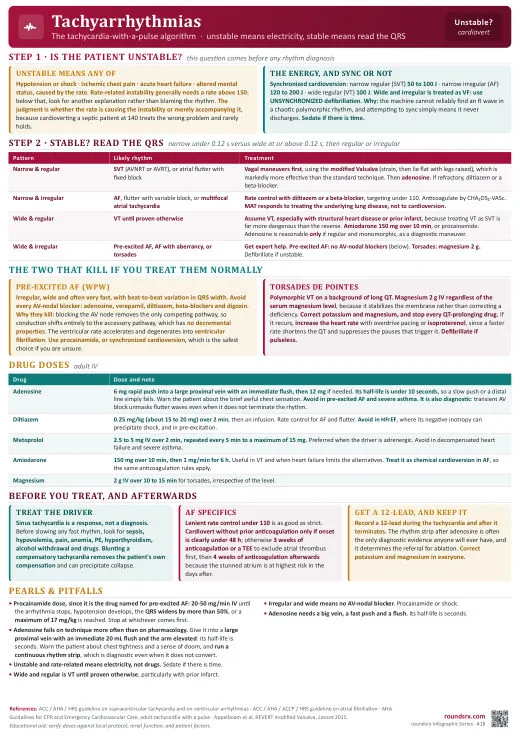 ⤢ Tap to open full size
RoundsRx Infographic Series · #18 · Cardiovascular · PDF 148 KB
Text version
Cardiology · One Pager
SVT
Narrow, regular, fast. Modified Valsalva first, then adenosine. Check for WPW before AV nodal blockers. Unstable → cardiovert.
💊 Key Drugs
Adenosine6 mg → 12 mg rapid push
Diltiazem20 mg IV over 2 min
Metoprolol5 mg IV q5min × 3
Procainamide15-17 mg/kg IV (WPW)
⚠️ Pitfalls
- AV nodal blockers in WPW → VF
- Not trying modified Valsalva first
- Missing atrial flutter (2:1 looks like SVT at 150)
- Adenosine in wide-complex tachycardia
RoundsRx · Cardiology · One Pager
ACC/AHA SVT 2015 · REVERT 2015