Syncope
Transient loss of consciousness from cerebral hypoperfusion. The key question: is this cardiac or benign? Risk-stratify every patient -most syncope is vasovagal, but cardiac syncope kills.
🔍 Overview
Definition & Classification
Syncope = transient loss of consciousness (TLOC) due to global cerebral hypoperfusion, with rapid onset, short duration, and spontaneous complete recovery. NOT seizure, NOT hypoglycemia, NOT stroke.
Classification
| Category | Mechanism | Examples | Prognosis |
|---|---|---|---|
| Reflex (neurally mediated) | Inappropriate vasodilation ± bradycardia | Vasovagal, situational (cough, micturition), carotid sinus hypersensitivity | Benign |
| Orthostatic hypotension | Volume depletion or autonomic failure | Dehydration, hemorrhage, meds (alpha-blockers, diuretics), autonomic neuropathy (DM, Parkinson) | Treat underlying cause |
| Cardiac -Arrhythmic | Brady or tachy → low CO | Complete heart block, VT, long QT, Brugada, sick sinus, pacemaker malfunction | Dangerous |
| Cardiac -Structural | Fixed obstruction → low CO | Severe AS, HOCM, Category E PE, aortic dissection, cardiac tamponade, atrial myxoma | Dangerous |
Key Epidemiology
- ~40% of people will experience syncope in their lifetime. 1-3% of ED visits.
- Reflex syncope accounts for ~60% of cases (most common overall)
- Cardiac syncope: ~15% of cases but accounts for majority of syncope-related deaths
- Unexplained in ~15-20% even after full workup
- 1-year mortality: vasovagal ~0%, cardiac syncope ~18-33%
Not all TLOC is syncope. Differential: seizure (postictal state, tongue biting, incontinence), hypoglycemia (glucose < 50), TIA (focal deficits), psychogenic pseudosyncope (eyes closed, prolonged duration).
📋 On Rounds
Pimp Questions
What are the high-risk ECG findings in syncope?
Bifascicular block, QTc > 500ms, Brugada pattern (coved ST in V1-V3), pre-excitation (WPW), Mobitz II or complete heart block, sustained or non-sustained VT, sinus pauses > 3 sec, new Q waves suggesting MI. Any of these = admit for monitoring.
What is the San Francisco Syncope Rule (CHESS)?
C-HF history, H-Hct < 30%, E-ECG abnormal, S-Shortness of breath, S-Systolic BP < 90. Any positive = high risk (~98% sensitivity). Identifies patients needing admission. Negative SFSR = low risk for 7-day serious outcome.
How do you differentiate syncope from seizure?
Syncope: prodrome (lightheaded, warm, diaphoretic), brief LOC (< 30 sec), rapid recovery. Seizure: aura, tonic-clonic activity > 60 sec, tongue biting (lateral), postictal confusion 15-30 min, incontinence. Brief myoclonic jerks CAN occur in syncope (convulsive syncope) -don't be fooled.
When do you admit a patient with syncope?
Admit if: abnormal ECG, structural heart disease, exertional syncope, syncope causing significant injury, recurrent syncope, family hx of sudden cardiac death, new neurologic deficits. Low-risk features (young, prodrome, positional trigger, normal ECG, no heart disease) = safe discharge.
What is carotid sinus hypersensitivity?
Exaggerated response to carotid sinus stimulation → > 3 sec asystole (cardioinhibitory) or SBP drop > 50 mmHg (vasodepressor) or both (mixed). Common in elderly males. Diagnosed by carotid sinus massage (CSM). Treatment: pacemaker for cardioinhibitory type.
What is the PERC rule's role in syncope?
Syncope can be the presenting symptom of PE (up to 17% of PE patients). If you suspect PE, use PERC to rule out (if all 8 criteria negative → no D-dimer needed). If PERC fails → D-dimer or CTPA. Always consider PE in unexplained syncope with tachycardia or hypoxia.
Clinical Examples
Case 1: Vasovagal Syncope
22F fainted while standing in line at DMV. Felt warm, lightheaded, and nauseated beforehand. Witnessed to go limp, regained consciousness in < 30 sec. Normal exam, normal ECG. Dx: Classic vasovagal -prodrome + positional trigger + young + normal ECG. Reassurance and hydration. No workup needed.
22F fainted while standing in line at DMV. Felt warm, lightheaded, and nauseated beforehand. Witnessed to go limp, regained consciousness in < 30 sec. Normal exam, normal ECG. Dx: Classic vasovagal -prodrome + positional trigger + young + normal ECG. Reassurance and hydration. No workup needed.
Case 2: Cardiac Syncope -Complete Heart Block
78M with h/o CAD found on floor by wife. No prodrome. ECG shows complete heart block with ventricular rate 32. SBP 80. Dx: Cardiac syncope from CHB. Transcutaneous pacing → cardiology for permanent pacemaker. Admit to CCU. No prodrome + abnormal ECG + age = high risk.
78M with h/o CAD found on floor by wife. No prodrome. ECG shows complete heart block with ventricular rate 32. SBP 80. Dx: Cardiac syncope from CHB. Transcutaneous pacing → cardiology for permanent pacemaker. Admit to CCU. No prodrome + abnormal ECG + age = high risk.
Case 3: Orthostatic Syncope
65M on lisinopril, amlodipine, and tamsulosin. Passed out getting up from bed at night. Orthostatics: supine BP 140/80, standing BP 100/60 (drop 40). Dx: Orthostatic hypotension -medication-related (alpha-blocker + antihypertensives). Reduce tamsulosin, hold amlodipine, encourage hydration and compression stockings.
65M on lisinopril, amlodipine, and tamsulosin. Passed out getting up from bed at night. Orthostatics: supine BP 140/80, standing BP 100/60 (drop 40). Dx: Orthostatic hypotension -medication-related (alpha-blocker + antihypertensives). Reduce tamsulosin, hold amlodipine, encourage hydration and compression stockings.
Case 4: Exertional Syncope -HOCM
19M college athlete collapsed during basketball. No prodrome. Exam: harsh crescendo-decrescendo systolic murmur at LLSB that increases with Valsalva. ECG: LVH with deep septal Q waves. Dx: HOCM. Echo confirmed. Restrict from competitive sports. Family screening. Consider ICD if high-risk features. Exertional syncope in young = cardiac until proven otherwise.
19M college athlete collapsed during basketball. No prodrome. Exam: harsh crescendo-decrescendo systolic murmur at LLSB that increases with Valsalva. ECG: LVH with deep septal Q waves. Dx: HOCM. Echo confirmed. Restrict from competitive sports. Family screening. Consider ICD if high-risk features. Exertional syncope in young = cardiac until proven otherwise.
Sample Presentation
Mr. Davis is a 74-year-old man with CAD, HTN, and HFrEF (EF 30%) who presents after a witnessed syncopal episode while sitting in a chair. No prodrome. Wife reports he went pale, slumped over, was unresponsive for ~10 seconds, then woke up confused. No seizure activity, no incontinence. ECG shows sinus rhythm with bifascicular block (RBBB + LAFB), QTc 480ms. Orthostatics negative. Troponin negative. BNP elevated at 850.
Key Points: High-risk syncope -no prodrome, structural heart disease (HFrEF), abnormal ECG (bifascicular block). Admit for continuous telemetry monitoring. Consider EP study. Bifascicular block in setting of syncope suggests intermittent complete heart block -may need pacemaker or ICD given EF 30%.
Daily Rounds Checklist
- Telemetry review: Any pauses > 3 sec? Any VT runs? Any new arrhythmias?
- Orthostatic vitals: Repeat if initially positive or if meds adjusted
- ECG changes: Repeat ECG if initial was abnormal or if symptoms recur
- Echo results: Structural heart disease? EF? Valvular disease? HOCM?
- Medication review: Any QT-prolonging drugs? Antihypertensives? Alpha-blockers?
- Recurrence: Any further episodes? Near-syncope? Presyncope?
- EP consult: If cardiac etiology suspected -document their recs
- Disposition plan: Safe for discharge? Need event monitor? Follow-up arranged?
🧪 Workup
Initial Evaluation (ALL Patients)
- Detailed history: Position (supine/standing/exertional), prodrome, witnesses, duration, recovery, medications, family hx of sudden death
- Physical exam: Orthostatic vitals (supine → standing, wait 3 min), cardiac auscultation (murmurs), carotid bruits, neurologic exam
- 12-lead ECG -MANDATORY in every syncope patient. Look for: long QT, Brugada, WPW, heart block, old MI (Q waves), LVH
- Orthostatic vitals: SBP drop > 20 mmHg OR DBP drop > 10 mmHg within 3 min of standing = positive
The history + ECG alone will identify the cause in ~50% of syncope patients. Routine labs, CT head, EEG, and carotid ultrasound have extremely low yield and should NOT be ordered unless specifically indicated.
High-Risk ECG Findings
| Finding | Suggests | Action |
|---|---|---|
| Bifascicular block (RBBB + LAFB or LPFB) | Intermittent complete heart block | Admit, EP consult, likely pacemaker |
| QTc > 500 ms | Long QT syndrome → torsades de pointes | Admit, telemetry, avoid QT-prolonging drugs |
| Brugada pattern (coved ST V1-V3) | Brugada syndrome → VF | EP consult, ICD evaluation |
| Pre-excitation (short PR, delta wave) | WPW → AF with rapid conduction → VF | EP consult for ablation |
| Mobitz II / CHB | High-grade AV block | Pacing (transcutaneous → permanent) |
| VT / Non-sustained VT | Ventricular arrhythmia | Admit, EP consult, ICD evaluation |
| Pathologic Q waves | Prior MI → scar-mediated VT | Echo, EP consult |
Selective Testing
- Echocardiogram: If cardiac murmur, abnormal ECG, exertional syncope, or known heart disease
- Continuous monitoring: Holter (24-48h) if daily symptoms; event monitor (2-4 weeks) if weekly; implantable loop recorder (ILR) for recurrent unexplained syncope ISSUE-3, 2012
- Tilt table test: Recurrent syncope suspected vasovagal but diagnosis unclear. Sensitivity 26-80%.
- EP study: Suspected arrhythmic syncope with non-diagnostic non-invasive workup, structural heart disease
- Labs: Only if clinically indicated -CBC (anemia/bleeding), BMP (dehydration), troponin (ACS), BNP (HF), glucose, pregnancy test
Risk Stratification Scores
| Score | Criteria | Use |
|---|---|---|
| San Francisco Syncope Rule (CHESS) | CHF hx, Hct < 30, ECG abnormal, SOB, SBP < 90 | Any positive = high risk. ~98% sensitivity for 7-day serious outcome STePS, 2006 |
| Canadian Syncope Risk Score | Predisposition to vasovagal, heart disease, elevated troponin, abnormal QRS axis, QTc > 480, ED diagnosis, SBP < 90 | Validated prediction of 30-day serious adverse events. Score -3 to +11. CSRS, 2016 |
| ROSE Rule | BNP ≥ 300, bradycardia ≤ 50, rectal exam with fecal occult blood, anemia, chest pain, ECG Q-wave, saturation ≤ 94% on RA | Predicts 1-month serious outcome. Any positive = high risk. ROSE, 2010 |
Canadian Syncope Risk Score -30-day serious adverse event risk after ED syncope (guides admission vs discharge)
Validated score for ED risk stratification. Predicts 30-day serious adverse events. Canadian Syncope Risk Score, Thiruganasambandamoorthy 2016
| Predictor | Points |
|---|---|
| ED diagnosis: vasovagal | −2 |
| Heart disease history (HF, CAD, VHD) | +1 |
| Any ED SBP < 90 or > 180 | +2 |
| Troponin elevated (> 99th percentile) | +2 |
| Abnormal QRS axis (< −30° or > 100°) | +1 |
| QRS > 130 ms | +1 |
| Corrected QT > 480 ms | +2 |
| ED diagnosis: cardiac syncope | +2 |
Score ≤ −1: very low risk (~1%) → safe for discharge. Score ≥ 3: high risk (~20%+) → admit. San Francisco Syncope Rule, Quinn 2004
🚨 Management
Admission Criteria
Admit if ANY of these present: Abnormal ECG, structural heart disease (EF < 35%, severe AS, HOCM), exertional syncope, syncope while supine, family hx of sudden cardiac death < 50, significant injury from syncope, recurrent syncope, new neurologic deficits, suspected PE/ACS.
Cardiac Syncope -Arrhythmic
- Bradycardia (sinus node dysfunction, heart block): Permanent pacemaker. Atropine or transcutaneous pacing as bridge.
- VT with structural heart disease: ICD implantation. Antiarrhythmics (amiodarone, sotalol) as adjunct. EP study for VT ablation.
- Long QT: Avoid QT-prolonging drugs (www.crediblemeds.org). Beta-blockers (nadolol) first-line. ICD if cardiac arrest survivor or recurrent syncope on beta-blockers.
- Brugada: ICD for cardiac arrest survivors or spontaneous type 1 with syncope. Avoid fever (triggers arrhythmia). Isoproterenol for VT storm.
- WPW: Catheter ablation of accessory pathway (curative in > 95%). Avoid AV nodal blockers (digoxin, verapamil, beta-blockers) in AF with WPW.
Cardiac Syncope -Structural
- Severe AS with syncope: Urgent AVR (surgical or TAVR). No medical temporizing.
- HOCM: Avoid dehydration, Valsalva, heavy exertion. Beta-blockers or verapamil. ICD if high-risk (family hx SCD, massive LVH > 30mm, unexplained syncope, NSVT). Myectomy or alcohol septal ablation for refractory symptoms.
- PE: Anticoagulation. Thrombolytics if Category E PE with hemodynamic compromise.
Reflex (Vasovagal) Syncope
- First-line: Education, reassurance, trigger avoidance, increase salt & fluid intake (2-3L/day), physical counterpressure maneuvers (leg crossing, hand grip, squatting) PC-Trial, 2006
- Second-line: Midodrine (ProAmatine) 5-10mg TID (alpha-1 agonist, raises BP). Fludrocortisone 0.1-0.2mg daily (volume expansion).
- Tilt training: Progressive standing exercises. Evidence is mixed.
- Pacemaker: Only for recurrent vasovagal with documented prolonged asystole (> 3 sec) on ILR. Dual-chamber pacing with rate-drop response. ISSUE-3, 2012
Orthostatic Syncope
- Medication review: Reduce/stop offending agents (diuretics, alpha-blockers, vasodilators, TCAs)
- Non-pharmacologic: Compression stockings (30-40 mmHg), abdominal binder, rise slowly, elevate HOB, increase salt & fluids
- Pharmacologic: Midodrine 5-10mg TID or droxidopa (Northera) for neurogenic OH
Safe for discharge: Young patient (< 50), clear vasovagal trigger, no cardiac history, normal ECG, normal exam, no exertional component, no family hx of SCD. Counsel on prodrome recognition, hydration, and counterpressure maneuvers.
💊 Medications
Medications for Recurrent Syncope
| Drug | Indication | Dose | Notes |
|---|---|---|---|
| Midodrine | Orthostatic hypotension | 2.5-10 mg PO TID | Alpha-1 agonist. Give morning/noon/afternoon. Avoid evening dose (supine HTN) |
| Fludrocortisone | Orthostatic hypotension | 0.1-0.2 mg PO daily | Volume expansion. Monitor K+ and edema. Avoid in HF |
| Droxidopa | Neurogenic orthostatic hypotension | 100-600 mg PO TID | For autonomic failure (Parkinson's, MSA). Norepinephrine prodrug |
| Beta-blockers | Long QT syndrome | Nadolol 40-80 mg daily preferred | Reduces risk of cardiac events in LQTS. Non-selective preferred |
| SSRI (paroxetine) | Refractory vasovagal | 20 mg PO daily | Limited evidence. Consider in severely recurrent vasovagal only |
Most syncope does not need medications. Vasovagal is treated with counter-pressure maneuvers, hydration, and trigger avoidance. Medication review (stopping offending agents) is often the most important intervention.
⚡ Summary
Summary
The Question That Matters
Transient loss of consciousness from cerebral hypoperfusion, with spontaneous complete recovery. Most syncope is vasovagal and benign; cardiac syncope kills. The entire evaluation is aimed at separating the two, not at finding a cause for every episode.
The History Does Most of the Work
Prodrome of nausea, warmth, tunnel vision, and a trigger such as pain, standing, heat or micturition points to vasovagal. Syncope during exertion, while supine, or with palpitations and no prodrome points to cardiac, as does a family history of sudden death. Injury from the fall favors cardiac, because there was no warning to break it.
ECG on Everyone
Look for the conditions that cause sudden death: long or short QT, Brugada pattern, pre-excitation, ARVC changes, hypertrophic cardiomyopathy, bifascicular block, complete heart block, ischemia. A normal ECG with a normal exam and a typical prodrome is highly reassuring, and a resting ECG is one of the few tests that reliably changes disposition.
Check Orthostatics and Examine the Heart
A fall of 20 mmHg systolic or 10 mmHg diastolic within 3 min of standing. Review medications, which are the commonest reversible cause in older patients: antihypertensives, alpha blockers, diuretics, nitrates, antidepressants. Listen for aortic stenosis and hypertrophic cardiomyopathy, both of which present as exertional syncope.
Order Tests Selectively
Routine head CT, carotid ultrasound and EEG have almost no yield in undifferentiated syncope and should not be reflexive. Echo when structural disease is suspected, ambulatory or implantable monitoring when arrhythmia is suspected but not captured, and exercise testing for exertional syncope. Focal neurology means it was not simple syncope, so image that patient.
Use a Score to Support, Not Replace, Judgment
Canadian Syncope Risk Score and San Francisco Syncope Rule stratify 30-day serious outcomes and help defend a discharge decision. They do not override a worrying history: exertional syncope with a normal workup still warrants investigation.
Admit for the Right Reasons
Abnormal ECG, known structural heart disease or heart failure, exertional or supine syncope, palpitations preceding the event, family history of sudden death, significant injury, persistent abnormal vital signs, or severe anemia and suspected GI bleeding. Age alone is not an admission criterion, though it raises the probability of every dangerous cause.
Distinguish the Mimics and Treat What You Find
Seizure: prolonged postictal confusion, tongue biting laterally, incontinence (brief myoclonic jerks are common in ordinary syncope and are not seizures). Hypoglycemia, intoxication, psychogenic pseudosyncope. Treat vasovagal disease with education, trigger avoidance, fluid and salt, and counterpressure maneuvers, with midodrine or fludrocortisone for refractory cases. Cardiac syncope is treated by treating the cardiac disease, and it needs driving restrictions discussed and documented.
📄 One Pager
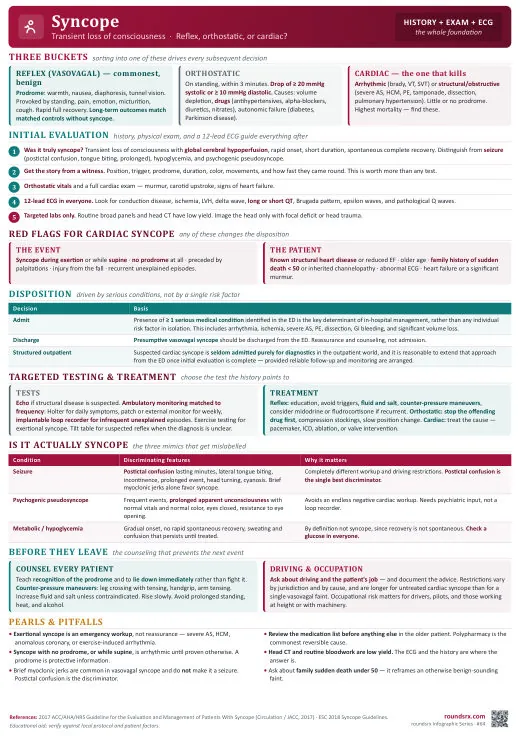
Text version
One-Pager
Syncope
Risk Stratification & Workup
Categories
Reflex/vasovagal (60%) -benign, prodrome, positional trigger. Orthostatic (15%) -meds, dehydration, autonomic. Cardiac arrhythmic (10%) -heart block, VT, long QT, Brugada, WPW. Cardiac structural (5%) -AS, HOCM, PE, tamponade.
Mandatory Workup
History (position, prodrome, exertional, family hx SCD) + orthostatic vitals + 12-lead ECG. That's it for low-risk. Echo if murmur/abnormal ECG/exertional. Labs only if indicated. Skip CT head and EEG.
High-Risk ECG Flags
Bifascicular block, QTc > 500, Brugada (coved ST V1-V3), WPW (short PR + delta wave), Mobitz II/CHB, VT/NSVT, pathologic Q waves (old MI).
Risk Scores
SFSR (CHESS): CHF, Hct < 30, ECG abnl, SOB, SBP < 90 -any positive = high risk. CSRS: validated 30-day risk, score -3 to +11. ROSE: BNP ≥ 300 strongest predictor.
Related Topics
ACS OverviewAortic DissectionAortic StenosisArrhythmiasAtrial FibrillationCardiac Tamponade