Toxicology & Overdose
- Rumack-Matthew nomogram, APAP level vs time to determine NAC need
- NAC: N-acetylcysteine 150mg/kg/1h → 50mg/kg/4h → 100mg/kg/16h Prescott 1979
- AST/ALT may be normal initially (peaks 72–96h). King’s College for transplant referral
- Tinnitus, tachypnea (resp alkalosis + AG met acidosis). Alkalinize urine: bicarb drip, target urine pH 7.5–8
- Dialysis if level >90 or severe symptoms
- A normal, low or even negative anion gap does not exclude salicylate poisoning. Many chloride ion-selective electrodes read salicylate as chloride, which hides the gap acidosis, and the error grows with the level. Send a level whenever the story fits (see low anion gap causes).
- Wide QRS (>100ms), sodium channel blockade, seizures
- Sodium bicarbonate 1–2 mEq/kg IV bolus (narrows QRS)
- NEVER flumazenil in TCA/benzo co-ingestion (lowers seizure threshold)
- Naloxone 0.04–0.4mg IV titrate (start low). Drip for long-acting opioids
- BB: Glucagon 3–5mg IV
- CCB: High-dose insulin 1u/kg/hr + D10W
- Presentation: nausea/vomiting, visual disturbance (yellow-green halos, "Van Gogh"), confusion, bradyarrhythmia + ectopy (classic: PAT with block, bidirectional VT). Hyperkalemia in acute toxicity (Na/K-ATPase block).
- DigiFab (digoxin-specific Fab fragments). Empiric 10–20 vials for acute OD; calculated # vials = (level × weight) / 100.
- Indications: hemodynamic instability, K⁺ > 5, symptomatic bradycardia/heart block, dig level > 10 (acute) or > 6 (chronic), ingestion > 10 mg adult / 4 mg child.
- Avoid IV calcium in dig toxicity (theoretical "stone heart" from intracellular Ca overload, though contested). Use DigiFab instead.
- Vitamin K 10 mg IV slow (peaks at 12–24h, restores factor synthesis).
- 4-factor PCC (Kcentra) 25–50 units/kg IV for life-threatening bleed (reverses INR within minutes). FFP if PCC unavailable.
- Long-acting rodenticides ("superwarfarins" e.g. brodifacoum) require weeks to months of oral vitamin K.
- Cholinergic toxidrome (SLUDGE / DUMBBBELS): miosis, salivation, lacrimation, urination, diarrhea, bradycardia, bronchospasm, bronchorrhea, fasciculations, seizures.
- Atropine 2 mg IV, double q3–5 min until secretions dry (titrate to lung exam, NOT pupils or HR). No upper-limit dose; severe poisonings need 10–100+ mg.
- Pralidoxime (2-PAM) 1–2 g IV over 15–30 min, then 500 mg/hr infusion. Reactivates AChE if given before "aging" (12–48h). Best within 6h.
- Decontaminate skin/clothing (provider PPE: nitrile gloves, gown, eye protection, nerve agent exposure can affect responders).
- Supportive care first. Pure benzo overdoses rarely cause death; respiratory depression worse with co-ingestion.
- Flumazenil (Romazicon) 0.2 mg IV q1 min (max 3 mg). Rarely used.
- Avoid flumazenil in: chronic benzo users (precipitates withdrawal seizures), TCA / proconvulsant co-ingestion (removes seizure protection), unknown overdose. Safe only for iatrogenic oversedation in benzo-naive patients.
- Trigger: inadvertent IV bupivacaine / ropivacaine / lidocaine. Presents with seizures → cardiac arrest (refractory to ACLS).
- Intralipid 20% 1.5 mL/kg IV bolus, then 0.25 mL/kg/min infusion. Lipid sink pulls drug out of cardiac tissue. Continue until hemodynamic stability + 10 min.
- Avoid vasopressin (worsens outcomes); use low-dose epinephrine (≤ 1 mcg/kg).
| Poison | Antidote | Dose | Pearl |
|---|---|---|---|
| Acetaminophen | NAC | 150 mg/kg/1h → 50 mg/kg/4h → 100 mg/kg/16h | Plot 4h level on Rumack-Matthew. Effective > 24h still. |
| Salicylate | Sodium bicarbonate + dialysis | Bicarb drip, target urine pH 7.5–8 | Dialysis if level > 90 or severe symptoms. Avoid intubation. |
| Opioid | Naloxone | 0.04–0.4 mg IV titrate to RR | Goal is breathing, not consciousness. Drip 2/3 effective bolus/hr for long-acting. |
| Benzodiazepine | Flumazenil | 0.2 mg IV q1 min (max 3 mg) | Rarely used. Avoid in chronic users, TCA co-ingestion. |
| TCA | Sodium bicarbonate | 1–2 mEq/kg IV bolus → drip pH 7.45–7.55 | QRS > 100 ms or R in aVR > 3 mm. NO flumazenil. |
| Beta-blocker | Glucagon + HIE | 3–10 mg IV bolus → 3–5 mg/hr; insulin 1 u/kg/hr | Glucagon causes vomiting (aspiration risk). |
| Calcium channel blocker | Calcium + HIE + lipid | CaCl 1–2 g IV; insulin 1 u/kg/hr + D10 | HIE is the primary therapy for severe CCB OD. |
| Methanol / ethylene glycol | Fomepizole + dialysis | 15 mg/kg IV load → 10 mg/kg q12h | Dialysis if pH < 7.25, AKI, visual symptoms, level > 50. |
| Organophosphate | Atropine + 2-PAM | Atropine 2 mg double q3–5 min; 2-PAM 1–2 g IV | Titrate atropine to dry secretions. No upper-limit dose. |
| Warfarin / superwarfarin | Vitamin K + 4F-PCC | Vit K 10 mg IV; PCC 25–50 u/kg if bleeding | Superwarfarins need weeks of oral vit K. |
| Digoxin | DigiFab | 10–20 vials acute; calc = (level × kg)/100 | K⁺ > 5 = strong indication. Avoid IV calcium. |
| Valproate | L-carnitine ± dialysis | 100 mg/kg IV load → 15 mg/kg q4h | Check ammonia even with normal LFTs and therapeutic level. |
| Local anesthetic (LAST) | Intralipid 20% | 1.5 mL/kg bolus → 0.25 mL/kg/min | Bupivacaine arrest is refractory to ACLS without lipid. |
| Iron | Deferoxamine | 15 mg/kg/hr IV (max 6 g/24h) | "Vin rose" urine = chelation working. Level > 500 mcg/dL. |
| Methemoglobinemia | Methylene blue | 1–2 mg/kg IV over 5 min | SpO2 stuck at ~85% despite O2; chocolate-brown blood. Avoid in G6PD deficiency. |
| Cyanide | Hydroxocobalamin | 5 g IV over 15 min, repeat if needed | Smoke inhalation + altered mental status + lactate > 8. |
- Presentation: CNS depression / coma (dose-related), hyperammonemic encephalopathy often disproportionate to LFTs, anion gap metabolic acidosis (lactate from mitochondrial dysfunction), hypotension, cerebral edema in severe cases. Delayed: pancreatitis, thrombocytopenia.
- Workup: VPA level (repeat q4–6h until falling, sustained-release peaks late), ammonia, lactate, lipase, LFTs, CBC, BMP, ABG/VBG, APAP + salicylate co-ingestion screen.
- L-carnitine 100 mg/kg IV load (max 6 g) over 30 min, then 15 mg/kg q4h. Treats and prevents hyperammonemia and hepatotoxicity (VPA depletes carnitine, shunting metabolism to toxic omega-oxidation pathway).
- Hemodialysis if: level > 850 mcg/mL, level > 450 with severe symptoms, refractory shock, cerebral edema, or severe acidosis. VPA is dialyzable once protein binding saturates.
- Activated charcoal if < 1–2h post-ingestion and airway protected. Multi-dose charcoal (MDAC) for sustained-release Depakote ER.
- Lactulose / rifaximin if hyperammonemic encephalopathy persists despite L-carnitine.
- Naloxone is NOT effective. Supportive care for CNS depression: airway, fluids, pressors as needed.
| Toxidrome | Pupils | HR | Temp | Skin | Mental Status | Examples |
|---|---|---|---|---|---|---|
| Sympathomimetic | Mydriasis | ↑↑ | ↑ | Diaphoretic | Agitation, psychosis | Cocaine, amphetamines, MDMA |
| Anticholinergic | Mydriasis | ↑ | ↑ | Dry, flushed | Delirium, hallucinations | Diphenhydramine, TCAs, atropine |
| Cholinergic | Miosis | ↓ or ↑ | Normal | Diaphoretic, secretions | Confusion, coma | Organophosphates, nerve agents |
| Opioid | Miosis (pinpoint) | ↓ | ↓ | Normal | CNS depression, coma | Heroin, fentanyl, morphine |
| Sedative-hypnotic | Normal or miosis | ↓ | ↓ | Normal | CNS depression, coma | Benzodiazepines, barbiturates, GHB |
| Serotonin syndrome | Mydriasis | ↑ | ↑↑ | Diaphoretic | Agitation, clonus, hyperreflexia | SSRI + tramadol / MAOI / linezolid; MDMA |
| Method | Indication | Timing | Contraindications |
|---|---|---|---|
| Activated Charcoal | Most oral ingestions of adsorbable substances | Within 1–2 hours (may extend for sustained-release) | Caustics, hydrocarbons, metals (iron, lithium, lead), alcohols, unprotected airway |
| Whole Bowel Irrigation | Sustained-release preps, iron, lithium, body packers | Any time if substance still in GI tract | Bowel obstruction, perforation, ileus, hemodynamic instability |
| Gastric Lavage | Rarely indicated, life-threatening ingestion within 1h | Within 1 hour | Caustics, hydrocarbons, impaired airway without intubation |
- Step 1, Osmolar Gap: Calculated Osm = 2(Na) + Glucose/18 + BUN/2.8 + EtOH/4.6. Gap = Measured − Calculated. Gap > 10 suggests toxic alcohol
- Step 2, Anion Gap: As toxic alcohols are metabolized, osmolar gap falls and anion gap rises (formic acid from methanol, glycolic/oxalic acid from ethylene glycol)
- Key point: A normal osmolar gap does NOT rule out toxic alcohol if presentation is delayed (parent compound already metabolized)
- Methanol: Visual disturbance (“snowfield vision”), optic disc hyperemia, formic acid → retinal toxicity
- Ethylene glycol: Flank pain, calcium oxalate crystals in urine (envelope-shaped), AKI
- Isopropanol: Elevated osmolar gap but NO anion gap (metabolized to acetone, not an acid). Ketonemia without acidosis
- Draw APAP level at 4 hours post-ingestion (or ASAP if > 4h)
- Treatment line: 150 mcg/mL at 4h declining to 4.7 mcg/mL at 24h
- Level above the treatment line → start NAC immediately
- Unknown ingestion time or staggered: start NAC empirically if APAP > 10 mcg/mL or AST elevated
- NAC IV protocol (21h): 150 mg/kg/1h → 50 mg/kg/4h → 100 mg/kg/16h Prescott 1979
- NAC stop criteria: APAP undetectable, AST/ALT trending down, INR < 2, clinically improving
| Feature | Serotonin Syndrome | Neuroleptic Malignant Syndrome (NMS) | Malignant Hyperthermia (MH) |
|---|---|---|---|
| Onset | Rapid (hours, within 24h) | Slow (days to weeks) | Acute (minutes to hours after anesthetic exposure) |
| Cause | Serotonergic drugs (SSRIs, MAOIs, tramadol, linezolid, MDMA) | Dopamine antagonists (haloperidol, metoclopramide) or dopamine withdrawal | Volatile anesthetics (sevoflurane, desflurane, isoflurane) and/or succinylcholine |
| Setting | Any setting (ward, ED, outpatient) | Any setting, often psychiatric patients | Operating room / post-anesthesia |
| Pathophysiology | Excess serotonin at 5-HT1A & 5-HT2A receptors | Central dopamine D2 receptor blockade in hypothalamus & basal ganglia | Uncontrolled Ca2+ release from sarcoplasmic reticulum via RYR1 mutation |
| Neuromuscular | Clonus, hyperreflexia, myoclonus (lower extremities > upper) | Lead-pipe rigidity, hyporeflexia, bradykinesia | Generalized rigidity (masseter spasm first), no clonus |
| Pupils | Mydriasis | Normal | Normal |
| GI | Diarrhea, hyperactive bowel sounds | Normal/decreased bowel sounds | Not prominent |
| Temp | ↑ (usually < 41°C) | ↑↑ (can be > 41°C) | ↑↑↑ (rapidly > 40°C, can exceed 43°C) |
| CK | Mildly elevated | Markedly elevated (> 1000, often > 10,000) | Massively elevated (> 10,000, can exceed 100,000) |
| Key Labs | Mild CK elevation, leukocytosis | CK ↑↑↑, WBC ↑, LFTs ↑, myoglobinuria | Hypercarbia (rising EtCO2 is often earliest sign), mixed respiratory & metabolic acidosis, hyperkalemia, myoglobinuria |
| Mental Status | Agitation, confusion | Altered, stupor, catatonia | Patient under anesthesia (may have delayed emergence) |
| Autonomic | Tachycardia, HTN, diaphoresis | Tachycardia, labile BP, diaphoresis, sialorrhea | Tachycardia, arrhythmias (hyperkalemia-driven), tachypnea, mottled skin |
| Treatment | Stop serotonergic drug, cyproheptadine 12mg then 4mg q4h, benzos, cooling | Stop antipsychotic, dantrolene 1–2.5 mg/kg IV, bromocriptine 2.5mg TID, cooling | Stop volatile anesthetic & succinylcholine, dantrolene 2.5 mg/kg IV q5min (max 10 mg/kg), 100% O2, aggressive cooling, treat hyperkalemia |
| Resolution | 24–72 hours | Days to weeks (7–14 days typical) | Hours with dantrolene (recheck CK q6h × 36h, may recur) |
| Mortality | Low (< 1% if recognized) | 5–20% (higher if unrecognized) | 5–10% with dantrolene (was > 70% before dantrolene) |
| Genetic | No | No (idiosyncratic) | Yes, autosomal dominant RYR1 mutation, test with caffeine-halothane contracture test |
- APAP level (4h post-ingestion), salicylate level, ethanol
- BMP, ABG, AG, osmolar gap, lactate, LFTs, coags
- ECG (QRS width, QTc)
- Urine drug screen (limited utility)
| Toxin | Antidote | Dose |
|---|---|---|
| Acetaminophen | NAC | 150/50/100 mg/kg over 21h IV |
| Opioids | Naloxone | 0.04–0.4mg IV titrate |
| TCA | Sodium bicarbonate | 1–2 mEq/kg IV bolus |
| Beta-blockers | Glucagon | 3–5mg IV |
| CCB | High-dose insulin | 1u/kg/hr + D10W |
| Methanol/EG | Fomepizole | 15mg/kg IV load |
| Organophosphates | Atropine + Pralidoxime | Atropine 2mg IV q5min |
| Digoxin | DigiFab | Based on level or empiric 10–20 vials if acute, life-threatening |
| Benzodiazepines | Flumazenil | 0.2mg IV over 30s, then 0.3mg, then 0.5mg q1min (max 3mg). Only for iatrogenic oversedation in benzo-naive patients |
| Local anesthetic toxicity | Lipid emulsion (Intralipid) | 20% lipid emulsion 1.5 mL/kg IV bolus, then 0.25 mL/kg/min infusion |
| Cyanide | Hydroxocobalamin | 5g IV over 15 min (Cyanokit). Smoke inhalation with lactic acidosis |
| Iron | Deferoxamine | 15 mg/kg/hr IV (max 6g/day). Rose-colored urine = vin rosé sign |
| Warfarin / Coagulopathy | Vitamin K + FFP/PCC | Vitamin K 10mg IV; 4-factor PCC (KCentra) 25–50 u/kg for life-threatening bleed |
| Isoniazid | Pyridoxine (B6) | Gram-for-gram (5g IV if unknown amount). INH seizures refractory to benzos |
| Drug | Dose | Notes |
|---|---|---|
| NAC IV | 150mg/kg in D5W/1h, 50mg/kg/4h, 100mg/kg/16h | Anaphylactoid reactions common first bag |
| Naloxone | 0.04mg → 0.4mg → 2mg titrate. Drip: 2/3 bolus/hr | Short t1/2; re-dosing needed for long-acting opioids |
| Glucagon | 3–5mg IV bolus, infusion 2–5mg/hr | BB OD. Causes vomiting (aspiration risk) |
| Insulin HIE | 1u/kg bolus then 1u/kg/hr + D10W | CCB OD. Monitor glucose q15min, K q1h |
| L-carnitine (Carnitor) | 100 mg/kg IV load (max 6 g) over 30 min, then 15 mg/kg IV q4h until ammonia normalizes and clinical improvement | Valproate toxicity / VPA-induced hyperammonemia. Reverses carnitine depletion driving omega-oxidation and ammonia accumulation. Continue until ammonia < 60 and patient awake. |
| Sodium bicarbonate | 1–2 mEq/kg IV bolus, then 150 mEq in 1 L D5W at 200 mL/hr | TCA toxicity (target QRS < 100, pH 7.45–7.55) and salicylate alkalinization (urine pH 7.5–8). |
| Fomepizole (Antizol) | 15 mg/kg IV load → 10 mg/kg q12h × 4, then 15 mg/kg q12h. Dose q4h during HD. | Methanol / ethylene glycol. Inhibits alcohol dehydrogenase. Add thiamine + pyridoxine. |
| Atropine | 2 mg IV, double q3–5 min until secretions dry | Organophosphate / carbamate / nerve agent. No upper-limit dose. Titrate to lung exam. |
| Pralidoxime (2-PAM) | 1–2 g IV over 15–30 min, then 500 mg/hr infusion | Reactivates AChE before "aging" (12–48h). Best within 6h of organophosphate exposure. |
| Flumazenil (Romazicon) | 0.2 mg IV q1 min (max 3 mg) | Benzo reversal. Avoid in chronic users, TCA / proconvulsant co-ingestion, or unknown OD. |
| DigiFab | Empiric 10–20 vials acute OD; calc # vials = (level × weight kg) / 100 | Digoxin toxicity. Indications: K⁺ > 5, dysrhythmia, level > 10 (acute) or > 6 (chronic). |
| Vitamin K (phytonadione) | 10 mg IV slow over 30 min; can also give PO/SC | Warfarin / superwarfarin. Onset 6–24h. Pair with 4F-PCC for active bleeding. |
| 4-factor PCC (Kcentra) | 25–50 units/kg IV based on INR | Reverses warfarin INR within minutes. Preferred over FFP for life-threatening bleed. |
| Intralipid 20% | 1.5 mL/kg IV bolus, then 0.25 mL/kg/min for 10 min after stability | Local anesthetic systemic toxicity (LAST), refractory TCA / CCB / BB toxicity. Lipid sink. |
| Methylene blue | 1–2 mg/kg IV over 5 min | Methemoglobinemia (SpO2 ~85% despite O2, chocolate blood). Avoid in G6PD deficiency (paradoxical hemolysis). |
| Hydroxocobalamin (Cyanokit) | 5 g IV over 15 min; repeat 5 g if severe | Cyanide poisoning (smoke inhalation + AMS + lactate > 8). Turns urine/skin red. Interferes with co-oximetry. |
| Deferoxamine | 15 mg/kg/hr IV, max 6 g/24h | Iron poisoning (level > 500 mcg/dL or symptomatic). "Vin rose" urine = active chelation. |
| Cyproheptadine | 12 mg PO load, then 2 mg q2h until improvement (max 32 mg/24h) | Serotonin syndrome (5-HT2A antagonist). Adjunct to benzos and active cooling. |
| Dantrolene | 2–3 mg/kg IV bolus, repeat to 10 mg/kg total | NMS, malignant hyperthermia. Direct skeletal muscle relaxant. |
Patient: 22F presents 6 hours after intentional ingestion of ~30g acetaminophen (60 tablets of 500mg). Nausea, vomiting, RUQ discomfort. VS: HR 92, BP 118/72, afebrile.
Labs: APAP level 220 mcg/mL at 6h post-ingestion, above treatment line on Rumack-Matthew nomogram. AST 45, ALT 38, INR 1.1, Cr 0.9.
Management:
- Start NAC immediately: 150 mg/kg IV over 1h → 50 mg/kg over 4h → 100 mg/kg over 16h
- Patient develops flushing and urticaria during first bag → anaphylactoid reaction. Slow infusion, diphenhydramine 50mg IV. Do NOT stop NAC
- Monitor: APAP level, AST/ALT, INR q6h. At 24h: APAP undetectable, AST peaked at 1,200 then trending down, INR 1.3
- NAC stop criteria met: APAP undetectable + AST trending down + INR < 2 + clinical improvement
- Psychiatry consult for intentional ingestion before discharge
Key lesson: NAC is most effective within 8h but still beneficial up to 24–72h. Never withhold NAC for anaphylactoid reactions.
Patient: 48M found confused with empty antifreeze container. GCS 12. VS: HR 110, BP 100/60, RR 28, SpO2 96%.
Labs: Na 140, K 4.2, Cl 100, HCO3 8, BUN 28, Cr 2.4. AG = 32. Measured Osm 340, calculated 290 → osmolar gap = 50. Lactate 6.2. UA: calcium oxalate crystals. EtOH undetectable.
Clinical reasoning: Elevated osmolar gap + elevated AG + AKI + Ca oxalate crystals = ethylene glycol poisoning.
Management:
- Fomepizole 15 mg/kg IV load immediately (blocks alcohol dehydrogenase)
- Emergent hemodialysis: pH 7.18, Cr 2.4, multiple indications. Increase fomepizole dosing during HD (q4h)
- Thiamine 100mg IV + pyridoxine 50mg IV (shunt metabolism away from toxic metabolites)
- IV bicarb drip to correct severe acidosis (target pH > 7.2)
- After 2 HD sessions: AG normalized, Cr trending down, osmolar gap closed
Key lesson: Osmolar gap and AG are inversely related over time. Early = high osmolar gap; late = high AG. Normal osmolar gap does NOT exclude toxic alcohol.
Patient: 35M on sertraline 200mg daily, started tramadol 2 days ago. Presents with agitation, diaphoresis, fever 39.2°C, HR 124, BP 158/92.
Exam: Mydriasis, bilateral lower extremity clonus (spontaneous, > 3 beats), hyperreflexia, tremor, hyperactive bowel sounds, diarrhea. CK 680.
Clinical reasoning: Serotonergic agents (SSRI + tramadol) + rapid onset + clonus + hyperreflexia + diaphoresis. Hunter Criteria met (spontaneous clonus with serotonergic agent).
Why NOT NMS: Rapid onset (hours not days), clonus (not rigidity), hyperreflexia (not hyporeflexia), diarrhea (not constipation), CK only 680 (not > 10,000).
Management:
- Stop all serotonergic agents (sertraline and tramadol)
- Cyproheptadine 12mg PO/NG load, then 4mg q4–6h
- Benzodiazepines (lorazepam 2mg IV PRN) for agitation and muscle rigidity
- Aggressive cooling if temp > 41°C. Antipyretics ineffective (fever from muscle activity)
- IV fluids for rhabdomyolysis prevention, monitor CK and renal function
- Symptoms improved within 24h. Full resolution by 72 hours
Key lesson: Serotonin syndrome is a clinical diagnosis (Hunter Criteria). Clonus is the hallmark. Rapid onset and rapid resolution once offending agents stopped.
| Toxin | Key Monitoring |
|---|---|
| APAP | AST/ALT q6–12h, INR, APAP level, lactate |
| Salicylate | Serial levels q2h, ABG, urine pH hourly |
| TCA | Continuous telemetry, serial ECG QRS width |
| BB/CCB | HR, BP, glucose q15min, K q1h, lactate |
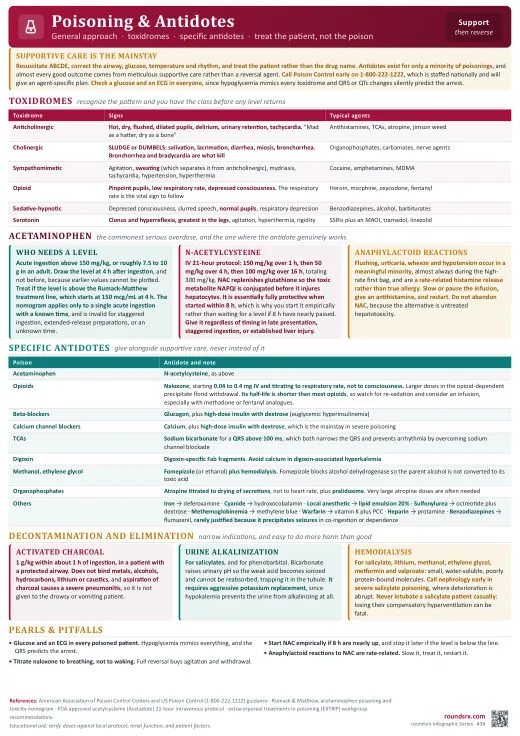
Text version
- Not checking APAP/ASA levels (coingestants common)
- Under-dosing naloxone for fentanyl analogs (may need 2–10+ mg)
- Flumazenil in chronic benzo users or TCA co-ingestion (seizures)
- Intubating a salicylate patient (sudden acidemia → arrest)
- Missing serotonin syndrome (clonus, hyperthermia, agitation)
- Calcium in dig toxicity ("stone heart", use DigiFab)