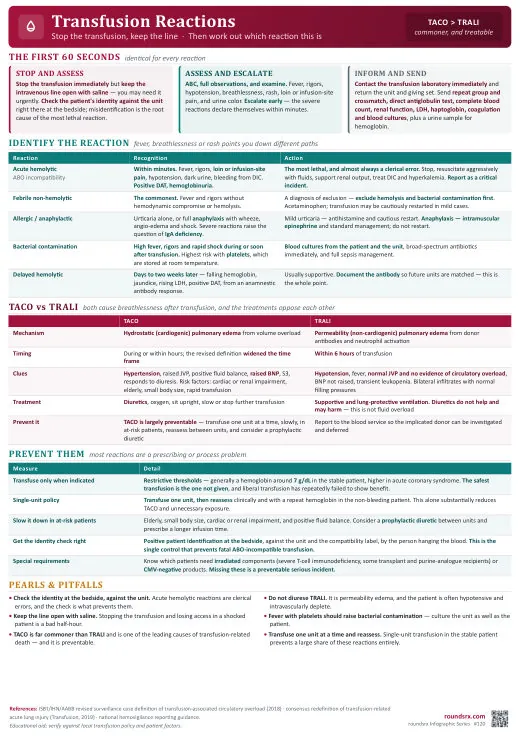
Transfusion Reactions
| Type | Timing | Key Features | Treatment |
|---|---|---|---|
| Acute Hemolytic | Minutes | Fever, flank pain, dark urine, hypotension, DIC | STOP transfusion, NS bolus, send blood bank sample |
| Febrile Non-Hemolytic (FNHTR) | 1–6h | Fever, chills, NO hemolysis | Acetaminophen, slow rate. Most common reaction |
| Allergic (mild) | Min–hours | Urticaria, pruritus, NO hemodynamic instability | Diphenhydramine, can restart slowly |
| Anaphylactic | Minutes | Hypotension, bronchospasm, angioedema (often IgA deficient) | STOP, IM epinephrine |
| TRALI | 2–6h | Acute hypoxemia, bilateral infiltrates, NO volume overload | Supportive (lung-protective vent), resolves 48–72h. Leading cause of transfusion death |
| TACO | 1–6h | Dyspnea, HTN, JVD, pulmonary edema, elevated BNP | Diuresis (furosemide), O2, slow future transfusions |
| Delayed Hemolytic | 3–14 days | Falling Hgb, jaundice, positive DAT | Usually mild, supportive |
| Feature | TRALI | TACO |
|---|---|---|
| BNP | Low / normal | Elevated |
| CVP / JVD | Normal | Elevated |
| BP | Hypotension | Hypertension |
| CXR | Bilateral infiltrates (like ARDS) | Pulmonary edema, effusions |
| Diuretics | No response | Responds |
| Type | Timing | Mechanism | Management |
|---|---|---|---|
| Delayed Hemolytic (DHTR) | 3-14 days | Anamnestic antibody response to minor RBC antigens (Kidd, Duffy, Kell) | Supportive. Future: antigen-negative units. Tormey & Stack, Immunohematology 2009 |
| Transfusion-Associated GVHD | 4-30 days | Donor T-cells attack immunocompromised recipient. Mortality >90% | Prevention: irradiated products for at-risk patients (HCT recipients, congenital immunodeficiency, Hodgkin lymphoma) |
| Post-Transfusion Purpura (PTP) | 5-12 days | Anti-HPA-1a antibodies cause severe thrombocytopenia | IVIG 1 g/kg x 2 days. Platelet transfusion usually ineffective. Mueller-Eckhardt, Lancet 1989 |
| Iron Overload | Chronic (>20 units) | Each pRBC unit contains ~250 mg iron. No excretion mechanism | Monitor ferritin. Chelation with deferasirox when ferritin >1000. Target organs: liver, heart, endocrine |
| Transfusion-Transmitted Infection | Variable | Bacterial contamination (platelets > RBCs), viral (rare with NAT screening) | Cultures, targeted antibiotics/antivirals. Dodd, Transfusion 2012 |
| Modification | What It Does | Indication |
|---|---|---|
| Leukoreduction | Removes WBCs (to <5 x 10⁶) | Prevents FNHTR, CMV transmission, HLA alloimmunization. Universal in most US blood banks Trial of Universal Leukoreduction, NEJM 2003 |
| Irradiation | Prevents donor T-cell proliferation | Prevents TA-GVHD: HCT recipients, Hodgkin lymphoma, fludarabine therapy, congenital immunodeficiency, directed donations from relatives |
| Washed | Removes plasma proteins (IgA, complement) | IgA-deficient patients with anti-IgA antibodies, severe allergic reactions, neonatal transfusions |
| CMV-negative | From CMV-seronegative donors | Pregnancy, neonates, CMV-negative transplant recipients. Leukoreduction is an acceptable alternative ("CMV-safe") |
| Volume-reduced | Concentrates product by removing supernatant | Patients at risk for TACO (CHF, renal failure, neonates). Slower infusion rate also helps |
- STOP transfusion, keep IV access
- Send blood bank sample: repeat type & screen, DAT, visual hemolysis check
- CBC, BMP, LDH, haptoglobin, bilirubin, UA (hemoglobinuria)
- Coags if hemolytic/DIC suspected
- BNP + CXR for TRALI vs TACO
- Blood cultures if febrile (bacterial contamination)
| Reaction | Immediate | Ongoing |
|---|---|---|
| Acute Hemolytic | STOP, NS bolus | UOP >1 mL/kg/hr, monitor for DIC |
| FNHTR | Acetaminophen | Can restart slowly. Pre-medicate future |
| Allergic | Diphenhydramine 25–50mg IV | Restart after urticaria resolves. Washed products for recurrence |
| Anaphylactic | Epinephrine 0.3–0.5mg IM | IgA level, future: washed/IgA-deficient products |
| TRALI | O2, intubation PRN | Lung-protective vent, resolves 48–72h. NO diuretics |
| TACO | Furosemide 20–40mg IV | O2, slow future transfusions (1 mL/kg/hr) |
| Drug | Indication | Dose |
|---|---|---|
| Acetaminophen | FNHTR, pre-med | 650mg PO/PR |
| Diphenhydramine | Allergic reactions | 25–50mg IV/PO |
| Epinephrine | Anaphylaxis | 0.3–0.5mg IM (1:1000) |
| Furosemide | TACO | 20–40mg IV |
| Strategy | Prevents | Details |
|---|---|---|
| Bedside verification (two-person check) | Acute hemolytic (ABO mismatch) | Verify patient ID, blood type, unit label at bedside. Clerical error is #1 cause of fatal reactions |
| Leukoreduced products | FNHTR, CMV, HLA alloimmunization | Universal in most blood banks. More effective than premedication King et al, Transfusion 2004 |
| Slow infusion rate | TACO | 1 mL/kg/hr (vs standard 2-4 mL/kg/hr) for at-risk patients. Maximum 4h per unit |
| Washed products | Anaphylaxis (IgA deficiency) | Removes >99% of plasma proteins including IgA |
| Furosemide 20 mg IV between units | TACO | For patients with CHF, renal failure, or fluid-sensitive states. Give between units, not prophylactically before first unit |
| Irradiated products | TA-GVHD | 25 Gy gamma irradiation. Required for immunocompromised patients |
| Parameter | Frequency | Target |
|---|---|---|
| Vital signs | q15min during transfusion | Fever, hypotension, desaturation |
| SpO2 | Continuous | Drop = TRALI/TACO/anaphylaxis |
| UOP | Hourly if hemolytic | >1 mL/kg/hr |
| Hemolysis labs | Post-reaction | Hgb, LDH, haptoglobin, DAT |
Patient: 45M post-op day 2 from exploratory laparotomy for perforated appendix. Receiving FFP for mildly elevated INR (1.8) before drain removal.
Event: 3 hours into second unit of FFP, develops acute dyspnea, SpO2 82% on RA, BP 78/45. Bilateral crackles. No JVD, no peripheral edema.
Labs: BNP 85 (normal), CXR shows bilateral infiltrates. CBC, troponin unremarkable.
Assessment: TRALI - acute hypoxemia + bilateral infiltrates + low BNP + no volume overload + within 6h of transfusion. High-risk: recent surgery (neutrophil priming).
Management: STOP transfusion. Supplemental O2, intubated for P/F <150. Lung-protective ventilation (6 mL/kg). NO diuretics (not cardiogenic). Hypotension treated with IVF. Notified blood bank. Improved over 48h, extubated day 3. Donor testing revealed anti-HLA antibodies.
Patient: 82F with CHF (EF 30%) and CKD3, admitted for symptomatic anemia (Hgb 5.8). Ordered for 2 units pRBCs.
Event: Near end of second unit (transfused at standard rate), develops progressive dyspnea, orthopnea. BP 185/95, HR 100, SpO2 88%. JVD present, bilateral crackles and lower extremity edema.
Labs: BNP 2,850 (baseline 800). CXR: vascular congestion with bilateral pleural effusions.
Assessment: TACO - volume overload in CHF patient. Elevated BNP, hypertension, JVD, responds to diuretics.
Management: STOP transfusion. Furosemide 40 mg IV with good diuresis (1.5 L in 4h). O2 via NRB, BiPAP briefly. Symptoms resolved. Future orders: 1 unit at a time, rate 1 mL/kg/hr, furosemide 20 mg IV between units.
Patient: 55F with GI bleed receiving pRBC transfusion. Nurse notes blood type on label says "B+" but patient wristband says "A+". 50 mL already infused.
Event: Patient develops acute flank pain, fever to 39.5, dark urine, rigors. BP drops to 80/50. Urine output = dark red.
Labs: DAT strongly positive. Plasma pink (free hemoglobin). LDH 1,200, haptoglobin undetectable, total bili 4.8, Cr rising. UA: hemoglobinuria.
Assessment: Acute hemolytic transfusion reaction from ABO mismatch (clerical error). Anti-A antibodies lysing B-positive donor cells.
Management: STOP immediately. Aggressive NS resuscitation targeting UOP >1 mL/kg/hr (to prevent renal failure from hemoglobin casts). Serial CBC, coags (watch for DIC), renal function. Blood bank investigation. Incident report. Patient stabilized, Cr peaked at 2.8, returned to baseline by day 5.