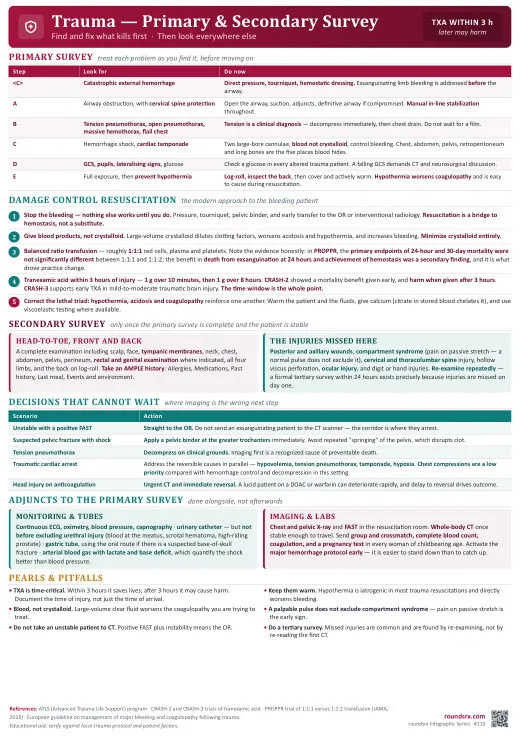
Trauma Primary & Secondary Survey
| Step | Assessment | Interventions |
|---|---|---|
| A -Airway | Patent? Speaking? Stridor? Facial/neck trauma? | Jaw thrust (maintain C-spine), suction, definitive airway if needed |
| B -Breathing | RR, SpO₂, breath sounds bilateral? Tracheal deviation? Chest wall movement? | Needle decompression (tension pneumo), chest tube, seal open pneumo |
| C -Circulation | HR, BP, skin (cool/clammy?), active bleeding? Pelvis stable? | 2 large-bore IVs, tourniquets, pelvic binder, MTP if needed |
| D -Disability | GCS, pupils, gross motor/sensory | Treat ↑ ICP (HOB 30°, mannitol/HTS), identify herniation |
| E -Exposure | Fully undress, log roll, inspect everywhere | Warm blankets, prevent hypothermia |
| Class | Blood Loss | HR | BP | Mental Status |
|---|---|---|---|---|
| I | < 750 mL (15%) | Normal | Normal | Normal |
| II | 750–1500 mL (15–30%) | ↑ (100–120) | Normal | Anxious |
| III | 1500–2000 mL (30–40%) | ↑ (>120) | ↓ | Confused |
| IV | > 2000 mL (>40%) | ↑ (>140) | ↓↓ | Obtunded |
| Component | Response | Score |
|---|---|---|
| Eye Opening (E) | Spontaneous | 4 |
| To voice | 3 | |
| To pain | 2 | |
| None | 1 | |
| Verbal (V) | Oriented | 5 |
| Confused | 4 | |
| Inappropriate words | 3 | |
| Incomprehensible sounds | 2 | |
| None | 1 | |
| Motor (M) | Obeys commands | 6 |
| Localizes pain | 5 | |
| Withdraws from pain | 4 | |
| Abnormal flexion (decorticate) | 3 | |
| Extension (decerebrate) | 2 | |
| None | 1 |
- FAST exam -Focused Assessment with Sonography in Trauma. 4 views: RUQ, LUQ, subxiphoid, suprapubic. Identifies free fluid.
- CXR (AP supine) -pneumothorax, hemothorax, mediastinal widening
- Pelvic XR -pelvic fracture (hemodynamic instability source)
- Foley -urine output monitoring (do NOT place if blood at meatus, high-riding prostate, scrotal hematoma)
- NGT/OGT -decompress stomach. OGT if midface fracture suspected.
| Phase | Goal | Key Actions |
|---|---|---|
| Phase 1: OR | Stop hemorrhage, limit contamination | Abbreviated surgery: pack bleeding, ligate vessels, staple bowel, temporary abdominal closure |
| Phase 2: ICU | Correct lethal diamond | Rewarm (target ≥ 36°C), correct acidosis (resuscitate), fix coagulopathy (products), replace calcium |
| Phase 3: Return to OR | Definitive repair | Remove packing, definitive vascular repair, bowel anastomosis, abdominal closure (24-72h later) |
- FAST exam -bedside, during primary survey
- CXR, pelvic XR
- CT pan-scan (head, C-spine, chest, abdomen/pelvis with IV contrast) -stable patients
- CBC, BMP, coags, type & crossmatch, lactate, ABG
- Urine drug screen, blood alcohol, pregnancy test
- Tetanus status
| Drug | Dose | Purpose |
|---|---|---|
| Tranexamic Acid (TXA) | 1g IV over 10 min → 1g over 8h | Antifibrinolytic -within 3h of injury |
| pRBC / FFP / Platelets | 1:1:1 ratio | MTP for hemorrhagic shock Class III–IV |
| Ketamine (Ketalar) | 1–2 mg/kg IV | RSI induction -hemodynamically stable, bronchodilator |
| Rocuronium (Zemuron) | 1.2 mg/kg IV | Paralytic for RSI -longer duration but sugammadex reversible |
| Norepinephrine (Levophed) | 0.1–0.5 mcg/kg/min | Vasopressor -AFTER volume resuscitation, not as substitute |
Patient: 28M MVC unrestrained driver, GCS 13 (E3V4M6). HR 132, BP 78/42, RR 28. Distended abdomen, pelvic instability on exam. FAST positive (Morrison's pouch).
Key findings: Class IV hemorrhagic shock (tachycardic, hypotensive, AMS). FAST positive = intra-abdominal hemorrhage. Unstable pelvis = likely pelvic fracture with venous plexus bleeding.
Management:
- Activate massive transfusion protocol, 1:1:1 (pRBC:FFP:platelets) PROPPR, 2015
- Pelvic binder immediately (reduces venous bleeding volume by ~50%)
- TXA 1g IV over 10 min → 1g over 8h (must give within 3h of injury) CRASH-2, 2010
- Permissive hypotension: target SBP 80-90 until surgical control
- OR for exploratory laparotomy, damage control surgery
Teaching point: In penetrating/blunt trauma with hemorrhagic shock, the ED goal is stop the bleeding, not normalize vitals with crystalloid. Crystalloid worsens coagulopathy, hypothermia, and acidosis.
Patient: 35F stab wound to left chest. Initially stable, now HR 140, BP 62/40, SpO₂ 82%. Absent breath sounds on left. Tracheal deviation to the right. JVD.
Key findings: Classic tension pneumothorax: hypotension + absent breath sounds + tracheal deviation + JVD. This is a clinical diagnosis, do NOT wait for CXR.
Management:
- Needle decompression IMMEDIATELY, 14g angiocath, 2nd intercostal space midclavicular line (or 5th ICS anterior axillary)
- Follow with tube thoracostomy (chest tube 28-32 Fr) in left 5th ICS anterior axillary line
- Reassess: expect rapid improvement in BP and SpO₂ after decompression
- If persistent hemorrhage (> 1500 mL initial output or > 200 mL/hr) → thoracotomy
- Serial CXR to confirm lung re-expansion
Teaching point: Tension pneumothorax is a clinical diagnosis treated before imaging. The classic triad (hypotension, absent breath sounds, tracheal deviation) may not all be present, decompress based on high clinical suspicion.
Patient: 55M fall from ladder, GCS 7 (E1V2M4). Right pupil 6 mm fixed. Left-sided hemiplegia. HR 58, BP 190/100. CT: right-sided epidural hematoma with 8 mm midline shift.
Key findings: Cushing triad (HTN + bradycardia + irregular breathing) = elevated ICP. Ipsilateral fixed dilated pupil + contralateral hemiplegia = uncal herniation. Epidural = "talk and die" lesion if not evacuated.
Management:
- Intubate for airway protection (GCS ≤ 8), avoid hypotension during RSI
- Mannitol 1 g/kg IV or hypertonic saline 23.4% 30 mL IV push (temporizing for herniation)
- Emergent neurosurgery consult for craniotomy and evacuation
- Target SBP > 100 (avoid hypotension, single episode doubles mortality in TBI)
- Head of bed 30°, avoid hyperthermia, maintain PaCO₂ 35-40 mmHg
Teaching point: In TBI, the secondary injury (hypotension, hypoxia, hyperthermia) is preventable. Maintaining SBP > 100 and SpO₂ > 90% is the single most impactful intervention for TBI outcomes.