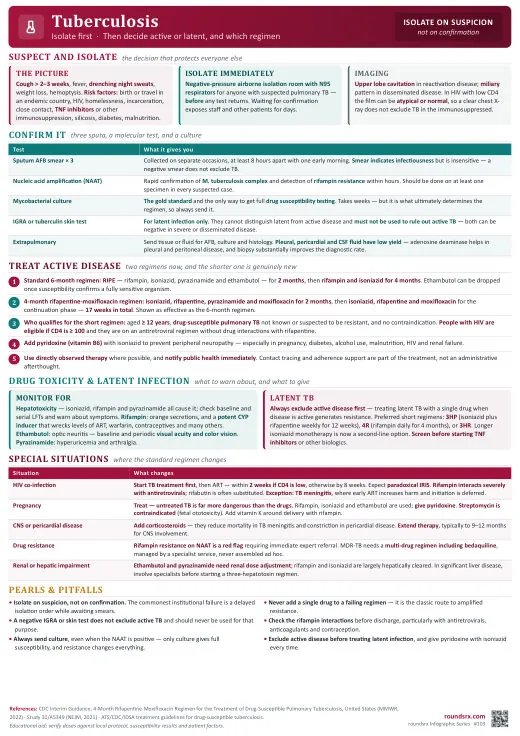
Tuberculosis
| Feature | Latent TB (LTBI) | Active TB |
|---|---|---|
| Symptoms | None | Cough > 2–3 wks, hemoptysis, fever, night sweats, weight loss |
| CXR | Normal | Upper lobe cavitary lesions, infiltrates, hilar LAD, Ghon complex |
| AFB smear | Negative | May be positive (3 sputum samples) |
| Infectious | No | Yes -airborne isolation required |
| PPD/IGRA | Positive | Usually positive (can be negative if immunosuppressed) |
| Site | Presentation | Diagnosis |
|---|---|---|
| TB Meningitis | Subacute headache, cranial nerve palsies, basilar meningitis | CSF: lymphocytic, low glucose, high protein. NAAT on CSF. |
| Miliary TB | Disseminated, diffuse millet-seed nodules on CXR. Immunosuppressed patients. | Culture blood, urine, bone marrow. |
| TB Lymphadenitis (Scrofula) | Painless cervical LAD, most common extrapulmonary TB | FNA with AFB/culture. |
| Vertebral (Pott Disease) | Back pain, paraspinal abscess. Can cause cord compression. | MRI spine. |
| Pleural TB | Exudative effusion, lymphocytic, high ADA (>40) | Pleural biopsy most sensitive. |
| Pericardial TB | Effusion, may cause tamponade. Common in HIV+. | Pericardial fluid culture, biopsy. |
| Renal TB | Sterile pyuria, hematuria | Urine AFB cultures. |
| GI TB | Mimics Crohn disease. Ileocecal region most common. | Colonoscopy with biopsy, AFB culture. |
- Rifampin = Red/orange body fluids
- INH = Injury to liver (hepatotoxicity) + Injury to nerves (peripheral neuropathy)
- Pyrazinamide = Painful joints (hyperuricemia/gout) + liver Problems
- Ethambutol = Eyes (optic neuritis)
| Drug | Duration | Major Side Effects |
|---|---|---|
| Rifampin (Rifadin) | 6 months | Orange body fluids, hepatotoxicity, drug interactions (CYP450 inducer) |
| Isoniazid (INH) | 6 months | Hepatotoxicity, peripheral neuropathy (give Pyridoxine (Vitamin B6) 25–50 mg daily) |
| Pyrazinamide | 2 months | Hepatotoxicity, hyperuricemia/gout |
| Ethambutol (Myambutol) | 2 months | Optic neuritis -check visual acuity monthly. Red-green color blindness. |
- Isoniazid (INH) 300 mg daily × 9 months (classic regimen)
- Rifampin (Rifadin) 600 mg daily × 4 months (shorter, preferred)
- INH + Rifapentine (Priftin) weekly × 12 weeks (3HP regimen -DOT)
- PPD (tuberculin skin test) -read at 48–72h. Induration (not redness) matters. Cutoff varies by risk.
- IGRA (QuantiFERON, T-SPOT) -blood test, single visit, not affected by BCG vaccination
- CXR -upper lobe infiltrates, cavitary lesions, Ghon/Ranke complex
- 3 sputum AFB smears and cultures -collected 8–24h apart. Culture is gold standard (takes 2–6 wks).
- NAAT (GeneXpert/Xpert MTB/RIF) -rapid PCR, also detects rifampin resistance
- HIV test -all TB patients (TB-HIV coinfection common)
| Cutoff | Population |
|---|---|
| ≥ 5 mm | HIV+, close contacts, immunosuppressed, CXR with old TB, organ transplant recipients |
| ≥ 10 mm | Recent immigrants (< 5 yrs), IVDU, healthcare workers, residents of congregate settings, children < 4 yrs, high-risk medical conditions (diabetes, ESRD, silicosis) |
| ≥ 15 mm | Low-risk individuals with no known TB exposure or risk factors |
| Drug | Dose | Key Monitoring |
|---|---|---|
| Isoniazid (INH) | 5 mg/kg (max 300 mg) daily | LFTs monthly. Give B6 (pyridoxine) to prevent neuropathy. |
| Rifampin (Rifadin) | 10 mg/kg (max 600 mg) daily | LFTs. CYP450 inducer -check all drug interactions. |
| Pyrazinamide | 25 mg/kg daily | LFTs, uric acid (causes hyperuricemia). |
| Ethambutol (Myambutol) | 15–20 mg/kg daily | Visual acuity and color vision monthly. |
| Pyridoxine (Vitamin B6) | 25–50 mg daily | Given with INH to prevent peripheral neuropathy. |
Patient: 34M immigrant, 3-month cough, night sweats, 15 lb weight loss. CXR: upper lobe cavitation. AFB smear 3+ positive. GeneXpert MTB/RIF positive, rifampin sensitive.
Management:
- Airborne precautions - negative pressure room, N95 for all staff
- Start RIPE therapy: Rifampin (Rifadin) + Isoniazid (INH) + Pyrazinamide (PZA) + Ethambutol (Myambutol) × 2 months, then Rifampin + Isoniazid × 4 months
- Add Pyridoxine (B6) 25–50 mg daily with INH to prevent neuropathy
- DOT (directly observed therapy) mandatory - improves adherence, prevents resistance
- Report to health department - legally required for all active TB cases
- HIV test in all TB patients
Key lesson: GeneXpert confirms TB and rules out rifampin resistance within hours. Start RIPE, isolate, report - do all three same day.
Patient: 52F with RA, positive IGRA, no symptoms, normal CXR. About to start Adalimumab (Humira) (anti-TNF biologic).
Management:
- Rule out active disease first - symptom screen + CXR (active TB must be excluded before treating latent)
- Preferred regimen: Rifampin (Rifadin) × 4 months or 3HP - Isoniazid + Rifapentine (Priftin) weekly × 12 doses (directly observed)
- Complete LTBI treatment BEFORE starting biologic - anti-TNF agents profoundly impair granuloma formation, risking TB reactivation
- Minimum 4 weeks of LTBI treatment should precede biologic initiation when possible
Key lesson: Biologic therapy (especially anti-TNF) is a major reactivation risk. Screen with IGRA before every biologic start. Treat and complete LTBI therapy first.
Patient: 28M with known TB, returns after incomplete treatment. GeneXpert and DST: MDR-TB - resistant to both Rifampin and Isoniazid.
Management:
- Infectious disease + public health consultation essential - do not manage MDR-TB alone
- Regimen per WHO 2022 guidance: Bedaquiline (Sirturo) + Linezolid (Zyvox) + Levofloxacin (Levaquin) as core agents
- Minimum 18-month treatment course - substantially longer than drug-sensitive TB
- Monitor for drug toxicities: bedaquiline (QTc prolongation), linezolid (bone marrow suppression, neuropathy), levofloxacin (tendinopathy, QTc)
- Airborne isolation maintained; DOT mandatory throughout
Key lesson: MDR-TB = resistant to rifampin + INH. Treatment is prolonged, toxic, and complex - always requires specialist and public health co-management. Incomplete prior treatment is the #1 driver of drug resistance.