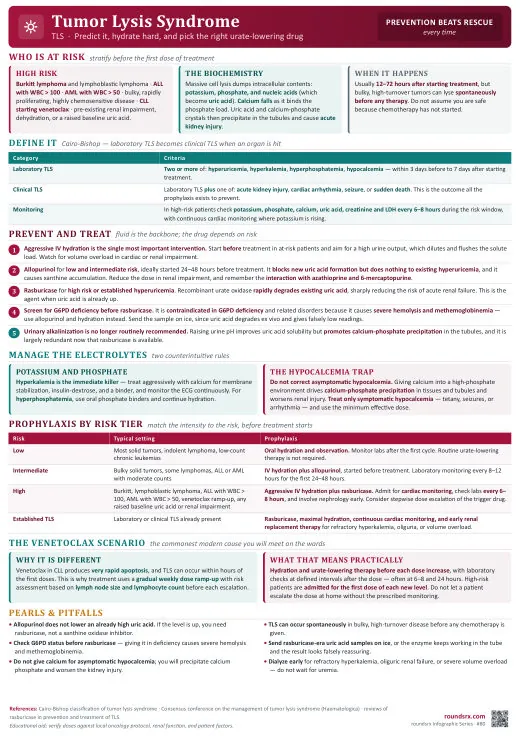
Tumor Lysis Syndrome
| Lab | Direction | Mechanism | Danger |
|---|---|---|---|
| Potassium | ↑↑ | Released from lysed cells | Cardiac arrhythmia → VF → death. Most immediately lethal. |
| Phosphate | ↑↑ | Released from lysed cells | Binds calcium → calcium phosphate deposition in kidneys → AKI |
| Calcium | ↓↓ | Bound by elevated phosphate | Seizures, QT prolongation, tetany |
| Uric acid | ↑↑ | Purine breakdown from nucleic acids | Crystal deposition in renal tubules → AKI |
- Highest risk: ALL (especially B-cell), Burkitt lymphoma, DLBCL (high LDH, bulky disease)
- Moderate risk: AML (high WBC > 100K), CLL treated with venetoclax
- Lower risk: most solid tumors (rare but can occur with highly chemo-sensitive tumors)
| Intervention | Dose | Notes |
|---|---|---|
| Aggressive IVF ALL PATIENTS | 2–3 L/m²/day NS (goal UOP 2 mL/kg/hr) | Start 24–48h before chemo. Dilutes uric acid + phosphate. Most important prevention. |
| Allopurinol (Zyloprim) MODERATE RISK | 300–600 mg PO daily | Prevents new uric acid formation (xanthine oxidase inhibitor). Does NOT break down existing uric acid. Start 1–2 days before chemo. |
| Rasburicase (Elitek) HIGH RISK | 0.2 mg/kg IV × 1 dose (or fixed 3–6 mg) | Recombinant uricase -rapidly breaks down existing uric acid. Works within hours. Rasburicase TLS Trial, 2001 CONTRAINDICATED in G6PD deficiency (hemolytic crisis -produces H₂O₂). Check G6PD before giving if possible. Falsely lowers uric acid if sample is not kept on ice. |
- Hyperkalemia: treat per hyperkalemia protocol (calcium, insulin/glucose, patiromer (Veltassa)/Lokelma, dialysis if refractory)
- Hyperphosphatemia: phosphate binders (sevelamer, aluminum hydroxide short-term), aggressive IVF, dialysis if severe
- Hypocalcemia: only treat if symptomatic (seizures, tetany, QT prolongation). Do NOT aggressively replete calcium -it worsens calcium-phosphate precipitation in kidneys
- Hyperuricemia: rasburicase (if not already given), aggressive IVF
- AKI: IVF,
- K⁺, PO₄, Ca²⁺, uric acid, Cr -the "TLS panel." Check q6-8h starting 12-24h before chemotherapy in high-risk tumors. Cairo-Bishop criteria: lab TLS = ≥ 2 of: K⁺ ≥ 6, PO₄ ≥ 4.5, Ca²⁺ ≤ 7, uric acid ≥ 8 (or 25% change from baseline).
- LDH -reflects tumor cell lysis and disease burden. Markedly elevated LDH pre-chemo = high TLS risk.
- Cr + BUN -AKI from uric acid crystallization in renal tubules (urate nephropathy) and calcium-phosphate precipitation.
- ECG -critical. Hyperkalemia (peaked T waves, widened QRS → fatal arrhythmia) and hypocalcemia (QTc prolongation → torsades). Get ECG before and after each lab check.
- Urine output -track hourly. Target ≥ 2 mL/kg/hr with aggressive hydration. Oliguria = urate nephropathy → may need dialysis.
- G6PD level -check BEFORE giving rasburicase. Rasburicase causes severe hemolytic anemia in G6PD-deficient patients (hydrogen peroxide accumulation). Prevalence: ~10% in African American males.
- Risk stratification: High risk = ALL, Burkitt lymphoma, DLBCL with bulky disease + high LDH, WBC > 100K in AML. Intermediate = most AML, CLL with high WBC. Low = most solid tumors, indolent lymphoma.
| Drug | Dose | Route | Notes |
|---|---|---|---|
| Rasburicase | 0.2 mg/kg IV × 1 dose | IV | Treatment of established TLS -converts uric acid → allantoin (highly soluble) Rasburicase TLS Trial, 2001. Onset within hours. Contraindicated in G6PD deficiency (severe hemolysis). Must put blood sample on ice immediately (rasburicase degrades uric acid in tube → falsely low reading). |
| Allopurinol | 300-600 mg PO daily (start 2-3 days before chemo) | PO | PROPHYLAXIS ONLY -does NOT treat established TLS. Xanthine oxidase inhibitor -prevents NEW uric acid formation but does not break down existing uric acid. Dose-reduce in CKD. |
| IV fluids (NS or D5W) | 200-250 mL/hr (3 L/m²/day) | IV | Aggressive hydration is the foundation. Start 24-48h before chemo. Target UOP ≥ 2 mL/kg/hr. Promotes renal uric acid excretion + prevents crystal precipitation. |
| Sevelamer | 800 mg PO TID with meals | PO | Phosphate binder for hyperphosphatemia. Avoid calcium-based binders (calcium carbonate, calcium acetate) -risk of CaPO₄ precipitation in tissues with already elevated PO₄ + Ca product. |
| Calcium gluconate | 1-2g IV over 10-20 min | IV | ONLY for symptomatic hypocalcemia (seizures, tetany, QTc prolongation). Avoid routine correction -exogenous calcium + high PO₄ → tissue calcification. |
| Insulin + D50 | 10 units regular insulin + 25g dextrose | IV | For hyperkalemia. Intracellular potassium shift. Check glucose at 1h. Use alongside calcium gluconate for membrane stabilization if ECG changes. |
| Kayexalate or patiromer | 15-30g PO or 8.4g PO | PO | GI potassium elimination for persistent hyperkalemia. Slow onset (hours). Not a substitute for insulin + calcium in acute setting. |
Patient: 19M newly diagnosed B-ALL, WBC 142K, LDH 2800, uric acid 9.8, Cr 1.4, K⁺ 5.2, PO₄ 5.8. Starting induction chemotherapy tomorrow.
Key findings: Very high TLS risk: ALL + WBC > 100K + elevated LDH + elevated uric acid + elevated PO₄ baseline. Cairo-Bishop criteria for laboratory TLS likely already met. Chemo will cause massive cell lysis.
Management:
- Rasburicase 0.2 mg/kg IV × 1 dose (uricase, enzymatically degrades uric acid, onset within hours)
- Aggressive IVF: D5W + NS at 200 mL/hr (target UOP > 2 mL/kg/hr, flushes uric acid and phosphate)
- Do NOT give allopurinol if giving rasburicase (allopurinol prevents uric acid formation; rasburicase degrades existing uric acid, allopurinol is the backup, not add-on)
- Monitor: BMP + uric acid + LDH + PO₄ q6h for first 72h after chemo starts
- Dialysis standby if K⁺ > 6 refractory to medical management or Cr doubling
Teaching point: Rasburicase is contraindicated in G6PD deficiency, it generates hydrogen peroxide during uric acid degradation, causing hemolytic anemia. Always check G6PD before giving rasburicase. Also: rasburicase degrades uric acid in the blood tube ex vivo, send samples on ice for accurate levels.
Patient: 55M with Burkitt lymphoma, 24h after starting R-CHOP. K⁺ 7.1, PO₄ 8.4, uric acid 14.2, Ca 6.8, Cr 4.2 (was 1.0). ECG: peaked T waves, widened QRS. Oliguric.
Key findings: Clinical TLS (laboratory TLS + organ dysfunction): hyperkalemia with ECG changes + AKI + hypocalcemia (from calcium-phosphate precipitation in renal tubules). Life-threatening emergency.
Management:
- Calcium gluconate 3g IV (membrane stabilization for hyperkalemia, do NOT correct hypocalcemia aggressively as this worsens Ca×PO₄ precipitation)
- Insulin 10 U + D50 (shift K⁺), albuterol 20 mg nebulized
- Emergent hemodialysis, most effective treatment for TLS with AKI (removes K⁺, PO₄, uric acid simultaneously)
- Rasburicase 0.2 mg/kg IV if not already given
- IVF if any UOP remaining; sevelamer for phosphate binding
Teaching point: In TLS, do NOT aggressively correct hypocalcemia unless symptomatic (tetany, seizures, QTc prolongation), giving IV calcium in the setting of hyperphosphatemia causes calcium-phosphate precipitation in kidneys and tissues, worsening AKI. Lower the phosphate first.
Patient: 42F presents with fatigue, found to have WBC 280K with 92% blasts (AML). Before any treatment: K⁺ 6.4, PO₄ 6.8, uric acid 12.4, LDH 4200, Cr 3.1. Ca 7.2.
Key findings: Spontaneous TLS, occurs before any chemotherapy due to rapid tumor cell turnover and death from massive tumor burden. Seen in highly proliferative cancers with very high WBC or bulky disease.
Management:
- Rasburicase 0.2 mg/kg IV STAT (most urgent, uric acid nephropathy is the primary driver of AKI in spontaneous TLS)
- Aggressive IVF 200-250 mL/hr targeting UOP > 2 mL/kg/hr
- Treat hyperkalemia aggressively (calcium gluconate, insulin/D50, dialysis if refractory)
- Must still start chemotherapy, delaying treatment allows tumor to keep lysing spontaneously
- Leukapheresis if WBC > 100K with leukostasis symptoms (addresses both leukostasis and TLS risk)
Teaching point: TLS can occur BEFORE chemotherapy in highly proliferative tumors. Any patient with WBC > 100K or LDH > 2× ULN should have TLS labs checked at presentation. Spontaneous TLS is actually a predictor of chemosensitivity, these tumors are dying fast on their own.
- K⁺, PO₄, Ca²⁺, uric acid, Cr q6-8h -for first 48-72h after chemo initiation. High-risk patients may need q4h monitoring initially.
- ECG -before each lab check. Hyperkalemia (peaked T → wide QRS → sine wave) and hypocalcemia (prolonged QTc) are immediately life-threatening.
- Urine output hourly -target ≥ 2 mL/kg/hr. Falling UOP = urate nephropathy or CaPO₄ precipitation → nephrology consult for possible dialysis.
- LDH trending -should decline after initial surge. Persistent elevation → ongoing tumor lysis.
- Fluid balance -aggressive IVF can cause volume overload, especially in patients with impaired renal or cardiac function. Daily weights + I/Os.
- Dialysis indications: refractory hyperkalemia, severe oliguria/anuria, volume overload unresponsive to diuretics, symptomatic hypocalcemia with concurrent hyperphosphatemia (can't give Ca safely)
- Ca × PO₄ product -if > 60 → high risk of metastatic calcification. Prioritize phosphate lowering.
Text version
- Allopurinol for established TLS (doesn't break down existing uric acid)
- IV calcium for hypocalcemia (CaPO₃ precipitation → renal damage)
- Not monitoring labs q6-8h after chemo in high-risk tumors
- Rasburicase in G6PD deficiency (hemolysis)