Upper GI Bleed (UGIB)
- Peptic ulcer disease (most common -40–50%) -H. pylori, NSAIDs, stress
- Mallory-Weiss tear (retching → gastroesophageal junction tear)
- Gastritis / duodenitis
- Dieulafoy lesion (large submucosal artery)
- Upper GI malignancy
- Esophageal varices (portal hypertension from cirrhosis)
- Gastric varices
- Higher mortality, requires different initial management (octreotide + antibiotics)
- CBC -Hgb/Hct (may be normal initially -equilibration takes hours), platelets
- BMP -BUN (elevated in UGIB from digestion of blood -BUN:Cr > 20:1 = UGIB), creatinine
- Coags -PT/INR, PTT, fibrinogen (especially if cirrhosis or on anticoagulants)
- Type & Screen -always. Type & Cross if actively bleeding
- LFTs -cirrhosis workup if variceal source suspected
- Nasogastric lavage -controversial; positive (bloody or coffee-ground aspirate) confirms UGIB; negative does not rule out (30% false negative if duodenal source)
- EGD (upper endoscopy) -diagnostic and therapeutic; perform within 24 hours (within 12h if hemodynamically unstable or actively bleeding)
Patient: 58M on aspirin + clopidogrel (Plavix), presents with melena × 2 days, hematemesis in ED. HR 112, BP 88/54, Hgb 6.8.
Immediate resuscitation:
- 2 large-bore IVs (18G or larger). Type & crossmatch.
- IV LR bolus 1L. Transfuse 2 units pRBC (Hgb < 7, hemodynamically unstable).
- NPO. Proton pump inhibitor: pantoprazole (Protonix) 80mg IV bolus → 8mg/hr drip.
- Hold aspirin and clopidogrel -discuss with cardiology (balancing GI bleed vs stent thrombosis risk).
- Octreotide (Sandostatin) 50mcg IV bolus → 50mcg/hr IF variceal bleed suspected (cirrhosis, known varices). Add ceftriaxone (Rocephin) 1g IV daily for SBP prophylaxis.
- GI consult for EGD within 24h (within 12h if hemodynamically unstable after resuscitation).
Post-EGD: Ulcer with visible vessel found and clipped. Continue PPI IV drip × 72h → then PO PPI BID. Resume aspirin in 3-5 days (cardiovascular benefit > rebleed risk if indicated). Clopidogrel -discuss with cards about timing.
Glasgow-Blatchford Score: Determines need for intervention. Score 0 = safe for outpatient management. This patient scores high → inpatient + urgent EGD.
Patient: 52M with cirrhosis (Child-Pugh C), presents with hematemesis of bright red blood. HR 128, BP 78/44.
Management:
- Octreotide drip: 50 mcg IV bolus → 50 mcg/hr (reduces portal pressure).
- Ceftriaxone 1g IV daily, antibiotic prophylaxis in cirrhotics with GI bleed (reduces mortality).
- Restrictive transfusion: target Hgb 7. Avoid over-resuscitation, raises portal pressure → rebleeding.
- Emergent EGD within 12 hours. Band ligation of varices.
- If rebleeding after banding → TIPS (transjugular intrahepatic portosystemic shunt).
Key lesson: In variceal bleeds, octreotide + antibiotics + EGD within 12h. Over-transfusing KILLS, target Hgb 7, not 10.
Patient: 75F on apixaban for AFib, presents with painless bright red blood per rectum × 6 hours. HR 95, BP 110/68, Hgb 8.2.
Management:
- Hold apixaban. IV fluids, type and crossmatch.
- No need for FFP/PCC unless actively hemorrhaging and hemodynamically unstable.
- Colonoscopy within 24h → diverticular bleed identified → endoscopic clipping.
- If massive ongoing bleed → CT angiography → IR embolization.
- Resume anticoagulation in 7 days (balancing stroke risk vs rebleed risk).
Key lesson: Most lower GI bleeds stop spontaneously. Colonoscopy within 24h is diagnostic. Don't forget to restart anticoagulation, stroke risk often outweighs rebleed risk.
| Drug | Dose | Indication | Notes |
|---|---|---|---|
| Pantoprazole (Protonix) | 80 mg IV bolus → 8 mg/hr × 72h | Non-variceal UGIB (high-risk) | Raises gastric pH → stabilizes clot. Start before EGD empirically. Switch to oral after 72h. |
| Octreotide (Sandostatin) | 50 mcg IV bolus → 50 mcg/hr × 3–5 days | Variceal UGIB | ↓ Splanchnic blood flow → ↓ portal pressure. Start as soon as variceal source suspected. Continue 3–5 days post-banding. |
| Ceftriaxone (Rocephin) | 1 g IV daily × 7 days | Variceal UGIB (cirrhosis) | Prophylaxis against SBP and bacterial infections. Significantly reduces mortality. Start with octreotide immediately. |
| FFP / Vitamin K | FFP 2–4 units; Vit K 10 mg IV | Coagulopathy (INR > 1.5–2) | Reverse anticoagulation before endoscopy if significant coagulopathy. Vit K for warfarin reversal. 4-factor PCC if urgent. |
| PRBCs | Transfuse to Hgb 7–9 g/dL | Hemodynamically significant bleed | Restrictive transfusion (target Hgb 7) TRIGGER, 2015. Exception: ACS/active cardiac disease -target 8–9. |
Patient: 52M with alcohol-related cirrhosis (Child-Pugh C), presents with large-volume hematemesis and melena. History of prior variceal bleed 1 year ago, non-compliant with nadolol.
Key findings: HR 128, BP 78/44, Temp 37.8°C, SpO2 94%. Distended abdomen with fluid wave. Hgb 6.2, platelets 62K, INR 1.8, Cr 1.9, lactate 5.1. Glasgow-Blatchford score: 17 (high risk).
Management:
- 2 large-bore IVs, type and crossmatch, transfuse pRBCs target Hgb 7 (restrictive strategy) Villanueva, 2013
- Octreotide 50 mcg IV bolus then 50 mcg/hr drip x 3-5 days (start BEFORE endoscopy)
- Ceftriaxone 1g IV daily x 7 days (antibiotic prophylaxis in cirrhotic GI bleed reduces mortality)
- Urgent EGD within 12h for band ligation. If bleeding uncontrolled: Blakemore tube as bridge to TIPS
Teaching point: In variceal bleeding, the triad is: restrictive transfusion (Hgb 7), octreotide, and antibiotics. Over-transfusion increases portal pressure and worsens bleeding.
Patient: 71F with Afib on apixaban 5 mg BID and aspirin 81 mg daily (recent drug-eluting stent 3 months ago), presents with coffee-ground emesis and black tarry stools x 2 days.
Key findings: HR 102, BP 108/62, Hgb 7.8 (baseline 12.4), BUN 48, Cr 1.1. Glasgow-Blatchford score: 12. EGD: 1.5 cm duodenal ulcer with visible vessel (Forrest IIa).
Management:
- Hold apixaban and aspirin. Consider andexanet alfa only if life-threatening bleed requiring emergent intervention
- IV PPI: pantoprazole 80 mg bolus then 8 mg/hr drip x 72h after endoscopic hemostasis
- EGD within 24h: dual therapy (epinephrine injection + thermal coagulation or clips) for Forrest Ia, Ib, IIa
- Restart apixaban within 7 days (delay increases stroke risk more than bleed risk). Resume aspirin only if < 6 months post-stent
Teaching point: The decision to restart anticoagulation after GI bleed is critical. Delaying beyond 7 days significantly increases thromboembolic events. IV PPI drip is only indicated after endoscopic therapy for high-risk ulcer stigmata.
Patient: 34M with no significant PMH, presents to ED with one episode of coffee-ground emesis after heavy NSAID use for back pain. No hemodynamic instability, no melena.
Key findings: HR 76, BP 128/78, Hgb 14.2. BUN/Cr normal. Glasgow-Blatchford score: 0 (HR < 100, Hgb > 13 in male, BUN < 18.2, SBP > 109, no syncope/melena/liver disease/heart failure).
Management:
- Glasgow-Blatchford score of 0 = very low risk. Can safely discharge with outpatient EGD Stanley, 2009
- Start PO PPI: pantoprazole 40 mg BID. Stop NSAIDs. Outpatient EGD within 1-2 weeks
- H. pylori testing at time of EGD. If positive, triple therapy for eradication
- Return precautions: hematemesis, melena, lightheadedness, syncope
Teaching point: Glasgow-Blatchford score of 0 identifies patients who can be safely discharged. It outperforms clinical judgment for identifying low-risk patients who do not need admission or urgent endoscopy.
| Parameter | Frequency | Target / Action |
|---|---|---|
| Vitals | q4h floor, q1–2h ICU | HR, BP, RR, SpO₂, Temp -notify for significant deviations |
| Labs (BMP, CBC) | Daily AM or as indicated | Trend Cr, K⁺, WBC, Hgb -adjust treatment based on trajectory |
| Disease-specific markers | Per clinical context | See Overview and Management tabs for condition-specific targets |
| I&Os | Strict if volume-sensitive | UOP ≥ 0.5 mL/kg/hr. Net fluid balance guides diuresis or resuscitation. |
| Telemetry | Continuous if indicated | Arrhythmia detection. Discontinue when no longer indicated (reduces alarm fatigue). |
| Clinical response | Each assessment | Symptom improvement, functional status, appetite, mental status -the exam matters more than labs |
Text version
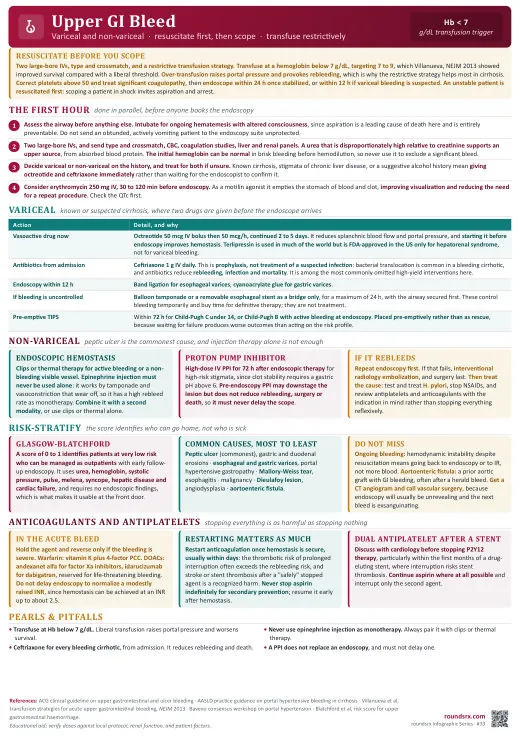
- PUD (most common)
- Mallory-Weiss tear
- Rx: IV pantoprazole 80 mg → 8 mg/hr
- EGD within 24h (12h if unstable)
- Treat H. pylori
- Portal hypertension (cirrhosis)
- Start immediately: Octreotide 50 mcg → 50 mcg/hr
- Antibiotics: Ceftriaxone 1g IV daily × 7 days
- EGD with band ligation
- TIPS if refractory
- BUN:Cr > 20:1
- Blood digested as protein
- Confirms UGIB source
- Target Hgb 7–9 TRIGGER, 2015
- Restrictive = better survival
- ACS: target Hgb 8–9
- Over-transfusing variceal bleed
- No antibiotics in cirrhotic
- Scoping unstable patient