Urinary Incontinence
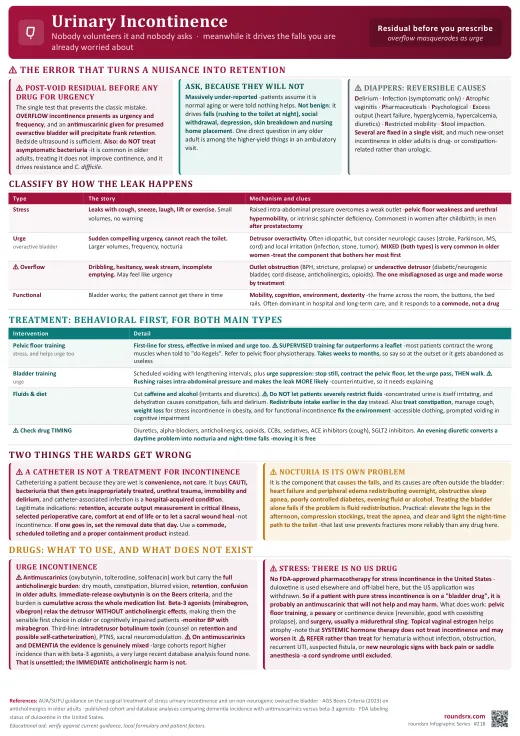
| Type | The story | Mechanism and clues |
|---|---|---|
| Stress | Leaks with coughing, sneezing, laughing, lifting or exercise. Small volumes, no warning | Increased intra-abdominal pressure overcomes a weak outlet -pelvic floor weakness and urethral hypermobility, or intrinsic sphincter deficiency. Commonest in women after childbirth, and in men after prostatectomy. |
| Urge overactive bladder | Sudden compelling urgency, cannot reach the toilet in time. Larger volumes, with frequency and nocturia | Detrusor overactivity. Often idiopathic, but consider neurologic causes (stroke, Parkinson disease, multiple sclerosis, cord pathology) and local irritation (infection, stone, tumor). |
| Mixed | Features of both | Very common, particularly in older women. Treat the component that bothers the patient most first, rather than trying to fix both at once. |
| ⚠ Overflow | Constant dribbling, incomplete emptying, hesitancy, weak stream. May feel like urgency | Either outlet obstruction (benign prostatic hyperplasia, stricture, severe prolapse) or an underactive detrusor (diabetic or other neurogenic bladder, spinal cord disease, and drugs -anticholinergics and opioids). This is the one that gets misdiagnosed as urge and made worse by treatment. |
| Functional | The bladder works; the patient cannot get there in time | Mobility, cognition, environment or dexterity -the walking frame across the room, the buttons, the bed rails, the unfamiliar ward. Frequently the dominant factor in hospital and long-term care, and the one that responds to a commode rather than a drug. |
- Diuretics (volume and urgency), alpha-blockers (can worsen stress incontinence in women by relaxing the outlet), anticholinergics and opioids (retention and overflow), calcium channel blockers (retention and nocturnal diuresis from redistributed edema), sedatives (blunt the arousal that would otherwise wake them), ACE inhibitors (cough provoking stress leakage), and SGLT2 inhibitors and poorly controlled diabetes (osmotic diuresis).
- Review the timing as well as the drug -an evening diuretic dose converts a manageable daytime problem into nocturia and night-time falls. Moving the dose is free.
- A bladder diary over about 3 days is the highest-yield instrument: voided volumes, leak episodes with what provoked them, fluid intake and timing. It frequently reframes the diagnosis, and it quantifies the caffeine and evening fluid load the patient has not thought about.
- Examination: abdominal (palpable bladder), pelvic in women (atrophy, prolapse, pelvic floor strength), prostate in men, a focused neurologic exam including perineal sensation and anal tone where a neurogenic cause is plausible, and an honest assessment of mobility and dexterity.
- Urinalysis to look for infection, hematuria and glycosuria. ⚠ Do not treat asymptomatic bacteriuria -it is common in older adults, treating it does not improve incontinence, and it drives resistance and Clostridioides difficile.
- ⚠ Post-void residual, before starting any drug for urgency. This is the single test that prevents the classic error: overflow presents as urgency and frequency, and an antimuscarinic given for presumed overactive bladder will precipitate frank retention. Bedside ultrasound is sufficient.
- Urodynamics is not routine -reserve it for diagnostic uncertainty, prior anti-incontinence surgery, suspected neurogenic bladder, or before surgical intervention.
- Hematuria without infection, which needs evaluation for malignancy in its own right.
- Persistently elevated post-void residual or suspected obstruction.
- Recurrent urinary tract infection, pelvic pain, or a suspected fistula (continuous leak, especially after pelvic surgery or radiation).
- New neurologic signs, particularly with back pain, saddle anesthesia or bowel involvement -that is a cord syndrome until excluded, not incontinence.
- Significant prolapse, prior pelvic radiation or previous incontinence surgery.
| Intervention | Detail |
|---|---|
| Pelvic floor muscle training stress, and helps urge too | First-line for stress incontinence and effective in mixed and urge as well. Supervised training substantially outperforms a leaflet, because most patients contract the wrong muscles when simply told to "do Kegels" -refer to a pelvic floor physiotherapist where available. Requires weeks to months of consistent practice, so say that at the outset or the patient abandons it as ineffective. |
| Bladder training urge | Scheduled voiding with progressively lengthened intervals, plus urge-suppression technique -stop still, contract the pelvic floor, wait for the urge to pass, then walk rather than rush. Rushing raises intra-abdominal pressure and makes the leak more likely, which is why the instruction is counterintuitive and needs explaining. |
| Fluid and dietary | Reduce caffeine and alcohol, both bladder irritants and diuretics. ⚠ Do not let patients restrict fluids severely -concentrated urine is itself irritating, and dehydration causes constipation, falls and delirium. Redistribute intake toward earlier in the day instead. |
| Weight loss | Genuinely effective for stress incontinence in patients with obesity, by reducing the intra-abdominal pressure load on the pelvic floor. |
| Address the modifiable | Treat constipation, manage cough, topical vaginal estrogen for atrophy, and for functional incontinence fix the environment -a commode, a clear night-time path, accessible clothing, and prompted voiding in cognitive impairment. |
| Option | Detail |
|---|---|
| ⚠ Antimuscarinics oxybutynin, tolterodine, solifenacin | Effective, but carry the full anticholinergic burden: dry mouth, constipation, blurred vision, urinary retention, and confusion in older adults. Immediate-release oxybutynin is the worst offender and appears on the Beers criteria. Remember the burden is cumulative across the whole medication list -see Deprescribing & Polypharmacy. |
| Beta-3 agonists mirabegron, vibegron | Relax the detrusor without anticholinergic effects, which makes them the more sensible first choice in older adults, in anyone with cognitive impairment, and in patients already carrying anticholinergic load. Monitor blood pressure with mirabegron. |
| Third-line options | When behavioral and drug therapy fail: intradetrusor onabotulinumtoxinA (effective, but counsel about retention and the possible need for self-catheterization), percutaneous tibial nerve stimulation, and sacral neuromodulation. All warrant specialist referral. |
- ⚠ There is no FDA-approved drug for stress incontinence in the United States. Duloxetine is used for it in some countries and off-label here, but the US application was withdrawn. If a patient with pure stress incontinence is on a drug "for their bladder", it is probably an antimuscarinic that will not help and may harm.
- Pelvic floor muscle training is the mainstay, and a pessary or other continence device is a reasonable, reversible option -particularly with coexisting prolapse or where surgery is unwanted.
- Surgery is effective where conservative measures fail, most commonly a midurethral sling. Refer for a proper discussion of benefits and risks rather than presenting it as a last resort.
- Topical vaginal estrogen helps genitourinary atrophy and associated urgency. Note the distinction: systemic hormone therapy does not treat incontinence and may worsen it, whereas low-dose vaginal estrogen is the relevant preparation here.
- Containment products are legitimate care, not failure -pads and appropriate garments preserve dignity and independence while treatment takes effect, or when the patient chooses not to pursue further intervention.
"Mrs. G is a 79-year-old woman who mentioned leaking only when I asked directly, having assumed it was part of aging. Her bladder diary shows sudden urgency with larger-volume leaks, frequency and three episodes of nocturia, so this is predominantly urge incontinence, though she also leaks a little when she coughs, making it mixed. She has fallen twice at night rushing to the bathroom, which is the reason this matters more than she thinks. Before treating I checked a post-void residual, which was 40 mL, so this is not overflow -that mattered because an antimuscarinic in overflow would have precipitated retention. Her urinalysis shows bacteriuria without symptoms, and I am specifically not treating that. Going through DIAPPERS, two things stand out: her furosemide is dosed at 6 pm, which is converting a daytime problem into nocturia and night-time falls, and she has significant constipation. My plan is to move the diuretic to the morning, treat the constipation, refer for supervised pelvic floor training with bladder retraining, and reduce her evening caffeine. If she needs a drug I would choose a beta-3 agonist rather than an antimuscarinic given her age and the fall history, and I would check her blood pressure on it. I have also asked about a commode for the bedroom, since some of this is functional."
- Did you ask? Patients rarely volunteer it, and the diagnosis starts with the question.
- Type classified from how the leak happens, using a 3-day bladder diary rather than recall.
- DIAPPERS run through, with the medication list and dose timing genuinely reviewed.
- ⚠ Post-void residual measured before any drug for urgency.
- Asymptomatic bacteriuria not treated.
- Behavioral therapy offered first, with a referral for supervised pelvic floor training rather than a leaflet, and realistic timelines given.
- If prescribing for urgency: beta-3 agonist preferred in older or cognitively impaired patients; if an antimuscarinic is used, count it against the total anticholinergic burden.
- Red flags checked -hematuria, retention, recurrent infection, neurologic signs, continuous leak.
| Point | Detail |
|---|---|
| Ask directly | Massively under-reported -patients assume it is normal aging. Not benign: drives falls, isolation, depression, skin breakdown and nursing home placement. |
| Classify by the story | Stress = cough, sneeze, lift; small volumes, no warning. Urge = sudden urgency, larger volumes, frequency, nocturia. Mixed = both (common). Overflow = dribbling, hesitancy, incomplete emptying. Functional = bladder fine, cannot get there. |
| ⚠ Post-void residual FIRST | The single test that prevents the classic error: overflow masquerades as urge, and an antimuscarinic will precipitate retention. Bedside ultrasound suffices. |
| Reversible causes | DIAPPERS -Delirium, Infection, Atrophic vaginitis, Pharmaceuticals, Psychological, Excess output, Restricted mobility, Stool impaction. Several fixable in one visit, and new-onset incontinence in older adults is often drug- or constipation-related rather than urologic. |
| Drugs & timing | Diuretics, alpha-blockers, anticholinergics, opioids, calcium channel blockers, sedatives, ACE inhibitors, SGLT2 inhibitors. Check the TIMING too -an evening diuretic creates nocturia and night-time falls, and moving it is free. |
| ⚠ Do not treat | Asymptomatic bacteriuria -common, does not improve continence, drives resistance and C. difficile. |
| First-line is behavioral | Supervised pelvic floor training (far better than a leaflet -most people contract the wrong muscles; takes weeks to months, so say so). Bladder training with urge suppression: stop, contract, let it pass, then walk -rushing raises intra-abdominal pressure and worsens the leak. Cut caffeine and alcohol, but do NOT severely restrict fluids. |
| Urge: drug choice | Beta-3 agonists (mirabegron, vibegron) preferred in older adults -no anticholinergic effect; monitor BP with mirabegron. Antimuscarinics work but bring dry mouth, constipation, retention and confusion; immediate-release oxybutynin is on Beers. Third-line: botulinum toxin (counsel on retention), PTNS, sacral neuromodulation. |
| ⚠ Stress: no US drug | No FDA-approved pharmacotherapy for stress incontinence in the US. Pelvic floor training, pessary, or midurethral sling. If a pure-stress patient is on a "bladder drug", it is likely an antimuscarinic that will not help. |
| Refer | Hematuria without infection, raised residual or obstruction, recurrent infection, pelvic pain, suspected fistula, prolapse, prior pelvic radiation or surgery, and new neurologic signs -that is a cord syndrome until excluded. |
- Ask the question. Nobody volunteers this, and it is quietly causing the falls you are already worried about.
- Check a residual before you prescribe. Treating overflow as urge is the error that turns a nuisance into retention.
- Behavioral therapy first, and beta-3 before antimuscarinic in the old. The drug is rarely where the benefit is.