UTI & Pyelonephritis
The most common bacterial infection in adults. The biggest mistake residents make: treating asymptomatic bacteriuria. A positive UA or culture in a patient without urinary symptoms is NOT a UTI -it's colonization. Don't treat the lab.
🔍 Overview
Classification
| Type | Definition | Treatment Duration |
|---|---|---|
| Uncomplicated cystitis | Lower UTI (dysuria, frequency, urgency) in non-pregnant, premenopausal women with normal urinary tract | 3–5 days |
| Complicated UTI | UTI with: male sex, pregnancy, structural abnormality, catheter, immunosuppression, renal transplant, recent instrumentation | 7–14 days |
| Pyelonephritis | Upper UTI: fever, flank pain, CVA tenderness ± lower urinary symptoms | 5–7 days (outpatient FQ) or 10–14 days (if complicated/inpatient) |
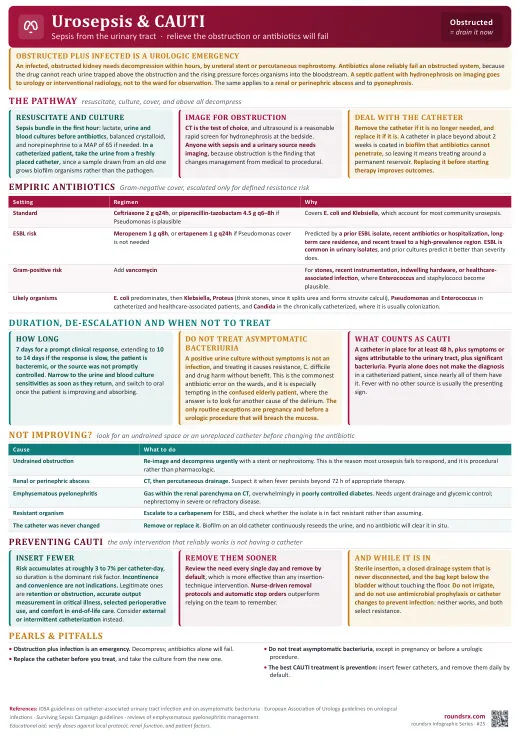
| Catheter-associated UTI (CAUTI) | Catheter in place (or removed within 48h) + symptoms + culture ≥ 10³ CFU/mL. NOT the same as asymptomatic bacteriuria from catheter. | 7 days (remove/replace catheter first) |
Asymptomatic Bacteriuria -Do NOT Treat
Positive UA/culture WITHOUT urinary symptoms = asymptomatic bacteriuria. Do NOT treat. Treating ASB drives antibiotic resistance, C. diff risk, and adverse drug effects without benefit. IDSA, 2019
- Exceptions (treat ASB): pregnancy (risk of pyelonephritis → preterm labor), pre-urologic procedure with mucosal bleeding expected
- Do NOT treat ASB in: elderly, catheterized patients, diabetics, spinal cord injury, nursing home residents -even if pyuria is present
- Pyuria alone is NOT an indication for treatment -it reflects inflammation, not necessarily infection
💊 Management
Empiric Antibiotics
| Diagnosis | First-Line | Alternative | Notes |
|---|---|---|---|
| Uncomplicated cystitis | Nitrofurantoin 100 mg BID × 5 days 1ST LINE | TMP-SMX DS BID × 3 days (if local resistance < 20%). Fosfomycin 3g PO × 1 dose. | Avoid fluoroquinolones for uncomplicated cystitis -FDA warning, collateral damage, save for complicated infections. Nitrofurantoin: avoid if CrCl < 30 (ineffective + toxic). IDSA/ESCMID UTI Guidelines, 2011 |
| Pyelonephritis -outpatient | Ciprofloxacin (Cipro) 500 mg BID × 7 days or levofloxacin (Levaquin) 750 mg daily × 5 days Peterson et al., 2008 | TMP-SMX DS BID × 14 days (if susceptible). Ceftriaxone 1g IM × 1 + oral step-down. | FQs are appropriate here (upper tract). Get urine culture to guide de-escalation. Consider admission if: unable to tolerate PO, sepsis, pregnancy, concern for obstruction. |
| Pyelonephritis -inpatient | Ceftriaxone (Rocephin) 1g IV daily 1ST LINE | Ciprofloxacin 400 mg IV q12h. Piperacillin-tazobactam if MDR risk. Meropenem if ESBL. | Step down to oral once afebrile × 48h and tolerating PO. Total duration depends on oral step-down agent: FQ 5–7 days, TMP-SMX 7–10 days, beta-lactam 10–14 days. CT abdomen if no improvement in 48–72h (abscess? obstruction?). |
| CAUTI | Based on local antibiogram + culture | Broader coverage initially (ceftriaxone or FQ). Narrow based on susceptibilities. | Remove or replace the catheter first -this alone can resolve the infection. Culture from NEW catheter. Duration 7 days. IDSA CAUTI, 2010 Assess if catheter is still needed -remove ASAP. |
ESBL UTI: For uncomplicated ESBL cystitis, nitrofurantoin and fosfomycin retain activity. For ESBL pyelonephritis or complicated UTI, carbapenems (ertapenem, meropenem) are required. Avoid fluoroquinolones even if susceptible in vitro - clinical failure rates are higher with ESBL producers. Doi et al., 2015
Recurrent UTI (>= 3 episodes/year): Evaluate for structural abnormalities (renal ultrasound, post-void residual). Non-antibiotic prevention: vaginal estrogen (postmenopausal, restores lactobacilli and lowers vaginal pH), cranberry products, D-mannose. Antibiotic prophylaxis options: post-coital TMP-SMX, continuous low-dose nitrofurantoin. Set expectations on cranberry: the evidence is mixed. The best-known single RCT was negative Barbosa-Cesnik, 2011, while the pooled Cochrane review does find a modest benefit in women with recurrent UTI Cochrane, 2023. Offer it as a low-harm adjunct, not as established therapy.
Pregnancy UTI: Screen ALL pregnant women for ASB at 12-16 weeks (one of only two situations where ASB requires treatment). Treat with cephalexin, amoxicillin, or nitrofurantoin (avoid in first trimester and at term). Untreated ASB in pregnancy progresses to pyelonephritis in 20-30% of cases. Smaill & Vazquez (Cochrane), 2019
🔄 Updated Practice: Complicated UTI was traditionally defined by a checklist of host factors (male, catheter, pregnant, etc.). The modern definition is simpler: any UTI that extends beyond the bladder. Additionally, asymptomatic bacteriuria should NOT be treated (except in pregnancy and before urologic procedures) -old practice was to treat all positive urine cultures.
📋 On Rounds
An 85-year-old with dementia has a positive UA (leukocyte esterase, bacteria) but no urinary symptoms. Should you treat?
No. This is asymptomatic bacteriuria (ASB). Up to 50% of elderly nursing home residents and 100% of chronically catheterized patients have bacteriuria without true infection. Treating ASB does not reduce mortality, morbidity, or subsequent symptomatic UTIs -but it does increase antibiotic resistance and C. diff risk. The exception: confusion in the elderly is NOT a urinary symptom. AMS + bacteriuria does not automatically = UTI.
Why is moxifloxacin the wrong fluoroquinolone for a UTI?
Only about 20% is excreted unchanged in urine (it is cleared by hepatic conjugation, not filtration), so it never reaches therapeutic urinary concentrations, and UTI is not on its FDA label at all. Use levofloxacin or ciprofloxacin; levofloxacin 750 mg also covers Pseudomonas. See the full comparison →
Why should fluoroquinolones be avoided for uncomplicated cystitis?
FQ's (ciprofloxacin, levofloxacin) carry FDA black box warnings for tendon rupture, peripheral neuropathy, aortic dissection, and CNS effects -risks that are disproportionate for a self-limiting infection like uncomplicated cystitis. Nitrofurantoin or TMP-SMX are equally effective with far less toxicity. FQ's should be reserved for complicated UTIs, pyelonephritis when oral is needed, or resistant organisms.
An elderly patient has a positive urine culture but no urinary symptoms. Should you treat?
NO -this is asymptomatic bacteriuria (ASB), and treating it causes harm. ASB is defined as bacteria in urine without urinary symptoms (dysuria, frequency, urgency, suprapubic pain, fever). Do NOT treat ASB -antibiotics don't improve outcomes and promote resistance + C. diff. This is one of the most common antibiotic stewardship violations. Only 2 exceptions where you DO treat ASB: (1) Pregnancy, untreated ASB progresses to pyelonephritis in 20-30% and is linked to preterm delivery and low birth weight; screen and treat all pregnant women. (2) Before urologic procedures with mucosal trauma (TURP, ureteroscopy with stone manipulation), prevents post-procedure bacteremia and sepsis. Pre-procedure antibiotics only, not chronic treatment.
What antibiotics require dose adjustment in renal failure for UTI, and which don't?
Nitrofurantoin: AVOID if CrCl < 30 (doesn't concentrate in urine → ineffective, and accumulates → peripheral neuropathy). TMP-SMX: avoid if CrCl < 15. Watch for hyperkalemia (trimethoprim blocks ENaC). Ciprofloxacin: reduce to 250 mg BID if CrCl < 30. Ceftriaxone: no adjustment needed (biliary excretion). Fosfomycin: single 3g dose, no adjustment needed, but less effective in complicated UTI.
A patient with uncomplicated cystitis has an E. coli culture showing resistance to TMP-SMX but susceptibility to ciprofloxacin. What is the best treatment?
Still nitrofurantoin 100 mg BID x 5 days. Even with TMP-SMX resistance, the answer for uncomplicated cystitis is NOT fluoroquinolones. Nitrofurantoin remains first-line regardless of TMP-SMX susceptibility. FQs carry FDA black box warnings for tendon rupture, neuropathy, and aortic dissection - risks far exceeding the benefit for a self-limited infection. FQs should be reserved for pyelonephritis or complicated UTI.
How do you distinguish UTI from asymptomatic bacteriuria in a catheterized patient?
Catheterized patients almost universally develop bacteriuria by 5-7 days. CAUTI requires new systemic symptoms (fever > 38C, rigors, altered mental status, hemodynamic instability) plus culture >= 10^3 CFU/mL from a freshly placed catheter. Pyuria alone is NOT diagnostic. The IDSA 2010 CAUTI guidelines emphasize that neither pyuria nor bacteriuria alone warrants treatment. IDSA CAUTI Guidelines, 2010
What is the role of urine culture in uncomplicated cystitis?
No urine culture needed for uncomplicated cystitis - treat empirically. Culture is indicated for: complicated UTI, pyelonephritis, recurrent UTI (>= 3/year), treatment failure, suspected resistant organisms, and male UTI. For uncomplicated cystitis, the AUA/CUA/SUFU 2019 guidelines recommend empiric treatment based on local antibiogram. Culturing every UTI drives unnecessary antibiotic changes and delays treatment.
A patient treated for pyelonephritis remains febrile after 72 hours of appropriate antibiotics. What is the next step?
CT abdomen/pelvis with IV contrast to rule out perinephric abscess, renal abscess, or obstruction (obstructive pyelonephritis/pyonephrosis). Perinephric abscess occurs in ~5% of pyelonephritis cases and requires drainage. Obstructive pyonephrosis is a urologic emergency requiring percutaneous nephrostomy or ureteral stent. Also reassess culture susceptibilities and consider resistant organism or alternative diagnosis.
What is the evidence for short-course antibiotic therapy in UTI?
In adults, short courses hold up. Cystitis: nitrofurantoin 5 days, TMP-SMX 3 days (IDSA/ESCMID 2011). Pyelonephritis in women: ciprofloxacin 7 days is non-inferior to 14 Sandberg, 2012, and levofloxacin 750 mg × 5 days is non-inferior to ciprofloxacin × 10 days Peterson, 2008. Shorter courses cut C. diff risk, resistance, and adverse effects without losing cure rates. Do not extrapolate to children: the SCOUT trial SCOUT, 2023 found 5 days was not non-inferior to 10 in children aged 2 months to 10 years (4.1% vs 0.6% persistent UTI).
Case 1: Complicated Pyelonephritis
Presentation: 45F presents with 2 days of fever (39.2°C), right flank pain, nausea, and dysuria. Labs: WBC 16.2, Cr 1.1. UA: pyuria, positive nitrites, many bacteria. Blood cultures drawn × 2.
Initial Management: Started on ceftriaxone 1g IV daily empirically. IV fluids for hydration. Urine and blood cultures pending.
Hospital Course: Blood cultures return positive for E. coli (pan-sensitive). Urine culture confirms same organism. Sensitivities show susceptibility to TMP-SMX (Bactrim). De-escalated to TMP-SMX DS 1 tab PO BID. Afebrile by 48h. Total antibiotic course: 10-14 days (extended due to bacteremia).
Key Teaching Points: Always obtain blood cultures in pyelonephritis (positive in ~25%). Bacteremia extends duration to 10-14 days. If no clinical improvement by 48-72h → CT abdomen/pelvis to rule out perinephric abscess or obstruction. De-escalate based on sensitivities, not empirically.
Initial Management: Started on ceftriaxone 1g IV daily empirically. IV fluids for hydration. Urine and blood cultures pending.
Hospital Course: Blood cultures return positive for E. coli (pan-sensitive). Urine culture confirms same organism. Sensitivities show susceptibility to TMP-SMX (Bactrim). De-escalated to TMP-SMX DS 1 tab PO BID. Afebrile by 48h. Total antibiotic course: 10-14 days (extended due to bacteremia).
Key Teaching Points: Always obtain blood cultures in pyelonephritis (positive in ~25%). Bacteremia extends duration to 10-14 days. If no clinical improvement by 48-72h → CT abdomen/pelvis to rule out perinephric abscess or obstruction. De-escalate based on sensitivities, not empirically.
Case 2: Catheter-Associated UTI (CAUTI)
Presentation: 70M, post-op day 5 from hip replacement, Foley catheter in place × 5 days. New fever (38.6°C), no other localizing symptoms. UA: positive LE, positive nitrites, WBC > 100. Urine culture: Klebsiella pneumoniae > 100K CFU/mL.
Critical Decision: Is this CAUTI or asymptomatic bacteriuria? With a catheter in place, bacteriuria is nearly universal by day 5. Pyuria alone does NOT indicate infection in catheterized patients. However, this patient has new fever without another source → treat as CAUTI.
Management: Foley removed immediately (or replaced if still needed). Started ceftriaxone 1g IV daily. Narrowed to cephalexin (Keflex) 500 mg PO QID based on sensitivities. Total duration: 7 days (shorter course for CAUTI with prompt catheter removal).
Key Teaching Points: Step 1 is always remove or replace the catheter. Do NOT treat asymptomatic bacteriuria in catheterized patients, it does not reduce complications and promotes resistance + C. difficile. Fever is the most reliable sign of true CAUTI. Duration is 7 days (not 10-14) when catheter is removed promptly.
Critical Decision: Is this CAUTI or asymptomatic bacteriuria? With a catheter in place, bacteriuria is nearly universal by day 5. Pyuria alone does NOT indicate infection in catheterized patients. However, this patient has new fever without another source → treat as CAUTI.
Management: Foley removed immediately (or replaced if still needed). Started ceftriaxone 1g IV daily. Narrowed to cephalexin (Keflex) 500 mg PO QID based on sensitivities. Total duration: 7 days (shorter course for CAUTI with prompt catheter removal).
Key Teaching Points: Step 1 is always remove or replace the catheter. Do NOT treat asymptomatic bacteriuria in catheterized patients, it does not reduce complications and promotes resistance + C. difficile. Fever is the most reliable sign of true CAUTI. Duration is 7 days (not 10-14) when catheter is removed promptly.
Case 3: ESBL-Producing E. coli UTI
Presentation: 32F with history of 4 UTIs in the past year, now presenting with dysuria and frequency × 2 days. No fever, no flank pain. Prior cultures have shown progressively resistant E. coli. Current urine culture: ESBL-producing E. coli, resistant to TMP-SMX, ciprofloxacin, ampicillin, and ceftriaxone. Susceptible to nitrofurantoin, fosfomycin, and carbapenems.
Management (Uncomplicated Cystitis): Since this is uncomplicated lower tract infection, started nitrofurantoin (Macrobid) 100 mg PO BID × 5 days. Nitrofurantoin retains activity against many ESBL organisms for cystitis because it concentrates in urine. Fosfomycin (Monurol) 3g PO × 1 is an alternative.
If This Were Complicated/Pyelonephritis: Would require ertapenem (Invanz) 1g IV daily or meropenem 1g IV q8h. Carbapenems are the backbone for ESBL complicated infections. Avoid fluoroquinolones even if susceptible in vitro, clinical failure rates are higher with ESBL producers.
Key Teaching Points: ESBL cystitis can often be treated with oral agents (nitrofurantoin, fosfomycin). Save carbapenems for complicated or upper tract ESBL infections. Fluoroquinolones should be avoided for ESBL. Consult ID for recurrent ESBL infections, consider suppressive prophylaxis and evaluation for structural abnormalities.
Management (Uncomplicated Cystitis): Since this is uncomplicated lower tract infection, started nitrofurantoin (Macrobid) 100 mg PO BID × 5 days. Nitrofurantoin retains activity against many ESBL organisms for cystitis because it concentrates in urine. Fosfomycin (Monurol) 3g PO × 1 is an alternative.
If This Were Complicated/Pyelonephritis: Would require ertapenem (Invanz) 1g IV daily or meropenem 1g IV q8h. Carbapenems are the backbone for ESBL complicated infections. Avoid fluoroquinolones even if susceptible in vitro, clinical failure rates are higher with ESBL producers.
Key Teaching Points: ESBL cystitis can often be treated with oral agents (nitrofurantoin, fosfomycin). Save carbapenems for complicated or upper tract ESBL infections. Fluoroquinolones should be avoided for ESBL. Consult ID for recurrent ESBL infections, consider suppressive prophylaxis and evaluation for structural abnormalities.
📣 Sample Presentation
One-Liner
"Ms. Chen is a 28-year-old healthy woman presenting with 3 days of dysuria, frequency, and urgency. No fever, no flank pain. UA: positive LE, positive nitrites, WBC 80. Consistent with uncomplicated cystitis."
Key Points to Cover on Rounds
Uncomplicated cystitis in a healthy, non-pregnant female. Treatment: nitrofurantoin 100 mg BID × 5 days (first-line). Avoided fluoroquinolones (FDA black box, disproportionate risk for self-limiting infection). Urine culture sent but treatment is empiric -will adjust only if resistant. No imaging needed. Plan: symptom relief with phenazopyridine 200 mg TID × 2 days, return if fever/flank pain develop (would indicate pyelonephritis).
Monitoring Parameters -Urinary Tract Infections
| Parameter | Frequency | Target / Action |
|---|---|---|
| Symptom resolution | 48-72h after starting antibiotics | Dysuria, frequency, urgency should improve within 48-72h. If not improving → recheck culture, consider resistant organism, imaging for complication (abscess, obstruction). |
| Temperature (pyelonephritis) | q4-8h inpatient | Fever should defervesce within 48-72h on appropriate antibiotics. Persistent fever → CT abdomen/pelvis to rule out perinephric abscess or obstruction. |
| Urine culture results | Check at 48h when available | Narrow antibiotic based on susceptibilities. De-escalate from IV to PO when afebrile 24-48h and tolerating PO. |
| Creatinine | At baseline; repeat if on nephrotoxic agents or pyelonephritis | Monitor for AKI in pyelonephritis. Adjust antibiotic dosing for renal function (nitrofurantoin ineffective if CrCl < 30). |
| Blood cultures (pyelonephritis) | At presentation; no routine repeat | Positive in ~20-30% of pyelonephritis. Guides duration (bacteremia may warrant 10-14 day course). Repeat only if persistent bacteremia suspected. |
Do NOT repeat UA or urine culture for "test of cure." Bacteriuria can persist after successful treatment and does not require retreatment if the patient is asymptomatic. Repeating cultures leads to unnecessary antibiotic courses and C. diff risk.
🧪 Workup
Diagnostic Workup - UTI & Pyelonephritis
Workup depends on UTI classification. Uncomplicated cystitis: UA dipstick sufficient, no culture needed. Complicated UTI/pyelonephritis: UA + urine culture + blood cultures.
| Test | When to Order | Interpretation |
|---|---|---|
| UA dipstick | All suspected UTIs | Leukocyte esterase (sensitivity ~75-96%) and nitrites (specificity ~90% but only detects Enterobacteriaceae). Negative nitrites does NOT rule out UTI. |
| Urine microscopy | Equivocal UA or complicated UTI | WBC > 10/hpf supports UTI. WBC casts suggest pyelonephritis. Bacteria on gram stain corresponds to >= 10^5 CFU/mL. |
| Urine culture | Complicated UTI, pyelonephritis, recurrent UTI, treatment failure, male UTI | >= 10^5 CFU/mL = significant. >= 10^3 CFU/mL with symptoms can be significant (especially CAUTI). Mixed flora suggests contamination - repeat clean catch. |
| Blood cultures | Pyelonephritis, sepsis, complicated UTI | Positive in ~20-30% of pyelonephritis. Same organism as urine confirms source. May extend treatment duration to 10-14 days. |
| CT abdomen/pelvis | No improvement at 48-72h, suspected obstruction or abscess | Rule out perinephric abscess, pyonephrosis, obstructing stone. Contrast required for abscess detection. Stunell et al., 2007 |
| Renal ultrasound | Recurrent UTI, suspected structural abnormality, pregnancy (avoid CT) | Hydronephrosis suggests obstruction. Post-void residual > 200 mL suggests retention. Safe in pregnancy. |
💊 Medications
Antibiotic Therapy -Urinary Tract Infections
Uncomplicated cystitis does NOT require urine culture. Treat empirically. Reserve cultures for complicated UTI, pyelonephritis, recurrent infections, or treatment failure. Always check local antibiogram for resistance patterns.
| Indication | Drug | Dose | Duration | Key Notes |
|---|---|---|---|---|
| Uncomplicated Cystitis | Nitrofurantoin (Macrobid) FIRST-LINE | 100 mg PO BID | 5 days | Avoid if CrCl < 30 (poor urinary concentration). Take with food. Not effective for pyelonephritis (no tissue penetration). |
| TMP-SMX DS (Bactrim) | 1 DS tab PO BID | 3 days | Use only if local E. coli resistance < 20%. Check sulfa allergy. Avoid in 3rd trimester pregnancy. | |
| Fosfomycin (Monurol) | 3g PO × 1 dose | Single dose | Convenient but less effective than multi-day regimens. Good option for MDR organisms (ESBL). Not for complicated UTI. | |
| Pyelonephritis (inpatient) | Ceftriaxone FIRST-LINE | 1g IV daily | Step down to PO when afebrile 24-48h; total duration by PO agent: FQ 5-7d, TMP-SMX 7-10d, beta-lactam 10-14d | Broad GNR coverage. Obtain blood and urine cultures before starting. Transition to PO based on susceptibilities. |
| Ciprofloxacin | 400 mg IV q12h | Step down to PO 500 mg BID; total 5-7 days | Fluoroquinolone -FDA black box warning (tendon, nerve, CNS effects). Use only if no safer alternative. Shorter course (5-7d) if FQ used Sandberg, 2012. | |
| Piperacillin-tazobactam | 3.375g IV q8h (extended infusion) | Narrow when cultures available | Reserve for severely ill or concern for resistant organisms. De-escalate promptly. | |
| Pyelonephritis (outpatient) | Ciprofloxacin | 500 mg PO BID | 5-7 days | Most effective oral option for pyelo. Check local resistance. Give initial dose of ceftriaxone 1g IV/IM if any concern. |
| TMP-SMX DS | 1 DS tab PO BID | 7-14 days | Only if susceptibility confirmed. Give initial parenteral dose (ceftriaxone 1g) for reliable early bactericidal activity. |
Asymptomatic bacteriuria: Do NOT treat except in pregnancy or pre-urologic procedure. Positive UA/culture without dysuria, frequency, or urgency = colonization, not infection. Treating ASB drives resistance and causes C. diff.
⚡ Summary
Summary
Do Not Treat Asymptomatic Bacteriuria
A positive urinalysis or culture without urinary symptoms is colonization. Treating it drives resistance and C. difficile without benefit (IDSA 2019). The only two exceptions are pregnancy and before a urologic procedure with anticipated mucosal bleeding. Pyuria alone is not an indication to treat, and a foul-smelling or cloudy specimen is not a diagnosis.
Do Not Send Urine Reflexively in a Confused Elderly Patient
Bacteriuria is present in a large proportion of older adults and in essentially everyone with a chronic catheter, so a positive culture in a delirious patient is frequently incidental. Look for the real cause of the delirium: attributing it to a UTI is one of the commonest diagnostic anchors in geriatrics.
Classify Before Prescribing
Uncomplicated cystitis: a non-pregnant woman with a normal urinary tract. Complicated: male sex, pregnancy, catheter, obstruction, stones, immunosuppression or a structural or functional abnormality. Pyelonephritis: fever, flank pain, costovertebral angle tenderness, systemic illness. The category sets both the drug and the duration.
First-Line for Uncomplicated Cystitis
Nitrofurantoin for 5 days, TMP-SMX for 3 days where local resistance is under 20%, or single-dose fosfomycin. Avoid fluoroquinolones for simple cystitis: tendon rupture, aortic aneurysm, neuropathy and C. difficile risk make them a poor trade when narrower agents work. Nitrofurantoin does not treat pyelonephritis, because it does not achieve tissue levels.
Pyelonephritis Needs Different Drugs and Longer Courses
Ceftriaxone or another agent with good renal tissue penetration, 7 to 14 days depending on the agent and response. Get blood and urine cultures and admit for vomiting, hemodynamic instability, pregnancy or failure of outpatient therapy. Image if there is no improvement in 48 to 72 h, looking for obstruction or abscess, since an obstructed infected kidney needs urgent decompression, not more antibiotics.
Know What ESBL Changes
For uncomplicated ESBL cystitis, nitrofurantoin and fosfomycin retain activity. ESBL pyelonephritis or complicated infection requires a carbapenem, ertapenem or meropenem. Avoid fluoroquinolones even when they test susceptible, because failure rates are high.
Pregnancy Is the Exception to Almost Every Rule
Screen all pregnant women for asymptomatic bacteriuria at 12 to 16 weeks and treat it, because untreated it progresses to pyelonephritis and preterm labor. Use cephalexin, amoxicillin or nitrofurantoin, avoiding nitrofurantoin in the first trimester and at term, and avoid TMP-SMX in the first trimester and near delivery.
Work Up Recurrence Rather Than Re-Treating It
Three or more episodes a year warrants a renal ultrasound and a post-void residual. Non-antibiotic prevention first: vaginal estrogen in postmenopausal women, which restores lactobacilli and lowers vaginal pH, plus hydration and voiding habits. Remove or exchange a chronic catheter before treating a catheter-associated infection, since the biofilm makes antibiotics alone ineffective.
📄 One Pager
Text version
ID · One Pager
UTI -Cystitis & Pyelonephritis
Cystitis: nitrofurantoin × 5d (avoid FQ). Pyelo: ceftriaxone or cipro. ASB: treat ONLY in pregnancy or pre-urologic surgery. Don't treat pyuria in catheterized patients.
Uncomplicated Cystitis
Dysuria + frequency + urgency in healthy non-pregnant female. Nitrofurantoin 100 BID × 5d (first-line). TMP-SMX × 3d if susceptible. Avoid fluoroquinolones.
Pyelonephritis
Fever + flank pain + CVA tenderness. Ceftriaxone 1g IV (inpatient) or cipro 500 BID × 7d (outpatient, if susceptible). Blood cultures + urine culture. Imaging if not improving at 48-72h.
Asymptomatic Bacteriuria
Do NOT treat ASB -causes harm (resistance + C. diff). Only 2 exceptions: (1) Pregnancy. (2) Pre-urologic procedures with mucosal bleeding. Not in elderly, catheterized, diabetic, or nursing home.
Key Drugs
Nitrofurantoin100 mg BID × 5d
TMP-SMX DS1 tab BID × 3d
Ceftriaxone1g IV daily
Ciprofloxacin500 mg BID × 7d (pyelo)
Pitfalls
- FQ for uncomplicated cystitis (disproportionate risk)
- Treating ASB in elderly/catheterized patients
- Nitrofurantoin if CrCl < 30 (ineffective)
- Not culturing urine in pyelonephritis
Related Topics
Cellulitis & Skin InfectionsCLABSI & Line InfectionsDiabetic Foot InfectionFungal InfectionsHantavirus (HPS & HFRS)Herpes Simplex (HSV)