Valvular Heart Disease
| Parameter | Mild | Moderate | Severe |
|---|---|---|---|
| Aortic valve area (AVA) | > 1.5 cm² | 1.0–1.5 cm² | < 1.0 cm² |
| Mean gradient | < 20 mmHg | 20–40 mmHg | > 40 mmHg |
| Peak velocity | < 3 m/s | 3–4 m/s | > 4 m/s |
- Symptomatic severe AS: any symptom from the classic triad → immediate referral for AVR
- Classic triad (SAD): S yncope (3-year survival without AVR) · A ngina (5-year) · D yspnea/HF (2-year). Once symptoms develop, mortality is 50% at 2 years without surgery.
- Asymptomatic severe AS with EF < 50% → AVR
- TAVR (transcatheter) now approved for all surgical risk categories PARTNER 3, 2019
| Feature | Acute MR | Chronic MR |
|---|---|---|
| Cause | Papillary muscle rupture (post-MI), chordae rupture, endocarditis | Mitral valve prolapse (#1), rheumatic disease, annular dilation from LV dilation |
| LV size | Normal (no time to dilate) | Dilated (volume overload compensated) |
| LA size | Normal → pulmonary edema (no compliance) | Dilated (accommodates regurgitant volume) |
| Murmur | May be soft or absent (equalization of pressures) | Holosystolic at apex, radiates to axilla |
| Treatment | Emergent surgery. Afterload reduction (nitroprusside, IABP) as bridge. | Surgery when: symptomatic, or asymptomatic with EF ≤ 60% or LVESD ≥ 40 mm. MitraClip for high surgical risk. |
| Feature | Acute AR | Chronic AR |
|---|---|---|
| Cause | Endocarditis (valve destruction), aortic dissection, trauma | Bicuspid aortic valve, rheumatic disease, aortic root dilation (Marfan, HTN) |
| LV response | Normal size → cannot accommodate volume → pulmonary edema | Eccentric hypertrophy (LV dilation -"cor bovinum") |
| Pulse pressure | May be narrow (LV can't compensate) | Wide (bounding "water-hammer" pulse, Corrigan pulse, de Musset sign) |
| Murmur | Short early diastolic (equalization) | Blowing early diastolic at LUSB, best heard sitting up and leaning forward |
| Treatment | Emergent surgery. Nitroprusside bridge. IABP is CONTRAINDICATED in AR. | Surgery when symptomatic, or asymptomatic with EF < 55% or LVESD > 50 mm or LVIDd > 65 mm. |
| Feature | Details |
|---|---|
| #1 Cause | Rheumatic heart disease (virtually always). Rare in developed countries now. |
| Pathophysiology | Stenotic MV → ↑ LA pressure → LA dilation → atrial fibrillation → pulmonary HTN → RV failure |
| Murmur | Low-pitched diastolic rumble at apex with opening snap. Best heard in left lateral decubitus. Shorter snap-to-rumble interval = more severe. |
| Key complication | Afib (from LA dilation) → high stroke risk → anticoagulate with warfarin (DOACs inferior in mechanical/rheumatic valvular disease) |
| Severity | Normal MVA ~4–6 cm². Severe MS: MVA < 1.5 cm², mean gradient > 10 mmHg |
| Treatment | Rate control (BB/CCB) + anticoagulation if Afib. Intervention: percutaneous mitral balloon commissurotomy (PMBC) if pliable valve, no significant MR, no LA thrombus. Otherwise → surgical MV replacement. |
| Feature | Details |
|---|---|
| #1 Cause | Functional/secondary -RV dilation from pulmonary HTN, LV failure, or COPD stretches the tricuspid annulus |
| Primary causes | Endocarditis (IVDU -right-sided), Ebstein anomaly, carcinoid, rheumatic, pacemaker leads |
| Murmur | Holosystolic at LLSB. ↑ with inspiration (Carvallo sign) -increased RV venous return augments regurgitant flow |
| Exam findings | Elevated JVP with prominent CV waves, pulsatile liver, peripheral edema, ascites |
| Treatment | Treat the underlying cause (pulmonary HTN, LV failure). Diuretics for volume overload. Surgery rarely needed unless primary TR with severe symptoms. |
| Lesion | Murmur | Timing | Best Heard | Key Maneuver |
|---|---|---|---|---|
| Aortic Stenosis | Crescendo-decrescendo (ejection) | Systolic | RUSB → carotids | ↓ with Valsalva (except HCM) |
| Mitral Regurgitation | Holosystolic (blowing) | Systolic | Apex → axilla | ↑ with handgrip (↑ afterload) |
| Aortic Regurgitation | Early diastolic (blowing, decrescendo) | Diastolic | LUSB, sitting up/leaning forward | Wide pulse pressure, water-hammer pulse |
| Mitral Stenosis | Low-pitched rumble with opening snap | Diastolic | Apex, left lateral decubitus | Louder with exercise (↑ flow) |
| Tricuspid Regurgitation | Holosystolic (blowing) | Systolic | LLSB | ↑ with inspiration (Carvallo sign) |
- New murmur with symptoms (dyspnea, syncope, chest pain)
- Any diastolic murmur (always pathologic)
- Any holosystolic murmur (MR or TR)
- Grade ≥ 3/6 systolic murmur
- Systolic murmur + abnormal symptoms/exam findings
- Known valve disease with change in symptoms
Patient: 76M with progressive dyspnea on exertion and an episode of exertional syncope. Crescendo-decrescendo systolic murmur at RUSB radiating to carotids. Echo: AVA 0.6 cm², mean gradient 48 mmHg, peak velocity 4.5 m/s, EF 55%.
Key findings: Symptomatic severe AS (SAD triad: Syncope, Angina, Dyspnea). Once symptoms develop, mortality without intervention: syncope = 3-year, angina = 5-year, HF = 2-year median survival.
Management:
- Immediate referral for aortic valve replacement, do NOT delay
- Heart team discussion: TAVR vs SAVR. TAVR now approved for all surgical risk categories PARTNER 3, 2019
- TAVR preferred if: age > 65, high surgical risk, no bicuspid valve. SAVR preferred if: age < 50, bicuspid, concomitant CABG needed
- AVOID vasodilators (ACEi/nitrates) and excessive diuresis, fixed obstruction means preload-dependent
- No balloon valvuloplasty as definitive therapy (restenosis in weeks), only as bridge to TAVR/SAVR
Teaching point: Symptomatic severe AS is a surgical emergency, median survival without intervention is 2-5 years depending on symptoms. There is no effective medical therapy for AS. The only treatment is valve replacement.
Patient: 62M, 3 days post-inferior STEMI. Sudden dyspnea, new holosystolic murmur radiating to axilla, flash pulmonary edema. BP 85/50. Echo: EF 50%, flail posterior MV leaflet, severe eccentric MR jet. BNP 4200.
Key findings: Acute severe MR from papillary muscle rupture post-MI. The posteromedial papillary muscle (single blood supply from PDA) is vulnerable in inferior MI. This is a surgical emergency, mortality without surgery approaches 75% at 24h.
Management:
- Emergent cardiac surgery consult for MV repair or replacement
- Afterload reduction: nitroprusside or IV nitroglycerin (reduces regurgitant fraction by lowering SVR)
- IABP for hemodynamic stabilization as bridge to OR (reduces afterload during systole → reduces MR)
- Inotropes (dobutamine) if cardiogenic shock
- Avoid increasing afterload (phenylephrine, vasopressin), worsens regurgitation
Teaching point: Acute severe MR is a volume + pressure emergency. The LV has not had time to dilate and compensate. Unlike chronic MR (where EF can be preserved for years), acute MR → immediate pulmonary edema and shock. Surgery is the only definitive treatment.
Patient: 42F immigrant from South Asia with progressive dyspnea, now palpitations. HR 142 irregularly irregular, bilateral rales. Echo: MVA 1.1 cm² (moderate-severe MS), LA diameter 5.8 cm, RV pressure 55 mmHg. No MV thrombus on TEE.
Key findings: Rheumatic mitral stenosis with new Afib. MS increases LA pressure → LA dilation → Afib. Afib causes loss of atrial kick + rapid rate → dramatically worsened hemodynamics. MS + Afib = high stroke risk (warfarin required, not DOACs).
Management:
- Rate control with IV diltiazem or beta-blocker, slower HR = longer diastolic filling time through stenotic valve
- IV furosemide for pulmonary congestion (MS causes pulmonary venous HTN)
- Anticoagulation with warfarin (NOT DOACs, valvular AF from MS requires warfarin, INR 2-3)
- Once stable: percutaneous mitral balloon commissurotomy (PMBC) if valve morphology favorable (Wilkins score ≤ 8)
- If PMBC not feasible: surgical MV repair or replacement
Teaching point: Mitral stenosis with Afib is the ONE scenario where warfarin is mandatory over DOACs. DOACs have not been studied in rheumatic MS. Rate control is more important than rhythm control, slow rates improve diastolic filling through the stenotic valve.
| Test | Purpose | When to Order |
|---|---|---|
| TTE (transthoracic echo) | Valve area, gradients, regurgitation severity, EF, chamber dimensions | All suspected valvular disease. First-line imaging. |
| TEE (transesophageal echo) | Superior visualization of mitral valve, prosthetic valves, endocarditis vegetations, LA thrombus | Prosthetic valve evaluation, pre-surgical planning, suspected endocarditis with negative TTE, pre-cardioversion in AF with valvular disease |
| ECG | LVH (voltage criteria in AS), atrial fibrillation (common in MS, MR), conduction abnormalities | All patients -baseline and with any symptom change |
| BNP / NT-proBNP | Assess hemodynamic burden, detect subclinical decompensation | Baseline and trending with symptom changes. Helps time intervention in asymptomatic severe disease. |
| Exercise stress test | Unmask symptoms in "asymptomatic" severe AS or MR. Assess functional capacity and hemodynamic response. | Asymptomatic severe valve disease when surgery timing is uncertain. Contraindicated in symptomatic severe AS. |
| Cardiac catheterization | Coronary anatomy pre-operatively, hemodynamic assessment when echo is discordant | Pre-surgical evaluation (assess CAD), discrepant echo findings |
| Setting | Monitoring | Purpose |
|---|---|---|
| Inpatient (high risk) | Continuous telemetry | Detect arrhythmias (VT, pauses, heart block). Minimum 24-48h |
| Holter monitor | 24-48h outpatient | Frequent symptoms (> 1/week). Captures rhythm during symptoms |
| Event monitor | 2-4 weeks outpatient | Less frequent symptoms. Patient-activated during episodes |
| Implantable loop recorder | Up to 3 years | Recurrent unexplained syncope. Gold standard for infrequent events. ISSUE-3 |
| Orthostatic vitals | At follow-up visits | Confirm response to treatment. SBP drop > 20 or DBP > 10 within 3 min of standing |
| Driving restrictions | Counsel at discharge | Varies by state/country. Generally no driving for weeks to months after cardiac syncope |
| Indication | Drug | Dose / Target | Notes |
|---|---|---|---|
| Mechanical valve anticoagulation | Warfarin (Coumadin) | Target INR 2.5–3.5 (mitral) or 2.0–3.0 (aortic bileaflet) | Warfarin ONLY. DOACs contraindicated [RE-ALIGN]. Lifelong therapy. Add ASA 81mg for additional protection. |
| AF with valvular disease (MS or mechanical valve) | Warfarin (Coumadin) | Target INR 2.0–3.0 | Warfarin, NOT DOACs. "Valvular AF" = moderate-severe MS or mechanical valve. All other AF with valve disease can use DOACs. |
| Volume overload / congestion | Furosemide (Lasix) | 20–80 mg PO/IV daily, titrate to symptoms | Diuretics for symptom relief in any valve lesion with congestion. Caution in severe AS -avoid excessive preload reduction. |
| Afterload reduction (regurgitant lesions) | ACEi/ARB (e.g., lisinopril, losartan) | Standard dosing, titrate to BP | Beneficial in chronic MR and AR with LV dysfunction or HTN. Reduces regurgitant volume. Avoid vasodilators in severe AS. |
| Rate control (MS with AF) | Beta-blockers or CCBs | Metoprolol 25–100mg BID or diltiazem 30–60mg TID | Slowing HR increases diastolic filling time -critical in MS. Avoid tachycardia. |
- Prosthetic heart valve (mechanical or bioprosthetic)
- Prior infective endocarditis
- Unrepaired cyanotic CHD (including palliative shunts/conduits)
- Cardiac transplant with valvulopathy
- Drug: Amoxicillin 2g PO 30–60 min before procedure. If PCN allergy: clindamycin 600mg PO or azithromycin 500mg PO.
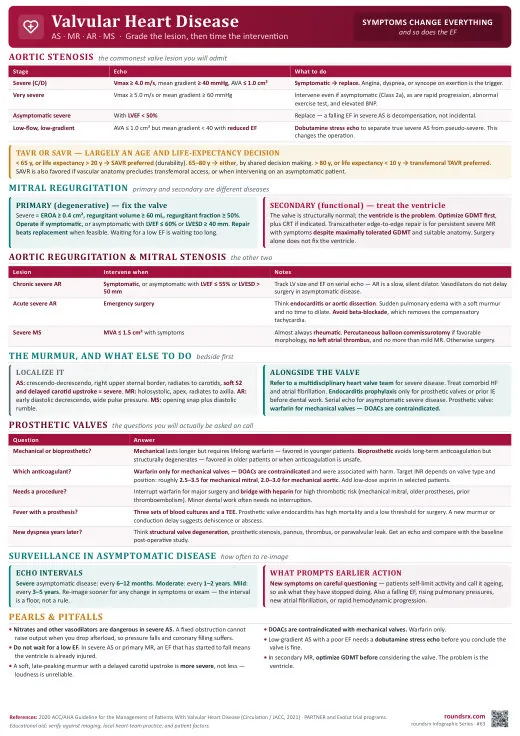
Text version
- AVA < 1.0 cm², mean gradient > 40 mmHg, Vmax > 4 m/s
- Symptoms: exertional dyspnea, syncope, angina
- Once symptomatic → 2-year survival ~50% without intervention
- Low-flow low-gradient: dobutamine stress echo to differentiate true vs pseudo-severe
- Symptomatic severe AS → TAVR or SAVR (no medical therapy works)
- Asymptomatic severe AS + EF < 50% → surgery
- Severe MR → surgery when EF ≤ 60% or LVESD ≥ 40mm
- Acute severe MR (papillary rupture) → emergent surgery
- Mechanical valve = warfarin lifelong (DOACs contraindicated [RE-ALIGN])
- INR target: 2.5-3.5 (mitral), 2.0-3.0 (aortic)
- Bioprosthetic: warfarin × 3-6 months → then ASA only
- TAVR: DAPT × 3-6 months → then ASA
- Vasodilators in severe AS (fixed obstruction → hypotension)
- DOACs with mechanical valve [RE-ALIGN increased events]
- Missing low-flow low-gradient AS (gradient looks mild)
- Delaying surgery in asymptomatic severe with declining EF