Vasculitis
| Size | Disease | Key Features | Antibody | Treatment |
|---|---|---|---|---|
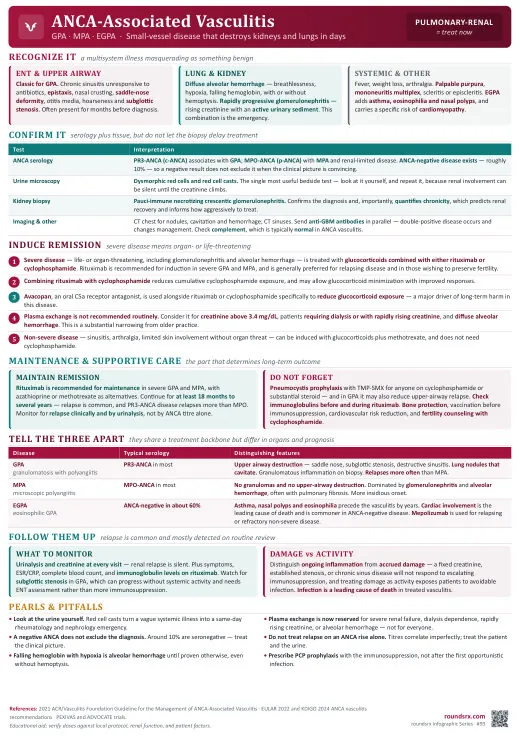
| Small vessel (ANCA-associated) | GPA (Granulomatosis with Polyangiitis) | Upper airway (sinusitis, saddle-nose, subglottic stenosis) + lungs (cavitary nodules, DAH) + kidneys (RPGN). Classic triad. | c-ANCA / PR3 | Pulse steroids + rituximab or cyclophosphamide RAVE, 2010. Plasmapheresis if severe renal or DAH. |
| MPA (Microscopic Polyangiitis) | Kidneys (RPGN -most common presentation) + lungs (DAH). No upper airway involvement (distinguishes from GPA). No granulomas on biopsy. | p-ANCA / MPO | Same as GPA. | |
| EGPA (Eosinophilic GPA / Churg-Strauss) | Asthma (adult-onset, severe) + eosinophilia (> 1500) + sinusitis + neuropathy (mononeuritis multiplex) + cardiac involvement. | p-ANCA / MPO (40–60%) | Steroids (often sufficient for mild). Mepolizumab (anti-IL5) MIRRA, 2017. Cyclophosphamide if organ-threatening. | |
| Medium vessel | PAN (Polyarteritis Nodosa) | ANCA-negative. Microaneurysms on angiography. Skin (livedo, nodules, ulcers), renal (HTN, infarction -but NOT glomerulonephritis), GI (mesenteric ischemia), neuropathy. Associated with HBV. | Negative | Steroids + cyclophosphamide. Treat HBV if associated. |
| Large vessel | Giant Cell Arteritis (GCA) | Age > 50. Temporal headache, jaw claudication, scalp tenderness, vision loss (anterior ischemic optic neuropathy). ESR often > 100. | Negative | Start steroids BEFORE biopsy (don't wait -vision loss is irreversible). Prednisone 40–60 mg/day. Tocilizumab for steroid-sparing GiACTA, 2017. |
| Takayasu arteritis | Young women (< 40). Aorta + branches → limb claudication, BP discrepancy, absent pulses, bruits. "Pulseless disease." | Negative | Steroids + methotrexate/tocilizumab. |
- ANCA -c-ANCA/PR3 (GPA/Wegener's), p-ANCA/MPO (MPA, EGPA). Send BOTH ELISA (PR3, MPO) AND IFA (c-ANCA, p-ANCA).
- CBC, BMP, LFTs, ESR, CRP -baseline organ function + inflammatory markers
- UA with microscopy -dysmorphic RBCs, RBC casts = glomerulonephritis (RPGN). This is an emergency -needs urgent renal biopsy.
- Cr + GFR -rapidly rising Cr = RPGN
- CXR / CT chest -pulmonary hemorrhage (DAH), nodules/cavities (GPA), infiltrates
- Renal biopsy -pauci-immune crescentic GN (hallmark of ANCA-associated vasculitis). Also classifies severity.
- Tissue biopsy -skin, sural nerve, temporal artery (GCA), lung -shows granulomatous inflammation (GPA) or necrotizing vasculitis
- Complement levels (C3, C4) -low in complement-mediated vasculitis (cryoglobulinemic, anti-GBM, SLE). Normal in ANCA vasculitis.
- Cryoglobulins + HCV -HCV-associated cryoglobulinemic vasculitis (type II mixed)
- Anti-GBM antibodies -Goodpasture syndrome (pulmonary-renal syndrome with linear IgG on biopsy)
- Eosinophil count -markedly elevated in EGPA (eosinophilic granulomatosis with polyangiitis / Churg-Strauss)
| Phase | Regimen | Details |
|---|---|---|
| Induction | Pulse methylpred 1g IV × 3d → pred 1 mg/kg taper + Rituximab (Rituxan) 375 mg/m² × 4 wks | Rituximab preferred over cyclophosphamide RAVE, 2010. Especially for PR3+/relapsing. |
| Alternative | Cyclophosphamide IV 15 mg/kg q2–4 wks | If rituximab unavailable. Limit cumulative dose (bladder CA risk). Mesna for cystitis prevention. |
| Severe renal/DAH | Add plasmapheresis | PLEX for Cr > 5.7 or DAH requiring ventilation. |
| Maintenance | Rituximab (Rituxan) 500 mg q6 months or azathioprine (Imuran) | Maintain ≥ 2 years. PR3+ = longer maintenance (higher relapse). |
| Drug | Dose | Route | Notes |
|---|---|---|---|
| ANCA-Associated Vasculitis -Induction | |||
| Rituximab | 375 mg/m² weekly × 4 or 1000 mg × 2 | IV | First-line induction (equal to cyclophosphamide). RAVE, 2010. Preferred in relapsing disease. Fewer side effects than CYC. Screen HBV. |
| Cyclophosphamide | 15 mg/kg IV q2 weeks × 3 then q3 weeks | IV | Alternative induction. Effective but more toxicity (bladder cancer, infertility, myelosuppression). Mesna for bladder protection. Limit cumulative dose. |
| Methylprednisolone | 500-1000 mg IV × 3 days | IV | Pulse steroids with induction. Then prednisone 1 mg/kg taper over 3-6 months. [PEXIVAS: reduced-dose glucocorticoid non-inferior, 2020] |
| Avacopan | 30 mg BID | PO | C5a receptor inhibitor -steroid-sparing. ADVOCATE, 2021. Can replace prednisone during induction (add to RTX or CYC). Superior sustained remission at 52 weeks. |
| Maintenance | |||
| Rituximab | 500 mg q6 months × 2-4 years | IV | Preferred maintenance. MAINRITSAN, 2014 -superior to azathioprine. Duration: minimum 2 years, possibly longer for PR3+. |
| Azathioprine | 2 mg/kg/day | PO | Alternative maintenance. Check TPMT. Less effective than rituximab for relapse prevention. |
| Giant Cell Arteritis (GCA) | |||
| Prednisone | 40-60 mg daily | PO | Start IMMEDIATELY if clinical suspicion -do NOT wait for biopsy. Taper over 12-24 months. Visual loss = methylprednisolone 1g IV × 3d. |
| Tocilizumab | 162 mg SQ weekly | SQ | Steroid-sparing for GCA. GiACTA, 2017. Sustained remission with 26-week taper vs 52-week steroid-only taper. Now first-line adjunct. |
Patient: 52M with chronic sinusitis refractory to antibiotics, new hemoptysis, and Cr rising 1.1 → 3.6 over 10 days. UA: RBC casts, proteinuria. CT chest: bilateral cavitary lung nodules.
Key findings: Classic GPA triad: upper airway (sinusitis) + lower airway (cavitary nodules, hemoptysis) + renal (RPGN with RBC casts). c-ANCA/PR3 positive.
Management:
- Urgent renal biopsy, expect pauci-immune crescentic GN
- Induction: rituximab 375 mg/m² weekly × 4 (preferred over cyclophosphamide for GPA) RAVE, 2010
- Pulse methylprednisolone 500-1000 mg IV × 3 days → prednisone 1 mg/kg taper
- Plasma exchange if severe renal involvement (Cr > 5.7) or DAH PEXIVAS, 2020
- PJP prophylaxis with TMP-SMX (also prevents GPA relapse in upper airway)
Teaching point: c-ANCA/PR3 = GPA. Rituximab is now preferred over cyclophosphamide for induction in GPA, equal efficacy with better safety profile and superior for relapsing disease.
Patient: 74F with new temporal headache × 2 weeks, jaw claudication, and 4 hours of monocular vision loss in right eye that resolved. ESR 98, CRP 8.4. Temporal artery tender and non-pulsatile.
Key findings: GCA with amaurosis fugax, ophthalmologic emergency. If untreated, permanent bilateral blindness occurs in 20% within days. ESR > 50 + age > 50 + new headache + jaw claudication = high probability.
Management:
- IV methylprednisolone 1g daily × 3 days (vision-threatening GCA = IV steroids STAT)
- Then prednisone 1 mg/kg daily with slow taper over 12-18 months
- Temporal artery biopsy within 2 weeks (steroids do not alter biopsy for 10-14 days, do NOT delay steroids for biopsy)
- Urgent ophthalmology consult
- Tocilizumab 162 mg SQ weekly as steroid-sparing agent GiACTA, 2017
Teaching point: Never delay steroids in suspected GCA to wait for biopsy. Permanent blindness is the feared complication, treat first, biopsy second. Tocilizumab is now standard steroid-sparing therapy.
Patient: 38F with severe asthma (diagnosed age 30), new peripheral neuropathy (foot drop), purpuric rash on lower extremities, eosinophils 4,200/μL. p-ANCA/MPO positive. CT chest: patchy GGOs.
Key findings: EGPA (Churg-Strauss): late-onset asthma + eosinophilia (> 1500) + extra-pulmonary organ involvement (mononeuritis multiplex, skin). Five-Factor Score determines prognosis.
Management:
- Prednisone 1 mg/kg daily (first-line for EGPA)
- If poor prognostic factors (cardiac, GI, renal, CNS involvement): add cyclophosphamide or rituximab
- Mepolizumab 300 mg SQ q4 weeks (anti-IL-5, FDA-approved for EGPA, steroid-sparing) MIRRA, 2017
- EMG/NCV to characterize neuropathy; neurology consult
- Echocardiogram, cardiac involvement is the #1 cause of death in EGPA
Teaching point: EGPA is the one ANCA vasculitis with asthma and eosinophilia. Cardiac involvement (myocarditis, pericarditis) occurs in ~60% and is the leading cause of mortality, always get an echo.
| Parameter | Approach | Notes |
|---|---|---|
| Symptom assessment | Each visit (RN 1-3x/week) | Pain, dyspnea, nausea, anxiety, delirium -use validated scales |
| Functional status | Weekly | PPS trending. Declining PPS confirms trajectory. Document for recertification |
| Medication review | Each visit | Are comfort meds working? Side effects? Need dose adjustment? Route change needed? |
| Caregiver assessment | Each visit | Burnout, coping, need for respite care, bereavement risk assessment |
| Labs | Generally NOT indicated | Labs rarely change management in hospice. Only draw if result will change comfort plan |
| Recertification | 90 days, 90 days, then 60-day periods | Two physicians must certify continued eligibility. Document ongoing decline |
Text version
- Waiting for biopsy to start treatment (life-threatening disease -treat empirically)
- Missing pulmonary-renal syndrome (DAH + RPGN = emergent)
- Not starting PCP prophylaxis on immunosuppression
- Missing relapse (monitor ANCA titers, Cr, UA q3-6 months)