VTE Prophylaxis & Treatment
Venous thromboembolism (VTE) encompasses deep vein thrombosis (DVT) and pulmonary embolism (PE). PE is a DVT that has embolized to the pulmonary vasculature. ~600,000 VTE events/year in the US; ~100,000 deaths/year. Hospital-acquired VTE is the #1 preventable cause of hospital death.
- Stasis: Immobility, hospitalization, long flights, paralysis, obesity
- Endothelial injury: Surgery, trauma, central lines, prior DVT, vasculitis
- Hypercoagulability: Cancer (#1 acquired), pregnancy, OCP/HRT, Factor V Leiden, prothrombin mutation, antiphospholipid syndrome, nephrotic syndrome
| Risk Factor | Points |
|---|---|
| Active cancer | 3 |
| Previous VTE (excluding SVT) | 3 |
| Reduced mobility (≥ 3 days) | 3 |
| Known thrombophilia | 3 |
| Recent (≤ 1 month) surgery or trauma | 2 |
| Age ≥ 70 | 1 |
| Heart or respiratory failure | 1 |
| Acute MI or stroke | 1 |
| Acute infection or rheumatic disorder | 1 |
| Obesity (BMI ≥ 30) | 1 |
| Ongoing hormonal treatment | 1 |
- ~50% of hospital DVTs are asymptomatic. Prophylaxis prevents them before they embolize.
- Post-thrombotic syndrome: 20-50% of DVT patients develop chronic venous insufficiency (pain, swelling, ulcers)
- Chronic thromboembolic pulmonary hypertension (CTEPH): ~4% of PE patients. Screen if persistent dyspnea after PE treatment.
- Cancer-associated VTE: 4-7x increased risk. Consider occult cancer workup in unprovoked VTE (age-appropriate screening).
A: Clinical signs of DVT (3), PE most likely dx (3), HR > 100 (1.5), immobilization/surgery in 4 wks (1.5), prior DVT/PE (1.5), hemoptysis (1), cancer (1). Score > 4 = PE likely → CTPA. Score ≤ 4 = PE unlikely → D-dimer first. Simplifies to 2-tier: likely vs unlikely.
A: Only in LOW pre-test probability patients. All 8 must be negative: age < 50, HR < 100, O2 sat ≥ 95%, no hemoptysis, no estrogen use, no prior DVT/PE, no unilateral leg swelling, no surgery/trauma in 4 weeks. If ALL negative → PE ruled out without D-dimer. Misses < 2%.
A: For patients > 50: cutoff = age × 10 (e.g., 65yo → cutoff 650 ng/mL instead of 500). Validated in ADJUST-PE trial -increased specificity from 34% to 46% without missing PEs. Only use in PE-unlikely patients. Reduces unnecessary CTPAs by ~12%.
A: LMWH was standard (CLOT trial). Now DOACs (edoxaban per HOKUSAI-VTE Cancer, rivaroxaban per SELECT-D) are alternatives EXCEPT in GI/GU cancers (higher bleeding risk with DOACs). Avoid warfarin in cancer -harder to manage, drug interactions, unreliable INR.
A: Category E only (formerly massive): sustained hypotension (SBP < 90 for > 15 min), pulselessness, or persistent bradycardia. Alteplase 100mg IV over 2h is standard. NOT for Category C3 (RV strain + normal BP) -PEITHO, 2014 showed tPA reduced hemodynamic collapse but increased ICH. Category C3 = anticoagulation + close monitoring.
A: Provoked by a major transient risk factor (surgery, immobility): 3 months. Unprovoked or provoked by a persistent risk factor: extended with no planned stop date unless bleeding risk is high, at reduced dose after 6 months. Cancer: treat as long as cancer is active. Recurrent unprovoked: indefinite. Use D-dimer after stopping to guide (PROLONG study).
58M, 5 days post-TKR, left calf swelling and tenderness. D-dimer 2400. Duplex US: acute occlusive thrombus in left popliteal vein. Dx: Provoked proximal DVT. Start enoxaparin (Lovenox) 1mg/kg BID, bridge to apixaban (Eliquis). Duration: 3 months (provoked by surgery).
45F on OCPs presents with acute dyspnea, HR 115, BP 110/70, SpO2 91%. CTPA: bilateral PE with RV/LV ratio > 1. Troponin 0.15. BNP 450. Dx: Category C3 PE, formerly submassive (RV strain + elevated biomarkers, but hemodynamically stable). Start heparin drip. Monitor closely in ICU. tPA NOT indicated unless hemodynamic decompensation. PEITHO, 2014
62F with metastatic pancreatic cancer, found to have incidental PE on staging CT. Asymptomatic, hemodynamically stable. Dx: Cancer-associated VTE. Start enoxaparin (Lovenox) 1mg/kg BID (preferred over DOAC in GI malignancy due to bleeding risk). CLOT, 2003 Duration: as long as cancer is active or on treatment.
70M on heparin drip for DVT, day 7. Platelets dropped from 220K to 85K (60% decline). 4T score: 6 (high probability). Dx: HIT. STOP all heparin immediately (including flushes). Start argatroban (direct thrombin inhibitor). Send PF4 antibody + SRA. Do NOT give warfarin until platelets > 150K (risk of warfarin-induced venous limb gangrene).
Mrs. Thompson is a 52-year-old woman presenting with 3 days of left leg swelling and pain. She returned from a 12-hour flight 5 days ago. No prior VTE. On estrogen HRT. Exam: left calf 3cm larger than right, pitting edema, tenderness along deep veins, positive Homan's sign. Wells DVT score: 3 (calf swelling > 3cm, pitting edema, entire leg swollen). D-dimer: 1,800 ng/mL.
- VTE prophylaxis ordered? Check every patient, every day. Document reason if held.
- Anticoagulation therapeutic? aPTT (heparin drip), anti-Xa (LMWH), INR (warfarin)
- Platelet monitoring: q2-3 days on heparin (days 4-14) for HIT surveillance
- Renal function: CrCl for LMWH/DOAC dosing adjustments
- Bleeding assessment: GI symptoms, hematuria, gum bleeding, hemoptysis, surgical site
- Leg symptoms: Swelling trending? Pain improving? Signs of extension?
- Hemodynamics (PE): HR, BP, SpO2 trending. Any signs of RV failure?
- Transition plan: Bridge to oral anticoagulation. Discharge with follow-up (hematology if unprovoked/recurrent)
| Wells DVT Score | Points |
|---|---|
| Active cancer (treatment within 6 months) | 1 |
| Paralysis/paresis/recent cast of lower extremity | 1 |
| Bedridden > 3 days or major surgery within 12 weeks | 1 |
| Localized tenderness along deep venous system | 1 |
| Entire leg swollen | 1 |
| Calf swelling > 3 cm compared to other leg | 1 |
| Pitting edema (greater in symptomatic leg) | 1 |
| Collateral superficial veins (non-varicose) | 1 |
| Previously documented DVT | 1 |
| Alternative diagnosis as likely or more likely | -2 |
Score ≥ 2: DVT likely → duplex ultrasound. Score < 2: DVT unlikely → D-dimer first (if negative, DVT ruled out).
| Wells PE Score | Points |
|---|---|
| Clinical signs/symptoms of DVT | 3 |
| PE is #1 diagnosis (or equally likely) | 3 |
| Heart rate > 100 | 1.5 |
| Immobilization (≥ 3 days) or surgery in prior 4 weeks | 1.5 |
| Previous DVT/PE | 1.5 |
| Hemoptysis | 1 |
| Malignancy (treatment in last 6 months or palliative) | 1 |
Score > 4 (PE likely): → CTPA directly. Score ≤ 4 (PE unlikely): → D-dimer first. Use age-adjusted D-dimer (age × 10 for patients > 50) ADJUST-PE, 2014
- Duplex ultrasound: First-line for DVT. Sensitivity 94%, specificity 98% for proximal DVT. Lower sensitivity for calf DVT (~70%).
- CTPA: Gold standard for PE. Sensitivity 83-100%, specificity 89-97%. PIOPED II, 2006
- V/Q scan: Alternative if CTPA contraindicated (contrast allergy, renal failure). Best when CXR is normal. Reports as normal/low/intermediate/high probability.
- Bedside echo: RV dilation, RV hypokinesis, McConnell's sign (RV free wall akinesis with apical sparing). Useful in Category E PE when too unstable for CTPA.
| Category | Hemodynamics | RV Dysfunction | Biomarkers | Mortality | Treatment |
|---|---|---|---|---|---|
| Massive | SBP < 90 or arrest | Yes | Elevated | 25-65% | tPA + heparin |
| Category C3 | Normal | Yes | Elevated (troponin/BNP) | 3-15% | Heparin + ICU monitoring |
| Low-risk | Normal | No | Normal | < 1% | Anticoagulation |
| Agent | Dose | Notes |
|---|---|---|
| Enoxaparin (Lovenox) | 40mg SQ daily | First-line medical prophylaxis. Adjust for CrCl < 30 (30mg daily). Hold if platelets < 50K or active bleeding. |
| Heparin (UFH) | 5000 units SQ q8h | Use if CrCl < 30 or high bleeding risk (can reverse with protamine). TID dosing > BID for medical patients. |
| SCDs (mechanical) | Bilateral | Use alone if active bleeding, platelets < 50K, or high bleed risk. Use WITH pharmacologic in highest-risk patients. Remove for ambulation. |
| Fondaparinux (Arixtra) | 2.5mg SQ daily | Alternative if HIT history. No platelet monitoring needed. Contraindicated CrCl < 30. |
| Agent | Dose | Monitoring | Notes |
|---|---|---|---|
| Heparin drip (UFH) | 80 units/kg bolus → 18 units/kg/hr | aPTT q6h → q12h when stable | Use for Category E PE, renal failure, high bleed risk (short half-life, reversible) |
| Enoxaparin (Lovenox) | 1mg/kg SQ BID or 1.5mg/kg daily | Anti-Xa if obese or renal impairment | Preferred for most DVT. Avoid if CrCl < 30. |
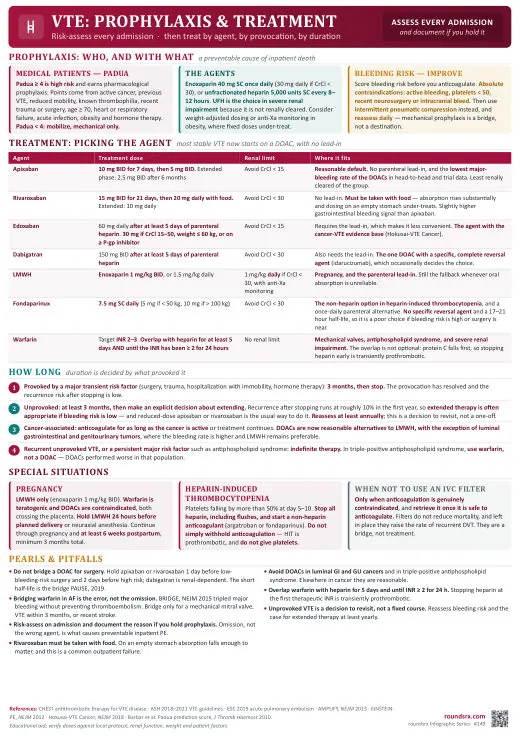
| Apixaban (Eliquis) | 10mg BID × 7 days → 5mg BID | None routinely | No heparin lead-in needed. First-line for non-cancer VTE. AMPLIFY, 2013 |
| Rivaroxaban (Xarelto) | 15mg BID × 21 days → 20mg daily | None routinely | No heparin lead-in. Once-daily maintenance. EINSTEIN-PE, 2012 |
| Warfarin (Coumadin) | Target INR 2.0-3.0 | INR daily → weekly → monthly | Requires 5-day heparin bridge. Cheap. Use if mechanical valve, APS, severe renal failure. |
| Edoxaban (Savaysa) | 60mg daily (after 5-day heparin lead-in) | None routinely | Requires parenteral lead-in. Reduce to 30mg if CrCl 15-50 or weight ≤ 60kg. HOKUSAI-VTE, 2013 |
| Scenario | Duration | Rationale |
|---|---|---|
| Provoked by major transient risk (surgery, immobilization) | 3 months | Low recurrence risk once risk factor resolved (~3%/year) |
| Provoked by minor transient risk (travel, estrogen, minor injury) | 3 months (consider extended) | Intermediate recurrence risk. Reassess at 3 months. |
| Unprovoked (first event) | Extended, with no planned stop date Stop at 3 months only if bleeding risk is high | Extended therapy is now the default, not a reassessment (CHEST 2021 gives this a strong recommendation; ASH 2020 agrees for patients at lower bleeding risk). Recurrence after stopping is roughly 10% at 1 year, 16% at 2 years and 25% at 5 years, and the risk does not fall with time, which is why there is no duration that makes stopping safe. After the first 6 months, drop to reduced-dose apixaban 2.5 mg BID or rivaroxaban 10 mg daily, which keeps most of the protection with less bleeding. Reassess bleeding risk yearly rather than reassessing whether to continue. D-dimer after stopping (PROLONG) and the HERDOO2 rule in women can support stopping when the patient prefers it. |
| Provoked by a persistent risk factor (active cancer, antiphospholipid syndrome, IBD, chronic immobility) | Extended, with no planned stop date | The provoking factor is still there, so the risk never returns to baseline, and CHEST groups these with unprovoked VTE for extended therapy. Antiphospholipid syndrome is the exception to DOACs: use warfarin, since DOACs performed worse in triple-positive APS. |
| Recurrent unprovoked | Indefinite | ~30% recurrence if stopped. Benefit of continued anticoagulation outweighs bleeding risk. |
| Cancer-associated | As long as cancer active | LMWH or DOAC (not warfarin). Reassess every 3-6 months. CLOT, 2003 |
- Cancer-associated VTE: LMWH or edoxaban/rivaroxaban (avoid DOACs in GI/GU cancers -bleeding). Avoid warfarin. Treat indefinitely while cancer active.
- Pregnancy: LMWH only (enoxaparin 1mg/kg BID). Warfarin is teratogenic. DOACs contraindicated. Hold LMWH 24h before delivery.
- Renal failure (CrCl < 30): UFH or dose-adjusted LMWH (enoxaparin 1mg/kg daily, monitor anti-Xa). Warfarin safe. Apixaban can be used (less renal clearance). Avoid rivaroxaban, edoxaban.
- HIT: Stop ALL heparin. Start argatroban (hepatic metabolism, use in renal failure) or bivalirudin. Transition to warfarin only after platelets > 150K. Fondaparinux is an alternative.
- Obesity (> 120kg or BMI > 40): Use weight-based LMWH with anti-Xa monitoring. DOACs may have reduced efficacy (limited data). Consider heparin drip for acute treatment.
| DOAC | VTE dosing | Renal cutoffs | Reversal agent | Notes |
|---|---|---|---|---|
| Apixaban (Eliquis) PREFERRED non-cancer | 10 mg BID × 7 d → 5 mg BID. Extended Rx: 2.5 mg BID after 6 mo. | Avoid CrCl < 25 (no dose data). Approved down to CrCl 15 by FDA but data weak. | Andexanet alfa (Andexxa) bolus + 2-h infusion. Alternative: 4F-PCC (Kcentra) 50 u/kg if andexanet unavailable. | Lowest major-bleed signal of any DOAC (AMPLIFY 0.6%). No food restriction. Twice-daily dosing the only downside. |
| Rivaroxaban (Xarelto) | 15 mg BID × 21 d → 20 mg daily with food. Extended Rx: 10 mg daily after 6 mo. | Avoid CrCl < 30 for VTE. | Andexanet alfa · 4F-PCC 50 u/kg. | Once-daily after the 21-day load. Must take with food (absorption ↑ 39%). Slightly higher GI bleeding signal than apixaban. |
| Edoxaban (Savaysa) | 60 mg daily AFTER 5-10 days of parenteral lead-in (heparin or LMWH). Reduce to 30 mg if CrCl 15-50, weight ≤ 60 kg, or strong P-gp inhibitor. | Avoid CrCl < 15. | Andexanet alfa (off-label) · 4F-PCC. | Used in HOKUSAI-VTE Cancer for cancer-associated VTE. Lead-in requirement makes it less convenient than apixaban/riva. |
| Dabigatran (Pradaxa) | 150 mg BID AFTER 5-10 days of parenteral lead-in. | Avoid CrCl < 30. | Idarucizumab (Praxbind) 5 g IV -specific antidote, works within minutes. | Direct thrombin inhibitor (others are factor Xa). High GI bleeding signal at 150 mg dose. Best reversal of any DOAC. Dyspepsia common. |
| Anticoagulant | Reversal | Dose / Notes |
|---|---|---|
| Warfarin | 4F-PCC (Kcentra) + Vitamin K 10 mg IV | 4F-PCC dose by INR: INR 2-4 → 25 u/kg; INR 4-6 → 35 u/kg; INR > 6 → 50 u/kg (max 5000 u). Faster and less volume than FFP. Always co-give Vitamin K 10 mg IV -PCC effect lasts ~6 h, Vit K provides durable reversal. FFP only if PCC unavailable (15-30 mL/kg). |
| Unfractionated heparin (UFH) | Protamine sulfate | 1 mg per 100 units of heparin given in the last hour. Last 1-2 h → 0.5 mg per 100 u. Last 2-4 h → 0.25 mg per 100 u. Max 50 mg single dose. Watch for hypotension and anaphylaxis (especially in fish-allergy or prior protamine exposure -e.g., NPH insulin patients). |
| LMWH (enoxaparin) | Protamine -partial reversal only | Reverses ~60% of anti-Xa activity. Within 8 h of dose: 1 mg protamine per 1 mg enoxaparin. 8-12 h after dose: 0.5 mg per 1 mg. > 12 h: not effective. Consider 4F-PCC if life-threatening. |
| Apixaban / Rivaroxaban / Edoxaban (Factor Xa inhibitors) | Andexanet alfa (Andexxa) 1st-line · 4F-PCC alternative | Andexanet bolus + 2-h infusion (low-dose 400 mg + 4 mg/min, or high-dose 800 mg + 8 mg/min depending on agent / time / dose). Alternative: 4F-PCC 50 u/kg if andexanet unavailable, cost-prohibitive, or contraindicated. ANNEXA-4, 2019 |
| Dabigatran (direct thrombin inhibitor) | Idarucizumab (Praxbind) 5 g IV -specific antidote | Two 2.5 g vials given consecutively over 5-10 min. Reversal within minutes (binds dabigatran 350× more tightly than thrombin). RE-VERSE AD, 2017. Hemodialysis is an alternative (60% removal in 2 h) -useful in advanced renal failure. |
| Argatroban / Bivalirudin (used in HIT) | No specific reversal | Stop infusion. Argatroban half-life ~50 min, bivalirudin ~25 min. Supportive care + transfusion. 4F-PCC may be considered if life-threatening but data limited. |
| Fondaparinux | No proven reversal | Stop the drug. Half-life 17-21 h. Recombinant factor VIIa has been tried (limited data, off-label). Consider 4F-PCC empirically. Hemodialysis ineffective. |
| Modality | Indication | Procedure | Evidence |
|---|---|---|---|
| Systemic tPA | Category E PE (hemodynamic compromise) only. NOT for Category C3 alone. | Alteplase 100 mg IV over 2 h, OR 50 mg bolus in cardiac arrest. Heparin co-administered. | PEITHO, 2014 -systemic lysis in submassive PE causes more harm than good. |
| Catheter-directed thrombolysis (CDT) | Category C3 to D (RV strain, formerly submassive) where systemic lysis is too risky; or Category E with relative contraindication to systemic. | Catheter advanced into pulmonary artery; low-dose alteplase (1 mg/h × 12-24 h, total dose 10-24 mg) infused locally. EKOS adds ultrasound to fragment clot. | ULTIMA, 2014 · SEATTLE II, 2015 |
| Mechanical thrombectomy (catheter aspiration) | Massive or intermediate-high-risk PE, especially when thrombolytics contraindicated. Increasingly used as first-line in Category C3 to D. | FlowTriever (Inari) -large-bore aspiration catheter; mechanical thrombus removal without lytic. Penumbra Indigo -aspiration. No tPA needed. | FLARE, 2019 · FLAME, 2023 · PEERLESS, 2024 |
| Surgical embolectomy | Category E PE with absolute contraindication to all thrombolytics AND failed CDT/mechanical, OR clot-in-transit through PFO with paradoxical embolism risk. | Median sternotomy, cardiopulmonary bypass, direct extraction. | Largely superseded by catheter-based options. Reserved for centers with surgical expertise. |
| VA-ECMO | Cardiac arrest from PE or refractory shock as a bridge to definitive therapy (CDT, thrombectomy, or recovery). | Veno-arterial ECMO provides circulatory support while thrombus resolves or is removed. | Increasingly used at PERT-equipped centers. PERT consortium data supports multidisciplinary approach. |
| Category | 2 points | 1 point | 0 points |
|---|---|---|---|
| Thrombocytopenia | Platelet drop > 50% AND nadir ≥ 20K | Drop 30-50% OR nadir 10-19K | Drop < 30% OR nadir < 10K |
| Timing | Days 5-10 (or < 1 day with prior heparin in last 30 d) | Possibly 5-10 (no clear records) or > 10 days | < 4 days without prior exposure |
| Thrombosis | New thrombosis · skin necrosis at injection site · acute systemic reaction after IV bolus | Progressive thrombosis · erythematous skin lesions · suspected (not confirmed) thrombosis | None |
| Other cause for thrombocytopenia | None apparent | Possible | Definite |
- Indication: Acute proximal DVT or PE with absolute contraindication to anticoagulation (active major bleeding, recent CNS surgery)
- Retrievable filters preferred -remove once anticoagulation can be restarted (filter itself increases DVT risk)
- NOT indicated as adjunct to anticoagulation in most cases