Celiac Disease
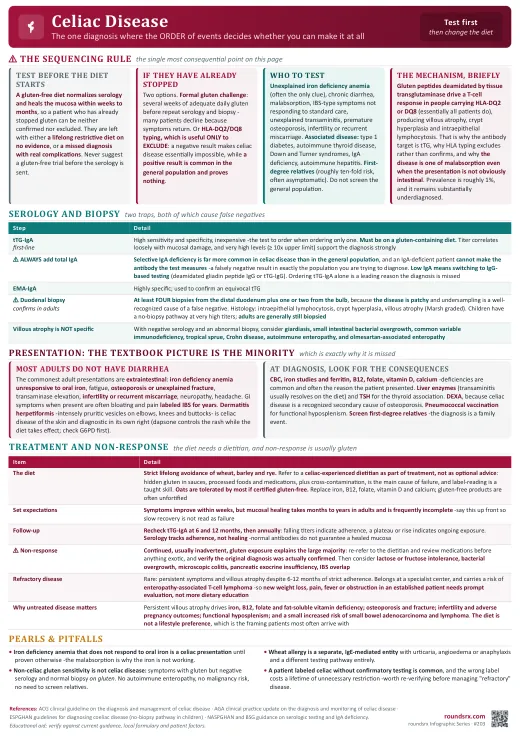
Celiac disease is an immune-mediated enteropathy triggered by gluten in genetically susceptible people (essentially all carry HLA-DQ2 or DQ8). Gluten peptides deamidated by tissue transglutaminase drive a T-cell response that produces villous atrophy, crypt hyperplasia and intraepithelial lymphocytosis in the small bowel -which is why the disease is defined by malabsorption even when the presentation is not obviously intestinal. It affects roughly 1% of the population and remains substantially underdiagnosed.
- Most adults do NOT present with classic diarrhea and steatorrhea. The textbook picture is now the minority, which is precisely why the diagnosis is missed.
- The commonest adult presentations are extraintestinal: iron deficiency anemia unresponsive to oral iron (often the only clue), fatigue, osteoporosis or unexplained fractures, transaminase elevation, infertility or recurrent miscarriage, neuropathy, and headache.
- GI symptoms when present may be bloating, flatulence, abdominal pain and weight change rather than diarrhea, and are frequently labeled irritable bowel syndrome for years.
- Dermatitis herpetiformis -intensely pruritic vesicles on extensor surfaces, elbows, knees and buttocks -is celiac disease of the skin and is diagnostic in its own right; these patients need the diet whether or not they have gut symptoms.
- Symptomatic: chronic diarrhea, unexplained weight loss, malabsorption, IBS-type symptoms not responding to standard care, and especially iron deficiency anemia without an obvious source.
- Associated conditions: type 1 diabetes, autoimmune thyroid disease, Down and Turner syndromes, IgA deficiency, autoimmune hepatitis, unexplained transaminitis, premature osteoporosis.
- First-degree relatives of a patient with confirmed celiac disease -risk is roughly ten-fold, and many are asymptomatic.
- Do not test the general population; test on symptoms, associated disease, or family history.
- Tissue transglutaminase IgA (tTG-IgA) is the first-line test -high sensitivity and specificity, inexpensive, and the one to order when ordering only one.
- ⚠ Always order total IgA at the same time. Selective IgA deficiency is markedly more common in celiac disease than in the general population, and an IgA-deficient patient produces a falsely negative tTG-IgA. If IgA is low, switch to IgG-based testing (deamidated gliadin peptide IgG or tTG-IgG).
- Endomysial antibody (EMA) IgA is highly specific and used as a confirmatory test where the tTG is equivocal.
- Antibody titer correlates loosely with mucosal damage, and very high tTG levels (conventionally ≥ 10 times the upper limit of normal) support the diagnosis strongly -in children, a no-biopsy pathway exists on that basis with confirmatory EMA, but adults are generally still biopsied.
- Upper endoscopy with duodenal biopsies confirms the diagnosis in adults: take at least four biopsies from the distal duodenum plus one or two from the duodenal bulb, because the disease is patchy and inadequate sampling is a common cause of a falsely negative biopsy.
- Histology shows intraepithelial lymphocytosis, crypt hyperplasia and villous atrophy (graded by the Marsh classification).
- Villous atrophy is not specific to celiac disease -consider giardiasis, small intestinal bacterial overgrowth, common variable immunodeficiency, tropical sprue, Crohn disease, autoimmune enteropathy, and olmesartan-associated enteropathy if serology is negative but the biopsy is abnormal.
- CBC and iron studies, ferritin, B12, folate, vitamin D, calcium -deficiencies are common and often the reason the patient presented.
- Liver enzymes (transaminitis is frequent and usually resolves on the diet), TSH given the autoimmune thyroid association.
- DEXA -celiac disease is a recognized cause of secondary osteoporosis, and this connects directly to the osteoporosis topic's secondary-cause workup.
- Screen first-degree relatives -a positive diagnosis is a family event, not just an individual one.
- Strict, lifelong elimination of wheat, barley and rye. Symptoms often improve within weeks; mucosal healing takes months to years in adults and is frequently incomplete, which is worth saying up front so patients do not interpret slow recovery as failure.
- Refer to a dietitian with celiac expertise -this is not optional advice. Hidden gluten in sauces, processed foods, medications and cross-contamination is the main reason diets fail, and label-reading is a taught skill.
- Oats are tolerated by most but must be certified gluten-free (cross-contamination during processing is the issue rather than oats themselves).
- Replace what is missing: iron, B12, folate, vitamin D and calcium as indicated; gluten-free products are often not fortified, so intake of B vitamins and fiber can fall on the diet.
- Immunizations: functional hyposplenism occurs in celiac disease, so ensure pneumococcal vaccination is current.
- Recheck tTG-IgA at 6 and 12 months, then annually -falling titers indicate adherence, and a plateau or rise points to ongoing gluten exposure.
- Reassess symptoms, weight, nutritional labs and bone density; repeat DEXA per osteoporosis guidance where the initial scan was abnormal.
- Serology is a marker of adherence, not of healing -normal antibodies do not guarantee a healed mucosa, which is why persistent symptoms sometimes warrant repeat biopsy.
- Continued gluten exposure is the answer in the large majority -usually inadvertent. Re-refer to the dietitian and review medications and supplements before considering anything exotic.
- Then consider coexisting conditions: lactose or fructose intolerance (common early, often transient), small intestinal bacterial overgrowth, microscopic colitis, pancreatic exocrine insufficiency, and functional overlap with IBS.
- Verify the original diagnosis -patients labeled celiac without confirmatory testing are common, and a wrong label produces a lifetime of unnecessary restriction.
- Refractory celiac disease is rare (persistent symptoms and villous atrophy despite 6-12 months of strict adherence) and belongs with a specialist center; it carries a risk of enteropathy-associated T-cell lymphoma, so new alarm features -weight loss, abdominal pain, fever, obstruction- in an established patient require prompt evaluation rather than dietary re-education.
- Non-celiac gluten sensitivity -symptoms with gluten but negative serology and normal biopsy on a gluten-containing diet. Real for the patient, but it is not celiac disease: no autoimmune enteropathy, no malignancy risk, no need to screen relatives, and the diet can be less absolute.
- Wheat allergy -IgE-mediated, with urticaria, angioedema or anaphylaxis, and a different testing pathway entirely.
- Dermatitis herpetiformis -treated with the gluten-free diet; dapsone controls the rash rapidly while the diet takes effect, and requires G6PD testing before starting.
Ms. Novak is a 34-year-old woman referred for iron deficiency anemia unresponsive to 6 months of oral iron. Hemoglobin 10.4, ferritin 8, MCV 76. She reports bloating and intermittent loose stools attributed to IBS for several years, and has a sister with type 1 diabetes. She has not changed her diet. No overt bleeding; menses are normal.
- Serology sent BEFORE any dietary change is suggested -the single most important sequencing rule.
- tTG-IgA ordered WITH total IgA; IgG-based testing substituted if IgA deficient.
- Adults biopsied to confirm, with at least four distal duodenal samples plus bulb biopsies.
- Nutritional consequences checked: iron, ferritin, B12, folate, vitamin D, calcium, liver enzymes, TSH.
- DEXA arranged -celiac disease is a secondary cause of osteoporosis.
- Dietitian referral made, not just diet advice given; pneumococcal vaccination confirmed.
- First-degree relatives advised to be screened.
- tTG-IgA rechecked at 6 and 12 months, then annually, as an adherence marker.