Free Printable Cheat Sheets for Residents
Nights & Cross-Cover Pack
The calls that come in overnight on the wards: chest pain, a fast heart rate, a fever that could be sepsis, new confusion, a glucose out of range, an abnormal potassium or sodium, a high blood pressure reading, alcohol withdrawal, a falling hemoglobin, and a bleeding patient on an anticoagulant. On each of these calls the first decision is whether the patient needs you at the bedside now.
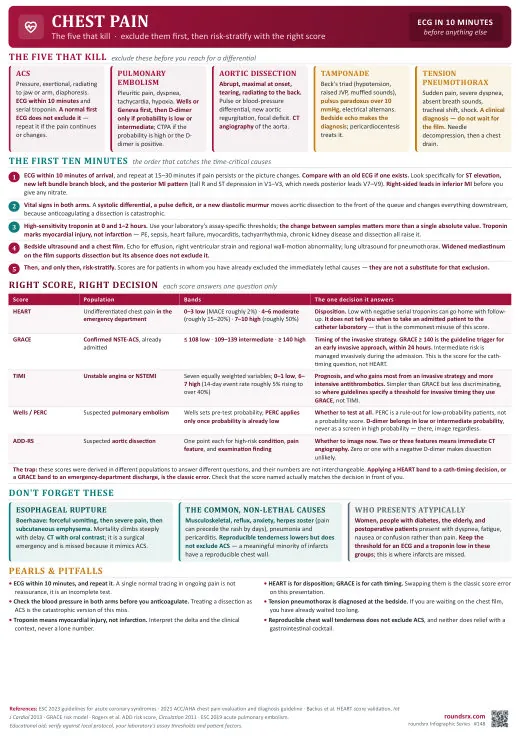
- #148 Chest Pain The five that kill · exclude them first, then risk-stratify Full topic →
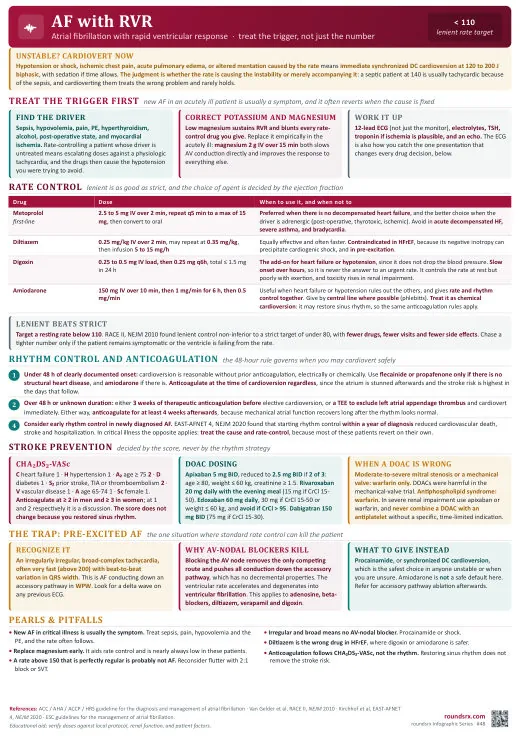
- #48 AF with RVR Atrial fibrillation with rapid ventricular response Full topic →
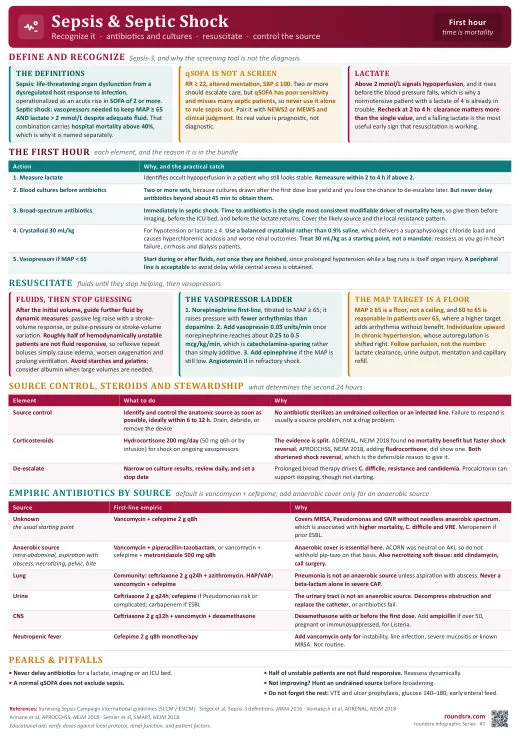
- #1 Sepsis & Septic Shock Recognition → Resuscitation · the first hour Full topic →
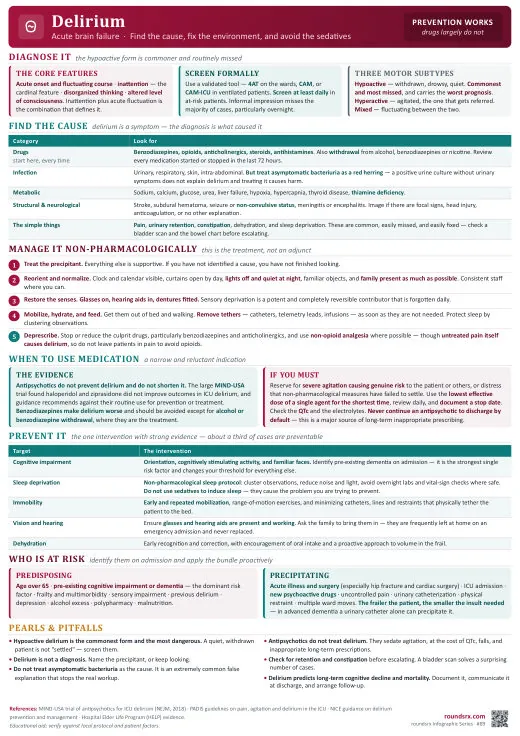
- #89 Delirium Acute brain failure · find the cause, fix the environment Full topic →
- #87 Inpatient Diabetes Management Basal-bolus, not sliding scale · ward target 100-180 Full topic →
- #123 Inpatient Hypoglycemia Treat now, then find why · usually preventable Full topic →
- #11 Electrolyte Emergencies Potassium · Sodium · Magnesium · Phosphate · Calcium Full topic →
- #49 Hyperkalemia Protect · shift · remove Full topic →
- #43 Hypertensive Emergency Severe BP + acute organ damage · controlled reduction Full topic →
- #36 Alcohol Withdrawal From tremor to delirium tremens · treat early Full topic →
- #138 Blood Transfusion Thresholds and products · One unit, then reassess Full topic →
- #19 Anticoagulation Reversal Warfarin · DOACs · Heparin · major bleeding Full topic →
ICU Pack
The first sixteen sheets of the series form the ICU set: sepsis and shock, the ventilator from intubation to the breathing trial, sedation, pressors and inotropes, kidney and acid-base, DKA, nutrition and the prophylaxis bundle, the airway, and care after return of circulation. Printed together they are the core of a unit orientation.
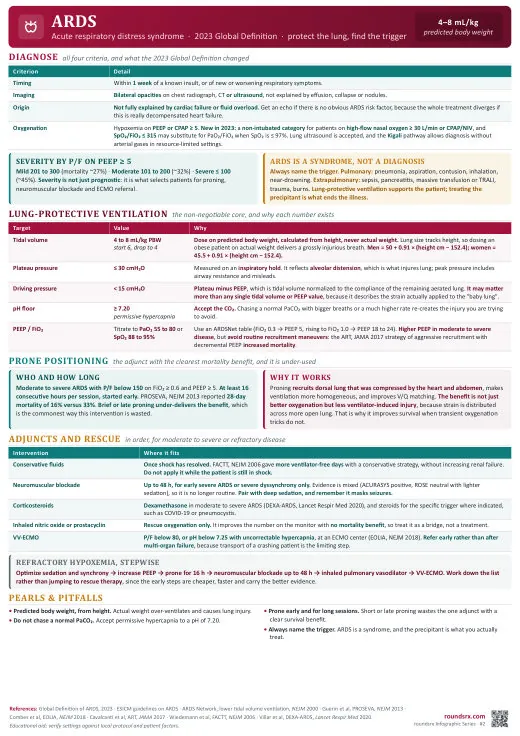
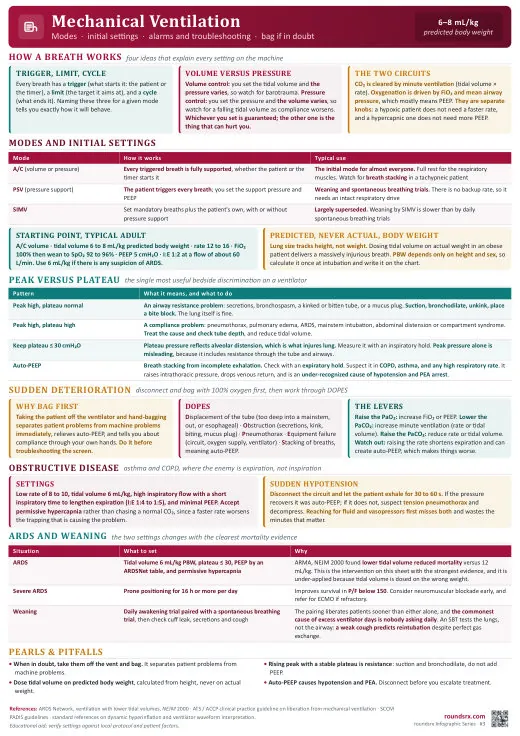
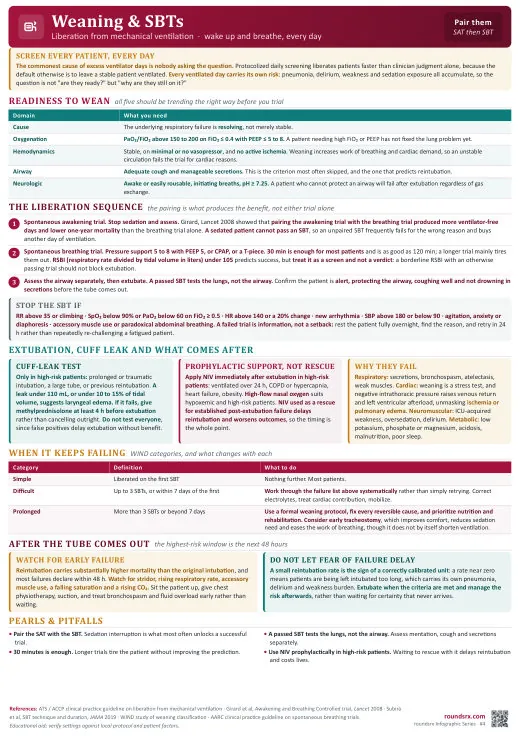
- #1 Sepsis & Septic Shock Recognition → Resuscitation · the first hour Full topic →
- #2 ARDS Acute Respiratory Distress Syndrome · 2023 Global Definition Full topic →
- #3 Mechanical Ventilation Modes · Initial Settings · Alarms & Troubleshooting Full topic →
- #4 Weaning & SBTs Liberation from Mechanical Ventilation
- #5 Sedation & Delirium Analgesia-first · Light sedation · ABCDEF bundle Full topic →
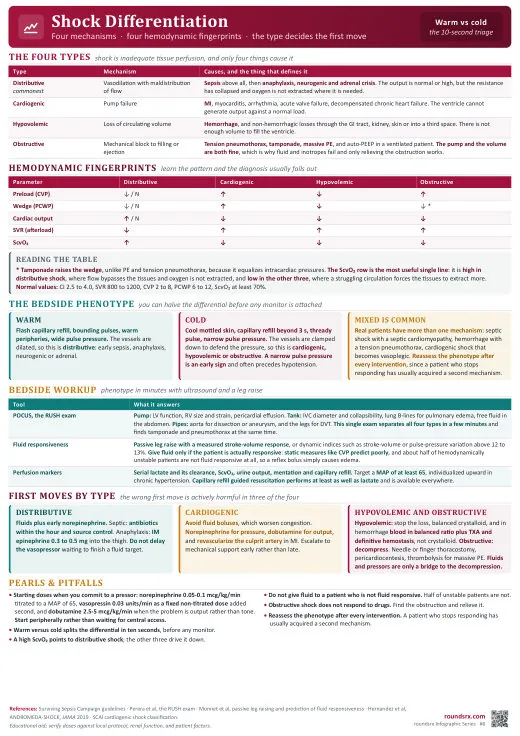
- #6 Shock Differentiation Four mechanisms · four hemodynamic fingerprints Full topic →
- #7 Vasopressors Squeeze the pipes · receptor pharmacology, dosing and the escalation ladder Full topic →
- #8 Inotropes Drive the pump · contractility, cardiac output & inodilators Full topic →
- #9 Acute Kidney Injury KDIGO Staging · Prevention · When to Start RRT Full topic →
- #10 Acid-Base Interpretation A reproducible stepwise read of any ABG Full topic →
- #11 Electrolyte Emergencies Potassium · Sodium · Magnesium · Phosphate · Calcium Full topic →
- #12 DKA & HHS BHB replaces the anion gap · ADA/EASD 2024 consensus Full topic →
- #13 Nutrition in Critical Illness When · What · How much
- #14 ICU Prophylaxis VTE · Stress Ulcer · The Daily Checklist Full topic →
- #15 Airway & RSI Rapid Sequence Intubation · prepare for the difficult airway Full topic →
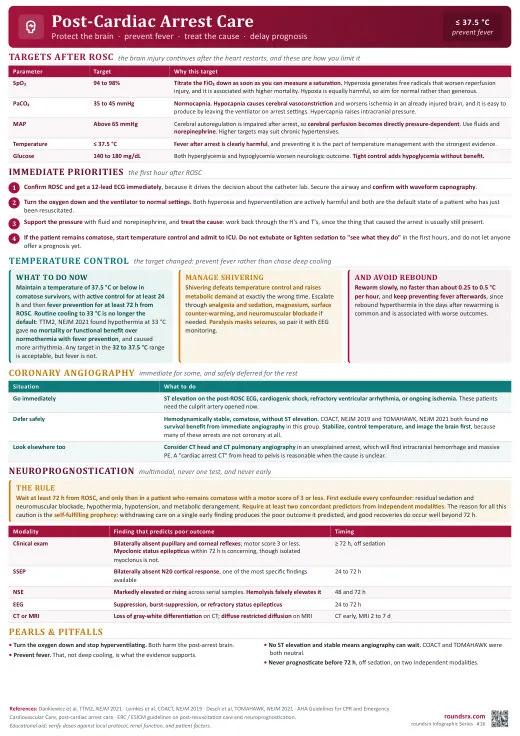
- #16 Post-Cardiac Arrest Care Protect the brain · prevent fever · delay prognosis Full topic →
Code & Rapid Response Pack
The arrest algorithm and post-arrest care first, then the emergencies a rapid response call most often turns out to be: hypotension of unclear cause, a fast or slow rhythm, a failing airway, seizures, stroke, anaphylaxis, major bleeding, pulmonary embolism and poisoning.
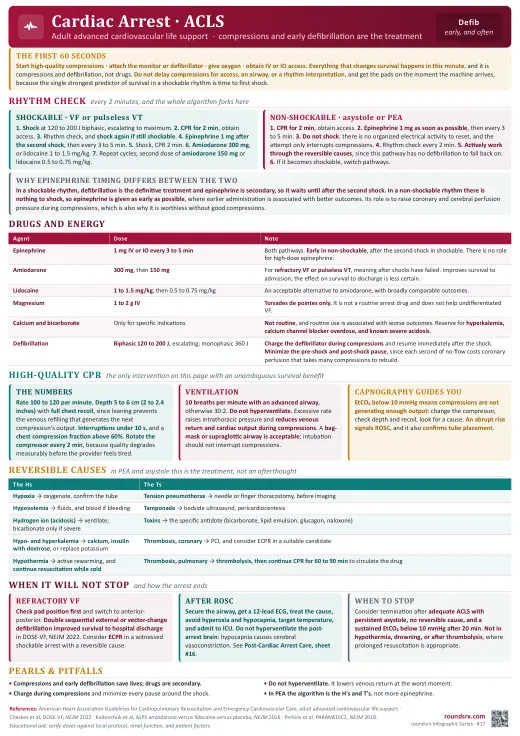
- #17 Cardiac Arrest · ACLS Adult Advanced Life Support · 2025 AHA Full topic →
- #16 Post-Cardiac Arrest Care Protect the brain · prevent fever · delay prognosis Full topic →
- #6 Shock Differentiation Four mechanisms · four hemodynamic fingerprints Full topic →
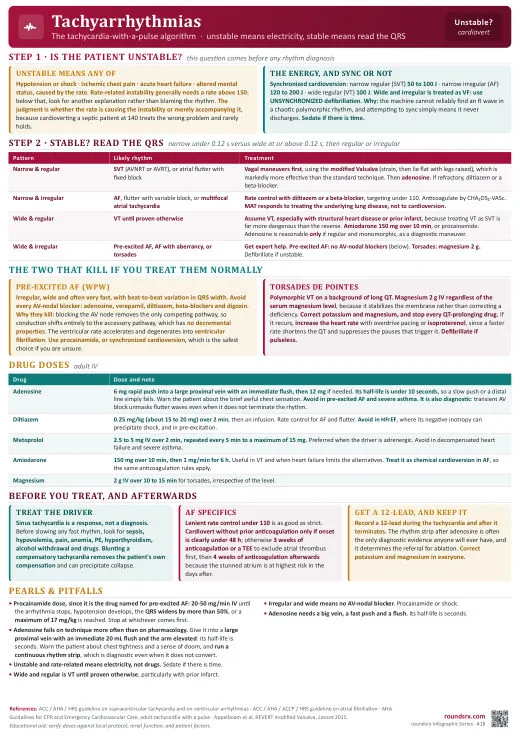
- #18 Tachyarrhythmias The tachycardia-with-a-pulse algorithm · rate > 150 Full topic →
- #61 Bradycardia & Heart Block Symptomatic? Reversible? Infranodal? · the three questions Full topic →
- #15 Airway & RSI Rapid Sequence Intubation · prepare for the difficult airway Full topic →
- #31 Status Epilepticus The time-critical seizure emergency · treat by the clock Full topic →
- #42 Acute Ischemic Stroke Time is brain · thrombolysis & thrombectomy Full topic →
- #53 Anaphylaxis Epinephrine first · IM, into the thigh, now Full topic →
- #32 Major Hemorrhage Massive transfusion · damage-control resuscitation Full topic →
- #40 Pulmonary Embolism Diagnose · risk-stratify · treat by severity Full topic →
- #34 Poisoning & Antidotes General approach · toxidromes · specific antidotes Full topic →
Cardiology Pack
The most common cardiology admissions come first (chest pain, decompensated heart failure and atrial fibrillation), followed by acute coronary syndromes, the four pillars of heart failure therapy, syncope, valve disease, pericarditis, conduction disease, and the two that must never be missed: cardiogenic shock and aortic dissection.
- #148 Chest Pain The five that kill · exclude them first, then risk-stratify Full topic →
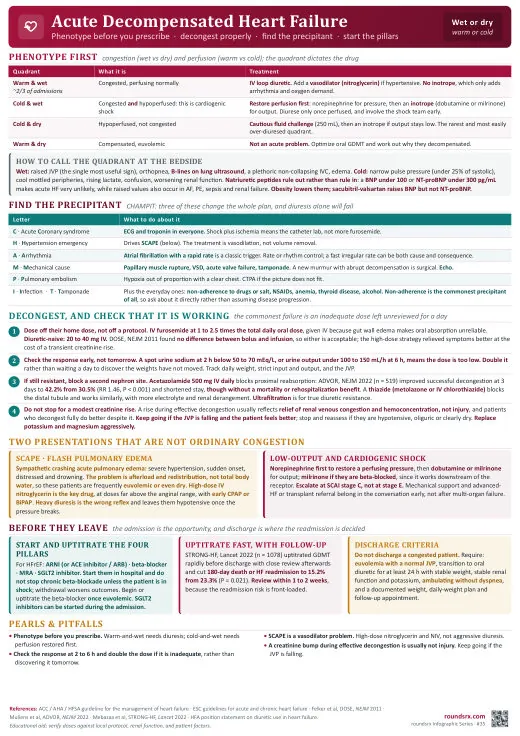
- #35 Acute Heart Failure Phenotype · decongest · find the precipitant · start the pillars Full topic →
- #48 AF with RVR Atrial fibrillation with rapid ventricular response Full topic →
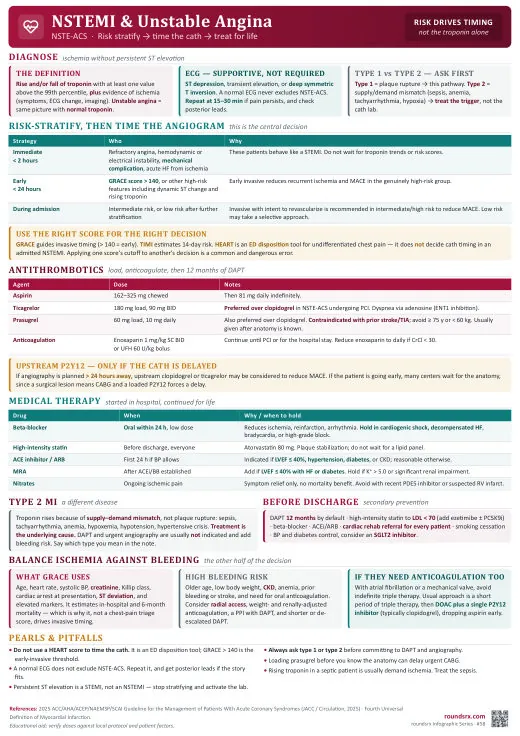
- #58 NSTEMI & Unstable Angina NSTE-ACS · risk stratify, time the cath, treat for life Full topic →
- #67 Chronic HFrEF · GDMT Four pillars · start all four early, titrate to target Full topic →
- #64 Syncope Reflex, orthostatic, or cardiac? · history + exam + ECG Full topic →
- #57 STEMI ST-elevation MI · recognize, reperfuse, protect the myocardium Full topic →
- #63 Valvular Heart Disease AS · MR · AR · MS · grade the lesion, then time the intervention Full topic →
- #62 Acute Pericarditis Two of four criteria · NSAID + colchicine, taper by CRP Full topic →
- #61 Bradycardia & Heart Block Symptomatic? Reversible? Infranodal? · the three questions Full topic →
- #50 Cardiogenic Shock Pump failure · perfuse the organs, fix the cause Full topic →
- #59 Aortic Dissection Acute aortic syndrome · rate first, then pressure, then the surgeon Full topic →
Antibiotics & Infectious Disease Pack
The spectrum chart first, as the reference the rest of the pack builds on, then the common inpatient infections (pneumonia, urinary, skin, intra-abdominal, C. difficile), then the hospital-acquired and high-stakes ones. Each infection sheet pairs the empiric regimen with how long to treat.
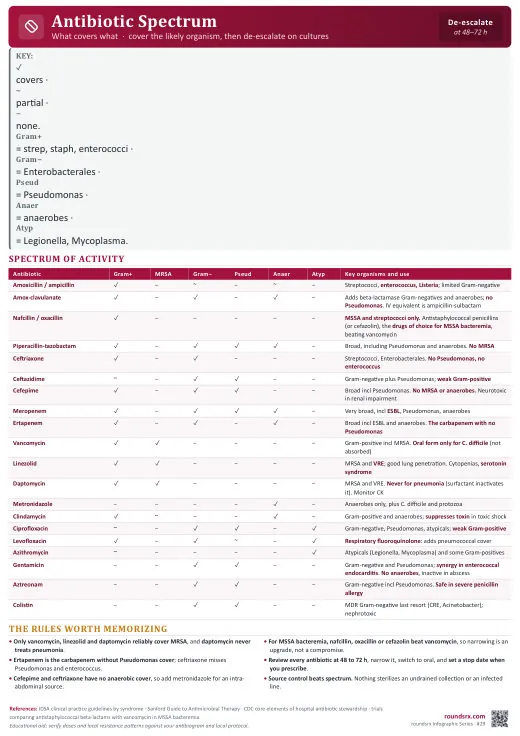
- #29 Antibiotic Spectrum What covers what · gram-positive vs gram-negative Full topic →
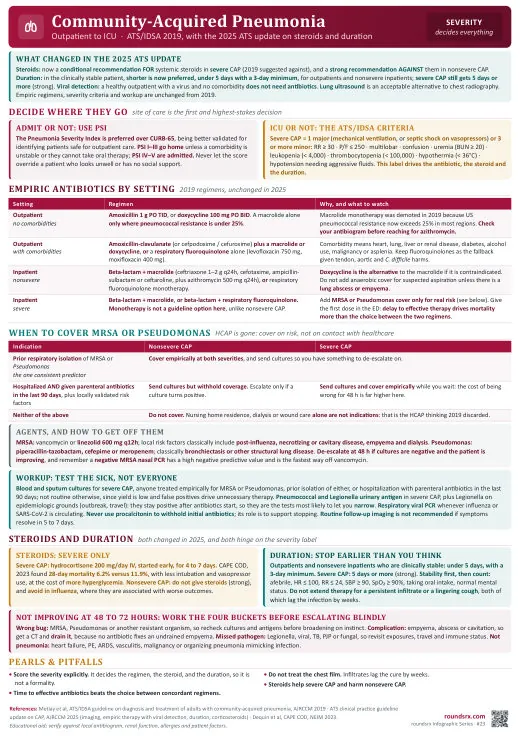
- #23 Community-Acquired Pneumonia Outpatient to ICU · severity drives the regimen, the steroid and the duration Full topic →
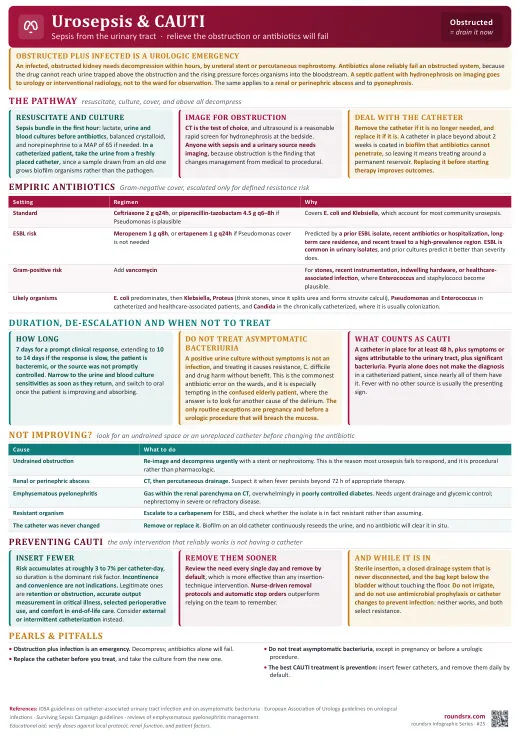
- #25 Urosepsis & CAUTI Sepsis from the urinary tract · drain the obstruction Full topic →
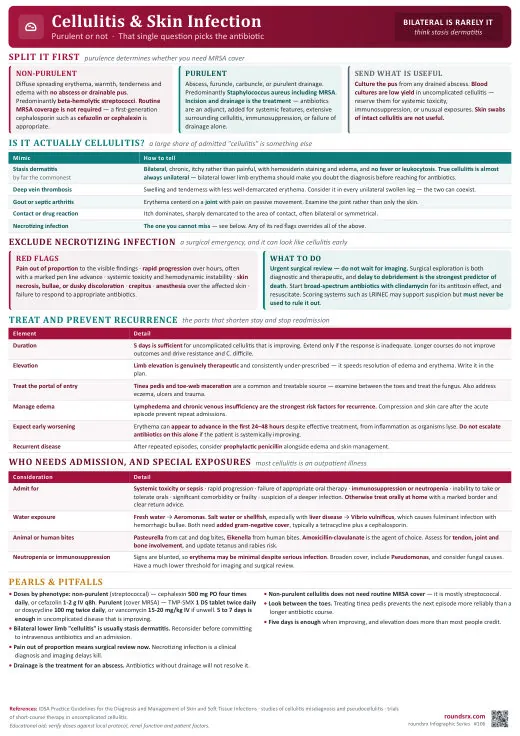
- #106 Cellulitis & Skin Infection Purulent or not · bilateral is rarely cellulitis Full topic →
- #24 Intra-Abdominal Sepsis Secondary peritonitis · source control first Full topic →
- #75 Clostridioides difficile Test only if it fits · fidaxomicin first · soap and water Full topic →
- #21 HAP & VAP Hospital- & ventilator-associated pneumonia
- #30 Antibiotic Safety Allergy alternatives · adverse effects · what to monitor
- #27 Catheter-Related BSI Central-line bloodstream infection (CLABSI) Full topic →
- #150 Diabetic Foot Infection Grade it, probe it, perfuse it · antibiotics alone will not heal it Full topic →
- #22 Bacterial Meningitis The CNS emergency · antibiotics before the scan Full topic →
- #113 Neutropenic Fever Antibiotics within 60 minutes · this is sepsis until proven otherwise Full topic →
Clinic Pack
The conditions that fill a primary care schedule, roughly most common first: hypertension, type 2 diabetes and lipids, then screening, weight, mood, back pain, kidney disease, reflux, smoking, bone health, and the cardiovascular-kidney-metabolic framework that ties the first three together.
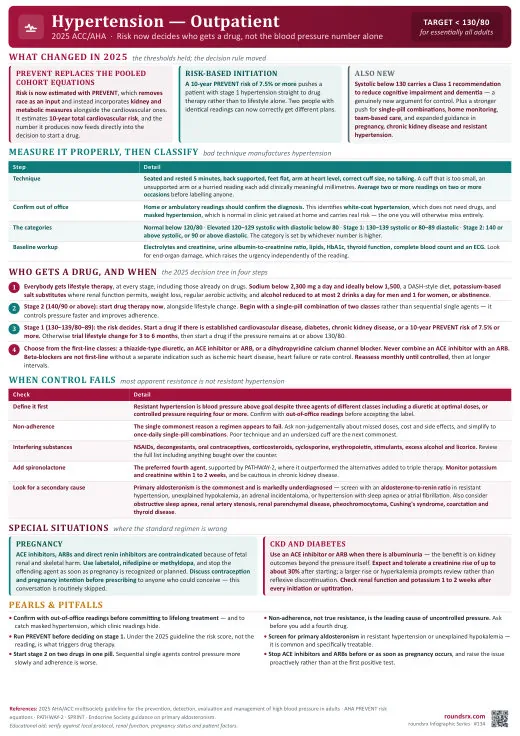
- #134 Hypertension: Outpatient 2025 ACC/AHA · PREVENT risk now decides who gets a drug Full topic →
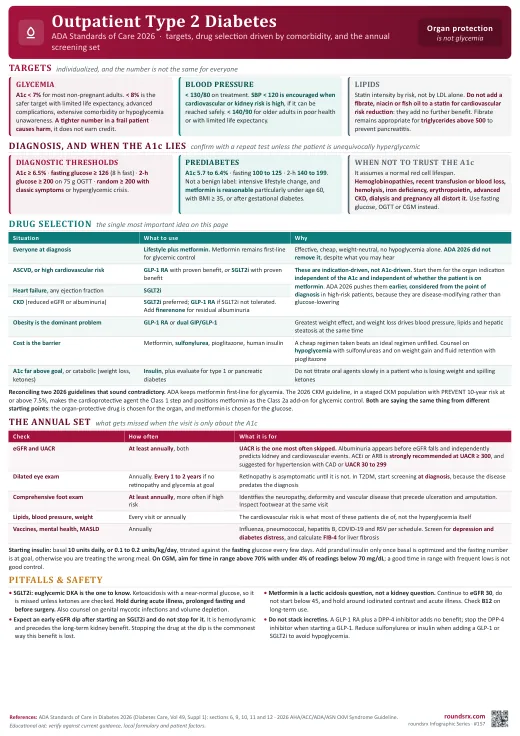
- #157 Outpatient Type 2 Diabetes ADA Standards of Care 2026 · targets, comorbidity-driven drug choice, the annual screening set Full topic →
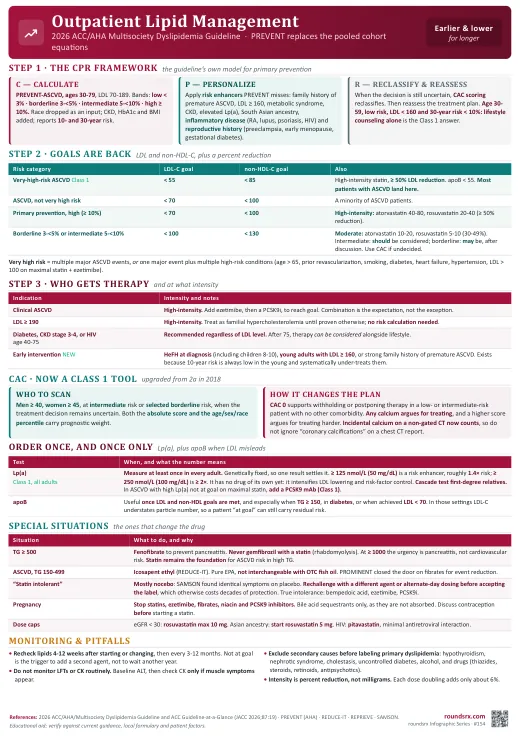
- #154 Outpatient Lipid Management 2026 ACC/AHA dyslipidemia guideline · PREVENT risk bands, numeric LDL goals, parallel add-ons Full topic →
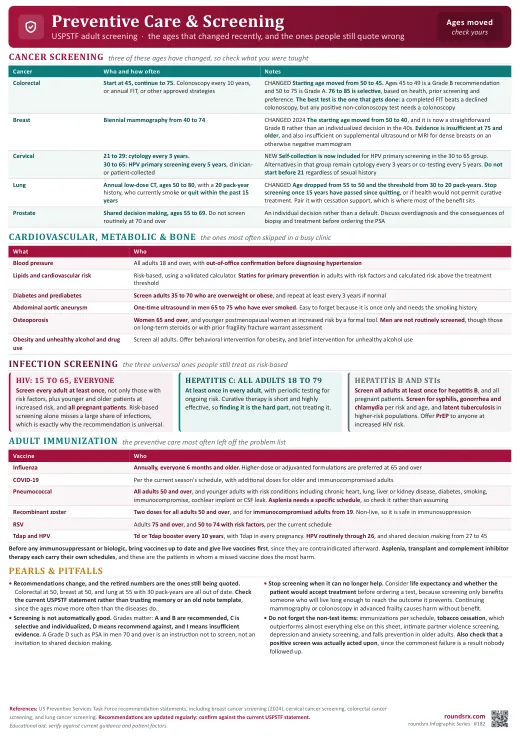
- #182 Preventive Care & Screening USPSTF adult screening · the ages that changed, plus adult immunization Full topic →
- #156 Obesity Management & GLP-1 Agents Who qualifies, titration schedules, monitoring · plus the perioperative and bariatric reversals Full topic →
- #195 Depression & Anxiety Score it, screen for bipolar, ask about suicide directly · pick the drug by its side effects Full topic →
- #199 Low Back Pain Find the few percent that is not nonspecific · then do not image the rest Full topic →
- #70 Chronic Kidney Disease KDIGO 2024 · stage it, slow it, treat the cardiovascular risk Full topic →
- #193 GERD, PUD & H. pylori Alarm features decide the first step · PPI timing before escalation · clarithromycin triple retired 2024 Full topic →
- #185 Smoking Cessation Combine pharmacotherapy with behavioral support · and treat relapse as data, not failure Full topic →
- #191 Osteoporosis A fragility fracture IS the diagnosis · treat by risk tier, never stop denosumab without a plan Full topic →
- #155 Cardiovascular-Kidney-Metabolic (CKM) Syndrome 2026 AHA/ACC/ADA/ASN guideline · five stages, screening by stage, the four CKD drug thresholds Full topic →
- Orientation folders: print the pack for the rotation each intern starts on. A single PDF per pack means one print job instead of a dozen downloads.
- The workroom wall: pin the ICU or Code sheets by the workstations. The QR code in each footer opens the live page, so when a guideline changes, the printed copy points to the update instead of stranding people on the old one.
- Night float handoff: the Nights & Cross-Cover Pack covers the pages that most often arrive after hours.
- Teaching sessions: a sheet makes a ready handout for noon conference or morning report, and nearly every one links to a full topic page with the complete protocol for anyone who wants to go deeper.
Printing on US Letter paper: the sheets are A4, so choose Fit to page (or Shrink oversized pages) in the print dialog. At 100% scale a Letter printer trims the bottom of an A4 page, which is where the footer and QR code sit.
- Built from the current guideline, and named on the sheet. Each sheet lists its sources in the footer, for example the 2025 AHA guidelines for post-cardiac arrest care, the 2026 ACC/AHA dyslipidemia guideline, KDIGO 2024 for chronic kidney disease, and the 2026 AASLD/IDSA hepatitis B guideline. Trial results are checked against the primary publication, not a press release.
- The why, not only the what. A dose, a threshold or a follow-up interval comes with the reason for it: what it protects against and what would change the plan. That is what lets a sheet teach as well as remind.
- Updated when the evidence changes. When a new guideline replaces an old one, the affected sheets are re-rendered and the change is logged on What's New in Medicine, with what changed from the previous edition.
- One page, every time. Each sheet is a single vector A4 page that stays sharp when zoomed or enlarged. Nearly all also appear on their topic page under the One Pager tab, next to the full protocol.
More free tools for the same rotations: the Intern Survival Guide, the Pimp Me quiz, clinical pearls and clinical calculators.