ACS Overview
- Chest pain → ECG within 10 min → Troponin
- ST elevation in 2 contiguous leads = STEMI → cath lab NOW → STEMI Protocol →
- No ST elevation + troponin rising = NSTEMI → NSTEMI Protocol →
- Normal ECG + normal troponin = unstable angina or non-cardiac
| Component | 0 | 1 | 2 |
|---|---|---|---|
| History | Slightly suspicious | Moderately | Highly suspicious |
| ECG | Normal | Non-specific | ST deviation |
| Age | <45 | 45–64 | ≥65 |
| Risk Factors | None | 1–2 | ≥3 or known CAD |
| Troponin | Normal | 1–3×ULN | >3×ULN |
| Feature | STEMI | NSTEMI | Unstable Angina |
|---|---|---|---|
| Pathology | Complete coronary occlusion (transmural) | Partial occlusion / subtotal thrombus | Partial occlusion, no necrosis |
| ECG | ST elevation ≥1mm in 2 contiguous leads (or new LBBB) | ST depression, T-wave inversion, or nonspecific | Normal or nonspecific changes |
| Troponin | Elevated (rises within 3–6h) | Elevated | Normal |
| Cath timing | Emergent PCI (<90 min door-to-balloon) [STEMI Protocol] | Early invasive (2–24h) or ischemia-guided [NSTEMI Protocol] | Risk-stratified approach |
| Mortality (30d) | ~6–8% | ~3–5% | <1% |
| Feature | Type 1 MI (Plaque Rupture) | Type 2 MI (Supply-Demand Mismatch) |
|---|---|---|
| Mechanism | Atherosclerotic plaque rupture/erosion → thrombotic occlusion | Oxygen supply-demand mismatch WITHOUT plaque rupture |
| Triggers | Spontaneous plaque event | Tachycardia, anemia, sepsis, hypotension, respiratory failure, hypertensive crisis |
| Treatment | Antiplatelet + anticoag + PCI/CABG | Treat the underlying cause (e.g., transfuse, treat sepsis, rate control) |
| Cath indicated? | Yes | Usually no (unless type 1 cannot be excluded) |
| DAPT needed? | Yes (12 months) | Not routinely, depends on underlying CAD |
| Killip Class | Findings | 30-Day Mortality |
|---|---|---|
| I | No HF signs | ~6% |
| II | Rales, S3, JVD | ~17% |
| III | Frank pulmonary edema | ~38% |
| IV | Cardiogenic shock (SBP <90, end-organ hypoperfusion) | ~67% |
| Test | How to Do It | Why |
|---|---|---|
| 12-lead ECG WITHIN 10 MIN | Repeat every 15 to 30 minutes if the first is non-diagnostic and the pain persists. | ⚠ A single normal ECG does not exclude ACS. Infarction evolves, so the diagnostic tracing is often the third one. Comparing against an old ECG converts an ambiguous finding into a decision. |
| Extra leads EASILY MISSED | V4R in every inferior STEMI, and posterior leads V7 to V9 when there is ST depression in V1 to V3. | These change treatment, not just the label. A right ventricular infarct is preload dependent, so nitrates can drop the pressure catastrophically and the answer is fluids instead. A posterior infarct is a true STEMI that the standard 12 leads show only as reciprocal depression, so without the extra leads it gets managed as an NSTEMI and misses the cath lab. |
| High-sensitivity troponin | Serial draws on a 0/1 h or 0/3 h protocol. | The delta matters more than the absolute number. A raised troponin is not automatically ACS: sepsis, pulmonary embolism, heart failure, myocarditis and renal disease all raise it, and a rise without a delta and without ischemic features is usually type 2. Never wait for a troponin in a STEMI, which is an ECG diagnosis. ⚠ High-dose biotin supplements can make troponin falsely LOW on susceptible assays and hide an NSTEMI, so ask about hair/skin/nail supplements (see biotin interference). |
| CBC, BMP, coagulation studies | Baseline before anticoagulation. | Anemia both worsens ischemia and changes the bleeding calculus. Potassium and magnesium drive peri-infarct arrhythmia, and renal function sets the contrast plan and the dose of every renally cleared antithrombotic. |
| Chest radiograph | Portable, without delaying reperfusion. | Looks for the alternatives that would make anticoagulation dangerous, principally a widened mediastinum suggesting aortic dissection, and shows pulmonary edema that reclassifies the patient's Killip class. |
| Echocardiogram | When the diagnosis is uncertain or the patient is unstable. | A regional wall motion abnormality supports ischemia when the ECG is equivocal, and it identifies the mechanical complications that change the operation: acute mitral regurgitation, ventricular septal rupture, tamponade. |
| Intervention | Details |
|---|---|
| Aspirin | 325mg chewed immediately |
| O2 | Only if SpO2 <90% DETO2X-AMI AVOID |
| Nitroglycerin | 0.4mg SL q5min ×3. AVOID: RV infarct, SBP <90, PDE5i use |
| Heparin | UFH 60u/kg bolus → 12u/kg/hr (or enoxaparin 1mg/kg q12h) |
| Beta-blocker | Within 24h if stable. Avoid in HF, bradycardia, cocaine |
| Atorvastatin | 80mg immediately (high-intensity) |
| Scenario | Target | Details |
|---|---|---|
| STEMI, PCI-capable center [Full Protocol] | <90 min door-to-balloon | Activate cath lab from ED or EMS. Goal <60 min for walk-in STEMIs |
| STEMI, transfer to PCI center | <120 min first medical contact to device | If transfer time exceeds this, give fibrinolytics at presenting hospital |
| Fibrinolysis (if PCI unavailable) | <30 min door-to-needle | Tenecteplase (TNK) weight-based single bolus. Rescue PCI if no ST resolution by 60–90 min |
| NSTEMI, early invasive [Full Protocol] | 2–24 hours | High-risk features: refractory angina, hemodynamic instability, new HF, GRACE >140 TIMACS, 2009 |
| NSTEMI, ischemia-guided | Selective cath | Low-risk, no recurrent symptoms, negative stress test |
| Agent | Loading Dose | Maintenance | Timing / Notes |
|---|---|---|---|
| Aspirin | 325 mg chewed | 81 mg daily (lifelong) | Give immediately to ALL ACS patients |
| Ticagrelor | 180 mg PO | 90 mg BID × 12 mo | Preferred P2Y12. Reversible. Use only with ASA 81mg. PLATO, 2009 |
| Prasugrel | 60 mg PO | 10 mg daily × 12 mo | STEMI going to PCI. Avoid if prior stroke/TIA, age ≥75, wt <60 kg. TRITON-TIMI 38, 2007 |
| Clopidogrel | 600 mg (PCI) or 300 mg | 75 mg daily × 12 mo | Alternative. CYP2C19 poor metabolizers = reduced efficacy |
| GP IIb/IIIa (antiplatelet -bailout only, bailout = rescue mid-procedure) | Eptifibatide or tirofiban | Infusion during/post PCI | High thrombus burden only. NOT routine before cath. EARLY-ACS, 2009. Why bailout only? Strongest antiplatelet (blocks final common pathway) but biggest bleeding risk -modern P2Y12 + bivalirudin + DES deliver similar ischemic benefit with less bleeding. |
| Cangrelor | 30 mcg/kg IV bolus | 4 mcg/kg/min | IV P2Y12 for NPO patients in cath lab. Immediate onset/offset |
| Score | Components | Interpretation |
|---|---|---|
| TIMI (NSTEMI/UA) | Age ≥65, ≥3 CAD RFs, known CAD, ASA use past 7d, ≥2 angina episodes/24h, ST deviation, elevated troponin (1 pt each, max 7) | 0–2: Low (5%). 3–4: Intermediate. 5–7: High (41%) → early invasive |
| GRACE | Age, HR, SBP, Cr, Killip class, cardiac arrest, ST deviation, troponin (calculator-based) | <108: Low (<1% death). 109–140: Intermediate. >140: High (>3%) → early invasive <24h |
| Letter | Class | Drug / Target | Rationale |
|---|---|---|---|
| A | ACE inhibitor (or ARB) | Lisinopril 2.5–20 mg daily | Prevents remodeling. Start within 24h if stable. EF ≤40%, anterior MI, HF, DM. SAVE, 1992 |
| B | Beta-blocker | Metoprolol succinate or carvedilol | Reduces mortality, prevents arrhythmias. Avoid in cardiogenic shock |
| C | Cholesterol / Statin | Atorvastatin 80 mg or rosuvastatin 40 mg | High-intensity for ALL post-ACS. Target LDL <70. PROVE IT, 2004 |
| D | Dual antiplatelet | ASA 81 mg + ticagrelor 90 BID | 12 months standard. Reduces stent thrombosis and recurrent events |
| E | Eplerenone (MRA) | Eplerenone 25–50 mg daily | If EF ≤40% + HF symptoms or DM. Monitor K+ and Cr. EPHESUS, 2003 |
| Topic | Old practice | 2025 update | Why / trial basis |
|---|---|---|---|
| DAPT after PCI CHANGED | 12 mo DAPT (ASA + P2Y12) for everyone | 1 mo DAPT, then ticagrelor monotherapy (Class 1, LOE A). 12 mo still default if not at high bleeding risk. | Aspirin withdrawal at 1 mo with continued ticagrelor cuts BARC 2/3/5 bleeding ~44% with no increase in ischemic events. Benefit largest in NSTE-ACS. TWILIGHT, 2019 TICO, 2020 T-PASS, 2023 |
| P2Y12 choice | Clopidogrel acceptable | Ticagrelor or prasugrel preferred over clopidogrel post-PCI | More potent platelet inhibition reduces CV death/MI/stroke. Reserve clopidogrel for high bleeding risk or when ticagrelor/prasugrel are contraindicated. PLATO, 2009 |
| AFib + PCI triple therapy CHANGED | Triple therapy (OAC + ASA + P2Y12) for variable durations | Short triple (1 to 4 weeks), then drop ASA, then OAC + clopidogrel through month 12, then OAC alone (Class 1) | Adding ASA to OAC + P2Y12 increases bleeding 3 to 4 fold without reducing ischemic events. Clopidogrel preferred over ticagrelor/prasugrel as the dual partner (bleeding). DOACs (especially apixaban) preferred over warfarin. AUGUSTUS, 2019 PIONEER AF-PCI, 2016 |
| LDL target post-ACS CHANGED | Add non-statin if LDL ≥ 70 on max statin | Non-statin if LDL ≥ 70 (Class 1). Reasonable to intensify if LDL 55 to <70 on max statin (Class 2a, lower threshold) | Post-ACS is the highest-risk window. Adding ezetimibe or PCSK9 inhibitor reduces CV events. The 2025 guideline pushes the intensification floor lower than the 2018 cholesterol guideline. FOURIER, 2017 ODYSSEY OUTCOMES, 2018 |
| Intravascular imaging UPGRADED | IVUS/OCT Class 2a (2021 revasc guideline) | Class 1 for PCI guidance, especially complex lesions (left main, long lesions, bifurcation, CTO) | Lower cardiac death and stent thrombosis vs angiography alone. RENOVATE-COMPLEX-PCI, 2023 ILUMIEN IV, 2023 |
| Multivessel disease CHANGED | Culprit-only PCI was the conservative default | Complete revascularization (Class 1). Treat severely stenotic non-culprit lesions same setting or staged. | Reduces recurrent MI and CV death vs culprit-only. COMPLETE, 2019 MULTISTARS-AMI, 2023 FULL REVASC, 2024 |
| Cardiogenic shock NEW | No proven mechanical support; routine pump use unsupported | Microaxial flow pump (Impella CP) reasonable in select AMI shock (Class 2a). Transfer to shock center (Class 1). | First positive shock RCT to show mortality benefit. Patient selection critical (anterior STEMI, no severe RV failure). Caveats: more bleeding, limb ischemia, AKI. DanGer Shock, 2024 |
| Vascular access | Femoral default | Radial preferred over femoral for PCI in ACS (Class 1) | Reduces bleeding, vascular complications, and mortality. MATRIX, 2015 RIVAL, 2011 |
| hs-Troponin protocols | Serial 3 to 6 hr troponins standard | 0/1h or 0/2h hs-cTn algorithms formalized for rule-in/rule-out | Faster ED disposition without missed MIs. ESC 2020 already endorsed; 2025 ACC/AHA brings US guidance in line. |
| Periprocedural anticoag UNCHANGED | UFH for NSTE-ACS; UFH or bivalirudin for STEMI PCI | Same: UFH Class 1 for NSTE-ACS; bivalirudin Class 2a alternative for STEMI PCI, Class 2b for NSTE-ACS | UFH remains the workhorse. Bivalirudin reduces bleeding but did not unseat UFH in trials (BRIGHT-4 was the closest positive signal). Fondaparinux alone does NOT cover PCI (catheter thrombosis risk), add UFH bolus at cath. |
📖 What "Class 1" and "LOE A" mean (click to expand)
ACC/AHA guidelines grade every recommendation on two axes: Class of Recommendation (strength) and Level of Evidence (quality of data). The two are written together, e.g., "Class 1, LOE A."
| Class | Strength | Phrase you'll see | Bedside translation |
|---|---|---|---|
| Class 1 | Strong (Benefit >>> Risk) | "is recommended", "should", "is indicated" | Standard of care. Skipping it without a documented reason is below the standard. |
| Class 2a | Moderate (Benefit >> Risk) | "is reasonable", "can be useful" | Lean toward doing it. Most experts would. |
| Class 2b | Weak (Benefit ≥ Risk) | "may be reasonable", "may be considered" | Optional, case-by-case. |
| Class 3: No Benefit | Moderate against | "is not recommended" | Don't do it, no upside. |
| Class 3: Harm | Strong against | "potentially harmful", "should not" | Don't do it, actively harmful. |
| Level of Evidence | Source |
|---|---|
| LOE A | Multiple high-quality RCTs or meta-analyses. Best evidence. |
| LOE B-R | One or more moderate-quality Randomized trials. |
| LOE B-NR | Well-designed Non-Randomized studies. |
| LOE C-LD | Limited Data: small studies, registries, retrospective. |
| LOE C-EO | Expert Opinion only, no real evidence. |
- Triple therapy (DOAC + ASA + clopidogrel): 1 to 4 weeks. Typically 1 week if low ischemic risk, up to 1 month if high (left main, complex multivessel, recent stent thrombosis).
- Dual therapy (DOAC + clopidogrel): through month 12 post-PCI. Aspirin is dropped.
- Monotherapy (DOAC alone): after 12 months. Why: the stent has fully endothelialized and chronic dual antithrombotic adds bleeding without ischemic benefit.
- P2Y12 choice: clopidogrel preferred (not ticagrelor or prasugrel) once on dual therapy. Why: bleeding risk on top of OAC is unacceptable with potent P2Y12 inhibitors.
- OAC choice: DOAC preferred over warfarin unless mechanical valve or severe MS. Apixaban has the most direct ACS+PCI evidence (AUGUSTUS).
| Drug | Dose | Notes |
|---|---|---|
| Aspirin | 325mg chew, then 81mg daily | ALL ACS unless true allergy |
| Ticagrelor | 180mg load, 90mg BID | Preferred P2Y12 (PLATO trial). Use aspirin 81mg only |
| Clopidogrel | 600mg load, 75mg daily | Alternative. CYP2C19 polymorphisms |
| Heparin | 60u/kg, 12u/kg/hr | aPTT 1.5–2.5× control |
Patient: 58M smoker, acute crushing chest pain radiating to left arm × 45 min, diaphoresis, nausea. HR 95, BP 142/88, SpO2 96%.
ECG: ST elevation 3mm in V1–V4 with reciprocal ST depression in II, III, aVF. Anterior STEMI, LAD territory.
Immediate actions (first 10 minutes):
- ASA 325 mg chewed + ticagrelor 180 mg PO load
- Heparin 60 u/kg IV bolus then 12 u/kg/hr
- Cath lab activation, target door-to-balloon <90 min
- Atorvastatin 80 mg PO. NTG 0.4 mg SL (anterior wall, no RV involvement)
Cath findings: 100% proximal LAD occlusion. DES placed. TIMI 3 flow restored. Door-to-balloon time: 68 minutes.
Post-PCI orders:
- ICU admission, continuous telemetry × 48h (VT/VF risk highest early)
- Echo next AM → EF 35% with anterior wall hypokinesis
- Start ABCDE: lisinopril 2.5 mg, metoprolol 25 mg BID, atorvastatin 80 mg, ASA 81 + ticagrelor 90 BID, eplerenone 25 mg (EF <40%)
- Cardiac rehab referral before discharge
Key lesson: Anterior STEMI = large territory at risk. Time is myocardium. ABCDE medications are essential at discharge, especially with reduced EF.
Patient: 72F with DM, HTN, HLD. Substernal pressure at rest × 2h, now improving. HR 82, BP 158/92, SpO2 97%.
ECG: ST depression 1.5 mm in V4–V6, T-wave inversions in I, aVL. No ST elevation.
Labs: hs-troponin 0h = 85 ng/L (elevated), 3h = 142 ng/L (rising). Cr 1.1, K 4.2.
Risk stratification:
- HEART score: H=2, E=2, A=2, R=2, T=2 = 10 (high risk)
- TIMI score: Age ≥65, ≥3 RFs, ST deviation, elevated troponin, ≥2 episodes = 5/7 (high risk)
- GRACE score: 156 (high risk, >3% in-hospital death) → early invasive strategy <24h
Management:
- ASA 325 mg + ticagrelor 180 mg load + heparin drip
- Atorvastatin 80 mg, metoprolol 25 mg (HR/BP allow it)
- Cath within 24h → 80% circumflex stenosis, DES placed
- Discharge on ABCDE meds. HbA1c optimization. Cardiac rehab
Key lesson: NSTEMI is not benign. Use GRACE/TIMI to identify high-risk patients who benefit from early invasive strategy (<24h). This patient had multiple high-risk features mandating prompt catheterization.
Patient: 68M admitted for pneumonia/sepsis. HR 128, BP 88/54, SpO2 89% on 4L NC. Febrile to 39.2°C. Known 2-vessel CAD (prior cath showed 60% LAD, 50% RCA).
ECG: Sinus tachycardia, no acute ST changes. Nonspecific T-wave flattening laterally.
Labs: hs-troponin 0h = 65 ng/L, 3h = 78 ng/L (mildly elevated, stable). Lactate 3.8. WBC 18k.
Clinical reasoning:
- Troponin elevation in setting of sepsis + tachycardia + hypotension + hypoxia = classic Type 2 MI (demand ischemia)
- No acute plaque rupture, this is supply-demand mismatch from systemic illness
- Catheterization is NOT indicated, would not change management and exposes patient to procedural risk
Management:
- Treat the underlying cause: IV antibiotics, fluid resuscitation, vasopressors if needed
- Supplemental O2 to target SpO2 ≥94%
- Hold beta-blocker (hypotensive, septic). Hold ACEi (acute hypotension)
- Continue home statin. Trend troponins, expect resolution as sepsis improves
- Cardiology consult if troponin continues to rise despite source control, or new ST changes
Key lesson: Not every troponin elevation is a Type 1 MI. The critical question: is there a plaque event, or is there a supply-demand problem? Type 2 MI is treated by fixing the underlying trigger. Reflexive catheterization causes harm.
| Parameter | Frequency |
|---|---|
| Telemetry | Continuous. VT/VF risk highest 24–48h |
| Troponins | 0h, 3h (hs-trop) |
| ECGs | q15–30min if symptoms persist |
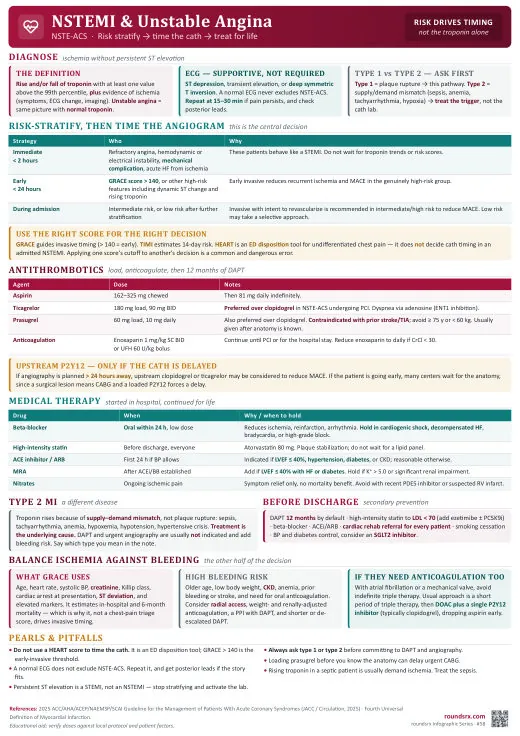
Text version
- ECG within 10 min of chest pain, then troponin. Repeat ECG q15–30 min if the first is normal but symptoms persist, because occlusion can declare itself late.
- ASA 325 mg chewed immediately in all ACS unless true allergy. Chewed for faster absorption.
- Serial hs-troponin 0h and 3h to catch the rise; a single value cannot distinguish acute from chronic elevation.
- Right-sided ECG (V4R) for inferior STEMI before nitrates, because RV infarct is preload-dependent and nitro drops the BP.
- Labs: CBC, BMP, coags, BNP, CXR. Bedside: is this Killip I or Killip IV?
- STEMI: complete occlusion (transmural). ST elevation ≥1 mm in 2 contiguous leads or new LBBB, troponin elevated. 30-day mortality ~6–8%. Emergent PCI.
- NSTEMI: partial occlusion / subtotal thrombus. ST depression, T-wave inversion or nonspecific ECG, troponin elevated. 30-day mortality ~3–5%. Early invasive 2–24 h or ischemia-guided.
- Unstable angina: partial occlusion, no necrosis. Normal or nonspecific ECG, troponin normal. Mortality <1%. Risk-stratified approach.
- STEMI equivalents get the same emergent reperfusion: new LBBB, de Winter T-waves, posterior MI, Wellens syndrome, hyperacute T waves, ST elevation in aVR, high lateral OMI, Aslanger pattern.
- Type 2 MI (supply-demand mismatch from tachycardia, anemia, sepsis, hypotension) is treated by fixing the trigger, not by cath, because there is no plaque to open.
- Continuous telemetry: VT/VF risk is highest in the first 24–48 h post-infarct.
- hs-troponin at 0h and 3h: a rising pattern separates acute injury from chronic elevation.
- Repeat ECG q15–30 min while symptoms persist: catches evolving ST elevation the first tracing missed.
- Echo before discharge: EF drives whether ACEi, MRA, and ICD discussion are indicated (EF ≤40%).
- K⁺ and Cr on eplerenone: MRAs cause hyperkalemia and creatinine rise.
- Killip class at presentation is the single strongest predictor of in-hospital mortality in STEMI (I ~6%, II ~17%, III ~38%, IV ~67%).
- Nitroglycerin in inferior STEMI without checking V4R. The RV is preload-dependent, so venodilation causes profound hypotension. Give IV fluids instead.
- Reflexively cathing a Type 2 MI. Troponin elevation in a septic tachycardic patient is almost always demand ischemia; catheterization exposes them to procedural risk without changing management.
- Applying HEART to an admitted NSTEMI to pick cath timing. HEART is an ED disposition score. GRACE >140 is what drives early invasive <24 h.
- MONA is dead. Morphine may increase mortality in ACS (use only for refractory pain) and oxygen is only for SpO₂ <90%, because hyperoxia may increase infarct size.
- Routine upstream GP IIb/IIIa. Strongest antiplatelet but biggest bleeding risk; bailout only for high thrombus burden.
- Fondaparinux alone does NOT cover PCI (catheter thrombosis risk). Add a UFH bolus at cath.
- HEART, ED chest pain disposition only. 0–3 low (consider discharge), 4–6 moderate (admit), 7–10 high (early invasive).
- GRACE, NSTEMI invasive timing. <108 low (<1% death), 109–140 intermediate, >140 high (>3%) so cath <24 h. Preferred per ESC.
- TIMI (NSTEMI/UA), simpler alternative. 0–2 low (5%), 3–4 intermediate, 5–7 high (41%) so early invasive.
- Killip IV = cardiogenic shock: emergent PCI plus consider mechanical support and transfer to a shock center.
- Escalate immediately for: refractory angina, hemodynamic instability, new heart failure, or sustained ventricular arrhythmia, regardless of score.
- 2025 ACC/AHA/ACEP/NAEMSP/SCAI guideline replaces the 2013 STEMI and 2014 NSTE-ACS guidelines. Biggest behavior changes: shorter DAPT with ticagrelor monotherapy, and short-course triple therapy in AFib + PCI.
- DAPT after PCI (CHANGED): 1 month DAPT then ticagrelor monotherapy (Class 1, LOE A); 12 months remains the default if not at high bleeding risk. TWILIGHT, 2019
- AFib + PCI (CHANGED): triple therapy 1 to 4 weeks, drop the aspirin, then OAC + clopidogrel through month 12, then OAC alone. AUGUSTUS, 2019
- Multivessel disease (CHANGED): complete revascularization is now Class 1 over culprit-only. COMPLETE, 2019
- Cardiogenic shock (NEW): microaxial flow pump reasonable in selected AMI shock (Class 2a); transfer to a shock center is Class 1. DanGer Shock, 2024
- Ticagrelor over clopidogrel: PLATO, 2009. Radial over femoral is Class 1. NSTEMI early invasive in high risk: TIMACS, 2009