URGENTCardiology
NSTEMI / Unstable Angina
Acute coronary syndrome WITHOUT ST elevation. Partial or intermittent coronary occlusion. Risk-stratify early (TIMI, GRACE, HEART) to determine invasive vs conservative strategy. Unlike STEMI, you have time to think -but not too much.
🔍 Overview
🆕 2025 ACS Guideline updates apply here. Shorter DAPT with ticagrelor monotherapy after 1 month (biggest bleeding-reduction benefit in NSTE-ACS), short-course triple therapy in AFib + PCI, GRACE-driven early invasive timing unchanged, lower LDL targets post-ACS. See full 2025 changes table →
NSTEMI vs Unstable Angina
| Feature | NSTEMI | Unstable Angina |
|---|---|---|
| Troponin | Elevated (rise and/or fall) | Normal |
| ECG | ST depression, T-wave inversions, or nonspecific (NO ST elevation) | Same -may be normal |
| Pathology | Partial/intermittent occlusion with myocardial necrosis | Partial/intermittent occlusion without necrosis |
| Management | Same initial management. NSTEMI → higher risk → earlier invasive strategy. | Risk-stratify. May be managed conservatively if low-risk. |
With high-sensitivity troponin assays, true "unstable angina" is increasingly rare. Most patients with ACS symptoms now have detectable troponin elevation.
Risk Stratification -HEART Score -ED chest pain disposition (discharge vs admit vs cath)
Best for ED chest pain disposition -identifies low-risk patients safe for early discharge vs those needing admission and workup. HEART Pathway, 2015
| Component | 0 Points | 1 Point | 2 Points |
|---|---|---|---|
| H -History | Non-suspicious | Moderately suspicious | Highly suspicious |
| E -ECG | Normal | Non-specific repolarization changes | Significant ST deviation |
| A -Age | < 45 | 45–64 | ≥ 65 |
| R -Risk factors | None | 1–2 factors | ≥ 3 factors or known CAD |
| T -Troponin | Normal | 1–3× ULN | > 3× ULN |
| Score | Risk | Action |
|---|---|---|
| 0–3 | Low (< 2% MACE at 6 weeks) | Consider early discharge with outpatient follow-up. Stress test if needed. |
| 4–6 | Intermediate | Admit, observe, serial troponins. Consider angiography. |
| 7–10 | High (> 50% MACE) | Early invasive strategy -angiography within 24h. |
TIMI Risk Score for UA/NSTEMI -14-day risk of death, MI, or urgent revascularization
Quick bedside risk stratification -7 yes/no questions, 1 point each. Higher score = higher risk of adverse events at 14 days. TIMI 11B, 1998
| Variable | 1 Point If Present |
|---|---|
| Age ≥ 65 | Yes / No |
| ≥ 3 CAD risk factors | HTN, DM, dyslipidemia, smoking, family hx of premature CAD |
| Known CAD (stenosis ≥ 50%) | Prior coronary stenosis ≥ 50% on cath |
| ASA use in past 7 days | Suggests breakthrough event despite aspirin |
| ≥ 2 anginal episodes in 24h | Recurrent ischemia = higher risk |
| ST deviation ≥ 0.5 mm | ST depression or transient ST elevation on ECG |
| Elevated cardiac biomarkers | Troponin or CK-MB above upper limit of normal |
| TIMI Score | 14-Day Event Rate | Risk Level | Action |
|---|---|---|---|
| 0–2 | 4.7% | Low | Conservative management. Consider early discharge if HEART score also low. |
| 3–4 | 13.2% | Intermediate | Admit. Consider angiography within 24–72h. |
| 5–7 | 40.9% | High | Early invasive strategy -cath within 24h. Consider ICU-level monitoring. |
TIMI vs HEART vs GRACE: TIMI is quick and easy at bedside (7 yes/no questions). HEART is best validated for ED chest pain disposition (who goes home vs who gets admitted). GRACE is the most accurate mortality predictor and drives invasive strategy timing (GRACE > 140 → cath within 24h). Use GRACE for admitted NSTEMI patients.
GRACE Score (Global Registry of Acute Coronary Events) -in-hospital and 6-month mortality after ACS, guides invasive timing
Most accurate predictor of in-hospital and 6-month mortality in ACS -used to determine timing of invasive strategy in admitted NSTEMI patients.
| Variable | Details |
|---|---|
| Age | Continuous -higher age = more points (e.g., 60 yo = ~58 pts, 80 yo = ~91 pts) |
| Heart rate | Higher HR = more points (e.g., HR 100 = ~15 pts, HR 150 = ~42 pts) |
| Systolic BP | Inverse -lower SBP = more points (SBP 80 = ~63 pts, SBP 160 = ~12 pts) |
| Creatinine | Higher Cr = more points (renal dysfunction worsens prognosis) |
| Killip class | I (no HF) = 0 pts → IV (cardiogenic shock) = ~64 pts |
| Cardiac arrest at presentation | Yes = +43 pts |
| ST-segment deviation | Yes = +30 pts |
| Elevated cardiac enzymes | Yes = +15 pts |
| GRACE Score | In-Hospital Mortality | Risk Level | Action |
|---|---|---|---|
| ≤ 108 | < 1% | Low | Conservative strategy. Stress test before discharge. |
| 109–140 | 1–3% | Intermediate | Consider angiography within 24–72h based on other features. |
| > 140 | > 3% | High | Early invasive strategy -cath within 24h. |
Killip Classification (used in GRACE):
I -No heart failure signs
II -Rales, S3, elevated JVP (mild HF)
III -Acute pulmonary edema
IV -Cardiogenic shock (SBP < 90, end-organ hypoperfusion)
I -No heart failure signs
II -Rales, S3, elevated JVP (mild HF)
III -Acute pulmonary edema
IV -Cardiogenic shock (SBP < 90, end-organ hypoperfusion)
GRACE > 140 = early invasive within 24h. This is the most important cutoff to know. Higher GRACE = more benefit from early angiography TIMACS, 2009.
🚨 Management
Step-by-Step Management -NSTEMI/UA
1
ABCs + Vitals + IV Access + Continuous Telemetry
12-lead ECG within 10 minutes. Establish 2 large-bore IVs. Continuous cardiac monitoring. Supplemental O₂ only if SpO₂ < 90%.
12-lead ECG within 10 minutes. Establish 2 large-bore IVs. Continuous cardiac monitoring. Supplemental O₂ only if SpO₂ < 90%.
2
Aspirin 325 mg -CHEW immediately (antiplatelet) ISIS-2, 1988
Do NOT swallow whole -chewing provides faster buccal absorption. Continue 81 mg daily lifelong after.
Do NOT swallow whole -chewing provides faster buccal absorption. Continue 81 mg daily lifelong after.
3
Nitroglycerin for ongoing chest pain
SL NTG 0.4 mg q5min × 3, then NTG drip 5–200 mcg/min if pain persists. ⚠️ Contraindications: SBP < 90, RV infarct (check right-sided ECG), PDE5 inhibitor within 24–48h.
SL NTG 0.4 mg q5min × 3, then NTG drip 5–200 mcg/min if pain persists. ⚠️ Contraindications: SBP < 90, RV infarct (check right-sided ECG), PDE5 inhibitor within 24–48h.
4
Anticoagulation -start heparin (anticoagulant)
Give to all NSTE-ACS unless contraindicated (active bleeding, recent ICH, known HIT). Risk scores guide cath timing, NOT the decision to anticoagulate.
UFH drip: 60 U/kg bolus (max 4,000) → 12 U/kg/hr (max 1,000). Target aPTT 1.5–2.5× control.
OR Enoxaparin: 1 mg/kg SC BID (if no PCI planned within 24h, CrCl > 30) ESSENCE, 1997
⚠️ Do NOT switch between heparin types (increases bleeding risk).
Give to all NSTE-ACS unless contraindicated (active bleeding, recent ICH, known HIT). Risk scores guide cath timing, NOT the decision to anticoagulate.
UFH drip: 60 U/kg bolus (max 4,000) → 12 U/kg/hr (max 1,000). Target aPTT 1.5–2.5× control.
OR Enoxaparin: 1 mg/kg SC BID (if no PCI planned within 24h, CrCl > 30) ESSENCE, 1997
⚠️ Do NOT switch between heparin types (increases bleeding risk).
5
Risk stratify -TIMI + HEART + GRACE + serial troponins
TIMI score Quick bedside -7 yes/no questions, 1 point each. Predicts 14-day death/MI/urgent revasc. Fast to calculate at the bedside; higher score = more benefit from early invasive strategy. TIMI 11B, 1998
HEART score ED disposition -best for deciding who goes home vs who gets admitted. 0–3 = low risk (< 2% MACE), safe for early discharge with outpatient follow-up.
GRACE score Most accurate mortality prediction -in-hospital and 6-month mortality. Drives invasive strategy timing: GRACE > 140 = cath within 24h. Use for all admitted NSTEMI patients.
Serial troponins q3–6h -watch for rise and/or fall pattern.
TIMI score Quick bedside -7 yes/no questions, 1 point each. Predicts 14-day death/MI/urgent revasc. Fast to calculate at the bedside; higher score = more benefit from early invasive strategy. TIMI 11B, 1998
HEART score ED disposition -best for deciding who goes home vs who gets admitted. 0–3 = low risk (< 2% MACE), safe for early discharge with outpatient follow-up.
GRACE score Most accurate mortality prediction -in-hospital and 6-month mortality. Drives invasive strategy timing: GRACE > 140 = cath within 24h. Use for all admitted NSTEMI patients.
Serial troponins q3–6h -watch for rise and/or fall pattern.
6
Decide: Invasive vs Conservative Strategy TIMACS, 2009
GRACE > 140 or high-risk features → Early invasive (cath within 24h)
GRACE 109–140 (intermediate risk) → Delayed invasive (cath within 24–72h)
GRACE ≤ 108, negative troponins, no high-risk features → Conservative. Stress test if needed.
GRACE > 140 or high-risk features → Early invasive (cath within 24h)
GRACE 109–140 (intermediate risk) → Delayed invasive (cath within 24–72h)
GRACE ≤ 108, negative troponins, no high-risk features → Conservative. Stress test if needed.
Invasive vs Conservative Strategy
| Strategy | Who | Timing | Notes |
|---|---|---|---|
| Immediate invasive (< 2h) | Refractory angina, hemodynamic instability, VT/VF, acute HF | Emergent cath | This is essentially a STEMI-equivalent presentation without ST elevation. |
| Early invasive (≤ 24h) | GRACE > 140, rising troponin, new ST changes, dynamic ECG changes | Cath within 24h | TIMACS, 2009: early (< 24h) vs delayed (> 36h) → reduced refractory ischemia in high-risk patients (GRACE > 140). |
| Delayed invasive (24–72h) | GRACE 109–140, intermediate risk (e.g., diabetes, EF < 40%, post-MI angina, prior PCI/CABG, GFR < 60) | Cath within 72h | Acceptable for stable patients. Load P2Y12 when anatomy known (cath lab). |
| Conservative / ischemia-guided | GRACE ≤ 108, no recurrent symptoms, negative serial troponins, no high-risk features | Stress test if needed | Medical management. Cath only if stress test positive or recurrent symptoms. |
7
P2Y12 inhibitor -timing depends on strategy (antiplatelet) PLATO, 2009 TRITON-TIMI 38, 2007
Going to cath → Load in the cath lab AFTER coronary anatomy is known (preserves CABG option -ticagrelor/clopidogrel delay surgery 5–7 days).
Conservative strategy → Load upfront (ticagrelor 180 mg or clopidogrel 600 mg).
Preferred: Ticagrelor 90 mg BID (reversible, faster onset, no CYP2C19 resistance). Prasugrel if going to PCI and no contraindications (prior stroke/TIA, age ≥75, wt <60 kg).
Going to cath → Load in the cath lab AFTER coronary anatomy is known (preserves CABG option -ticagrelor/clopidogrel delay surgery 5–7 days).
Conservative strategy → Load upfront (ticagrelor 180 mg or clopidogrel 600 mg).
Preferred: Ticagrelor 90 mg BID (reversible, faster onset, no CYP2C19 resistance). Prasugrel if going to PCI and no contraindications (prior stroke/TIA, age ≥75, wt <60 kg).
| Agent | Loading | Maintenance | Mechanism | Notes |
|---|---|---|---|---|
| Ticagrelor (Brilinta) PREFERRED | 180 mg PO | 90 mg BID | Reversible | Faster onset, no CYP2C19 issue. Side effects: dyspnea, bradycardia (adenosine accumulation -blocks RBC ENT1 reuptake). Do NOT use with ASA > 100 mg. |
| Prasugrel (Effient) | 60 mg PO | 10 mg daily | Irreversible | Only after anatomy known (PCI confirmed). Contraindicated: prior stroke/TIA. Avoid: age ≥ 75, wt < 60 kg. |
| Clopidogrel (Plavix) 2ND LINE | 600 mg PO | 75 mg daily | Irreversible (prodrug) | Use if ticagrelor/prasugrel contraindicated. ~30% of patients are CYP2C19 poor metabolizers (consider genetic testing). |
| Cangrelor (Kengreal) IV OPTION | 30 mcg/kg IV bolus | 4 mcg/kg/min infusion | Reversible (IV) | For cath lab if patient can't take PO or needs immediate platelet inhibition. Bridge until oral P2Y12 onset. |
Pre-treatment controversy in NSTEMI. ACCOAST, 2013 showed prasugrel pre-treatment before angiography provided no ischemic benefit but INCREASED bleeding. Current ESC guidance: do NOT routinely pre-treat with P2Y12 if early invasive strategy is planned -load in the cath lab once anatomy is known. STEMI is different (load upfront because diagnosis is certain).
GP IIb/IIIa inhibitors (tirofiban / Aggrastat, eptifibatide / Integrilin) (antiplatelet -bailout = rescue use mid-procedure)
Bailout role only: high thrombus burden, slow flow / no-reflow, or bridge when P2Y12 absorption is in doubt (vomiting, intubation). EARLY ACS, 2009 showed pre-cath use adds bleeding without benefit. Why bailout only? Strongest antiplatelet class (blocks final common pathway) but biggest bleeding risk -modern P2Y12 + bivalirudin + DES deliver ~95% of the ischemic benefit with less bleeding.
Bailout role only: high thrombus burden, slow flow / no-reflow, or bridge when P2Y12 absorption is in doubt (vomiting, intubation). EARLY ACS, 2009 showed pre-cath use adds bleeding without benefit. Why bailout only? Strongest antiplatelet class (blocks final common pathway) but biggest bleeding risk -modern P2Y12 + bivalirudin + DES deliver ~95% of the ischemic benefit with less bleeding.
PCI vs CABG vs Medical Therapy:
• Stable CAD: PCI does NOT beat optimal medical therapy on hard outcomes COURAGE, 2007
• Multivessel / left-main: CABG preferred for complex anatomy SYNTAX, 2009
• Diabetics with multivessel CAD: CABG beats PCI FREEDOM, 2012
• Stable CAD: PCI does NOT beat optimal medical therapy on hard outcomes COURAGE, 2007
• Multivessel / left-main: CABG preferred for complex anatomy SYNTAX, 2009
• Diabetics with multivessel CAD: CABG beats PCI FREEDOM, 2012
If CABG is needed: hold oral P2Y12 (clopidogrel 5d, ticagrelor 3d, prasugrel 7d), continue ASA. If antiplatelet protection still needed, bridge with cangrelor (preferred -IV P2Y12, off in ~1h) or short-acting GP IIb/IIIa (tirofiban / eptifibatide, off in 2–4h). This is why P2Y12 is loaded in the cath lab, not before -pre-loading forces a 5–7 day surgical delay if anatomy turns out to need CABG.
8
High-intensity statin -start within 24h PROVE IT-TIMI 22, 2004
Atorvastatin 80 mg PO (or rosuvastatin 40 mg). Start regardless of LDL -plaque stabilization + anti-inflammatory effects beyond lipid lowering. Lifelong.
Atorvastatin 80 mg PO (or rosuvastatin 40 mg). Start regardless of LDL -plaque stabilization + anti-inflammatory effects beyond lipid lowering. Lifelong.
9
Beta-blocker within 24 hours (if hemodynamically stable)
Metoprolol tartrate 12.5–25 mg PO q6–12h → titrate to HR 55–65. ⚠️ Hold if: SBP < 100, HR < 60, active HF/pulmonary edema, cocaine use, high-degree AV block. Defer until after the invasive/conservative decision and hemodynamic status is clear -BB is not emergent.
Metoprolol tartrate 12.5–25 mg PO q6–12h → titrate to HR 55–65. ⚠️ Hold if: SBP < 100, HR < 60, active HF/pulmonary edema, cocaine use, high-degree AV block. Defer until after the invasive/conservative decision and hemodynamic status is clear -BB is not emergent.
10
Post-PCI / Discharge Optimization
DAPT: ASA 81 mg + ticagrelor 90 mg BID × 12 months (minimum 6 months if high bleed risk) PLATO, 2009
High-intensity statin lifelong 4S, 1994
Beta-blocker (continue indefinitely if EF reduced)
ACEi/ARB if EF < 40%, HTN, DM, or CKD
Smoking cessation + cardiac rehab referral
DAPT: ASA 81 mg + ticagrelor 90 mg BID × 12 months (minimum 6 months if high bleed risk) PLATO, 2009
High-intensity statin lifelong 4S, 1994
Beta-blocker (continue indefinitely if EF reduced)
ACEi/ARB if EF < 40%, HTN, DM, or CKD
Smoking cessation + cardiac rehab referral
⚠️ Do NOT delay for any of these steps:
• Aspirin -give IMMEDIATELY on recognition
• ECG -within 10 minutes
• Heparin -start as soon as NSTEMI/UA diagnosis confirmed (STEMI primary PCI = give in cath lab; STEMI lytic = give as adjunct in the ED)
• Cath -within 2h if hemodynamically unstable (treat like STEMI)
• Aspirin -give IMMEDIATELY on recognition
• ECG -within 10 minutes
• Heparin -start as soon as NSTEMI/UA diagnosis confirmed (STEMI primary PCI = give in cath lab; STEMI lytic = give as adjunct in the ED)
• Cath -within 2h if hemodynamically unstable (treat like STEMI)
📋 On Rounds
Pimp Questions
Why delay P2Y12 loading until cath in NSTEMI?
~10–15% of NSTEMI patients have left main or severe three-vessel disease requiring CABG SYNTAX, 2009 FREEDOM, 2012. If you load ticagrelor or clopidogrel before knowing the anatomy, the patient must wait 5–7 days for the drug to wash out before safe surgery (bleeding risk). By waiting to load until coronary anatomy is known in the cath lab, you preserve the option for urgent CABG without delay.
What's the HEART score and how does it guide disposition?
HEART = History, ECG, Age, Risk factors, Troponin. Score 0–10. 0–3 = low risk (< 2% MACE at 6 weeks) → safe for early discharge with outpatient follow-up. 4–6 = intermediate → admit, observe, serial troponins, consider cath. 7–10 = high risk (> 50% MACE) → early invasive strategy within 24h. The HEART score has been validated in multiple large studies and is increasingly used over TIMI for ED chest pain evaluation.
When do you choose early invasive (cath within 24h) vs conservative strategy in NSTEMI?
Early invasive (cath within 24h): GRACE score > 140, troponin rise, dynamic ST changes, hemodynamic instability, recurrent angina despite therapy, diabetes, eGFR < 60, prior CABG/PCI, LVEF < 40%. Conservative (medical therapy, stress test before cath): low GRACE score, no dynamic changes, troponin borderline, low-risk features. TIMACS, 2009: early intervention (within 24h)
What anticoagulation do you start in NSTEMI and when do you stop it?
Unfractionated heparin drip (60 U/kg bolus → 12 U/kg/hr, target aPTT 1.5-2.5× control) or enoxaparin 1 mg/kg SC BID (if not going to cath immediately). Continue until cath/PCI or for 48h if conservative strategy. Fondaparinux 2.5 mg SC daily is an alternative with lowest bleeding risk but needs UFH supplementation at cath. Key: don't switch between heparin types (increases bleeding risk).
Case 1: Type 1 NSTEMI, Classic Presentation
62M with HTN, DM2, and 40-pack-year smoking history presents with substernal chest pressure radiating to the left arm for 2 hours, associated with diaphoresis and nausea. Vitals: BP 158/92, HR 88, SpO2 96%. ECG shows ST depressions in V4-V6 with T-wave inversions in I and aVL. Troponin trending 0.4 → 1.8 → 3.2 ng/mL. HEART score 8 (high risk).
Management: Aspirin 325 mg chewed immediately, heparin drip (60 U/kg bolus → 12 U/kg/hr), atorvastatin 80 mg, metoprolol tartrate 12.5 mg PO BID. GRACE score 148, early invasive strategy, cath within 24 hours. P2Y12 inhibitor loading deferred until coronary anatomy known in the cath lab to preserve CABG option. NTG SL PRN for recurrent chest pain.
Management: Aspirin 325 mg chewed immediately, heparin drip (60 U/kg bolus → 12 U/kg/hr), atorvastatin 80 mg, metoprolol tartrate 12.5 mg PO BID. GRACE score 148, early invasive strategy, cath within 24 hours. P2Y12 inhibitor loading deferred until coronary anatomy known in the cath lab to preserve CABG option. NTG SL PRN for recurrent chest pain.
Case 2: Type 2 NSTEMI, Demand Ischemia
78F admitted for community-acquired pneumonia, found to have troponin mildly elevated at 0.12 → 0.18 → 0.14 ng/mL (rising then trending down). HR 112 on admission, now improving to 88 with IV fluids and antibiotics. ECG shows sinus tachycardia with nonspecific T-wave flattening, no ST depressions or dynamic changes. No chest pain, troponin was drawn as part of sepsis workup.
Management: This is Type 2 MI (demand ischemia), tachycardia and hypoxemia from pneumonia caused supply-demand mismatch, not plaque rupture. Treat the underlying pneumonia, not with cath. Avoid aggressive anticoagulation or invasive strategy. Start atorvastatin 80 mg for secondary prevention. Cardiology consult for outpatient stress test after pneumonia resolves. Serial troponins to confirm downtrend.
Management: This is Type 2 MI (demand ischemia), tachycardia and hypoxemia from pneumonia caused supply-demand mismatch, not plaque rupture. Treat the underlying pneumonia, not with cath. Avoid aggressive anticoagulation or invasive strategy. Start atorvastatin 80 mg for secondary prevention. Cardiology consult for outpatient stress test after pneumonia resolves. Serial troponins to confirm downtrend.
Case 3: High-Risk NSTEMI with Cardiogenic Shock
55M with no prior cardiac history presents with acute dyspnea, diaphoresis, and chest tightness for 6 hours. Vitals: BP 82/54, HR 118, SpO2 88% on 4L NC. Exam reveals bilateral crackles, elevated JVP, cool extremities. ECG shows diffuse ST depressions with TWI in V1-V4 and reciprocal changes. Troponin 8.6 ng/mL. Bedside echo: EF 30%, diffuse hypokinesis. Killip class IV.
Management: This is NSTEMI with cardiogenic shock, treat as STEMI equivalent. Emergent cath (< 2 hours). Start norepinephrine for hemodynamic support (avoid dobutamine alone if SBP < 90). Consider IABP or Impella for mechanical circulatory support. Cath reveals multivessel disease, culprit PCI now, then heart team discussion for staged PCI vs CABG for remaining lesions. Hold beta-blocker until hemodynamically stable. ICU admission mandatory.
Management: This is NSTEMI with cardiogenic shock, treat as STEMI equivalent. Emergent cath (< 2 hours). Start norepinephrine for hemodynamic support (avoid dobutamine alone if SBP < 90). Consider IABP or Impella for mechanical circulatory support. Cath reveals multivessel disease, culprit PCI now, then heart team discussion for staged PCI vs CABG for remaining lesions. Hold beta-blocker until hemodynamically stable. ICU admission mandatory.
📣 Sample Presentation
One-Liner
"Mrs. Patel is a 65-year-old with DM, HTN, and dyslipidemia presenting with exertional chest pressure × 3 days, now at rest. ECG shows ST depressions in V4-V6. Troponin trending 0.8→2.4→3.1. GRACE score 142 (high risk)."
Key Points to Cover on Rounds
Troponin peaked at 3.1, now downtrending. Started on heparin drip, ASA, ticagrelor load. Cardiology consulted -planned for cath tomorrow morning (early invasive strategy given high GRACE score). Atorvastatin 80 started. Metoprolol 12.5 BID. Pain controlled with nitroglycerin. No dynamic ECG changes overnight.
Monitoring Parameters -NSTEMI / Unstable Angina
| Parameter | Frequency | Target / Action |
|---|---|---|
| Continuous telemetry | Duration of hospitalization (minimum 24-48h) | Monitor for VT/VF, new AF, bradycardia, ST changes. Ischemic ST changes on telemetry → repeat 12-lead ECG immediately. |
| Serial troponins | At presentation, 3h, 6h (until peak identified) | Rising pattern confirms NSTEMI. Plateau or decline = peak identified. Re-elevation after decline → reinfarction or stent thrombosis. |
| Chest pain assessment | q4h nursing assessment + PRN | Recurrent chest pain → repeat ECG, consider NTG, notify cardiology. Refractory pain = indication for urgent cath. |
| BP | q4h (q1h if on NTG drip or hemodynamically unstable) | SBP ≥ 90 for beta-blocker and ACEi initiation. Hold NTG if SBP < 90. Target HR 60-70 with beta-blocker. |
| HR | q4h; continuous on telemetry | Tachycardia > 100 → pain? anxiety? HF? bleeding? Bradycardia < 50 → hold BB, check for conduction disease. |
| aPTT (if on heparin drip) | q6h until therapeutic, then q12h | Goal aPTT 60-80 seconds (1.5-2.5× control). Adjust per institutional heparin nomogram. |
| BMP | Daily; post-cath (contrast nephropathy) | K⁺ > 4.0, Mg²⁺ > 2.0. Cr at 24 and 48h post-contrast. Cr rise > 0.5 = contrast nephropathy. |
| Hgb / Hct | Daily; more frequently if on anticoagulation or post-cath | Hgb drop > 2 without overt bleeding → access site bleed? retroperitoneal hemorrhage? GI bleed? |
Red flags requiring immediate action: Recurrent chest pain with dynamic ECG changes, hemodynamic instability, new murmur (mechanical complication), unexplained Hgb drop (bleeding), acute HF symptoms.
🧪 Workup
Diagnostic Evaluation -NSTEMI / Unstable Angina
Serial troponins are essential. A rising pattern (delta) distinguishes acute MI from chronic troponin elevation. Use HEART score and TIMI risk score to guide disposition and invasive strategy timing.
| Test | Rationale | Key Values |
|---|---|---|
| Serial troponins | Diagnose NSTEMI (rising/falling pattern). Draw at presentation, 3h, and 6h. Unstable angina = negative troponins with ischemic symptoms. | hs-cTnI or hs-cTnT: rising delta > 20% from baseline = acute injury. Peak troponin correlates with infarct size and prognosis. Biotin supplements (5 mg or more) can make troponin falsely low on susceptible assays, so a negative result in a biotin user does not exclude MI (see biotin interference). |
| 12-lead ECG | ST depressions, T-wave inversions, or dynamic changes. Repeat with any symptom recurrence. | ST depression ≥ 0.5 mm in 2+ contiguous leads. New TWI ≥ 1 mm. Normal ECG does NOT exclude NSTEMI. Wellens' pattern (deep symmetric TWI in V2-V3) = critical LAD stenosis. LCx occlusion is often electrically silent -standard 12-lead has no posterior-facing leads, so isolated posterior/lateral wall ischemia may show only subtle ST depression in V1–V3 or no changes at all. If clinical suspicion is high despite a normal ECG, get posterior leads (V7–V9) and maintain a low threshold for serial ECGs and troponins. |
| HEART score | Risk stratification for chest pain. Guides disposition (discharge vs admit vs cath). | 0-3 = low risk (1.7% MACE, consider discharge). 4-6 = moderate (12% MACE, admit). 7-10 = high (65% MACE, early invasive). |
| TIMI risk score | Predicts 14-day MACE in NSTEMI/UA. Guides invasive vs conservative strategy. | Score 0-2 = low risk. 3-4 = intermediate. 5-7 = high risk → early invasive strategy (cath within 24h). |
| TTE (echocardiogram) | Assess EF, regional wall motion abnormalities (correlate with ischemic territory), valvular disease. | New RWMA supports ACS. EF ≤ 40% → ACEI/ARB + aldosterone antagonist post-MI. Assess for mechanical complications. |
| CBC | Baseline Hgb for bleeding risk, platelets for DAPT safety. | Anemia may contribute to demand ischemia (Type 2 MI). Thrombocytopenia limits antiplatelet options. |
| BMP | Cr for contrast and medication dosing, K⁺/Mg²⁺ for arrhythmia risk. | Adjust heparin dosing for renal function. K⁺ > 4.0, Mg²⁺ > 2.0. |
| Coags, lipid panel | Baseline coags before anticoagulation. Lipid panel within 24h (LDL drops after 24-48h in acute MI). | Start high-intensity statin (atorvastatin 80 mg) regardless of LDL. |
The "ECG-negative" NSTEMI -beware the LCx. The left circumflex artery supplies the posterior and lateral walls, which are poorly represented on a standard 12-lead ECG. An isolated LCx occlusion can present with ischemic symptoms, rising troponins, and a completely normal or near-normal ECG. This is one of the most commonly missed MIs. Always obtain posterior leads (V7–V9) when ACS is suspected and the standard ECG is unrevealing. Look for subtle reciprocal ST depression in V1–V3 (tall R waves, ST depression = posterior STEMI equivalent).
Type 2 MI (demand ischemia) -troponin elevation from supply-demand mismatch (sepsis, tachycardia, anemia, hypotension) rather than plaque rupture. Treat the underlying cause, not with cath. Distinguish from Type 1 (atherothrombotic) by clinical context.
💊 Medications
Key Medications -NSTEMI / Unstable Angina
| Class | Drug / Dose | Key Pearls |
|---|---|---|
| Aspirin | ASA 325 mg loading (chew), then 81 mg daily indefinitely | Give immediately on presentation. Non-enteric coated for faster absorption. Continue lifelong. |
| P2Y12 inhibitor | Ticagrelor (Brilinta) 180 mg load → 90 mg BID PREFERRED Clopidogrel (Plavix) 600 mg load → 75 mg daily Prasugrel (Effient) 60 mg load → 10 mg daily (post-PCI only) | Ticagrelor superior to clopidogrel PLATO, 2009. Prasugrel contraindicated if prior stroke/TIA, age ≥ 75, or weight < 60 kg. DAPT duration: minimum 12 months post-PCI. |
| Anticoagulation | Heparin (UFH) 60 U/kg bolus (max 4000 U) → 12 U/kg/hr (max 1000 U/hr) OR Enoxaparin 1 mg/kg SC q12h | Continue until cath or for duration of hospitalization if conservative strategy. Check aPTT q6h for UFH (goal 60-80s). Reduce enoxaparin to 1 mg/kg daily if CrCl < 30. |
| Beta-blocker | Metoprolol tartrate 12.5-25 mg PO q6-12h → titrate to HR 60-70 | Start within 24h if no HF, cardiogenic shock, bradycardia, or heart block. Avoid IV beta-blocker acutely (increased cardiogenic shock risk). Convert to succinate for discharge. |
| Statin | Atorvastatin (Lipitor) 80 mg daily PREFERRED OR Rosuvastatin 40 mg daily | High-intensity statin for ALL ACS regardless of baseline LDL. Start in-hospital. Do not check LDL to decide -just start it. |
| ACEi / ARB | Lisinopril 2.5-5 mg daily (start low) OR Losartan 25-50 mg daily if ACEi intolerant | Indicated if EF ≤ 40%, anterior MI, diabetes, or HTN. Start within 24h if hemodynamically stable (SBP ≥ 90). Continue indefinitely. |
| Nitroglycerin | NTG 0.4 mg SL q5min × 3 PRN chest pain NTG drip 5-200 mcg/min for refractory pain | Contraindicated if SBP < 90, RV infarct, PDE5 inhibitor within 24-48h. Provides symptom relief -does NOT reduce mortality. |
Timing of invasive strategy: Immediate cath (< 2h) if refractory angina, hemodynamic instability, or VT/VF. Early invasive (within 24h) if GRACE > 140 or TIMI ≥ 3. Delayed invasive (25-72h) for lower-risk patients. Ischemia-guided (conservative) if low-risk and symptom-free.
⚡ Summary
Summary
NSTEMI or Unstable Angina
Both have ischemic symptoms without ST elevation; the troponin separates them. With high-sensitivity assays true unstable angina is increasingly rare, because almost every real ACS now shows a detectable troponin rise. Use serial troponins with a delta, since a single value neither confirms nor excludes.
GRACE Drives the Timing of Angiography
GRACE above 140 means early invasive within 24 h, which is the single most important cutoff on the page. Higher GRACE means more benefit from early angiography (TIMACS). Very high risk features, ongoing ischemia, hemodynamic or electrical instability, or mechanical complication, mean immediate angiography regardless of score.
Use the Right Score for the Right Decision
HEART is for emergency department disposition, who goes home and who is admitted. GRACE is the mortality predictor and drives invasive timing. TIMI is quick at the bedside but is the least discriminating. Applying a HEART cutoff to cath timing in an admitted NSTEMI is a category error: it was never validated for that decision.
Initial Therapy
Aspirin, anticoagulation (usually enoxaparin or unfractionated heparin), high-intensity statin, and a beta blocker within 24 h once stable. Nitrates and morphine for symptoms only, with the same caveats as in STEMI. Oxygen only if the saturation is below 90%.
Do Not Routinely Pre-Treat With a P2Y12 Inhibitor
ACCOAST showed prasugrel pre-treatment before angiography gave no ischemic benefit and increased bleeding. If an early invasive strategy is planned, wait until the coronary anatomy is known, so the agent can be chosen against the actual plan, including the possibility of urgent CABG.
Know the 2025 DAPT Change
Shorter dual antiplatelet therapy with a switch to ticagrelor monotherapy after 1 month, where the bleeding-reduction benefit is largest in NSTE-ACS. Short-course triple therapy for atrial fibrillation plus PCI, dropping aspirin early and continuing an oral anticoagulant with a P2Y12 inhibitor, since prolonged triple therapy bleeds far more than it prevents.
A Conservative Strategy Is Legitimate for Some
Low-risk patients, and those in whom revascularization would not be pursued because of frailty, severe comorbidity or patient preference, are managed medically with ischemia-guided testing. The choice should be explicit and documented, not the default that happens when nobody calls cardiology.
Watch for the Type 2 Trap and Killip Class
A troponin rise in sepsis, tachyarrhythmia, anemia or hypoxia is usually demand ischemia, not plaque rupture, and catheterizing those patients causes harm; treat the precipitant. Killip class at presentation carries strong prognostic weight (I no failure, II rales or S3, III pulmonary edema, IV cardiogenic shock) and feeds the GRACE score. Every discharge gets the full secondary-prevention package plus cardiac rehabilitation.
📄 One Pager
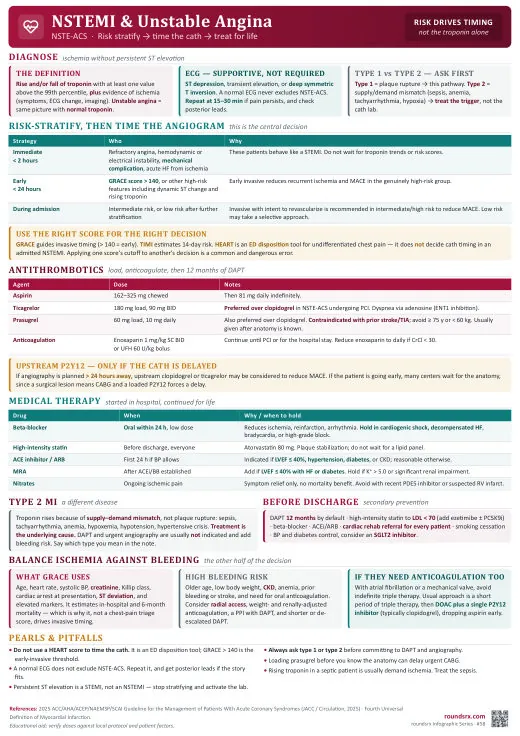 ⤢ Tap to open full size
RoundsRx Infographic Series · #58 · Cardiovascular · PDF 154 KB
Text version
Cardiology · One Pager
NSTEMI / Unstable Angina
Troponin rise + ischemic symptoms. Risk stratify with GRACE. High risk → early invasive. Low risk → conservative + stress test.
🧪 Diagnosis
- Troponin rise + fall with ≥ 1 value > 99th percentile
- Ischemic symptoms or ECG changes (ST depression, TWI)
- UA = same presentation but troponin negative
- GRACE score determines invasive vs conservative strategy
🚨 Management
- ASA 325 + P2Y12 load + heparin drip
- GRACE > 140 → cath within 24h (early invasive)
- Low GRACE → conservative: medical therapy + stress test
- Atorvastatin 80 mg, BB if no contraindication
⚠️ High-Risk Features
- Dynamic ST changes
- Recurrent angina despite medical therapy
- Hemodynamic instability
- Elevated troponin trending up
- EF < 40% on echo
- Diabetes, CKD, prior PCI/CABG
💊 Key Drugs
ASA325 mg → 81 mg daily
Ticagrelor180 mg load → 90 BID
Heparin60 U/kg bolus → drip
Atorvastatin80 mg daily
⚠️ Pitfalls
- Switching heparin types (increases bleeding)
- Missing Wellens or de Winter pattern
- Not risk-stratifying with GRACE
- Discharging without follow-up plan
RoundsRx · Cardiology · One Pager
ACC/AHA NSTE-ACS 2014 · TIMACS 2009
Related Topics
ACS OverviewAortic DissectionAortic StenosisArrhythmiasAtrial FibrillationCardiac Tamponade