EMERGENTCardiology
STEMI
ST-elevation myocardial infarction -complete coronary artery occlusion. Door-to-balloon < 90 minutes. Every minute of delay = more dead myocardium. This is the most time-critical diagnosis in cardiology.
🔍 Overview
🆕 2025 ACS Guideline updates apply here. Shorter DAPT with ticagrelor monotherapy after 1 month, complete revascularization for multivessel disease, intravascular imaging upgraded to Class 1, Impella CP for select cardiogenic shock, lower LDL targets post-ACS. See full 2025 changes table →
ECG Criteria
STEMI = cath lab activation. Do not delay for troponin.
| Criteria | Definition |
|---|---|
| ST elevation | ≥ 1 mm in ≥ 2 contiguous leads (or ≥ 2 mm in V1–V3 in men, ≥ 1.5 mm in women) |
STEMI Equivalents
These patterns require emergent reperfusion even without classic ST elevation. Recognizing STEMI equivalents prevents missed cath lab activations.
| Pattern | ECG Findings | Clinical Significance |
|---|---|---|
| New LBBB | New or presumably new LBBB in the setting of ischemic symptoms | Treat as STEMI. Use Sgarbossa criteria if prior LBBB: concordant ST elevation ≥ 1 mm (5 pts), concordant ST depression ≥ 1 mm in V1–V3 (3 pts), discordant ST elevation ≥ 5 mm (2 pts). Score ≥ 3 = MI. Modified Sgarbossa (Smith): ST/S ratio ≥ 0.25 in any lead replaces the 5 mm rule, higher sensitivity. |
| Posterior MI | ST depression V1–V3 with tall R waves ± upright T waves | Reciprocal changes of posterior ST elevation. Get posterior leads (V7–V9): ST elevation ≥ 0.5 mm confirms posterior STEMI. Often occurs with inferior MI (RCA/LCx). Missed in ~75% of cases on standard 12-lead. |
| De Winter T waves | 1–3 mm upsloping ST depression at the J-point with tall, symmetric T waves in precordial leads. No ST elevation. | Proximal LAD occlusion. Present in ~2% of anterior MIs. Static pattern (does not evolve into ST elevation). Activate cath lab immediately. |
| Wellens syndrome | Type A (25%): Biphasic T waves (up-down) in V2–V3. Type B (75%): Deep symmetric T-wave inversions in V2–V3 (± V1–V6) | Critical proximal LAD stenosis. Occurs during pain-free intervals (T waves normalize during active ischemia). Will progress to massive anterior MI without intervention. Do NOT stress test, go to cath lab. |
| Hyperacute T waves | Tall, broad-based, symmetric T waves in a coronary territory. Often taller than the QRS complex. | Earliest sign of acute MI, precedes ST elevation by minutes to hours. Represents subendocardial ischemia with transmural progression. If clinical suspicion is high, serial ECGs q15–30 min or activate cath lab. |
| ST elevation in aVR | Diffuse ST depression in ≥ 6 leads with ST elevation in aVR (± V1) | Left main or proximal LAD occlusion, or severe 3-vessel disease. Very high mortality. Emergent cardiology consultation. Not a classic “STEMI activation” at all centers but requires urgent catheterization. |
| Isolated RV infarction | ST elevation in V4R (> 1 mm) with inferior ST elevation (II, III, aVF). May have ST elevation V1 with depression V2. | Proximal RCA occlusion. Preload-dependent, avoid nitrates, diuretics, morphine. Treat hypotension with IV fluid boluses. Get right-sided leads on all inferior STEMIs. |
| Aslanger pattern | ST elevation in lead III only (not II), with ST depression in any precordial lead, and ST elevation in V1 that does not exceed the ST depression in V6 | Inferior MI with concomitant multi-vessel disease. Subtle pattern, does not meet classic STEMI criteria. Associated with worse outcomes due to multi-vessel involvement. Requires emergent angiography. |
| High Lateral OMI (South African Flag sign) | ST elevation in I and aVL (± V2) with reciprocal ST depression in III and aVF. ST changes may be subtle (< 1 mm) and not meet classic STEMI voltage criteria. | LCx or diagonal branch (D1) occlusion. High lateral territory is poorly represented on standard 12-lead, often missed. The “South African Flag” sign refers to the characteristic ECG morphology resembling the flag’s shape. Low voltage in limb leads makes detection harder. Have a low threshold for cath lab activation with ischemic symptoms + subtle I/aVL changes. |
Coronary Territories
| ECG Leads | Territory | Artery | Key Complications |
|---|---|---|---|
| V1–V4 | Anterior | LAD | Largest territory. Highest mortality. LV failure, cardiogenic shock, VT/VF, anterior wall aneurysm. |
| II, III, aVF | Inferior | RCA (85%) or LCx (15%) | Bradycardia (AV node from RCA), RV infarct (get right-sided leads V4R). Hypotension -treat with fluids, NOT nitrates. |
| I, aVL, V5–V6 | Lateral | LCx | Often subtle. May be missed. MR from papillary muscle ischemia. |
| V7–V9 | Posterior | PDA (from RCA or LCx) | Missed on standard 12-lead. Always check if ST depression V1–V3. |
| V4R | Right ventricle | Proximal RCA | Avoid nitroglycerin, morphine, diuretics -RV is preload-dependent. Treat hypotension with IV fluids. |
🚨 Management
Step-by-Step Management -STEMI
1
ABCs + IV Access + Continuous Telemetry + 12-lead ECG within 10 min
Two large-bore IVs. Continuous cardiac monitoring. 12-lead ECG is the STEMI trigger -ST elevation in ≥2 contiguous leads (or new LBBB with positive Sgarbossa) confirms diagnosis. Supplemental O₂ only if SpO₂ < 90%.
Two large-bore IVs. Continuous cardiac monitoring. 12-lead ECG is the STEMI trigger -ST elevation in ≥2 contiguous leads (or new LBBB with positive Sgarbossa) confirms diagnosis. Supplemental O₂ only if SpO₂ < 90%.
🔄 Updated Practice: Old teaching: give supplemental oxygen to all MI patients. Current practice: oxygen only if SpO₂ < 90%. DETO2X-AMI, 2017 and AVOID, 2015 showed routine oxygen in normoxemic MI does NOT reduce infarct size and may worsen outcomes through coronary vasoconstriction. Hyperoxia is not benign.
2
Aspirin 325 mg -CHEW immediately (antiplatelet) ISIS-2, 1988
Do NOT swallow whole -chewing provides faster buccal absorption. Continue 81 mg daily lifelong after.
Do NOT swallow whole -chewing provides faster buccal absorption. Continue 81 mg daily lifelong after.
3
Activate cath lab NOW
Single phone call. Goal: door-to-balloon < 90 min. Don't wait for troponin to come back -ECG is the trigger. Notify interventionalist, OR team, and transfer team simultaneously.
Single phone call. Goal: door-to-balloon < 90 min. Don't wait for troponin to come back -ECG is the trigger. Notify interventionalist, OR team, and transfer team simultaneously.
4
Decide reperfusion strategy: Primary PCI vs Fibrinolysis STREAM, 2013
PCI available within 120 min → Primary PCI (gold standard). Door-to-balloon target < 90 min. Stent the culprit lesion.
PCI not available within 120 min → Fibrinolysis within 30 min of first medical contact. Tenecteplase (weight-based single IV bolus) or alteplase. Transfer for angiography within 3–24h regardless (pharmacoinvasive strategy).
PCI available within 120 min → Primary PCI (gold standard). Door-to-balloon target < 90 min. Stent the culprit lesion.
PCI not available within 120 min → Fibrinolysis within 30 min of first medical contact. Tenecteplase (weight-based single IV bolus) or alteplase. Transfer for angiography within 3–24h regardless (pharmacoinvasive strategy).
Fibrinolysis contraindications. Absolute: any prior ICH, ischemic stroke within 3 months, known intracranial neoplasm/AVM, suspected aortic dissection, active bleeding, significant closed head/facial trauma within 3 months. Relative: uncontrolled HTN (> 180/110), anticoagulant use, recent surgery (< 3 weeks), traumatic CPR, recent internal bleeding, pregnancy, active peptic ulcer.
5
Heparin -anticoagulation (anticoagulant)
How this differs from NSTEMI: in NSTEMI, you start heparin in the ED right after the diagnosis is confirmed (the patient may not get to cath for hours, so you protect them while they wait). In STEMI, the destination is the cath lab and the wait is short (door-to-balloon < 90 min), so the heparin dose is timed to the procedure -who gives it depends on the reperfusion strategy:
Primary PCI → Heparin is given in the cath lab by the interventionalist, not on the floor. UFH 70–100 units/kg IV bolus, ACT-titrated to 250–300 sec. (Why: ACT-guided dosing in the lab is precise; pre-loading on the floor complicates that titration.) Bivalirudin is an alternative (lower bleeding, slightly higher stent thrombosis).
Fibrinolysis → Heparin is given immediately, as adjunct to the lytic. UFH 60 units/kg IV bolus (max 4000) → 12 units/kg/hr infusion (max 1000/hr). Target aPTT 1.5–2× control. Continue 48h or until revascularization. (Why: there's no cath lab in this scenario, so anticoagulation has to start at the time of lysis to keep the artery open.)
How this differs from NSTEMI: in NSTEMI, you start heparin in the ED right after the diagnosis is confirmed (the patient may not get to cath for hours, so you protect them while they wait). In STEMI, the destination is the cath lab and the wait is short (door-to-balloon < 90 min), so the heparin dose is timed to the procedure -who gives it depends on the reperfusion strategy:
Primary PCI → Heparin is given in the cath lab by the interventionalist, not on the floor. UFH 70–100 units/kg IV bolus, ACT-titrated to 250–300 sec. (Why: ACT-guided dosing in the lab is precise; pre-loading on the floor complicates that titration.) Bivalirudin is an alternative (lower bleeding, slightly higher stent thrombosis).
Fibrinolysis → Heparin is given immediately, as adjunct to the lytic. UFH 60 units/kg IV bolus (max 4000) → 12 units/kg/hr infusion (max 1000/hr). Target aPTT 1.5–2× control. Continue 48h or until revascularization. (Why: there's no cath lab in this scenario, so anticoagulation has to start at the time of lysis to keep the artery open.)
6
P2Y12 inhibitor -load upfront in STEMI (antiplatelet) PLATO, 2009 TRITON-TIMI 38, 2007
Why STEMI gets P2Y12 upfront, NSTEMI usually defers until cath anatomy is known: In STEMI, the diagnosis is certain (ST elevation = thrombotic occlusion), the destination is certain (cath lab for primary PCI), and CABG-needing anatomy is uncommon (~3–5% of STEMIs, usually a single culprit), so pre-loading lets platelet inhibition reach therapeutic levels by the time of stent deployment. In NSTEMI/UA, ~10–15% turn out to need CABG (3-vessel disease, left main, complex anatomy); pre-loaded ticagrelor or prasugrel force a 5–7 day wait off antiplatelet before surgery, delaying revascularization and increasing in-hospital complications. ACCOAST, 2013 showed upstream prasugrel in NSTEMI did not reduce ischemic events and increased major bleeding, which is why current ACC/AHA guidelines recommend P2Y12 loading at the time of PCI in NSTEMI, not in the ED.
Primary PCI → Ticagrelor 180 mg PO load (preferred) OR prasugrel 60 mg PO load (avoid prior stroke/TIA, age ≥ 75, wt < 60 kg). Clopidogrel 600 mg PO if neither tolerated.
Fibrinolysis → Clopidogrel 300 mg PO load if age < 75; 75 mg PO load if age ≥ 75. CLARITY-TIMI 28, 2005 Ticagrelor and prasugrel are NOT studied with lytics -use clopidogrel.
Why STEMI gets P2Y12 upfront, NSTEMI usually defers until cath anatomy is known: In STEMI, the diagnosis is certain (ST elevation = thrombotic occlusion), the destination is certain (cath lab for primary PCI), and CABG-needing anatomy is uncommon (~3–5% of STEMIs, usually a single culprit), so pre-loading lets platelet inhibition reach therapeutic levels by the time of stent deployment. In NSTEMI/UA, ~10–15% turn out to need CABG (3-vessel disease, left main, complex anatomy); pre-loaded ticagrelor or prasugrel force a 5–7 day wait off antiplatelet before surgery, delaying revascularization and increasing in-hospital complications. ACCOAST, 2013 showed upstream prasugrel in NSTEMI did not reduce ischemic events and increased major bleeding, which is why current ACC/AHA guidelines recommend P2Y12 loading at the time of PCI in NSTEMI, not in the ED.
Primary PCI → Ticagrelor 180 mg PO load (preferred) OR prasugrel 60 mg PO load (avoid prior stroke/TIA, age ≥ 75, wt < 60 kg). Clopidogrel 600 mg PO if neither tolerated.
Fibrinolysis → Clopidogrel 300 mg PO load if age < 75; 75 mg PO load if age ≥ 75. CLARITY-TIMI 28, 2005 Ticagrelor and prasugrel are NOT studied with lytics -use clopidogrel.
When to add IV antiplatelet (cangrelor or GP IIb/IIIa) on top of -or instead of -oral P2Y12:
• Patient can't absorb oral P2Y12 (vomiting, intubated, post-arrest, cardiogenic shock with poor gut perfusion, NPO): use cangrelor IV (preferred -same P2Y12 class, on/off in ~1h) or GP IIb/IIIa as the bridge.
• PCI going badly (large visible thrombus, slow flow / no-reflow, distal embolization, failed reperfusion): add GP IIb/IIIa on top of the oral P2Y12 already given. Interventionalist's call.
• Cath shows CABG-needing anatomy (rare in STEMI -usually a single culprit, but possible): hold further oral P2Y12, bridge with cangrelor or short-acting GP IIb/IIIa until surgery.
• With fibrinolysis: do NOT add GP IIb/IIIa -bleeding risk too high (FINESSE killed this combination).
• Patient can't absorb oral P2Y12 (vomiting, intubated, post-arrest, cardiogenic shock with poor gut perfusion, NPO): use cangrelor IV (preferred -same P2Y12 class, on/off in ~1h) or GP IIb/IIIa as the bridge.
• PCI going badly (large visible thrombus, slow flow / no-reflow, distal embolization, failed reperfusion): add GP IIb/IIIa on top of the oral P2Y12 already given. Interventionalist's call.
• Cath shows CABG-needing anatomy (rare in STEMI -usually a single culprit, but possible): hold further oral P2Y12, bridge with cangrelor or short-acting GP IIb/IIIa until surgery.
• With fibrinolysis: do NOT add GP IIb/IIIa -bleeding risk too high (FINESSE killed this combination).
7
Nitroglycerin for ongoing chest pain
SL NTG 0.4 mg q5 min × 3, then NTG drip 5–200 mcg/min if pain persists. ⚠️ AVOID in: RV infarct (preload-dependent -check V4R first in inferior MI), SBP < 90, PDE5 inhibitor within 24h (sildenafil) or 48h (tadalafil).
SL NTG 0.4 mg q5 min × 3, then NTG drip 5–200 mcg/min if pain persists. ⚠️ AVOID in: RV infarct (preload-dependent -check V4R first in inferior MI), SBP < 90, PDE5 inhibitor within 24h (sildenafil) or 48h (tadalafil).
8
High-intensity statin -start within 24h PROVE IT-TIMI 22, 2004
Atorvastatin 80 mg PO (or rosuvastatin 40 mg). Start regardless of LDL -plaque stabilization + anti-inflammatory effects beyond lipid lowering. Lifelong.
Atorvastatin 80 mg PO (or rosuvastatin 40 mg). Start regardless of LDL -plaque stabilization + anti-inflammatory effects beyond lipid lowering. Lifelong.
9
Beta-blocker within 24h (if hemodynamically stable)
Metoprolol tartrate 12.5–25 mg PO q6–12h → titrate to HR 55–65. ⚠️ Hold if: cardiogenic shock, HR < 60, SBP < 100, decompensated HF, cocaine use, severe reactive airway, high-degree AV block. COMMIT-CCS 2, 2005 -early IV BB is harmful in unstable patients; oral BB once stable is the standard.
Metoprolol tartrate 12.5–25 mg PO q6–12h → titrate to HR 55–65. ⚠️ Hold if: cardiogenic shock, HR < 60, SBP < 100, decompensated HF, cocaine use, severe reactive airway, high-degree AV block. COMMIT-CCS 2, 2005 -early IV BB is harmful in unstable patients; oral BB once stable is the standard.
10
ACEi/ARB within 24h SAVE, 1992
Lisinopril 2.5–5 mg PO daily (or equivalent). Especially if anterior MI or EF < 40%. Prevents adverse remodeling. Hold if SBP < 100 or AKI.
Lisinopril 2.5–5 mg PO daily (or equivalent). Especially if anterior MI or EF < 40%. Prevents adverse remodeling. Hold if SBP < 100 or AKI.
11
Post-PCI / Discharge Optimization
DAPT: ASA 81 mg + ticagrelor 90 mg BID (or prasugrel 10 mg daily) × 12 months minimum post-ACS DAPT Study, 2014. May shorten to 3–6 months if high bleed risk TWILIGHT, 2019.
High-intensity statin lifelong 4S, 1994
Beta-blocker -continue indefinitely if EF reduced
ACEi/ARB if EF < 40%, HTN, DM, or CKD
Aldosterone antagonist (spironolactone or eplerenone) if EF ≤ 40% + symptomatic HF or DM EPHESUS, 2003
Smoking cessation + cardiac rehab referral
DAPT: ASA 81 mg + ticagrelor 90 mg BID (or prasugrel 10 mg daily) × 12 months minimum post-ACS DAPT Study, 2014. May shorten to 3–6 months if high bleed risk TWILIGHT, 2019.
High-intensity statin lifelong 4S, 1994
Beta-blocker -continue indefinitely if EF reduced
ACEi/ARB if EF < 40%, HTN, DM, or CKD
Aldosterone antagonist (spironolactone or eplerenone) if EF ≤ 40% + symptomatic HF or DM EPHESUS, 2003
Smoking cessation + cardiac rehab referral
⚠️ Do NOT delay for any of these steps:
• ASA -give IMMEDIATELY on recognition
• ECG -within 10 minutes
• Cath lab activation -single phone call, don't wait for troponin
• Door-to-balloon < 90 min (primary PCI) or door-to-needle < 30 min (fibrinolysis)
• ASA -give IMMEDIATELY on recognition
• ECG -within 10 minutes
• Cath lab activation -single phone call, don't wait for troponin
• Door-to-balloon < 90 min (primary PCI) or door-to-needle < 30 min (fibrinolysis)
💊 Medications
Acute STEMI Medications
| Drug | Dose | Timing | Notes |
|---|---|---|---|
| Aspirin (antiplatelet) IMMEDIATE | 325 mg chewed (not swallowed) | Immediately on recognition | Chewing provides faster absorption. Continue 81 mg daily indefinitely after. ISIS-2, 1988 |
| Ticagrelor (Brilinta) (antiplatelet) PREFERRED P2Y12 | 180 mg loading → 90 mg BID | At time of PCI (or sooner) | Preferred over clopidogrel PLATO, 2009: reduced CV death + MI + stroke. Reversible binding. Side effects: dyspnea, bradycardia pauses (due to adenosine accumulation -ticagrelor blocks RBC ENT1 reuptake). Do NOT use with > 100 mg ASA. |
| Prasugrel (Effient) (antiplatelet) PREFERRED P2Y12 | 60 mg loading → 10 mg daily | At time of PCI | TRITON-TIMI 38, 2007: superior to clopidogrel. Contraindicated: prior stroke/TIA, age ≥ 75, weight < 60 kg (increased bleeding). |
| Clopidogrel (Plavix) (antiplatelet) 2ND LINE P2Y12 | 600 mg loading → 75 mg daily | At PCI | Use if ticagrelor/prasugrel contraindicated. Prodrug -depends on CYP2C19 metabolism. ~30% of patients are poor metabolizers (consider genetic testing). |
| Heparin (UFH) (anticoagulant) PCI | 70–100 units/kg IV bolus (per cath lab) | At PCI | ACT-guided in cath lab. Bivalirudin is alternative (lower bleeding but higher stent thrombosis). If no PCI planned: enoxaparin 1 mg/kg SC BID is an option ESSENCE, 1997 |
| GP IIb/IIIa inhibitor (tirofiban / Aggrastat, eptifibatide / Integrilin) (antiplatelet) BAILOUT ONLY (bailout = rescue use mid-procedure) | Tirofiban: 25 mcg/kg IV bolus → 0.15 mcg/kg/min infusion. Eptifibatide: 180 mcg/kg IV bolus → 2 mcg/kg/min infusion. | In cath lab if needed -NOT routine, NOT before cath | No longer routine in primary PCI. Reserved for cath-lab bailout: large thrombus burden, slow flow / no-reflow, distal embolization, or as a bridge when P2Y12 absorption is in doubt (vomiting, intubation). FINESSE, 2008 HORIZONS-AMI, 2008 killed routine pre-cath use. Interventionalist's call. Why bailout only? Strongest antiplatelet class (blocks the final common pathway where all aggregation signals converge) but biggest bleeding risk. Modern ticagrelor/prasugrel/cangrelor + bivalirudin + DES now give ~95% of the ischemic benefit with less bleeding -marginal gain no longer worth the bleeding cost. |
| High-intensity statin ALL ACS | Atorvastatin 80 mg or rosuvastatin 40 mg | Within 24h | Start regardless of LDL. Plaque stabilization + anti-inflammatory beyond lipid lowering. Lifelong. PROVE IT-TIMI 22, 2004 4S, 1994 |
| Beta-blocker | Metoprolol 12.5–25 mg PO | Within 24h if stable | Avoid if: cardiogenic shock, HR < 60, SBP < 100, decompensated HF, cocaine use, severe reactive airway. |
| ACEi / ARB | Lisinopril 2.5–5 mg or equivalent | Within 24h | Especially if anterior MI or EF < 40%. Prevents remodeling. Reduce mortality SAVE, 1992. |
| Nitroglycerin (Nitrostat) | 0.4 mg SL q5 min × 3, or drip 5–200 mcg/min | For ongoing chest pain | AVOID in: RV infarct (preload-dependent), SBP < 90, PDE5 inhibitor within 24h (sildenafil) or 48h (tadalafil). Inferior MI → check V4R first. |
⚠️ Mechanical Complications
Mechanical Complications (Days 1–14)
If a STEMI patient suddenly decompensates 2–7 days post-MI → think mechanical complication.
| Complication | Timing | Presentation | Diagnosis | Treatment |
|---|---|---|---|---|
| Ventricular free wall rupture | Day 3–7 | Sudden PEA arrest, tamponade | Bedside echo → pericardial effusion | Emergent surgery. Almost always fatal without it. |
| Ventricular septal rupture (VSR) | Day 3–7 | New harsh holosystolic murmur + acute HF | Echo with color Doppler → L-to-R shunt. O₂ step-up on right heart cath. | Surgical repair. IABP/Impella as bridge. Very high mortality. |
| Papillary muscle rupture | Day 2–7 | New holosystolic murmur → acute severe MR → flash pulmonary edema | Echo → flail mitral leaflet, severe MR | Emergent mitral valve surgery. Afterload reduction (nitroprusside, IABP) as bridge. |
| LV aneurysm | Weeks–months | Persistent ST elevation post-MI, HF symptoms, arrhythmias | Echo → dyskinetic/akinetic thin-walled segment | Medical management. Anticoagulation if thrombus. Surgery if refractory arrhythmias. |
📋 On Rounds
Pimp Questions
Why must you check V4R in inferior STEMI?
Inferior STEMI (II, III, aVF) is usually from RCA occlusion, and the proximal RCA also supplies the RV. Up to 40% of inferior STEMIs have RV involvement. RV infarct makes the patient preload-dependent -nitrates, morphine, and diuretics drop preload → hemodynamic collapse. V4R (right-sided V4) showing ≥ 1 mm ST elevation confirms RV involvement. Treatment: IV fluids (not nitrates), avoid diuretics, maintain preload.
What are the Sgarbossa criteria?
Used to diagnose STEMI in the presence of LBBB (where ST changes are expected). Original Sgarbossa: (1) concordant ST elevation ≥ 1 mm -most specific, (2) concordant ST depression ≥ 1 mm in V1–V3, (3) discordant ST elevation ≥ 5 mm. Modified Sgarbossa (Smith): replaces criterion 3 with ST/S ratio ≥ 25% -more sensitive. Any positive criterion in the right clinical context → activate cath lab.
Why is ticagrelor preferred over clopidogrel?
PLATO, 2009: ticagrelor reduced the composite of CV death, MI, and stroke by 16% vs clopidogrel, with 22% reduction in CV mortality. Key advantages: (1) reversible binding (clopidogrel is irreversible -platelet function recovers faster after stopping ticagrelor), (2) no CYP2C19 dependency (clopidogrel is a prodrug requiring activation -~30% are poor metabolizers). Downsides: BID dosing, dyspnea (~14%), cost.
What is the door-to-balloon time target and what happens if your hospital can't do PCI?
Door-to-balloon time target: ≤ 90 minutes at a PCI-capable hospital. If diagnosed in the field by EMS → target first medical contact-to-balloon ≤ 90 min. If your hospital is NOT PCI-capable: transfer target is first medical contact-to-balloon ≤ 120 min. If transfer time would exceed 120 min → give fibrinolytic therapy (tPA) within 30 minutes of arrival (door-to-needle ≤ 30 min) and then transfer for rescue PCI.
📣 Sample Presentation
One-Liner
"Mr. Jackson is a 58-year-old smoker with HTN presenting with acute crushing substernal chest pain radiating to left arm × 2 hours. ECG shows ST elevation in leads II, III, aVF. Taken for emergent PCI with DES to RCA with TIMI 3 flow post-intervention."
Key Points to Cover on Rounds
Cath: 99% occlusion of mid-RCA, single DES placed, TIMI 3 flow restored. Peak troponin 42 ng/mL. Echo: EF 45%, inferior hypokinesis. Medications: ASA 81 mg + ticagrelor 90 BID (DAPT), atorvastatin 80, metoprolol 25 BID, lisinopril 5 daily. No arrhythmias on telemetry. Pain-free since cath. Cardiac rehab referral placed. Plan: discharge tomorrow if stable.
Monitoring Parameters -STEMI
| Parameter | Frequency | Target / Action |
|---|---|---|
| Continuous telemetry | Minimum 48 hours post-PCI (longer if EF ≤ 40% or arrhythmias) | Watch for reperfusion arrhythmias (AIVR -usually benign, VT/VF, bradycardia in inferior MI). AIVR is a sign of successful reperfusion -do not treat unless hemodynamically unstable. |
| Serial troponins | q3-6h until peak identified (typically 12-24h post-PCI) | Peak troponin correlates with infarct size. Rising troponin after initial decline → stent thrombosis or reinfarction. |
| ECG | Immediately post-PCI, then daily × 2-3 days | ST resolution > 50% within 60-90 min post-PCI = successful reperfusion. New ST changes → concern for stent thrombosis, re-occlusion. |
| BP and HR | q1h × 4h post-cath, then q4h | SBP > 90 for ACEI/BB initiation. HR 60-80. Hypotension in inferior MI → suspect RV infarct (give fluids, avoid nitroglycerin). |
| Access site | q15min × 1h, then q1h × 4h post-cath | Check for hematoma, bleeding, pseudoaneurysm. Radial: check radial pulse, hand perfusion. Femoral: check distal pulses, retroperitoneal bleed (back pain, Hgb drop). |
| BMP | Daily × 2-3 days, then post-ACEI initiation | Cr (contrast nephropathy peaks 48-72h post-cath). K⁺ > 4.0 and Mg²⁺ > 2.0 for arrhythmia prevention. |
| DAPT compliance | Daily medication reconciliation | ASA 81 mg daily + P2Y12 inhibitor (ticagrelor 90 BID or prasugrel 10 daily). Minimum 12 months post-DES. Premature DAPT discontinuation = stent thrombosis risk. |
| Echocardiogram | Within 24-48h post-PCI | EF, wall motion, mechanical complications (VSD -new murmur + hemodynamic collapse; papillary muscle rupture -acute MR). Repeat at 6-12 weeks if EF ≤ 40%. |
Post-STEMI DAPT is critical. Educate patients: do NOT stop aspirin or ticagrelor/prasugrel without cardiology approval. Premature discontinuation within 30 days of DES = highest risk period for stent thrombosis.
🧪 Workup
Diagnostic Evaluation -STEMI
Do NOT delay reperfusion for labs. Door-to-balloon goal < 90 min (PCI) or door-to-needle < 30 min (fibrinolytics). Draw labs while activating the cath lab.
| Test | Rationale | Key Values |
|---|---|---|
| 12-lead ECG | Diagnose STEMI. Identify culprit territory. Repeat q15 min if evolving or diagnostic uncertainty. | ≥ 1 mm ST elevation in 2 contiguous leads (≥ 2 mm in V1-V3 for men > 40). New LBBB with ischemic symptoms. Right-sided leads (V4R) for inferior STEMI → RV involvement. |
| Serial troponins | Confirm myocardial injury and trend infarct size. Do NOT wait for troponin to activate cath lab in STEMI. | Draw at presentation, then q3-6h × 3. Peak troponin correlates with infarct size. High-sensitivity troponin (hs-cTnI or hs-cTnT). |
| CBC | Baseline Hgb (bleeding risk with anticoagulation/DAPT), platelets (for P2Y12 inhibitor). | Hgb < 10 = higher bleeding risk with aggressive antithrombotics. Plt < 100K = relative contraindication to DAPT. |
| BMP | Cr (contrast nephropathy risk, ACEI dosing), K⁺ (arrhythmia risk), glucose (stress hyperglycemia). | K⁺ > 4.0 and Mg²⁺ > 2.0 to minimize arrhythmia risk. Cr for contrast load planning. |
| Coagulation (PT/INR, aPTT) | Baseline before heparin. Identify existing anticoagulation. | Needed before heparin bolus in cath lab. |
| Lipid panel | Draw within 24h (acute-phase changes lower LDL after 24-48h). | Start high-intensity statin regardless of LDL. LDL target < 70 (some guidelines < 55). |
| BNP / NT-proBNP | Prognostication. Elevated BNP = higher risk of HF and mortality post-MI. | Guides post-MI HF risk stratification. |
| Echocardiogram | Assess EF, wall motion abnormalities (correlate with culprit vessel), mechanical complications (VSD, papillary muscle rupture, free wall rupture). | Obtain within 24-48h post-PCI. EF ≤ 40% → ACEI/ARB + aldosterone antagonist. New MR → papillary muscle dysfunction. |
| Type and screen | In case of bleeding complication or need for emergent surgery. | Standard pre-procedural lab. |
🏥 Clinical Cases
Case 1: Classic Anterior STEMI -The Textbook Case
Scenario: 58M, smoker, HTN, presents to ED at 2:14 AM with crushing substernal chest pain radiating to left arm × 40 minutes. Diaphoretic, pale, HR 102, BP 148/92.
| Phase | Time | Action | Rationale / Pearl |
|---|---|---|---|
| ED Arrival | T+0 min | 12-lead ECG within 10 minutes | ECG shows ST elevation V1-V4 with reciprocal ST depression in II, III, aVF. This is an anterior STEMI -LAD territory. Activate cath lab immediately. |
| Immediate Meds | T+5 min | ASA 325 mg (chewed) + ticagrelor 180 mg PO + heparin 60 U/kg bolus + atorvastatin 80 mg | Chew ASA for rapid absorption. Load P2Y12 inhibitor before cath. Heparin for anticoagulation during PCI. Statin started day 1 regardless of lipid panel. |
| Cath Lab | T+48 min | PCI to LAD: 99% proximal occlusion. Drug-eluting stent (DES) placed. TIMI 3 flow restored. | Door-to-balloon = 48 min (goal < 90 min). Complete occlusion confirmed -this is why ECG, not troponin, drives the decision. Troponin was still negative at arrival. |
| Troponin #1 | T+0 (arrival) | hs-cTnI: 45 ng/L (normal < 26) | Only mildly elevated at presentation -do not wait for troponin to confirm STEMI. ECG is the decision tool. Early troponin may be falsely reassuring in early presenters. |
| Troponin #2 | T+3h | hs-cTnI: 12,400 ng/L (> 250× ULN). Rising rapidly. | Large delta = large infarct. Rapid rise-and-fall pattern typical of reperfused STEMI. Expected to peak 12-24h post-onset. |
| Troponin #3 | T+6h | hs-cTnI: 38,600 ng/L. Still rising. | Continue trending q6h. The magnitude of peak predicts LV dysfunction severity and 30-day mortality. > 10,000 ng/L in anterior STEMI = high risk for EF < 40%. |
| Troponin #4 (peak) | T+12h | hs-cTnI: 85,000 ng/L (peak). Begins declining thereafter. | Peak troponin reached ~12h post-symptom onset. Large anterior MI confirmed. Correlates with TTE findings. Subsequent decline = no re-occlusion. Any secondary rise → suspect stent thrombosis. |
| CCU Day 1 | T+3h | Chest pain resolved. Troponin peaks at 85 ng/mL. TTE: EF 40%, anterior wall hypokinesis. | Peak troponin correlates with infarct size. EF 40% -will need ACEi/ARB and assess for ICD at 40 days. Start metoprolol 25 mg BID if hemodynamically stable. |
| Day 2 | T+24h | Troponin trending down: 42,000 → 18,000 ng/L. Start lisinopril 2.5 mg, uptitrate metoprolol. Cardiac rehab consult. Smoking cessation counseling. | Declining troponin = reassuring (no re-occlusion). ACEi started for EF ≤ 40% (reduces remodeling and mortality). BB reduces arrhythmia risk. Early rehab referral improves adherence and outcomes. |
| Discharge (Day 3) | ASA 81 mg + ticagrelor 90 BID (DAPT × 12 months). Metoprolol succinate 50 mg daily. Lisinopril 5 mg. Atorvastatin 80 mg. Cardiac rehab. Follow-up in 1 week. | Ensure all 4 pillars prescribed before discharge. LDL goal < 70 (or < 55 per ESC). Repeat TTE in 6-12 weeks. Discuss ICD if EF still ≤ 35% at 40 days. |
Teaching point: Anterior STEMIs have the worst prognosis because the LAD supplies ~40% of LV myocardium. These patients are most likely to develop systolic HF, and rapid reperfusion is critical.
Case 2: Inferior STEMI with RV Involvement -The Fluid-Dependent Patient
Scenario: 72M, DM2 and dyslipidemia, presents with epigastric pain and nausea × 1 hour. Thought it was indigestion. HR 48, BP 82/54. Diaphoretic.
| Phase | Time | Action | Rationale / Pearl |
|---|---|---|---|
| ED Arrival | T+0 | ECG: ST elevation II, III, aVF. Reciprocal depression I, aVL. | Inferior STEMI -RCA territory (85%). Immediately get right-sided leads (V4R). V4R shows ST elevation ≥ 1mm -confirms RV infarct. |
| Critical Decision | T+3 min | NO nitroglycerin. NO morphine. Start 500 mL NS bolus. | RV infarct = preload dependent. Nitrates and morphine drop preload → cardiovascular collapse. Fluids first. If still hypotensive after 1-2L, start dobutamine (not norepinephrine -need inotropy, not vasoconstriction). |
| Meds | T+8 min | ASA 325 + clopidogrel 600 (not ticagrelor -patient is bradycardic). Heparin. Atropine 0.5 mg IV for symptomatic bradycardia. | Ticagrelor can worsen bradycardia (PLATO showed more bradycardic pauses). Clopidogrel is safer here. Atropine for vagally-mediated bradycardia (common in inferior MI due to RCA supplying AV node). |
| Cath Lab | T+62 min | PCI to RCA: 100% mid-vessel occlusion. DES placed. TIMI 3 flow. BP improves to 106/68. | RCA reperfusion often dramatically improves hemodynamics. Bradycardia may resolve as AV node perfusion returns. If persistent complete heart block → temporary pacer. |
| Troponin #1 | T+0 (arrival) | hs-cTnI: 180 ng/L (elevated > 26) | Elevated at presentation -1 hour of symptoms means troponin is already rising. In inferior STEMI, absolute values tend to be lower than anterior (smaller territory). Still -do NOT wait for troponin result. |
| Troponin #2 | T+3h | hs-cTnI: 5,800 ng/L. Rising. | Moderate elevation consistent with RCA territory (supplies ~25-30% of LV). Compare: LAD occlusion often produces troponins > 50,000. |
| Troponin #3 (peak) | T+8h | hs-cTnI: 14,200 ng/L (peak). | Earlier peak than anterior STEMI (smaller territory = faster washout post-reperfusion). Declining troponin + improving hemodynamics = successful reperfusion. Any secondary rise → re-occlusion or stent thrombosis. |
| CCU Day 1 | T+6h | Sinus rhythm restored, HR 68. BP 110/72 on 150 mL/hr NS. TTE: EF 50%, inferior hypokinesis, RV dilated but improving. Troponin trending down. | RV function often recovers within days-weeks (RV is more resilient than LV). Avoid diuretics -patient needs volume. Hold ACEi until hemodynamically stable. |
| Day 2-3 | Troponin 3,400 → 890 ng/L (steadily declining). Wean fluids. Start low-dose metoprolol if HR tolerates. Start lisinopril 2.5 mg cautiously (monitor BP). | RV infarct patients are exquisitely sensitive to volume depletion AND afterload reduction. Titrate meds slowly. If EF preserved, ACEi is less urgent but still beneficial. | |
| Discharge (Day 4) | ASA 81 + clopidogrel 75 × 12 months. Metoprolol succinate 25 mg. Lisinopril 2.5 mg. Atorvastatin 80 mg. Strict diabetes management (A1c target < 7). | Key teaching: Always check V4R in inferior STEMI. RV infarct changes your entire management -no nitrates, aggressive fluids, be cautious with preload-reducing drugs. |
Teaching point: Diabetic patients often present atypically -epigastric pain, nausea, or just "not feeling right." Low threshold for ECG in any diabetic with GI complaints.
Case 3: Late Presenter with Cardiogenic Shock -The Nightmare Scenario
Scenario: 65F, no prior medical history, arrives by EMS after 6 hours of chest pain that started during sleep. She delayed calling because she thought it was anxiety. HR 118, BP 76/50, SpO2 89%, cold/clammy extremities, JVD.
| Phase | Time | Action | Rationale / Pearl |
|---|---|---|---|
| ED Arrival | T+0 | ECG: ST elevation V1-V6, I, aVL (massive anterolateral). Chest X-ray: bilateral pulmonary edema. | Extensive anterior STEMI with Killip Class IV (cardiogenic shock). This is the highest-risk presentation -mortality 40-50% even with PCI. Do NOT delay cath for stabilization. |
| Immediate | T+5 min | ASA 325 + clopidogrel 600 (avoid ticagrelor in shock -absorption unreliable). Heparin. Activate cath lab. Place arterial line. Start norepinephrine 0.1 mcg/kg/min. | Cardiogenic shock = primary PCI regardless of time from onset. Norepinephrine is first-line vasopressor in cardiogenic shock (SOAP II trial). Avoid dopamine (more arrhythmias). Load P2Y12 via NG if vomiting. |
| Pre-Cath | T+15 min | Intubated for respiratory failure and impaired consciousness. PA catheter placed: CI 1.6, PCWP 28, SVR 1800. | PA catheter confirms cardiogenic shock: low CI (< 2.2), high PCWP (> 18), high SVR. BiPAP is an alternative if patient is alert, but this patient is deteriorating. |
| Cath Lab | T+55 min | PCI to LAD: 100% proximal occlusion. DES placed. TIMI 2 flow (incomplete reperfusion). Intra-aortic balloon pump (IABP) placed. | TIMI 2 flow (partial) has worse prognosis than TIMI 3 (complete). Mechanical circulatory support (IABP or Impella) considered for refractory shock. IABP-SHOCK II, 2012 showed no mortality benefit for IABP, but still used as bridge. |
| Troponin #1 | T+0 (arrival) | hs-cTnI: 28,400 ng/L (massively elevated) | Already very high at presentation -6 hours of unreperfused ischemia. In cardiogenic shock, troponin may be falsely lower due to decreased cardiac output (poor washout). Once reperfused, expect a secondary surge. |
| Troponin #2 | T+3h post-PCI | hs-cTnI: 96,000 ng/L. Massive surge post-reperfusion. | Reperfusion washout phenomenon: troponin spikes after PCI as necrotic myocardium is reperfused and cellular contents flood the circulation. Higher post-PCI spike = more necrosis, not a new event. |
| Troponin #3 | T+12h | hs-cTnI: 142,000 ng/L (peak). | Late presenters (6h+) have the highest peak troponins. TIMI 2 flow means incomplete washout -troponin may plateau longer. This level predicts severe LV dysfunction and high 30-day mortality. |
| Troponin #4 | T+24h | hs-cTnI: 98,000 ng/L. Beginning to decline. | Slow decline expected with TIMI 2 flow. If troponin re-rises → stent thrombosis, extension of infarct, or type 2 MI from shock. Recheck ECG immediately. |
| CCU Day 1-2 | Persistent shock on norepi + dobutamine. TTE: EF 15%, diffuse anterior akinesis. Lactate trending down from 6.8 to 3.1. Cr rising (1.1 → 2.3). Troponin 98,000 → 54,000 ng/L. | Multiorgan dysfunction from prolonged cardiogenic shock. Add milrinone if dobutamine insufficient. Avoid aggressive diuresis -cardiorenal syndrome. Consider Impella if failing IABP. | |
| Day 3-5 | Slowly weaning vasopressors. Extubated Day 4. Watch for mechanical complications (VSD, papillary rupture -classically Day 3-7). | Day 3-7 is the danger zone for mechanical complications. New murmur + hemodynamic collapse = STAT TTE. Free wall rupture presents as sudden PEA arrest with tamponade. | |
| Day 7-10 | Off pressors. EF 20% on repeat TTE. Start captopril 6.25 mg TID (short-acting, easy to titrate). Careful diuresis with IV furosemide. | Use short-acting ACEi (captopril) initially -if BP drops, it wears off in hours. Sacubitril/valsartan NOT in acute phase (< 36h post-MI). Start after stabilization. | |
| Discharge (Day 14) | ASA 81 + clopidogrel 75 × 12 months. Carvedilol 3.125 BID. Captopril 12.5 TID (switch to sacubitril/valsartan outpatient). Atorvastatin 80. Eplerenone 25 mg. Furosemide PRN. LifeVest (wearable defibrillator) until 40-day EF reassessment for ICD. | EF 20% → high SCD risk. LifeVest bridges to 40-day reassessment (don't implant ICD immediately -EF may recover). If EF still ≤ 35% at 40 days → ICD. Refer for advanced HF evaluation if no recovery. |
Teaching point: Women present later, have atypical symptoms more often, and have higher mortality from STEMI than men. Always maintain high suspicion for ACS in women with chest, jaw, back, or epigastric pain.
Case 4: Posterior STEMI -The One You Almost Missed
Scenario: 49M, no known PMH, presents with 2 hours of severe interscapular and chest pressure. HR 78, BP 134/82. Initial ECG looks "normal" to the intern.
| Phase | Time | Action | Rationale / Pearl |
|---|---|---|---|
| ED Arrival | T+0 | ECG: No ST elevation. But -ST depression V1-V3, tall R waves in V1-V2 (R/S ratio > 1). Subtle but there. | This IS a STEMI. ST depression V1-V3 with tall R waves = posterior MI (mirror image). The standard 12-lead has NO posterior-facing leads. This is the most commonly missed STEMI. |
| Key Move | T+5 min | Posterior leads V7-V9. V7-V9 show ST elevation ≥ 0.5 mm. | Posterior STEMI confirmed. This is a STEMI equivalent -activate cath lab immediately. LCx or PDA (from RCA) territory. Any ST elevation ≥ 0.5 mm in posterior leads is diagnostic. |
| Meds | T+8 min | ASA 325 + ticagrelor 180 + heparin + atorvastatin 80. Cath lab activated. | Standard STEMI protocol. Do NOT wait for troponin to confirm. The posterior leads are your proof. |
| Cath Lab | T+72 min | PCI to LCx: 100% mid-vessel occlusion. DES placed. TIMI 3 flow. | LCx occlusion confirmed. Door-to-balloon 72 min. Without posterior leads, this patient would have been admitted as "NSTEMI" and waited hours-days for cath. |
| Troponin #1 | T+0 (arrival) | hs-cTnI: 620 ng/L (elevated) | 2 hours of symptoms -troponin already elevated. In posterior STEMI, the ECG may look "normal" but the troponin confirms myocardial injury. However the posterior leads, NOT the troponin, drove the cath lab activation. |
| Troponin #2 | T+3h | hs-cTnI: 4,200 ng/L. Rising. | LCx territory is smaller than LAD -expect moderate (not massive) troponin elevation. Peak troponins in LCx STEMI are typically 5,000-25,000 ng/L range. |
| Troponin #3 (peak) | T+8h | hs-cTnI: 9,800 ng/L (peak). | Moderate peak -consistent with smaller infarct territory and good TIMI 3 reperfusion. Early reperfusion limits infarct size. Declining troponin + preserved EF = excellent prognosis. |
| CCU Day 1 | Pain free. Troponin trending down: 6,100 ng/L. TTE: EF 55%, mild posterior/lateral hypokinesis. Mild MR (papillary muscle ischemia). | Good EF because LCx territory is smaller than LAD. Mild MR from posterior papillary muscle -monitor with serial TTE. Usually improves with reperfusion. | |
| Discharge (Day 2) | ASA 81 + ticagrelor 90 BID × 12 months. Metoprolol succinate 25 mg. Atorvastatin 80. Cardiac rehab. No ACEi needed (EF preserved). | Key teaching: "Normal" ECG + ACS symptoms → get posterior leads. ST depression V1-V3 is never normal in ACS. This diagnosis is made by the physician who thinks of it, not by the ECG machine's algorithm. |
Teaching point: Train yourself to look at V1-V3 for ST depression in every ACS patient. If you see it, say "posterior leads" out loud. The ECG machine will never auto-read "posterior STEMI" -only you will.
Case 5: Young Patient with Cocaine-Induced STEMI -The Trap
Scenario: 32M, no PMH, presents at 1 AM with chest pain after using cocaine 2 hours ago. HR 112, BP 168/104, agitated. ECG: ST elevation V1-V4.
| Phase | Time | Action | Rationale / Pearl |
|---|---|---|---|
| ED Arrival | T+0 | ECG: ST elevation V1-V4. STEMI criteria met. But -is this true coronary occlusion or cocaine-induced vasospasm? | Doesn't matter initially -treat as STEMI. Activate cath lab. Can distinguish at angiography. 6% of cocaine chest pain has real MI. |
| Critical Meds | T+3 min | ASA 325 mg. Benzodiazepine (diazepam 5-10 mg IV). Nitroglycerin 0.4 mg SL. NO BETA-BLOCKERS. | Beta-blockers are CONTRAINDICATED in cocaine MI -causes unopposed alpha stimulation → worsens coronary vasospasm and hypertension. Benzos reduce sympathetic drive. Nitro treats vasospasm. If nitro + benzo resolve ST elevation → likely vasospasm, not thrombotic occlusion. |
| Response | T+15 min | After diazepam + nitro: ST elevation persists. Pain ongoing. → Proceed to cath lab. | If ST changes resolve with benzos + nitro → observe, serial ECGs, troponins. If ST changes persist → angiography. This patient has persistent ST elevation → real occlusion until proven otherwise. |
| Cath Lab | T+58 min | PCI to LAD: Thrombus with 90% stenosis in a young vessel. Aspiration thrombectomy + DES. TIMI 3 flow. | Cocaine causes MI via: (1) coronary vasospasm, (2) accelerated atherosclerosis, (3) increased platelet aggregation, (4) increased myocardial oxygen demand. This patient had both thrombus AND underlying disease. |
| Troponin #1 | T+0 (arrival) | hs-cTnI: 52 ng/L (mildly elevated) | Only mildly elevated -cocaine was used 2h ago, but coronary occlusion may be more recent. Key point: if ST elevation resolves with benzos + nitro AND troponin is normal → vasospasm. If troponin rises → true infarction regardless of vasospasm resolution. |
| Troponin #2 | T+3h | hs-cTnI: 6,800 ng/L. Significant rise confirms infarction. | Rising troponin confirms true MI -not just vasospasm. Cocaine-induced MI can have both components (spasm + thrombus). The delta (52 → 6,800) confirms acute necrosis. |
| Troponin #3 (peak) | T+8h | hs-cTnI: 18,400 ng/L (peak). | Moderate peak -aspiration thrombectomy + early reperfusion limited infarct size. Young vessels with less collateral disease may paradoxically have larger infarcts (no collateral protection). Monitor for decline. |
| CCU Day 1 | Symptom free. Troponin declining: 11,200 ng/L. TTE: EF 50%. Start amlodipine 5 mg (vasodilator, safe in cocaine). Still no beta-blocker. | CCB (amlodipine or diltiazem) is safe and treats both vasospasm and hypertension. Can consider non-selective BB (carvedilol) only after cocaine fully cleared (24-48h) and only if clear cardiac indication. | |
| Discharge (Day 3) | ASA 81 + ticagrelor 90 BID × 12 months. Amlodipine 5 mg. Atorvastatin 80. Substance abuse counseling. Psychiatry referral. Social work. | Discharge prescription without addressing cocaine use = guaranteed readmission. Substance abuse consult is as important as the stent. Document the conversation. Arrange follow-up. |
Teaching point: The boards love this case. Remember: no beta-blockers with cocaine. Benzos + nitro first. And always address the substance use -it's the modifiable risk factor that will kill this patient.
⚡ Summary
Summary
Diagnose in the First 10 Minutes
ECG within 10 minutes of arrival. ST elevation of 1 mm or more in 2 contiguous leads (2 mm in V2-V3 for men under 40, 2.5 mm for men over 40, 1.5 mm for women), or a new LBBB with the Sgarbossa criteria. Do not wait for the troponin: it is normal early, and the ECG plus the story is the whole diagnosis.
Recognize the STEMI Equivalents
Occlusion without classic ST elevation: de Winter T waves, hyperacute T waves, Wellens syndrome, posterior MI, ST elevation in aVR with diffuse depression, high lateral OMI (South African flag sign) and the Aslanger pattern. All of these mean emergent reperfusion. Get posterior leads (V7 to V9) for ST depression in V1 to V3, and right-sided leads (V4R) for inferior infarcts.
Reperfuse Against the Clock
Door-to-balloon under 90 minutes at a PCI center, under 120 minutes if transferring. If that is unachievable, give fibrinolysis within 30 minutes of arrival, then transfer for angiography in 3 to 24 h (a pharmaco-invasive strategy). Activate the cath lab from the field on a prehospital ECG. Every 30-minute delay raises 1-year mortality by about 7.5%.
Give the Drugs That Matter
Aspirin 325 mg chewed (chewed for faster absorption). A P2Y12 inhibitor, ticagrelor or prasugrel preferred over clopidogrel; prasugrel is contraindicated after stroke or TIA. Anticoagulation with heparin or bivalirudin. High-intensity statin. Beta blocker within 24 h once stable, and not while the patient is in heart failure, hypotensive or bradycardic.
MONA Is Dead
Morphine may increase mortality, because it delays and blunts oral antiplatelet absorption, so use it only for refractory pain. Oxygen only if SpO₂ is below 90%: routine oxygen in a normoxic patient increases infarct size. Nitrates are symptomatic only, and are contraindicated in right ventricular infarct, hypotension and recent PDE5 inhibitor use.
Inferior STEMI: Check the Right Ventricle Before Nitrates
Get V4R in every inferior STEMI. RV infarct is preload-dependent, so nitrates and diuretics cause profound hypotension, and the treatment is fluid loading plus reperfusion. Inferior infarcts also cause bradycardia and heart block, so have atropine and pacing available.
Watch for the Mechanical Complications
Days 1 to 14: papillary muscle rupture with acute mitral regurgitation and flash pulmonary edema (a new murmur may be soft or absent), ventricular septal rupture with a harsh holosystolic murmur and a thrill, and free wall rupture with tamponade and sudden electromechanical dissociation. All three are surgical emergencies, and a late presenter who was never reperfused is the classic patient.
Know the Traps
Cocaine-associated STEMI: avoid beta blockers, which leave unopposed alpha stimulation and worsen the vasospasm; use benzodiazepines, nitrates and calcium channel blockers. Posterior MI is the one that gets missed: ST depression in V1 to V3 with tall R waves is a posterior injury current, not anterior ischemia. Cardiogenic shock means emergent PCI plus consideration of mechanical support, and it carries the highest mortality of any STEMI presentation. Every discharge gets the ABCDE package plus cardiac rehabilitation.
📄 One Pager
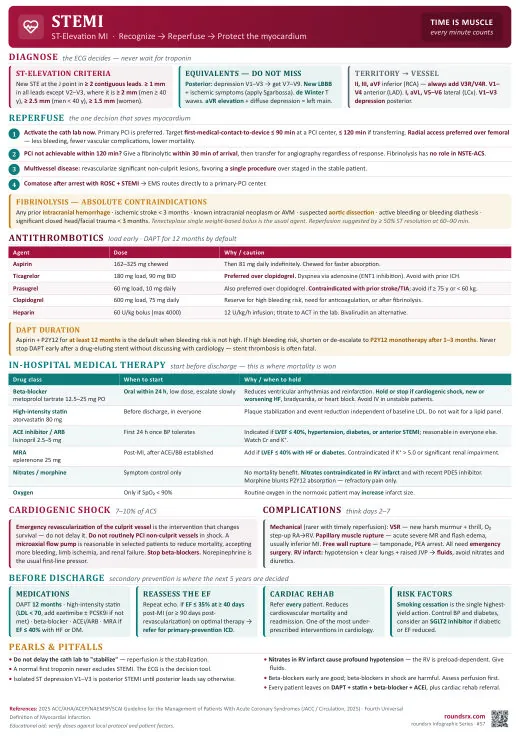 ⤢ Tap to open full size
RoundsRx Infographic Series · #57 · Cardiovascular · PDF 167 KB
Text version
Cardiology · One Pager
STEMI
Time is muscle. Door-to-balloon ≤ 90 min. ASA + P2Y12 + heparin + cath lab. Every minute of delay = more myocardium lost.
🧪 Diagnosis
- ST elevation ≥ 1mm in ≥ 2 contiguous leads (≥ 2mm in V1-V3)
- New LBBB with ischemic symptoms
- Posterior MI: ST depression V1-V3 → get V7-V9
- Troponin may be normal initially -ECG is the decision tool
🚨 Immediate Management
- ASA 325 mg chewed + P2Y12 load (ticagrelor 180 mg)
- Heparin bolus + drip
- Activate cath lab → PCI
- Atorvastatin 80 mg
- Morphine only if refractory pain (may reduce P2Y12 absorption)
🗺️ Territory Mapping
- II, III, aVF = Inferior (RCA)
- V1-V4 = Anterior (LAD)
- I, aVL, V5-V6 = Lateral (LCx)
- V3R, V4R = Right ventricle (check if inferior STEMI)
💊 Key Drugs
ASA325 mg chewed
Ticagrelor180 mg load
Heparin60 U/kg bolus
Atorvastatin80 mg
⚠️ Pitfalls
- Delaying PCI for "stabilization"
- Missing posterior/RV STEMI
- Nitro in RV infarct (preload dependent)
- No DAPT × 12 months post-PCI
RoundsRx · Cardiology · One Pager
ACC/AHA STEMI 2013 · PLATO 2009
Related Topics
ACS OverviewAortic DissectionAortic StenosisArrhythmiasAtrial FibrillationCardiac Tamponade